
Our readers keep the lights on and my garage snacks stocked. As an Amazon Associate, I earn from qualifying purchases.
Specs are compiled from manufacturer listings and verified buyer reviews and can change over time — please confirm the key details on the product page before buying.
Choosing the right 0W-20 oil is critical for your engine’s longevity, especially in cold climates. This viscosity grade is engineered to stay fluid at frigid temperatures for instant cold-start protection, then thicken up enough to guard against heat and wear during a summer road trip. The wrong oil can cause metal-on-metal grinding during cold starts or sludge buildup that reduces engine power and lifespan.
I’m Min Islam — the founder and writer behind Trending Car. This guide is built by comparing the manufacturers’ published specifications and the patterns across verified customer reviews, so you get each pick’s real strengths and trade-offs instead of marketing spin.
After analyzing the specs, official claims, and thousands of real-world owner experiences across nine top contenders, this lineup covers everything from extreme cold-weather startup protection to high-mileage seal conditioning — the essentials you need when choosing the best 0w-20 oil for your car, truck, or SUV.
Our Picks at a Glance

How To Choose The Best 0W-20 Oil
Selecting the best 0W-20 oil requires more than just picking the cheapest option. Your engine type, driving habits, and climate all influence the ideal 0W-20 oil for your vehicle. Consider these three key factors before purchasing.
Viscosity and cold-start protection
The “0W” part of 0W-20 is a cold-cranking rating — it tells you how thin the oil stays when the temperature drops. A true 0W oil flows easily at sub-zero temperatures, meaning it reaches critical engine parts in under a second on a frozen morning. For cold climates, the ‘0W’ rating is the most critical specification on the bottle. While all listed oils meet the 0W-20 SAE J300 grade, their additive packages determine performance under extreme pressure and heat.
Certifications and OEM approvals
Look for the latest API and ILSAC certifications printed on the back label. The current standard for modern gasoline engines is API SP (Resource Conserving) and ILSAC GF-7, which indicate the oil meets strict criteria for low-speed pre-ignition control, timing-chain wear protection, and fuel-economy retention. Many manufacturers also specify their own approvals — like GM dexos1 Gen 3, Ford WSS-M2C962-A1, or Chrysler MS-13340 — and using an oil that holds these exact approvals is the safest way to keep your warranty intact and your engine running at its best.
Synthetic base stock vs. conventional blend
All oils on this list are full synthetics, engineered from chemically uniform base stocks for superior performance. Full synthetics naturally resist thermal breakdown, flow better in the cold, and hold their viscosity longer under high heat than conventional or synthetic-blend oils. If you are driving a turbocharged direct-injection engine — or any modern vehicle built after 2010 — a full synthetic 0W-20 is the recommended baseline, not an upgrade. Some premium formulations also include extra additives for deposit control, seal conditioning, or high-mileage protection, which can extend your engine’s life significantly beyond a standard change interval.
Quick Comparison
| Model | Best For | Volume | Certification Tier | Key Additive Claim | Amazon |
|---|---|---|---|---|---|
| Valvoline Advanced Full Synthetic★ Best Overall | Best Overall Protection | 5 QT | API SP / ILSAC GF-7A | Amazon | |
| Castrol EDGE Advanced Full SyntheticExtended Interval | Extended Drain Interval | 5 Quarts | API SQ/SP / ILSAC GF-7 | Amazon | |
| Idemitsu IFG3 Full SyntheticAsian OEM Match | Asian OEM Compatibility | 5 Quarts | API SP / ILSAC GF-7A | Advanced LSPI protection for TGDI engines | Amazon |
| Mobil Full Synthetic | Reliable Upgrade from Conventional | 5 Quart | API SP Resource Conserving | Amazon | |
| K&N Premium Full Synthetic | Ultra-Clean Engine Interiors | 5 Quart | Not listed | SynthAMAX Technology additive package | Amazon |
| Quaker State Full Synthetic | Budget-Friendly Essential | 5 Quarts | API SP / ILSAC GF-6A | Reduces friction to boost horsepower | Amazon |
| Havoline PRO-DS Lifelong | Large-Capacity Convenience | 6 Quarts | API SP (implied for TGDI) | Unsurpassed LSPI mitigation for turbo engines | Amazon |
| Mobil High Mileage (6-pack) | High-Mileage Engine Care | 6 x 1 Quart | API SP Resource Conserving | Extra seal conditioner for leak prevention | Amazon |
| Liqui Moly Molygen New Generation | Premium European Build | 5 Liters | Not listed | UV-reactive green dye for leak detection | Amazon |
In‑Depth Reviews
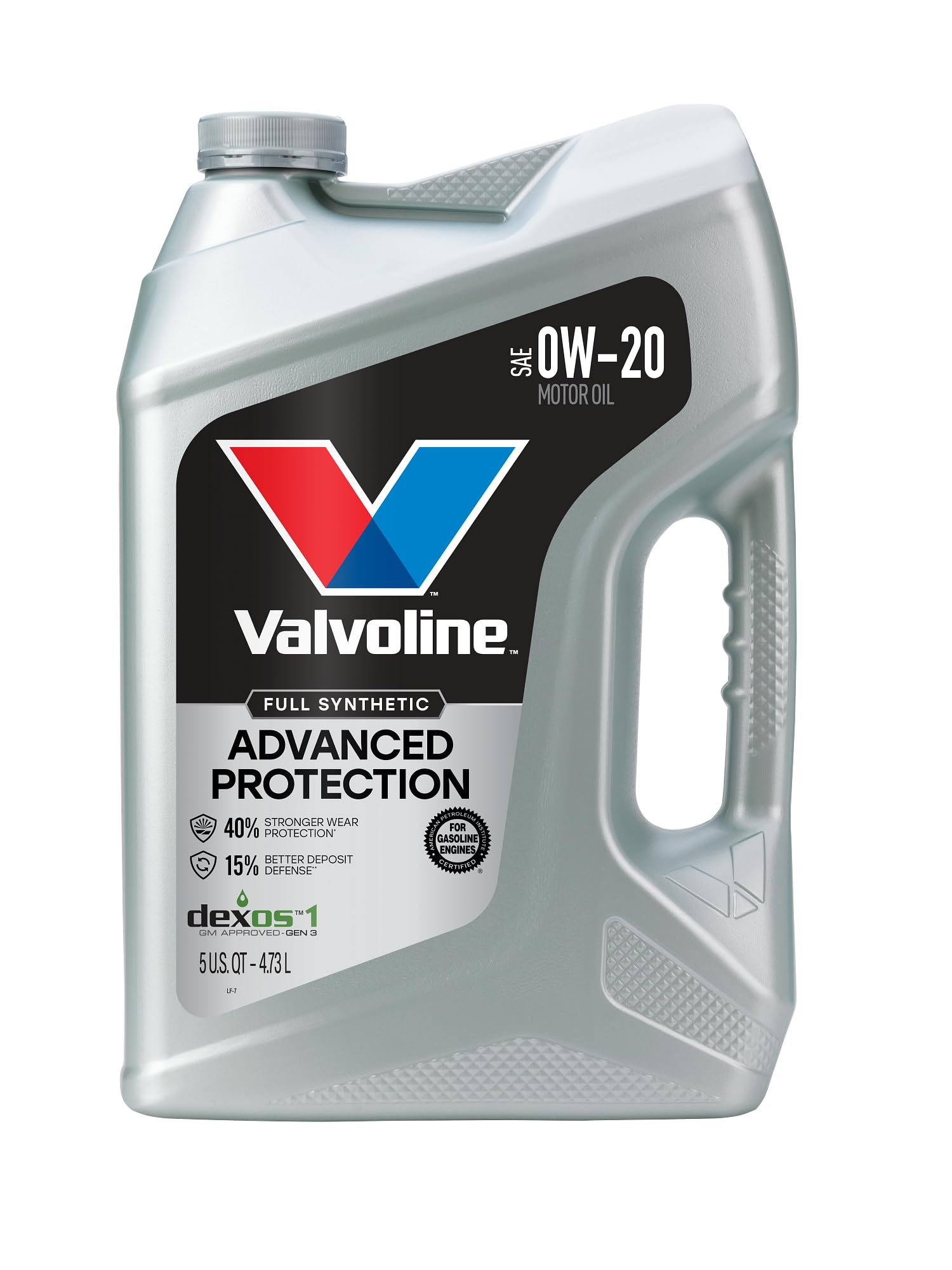
1. Valvoline Advanced Full Synthetic SAE 0W-20 Motor Oil 5 QT
Our pick — over 4.5★ from 10,000+ verified ratings; the strongest balance of quality and price.
The crowd favorite that wraps your engine in a triple layer of wear, deposit, and heat defense.
Valvoline’s Advanced formula tackles the four main causes of engine breakdown — wear, friction, heat, and deposits — with numbers that matter.
Engineered for excellent low-temperature flow, this oil reduces metal-to-metal contact during cold starts — when most engine wear actually occurs. It meets ILSAC GF-7A, API SP, and GM dexos1 Gen 3, along with Ford WSS-M2C962-A1 and Chrysler MS-13340. A longtime owner summed it up plainly: “used exclusively in Honda Accord (200k+ miles), Pilot (100k), and CR-V Hybrid (30k) with no engine issues.” The easy-pour bottle design and built-in volume indicator are small touches that make a messy job noticeably cleaner.
Why owners keep coming back
- Quality is the most-discussed trait — over 250 owners single it out — and the wear-protection number backs that reputation up with data
- Value-for-money is a close second, with many pointing out that the 5-quart jug beats buying single quarts hands-down
- Meets the latest OEM certifications for Honda, Ford, GM, and Chrysler, so warranty concerns are off the table
One honest caveat
- A smaller group notes occasional leakage with certain engine seals — worth checking your valve cover gasket condition before switching
Best suited for: Anyone driving a modern Honda, Toyota, Ford, or GM vehicle who wants the highest-rated, most-reviewed 0W-20 on the market with proven long-mileage protection.
Look elsewhere if: You need a high-mileage-specific formula with extra seal conditioners — this is a standard full synthetic, not a high-mileage blend.
2. Castrol EDGE 0W-20 Advanced Full Synthetic Motor Oil, 5 Quarts
The oil that stays in the game 20,000 miles at a time, backed by lab-tested viscosity retention.
Castrol EDGE is the extended-mileage specialist of this lineup. That translates into a manufacturer-stated capability of 20,000 miles between oil changes — or one year, whichever comes first — meaning fewer trips to the garage without sacrificing protection.
It meets API SQ/SP/SN PLUS/SN, ILSAC GF-7, GM dexos1 Gen 3, Chrysler MS 6395, Ford WSS-M2C947-B1, and Ford WSS-M2C962-A1. Buyers running it in a Honda Ridgeline and a 2012 Toyota Tundra 5.7 both gave it top marks, and one owner who sent a used sample to Blackstone Labs for analysis confirmed it “holds up well.” The 5-quart jug uses a built-in handle for controlled pouring. Compared to the Valvoline above, the Castrol EDGE trades a slightly higher entry point for the longest drain interval on this list, making it the pick for high-mileage commuters who want to stretch every service interval.
What the extended interval gets you
- 20,000-mile change capability means real cost savings over time for drivers who rack up miles fast
- Lab-testing from owners backs the durability claim — it does not thin out prematurely
Fair warning
- Reaching that 20,000-mile mark requires a full-synthetic-compatible filter and careful driving conditions — shorter intervals are safer for severe stop-and-go use
The right pick for: Long-haul drivers and highway commuters who prefer fewer oil changes and want lab-verified viscosity retention over extreme distances.
Think twice if: Your car sits in heavy city traffic most of the time — frequent short trips may prevent you from realizing the full extended-drain benefit.
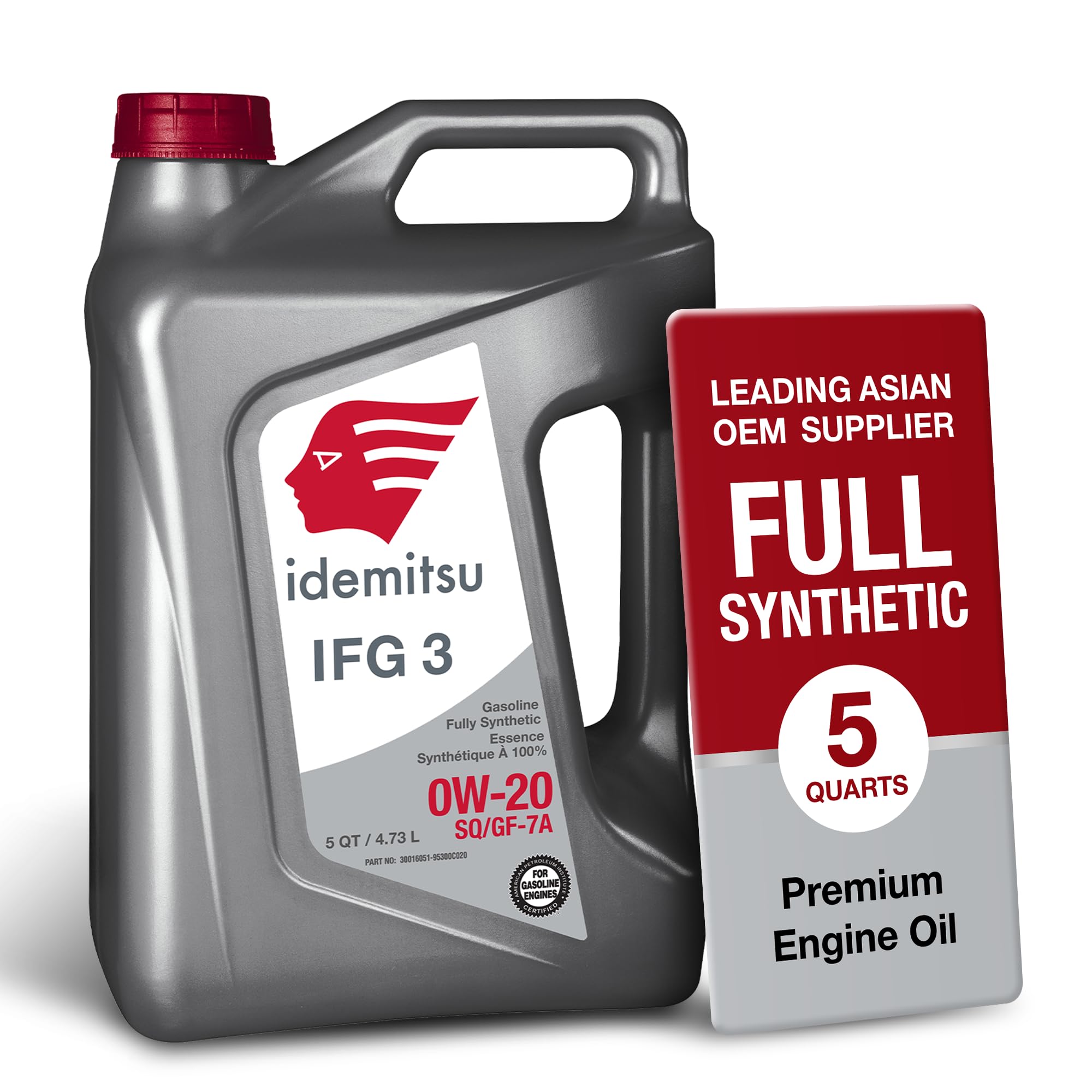
3. Idemitsu IFG3 0W-20 SP/GF-7A Full Synthetic Motor Oil – 5 Quart
The OEM-quality oil your Subaru, Honda, or Toyota practically begs for.
Idemitsu is the oil that Asian manufacturers like Honda often rebadge as their own — and the IFG3 formulation is specifically certified for Asian OEM, TGDI, and PFI engines. It incorporates advanced additive technology to protect against low-speed pre-ignition (LSPI) events, a common concern in turbocharged direct-injection engines. Owners of 2020 Subaru Outbacks and 2021 Subarus running 3,000-4,000 mile change intervals report clean Blackstone Labs analyses, with one noting “engine is healthy, no issues.”
It also meets API SP and ILSAC GF-7A, and is ISO and IATF certified for manufacturing quality. Quality is the top praised aspect, with OEM compatibility following closely behind, and several owners highlight improved fuel efficiency and smoother operation after switching. At 5 quarts, it covers most Asian sedan and crossover applications in a single jug. Compared to the Valvoline, the Idemitsu brings a sharper focus on Japanese-engine-specific additive packages and LSPI control that TGDI engines need.
Why Japanese-engine owners love it
- OEM compatibility is a top-cited strength — buyers report it is the same formulation Honda stamps with its own branding
- Fuel performance improvements are mentioned by owners who track mileage closely
- LSPI protection is built into the additive package, a critical safety net for turbocharged direct-injection engines
Worth noting
- It is a vehicle-specific fit label, so always confirm compatibility with your make and model before purchasing
The one for: Owners of Subaru, Honda, Toyota, and other Asian-brand vehicles who want OEM-level formulation without the dealer markup.
Not the best fit if: You drive a domestic or European vehicle that lists specific non-Asian OEM approvals — Idemitsu’s additive focus is tuned for Japanese-engine metallurgy.
4. Mobil Full Synthetic Motor Oil 0W-20, 5 Quart

The familiar blue bottle that bridges the gap from conventional to full synthetic with zero guesswork.
Mobil’s standard full synthetic 0W-20 is formulated specifically for vehicles upgrading from conventional oil or a synthetic blend. The balanced additive system helps prevent sludge and deposit formation while maintaining viscosity at high operating temperatures — exactly what a turbocharged gasoline engine needs under sustained load.
One owner buying this oil at a discount versus local retailers noted, “Best price on Amazon vs Costco/Walmart, saved 20%+.” Another reported that a sticking lifter became unstuck after the first oil change with this Mobil formula, which points to its cleaning ability. It meets API SP Resource Conserving, making it suitable for all gasoline-powered vehicles including turbocharged models. At 5 quarts, it covers most passenger cars and light trucks in a single jug.
What you get
- 1.5X longer protection than conventional gives a measurable safety margin for drivers extending past the basic 5,000-mile interval
- Excellent resistance to oil breakdown keeps the viscosity stable even during summer highway runs
- Resolved a sticking lifter for one owner, indicating real cleaning power in the additive package
A consideration
- It is a general-purpose full synthetic, not a high-mileage or extended-performance formula — drivers with engines over 100,000 miles may prefer the dedicated high-mileage version
Best for: The daily driver upgrading from conventional oil who wants a proven, widely available full synthetic at a competitive price point.
Consider an alternative if: Your engine is past 100,000 miles and you want extra seal conditioners — Mobil’s High Mileage variant (later in this list) is tailored for that purpose.
5. Quaker State Full Synthetic 0W-20 Motor Oil, 5 Quart

The entry-level full synthetic that punches well above its price tag with a decade-long warranty.
Quaker State’s 0W-20 is the value king of the lineup without cutting corners on modern certifications. It meets API SP Resource Conserving and ILSAC GF-6A, and it exceeds Chrysler MS-6395, GM dexos1 Gen 3, and Ford WSS-M2C962-A. The formulation is designed to reduce friction to boost horsepower compared to Quaker State conventional oil, and it delivers approved protection against sludge based on Sequence IIIH and VH tests.
A long-time owner with a 16-year-old Jeep running full synthetic for the last 12 years reported “no engine problem (knock on wood).” The bottle design is a practical winner — two handles and a shape that enables glug-free, mess-free pouring, plus an easy-to-read scale and a tamper-evident cap that replaces a foil seal. Quaker State backs this oil with a warranty of up to 10 years or 300,000 miles, whichever comes first, when you exclusively use their motor oil.
Why it stands out
- among the most affordable full synthetics in the 0W-20 category while still holding API SP and ILSAC GF-6A certifications
- The 10-year, 300,000-mile warranty is a confidence booster that few competitors match at this price tier
- Buyers love the twin-handle bottle — no more oil running down the side of the jug during a pour
One trade-off
- Review counts are lower than Valvoline or Castrol, so the long-term reliability consensus is thinner — but the existing feedback is overwhelmingly positive
Reach for this if: You need a budget-friendly, fully certified 0W-20 for a fleet vehicle, secondary car, or DIY oil changes where cost per quart matters most.
Look elsewhere if: You want a higher count of long-term owner experiences before committing — Valvoline and Castrol have more than 9,000 reviews each for deeper confidence.
6. K&N Motor Oil: 0W-20 Synthetic Engine Oil, 5 Quarts

The enthusiast-grade oil that keeps your engine interior looking factory-fresh past 100,000 miles.
K&N is best known for its air filters, but its full synthetic motor oil brings the same performance philosophy to engine protection. The advanced SynthAMAX Technology additive package targets harmful contaminants and sludge buildup, keeping critical components cleaner for longer. It is designed to reduce wear and tear while helping the engine run smooth in both cold and hot temperature conditions — a strong all-weather profile.
One owner running this oil in a 2014 BMW X1 xDrive28i with 135,000 miles reported the engine “looks really clean and almost ‘New’ still.” That kind of visual evidence from a high-mileage turbocharged European engine is hard to ignore. The 5-quart bottle weighs 9.2 pounds and covers most standard oil-change volumes in one go. Compared to the Valvoline, the K&N brings a more premium price that reflects its specialized additive approach and the brand’s performance-engineering heritage.
What owners celebrate
- Engine cleanliness at high mileage is the standout theme — a 135,000-mile BMW showing “almost new” internals is the kind of evidence that sells itself
- SynthAMAX Technology offers a unique additive approach not found in all full synthetics
- All-weather formulation means no seasonal oil swap is needed
Points to check
- Review volume is lower than the top two picks, so the performance consensus is still building
- Some buyers received bottles with the wrong viscosity weight — always verify the label before pouring
Best matched for: Enthusiasts who want a premium, clean-engine-focused oil for a turbocharged car and appreciate K&N’s engineering pedigree.
Not the one if: You need the broadest owner consensus or the lowest price — this sits in the premium tier with fewer reviews than the volume leaders.
7. Mobil Full Synthetic High Mileage Motor Oil 0W-20, 1 Quart (6-pack)

The 6-quart pack that brings tired engine seals back to life while protecting a 400,000-mile veteran.
Mobil’s High Mileage formula is designed specifically for vehicles with over 75,000 miles. — a common concern in aging engines. It also fights sludge and deposit formation with a balanced additive system that maintains viscosity at high operating temperatures.
One owner reported their car has “400,000 miles still going thank to this oil,” crediting the high-mileage formulation for the longevity. Another noted that a 2011 Honda CRV regained smoothness and quiet operation after switching. The 6-pack of 1-quart bottles is especially convenient for engines that need exactly 6 quarts — like many V6 trucks and SUVs — and the smaller bottles are easier to store in the trunk for top-ups between changes.
Why high-mileage drivers choose it
- Seal conditioner additive directly addresses the weeping gaskets and minor leaks that develop past 75,000 miles
- A verified 400,000-mile engine still running strong on this oil is the kind of real-world proof that matters
- The 6-quart case format covers full-change volumes for trucks and larger cars without needing a secondary bottle
One difference from the standard Mobil
- It costs more per quart than the standard Mobil full synthetic, reflecting the extra seal-conditioner and additive content
Ideal for: Owners of high-mileage cars and trucks who want to extend engine life, reduce leaks, and keep a proven platform on the road without switching brands.
skip it if: Your engine is under 75,000 miles and has no seal issues — the standard Mobil full synthetic offers the same base protection without the premium additive cost.
8. Havoline PRO-DS Lifelong Full Synthetic 0W-20, 6 Quarts
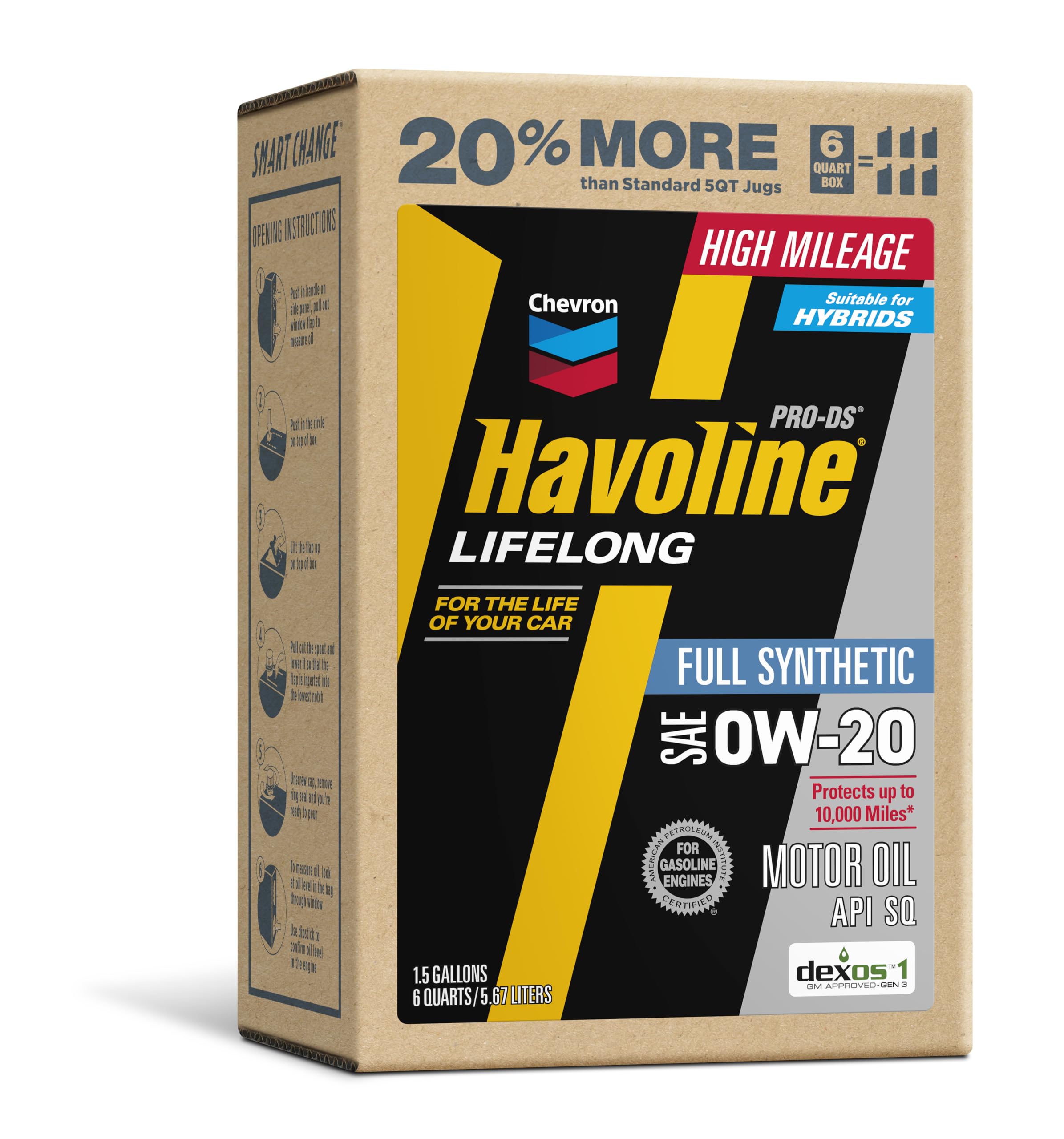
The 6-quart smart-pack that perfectly fills a third-gen Tacoma without a drop of waste.
Havoline PRO-DS Lifelong is designed for advanced, high-power-density engines with turbochargers and gasoline direct injection. It provides unsurpassed protection against sludge, varnish, and deposit buildup while delivering superior anti-wear protection for bearings and turbocharger durability. Crucially, it offers unsurpassed mitigation against Low Speed Pre-Ignition (LSPI), a destructive condition that can punch a hole through a piston in turbo direct-injection engines.
The 6-quart pouch format is a standout for anyone driving a 3rd-gen Tacoma — which takes exactly 6 quarts — or any other vehicle with a 6-quart capacity. Owners highlight the convenience, portability, and strong price-per-quart value. Quality and value for money are the top praised aspects, with one buyer noting that switching from Mobil 1 to Havoline was a permanent move after experiencing the price-to-performance ratio.
what separates it
- 6-quart pouch is both convenient and cost-effective for trucks and SUVs that need that exact volume
- LSPI mitigation is baked into the formula — a critical safety feature for any turbocharged direct-injection engine
- Priced competitively for a premium full synthetic with this level of additive engineering
Heads-up
- Spillage is possible with the pouch design — one owner admitted, “loved everything about it except when it spills”
The move for: Anyone driving a vehicle that needs exactly 6 quarts — particularly Tacoma, 4Runner, and F-150 owners — who want a modern LSPI-protected formula in an easy-to-store pack.
Pass if: Your engine takes a standard 5 quarts; the 6-quart pack leaves you with an open partial bottle to store.
9. Liqui Moly Molygen New Generation SAE 0W-20, 5 Liter

The green-glowing German oil that protects your engine and helps you find leaks instantly.
Liqui Moly’s Molygen New Generation is a fully synthetic 0W-20 engineered for instant lubrication after a cold start, optimum oil pressure under all operating conditions, and compatibility with turbochargers and catalytic converters. It reduces pollutant emissions and is miscible with all commercially available motor oils, making it a safe top-off option even if you are not doing a full drain.
The most distinctive feature is the UV-reactive green dye — when you shine a UV light on the engine bay, any leak glows bright green, making diagnosis much faster than with conventional oil. Owners mention “very little burn off between changes,” and one noted “cleaner, quieter engine” after switching. It is listed for specific models of Acura, Buick, Cadillac, Chevrolet, GMC, and other GM-family brands, so European and domestic owners both get coverage. At 5 liters, it offers slightly more volume than a standard 5-quart jug.
The German touch
- UV dye turns leak detection from a messy guessing game into a simple visual check — a unique feature no other oil on this list offers
- Quieter engine operation and very little burn-off between changes are recurring owner reports
- 5-liter volume provides a useful extra margin over the standard 5-quart size for engines that sit right at the limit
One thing to decide
- The premium price means you are paying for the advanced additive package and the UV feature — if leak detection is not a concern, a standard full synthetic may offer similar base performance for less
The one to grab if: You want German-engineered protection with the bonus of UV leak-detection capability, especially for European or GM-platform vehicles that meet its compatibility list.
pass on it if: You need the broadest OEM certification list — Liqui Moly’s approvals are narrower than ILSAC GF-7A options, so check your owner’s manual first.
Understanding the Specs
Viscosity Grade – The “0W-20” Decoded
The “0W” part is the winter (cold) viscosity rating. It measures how thin the oil stays when the engine is frozen, and a 0W oil is the thinnest common winter grade, flowing almost instantly at sub-zero temperatures to prevent metal-on-metal contact on startup. The “20” is the hot-operating viscosity — how thick the oil remains at normal engine operating temperature. A low hot viscosity like 20 means less internal drag, which improves fuel economy. All oils on this list must meet the SAE J300 standard for 0W-20 to carry this grade on the label.
API and ILSAC Certifications – Why They Matter
The American Petroleum Institute (API) “donut” on the bottle tells you which engine types the oil protects. API SP is the current gasoline-engine standard, covering low-speed pre-ignition (LSPI) control, timing-chain wear protection, and fuel-economy retention. ILSAC GF-7A is the latest international lubricant standard, adding stricter fuel-economy and deposit-control tests. If your car requires dexos1 Gen 3, Ford WSS-M2C962-A1, or Chrysler MS-13340, the oil must specifically list that approval — using an oil that only meets “API SP” does not automatically satisfy every OEM spec.
FAQ
Can I use 0W-20 oil in an engine that calls for 5W-20?
How often should I change 0W-20 synthetic oil?
Is there a difference between 0W-20 and 0W-16 oil?
What does “API SP Resource Conserving” mean?
Can I mix different brands of 0W-20 synthetic oil?
Does a higher price always mean better engine protection?
Will switching to a synthetic 0W-20 cause oil leaks in an older engine?
How important is the “dexos1 Gen 3” approval for GM vehicles?
What is LSPI and why is it dangerous for my turbo engine?
Final Thoughts: The Verdict
For most drivers, the 0w-20 oil to reach for first is the Valvoline Advanced Full Synthetic — its 40% stronger wear protection, the highest star rating on the market, and a decade of strong reviews make it the safest bet across the widest range of modern engines. If you want the longest possible change interval and lab-verified viscosity retention, grab the Castrol EDGE. For owners of high-mileage engines who need seal conditioning and leak prevention, the Mobil High Mileage 6-pack is the rightchoice. And for budget-conscious buyers who still want a fully certified synthetic, the Quaker State delivers API SP protection at a price that leaves room for a second jug.
How We Picked
We do not accept paid placement. Every pick is matched to a real buyer and a real use-case; we do not hands-on test units.
Sources & Methodology
Specifications: manufacturer listings and product documentation. Review insights: verified customer reviews, as of July 2026. Pricing: not shown on this page (it changes often); check the current price via the retailer link.
As an Amazon Associate, Trending Car earns from qualifying purchases. This does not affect which products we feature.