Can A Dead Battery Recharge Itself?: The Real Truth

Quick Summary: A dead car battery cannot recharge itself. It needs an outside energy source like a jump-start, battery charger, or alternator power from a running engine. If your car starts again after “resting,” it wasn’t fully dead—likely just weak or suffering from temperature or surface charge effects.
You turn the key, and nothing. No click. No crank. Your lights may be dim or dead. It’s scary and frustrating. Many drivers wonder, “Can a dead battery recharge itself?” The short answer is no. But you can test, revive, or replace it fast. In this guide, I’ll show you simple steps to diagnose your battery, charge it the right way, and avoid getting stuck again.

What “dead battery” really means
When people say a battery is “dead,” they mean it cannot start the car. But there are two kinds of “dead.” One is a weak or discharged battery that still holds some energy. The other is a failed battery that cannot hold a charge at all. The fix is very different for each case.
- Discharged: Low voltage from lights left on, cold weather, or short trips. Often recoverable with a charge.
- Failed: Damaged cells, heavy sulfation, or internal short. Needs replacement.
- Intermittent: Starts sometimes, then not. Often due to loose terminals or corroded connections.
Can a dead battery recharge itself?
No. A car battery cannot recharge itself without outside energy. A lead-acid battery stores energy. It does not create energy. If your car cranks after “resting,” it was not truly dead. It simply recovered a tiny surface charge or warmed up a bit. That is not a real recharge. You still need to test and charge it.

Here is what might trick you into thinking it “recharged” on its own:
- Warmer temperature improves chemistry slightly.
- Surface charge recovers a tiny voltage after rest.
- A loose terminal makes contact again.
- A parasitic drain stopped temporarily.
If your battery was fully flat, it needs a charger, a jump-start, or alternator output to regain charge.
How a car battery works (in simple terms)
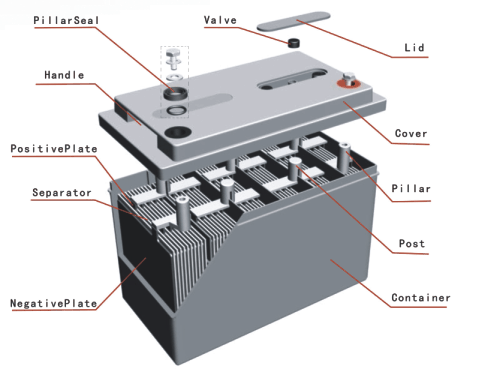
Your car’s lead-acid battery uses a chemical reaction to store energy. It has plates in acid. When charged, it holds potential energy. When you start the car, it delivers a quick burst of power to the starter. After the engine starts, the alternator recharges the battery during driving.

- Voltage tells you the state of charge.
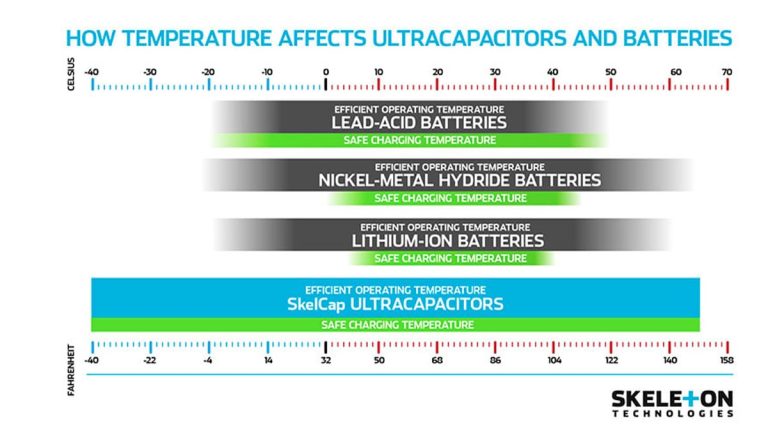
- Cold slows the reaction. Heat speeds wear.
- Short trips don’t give the alternator time to recharge.
If the battery is weak, the alternator alone may not be enough in one short drive. You may need a proper charger to bring it back.
Why a battery can seem to “come back to life”
Sometimes a “dead” battery starts your car later. That does not mean it recharged. It means something changed in a small way that helped, but only for the moment.

- Temperature rise: A cold battery is sluggish. When it warms, it delivers a bit more power.
- Surface charge effect: After a heavy draw, the voltage can sag. Resting can bounce the voltage a little.
- Connection issue: Wiggling the cable or slamming the door may shake a loose terminal enough to reconnect.
- Parasitic drain pause: A stuck relay or device finally went to sleep and stopped draining the battery.
None of these add real charge. They only change how the battery behaves. You still need to test and charge it.
How to diagnose a dead battery (step-by-step)
Before you replace a battery, test it. You can do this at home in minutes. You just need simple tools and a little patience. This quick check will save money and time.

Tools you’ll need
Gather a few basic items. Most are cheap and easy to find. Keep them in your trunk for emergencies.

- Digital multimeter
- Jumper cables or a jump starter
- Safety glasses and gloves
- Wire brush or battery terminal cleaner
- 12V smart battery charger (optional, but helpful)
Quick visual checks
Look first. Many “dead battery” problems are actually connection issues. A dirty or loose terminal can stop current flow and mimic a dead battery.

- Open the hood and find the battery.
- Check terminals for white or green buildup (corrosion).
- Wiggle the clamps. They should not move.
- Check cables for cracks or broken strands.
- Look for swelling, cracks, or leaks in the battery case.
If you see heavy corrosion or damage, fix that first. Clean terminals with a brush. Reattach clamps tight. Try to start again.
Measure the battery voltage (engine off)
This is the fastest test. It shows your state of charge. You can do it in under a minute with a multimeter.
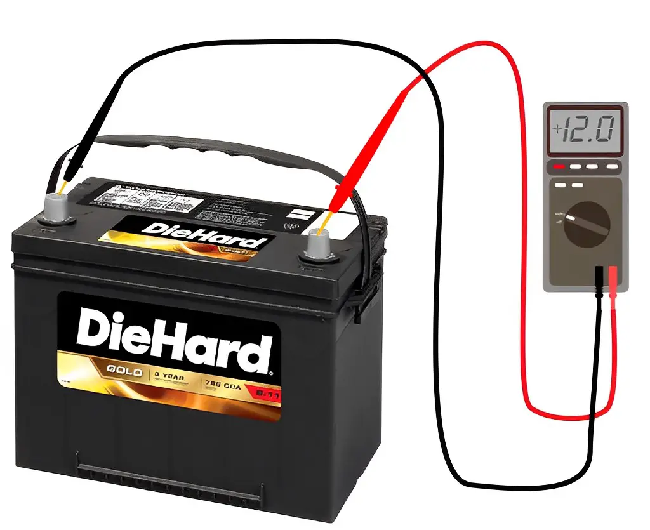
- Set multimeter to DC volts (20V range is fine).
- Touch red probe to positive (+). Touch black to negative (−).
- Read the voltage with the engine off for at least 30 minutes.
| Battery Voltage (12V Lead-Acid) | State of Charge | What It Means | Action |
|---|---|---|---|
| 12.6–12.8V | 100% | Healthy and fully charged | Good to go |
| 12.4–12.5V | 75–85% | Slightly low | Top up charge soon |
| 12.2–12.3V | 55–65% | Moderate discharge | Charge recommended |
| 12.0–12.1V | 40–50% | Low | Charge now |
| 11.8–11.9V | 30–35% | Very low | Likely won’t start; charge or jump |
| < 11.8V | < 30% | Deeply discharged | Smart charger or replace |
| 0–10V | N/A | Possible shorted cell or internal fault | Replace battery |
| Note | Key question | Can a dead battery recharge itself? | No—use a charger, jump-start, or alternator |
Check voltage while cranking
This test checks the battery under load. It is very useful. A weak battery often looks okay at rest but fails under load.
- Leave the multimeter connected.
- Have a helper try to start the engine for 3–5 seconds.
- Watch the voltage. Do not crank for long.
- If voltage drops below ~9.6V at 70°F, the battery is weak.
- Below ~8V, the battery is likely failing or connections are poor.
- If the engine does not crank and voltage stays high, suspect starter or cables.
Test the alternator (engine running)
Once it starts, check the charging system. The alternator keeps the battery healthy. A failing alternator causes repeat dead batteries.
- With engine idling, measure battery voltage again.
- A healthy system reads about 13.8–14.7V.
- Turn on lights and blower. Voltage should stay above 13.5V.
- If voltage is 12.2–12.6V while running, the alternator is not charging.
- If it’s over 15V, the regulator may be bad. That can overcharge the battery.
As explained by AAA, a full charging system test is the best way to confirm battery and alternator health. Many AAA service centers can test both on the spot.
How to safely jump-start a dead battery
A jump-start is the fastest way to get moving. Keep a quality set of 4-gauge jumper cables or a lithium jump starter in your trunk. Safety first: wear eye protection, and double-check cable clamps before you connect.
Tools you’ll need
Be ready before you need it. These tools can save a tow call and an hour of time.
- Heavy-duty jumper cables (10–20 feet)
- Another car with a good battery, or a jump pack
- Gloves and safety glasses
- Owner’s manual (to confirm jump points)
Step-by-step jump-start guide
Follow this exact order to avoid sparks and damage. Work in a safe area away from traffic. If you’re roadside, use hazards and reflectors. According to the National Highway Traffic Safety Administration, staying visible and safe is vital while stopped.
- Park cars close but not touching. Turn both ignitions off.
- Connect red clamp to dead battery positive (+).
- Connect other red clamp to donor positive (+).
- Connect black clamp to donor negative (−).
- Connect last black clamp to a metal ground on the dead car (unpainted engine bracket). Do not connect to the dead battery negative post.
- Start donor car. Let it run for 2–3 minutes.
- Try starting the dead car. If it cranks slow, wait 2 more minutes, then try again.
- Once started, remove clamps in reverse order:
- Black from ground on dead car
- Black from donor negative
- Red from donor positive
- Red from dead battery positive
Keep the engine running. Do not shut it off yet.
After the engine starts: What to do next
Do not just drive off and hope. You want to restore charge and confirm the system is healthy. Do this to avoid another no-start tomorrow morning.
- Let the car idle for 5–10 minutes.
- Drive for 20–30 minutes at highway speeds if you can.
- At home, put the battery on a smart charger until full.
- Test voltage again the next day before starting.
If it dies again quickly, the battery may be failing or the alternator may be weak. Test both.
Charging options: alternator, smart charger, trickle, and jump pack
Not all charging methods are equal. The alternator is good at topping up, not deep charging. A smart charger is best for a deeply discharged battery. Use the right tool for the job to protect your battery and save time.
| Charging Method | What It Does | Best Use | Time to Charge | Pros | Cons |
|---|---|---|---|---|---|
| Alternator (driving) | Replenishes charge while engine runs | Maintaining a healthy battery | 30–60+ min for light top-up | Free once running | Poor for deep recharge; can overheat weak batteries if pushed |
| Smart charger (automatic multi-stage) | Optimizes bulk, absorption, and float stages | Safely recharging a low or deeply discharged battery | 4–24 hours depending on amperage | Gentle, complete, extends battery life | Needs wall power; costs more |
| Trickle charger (low, constant) | Slow charge to maintain level | Storage maintenance, seasonal cars | Many hours to days | Prevents self-discharge | Old models can overcharge; use smart maintainers |
| Jump starter (lithium pack) | Provides instant cranking amps | Emergency starts | Instant | Portable, no donor car needed | Does not recharge the battery; just starts the car |
| Note | Key question | Can a dead battery recharge itself? | N/A | No external source means no recharge | Use a charger, jump, or alternator |
When to recharge vs. replace
You do not always need a new battery. But sometimes replacement is the only smart choice. Use the signs below to choose the right path and save money.
- Recharge if: Voltage is 11.8–12.4V, battery is under 4 years old, no swelling or leaks, and it holds charge after testing.
- Replace if: Voltage under 10V at rest, cannot hold charge, case is swollen or leaking, or it’s over 4–5 years old.
- Test alternator if: Battery keeps dying after driving or charging.
| Symptom | Likely Cause | DIY Fix | Next Step |
|---|---|---|---|
| Clicking, no crank | Weak battery or poor terminal connection | Clean/tighten terminals; jump-start | Charge fully and retest voltage |
| Cranks slow, then starts | Low state of charge | Use smart charger overnight | Check alternator output (13.8–14.7V) |
| Dies overnight | Parasitic drain or bad battery | Pull fuses to isolate draw; check dome light, OBD devices | Battery test; electrical diagnostic if draw persists |
| No power at all | Blown main fuse or disconnected terminal | Inspect and reseat terminals; check fuses | If still dead, test battery for internal fault |
| Swollen battery case | Overcharge, heat, or frozen electrolyte | Do not charge | Replace battery immediately |
| Repeated jump-starts needed | End-of-life battery or failing alternator | Load-test battery | Replace battery; repair alternator/regulator if needed |
Why car batteries die: top causes
Knowing the root cause helps you prevent the next breakdown. Most battery failures come from a few common issues. Tackle these, and you will extend battery life by years.
- Heat: High heat speeds up aging and water loss.
- Cold: Cold slows the chemical reaction and reduces cranking power.
- Short trips: Not enough time for the alternator to recharge the battery.
- Parasitic drains: Lights, modules, or add-ons that keep drawing power when off.
- Corrosion: Dirty or loose terminals add resistance and reduce power flow.
- Age: Most lead-acid batteries last 3–5 years. As Consumer Reports notes, extreme climates shorten that range.
Preventive care checklist (simple routine)
Small habits make a big difference. A few minutes a month can prevent the next no-start. Use this checklist to keep your battery in top shape.
- Inspect terminals monthly. Clean and tighten as needed.
- Check voltage at rest monthly. Aim for 12.6V or higher.
- Drive 20–30 minutes weekly to maintain charge.
- Use a smart maintainer if you drive infrequently.
- Secure the battery hold-down so it cannot vibrate.
- Keep the top of the battery clean and dry.
- Limit short trips or combine errands into one drive.
- Unplug power-hungry devices when parked.
Cold weather and hot climate tips
Weather matters. Batteries hate extreme temperatures. Give yours a little help, and you’ll avoid morning surprises and summer failures.
- Winter tips:
- Park indoors if possible.
- Use a battery blanket or maintainer in very cold regions.
- Turn off blower, heated seats, and lights before you crank.
- Crank in short bursts. Let the battery rest between tries.
- Summer tips:
- Check electrolyte levels on serviceable batteries.
- Keep the battery area clean for better cooling.
- Avoid long idling with heavy electrical loads.
- Test charging voltage; high heat can stress regulators.
For long storage in any season, disconnect the negative cable or use a maintainer. That prevents slow drains from modules and keeps the battery fresh.
How to use a smart charger (beginner-friendly)
A smart charger is the best way to bring back a low battery. It charges in stages and stops when full. It also helps reverse mild sulfation. Here’s a simple method that works with most 12V chargers.
- Read the charger manual. Confirm it supports your battery type (flooded, AGM, EFB).
- Turn off vehicle and accessories. Remove the key.
- Connect red clamp to battery positive (+). Connect black to negative (−), or to a clean metal ground on the vehicle.
- Plug in the charger. Select the correct mode (12V car, AGM if applicable).
- Let it run until it shows 100% or “Full/Float.” Do not interrupt early.
- Unplug charger. Remove black clamp first, then red.
- Let the battery rest 30 minutes. Check voltage. Aim for 12.6–12.8V.
- If voltage drops below 12.4V within 12 hours, the battery may be weak or sulfated.
- If it will not rise above 12.2V even after long charging, replace it.
Parasitic drain: find and fix common culprits
If your charged battery dies overnight, look for a parasitic draw. Modern cars do have small normal draws. But a stuck module, light, or add-on can pull it flat by morning.
- Common sources:
- Glove box or trunk light stuck on
- Phone chargers and dash cams
- Aftermarket stereos or alarms
- Faulty door switches
- ECU modules that never sleep
- DIY test:
- Charge battery first. Turn everything off. Close doors (latch them if needed).
- Use an ammeter in series with the negative cable.
- Wait 20–45 minutes for modules to sleep.
- Normal draw is often 20–50mA. Over 100mA is trouble.
- Pull fuses one by one to find the circuit with the draw.
Fixing the root cause saves your battery and your morning sanity.
Battery types: flooded vs. AGM vs. EFB
Not all 12V batteries are the same. Use the right charger mode and replacement type. The wrong match can shorten life or cause poor performance.
- Flooded lead-acid (most common): Good value; needs venting; can spill if tipped.
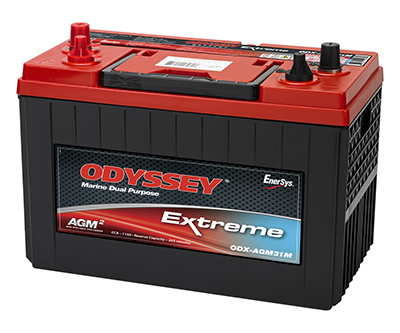
- AGM (Absorbent Glass Mat): Better for start-stop and high-demand systems; charges faster; more resistant to vibration.
- EFB (Enhanced Flooded Battery): Midstep between flooded and AGM; common on start-stop cars.
Use a charger that supports your battery type. Many smart chargers have specific AGM modes and profiles.
Signs your alternator, not your battery, is the problem
Alternators fail more often than people think. A bad alternator drains a healthy battery fast. Look for these signs if you keep getting stranded.
- Battery light on the dash while driving
- Dim lights that get brighter with revs
- Accessories slow or shut off randomly
- Voltage below 13V with engine running
- Worn or squealing serpentine belt
If you suspect alternator trouble, test running voltage and load. Many parts stores test for free. A proper shop can do a full charging and starting system test as explained by AAA.
Roadside safety and jump-start etiquette
Getting stuck is stressful. Stay safe while you work. A few smart steps reduce risk to you and your car.
- Pull far off the road. Use hazards and a reflective triangle.
- Keep people and pets inside the car away from traffic.
- Wear gloves and eye protection when handling batteries.
- Never smoke near a battery. Hydrogen gas can ignite.
- Follow connection order to prevent sparks.
For more roadside safety guidance, review tips from the National Highway Traffic Safety Administration.
Real-world scenarios and quick fixes
Here are common situations I see as a tech-minded driver. Use these playbooks to get rolling fast.
- Left lights on overnight
- Result: Battery at 11.8V or less. Car clicks but won’t crank.
- Fix: Jump-start. Then use a smart charger at home until full.
- Prevention: Set lights to auto. Do a parking exit check.
- Freezing morning, no crank
- Result: Slow crank. Voltage dips under 9.6V during start.
- Fix: Warm the battery if possible. Jump-start. Replace if old.
- Prevention: Use a maintainer or battery blanket in harsh winters.
- Weekend car dies after sitting
- Result: 12.2V after a week. Starts slow or not at all.
- Fix: Maintain with a smart tender. Drive longer once a week.
- Prevention: Disconnect negative cable during long storage.
- New battery, still dead
- Result: Battery tests good; keeps dying.
- Fix: Check alternator output. Check for parasitic draw.
- Prevention: Fix the drain. Replace weak alternator or regulator.
How long to drive after a jump-start?
Many drivers ask this. The answer depends on how low the battery was. The alternator is not a deep charger. It is a maintainer. Give it time, or better yet, use a smart charger.
- Minimum: 20–30 minutes of driving helps a little.
- Better: 45–60 minutes at highway speeds.
- Best: Full charge with a smart charger at home.
If the battery was deeply discharged, rely on a smart charger. Do not expect the alternator to do all the work in one trip.
Battery maintenance myths, busted
There is a lot of bad advice out there. Let’s keep it real and simple. Here are the most common myths I hear from drivers.
- Myth: A dead battery can recharge itself.
- Reality: It needs an external source. Period.
- Myth: Driving for 10 minutes fully recharges a battery.
- Reality: It only adds a small top-up.
- Myth: Disconnecting the battery while running tests the alternator.
- Reality: Dangerous for electronics. Use a multimeter instead.
- Myth: Cold kills batteries. Heat is fine.
- Reality: Heat ages batteries faster. Cold shows the weakness.
Simple battery replacement guide
Replacing a battery is a beginner-friendly DIY. Take your time and follow the steps. Save your radio presets and avoid short circuits.
- Find the right size and type (flooded/AGM/EFB). Match CCA and group size.
- Turn off ignition. Remove key. Wear gloves and glasses.
- Disconnect negative (−) first. Then positive (+).
- Remove hold-down bracket. Lift battery straight up.
- Clean tray and terminals. Install new battery.
- Connect positive (+) first. Then negative (−).
- Tighten hold-down. Wiggle test. It should be solid.
- Start car. Check voltage running (13.8–14.7V).
If your car has start-stop or complex electronics, keep memory alive with a 12V memory saver. Many newer cars also require battery registration. A dealer or shop can help.
How to store a car without killing the battery
Parking for weeks or months? Plan ahead. A little prep saves the battery and the tires. Do these quick steps before storage.
- Fully charge the battery first.
- Use a smart maintainer on a timer or built-in float mode.
- Disconnect the negative terminal if no maintainer is available.
- Keep the car in a cool, dry place.
- Check voltage monthly. Keep it above 12.5V.
Understanding sulfation and recovery
Sulfation is the buildup on the plates when a battery sits low. Light sulfation can be reduced by proper charging. Heavy sulfation is permanent. Recovery is possible only if you act early.
- Early signs: Slow crank, low voltage, takes charge slowly.
- Recovery: Use a smart charger with desulfation mode.
- Limits: If the battery cannot hold 12.4V after charge, it is likely done.
Some chargers have a “recondition” mode. It helps sometimes, but it cannot fix a broken cell or severe damage.
Electrical loads that surprise drivers
Modern cars sip power even when parked. Add a few gadgets, and the drain adds up. Know what to unplug to save your battery.
- Always-on dash cams
- Plug-in coolers
- OBD-II dongles and trackers
- Phone chargers left in sockets
- Aftermarket alarms
Use a switched accessory port if you can. Or unplug devices when you park. A little habit change stops slow drains.
Do hybrids and EVs have the same “dead battery” issue?
Yes, in a different way. Hybrids and EVs still use a 12V battery for computers and relays. If that small battery dies, the car may not “ready up,” even if the big traction battery is full.
- Fix is the same: Jump or charge the 12V battery with the right procedure.
- Use proper jump points. Many hybrids hide the 12V battery.
- Check your owner’s manual for the exact method.
Do not try to charge the high-voltage battery yourself. That system is separate and needs special care.
Key takeaways you can act on today
If your car would not start this morning, you are not alone. Follow these quick wins now. They will prevent most repeat failures.
- Test resting voltage today. Aim for 12.6V+.
- Clean and tighten terminals.
- Charge with a smart charger overnight.
- Check alternator output tomorrow.
- Plan a weekly 30-minute drive.
- Keep a jump pack in your trunk.
Stay proactive and your car will reward you with easy starts.
FAQs
Can a dead battery recharge itself if I just wait?
No. A dead or weak battery needs outside energy. Waiting may restore a tiny surface charge, but that will not start the car reliably.
How long should I drive after a jump-start?
Drive 30–60 minutes if possible. But the best move is to use a smart charger at home to reach a full charge.
Is it safe to jump-start a car in the rain?
Yes, with care. Keep connections secure and avoid standing water. Clamp order matters. Wear gloves if you have them.
What voltage is too low to start a car?
Most cars need about 12.4V or higher to crank well. Below 12.2V, cranking slows. Below 12.0V, it may not crank at all.
Will idling the car recharge the battery?
A little, but not much. Idling charges slowly. A steady drive or a smart charger is more effective.
How often should I replace my battery?
Every 3–5 years for most climates. Hot regions may see shorter life. Test yearly after year three.
Do I need a special charger for AGM batteries?
Yes, use a charger with an AGM mode. It follows the correct voltage profile and helps the battery last longer.
Conclusion
A car battery cannot recharge itself. It needs outside energy from a charger, a jump-start, or your car’s alternator. If your battery “comes back” after resting, it was never truly charged. It only bounced a little due to temperature or surface effects. The fix is simple: test, charge, and confirm your alternator is healthy. Keep your terminals clean, drive long enough to recharge, and use a smart maintainer if you do short trips. With these steps, you will avoid surprise no-starts and make your battery last years longer.
When in doubt, test. A few minutes with a multimeter beats guessing. And if you need backup, trusted sources like AAA and Consumer Reports offer helpful battery care advice. Stay prepared, keep a jump pack in the trunk, and you will always be ready to roll.