
Quick Summary: Here’s how to read battery label fast: find group size, CCA, reserve capacity, and date code. Match group size to your car. Pick CCA for your climate. Check the date (newer is better). Look for AGM or flooded type. Confirm polarity. This simple check keeps your car starting strong and avoids surprise breakdowns.
Your car won’t start. Lights dim. It smells like rotten eggs under the hood. You look at the battery and see a wall of codes and numbers. If you’ve wondered how to read battery label without guesswork, you’re in the right place. I’ll keep it simple and clear. You’ll learn what each number means, what to buy, and how to avoid costly mistakes with a dead battery.

What a Battery Label Actually Tells You (And Why It Matters)
A battery label is your map. It tells you size, power, age, and type. If you can read it, you can pick the right battery, spot a bad one, and avoid no-start headaches. In a few minutes, you’ll read any battery with confidence.
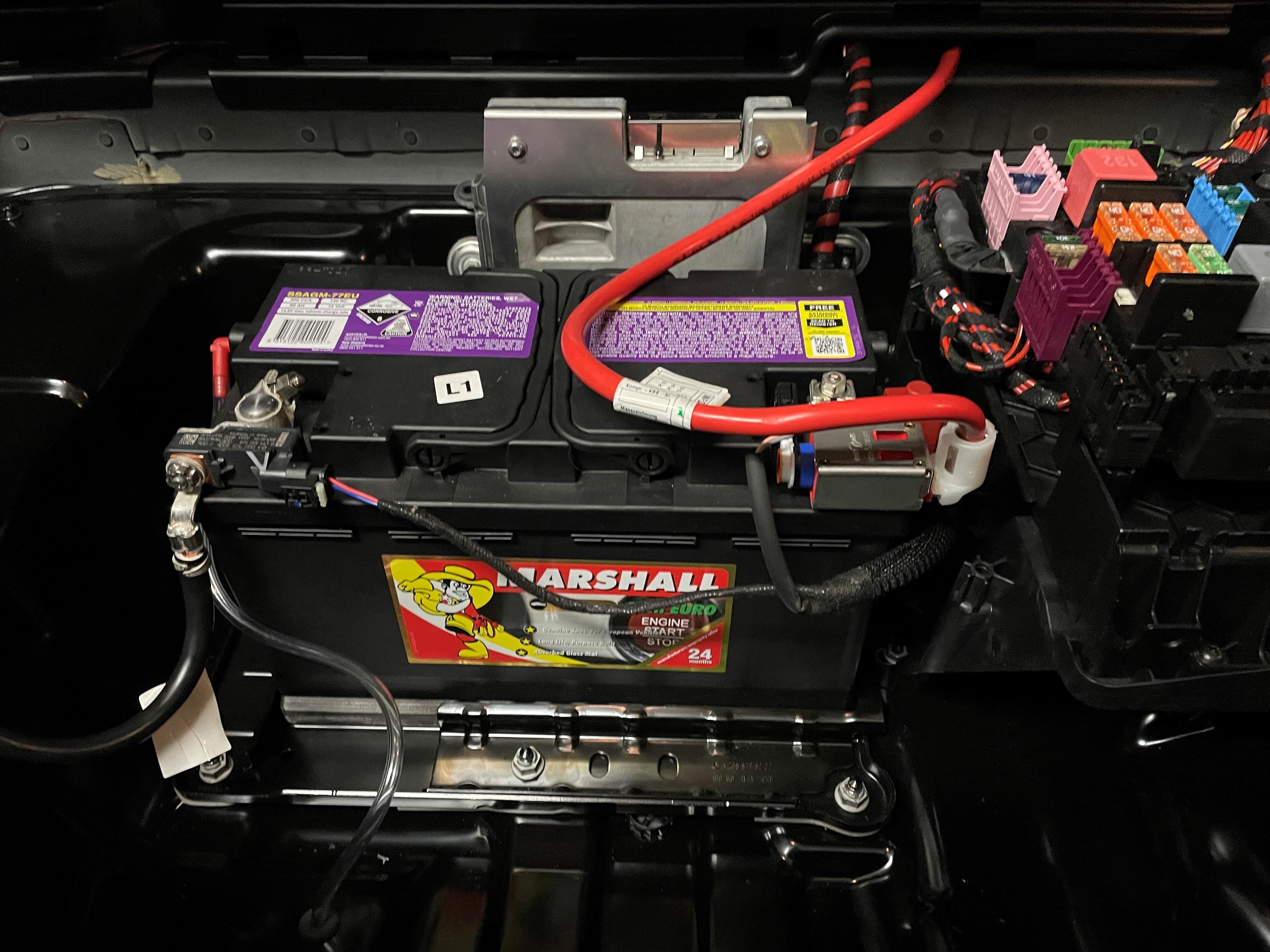
- Fit: Group size matches your tray, height, and terminals.
- Cranking power: CCA and CA show cold and warm starting strength.
- Stamina: Reserve Capacity keeps lights and electronics alive if the alternator fails.
- Type: Flooded, AGM, or EFB affects performance and price.
- Age: The date code shows how fresh it is (newer batteries last longer).
- Polarity: Terminal placement (left/right) must match your cables.
- Warranty: Tells you coverage and partial pro-rate.
Tools You Need to Read and Decode a Battery Label
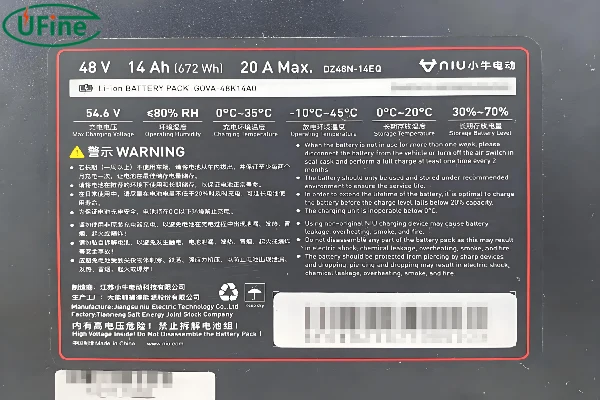
You don’t need a shop. A few basics help you see and decode fast. Bring these to the garage or parts store.
- Flashlight or phone light
- Gloves and safety glasses
- Rag or brush to wipe dirt
- Phone camera to snap the label
- Multimeter (for quick voltage test)
- Small mirror (helps in tight engine bays)
Step-by-Step: How to Read Battery Label (Car Batteries)
Follow these steps in order. You’ll avoid the most common mistakes and choose the right battery the first time.
- Find the Group Size (BCI)
Look for a code like 24F, 35, 48 (H6), 49 (H8), 65, or 94R. This is the battery’s footprint and terminal layout. Your car needs the exact match. - Check the Type
Look for Flooded, AGM, or EFB. AGM works better for start-stop and high electrical loads. Flooded is common and cheaper. - Read CCA (Cold Cranking Amps)
Higher CCA helps in cold weather. Match or exceed the factory number. Good for winter starts. - Find Reserve Capacity (RC)
RC is minutes of support if the alternator quits. More RC gives better endurance for lights and accessories. - Check the Date Code
Look for stamped letters/numbers on the label or top. Newer is better. Aim for within the last 3–6 months. - Confirm Polarity/Terminals
Make sure positive and negative posts match your car’s cables. Some group sizes flip sides. - Note Warranty
Look for free replacement period and pro-rated coverage. Keep the receipt. - Scan Extras
Look for Ah rating (often on European or deep-cycle units), “Start-Stop” tags, and recycling icons.
Battery Types You’ll See on the Label
Battery type affects price, performance, and how you charge it. Pick based on your car’s needs and climate.
- Flooded (Lead-Acid): Most common. Good value. Needs proper charging. Handles daily driving well.
- AGM (Absorbent Glass Mat): More resistant to vibration. Charges faster. Better for start-stop, many accessories, or harsh climates.
- EFB (Enhanced Flooded Battery): A step up from flooded. Often used in mild start-stop systems.
- GEL: Rare in modern cars. More common in special equipment.
How to Spot Type on the Label
Look for words like “AGM,” “Absorbed Glass Mat,” “EFB,” or “Flooded/SMF (sealed maintenance free).” Some labels use icons or short tags.

- AGM labels may also say “Valve Regulated” or “VRLA.”
- Flooded may say “Maintenance Free” or list “Do not open caps.”
- EFB may include “Start-Stop Ready.”
Voltage and What It Means
Most car batteries are 12-volt. The label may say 12V. Some hybrids use different systems, but the 12V battery still runs accessories and computers.
- 12V is standard for cars and light trucks.
- A full 12V battery reads about 12.6–12.8 volts at rest.
- If you see 24V, that’s for heavy equipment, not normal cars.
Group Size (BCI): Fit and Terminal Layout
Group size is the physical size and post layout. It must match your car’s tray and cables. Think of it like tire size for batteries.

- Examples: 24F, 35, 48 (H6), 49 (H8), 65, 94R
- 94R and 48 (H6) are common in many modern cars, including European models.
- 24F and 35 are common in many Japanese and American cars.
- “R” at the end often means reversed polarity (posts are flipped).
Where to Find Group Size
It’s usually bold on the top or front label. Look for “Group Size,” “BCI,” or in European labels “H5/H6/H7/H8.”
- Your owner’s manual lists the correct group.
- Parts stores can cross-reference by year, make, model.
Cold Cranking Amps (CCA): Starting Power in the Cold
CCA is how many amps the battery can deliver at 0°F for 30 seconds while staying above 7.2V. Higher CCA helps in winter starts and with older engines.
- Look for “CCA” followed by a number like 600, 700, or 800.
- Match or exceed your car’s original spec.
- If you live in cold states, higher CCA is better.
- Too low CCA can cause slow cranking or no-start.
Cranking Amps (CA) vs CCA
CA is measured at 32°F. It’s always higher than CCA. Use CCA to compare batteries for real-world cold starts.
- CA may appear as MCA (Marine Cranking Amps) in marine batteries.
- For cars, CCA matters most.
Reserve Capacity (RC): How Long It Can Run Without the Alternator
RC is the minutes a battery can deliver 25 amps at 80°F before dropping to 10.5V. It’s backup time for lights, fuel pump, and computers if your alternator fails.
- RC is often 90–160 minutes on car batteries.
- Higher RC means more time if the charging system fails.
- Great for cars with many accessories and audio systems.
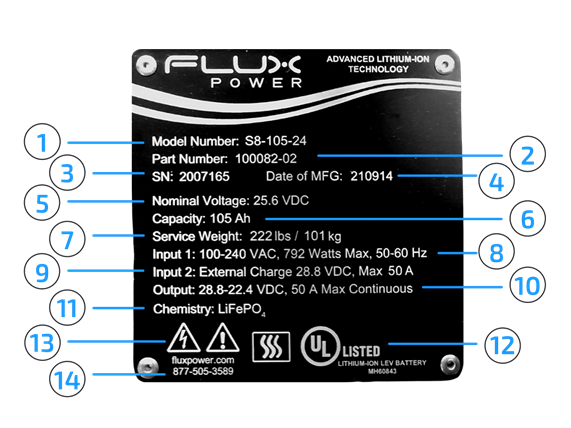
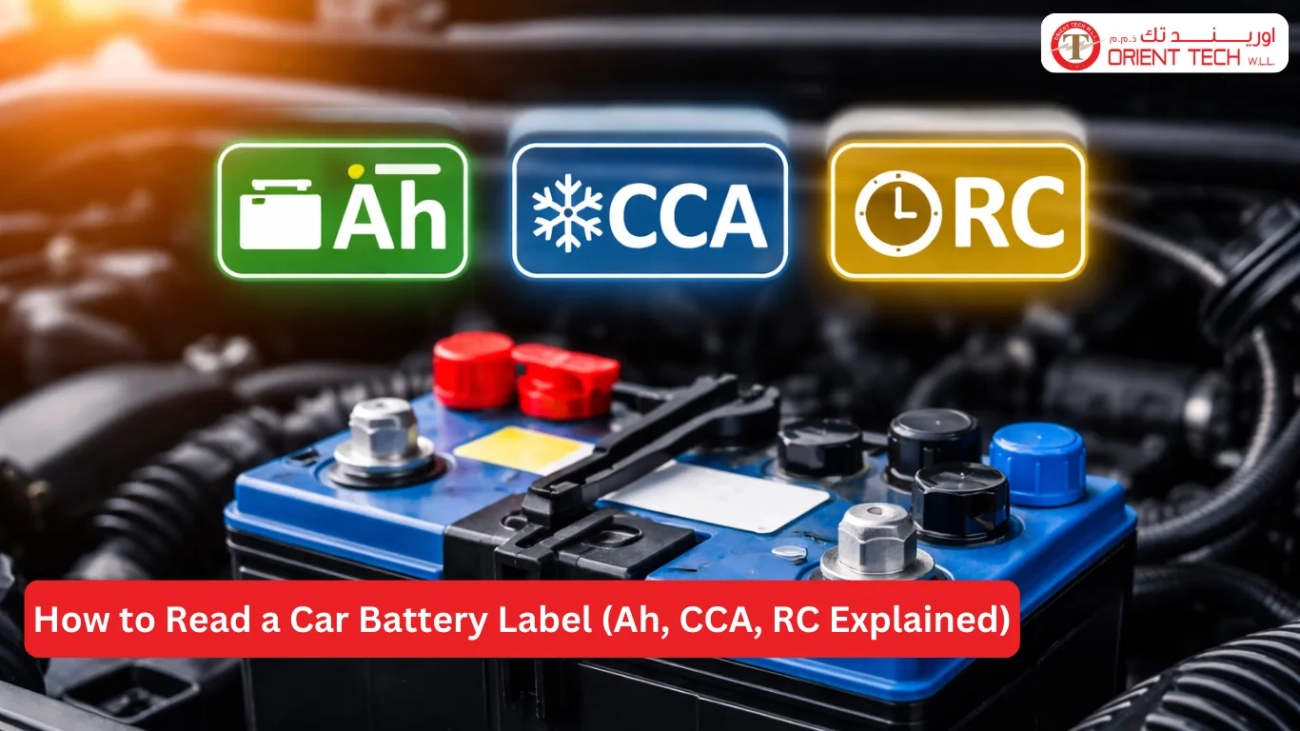
Amp-Hours (Ah): More Common on European Labels
Ah measures stored energy. It’s common on Euro batteries and deep-cycle units. More Ah means more capacity for loads over time.
- You may see 60Ah, 70Ah, or 80Ah on H6/H7/H8 batteries.
- Ah is not the same as CCA. One is capacity; the other is starting power.
Date Codes: How to Read Battery Age
Freshness matters. A battery sitting on a shelf loses charge and life. Labels show the month and year, often as a code.
- Common code: A3 = January 2023 (A=Jan, B=Feb … L=Dec; last digit = year)
- Sticker dots or punch-outs also mark month/year.
- Some have full dates like 04/24 or 2024-04.
- Pick the newest unit you can find, within 3–6 months of build.
Where Date Codes Hide
Look on the top lid, side label, or near the positive terminal. Some use heat-stamp dots that are easy to miss.
- Ask staff to help decode if you can’t spot it.
- Don’t buy a dusty or swollen battery.
Polarity and Terminals: Avoid a Costly Mix-Up
Positive and negative placement must match your cables. A reversed battery won’t fit or can cause a short if forced.
- Check for “+” and “-” on posts. Red is positive, black is negative.
- Group sizes like 94R flip terminal sides vs 94.
- Top-post vs side-post matters for GM models.
Terminal Styles You’ll See
Most are top-post. Some GM trucks use side-post. European cars may use recessed terminals with protective covers.
- Adapters exist, but best is the correct style for your car.
- Never force a cable onto the wrong post.
State-of-Charge Window, QR Codes, and Barcodes
Some batteries have a small “eye” that shows charge level. Others include QR codes for warranty and specs.
- Green/black eye is a quick check, but not perfect.
- Scan QR for manuals, safety sheets, or warranty status.
- Barcodes help track date and batch at the store.
Certifications and Safety Marks
Look for recycling symbols, DOT transport marks, and compliance logos. They show the battery meets safety and handling rules.
- Lead-acid recycling logos remind you to return the core.
- You may see warnings required by law about acid and lead exposure.
Warranty: Free Replacement and Pro-Rated Periods
Labels often show warranty like 36/72. The first number is free replacement months. The second is total months including pro-rate.
- Example: 36/72 means 36 months free, then pro-rated to 72 months.
- Keep the receipt and installation date.
- Many brands require in-store testing for claims.
Putting It All Together: Real Label Decodes
Let’s decode actual-style labels so you can spot the right battery fast. Read across each line and match to your car’s needs.
Example 1: 24F-AGM, 710 CCA, 120 RC, Date: C4
This label says group size 24F with AGM tech. It has 710 CCA and 120 minutes RC. Date code C4 means March 2024.
- Good for mid-size sedans in cold climates.
- AGM adds vibration resistance and faster charging.
- Fresh build date. Solid choice.
Example 2: 35, 550 CCA, 95 RC, Date: J3
Group 35, standard flooded, 550 CCA, 95 RC. J3 means October 2023. Fine for warm states or small engines.
- In very cold weather, 550 CCA may feel weak.
- Pick a newer unit if J3 is more than 6 months old.
Example 3: 48 (H6), 760 CCA, 70Ah, 130 RC, Date: 05/24
European-style H6 shows Ah and CCA. High CCA and 70Ah suit modern cars with many electronics. Date 05/24 is very fresh.
- Pairs well with start-stop systems if marked AGM or EFB.
- Higher RC gives better buffer on short trips.
Battery Voltage and State-of-Charge Chart
Use this chart to check your battery’s health at rest. Take readings after the car sits for at least 30 minutes with the engine off.
| Open-Circuit Voltage (12V) | State of Charge | Condition | What to Do | Notes (how to read battery label context) |
|---|---|---|---|---|
| 12.7–12.8V | 100% | Healthy and fully charged | No action needed | Use as reference when learning how to read battery label |
| 12.5–12.6V | 85–95% | Good | Optional top-up charge | Fine for daily driving |
| 12.3–12.4V | 60–75% | Low | Recharge soon | Frequent short trips cause this |
| 12.1–12.2V | 40–50% | Undercharged | Slow charge, test soon | May crank slow in cold |
| 11.9–12.0V | 25–35% | Very low | Charge now, load-test | Possible sulfation |
| Below 11.8V | <20% | Discharged | Charge fully, test or replace | Check parasitic draw |
Common Symptoms, Likely Causes, and Fast Fixes
Match what you see to the cause. Then pick the fastest DIY fix to get back on the road.
| Symptom | Likely Cause | Quick Test | DIY Fix | When to Replace |
|---|---|---|---|---|
| Clicking, no start | Weak battery, low CCA, corroded terminals | Measure 12.0–12.3V at rest | Clean posts, jump-start, recharge | Old date code, fails load test |
| Slow crank in cold | Low CCA for climate, old battery | Voltage drops below 9.6V when cranking | Warm battery, recharge | Upgrade CCA, replace if over 4–5 years |
| Lights dim at idle | Weak battery or alternator low output | 13.7–14.7V running check | Charge battery, test alternator | Battery won’t hold 12.4V+ |
| Battery dies overnight | Parasitic draw, trunk/glove light on | Check current draw with meter | Pull fuses to isolate circuit | Replace if test shows high internal drain |
| Strong rotten-egg smell | Overcharging, battery boiling | Measure 15V+ while running | Stop driving, check alternator | Replace swollen battery |
| Corrosion on posts | Acid vapor escape, age | Visual white/blue crust | Clean with baking soda mix | Replace if frequent and severe |
Climate, Driving Style, and What the Label Should Say
Your climate and commute change what numbers matter most. Tailor CCA and RC to your life.
- Cold states: Pick higher CCA. Oil thickens. Engines crank slower.
- Hot states: Heat kills batteries. Choose quality brands and fresh date codes.
- Short-trip city driving: Higher RC or Ah helps. Consider AGM for faster charge recovery.
- Audio systems and accessories: Aim for higher RC and Ah. Upgrade big grounds and cables.
- Start-stop cars: Use AGM or EFB as labeled. Don’t downgrade to standard flooded.
Buying Checklist Based on the Label
Use this quick checklist at the store. It prevents wrong-fit buys and weak starts.
- Confirm group size from your manual or store lookup.
- Match or exceed CCA from the OEM spec.
- Pick the right type (AGM/EFB if required).
- Check RC/Ah for your driving and accessories.
- Find the newest date code on the shelf.
- Verify polarity and terminal style.
- Check warranty terms and keep the receipt.
- Recycle the old battery to get the core refund.
Direct Definitions: Quick Label Glossary
These short definitions help you read any battery label in seconds. Save or screenshot this section.
- BCI Group Size: Battery size and post layout. Must match your car.
- CCA: Cold cranking amps at 0°F. Higher is better for cold starts.
- CA (MCA): Cranking amps at 32°F. Not a cold-weather measure.
- RC: Reserve capacity in minutes at 25 amps. Backup time.
- Ah: Amp-hours. Energy storage over time, common on Euro labels.
- AGM: Absorbent Glass Mat battery. Premium performance.
- EFB: Enhanced Flooded Battery for mild start-stop.
- Date Code: Build month/year. Newer is better.
- Polarity: + and − post positions. Must match cables.
Safety Tips Before You Touch Anything
Batteries store a lot of energy and acid. Handle with care. One wrong move can spark or spill.
- Wear gloves and eye protection.
- Turn the car off before disconnecting.
- Remove negative (−) first; reinstall negative last.
- Keep sparks and flames away from the battery.
- Lift with two hands; batteries are heavy.
- Neutralize acid with baking soda and water if you spill.
How to Test a Battery with a Multimeter (At Home)
Testing voltage tells you charge level fast. It won’t catch every problem, but it’s a strong start.
- Rest the car
Turn it off and wait 30 minutes. - Measure voltage
Set meter to DC volts, touch red to + and black to −. - Read the number
Compare to the voltage chart above. - Crank test
Have a helper start the engine while you watch voltage. If it dips below ~9.6V, the battery may be weak. - Charging system check
With engine running, look for 13.7–14.7V. Outside this range points to alternator or regulator issues.
Charging and Trickle Charging Tips
Charging right extends battery life. The wrong charger can damage AGM batteries. Read the label before you plug in.
- Use a smart charger with AGM mode if you have AGM.
- Charge slow and steady for deeply discharged batteries.
- Disconnect negative first if removing the battery for charging.
- Use a maintainer if your car sits for weeks at a time.
- Avoid “boost” modes unless you must start right away.
When to Replace vs. When to Recharge
A new battery is not always the answer. Test first. If it fails key checks, replace with the right label specs.
- Replace if over 4–5 years old and showing symptoms.
- Replace if swollen, leaks, or smells like sulfur.
- Recharge if you left lights on but the battery is newer and tests good after charging.
- Replace if voltage returns but drops again fast (can’t hold a charge).
- Replace if CCA tests below spec on a proper load tester.
Real-World Scenarios and What the Label Tells You
Here’s how label numbers guide you in everyday problems. Use them to solve no-start issues fast.
- Frozen morning, slow crank: Your 500 CCA battery is under spec for your SUV. Upgrade to 650–750 CCA in the same group.
- Weekend-only car dies between drives: Low RC/Ah and short trips. Choose higher RC or use a maintainer.
- Big audio system: High RC and Ah help. AGM resists voltage sag during bass hits.
- Check-engine light for low voltage codes: Aging flooded battery. New AGM in the same group size stabilizes voltage.
Mistakes to Avoid When Reading the Label
These common errors lead to wrong buys or dead cars. Avoid them with a quick double-check.
- Buying by brand only. Specs matter more than paint color.
- Ignoring date codes. Old stock means shorter life.
- Downgrading from AGM/EFB to flooded in a start-stop car.
- Assuming CA equals CCA. It doesn’t, and winter will prove it.
- Forgetting polarity. A reversed battery won’t hook up.
- Skipping RC/Ah for short-trip cars with many accessories.
Where to Verify Specs and Ratings
Double-check specs for your year, make, and model. Trusted sources help you match label numbers to your car.
- Owner’s manual and under-hood labels
- Parts store databases and fitment guides
- Independent resources like Consumer Reports battery advice
For broader guidance on battery buying and care, you can lean on expert sources such as the advice offered by AAA and research-backed testing from Consumer Reports. You’ll also find helpful safety and seasonal tips from agencies like the National Highway Traffic Safety Administration.
Troubleshooting: Is It the Battery or the Alternator?
Not every no-start is a bad battery. Use label knowledge plus quick tests to separate battery problems from charging issues.
- Battery suspected: Low open-circuit voltage, old date code, fails load test.
- Alternator suspected: Battery charges, then drains while driving. Running voltage below 13.7V or above 14.7V.
- Parasitic draw suspected: Good battery dies overnight. Check current draw with the car off.
How to Read Battery Label at the Parts Store
Stand at the shelf with confidence. Here’s your 60-second playbook to pick the right box.
- Match the group size tag to your car.
- Scan for AGM/EFB if your car requires it.
- Pick CCA at or above OEM spec (boost for cold states).
- Choose the newest date code in that group.
- Check RC/Ah if you run accessories or make short trips.
- Confirm polarity before you buy.
- Ask for the best warranty in your budget.
Label Reading for Start-Stop and Luxury Cars
Modern cars are picky. Start-stop systems and luxury features need stable voltage and strong recovery.
- Look for “AGM” or “EFB” on the label for start-stop.
- Choose higher Ah when available for Euro-size batteries.
- After replacement, some cars require battery registration.
Battery Care That Makes the Label Numbers Last
Good care lets your battery deliver its rated CCA and RC for years. Small habits make a big difference.
- Drive 20+ minutes after cold starts to recharge.
- Use a maintainer during long storage.
- Keep terminals clean and tight.
- Avoid deep discharges. They shorten life fast.
- Use the right charger mode for AGM vs flooded.
How the Label Helps You Save Money
Reading the label well keeps you from overbuying or underbuying. Fit and specs matter more than fancy names.
- Buy the correct group size so it fits right the first time.
- Pick enough CCA for your climate, not the highest on the shelf.
- Choose AGM only when your car or use case benefits.
- Grab the freshest build date to maximize lifespan.
Quick Reference Table: Core Label Terms
Keep this table handy when shopping. It ties label terms to what they mean in the real world.
| Label Term | What It Means | Why It Matters | Typical Range | Tip |
|---|---|---|---|---|
| BCI Group Size | Physical size and post layout | Fit and cable reach | 24F, 35, 48(H6), 94R, 65 | Must match your car |
| CCA | Cold starting amps at 0°F | Winter starts | 450–900 | Match or exceed OEM |
| CA (MCA) | Cranking amps at 32°F | Warm starts | 550–1100 | Less useful than CCA |
| RC | Minutes at 25A | Backup stamina | 90–160 min | Higher for many accessories |
| Ah | Capacity over time | Useful for Euro/start-stop | 60–95Ah | Not a starting rating |
| AGM/EFB | Battery construction type | Durability and charging | N/A | Use if your car needs it |
| Date Code | Build month/year | Freshness and life | A3, 05/24 | Pick the newest unit |
| Polarity | + and − post positions | Safe install | Normal or R (reversed) | Verify before purchase |
Step-by-Step: Replacing Your Battery Safely
When the label says it’s time to replace, do it right. Follow these steps to avoid shocks and shorts.
- Turn the car off. Set the parking brake.
- Take a phone photo of the cables and hold-downs.
- Remove negative (−) cable first, then positive (+).
- Undo the hold-down bracket and lift the battery out.
- Clean the tray and cables. Install anti-corrosion pads if you have them.
- Drop in the new battery. Confirm it sits flat and centered.
- Secure the hold-down. Tight, but do not crack the case.
- Connect positive (+) first, then negative (−).
- Start the car and check for secure mounting and no warning lights.
- On some models, perform battery registration or a memory relearn.
Environmental Responsibility and Recycling
Lead-acid batteries are highly recyclable. Return your old battery to get the core refund and keep hazards out of landfills.
- Most parts stores accept old batteries.
- Never throw a battery in the trash.
- Follow local recycling regulations and store guidelines.
Why Trusted Sources Agree on Label Basics
Safe driving and reliable starts depend on the right battery. Major organizations back the same core advice: choose proper fit, fresh date, and enough CCA.
- Seasonal prep tips and electrical safety are highlighted by the National Highway Traffic Safety Administration.
- Battery testing and replacement timing are covered by AAA in clear, driver-friendly guides.
- Independent testing by Consumer Reports helps compare battery performance by group and type.
FAQ
How do I know my battery’s group size?
Check the label for a code like 24F, 35, 48 (H6), 94R, or 65. It’s also in your owner’s manual and parts store databases.
What is a good CCA for my car?
Match or exceed the OEM spec. In cold climates, choose higher CCA for stronger winter starts.
Is AGM worth it?
If your car has start-stop, lots of electronics, or you drive in harsh conditions, yes. AGM charges faster and resists vibration better.
How old is too old on a date code?
Aim for within 3–6 months of the build date. Skip anything older unless discounted and tested good.
What does RC mean in real life?
RC is how long the battery can run essentials if the alternator fails. Higher RC gives more buffer for lights and electronics.
Can I use a standard charger on an AGM battery?
Use a smart charger with an AGM mode. Overcharging can damage AGM cells.
Why does my new battery still die?
You may have an alternator issue, a parasitic draw, or short trips that never recharge fully. Test the charging system and consider a maintainer.
Conclusion
You now know how to read battery label like a pro. Start with group size for fit. Match or exceed CCA for your climate. Check RC/Ah for your driving style. Confirm type (AGM/EFB) and polarity. Pick the freshest date code and a solid warranty. Test with a multimeter, keep terminals clean, and use a maintainer if you drive short trips. With these steps, you’ll avoid no-start surprises and keep your car running strong.