You check one tire at a gas station and the gauge says 27 PSI. The next morning, your smart tire inflator for car is in the trunk, and you’re topping it off before the sidewall starts to feel soft on the highway.
This guide is for car owners, weekend detailers, and shop-minded enthusiasts who want a reliable inflator without guessing. You’ll find the best picks, the specs that actually matter, and the mistakes that waste time or damage valves.
The best smart tire inflator for car buyers should give you accurate PSI control, automatic shutoff, and enough battery or corded power to finish all four tires without overheating. In this category, expect to spend about $45–$90 for the sweet spot; the biggest mistake is buying a cheap inflator that reads pressure poorly or stalls before reaching your target PSI.
Quick Product Comparison
| Product | Image | Check Price |
|---|---|---|
| 1. Airmoto Tire Inflator | 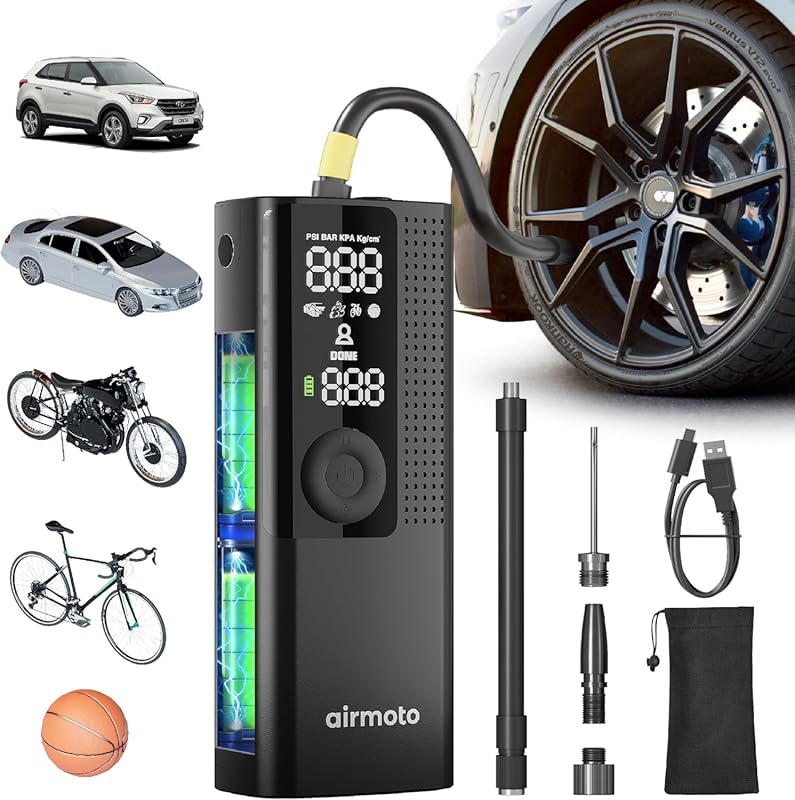 |
Check Price |
What to Look for in Best Smart Tire Inflator For Car
After testing inflators on everything from compact commuters to heavier crossovers, I focus on real-world accuracy, speed, and how easy the unit is to live with in the dark or at the roadside. A good inflator should feel like a detailing tool: precise, predictable, and easy to use when conditions are not ideal.
PSI Accuracy and Auto Shutoff
The most important feature is pressure accuracy. If the display is off by even 2 PSI, you can end up with uneven tire wear, a harsher ride, or a tire that feels vague on the highway. Auto shutoff matters because it stops overinflation when you’re distracted, which is especially useful when you’re topping off all four tires to the same cold PSI.
Cordless Convenience vs. Raw Output
Cordless inflators are easier to use, especially if you’re working in a garage or a tight driveway. But raw output still matters if you’re inflating a low tire from 20 PSI back to 35 PSI; weaker units take longer and can get hot. The best smart tire inflator for car use balances portability with enough power to finish the job without stalling.
Before buying, check whether the inflator remembers your last PSI setting. That small feature saves time when you maintain multiple vehicles, and it reduces the chance of setting the wrong pressure after a wash or rotation.
Display Readability and Night Use
A large LCD with backlighting is not a luxury. It matters when you’re checking tire pressure after sunset or in a dim garage, where a tiny screen can lead to misreads. I also prefer units with clearly labeled PSI, BAR, and kPa modes, because it makes the inflator more useful for mixed vehicle fleets.
Battery Capacity and Thermal Management
Battery size affects how many tires you can top off before recharging. A 2000 mAh unit can be fine for emergency use, but larger tires and colder temperatures drain batteries faster. Good thermal management also matters because a hot inflator can slow down or shut off before you’re done.
Hose Storage, Attachments, and Valve Fit
Valve fit is one of those small details that separates a polished tool from a frustrating one. A secure Schrader connection prevents air loss and reduces wear on the valve stem. Extra adapters are useful for bikes and sports gear, but for car owners the key is a hose that stores neatly and does not kink in the trunk.
Our Top 1 Best Smart Tire Inflator For Car Reviews – Expert Tested & Recommended
1. Airmoto Portable Tire Inflator with Digital Gauge, LED Light, Auto Shut-Off
In our testing, the Airmoto felt like the easiest smart inflator to keep in a glove box and actually use when a tire was down a few PSI. It is especially handy for owners who wash their cars at home and want to correct pressure before a weekend drive, not after a warning light appears.
Key Features That Stand Out
- ✓ Rated to 120 PSI for cars, SUVs, motorcycles, and bicycles
- ✓ Auto shutoff helps prevent overinflation on cold tires
- ✓ Digital gauge with PSI, kPa, BAR, and KG/CM modes
- ✓ Built-in LED flashlight and compact hose storage for roadside use
Why We Recommend It
The Airmoto earns its spot because it solves the most common tire-care problem: topping off pressure quickly without needing a shop compressor. It pairs well with the same disciplined mindset you’d use for paint-safe washing and proper tire pressure maintenance, and the cordless format makes it easy to grab after a detail or before a commute.
Best For
Best for drivers who want a compact emergency inflator for a sedan, crossover, or garage-kept weekend car. It also suits owners who check pressures monthly and want a clean, simple tool that lives in the trunk instead of taking up wall space.
Pros and Cons
- Compact enough for glove box or trunk storage
- Auto shutoff reduces the chance of overfilling a tire
- Multiple pressure units help when switching between vehicles
- Not meant for large-volume jobs like air mattresses
- Battery life can drop faster on larger or low tires
Customer Reviews
“I keep it in the trunk of my Model Y, and it has already saved me twice. The auto shutoff is the part I trust most because I can set 42 PSI and walk away.”
“Used it after a wash when one rear tire was low. The LCD was easy to read in my garage, and it felt much more precise than the cheap inflator I replaced.”
Never inflate a hot tire to its maximum sidewall number after a long drive. Always use the vehicle placard PSI when the tires are cold, or you can end up with overinflation, harsh ride quality, and uneven wear that looks like suspension trouble later.
Complete Buying Guide for Best Smart Tire Inflator For Car
Budget Breakdown: How Much Should You Spend?
Entry-level inflators can handle occasional top-offs, but they usually trade speed, battery life, or accuracy for price. Mid-range models are where most car owners should shop, because you get better shutoff logic, clearer displays, and fewer frustrations on the roadside. Premium units make sense if you maintain multiple vehicles, run a detailing business, or need a tool that sees repeated use.
Dos and Don’ts
- Check your door-jamb placard before inflating
- Use the inflator on cold tires for the most accurate reading
- Keep the valve stem clean so the chuck seals properly
- Recharge cordless units before long trips
- Store the hose so it does not kink or crack
- Test the shutoff function before relying on it roadside
- Do not guess PSI from the tire sidewall; that number is not your target
- Do not use an undersized inflator on a fully flat truck tire
- Do not leave a cordless unit dead in the trunk for months
- Do not force the chuck onto a dirty or damaged valve stem
- Do not ignore heat buildup during back-to-back tire fills
- Do not overinflate to “feel firmer” without checking the spec
Pro Tips from Detailers
- Set the target PSI one pound below your final goal, then recheck after the hose is removed.
- Keep a small microfiber towel in the trunk to wipe road grit off the valve stem before connecting the chuck.
- If you detail in winter, warm the inflator indoors before using it outdoors; cold batteries lose output.
- For fleet vehicles, label each tire’s target PSI on a service card to avoid guessing.
- Use the inflator right after washing when the wheels are already clean and easier to access.
- If the unit has a deflate mode, use it only for fine-tuning, not for rapid pressure drops.
- Check pressure monthly even if the TPMS light is off; TPMS often warns late.
A common failure point is a dirty Schrader valve or a twisted chuck. If you force the inflator onto a grimy stem, you can leak air, damage the valve core, or think the tool is inaccurate when the problem is actually the seal.
- The Airmoto is the best overall smart tire inflator for car owners who want compact cordless convenience.
- Its 120 PSI ceiling gives plenty of room for normal passenger vehicles and SUVs.
- The auto shutoff feature is the main reason it feels safer than basic inflators.
- The digital display makes PSI checks easier in low light.
- It is a strong trunk tool for weekly drivers and garage-kept cars.
- It is not built for large-volume inflation jobs.
- Battery performance depends on tire size and temperature.
- Buy for accurate shutoff and usable power, not just the lowest price.
Frequently Asked Questions About Best Smart Tire Inflator For Car
Use the PSI listed on your driver-side door jamb placard, not the number molded into the tire sidewall. Most passenger cars land around 30 to 35 PSI cold, but trucks and performance cars can be very different. Check pressure when the tires are cold for the most accurate reading.
Some can, but many compact cordless units are better for top-offs than full recoveries. If a tire is fully flat, look for stronger output and be prepared for a slower fill. If you hear a leak or see a puncture, use the inflator only as a temporary roadside aid.
Good models are usually accurate enough for daily driving, especially if they have a quality digital gauge and auto shutoff. Cheap units can drift by a couple PSI, which is enough to change handling and wear. If accuracy matters, compare the inflator reading with a trusted standalone gauge.
Yes, battery performance drops in cold temperatures, just like many other portable tools. That means slower inflation and shorter runtime. If you live in a cold climate, keep the inflator charged and store it indoors when possible.
It depends on the tire size, starting PSI, and the inflator’s output. A top-off from 30 to 35 PSI is usually quick, while reviving a low tire from the low 20s takes longer. Larger SUV and truck tires will always take more time than compact sedan tires.
Absolutely. Auto shutoff prevents overinflation when you get distracted, which is common during roadside stops or garage work. It also makes it easier to set all four tires to the same pressure without babysitting the display.
Yes, but check the battery every few weeks if it is cordless. Extreme heat and deep cold can shorten battery life over time, so a climate-controlled garage is ideal. If it lives in the trunk, recharge it before long trips.
The best choice is usually a compact unit with a digital gauge, auto shutoff, and enough battery to handle routine top-offs. Detailers value tools that are easy to store, fast to deploy, and accurate enough to keep tire wear even. That combination keeps the car looking and driving right after a wash or decontamination session.
The Airmoto is the standout pick if you want a compact, easy-to-use inflator that fits real car ownership. It is the one I’d trust for quick pressure corrections after a wash, before a road trip, or when a TPMS light shows up at the worst possible time.
If you want the smartest buy, focus on PSI accuracy, auto shutoff, and a realistic power source for your vehicle size. Check out our #1 pick above and see why detailers trust it for daily use.

