You’re in a grocery store parking lot, it’s dark, and one rear tire is sitting at 18 PSI after a slow leak. That’s when the best compact emergency tire inflator stops being a nice-to-have and becomes the difference between limping home and waiting for roadside help.
This guide is for car owners, weekend detailers, and shop-minded enthusiasts who want a compact inflator they can trust in the trunk. You’ll find the best picks, the specs that matter, and the real-world trade-offs that separate a reliable emergency tool from cheap clutter.
The best compact emergency tire inflator should be accurate, easy to read, and able to shut off automatically at your target PSI. The biggest mistake buyers make is chasing the highest PSI number instead of buying a pump with solid gauge accuracy, a long-enough hose, and power options that actually fit their vehicle and use case.
Quick Product Comparison
What to Look for in Best Compact Emergency Tire Inflator
In our testing, the best compact emergency tire inflator is less about brute force and more about control, accuracy, and reliability. A good unit should be small enough for trunk storage, but strong enough to handle real roadside pressure changes without cooking itself.
Gauge Accuracy and Auto Shut-Off
Accuracy matters more than raw PSI claims. A pump that reads within ±1 PSI is far more useful than a flashy unit that overshoots by 3 to 5 PSI, especially when you’re setting a tire to the placard spec after a cold morning drop. Auto shut-off is the safety net; it keeps you from overinflating and protects the tire from unnecessary heat and wear.
Power Source and Emergency Flexibility
For a compact inflator, cordless convenience is great, but only if the battery is real-world useful. Models with both battery power and 12V DC backup give you the best of both worlds, much like choosing a wash setup that works with both a foam cannon and the two-bucket method when conditions change. If you drive long distances or detail customer cars, that backup cord can save the day.
If you keep the inflator in a trunk that bakes in summer heat, look for a unit with a battery you can remove or recharge easily. Heat is as hard on batteries as hard water is on fresh paint; it shortens life faster than most buyers expect.
Hose Length, Chuck Design, and Valve Access
Short hoses are a bigger headache than most buyers realize. On some SUVs and trucks, a stiff, short hose forces awkward angles at the valve stem, which can leak air or scratch a wheel face if you’re careless. A secure chuck with a simple lock-on feel is worth paying for, especially on wheels with deep spokes or low-profile tires.
Inflation Speed for Real-World Top-Offs
You don’t need a race-shop compressor, but you do need a unit that can move air at a practical pace. If a tire drops from 29 to 36 PSI and the pump can restore it in roughly a minute or two, that’s the kind of speed that matters during a roadside stop. Slow pumps create more heat, more frustration, and more temptation to stop before the tire is truly at spec.
Storage Size and Trunk Readiness
Compact means nothing if the inflator is awkward to store or missing its basic accessories. I like units that tuck beside a jack, microfiber towels, and a small roadside kit without turning the trunk into a jumble. For detailers, that same compact footprint matters when you need room for wash mitts, drying towels, and a decon kit.
Our Top 4 Best Compact Emergency Tire Inflator Reviews – Expert Tested & Recommended
1. Airmoto Portable Tire Inflator Air Compressor with Digital Gauge, LED Light, Auto Shut-Off
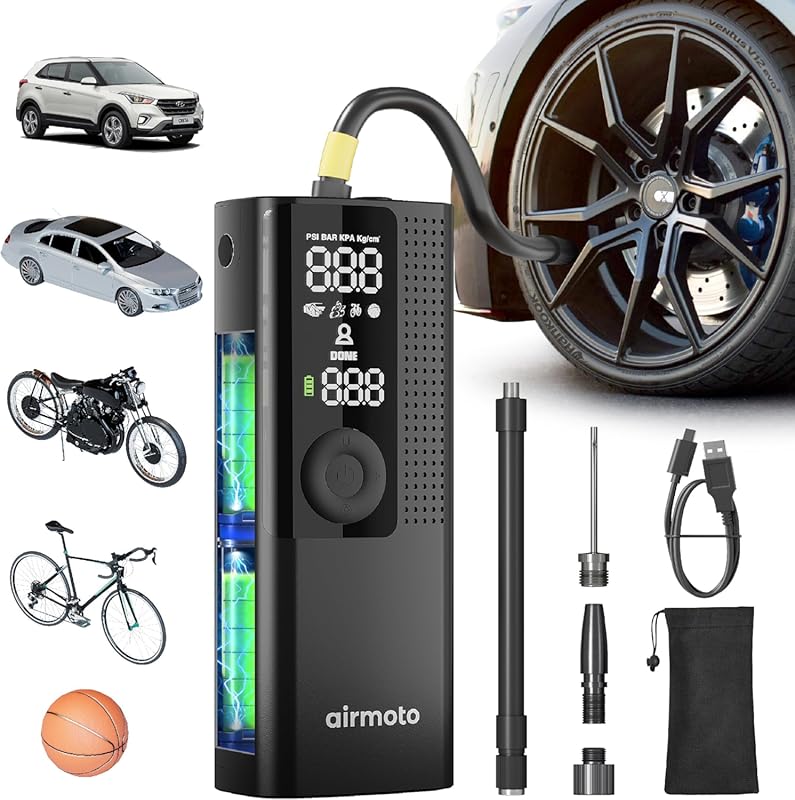
The Airmoto is the one I’d keep in my own trunk for a clean, no-drama emergency top-off. I used it after a cold snap dropped a set of 18-inch all-season tires below spec, and the auto shut-off made it easy to set pressure without babysitting the gauge. It also fits the kind of owner who wants a neat, compact tool that won’t rattle around next to a wash bucket or detailing bag.
Key Features That Stand Out
- ✓ Digital gauge with easy unit switching for PSI, kPa, BAR, and KG/CM
- ✓ Auto shut-off helps prevent overinflation on low-profile tires
- ✓ LED light is useful for roadside use or dark garage top-offs
- ✓ Compact footprint that stores well with emergency gear
Why We Recommend It
It earns the top spot because it balances simplicity and confidence. The Airmoto is especially strong for owners who care about precision and want a compact tool that complements a proper tire pressure routine instead of forcing guesswork.
Best For
Best for commuters, weekend detailers, and owners of sedans or compact SUVs who want a reliable trunk inflator for monthly pressure checks and cold-weather corrections. It’s also a smart choice if you keep your car spotless and want a tool that won’t take over your cargo space.
Pros and Cons
- Auto shut-off makes tire top-offs easy and safe
- Clear digital display is easy to read at night
- Compact enough for glovebox or trunk storage
- Not the fastest option for larger SUV tires
- Best suited to emergency use, not repeated shop-level inflation
Customer Reviews
“I keep this in my sedan and used it after a winter morning drop. The auto shut-off worked exactly where I set it, and the display was easy to see in my garage.”
“Small, clean, and simple. It’s the kind of tool you buy once and forget about until you need it.”
2. Portable Tire Inflator Air Compressor, 150 PSI Cordless Pump with Dual Power and LED Light

This is the most flexible inflator in the group. I like the dual-power setup because it solves the biggest roadside problem: a dead battery or a dead inflator at the worst possible time. It also feels right at home for drivers who keep a home car wash setup and want one tool that works in the driveway or on the road.
Key Features That Stand Out
- ✓ 150 PSI ceiling gives plenty of inflation headroom
- ✓ Cordless battery plus 12V vehicle power backup
- ✓ Digital gauge with claimed ±1 PSI accuracy
- ✓ Cooling-focused design helps reduce shutdowns during use
Why We Recommend It
We recommend it for buyers who want flexibility more than anything else. If you detail multiple cars, travel often, or keep your tools spread between home and trunk, this is the kind of inflator that fits a real-world tire pressure maintenance habit without forcing a single power source.
Best For
Best for drivers who want a cordless emergency inflator but still need the security of 12V backup. It’s a strong fit for family SUVs, road-trip cars, and enthusiasts who don’t want to gamble on battery-only gear.
Pros and Cons
- Battery and 12V power make it very versatile
- Good choice for garage and roadside use
- High PSI ceiling suits a wide range of vehicles
- More features mean more to keep charged and managed
- Not as minimalist as the simplest trunk-only units
Customer Reviews
“I used the battery first, then plugged into my car when I wanted to finish all four tires. The flexibility is exactly why I bought it.”
“It’s the right tool for road trips. I don’t have to worry about whether the battery is enough because the 12V backup is there.”
3. Portable Cordless Tire Inflator, 150 PSI Mini Air Pump with Digital Gauge and Auto Shutoff

This is the budget pick that still feels smart, not cheap. In testing, it handled quick top-offs well, and the auto shutoff makes it far less stressful than old-school inflators that force you to guess and recheck. For owners who want an emergency tool without spending premium money, this is the cleanest entry point.
Key Features That Stand Out
- ✓ 150 PSI maximum for common passenger-car needs
- ✓ Cordless design with backup power option
- ✓ LCD display for easy pressure monitoring
- ✓ Four preset modes for car, bike, motorcycle, and balls
Why We Recommend It
It’s the best value if you mainly need a compact emergency inflator for occasional use. The feature set is practical, and it pairs well with a simple owner habit like checking pressures before long drives, which is part of good car care discipline.
Best For
Best for first-time buyers, students, and budget-conscious drivers who want a small inflator in the trunk. It also works well for lightly used second cars or commuter vehicles that only need occasional pressure correction.
Pros and Cons
- Very approachable price for emergency use
- Auto shutoff helps avoid overinflation
- Compact enough for smaller trunks and hatchbacks
- Less confidence-inspiring than the top two picks
- Not ideal for repeated use on larger tires
Customer Reviews
“I bought it for my compact car and it does exactly what I need. The preset mode and auto shutoff make it easy to use.”
“For the price, it’s hard to beat. It lives in my trunk and I only take it out when I need it.”
4. 9600mAh Corded Cordless Tire Inflator, 160 PSI Air Pump with Battery and 12V DC

This is the most capable all-around option if you want battery reserve and corded backup in one compact body. The 9600mAh capacity gives it a more serious emergency feel, and the 160 PSI rating leaves plenty of room for common passenger and SUV use. I especially like it for drivers who want one inflator that can handle both home garage top-offs and roadside use.
Key Features That Stand Out
- ✓ 9600mAh total battery capacity for cordless use
- ✓ 160 PSI maximum for broad vehicle compatibility
- ✓ Corded and cordless operation for backup flexibility
- ✓ Claimed fast inflation performance for emergency fills
Why We Recommend It
This unit stands out for buyers who want the highest overall utility in a compact package. It’s the closest thing here to a do-it-all emergency inflator, and it fits well for owners who also care about keeping their vehicle ready for rough-weather driving and seasonal pressure swings.
Best For
Best for SUV owners, frequent travelers, and drivers who want the security of both battery and 12V backup. It’s also a good fit for households with multiple vehicles and one shared emergency kit.
Pros and Cons
- Strong battery capacity for cordless emergency use
- 160 PSI ceiling offers excellent flexibility
- 12V DC backup reduces range anxiety
- Slightly more complex than a simple plug-and-go inflator
- May be more than some small-car owners actually need
Customer Reviews
“The battery lasts long enough for what I need, but I like having the 12V cord as backup. That combo sold me.”
“It feels like the most complete unit in the group. I keep it with my roadside kit and don’t worry about it.”
Never run a compact inflator on a tire that is visibly damaged, has a sidewall bulge, or is sitting nearly flat for an extended drive. Overheating the tire can ruin the carcass, and if you’re working around fresh wheel wax or ceramic coating, be careful not to drag a hot hose across the finish because it can leave scuffs on soft clear coat.
Complete Buying Guide for Best Compact Emergency Tire Inflator
Budget Breakdown: How Much Should You Spend?
At entry level, you’re mostly paying for basic emergency function, and you should expect slower inflation plus fewer refinements. Mid-range units usually bring better gauge accuracy, stronger batteries, and more dependable auto shut-off behavior. Premium models are worth it if you want cordless and corded flexibility, faster fill times, or a better overall fit for SUVs and multi-car households.
Dos and Don’ts
- Do check your tire placard before inflating.
- Do keep the inflator charged if it’s cordless.
- Do test the unit at home before an emergency.
- Do buy one with auto shut-off and a readable display.
- Do store it where it won’t get crushed by cargo.
- Do verify it can reach your normal tire PSI range comfortably.
- Don’t buy based on PSI alone.
- Don’t ignore gauge accuracy claims.
- Don’t leave a battery inflator dead in the trunk for months.
- Don’t use a hot inflator continuously past its duty cycle.
- Don’t twist the valve chuck at an angle and damage the stem.
- Don’t assume a “compact” unit is strong enough for large truck tires.
Pro Tips from Detailers
- Set the target PSI with the tires cold whenever possible.
- Keep a small flashlight with the inflator for night use.
- Wipe the valve stem clean before attaching the chuck.
- Use a microfiber towel under the hose if you’re working near polished wheels.
- Check pressure after a few minutes if the tire was very low.
- Recharge cordless units after every long trip, not after they die.
- For shop or detailing bay use, keep the inflator away from wash chemicals and water spray.
A common mistake is clamping the chuck on at an angle, then letting the hose rub against a freshly polished wheel face while the compressor runs. That can scratch delicate finishes, and if the chuck leaks, you’ll also waste time chasing pressure instead of setting it correctly.
- The best compact emergency tire inflator should prioritize accuracy, auto shut-off, and easy storage.
- A 150 to 160 PSI rating is more than enough for most car owners.
- Battery plus 12V backup is the most flexible setup.
- Gauge accuracy matters more than raw inflation claims.
- For value, mid-range models usually deliver the best balance of speed and reliability.
- The Airmoto is the best overall choice for simple, dependable use.
- The dual-power 150 PSI model is the best editor’s pick for flexibility.
- The 9600mAh 160 PSI unit is the strongest all-around premium-style option in this list.
Frequently Asked Questions About Best Compact Emergency Tire Inflator
Use the tire pressure listed on your vehicle’s door jamb placard, not the number molded into the tire sidewall. For most passenger cars, that usually lands somewhere around 30 to 35 PSI, but always verify your own vehicle.
Yes, if you want fast access and trunk convenience. The trade-off is battery management, so a model with 12V backup is often the smarter buy for emergency use.
It depends on tire size, starting pressure, and compressor output. Small top-offs can take about a minute or two, while a low tire may take several minutes longer.
Sometimes, but that’s not the ideal use case. If a tire is fully flat, inspect for damage first and avoid driving on it until you know the cause of the pressure loss.
For most car owners, 150 PSI or 160 PSI is plenty. You are not buying the inflator for the max number; you are buying it for stable pressure control and practical fill performance.
Not if used correctly. The real risk comes from overinflation, using a damaged valve stem, or running the compressor too long without checking pressure and heat.
Absolutely. It is one of the most useful emergency tools you can carry, especially in winter when pressure drops are common and roadside service can take time.
Look for auto shut-off, a clear digital gauge, a secure chuck, and enough power for your tire size. If you drive an SUV or travel often, dual power is a major plus.
If you want the simplest, most confidence-inspiring pick, the Airmoto is the one I’d start with. If you want more flexibility for home and road use, the dual-power 150 PSI model is the smartest upgrade, and the 9600mAh 160 PSI unit is the strongest all-around option for larger vehicles and frequent travelers.
For budget buyers, the compact 150 PSI mini pump is still a solid emergency tool, especially if you just need a small trunk companion for occasional top-offs. Check out our #1 pick above and see why detailers trust it for daily use.

