Quick Summary: Cold drains car batteries by slowing the chemical reaction, thickening oil, and boosting starter demand. You can test your battery with a multimeter, jump it safely, recharge it with a smart charger, and prevent winter failure with simple steps. This guide shows fast fixes, easy checks, and when to replace.
If your car won’t start on a freezing morning, you’re not alone. Many drivers face dead batteries when temps drop. Cold weather kills battery power fast and makes engines harder to crank. The good news? You can diagnose and fix most issues at home with simple tools. In this guide, I’ll show you why cold weather kills battery performance, how to test it, and the best quick fixes you can do right now.

Why Cold Weather Kills Battery: The Science in Simple Terms
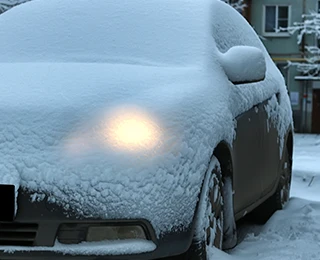
Car batteries use a chemical reaction to create electricity. When it’s cold, that reaction slows down. You get less power from the same battery. At the same time, your engine oil thickens, so the starter needs more power to turn the engine. Less power in the battery and more demand from the engine is a bad combo. That’s why winter mornings often mean a slow crank or no start.
How to Tell if Cold Killed Your Battery
You can spot a winter-weak battery with a few simple signs. Look for these common symptoms before you call a tow truck.
- Slow cranking or a clicking sound when you turn the key
- Dim headlights or flickering dashboard lights
- Battery warning light flashes on and off
- Car starts after a jump, then dies later
- Electronics reset (clock, radio presets)
- Strong fuel smell after repeated cranks (engine flooded, stop trying)
If this sounds like your car, don’t panic. You can test and fix it fast with simple tools.
Step-by-Step: How to Diagnose a Weak Battery in Winter
Use this clear checklist to see if your battery is the problem. You only need basic tools. Most checks take five to ten minutes. Work in a safe, well-lit area and wear gloves if you can.

Tools You Need
You can get these at any big-box store or auto parts shop. Keep them in your trunk all winter.
- Digital multimeter (reads DC volts)
- Jumper cables or a lithium jump starter
- Battery brush or small wire brush
- Dielectric grease or battery terminal protectant
- 12V smart charger (optional but helpful)
Safety First
Car batteries can vent gas. Sparks are dangerous. Stay safe while you test and jump. Follow these basics every time.
- Turn the ignition off and remove the key
- Wear eye protection and gloves
- Keep metal tools away from both terminals at once
- Clamp positive (+) first, then negative (−) when jumping
- Never smoke near a battery
1) Visual Check
Sometimes the fix is simple. Look before you test.
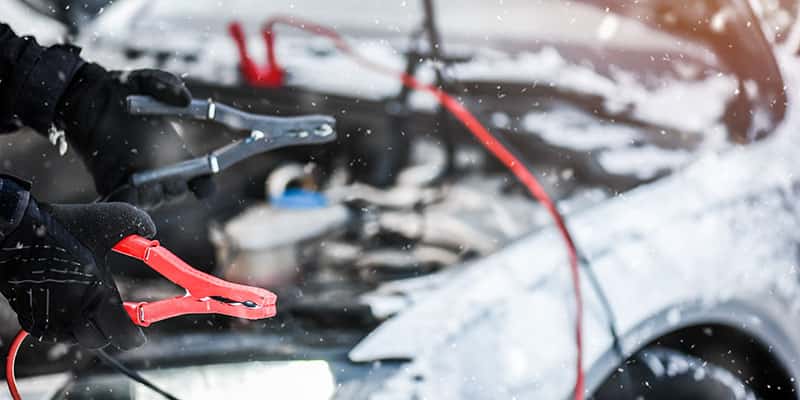
- Open the hood and find the battery.
- Check for corrosion (white or green crust) on terminals.
- Make sure terminals are tight. Wiggle each cable gently.
- Look for a swollen, cracked, or leaking case. If so, replace the battery.
2) Test Voltage (Engine Off)
This quick test shows the state of charge. Let the car sit for at least 30 minutes before you test.

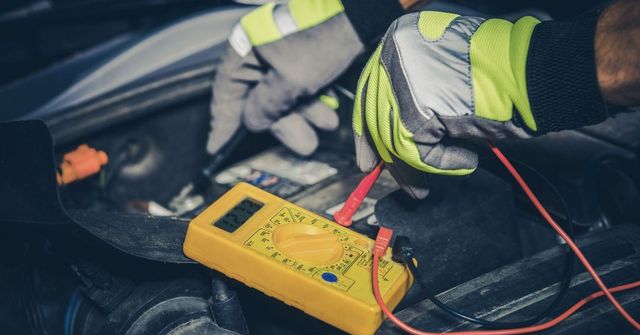
- Set the multimeter to DC volts (20V range).
- Touch red probe to positive (+) and black probe to negative (−).
- Read the number. Compare it to the chart below.
3) Try a Load Test at Home
A simple DIY load test can show if the battery drops too low under strain.

- Turn on headlights on high beam for 2 minutes.
- Turn them off and immediately check voltage.
- If it drops under 12.2V fast, the battery may be weak.
4) Crank Test
Watch the voltage as you try to start the car. This shows how the battery handles a heavy load.
- Keep the multimeter connected.
- Have a helper try to start the car for 3 seconds.
- If voltage drops below about 9.6V at 70°F, the battery is likely failing. In freezing temps, you might see a bit lower, but under 9.0V is bad news.
5) Alternator Check (Once It Starts)
Many “dead battery” issues are actually charging problems. Check your alternator next.
- With the engine idling, measure across the battery again.
- You should see 13.7–14.7V. Lower means undercharging; higher than 15V may mean overcharging.
- Turn on headlights, rear defrost, and blower. Voltage should hold near 13.5–14.5V.
What Happens Inside Your Battery in the Cold
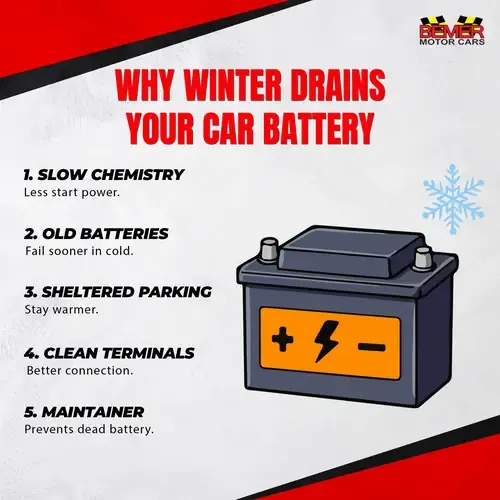
A lead-acid battery stores energy in lead plates and sulfuric acid. When it’s cold, chemical reactions slow down. That reduces the battery’s ability to deliver current. At 32°F, a typical car battery has only about 65–80% of its normal cranking power. At 0°F, it can drop to 50% or less. Meanwhile, your engine takes 2–3 times more torque to turn because oil thickens and parts contract.
- Less chemical activity = less current available
- Thick oil = starter needs more power
- Cold alternator = slower charging until it warms up
That’s the triple hit that causes winter no-starts.
Battery Voltage Chart for Cold Weather
Use this chart to judge your battery’s health at rest. Measure after the car sits for at least 30 minutes. Cold weather can lower voltage slightly, but the ranges still guide you well.
| State (Why cold weather kills battery context) | Open-Circuit Voltage (12V battery) | Condition | What To Do |
|---|---|---|---|
| Fully charged | 12.6–12.8V | Strong | No action needed |
| Mostly charged | 12.4–12.5V | Usable | Top off with a smart charger if it’s below freezing |
| Low charge | 12.2–12.3V | Weak in cold | Charge before next start; test again |
| Discharged | 12.0–12.1V | Likely no-start in cold | Recharge fully; consider a load test |
| Dead or sulfated | 11.8V or less | Fail | Jump to start; test and likely replace |
Starter, Oil, and Alternator: Other Winter Load Factors
Your battery isn’t the only player. Cold affects the whole starting system. Oil thickens. The starter draws more amps. The alternator charges slower until it warms up. If one part struggles, the rest work harder.
Thicker Oil = Harder Cranking
Thicker oil means the starter has to fight the engine. It draws more current from the battery. That drops voltage faster, which can trigger a no-start even if your battery was fine yesterday.
- Use the oil grade on your oil cap or owner’s manual
- In very cold climates, a 0W-20 or 5W-30 winter-grade oil helps
- Consider a block heater in extreme cold
Alternator Reality Check
The alternator tops up the battery after a start. In bitter cold, it may need more time to fully recharge. Short trips with lights and heat blasting can drain faster than the alternator can add back.
- Avoid short trips when it’s below freezing
- Let the car run 15–20 minutes after a cold start
- Use a smart charger overnight to maintain charge
Fixes You Can Do Right Now
Try these easy, fast steps to revive a car that won’t start in the cold. These work for most gas cars and many trucks.
- Turn off all accessories (heater fan, radio, lights).
- Try a 5-second crank. If it’s slow, stop and move to a jump.
- Jump with a lithium starter:
- Connect positive (+) to positive, negative (−) to a clean engine ground.
- Wait 30 seconds, then crank for up to 5 seconds.
- If it starts, let it idle 15–20 minutes.
- No jump pack? Use cables:
- Donor car idling. Red to dead +, red to donor +, black to donor −, black to engine ground on dead car.
- Wait 2–3 minutes. Try starting.
- If it still won’t start, remove and warm the battery indoors for 30–60 minutes, then recharge with a smart charger.
- Clean and tighten terminals with a brush. Add dielectric grease.
Preventive Winter Battery Care
Most winter battery problems are preventable. Use these habits to avoid morning surprises. They are cheap, fast, and effective.
- Test your battery every fall with a multimeter
- Top off with a smart charger once a month
- Clean terminals and protect with dielectric grease
- Replace batteries older than 4–5 years before deep winter
- Use a battery blanket or maintainer if you park outside
- Drive at least 20 minutes after a cold start
- Turn off heated seats and rear defrost after warm-up
Best Batteries for Cold Climates (What to Look For)
Not all batteries handle winter the same. Choose the right one and you’ll start strong even on icy mornings. Focus on these specs and features when you shop.
- Cold Cranking Amps (CCA): Higher is better for cold starts. Match or exceed factory spec.
- Reserve Capacity (RC): More minutes of backup power if the alternator lags in cold.
- AGM vs Flooded: AGM resists vibration, charges faster, and handles cold better.
- Fresh Date Code: Choose the newest battery on the shelf.
As explained by AAA, cold weather can cut battery output in half while increasing cranking demand, so choosing adequate CCA matters a lot in northern states.
Jumper Pack vs Cables: What’s Better in the Cold?
Both can get you going. In deep cold, a good lithium jump starter is fast and simple. Cables work too but need another car and good access for clamps. Here’s a quick compare to help you choose.
| Option | Pros | Cons | Best For |
|---|---|---|---|
| Lithium jump starter | Portable, fast, no donor car, USB charging | Needs charging, can weaken in subzero temps | Solo drivers, tight parking, emergencies |
| Jumper cables | Cheap, no battery to charge | Needs donor car, awkward in snow, risk of bad clamps | Households with multiple cars |
Common Winter Battery Problems: Symptoms, Causes, Fixes
Use this table to match what you see to a likely cause and a fast fix. It’s a quick way to decide your next step on a cold morning.
| Symptom | Likely Cause | Quick Fix |
|---|---|---|
| Single click, no crank | Weak battery or corroded terminals | Jump start; clean and tighten terminals; test voltage |
| Rapid clicking | Very low battery voltage | Use a jump pack; recharge fully; check for parasitic draw |
| Slow crank, then starts | Borderline battery in cold | Charge overnight; plan for replacement soon |
| Starts, then dies at idle | Undercharging alternator or loose belt | Check charging voltage; inspect serpentine belt |
| Dim lights even when running | Poor alternator output or corroded grounds | Measure 13.7–14.7V at idle; clean ground straps |
| Cranks strong but won’t fire | Fuel or ignition issue (not battery) | Stop cranking; avoid flooding; check codes if possible |
Real-World Scenarios and What to Do
Here are fast answers for the most common cold-start headaches. Follow the steps and you’ll either get going or know exactly what to fix next.
It’s 10°F. I Hear a Click. No Crank.
Your battery is likely at very low charge. Jump it and then check for the reason it drained.
- Jump with a pack, let it idle 20 minutes
- Test alternator output (should be 13.7–14.7V)
- Put it on a smart charger overnight
I Parked for 3 Days. Now It’s Dead.
Cold slows the battery and a small parasitic drain can push it over the edge.
- Fully recharge with a smart charger
- Check for dome light or OBD device left on
- If it dies again, test for parasitic draw with a multimeter
New Battery, Still Slow Crank When Cold
The battery may be fine. The oil, starter, or grounds could be the issue.
- Use the correct winter oil grade
- Clean battery and engine ground connections
- Have the starter draw tested at a shop if slow continues
Starts Then Stalls Right Away
This points to charging problems. The battery gets you started, the alternator keeps you running.
- Measure charging voltage at idle
- Inspect belt and tensioner
- Load-test alternator at a parts store
When to Replace vs Recharge
A charger can bring a good battery back to life. But if a battery is old or sulfated, replacement is smarter. Use these rules to decide quickly.
- Age 5+ years and winter weak? Replace.
- Crank voltage under 9.0V at mild temps? Replace.
- Won’t hold 12.4V after a full charge? Replace.
- Case is swollen or leaking? Replace now.
- Otherwise, recharge with a smart charger and re-test.
Charging in the Cold: Best Practices
A smart charger is your best winter tool. It charges slowly and safely. It also prevents overcharging, which can be worse in the cold when you try to rush it.
- Use a 1–10 amp smart charger with temperature compensation
- Charge in a ventilated area, off the car if possible
- For cars parked outside, use a weather-safe extension cord and battery maintainer
- AGM batteries prefer a smart charger set to AGM mode
According to Consumer Reports, routine maintenance charging helps extend battery life, especially when most trips are short and temperatures are low.
Cold Weather, Short Trips, and Parasitic Drains
Short trips don’t give the alternator time to refill the battery. Add a small drain like a phone charger left plugged in, and the battery slowly runs down. It may start on day one, struggle on day two, and fail on day three.
- Unplug chargers and accessories when parked
- Drive at least 15–20 minutes after starting
- Use a maintainer if you don’t drive often
How To Check for a Parasitic Battery Drain (DIY)
If your battery keeps dying, you may have a drain. This simple test shows which circuit is pulling power while the car is off.
- Turn off the car. Close doors. Wait 15 minutes for modules to sleep.
- Set the multimeter to DC amps (start at 10A range).
- Disconnect the negative terminal. Put the meter in series between cable and post.
- Healthy draw is often under 50 mA. More than 100–200 mA is a problem.
- Pull fuses one at a time to find the circuit that drops the draw.
- Fix or unplug the device on that circuit.
As explained by AAA, modern cars can have higher “sleep” draws briefly, so give modules time to power down before testing.
Cold Weather Myths: What’s True, What’s Not
Winter brings a lot of advice. Some of it helps. Some wastes time. Here’s what you should know right now.
- Myth: “Revving the engine charges the battery faster.” Truth: The alternator does increase output with RPM, but fast idling isn’t a fix for a weak battery. Use a charger.
- Myth: “Any battery with high CCA is best.” Truth: CCA matters, but quality, RC, and fresh date code matter too.
- Myth: “Let the car idle for a long time to warm up.” Truth: Gentle driving warms the car faster and charges better than long idling.
What About Hybrids and EVs in the Cold?
EVs and hybrids also struggle in the cold, but for different reasons. Range drops and charging slows. They still have a 12V battery that can die and stop the car from “starting” even if the high-voltage pack is full.
- Keep the 12V battery healthy with a maintainer if you don’t drive often
- Precondition (warm) the battery while plugged in
- Use seat heaters, not cabin heat, to save energy
- Expect reduced range in freezing temps
Based on this battery guide from the U.S. Department of Energy, cold can significantly reduce battery performance, both for traditional lead-acid and for EV lithium-ion systems.
Winter Battery Prep Checklist
Use this quick list in late fall. It takes less than an hour and can save you from a roadside call on the first snow day.
- Test resting voltage (aim for 12.6V+)
- Clean and tighten terminals
- Apply dielectric grease on connections
- Check alternator output
- Replace battery if 4–5 years old
- Put a jump pack in the trunk and keep it charged
- Switch to winter-grade oil
Table: Cold Weather Impact and Why Cold Weather Kills Battery
This table ties the science to what you feel behind the wheel. It shows how temperature affects both the battery and the rest of your car.
| Temperature | Battery Output | Engine Cranking Demand | Net Result (Why cold weather kills battery) |
|---|---|---|---|
| 70°F | 100% capacity | Normal | Strong start |
| 32°F | ~65–80% capacity | Higher | Longer crank; borderline batteries fail |
| 0°F | ~50% capacity | Much higher | Many no-starts; jump or charge needed |
| −20°F | ~40% or less | Extreme | Even strong batteries struggle; use heaters/maintainers |
How to Choose and Install a New Winter Battery (DIY)
Ready to swap your battery at home? It’s easier than you think. Follow these safe steps. Take a picture of the setup before you start so you can copy it.
- Check size and terminals:
- Look up Group Size in your owner’s manual or parts app
- Match terminal position (left/right) and height
- Get the right spec:
- Meet or beat OEM CCA
- Choose AGM if your car came with AGM or you need better cold performance
- Back up settings (optional):
- Use a 12V memory saver in the OBD port
- Remove old battery:
- Ignition off
- Remove negative (−) first, then positive (+)
- Undo the hold-down bracket
- Clean and prep:
- Brush terminals and cable ends
- Install felt washers and a light coat of dielectric grease
- Install new battery:
- Place in tray, secure hold-down
- Connect positive (+) first, then negative (−)
- Test:
- Start the car, check charging voltage
Avoid These Cold-Weather Battery Mistakes
Avoiding common errors can save your battery and your day. These mistakes are easy to make and easy to stop.
- Cranking for more than 10 seconds at a time (let the starter cool)
- Leaving the car idling for hours to “charge” (use a smart charger)
- Ignoring corrosion on terminals
- Buying the cheapest battery with low CCA
- Using the wrong oil grade
Battery Accessories That Help in the Cold
Simple add-ons can make winter starts easier. These are low-cost and take minutes to use or install.
- Battery maintainer (keeps charge topped off)
- Battery blanket (electric wrap adds warmth)
- Engine block heater (keeps oil thinner)
- Terminal protectors (reduce corrosion)
- Lithium jump pack (instant backup)
Plan for Winter Trips: Stay Ready
If you commute or drive in rural areas, plan ahead. A dead battery in the cold is more than an inconvenience—it’s a safety issue. Pack smart and keep your car ready.
- Keep a jump pack and cables in the trunk
- Carry gloves, flashlight, and a small tool kit
- Bring a blanket and emergency snacks
- Check your spare tire and tire pressures monthly
According to the National Highway Traffic Safety Administration, proper vehicle maintenance and readiness are key parts of safe winter driving.
FAQ: Cold Weather and Car Batteries
Why does my car start fine in the afternoon but not in the morning?
Cold mornings slow the battery’s chemical reaction and thicken oil. As temps rise later, the battery delivers more power. A borderline battery shows this time-of-day pattern.
Is my battery dead or is it the alternator?
Measure voltage while running. If you see 13.7–14.7V, the alternator is likely fine. If it’s lower, you may have a charging problem. If the car starts after a jump but dies at idle, suspect the alternator.
How long should I drive to recharge my battery in winter?
At least 20–30 minutes of mixed driving helps. Short trips with lights and heat on may not replace the energy used to start the car. A smart charger does the job best.
Do AGM batteries work better in the cold?
Yes. AGM batteries handle cold cranking better, accept charge faster, and resist vibration. They also recover better from deep discharge than standard flooded batteries.
Can I warm a frozen battery to save it?
If the electrolyte is frozen, do not try to charge it. Bring it indoors to thaw at room temp first. Then charge slowly with a smart charger. Replace if the case is swollen or cracked.
What voltage is too low to start a car?
Below about 12.2V, winter starts become unreliable. Under 12.0V, many cars won’t crank in the cold. After jumping, charge fully and test again.
How often should I replace my battery?
Most last 3–5 years. In hot or very cold areas, expect the shorter end. Test every fall. Replace before winter if it’s weak or over four years old.
Conclusion
Cold weather kills battery performance by slowing chemistry, thickening oil, and loading the starter. But you can stay in control. Test your battery with a multimeter. Use a smart charger to top it off. Keep terminals clean and tight. Choose a battery with solid CCA and a fresh date code. Carry a jump pack for fast help. With a little prep, you’ll start strong all winter long—and skip the tow truck.

