Want louder, clearer sound from your car stereo? This guide walks you through practical, step-by-step ways to boost your car stereo power—from upgrading your head unit to adding an amplifier—without breaking the bank. Transform your daily drive into a concert on wheels.
Key Takeaways
- Upgrade your head unit: A high-quality aftermarket stereo delivers cleaner signals and more power than factory units.
- Add an external amplifier: Amps provide dedicated power to your speakers, improving volume, clarity, and bass response.
- Use high-quality wiring: Thicker, oxygen-free copper cables reduce resistance and improve power delivery.
- Match impedance correctly: Ensure your speakers and amp are compatible to avoid damage and maximize output.
- Install a capacitor or upgrade your battery: Stabilize voltage for consistent performance, especially with subwoofers.
- Tune your system properly: Adjust gain, crossover, and EQ settings to get the best sound from your setup.
- Consider speaker upgrades: More efficient speakers can make a bigger difference than raw power alone.
How to Boost Car Stereo Power for Better Sound Quality
Your car stereo should do more than just play music—it should make you feel every beat, every note, and every drop of bass. But if your current system sounds flat, quiet, or distorted at higher volumes, it’s time to boost your car stereo power. The good news? You don’t need to be an audio engineer or spend thousands to get amazing sound. With a few smart upgrades and some know-how, you can dramatically improve your in-car audio experience.
In this guide, we’ll walk you through the most effective ways to increase your car stereo’s power and sound quality. Whether you’re a weekend cruiser or a daily commuter, these steps will help you get louder, clearer, and more dynamic audio. From simple tweaks to full system upgrades, we’ve got you covered.
Step 1: Start with a Better Head Unit
The head unit—your car’s stereo receiver—is the brain of your audio system. Factory stereos are often built to save costs, which means they deliver weak signals and limited power. Upgrading to a high-quality aftermarket head unit is one of the easiest and most impactful ways to boost car stereo power.
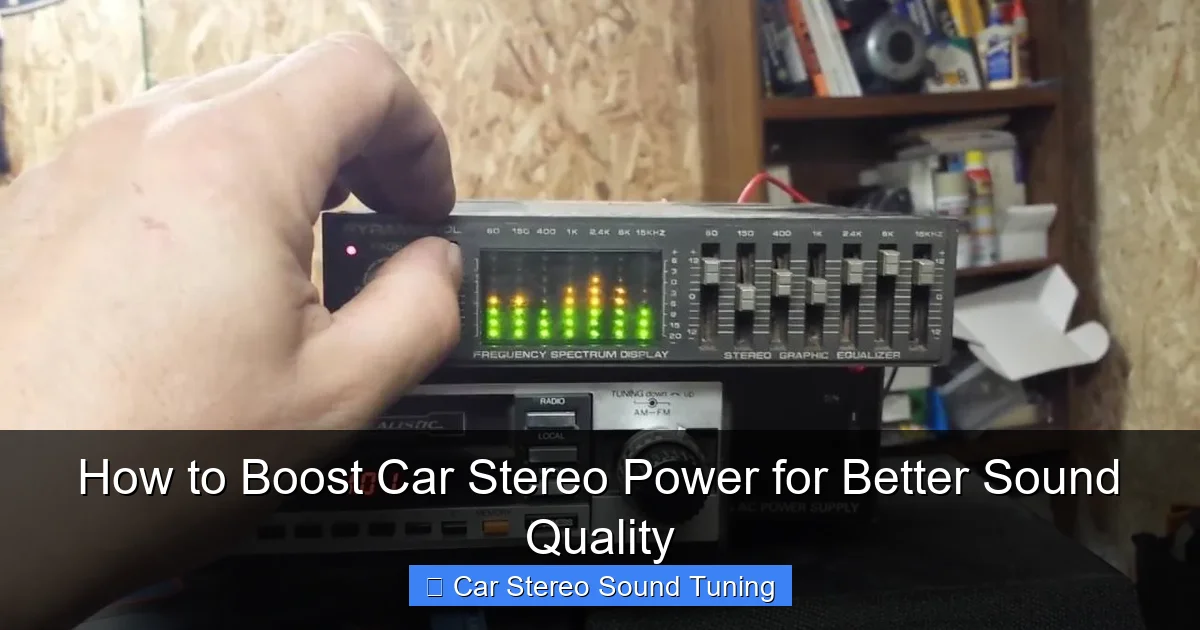
Visual guide about How to Boost Car Stereo Power for Better Sound Quality
Image source: i.ytimg.com
Why Upgrade Your Head Unit?
Aftermarket head units offer better digital-to-analog converters (DACs), higher preamp voltage (up to 4–5 volts), and built-in equalizers. This means cleaner sound, less distortion, and more headroom for your speakers and amp. Many also support modern features like Bluetooth, Apple CarPlay, and Android Auto.
What to Look For
- High preamp voltage: Aim for at least 4 volts to ensure strong signal output.
- Built-in EQ and time alignment: These help fine-tune sound for your car’s acoustics.
- Compatibility with amplifiers: Look for RCA outputs to connect an external amp.
- Power output: While most head units only deliver 15–20 watts RMS per channel, the real benefit is in signal quality, not raw power.
Tip: Brands like Pioneer, Kenwood, Sony, and Alpine offer reliable models under $200 that outperform most factory units.
Step 2: Add an External Amplifier
If you really want to boost car stereo power, adding an external amplifier is the single most effective upgrade. Amplifiers take the weak signal from your head unit and boost it to drive your speakers with authority.
Why You Need an Amp
Factory stereos and even many aftermarket units can’t deliver enough clean power to make your speakers perform at their best. An amp provides dedicated power, reducing distortion and allowing your speakers to play louder and clearer—especially at high volumes.
Choosing the Right Amplifier
- Match your speakers: Check the RMS power rating of your speakers and choose an amp that delivers 75–150% of that number.
- Number of channels: A 4-channel amp can power front and rear speakers. Add a mono amp for a subwoofer.
- Class D vs. Class AB: Class D amps are more efficient and great for subwoofers. Class AB amps offer better sound quality for full-range speakers.
- Size and installation: Compact amps fit under seats or in trunks. Make sure you have space and proper ventilation.
Installation Tips
- Disconnect the car battery before starting.
- Run a power cable from the battery to the amp using 8- or 4-gauge wire (depending on power needs).
- Use a fuse within 18 inches of the battery.
- Connect the ground wire to a bare metal spot on the chassis.
- Run RCA cables and remote turn-on wire from the head unit to the amp.
- Connect speaker wires from the amp to your speakers.
Example: A 4-channel 50W RMS amp like the Rockford Fosgate R400X4 can power all four speakers with clean, dynamic sound—perfect for most daily drivers.
Step 3: Upgrade Your Wiring
Even the best amp and speakers won’t perform well with thin, low-quality wiring. To truly boost car stereo power, you need proper gauge cables that minimize resistance and voltage drop.
Power and Ground Cables
Use thicker wire for higher-power systems. Here’s a quick guide:
- Up to 50 watts: 8-gauge wire
- 50–100 watts: 4-gauge wire
- 100+ watts: 2- or 0-gauge wire
Always use oxygen-free copper (OFC) wire—not copper-clad aluminum (CCA)—for better conductivity and durability.
RCA and Speaker Wires
Shielded RCA cables prevent interference from your car’s electrical system. For speaker wires, 16-gauge is fine for most setups, but go to 14-gauge for longer runs or higher power.
Fuses and Distribution Blocks
Protect your system with in-line fuses on all power lines. Use a distribution block if you’re running multiple amps.
Pro Tip: Keep power and signal cables separated. Run them on opposite sides of the car to avoid noise and interference.
Step 4: Match Impedance and Power Ratings
One of the biggest mistakes people make when boosting power is mismatching components. Your amplifier, speakers, and subwoofers must be compatible to work safely and efficiently.
Understanding Impedance
Impedance is measured in ohms (Ω) and affects how much power your amp can deliver. Most car speakers are 4 ohms, but some are 2 or 8 ohms. Check your amp’s specs—it will list power output at different impedances.
Example: An amp that delivers 50W RMS at 4 ohms might deliver 75W at 2 ohms—but only if it’s stable at that load. Running a 2-ohm load on a 4-ohm-only amp can cause overheating and damage.
Power Matching
Don’t underpower or overpower your speakers. Ideally, your amp should deliver 75–150% of your speaker’s RMS rating. Too little power causes distortion when you turn up the volume. Too much can blow the speakers.
Tip: Use a multimeter to check impedance if you’re unsure. Never guess—always verify.
Step 5: Stabilize Your Electrical System
Adding more power draws more current from your car’s electrical system. If your alternator, battery, or wiring can’t keep up, you’ll experience dimming lights, voltage drops, and poor performance—especially with subwoofers.
Upgrade Your Battery
A high-performance AGM (absorbent glass mat) battery like the Optima YellowTop provides stable power and handles deep discharges better than standard lead-acid batteries.
Install a Capacitor
A power capacitor stores energy and releases it quickly during bass-heavy songs. It helps prevent voltage drops and keeps your amp running smoothly. A 1-farad capacitor is good for systems under 1000 watts; go higher for bigger setups.
Consider an Alternator Upgrade
If you’re running a high-wattage system (1000W+), your factory alternator may not keep up. Upgrading to a high-output alternator ensures consistent power delivery.
Note: Most daily drivers don’t need a full electrical upgrade—just a good battery and capacitor will suffice.
Step 6: Upgrade Your Speakers
Even with more power, old or low-quality speakers won’t sound great. Upgrading to efficient, high-sensitivity speakers can make a huge difference—sometimes more than adding an amp.
What to Look For
- Sensitivity rating: Aim for 90 dB or higher. Higher sensitivity means louder sound with less power.
- Frequency response: Look for a wide range (e.g., 30Hz–20kHz) for full, balanced sound.
- Build quality: Paper cones are cheap but wear out. Polypropylene or composite cones last longer and sound better.
- Coaxial vs. Component: Component speakers (separate tweeters and woofers) offer better imaging and clarity.
Example: The JL Audio C2-650X component speakers deliver crisp highs and rich mids with just 50 watts—perfect for a power-boosted system.
Step 7: Tune Your System for Best Sound
More power is useless if your system isn’t tuned properly. Proper tuning ensures clarity, balance, and prevents damage.
Set the Gain Correctly
The gain control on your amp isn’t a volume knob—it matches the input signal to avoid distortion. Use a multimeter or test tones to set it right. Never max it out.
Use Crossovers
Crossovers send the right frequencies to the right speakers. Set your high-pass filter (HPF) on door speakers to block bass (e.g., 80Hz). Use a low-pass filter (LPF) on subwoofers (e.g., 80Hz).
Adjust the EQ
Use your head unit’s equalizer to balance sound. Cut harsh frequencies (2–4 kHz) and boost mids and lows slightly for a warmer tone. Avoid boosting too much—it can cause distortion.
Time Alignment
If your head unit supports it, adjust time alignment so sound from all speakers reaches your ears at the same time. This creates a more immersive soundstage.
Troubleshooting Common Issues
Even with the best setup, you might run into problems. Here’s how to fix common issues:
Bass Distortion or Rattling
This is often caused by overpowering speakers or incorrect crossover settings. Lower the gain, check your LPF, and ensure your subwoofer is properly boxed.
Hissing or Static Noise
Usually due to poor grounding or interference. Re-check all ground connections and keep RCA cables away from power wires.
Dimming Lights
A sign of insufficient power. Upgrade your capacitor or battery. If the problem persists, consider a high-output alternator.
No Sound from Speakers
Check fuses, remote turn-on wire, and speaker connections. Use a multimeter to test continuity.
Conclusion
Boosting your car stereo power doesn’t have to be complicated or expensive. By upgrading your head unit, adding an amplifier, using quality wiring, and tuning your system properly, you can transform your car into a mobile sound studio. Remember: it’s not just about more watts—it’s about cleaner, smarter power delivery.
Start with one or two upgrades, test the results, and build from there. Whether you’re chasing deep bass or crystal-clear vocals, these steps will help you get the best possible sound from your car stereo. So crank up the volume, hit the road, and enjoy every mile with music that moves you.
🎥 Related Video: sony car amplifier #shorts
📺 Kids Mind Technical
sony car amplifier #shorts #sony #caramplifier #sonymusic #viral #ytshorts #youtubeshorts #reels.

