Tire Inflator or Air Compressor Which One Is Best

A tire inflator is best for most drivers who want a compact, easy way to top off tires and handle emergencies. An air compressor is better if you need more airflow, faster inflation, or a tool for garage work beyond tires.
When drivers compare a tire inflator or air compressor, the best choice usually comes down to how often you add air, how much volume you need, and whether you want something for emergencies or for regular garage use. For most everyday drivers in 2025, a compact tire inflator is enough; for heavier vehicles, frequent inflation, or shop-style tasks, a larger air compressor makes more sense.
- Best everyday choice: Tire inflators suit most passenger vehicles.
- Best heavy-duty choice: Air compressors handle larger or frequent jobs better.
- Most important specs: Look at airflow, power source, gauge accuracy, and duty cycle.
- Main risk: Overinflation and inaccurate readings can cause problems.
- Best rule: Buy for your real use case, not the biggest number on the box.
Tire Inflator or Air Compressor: What Drivers Actually Need in 2025
The easiest way to think about this choice is simple: a tire inflator is built for convenience, while an air compressor is built for broader airflow and heavier-duty work. That difference matters more than brand names or extra features.
If you mainly top off car tires, check pressure before road trips, or want a backup for roadside emergencies, a portable inflator is usually the smarter buy. If you also plan to run air tools, inflate large truck tires often, or use compressed air around the garage, a compressor is the more versatile option.
Choose based on your most common job, not the most impressive spec on the box. Many drivers overbuy a compressor when a simple inflator would be easier to store and use.
How a Tire Inflator and an Air Compressor Work
Both tools move air into a tire, but they are designed differently. A tire inflator is typically a compact, portable device meant for quick pressure corrections, while an air compressor often stores or delivers air at a higher rate for repeated use.
Portable tire inflator basics for quick top-offs
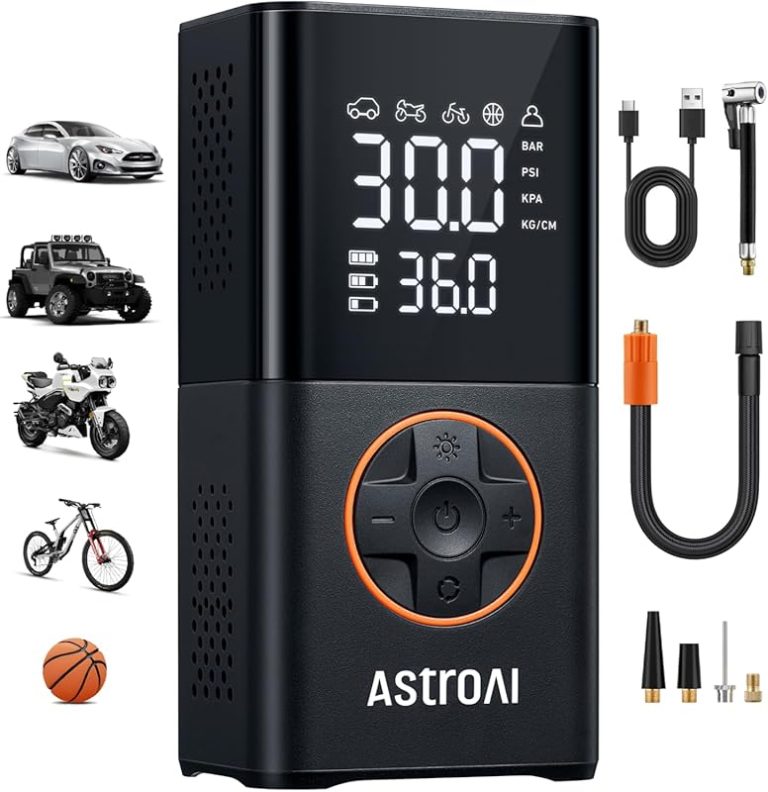
Portable tire inflators are usually small, lightweight, and easy to keep in a trunk, cargo area, or garage shelf. Many plug into a 12V outlet, a USB power source, or a battery pack, which makes them handy during roadside situations.
They work best when you need to add a few PSI rather than fill a completely flat tire from scratch. In practice, that means they are ideal for seasonal pressure changes, slow leaks that are being monitored, and routine maintenance.
Air compressor basics for higher-volume air delivery
Air compressors are designed to move more air, often with better speed and more consistent output. Some are compact enough for home use, while others are larger shop-style units with a tank that stores compressed air.
That extra capacity is useful when you need repeated inflation, faster fill times, or power for other pneumatic tasks. The tradeoff is that compressors are usually bulkier, louder, and less convenient to carry in a vehicle.
Tire Inflator vs Air Compressor: Key Differences That Matter on the Road
There is no universal winner because these tools solve different problems. The right answer depends on whether you want portability and simplicity or speed and multi-use capability.
| Option | Best For | Limit |
|---|---|---|
| Portable tire inflator | Emergency top-offs and everyday tire checks | Slower on larger tires and heavy-duty jobs |
| Air compressor | Frequent inflation, garage use, and air tools | Less portable and usually more expensive |
Speed, PSI range, and inflation capacity
Speed matters when you are dealing with more than a small pressure correction. A basic inflator can handle normal passenger car needs, but it may take longer on SUVs, trucks, or low-pressure tires that need a bigger refill.
PSI range is also important, but it should not be confused with how quickly air moves. A tool may technically reach the pressure you need while still being too slow for repeated use or larger tires.
Portability, power source, and storage convenience
Inflators win on convenience. They are easier to store, easier to carry, and often simpler to use during a roadside stop or in a cramped garage.
Compressors vary more widely. Some are portable enough for occasional transport, but many are better suited to a fixed spot in a garage or workshop. If space is limited, the smaller tool often makes more sense.
Noise, durability, and maintenance needs
Air compressors are often louder because they are doing more work. That is not necessarily a flaw, but it can be annoying in neighborhoods, apartment garages, or early-morning use.
Durability depends heavily on the model, build quality, and how it is used. A compressor may last a long time if maintained properly, but it also has more parts that can wear out. Inflators are simpler, though they can still fail if the hose, gauge, or power connection is neglected.
Best Use Cases for a Tire Inflator
A tire inflator is the better fit when your needs are occasional, predictable, and mostly about convenience. It is the tool most drivers can use without learning much, which is part of its appeal.
Daily drivers, commuters, and emergency roadside use
If you drive a sedan, hatchback, crossover, or small SUV and only need to restore tire pressure every so often, a compact inflator is usually enough. It is especially useful for commuters who want a quick check before work or a road trip.
It is also a smart emergency item. If a tire loses a few PSI and you are trying to reach a service station or safe location, a portable inflator can buy you time. For drivers who also want to understand warning lights and vehicle diagnostics, a guide like how to choose the right OBD2 scanner can be helpful alongside basic tire care.
Seasonal pressure checks and small PSI corrections
Tire pressure changes with temperature, so many drivers notice lower readings when the weather turns cold. In those cases, a portable inflator is usually all you need to make small corrections.
This is where inflators shine: add a few PSI, check the gauge, and move on. You do not need a full compressor setup just to keep tires near the recommended level.
Practical examples for cars, motorcycles, and bicycles
For cars, a tire inflator is often the simplest at-home solution. For motorcycles, it is useful because small pressure changes matter and the tires are smaller than truck tires.
Bicycles are another common use case, although valve compatibility matters. If you own several vehicles with different tire sizes, a compact inflator can still cover most everyday needs without taking over your storage space.
Best Use Cases for an Air Compressor
An air compressor makes more sense when inflation is only one part of the job. If you need broader utility, faster output, or repeated use, the compressor earns its place.
Truck tires, SUVs, and frequent inflation jobs
Larger tires usually need more air volume, even when the PSI target is not dramatically higher. That means a small inflator may work, but it can feel slow and less practical if you are doing the job often.
For trucks, work vehicles, lifted SUVs, or families with multiple cars, a compressor can save time and reduce frustration. It becomes even more useful if you are dealing with low tire pressure regularly due to load, terrain, or seasonal changes.
Garage work, air tools, and multi-purpose home use
Air compressors are not just for tires. They can also support air tools, dust cleaning, and other household or garage tasks, depending on the unit and accessories.
If you already want compressed air for more than inflation, that broader utility can justify the larger footprint. In that case, a compressor is less of a single-purpose purchase and more of a workshop tool.
When a larger tank or higher CFM is worth the cost
Tank size and airflow capacity start to matter when you need repeated bursts of air or faster recovery between tasks. That is where a compressor becomes more than a convenience item.
If you only inflate one tire a month, a large tank is probably unnecessary. But if you use air frequently, the added cost may be worth it for speed, consistency, and reduced waiting.
Cost Comparison: Budget Picks vs Long-Term Value
Price is one of the biggest reasons drivers choose a tire inflator over an air compressor. The cheaper option is not always the weaker one; it may simply be better matched to the job.
Upfront price differences and ownership costs
Portable inflators are usually the lower-cost entry point, and they often have lower ownership costs because they are simple to store and use. They also tend to need fewer accessories.
Compressors can cost more up front, especially if you want a unit with better airflow, a tank, or quieter operation. Long-term value depends on whether you will actually use the extra capability.
Choosing between a compact inflator and a shop-style compressor
A compact inflator is often the better value for drivers who want one practical tool for tire maintenance. It is easy to justify if your main goal is to avoid gas-station air machines and keep tires properly inflated.
A shop-style compressor makes sense only if you will use it often enough to benefit from the extra power. Otherwise, you may end up paying for capability you rarely need.
What features justify paying more in 2025
In 2025, the features that usually justify a higher price are accuracy, build quality, better hoses and fittings, clearer gauges or displays, and stronger power compatibility. These details matter more than flashy extras.
A well-designed inflator with a reliable gauge can be more useful than a larger unit that is awkward, noisy, or difficult to power. For some drivers, that is especially true if they want to pair tire care with other maintenance basics such as connecting an OBD2 scanner for routine vehicle checks.
Prices vary widely by brand, power type, and build quality, so compare features carefully instead of assuming the most expensive option is the best fit.
Common Mistakes Drivers Make When Buying or Using Either Option
Most problems come from choosing the wrong type of tool or using it without checking the basics. A little attention up front can prevent wasted money and unsafe inflation.
Confusing PSI needs with airflow needs
PSI tells you the pressure target, but airflow determines how quickly the tire gets there. Many buyers focus only on the pressure number and ignore whether the tool can actually deliver enough air in a reasonable time.
This is why a tool can look “strong” on paper and still feel weak in real use. For larger tires, airflow matters as much as the maximum pressure rating.
Ignoring duty cycle, hose length, and power compatibility
Duty cycle can matter if you plan to use the tool for more than short bursts. If a unit is not meant for extended operation, it may overheat or need rest periods.
Hose length and power compatibility also affect day-to-day convenience. A short hose or incompatible plug can turn a simple job into a frustrating one, especially at night or on the roadside.
Overinflation, inaccurate gauges, and poor maintenance habits
Overinflation is a real risk, especially if you rush or rely on a gauge you have not checked. Always compare the tire pressure to the vehicle placard or owner’s manual, not the number on the tool box.
Keep the hose, fittings, and gauge in decent condition. If a tool seems inconsistent, do not assume the tire is the problem. The gauge itself may be inaccurate or the connection may be leaking.
Never inflate a tire beyond the recommended pressure just because the tool can reach a higher number. Excess pressure can affect handling, wear, and safety.
Expert Warning Signs: When You Need Professional Help Instead
Some tire problems are better handled by a tire shop or roadside professional than by a portable inflator or compressor. Inflation tools are useful, but they are not repair solutions.
Repeated pressure loss, punctures, or valve stem issues
If a tire keeps losing air after you refill it, there may be a puncture, bead leak, or valve stem problem. In that case, adding more air is only a temporary fix.
Repeated pressure loss should be inspected soon, especially if the tire is losing air quickly. A professional can identify whether the tire is repairable or needs replacement.
When a tire is too damaged to safely inflate
If you see sidewall damage, deep cuts, exposed cords, or a bulge, do not keep inflating the tire. That kind of damage can make the tire unsafe even if it still holds air for a short time.
When in doubt, stop and get help. If the tire looks seriously compromised, the safest move is to have it inspected rather than trying to force it back into service.
Final Verdict: Which One Is Best for Your Vehicle and Lifestyle
For most drivers, the best answer is a tire inflator. It is smaller, easier to store, cheaper to own, and perfectly suited to routine pressure maintenance and roadside top-offs.
An air compressor is the better choice if you need faster inflation, larger-volume output, or a tool that supports garage projects beyond tires. If you want a practical rule for 2025, choose the inflator for convenience and the compressor for capability.
Simple recap for choosing the right option in 2025
Pick a tire inflator if you drive a normal passenger vehicle, want emergency backup, and mainly need small PSI corrections. Pick an air compressor if you own larger vehicles, inflate tires often, or want one tool that can do more than tire care.
If your tire keeps losing pressure or the damage looks questionable, ask a professional instead of relying on either tool. For routine maintenance, though, the right choice is the one that matches your actual driving habits, storage space, and budget.
Frequently Asked Questions
Not exactly. A tire inflator is usually a compact tool for quick tire top-offs, while an air compressor is built for higher airflow and broader use.
For most everyday car tires, a tire inflator is the better fit. It is easier to store, simpler to use, and usually enough for small pressure corrections.
Sometimes, but it depends on the model and the tire size. Many portable inflators are better for topping off tires than for filling a fully flat tire from empty.
Not always, but a compressor can be more practical for larger tires or frequent inflation. If you only need occasional top-offs, a strong inflator may still work.
Check PSI range, airflow capacity, power source, hose length, gauge accuracy, and storage size. Those details matter more than marketing claims.
Stop if the tire keeps losing pressure, has sidewall damage, or shows a bulge or cut. Those signs can point to a repair or replacement issue that needs inspection.