Choose paint correction products by matching the product cut, pad, and machine to your paint’s condition and defect level. Start with the least aggressive combo that can do the job, then test a small area before correcting the full vehicle.
Choosing paint correction products can feel confusing because compounds, polishes, pads, and machines all affect the final result. The smartest approach is to match the product to your paint condition, your correction goal, and your skill level—not just buy the most aggressive bottle on the shelf.
- Match first: Paint condition should guide product choice.
- Start mild: Use the least aggressive combo that works.
- Test spot: Always check one small area before full correction.
- Pad matters: The pad and machine affect cut and finish.
- Know limits: Deep damage and repainted panels may need a pro.
How to Choose Paint Correction Products That Match Your Paint’s Condition
Paint correction is not a one-product decision. A good setup depends on how damaged the paint is, how sensitive the finish may be, and how much material you actually need to remove to improve the surface.
If you are also planning a full prep routine, it helps to understand the paint surface first and then work backward from the problem. For many owners, the best results come after proper washing and decontamination, such as using a beginner clay bar checklist before correction or following a careful hand wash routine that avoids adding new marring.
Always start with the least aggressive product and pad combination that can remove the defect. That approach reduces the risk of haze, unnecessary clear coat removal, and extra polishing work.
Understand the Paint Correction Process Before Buying Anything
Paint correction is the process of improving paint by removing or reducing defects in the clear coat. Those defects can include swirls, oxidation, light scratches, water spots, and general dullness.
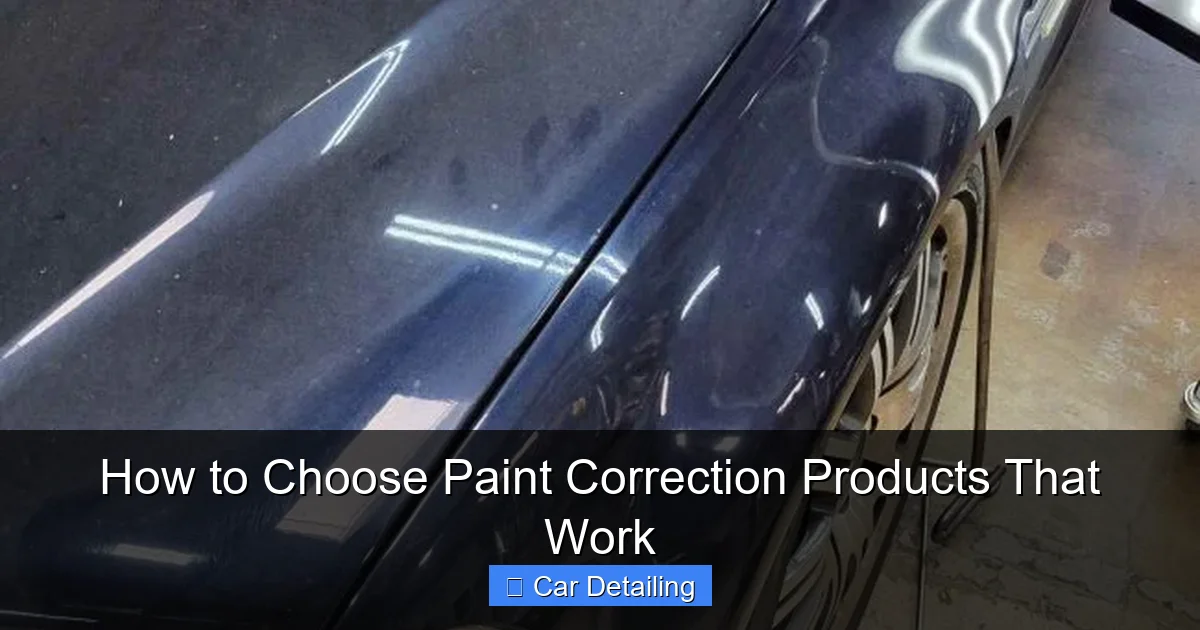
Visual guide about How to Choose Paint Correction Products That Work
Image source: dentwerkspro.com
Before buying products, it helps to know that correction usually involves three parts: the liquid product, the pad, and the machine. A compound with the wrong pad may finish poorly, while a mild polish with the right pad may solve the problem with less risk.
Compounds vs. polishes vs. finishing products
Compounds are usually the most aggressive category. They are designed to remove deeper defects faster, but they can leave micro-marring or haze if the finish is soft or the setup is too aggressive.
Polishes sit in the middle. They remove lighter defects and refine the surface, often leaving more gloss and less residue than a heavy compound.
Finishing products are the least aggressive. They are often used after correction to maximize clarity and gloss, especially on sensitive or dark paint where final appearance matters.
Product names vary by brand, so “compound” and “polish” do not always mean the same cut level from one manufacturer to another. Read the product description carefully instead of relying on the label alone.
When a one-step product is enough
A one-step product can be enough when the paint has light to moderate defects and you want a practical improvement rather than a show-car finish. These products combine cutting and finishing ability in one formula, which can save time.
They are especially useful for maintenance details, used cars with average wear, or owners who want a noticeable improvement without building a multi-stage system. If the paint is badly scratched or heavily oxidized, though, a one-step product may not be enough.
Identify Your Paint Type, Defects, and Correction Goals
The right paint correction products depend on what you are correcting and how much improvement you expect. A daily driver with swirl marks needs a different approach than a black luxury sedan with soft clear coat or a repainted panel with unknown history.
Clear coat hardness, soft paint, and sensitive finishes
Hard paint can tolerate more aggressive correction before it starts showing haze, but it may also take longer to correct. Soft paint can improve quickly, yet it can scratch or haze more easily during polishing.
Sensitive finishes, including some repainted panels and certain dark colors, often need a lighter pad and milder product first. If you are unsure how the paint behaves, a small test spot is safer than polishing the entire car with an unproven combo.
Swirls, oxidation, water spots, scratches, and haze
Swirl marks usually respond well to a medium polish or light compound. Oxidation may need stronger cut if the clear coat is heavily faded, while water spots sometimes require a more specific approach depending on whether the damage is on the surface or etched into the clear coat.
Deeper scratches are the hardest to judge. If you can feel a scratch with a fingernail, it may be too deep for safe removal by DIY correction, and trying to chase it aggressively can create more visible damage.
Not every defect should be “buffed out.” If the scratch has reached the base coat or primer, correction products will not truly fix it, and aggressive polishing can make the area thinner and more obvious.
Choose the Right Pad and Machine Combination for the Job
Many people focus on the bottle and overlook the pad and machine, but that combination often determines the real result. A mild polish on the wrong pad can underperform, while an aggressive compound on the wrong machine can leave the paint dull or uneven.
Dual-action polishers vs. rotary machines
Dual-action polishers are generally the safer starting point for most vehicle owners. They are more forgiving, easier to control, and less likely to create heat or holograms when used properly.
Rotary machines cut faster and can be effective for advanced users, but they also carry more risk. They are better suited to experienced detailers who know how to manage pressure, speed, and heat buildup.
Foam, microfiber, and wool pad differences
Foam pads are the most versatile and beginner-friendly. Softer foam pads are useful for finishing, while firmer foam pads can add more cut without jumping straight to a heavy compound.
Microfiber pads usually increase cutting power and can speed up defect removal, but they may finish less cleanly on some paints. Wool pads cut fast as well, but they are more commonly used in advanced correction because they can leave more texture to refine afterward.
| Option | Best For | Limit |
|---|---|---|
| Foam pad + polish | Light swirls and gloss enhancement | May be too mild for heavier defects |
| Microfiber pad + compound | Moderate to heavier correction | Can leave haze on softer paint |
| Wool pad + compound | Fast defect removal on harder paint | Usually needs follow-up finishing |
Compare Product Cut, Finish, and Working Time
When comparing paint correction products, look at three things together: how much they cut, how well they finish, and how long they stay workable on the panel. A product that removes defects quickly but dusts heavily or wipes off poorly may be frustrating in real use.
How to balance defect removal and gloss
More cut usually means faster defect removal, but it may also reduce clarity if the paint is soft or if the pad is too aggressive. A product that finishes well can save time because you may not need an extra refining step.
The best balance depends on the vehicle. A neglected daily driver may need stronger cut first, while a well-kept car may benefit more from a fine polish that improves gloss without overcorrecting the surface.
Why dusting, sling, and wipe-off matter in real-world use
Dusting can make cleanup harder and may force you to wipe the paint more often, which adds the risk of new micro-marring. Sling can also create a mess on trim, glass, and nearby panels if the product or pad is overloaded.
Wipe-off matters because a product that looks great during polishing but leaves stubborn residue slows the job down. In practice, easy removal often makes a product more valuable than slightly higher cut on paper.
Match Paint Correction Products to Your Skill Level and Budget
Not every product is meant for every user. A beginner usually benefits from a predictable, forgiving system, while a more experienced detailer may prefer a wider range of cut levels and specialized finishing options.
If you are building a broader detailing routine, it can help to think of correction as one part of the process, alongside washing and protection. For example, pairing correction with the right Ceramic Coating Guide — Complete Guide”>Ceramic Coating Guide Explained Simply”>ceramic coating buying guide or a careful ceramic coating maintenance guide can help preserve the finish after the work is done.
Beginner-friendly starter kits vs. pro-level systems
Starter kits are usually easier because they reduce guesswork. They often include a machine, one or two pads, and a polish that is designed to be manageable on common paint types.
Pro-level systems give you more flexibility, but they also require better judgment. Once you start mixing compounds, pads, and finishing products across different paint conditions, test spots become even more important.
- Identify the main defect before buying product
- Start with the least aggressive pad and polish
- Plan for a test spot on every new vehicle
- Choose a machine you can control confidently
- Factor in cleanup, residue, and finishing time
Cost-per-detail and product value in 2025
Value is not only about the sticker price. A product that uses less material, finishes faster, and avoids extra steps may cost less per detail than a cheaper bottle that requires repeated passes.
In 2025, product value is best judged by efficiency, consistency, and how well the system matches your vehicle and workflow. The cheapest option is not always the most economical if it adds time, frustration, or the need to redo panels.
Prices, kit contents, and pad durability vary widely by brand and region. Compare total system cost, not just the bottle size, before deciding what is actually a good value.
Common Mistakes When Choosing Paint Correction Products
Most paint correction mistakes happen before the machine even touches the car. People often buy based on hype, assume more aggression is better, or skip the small test spot that would have revealed a bad match.
Buying aggressive compounds too early
It is tempting to buy the strongest compound because it sounds like the fastest solution. The problem is that aggressive products can remove more than needed and leave the paint looking dull or hazy, especially on softer finishes.
A stronger product should be a tool of last resort, not the default choice. If a milder polish can remove the defect, it usually leaves you with more margin for error.
Ignoring test spots and paint sensitivity
A test spot is one of the simplest ways to avoid wasting time and product. It shows whether your chosen compound and pad can correct the paint without creating new problems.
Paint sensitivity can vary not only by brand, but also by panel, age, prior repairs, and even weather conditions. A method that works well on one car may behave differently on another with the same color.
Using the wrong pad/product combo
Some combinations simply do not work well together. A fine polish on an overly soft pad may not correct enough, while a heavy compound on a very aggressive pad may leave too much texture behind.
If the result looks cloudy, dusty, or uneven, the issue may be the combo rather than the product alone. Adjusting pad choice is often the fastest way to improve results without jumping to a harsher liquid.
When to Get Expert Help or Use a Professional Detailer
DIY correction is practical for many owners, but there are times when professional help is the safer choice. This is especially true when the finish is valuable, the damage is severe, or the paint history is unknown.
Severe defects, repainted panels, and luxury finishes
Deep scratches, heavy oxidation, and repainted panels can be difficult to judge safely. Luxury finishes and very soft paints also deserve extra caution because the margin for error is smaller.
A professional detailer may be able to inspect the paint more accurately, choose a better system, and reduce the risk of creating permanent haze or uneven correction.
Warning signs that DIY correction could make damage worse
If the paint already looks thin, the scratch appears deep, or the panel has been repainted recently, stop and assess before polishing. Another warning sign is when you cannot tell whether the defect is in the clear coat or below it.
When the risk of making the damage worse is higher than the value of a DIY fix, it is smarter to ask a professional. That advice is especially important for high-value vehicles, unusual finishes, or panels that may already have been corrected multiple times.
Final Recap: The Smart Way to Choose Paint Correction Products That Work
The best way to choose paint correction products is to start with the paint condition, then match the product, pad, and machine to the level of correction you actually need. In most cases, the safest path is to begin mild, test a small area, and only increase aggression if the paint truly needs it.
For most owners, that means choosing a balanced system instead of chasing the strongest compound. If you want better results with less risk, focus on compatibility, finish quality, and ease of use—not just cutting power.
Frequently Asked Questions
A beginner usually does best with a mild polish or a one-step product paired with a foam pad. This gives a safer starting point and reduces the chance of haze or overcorrection.
Use a compound when the defects are more noticeable and a polish when the paint only needs light to moderate improvement. A test spot is the easiest way to confirm which one works best.
Yes, but hand correction is usually slower and less effective than machine polishing. It can help with very light defects, but deeper swirls and scratches often need a machine.
A foam pad is usually the safest and most versatile choice. Softer foam is best for finishing, while firmer foam can add more correction without jumping straight to aggressive pads.
Dusting can happen when the product is overworked, the pad is overloaded, or the formula is simply less clean in use. Switching pads, using less product, or changing to a different polish can help.
Hire a professional if the paint is severely damaged, repainted, very soft, or on a high-value vehicle where mistakes are expensive. It is also a smart move when you cannot tell how deep the defect really is.

