
Our readers keep the lights on and my garage snacks stocked. As an Amazon Associate, I earn from qualifying purchases.
Specs are compiled from manufacturer listings and verified buyer reviews and can change over time — please confirm the key details on the product page before buying.
You grab a jug of blue liquid, pour it in, and hope it does the job — until a surprise freeze turns your squirters into icicles or baked-on bugs smear your road-trip view into a blur. The trick is matching the formula to the weather you actually drive in and the kind of grime you face.
I’m Min Islam — the founder and writer behind Trending Car. This guide is built by comparing the manufacturers’ published specifications and the patterns across verified customer reviews, so you get each pick’s real strengths and trade-offs instead of marketing spin.
Getting the best windshield washer fluid for your car depends on the freeze point, the cleaning strength, and whether the fluid leaves streaks on today’s sensitive glass and camera housings.
Quick Picks
- Clean Revolution Advanced All Season Windshield — Best Overall: Best Overall
- Clean Revolution EV Windshield Washer Fluid — Best Budget: EV Ready
- Prime Guard -35°F All Season Blast Windshield — Cold‑Weather Champ
- PEAK (PWN0H3) -20°F DE-ICER Windshield Washer — Proven Winter
- Prestone 2-in-1 All Season Year Round — Tesla Pick
- Prestone AS-657 Windshield Washer — Best Value: Budget Bug Remover
- ULTRA 1PLUS Windshield Washer Fluid — Compact Cleaner
How To Choose The Best Windshield Washer Fluid
Most people assume all washer fluid is basically the same — a blue liquid is a blue liquid. But the differences in freeze point, cleaning additives, and chemical makeup can make one jug a lifesaver and another a frozen mess in your reservoir.
Match the freeze rating to your actual winter lows
A fluid rated to 0°F is fine for mild freezes. But if you see single‑digit temps, look for a rating of -20°F or lower. The rating on the bottle is the temperature at which the fluid stays liquid — if it dips colder, the fluid turns to slush inside your lines.
Bug removal vs. ice melting — rarely both equally strong
Some formulas use enzymes and surfactants (surface‑active agents that break apart bug splatter) that work instantly but freeze at 32°F. Others use methanol (a type of alcohol) or ethanol for freeze protection but struggle with baked‑on grime. If you face both, you need a true all‑season that balances the two — or separate summer and winter jugs.
Methanol-free and low‑VOC fluids for modern cars
Many European and electric vehicle manufacturers recommend or require methanol‑free washer fluid to protect plastic tanks, paint, and sensor housings. Low‑VOC (volatile organic compound, a chemical that evaporates into the air) formulations also meet strict air quality rules in states like California and Texas without sacrificing freeze protection.
Quick Comparison
| Model | Best For | Freeze Rating | Volume | Formula Type | Amazon |
|---|---|---|---|---|---|
| Clean Revolution Advanced All Season | Extreme winter + summer dual‑use | -27°F | 128 oz | Low‑VOC, methanol‑free | Amazon |
| Clean Revolution EV Windshield Washer Fluid | Electric / performance cars | -15°F | 128 oz | Methanol‑free, plant‑based ethanol | Amazon |
| PEAK (PWN0H3) -20°F DE‑ICER | Reliable cold‑weather, budget‑conscious | -20°F | 1 gal | Ready‑to‑use conventional | Amazon |
| Prime Guard -35°F All Season Blast | Deep‑freeze climates, all‑season | -35°F | 1 gal | De‑icer, ready‑to‑use | Amazon |
| Prestone 2‑in‑1 All Season 0° | Tesla owners, moderate winter | 0°F | 1 gal | Conventional orange | Amazon |
| Prestone AS‑657 | Summer bug removal, mild climates | 32°F | 1 gal | Liquid | Amazon |
| ULTRA 1PLUS Advanced Formula | Warm‑weather daily driving | 32°F | 1 US qt | Ready‑to‑use, bug remover | Amazon |
In‑Depth Reviews
1. Clean Revolution Advanced All Season Windshield Washer Fluid Ultra Low VOC Formula
Our pick — rated 4.6★ across 942 verified ratings; the strongest balance of quality and price in this list.

This gallon handles -27°F frost and summer bugs without staining your sensors — one fluid for the whole year.
You get a -27°F freeze rating (the fluid stays liquid down to that low temperature, so your nozzles won’t ice up in a deep freeze) combined with a bug‑and‑grime dissolving formula. The maker says it exceeds California Type A and Texas clean air standards by dropping VOC levels by 40% compared to traditional fluids — so you are not breathing harsh fumes while you fill the reservoir. At 8.38 pounds with dimensions of 11.97 x 6.02 x 5.91 inches, the jug is slightly larger than the PEAK -20°F option (8.24 pounds), but the extra weight comes from a denser, more concentrated cleaning agent.
Buyers report it works well on Tesla Model X and Y vehicles with no fog or residue left behind — a common complaint with cheaper fluids. The water‑beading tech (a chemical treatment that makes water form beads and roll off) helps rain roll off between wipes, keeping your view clear at highway speed. The trade-off is the price sits at the premium end of this list, so it is best for someone who wants one fluid to cover scorching summers and polar winters without juggling two bottles. If your winter lows never dip below 20°F, a simpler mid‑range fluid will save you money.
What you gain
- Lab‑tested ice and frost protection to -27°F
- Low‑VOC formula exceeds strict state air standards
- Advanced water‑beading tech for rain visibility
The trade-off
- Premium price compared to conventional gallon jugs
- Scent is mild but not entirely odorless
Pick this if: you need a single fluid that handles deep winter freezes and summer bug splatter without leaving streaks on modern windshield glass.
Look elsewhere if: your winter lows never dip below 20°F — a simpler mid‑range fluid will save you money.
2. Clean Revolution EV Windshield Washer Fluid, 128oz, 100% Methanol-Free
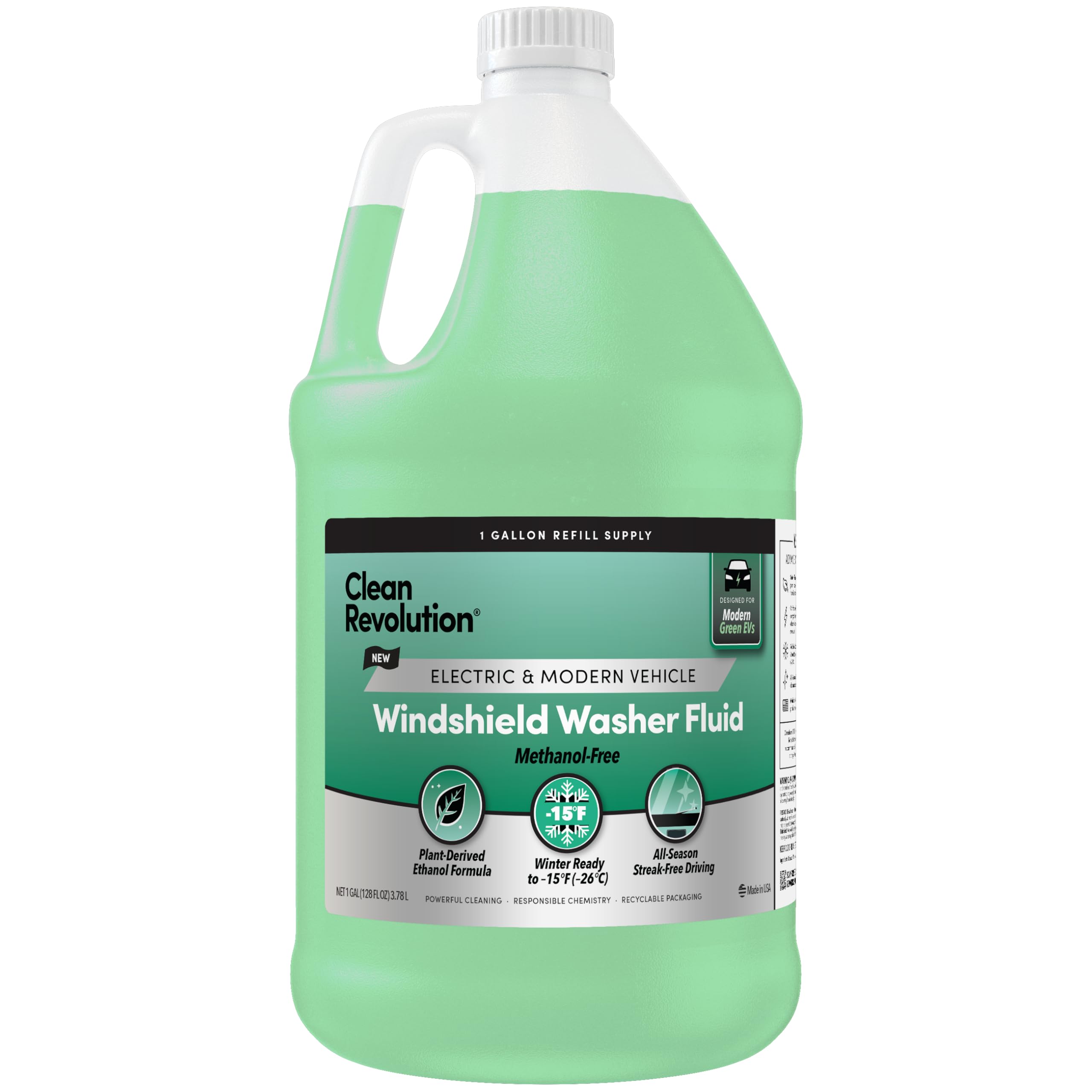
Reach for this jug if your Tesla or BMW owner’s manual says “methanol‑free only” — it keeps your sensors clear and your windshield frost‑free to -15°F.
This formula uses a plant‑derived ethanol (a type of alcohol from plants) base instead of petroleum or methanol, which is what many European and electric car manuals recommend — including Tesla vehicles that specify ethanol‑based fluid. It stays liquid down to -15°F (-26°C), which covers all but the deepest northern freezes. The 128‑ounce bottle weighs 8.11 pounds and measures 11.81 x 6.14 x 6.02 inches, making it slightly lighter than the standard Clean Revolution Advanced fluid (8.38 pounds) because of the different alcohol base.
Owners mention it leaves no fog or residue on their Model X and Model Y windshields. That matters because many conventional fluids smear across the glass and confuse the Full Self‑Driving cameras — the cameras inside the car that help with lane keeping and traffic-aware cruise control. The biodegradable formula also cleans road salt and grime without silicone, which is important for plastic reservoir tanks. However, the -15°F rating is less extreme than the -27°F Clean Revolution Advanced or the -35°F Prime Guard. If your area regularly hits -20°F, the Prime Guard or Clean Revolution Advanced might suit you better.
Why it stands out
- 100% methanol‑free, safe for EV and European car systems
- Plant‑derived ethanol, biodegradable formula
- Streak‑free on sensitive glass and camera housings
Keep in mind
- -15°F rating is less extreme than -27°F or -35°F fluids
- Premium price reflects the specialty formula
Reach for this if: you drive a Tesla, BMW, or any EV whose handbook requires methanol‑free fluid and you want a cleaner that won’t gunk up your sensor housings.
skip it if: your area sees sub‑20°F winters regularly — you need a deeper freeze rating.
3. Prime Guard -35°F All Season Blast Windshield Washer Fluid
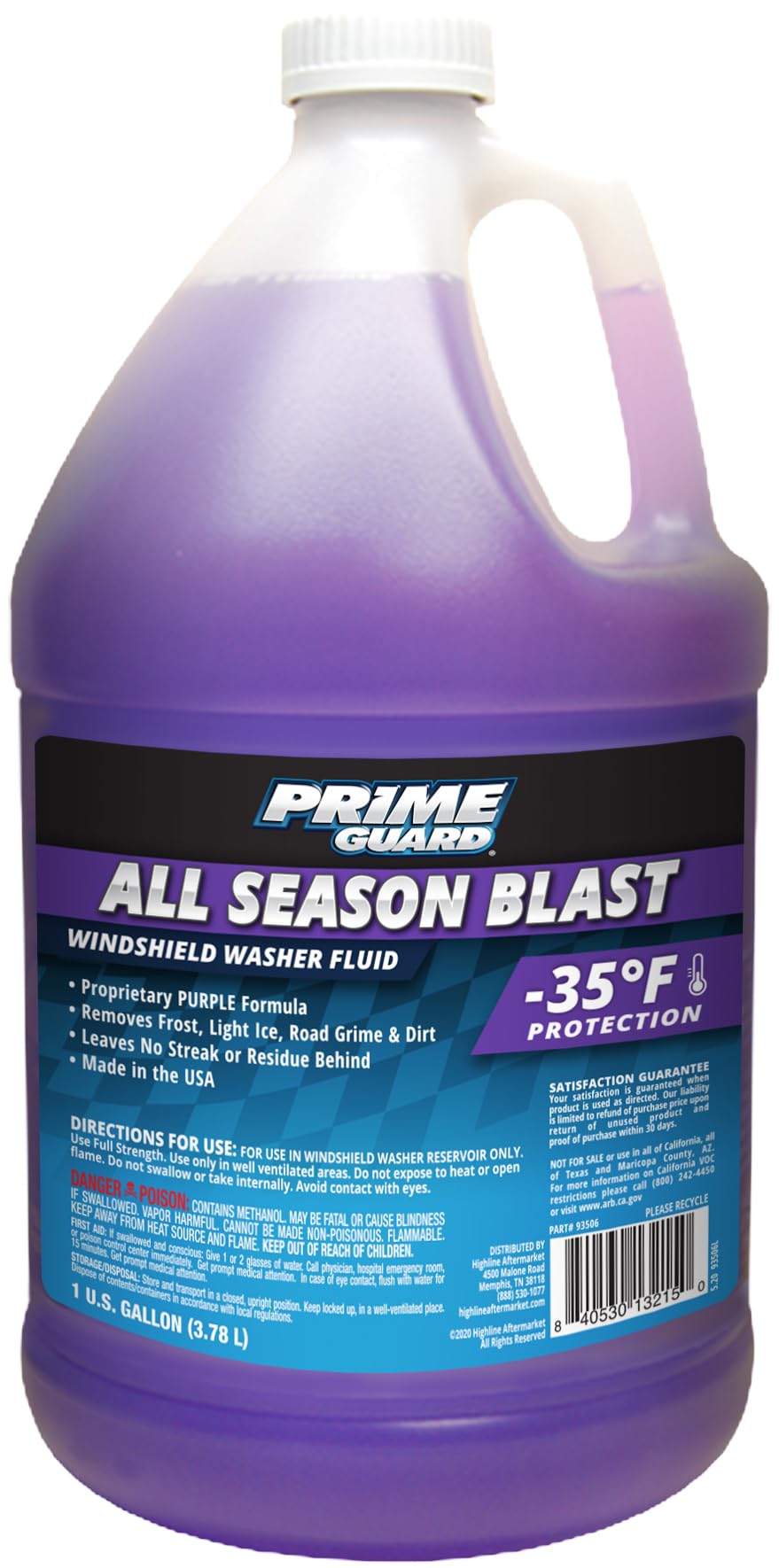
The only jug on this list rated to -35°F — it stays liquid where the Clean Revolution Advanced (-27°F) and PEAK (-20°F) freeze solid.
If your morning commute involves scraping ice at sub‑zero temperatures, Prime Guard’s Blast formula is the safety net you need. The -35°F protection rating is the lowest freeze point in this roundup, beating the Clean Revolution Advanced at -27°F by a full 8 degrees. One reviewer noted that in a pinch they were able to unfreeze their Challenger door with it, which tells you the de‑icing agents (chemicals that melt ice) are potent enough to handle more than just windshield frost. The 1‑gallon jug weighs 8.27 pounds and measures 11.97 x 6.18 x 6.1 inches, nearly identical in footprint to the Clean Revolution Advanced fluid but with a colder tolerance.
It also works as an all‑season cleaner, handling bugs and road grime during warmer months. Multiple owners in cold states say it sprays well and clears glass without a streaky film. However, the same strong de‑icing chemistry might not be ideal for warm‑weather drivers who only need bug removal — you are paying for a capability you will not use. It is also a relatively new product (first available in November 2024), so long‑term consistency data is thinner than the decades‑old brands like Prestone and PEAK.
The deep‑freeze ace: At -35°F, this fluid works where most competitors freeze solid — a true Arctic‑tier choice.
Grab this if: your winter temperatures regularly drop below -20°F and you want a fluid that also cuts ice from your door seals.
Pass if: you mainly deal with moderate cold and heavy bug loads — a lower freeze rating will clean bugs better.
4. PEAK (PWN0H3) -20°F DE-ICER Windshield Washer Fluid – 1 Gallon

The most‑reviewed winter fluid on the shelf — 942 buyers back up its -20°F promise, and one driver says it did not freeze at 65 mph like other brands did.
PEAK’s -20°F DE-ICER jug earns a 4.6 rating from nearly a thousand reviews, many from real winter drivers in New York, NorCal, and the Mountain West. One buyer specifically noted that it did not freeze or stick to their windshield at 65 mph like some other brands did — that is the exact failure mode that makes inferior fluids dangerous. The 8.24-pound gallon measures 11.89 x 6.1 x 6.06 inches, making it a hair lighter than the Clean Revolution Advanced (8.38 pounds) but with the same general jug footprint.
It is a ready‑to‑use formula — pour it straight in without mixing — and it keeps your windshield clean while protecting down to -20°F. That is enough for most of the lower 48 except the deepest cold pockets. Compared to the Prime Guard (-35°F) or Clean Revolution Advanced (-27°F), the freeze rating is the clear trade-off: -20°F is solid but not extreme. If you see -30°F mornings, step up to the Prime Guard. But for a proven, affordable winter fluid with a vast review history, this is the reliable bet.
What 942 customers note
- Does not freeze or stick at highway speeds in winter
- Ready‑to‑use, no dilution required
- Proven brand with years of consistent quality
Where it falls short
- -20°F rating is not enough for extreme sub‑zero climates
- Bug removal in summer is decent but not a standout feature
Best for: daily drivers in cold but not Arctic conditions who want a fluid with thousands of miles of customer proof behind it.
Not for: northern tier residents who see -30°F weeks — grab the Prime Guard or Clean Revolution Advanced instead.
5. Prestone 2-in-1 All Season Year Round Windshield Washer Fluid 0 Degree

The orange‑colored all‑season that Tesla owners say leaves no streaks on their windshields or Full Self‑Driving cameras — unlike many other fluids.
The standout story on this Prestone fluid is the chorus of Tesla owners who say it is the only fluid that does not leave streaks across their windshield or interfere with Full Self‑Driving cameras. One buyer who tried several other fluids before landing on this one said, “I looked up which fluid won’t do this and the Prestone was the top result” — and after using it for weeks, they confirmed it cleans well without the smearing. The 0°F freeze rating is the warmest in this list, so it is strictly a moderate‑winter or all‑season fluid, not a deep‑freeze choice.
At 3.72 kilograms per gallon (about 8.2 pounds), the weight is in the same ballpark as the PEAK and Clean Revolution jugs. The 2‑in‑1 formula handles general grime, bird droppings, and new bug splatters competently, and reviewers point out the water beading is excellent. A buyer even said it “did an unexpectedly decent job melting frost and very light ice accumulations” using a rear wiper. The catch is the 0°F limit — if your area regularly dips into the teens, you will need a colder fluid, or at least mix this with a winter booster. It is best for Tesla owners or anyone with a sensor‑heavy car in a moderate climate who needs streak‑free clarity above all else.
Strengths
- Leaves no streaks on modern glass or Tesla camera housings
- Excellent water beading and frost melting for light ice
- Popular pick among EV and European car owners
Limits
- 0°F rating is too warm for hard winter climates
- Baked‑on bug residue requires patience and multiple sprays
Ideal if: you drive a Tesla or similarly sensor‑heavy car and need a clean, streak‑free formula for moderate winters and year‑round use.
Skip if: your temps hit single digits or lower — go for a -20°F or -35°F fluid.
6. Prestone AS-657 Windshield Washer, 1 gal, Clean Green
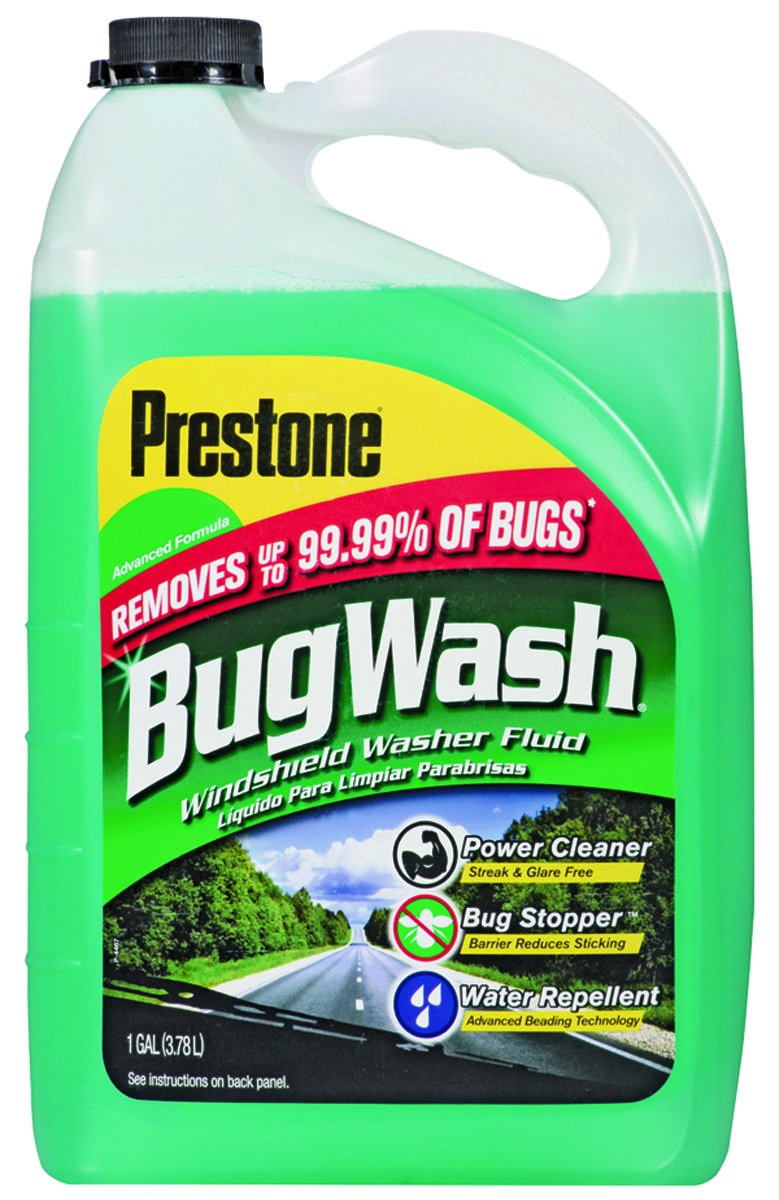
The summer‑only specialist that cuts through bug splatter faster than standard blue fluid — but freezes at 32°F, so keep it out of winter.
This Prestone green fluid is built for bugs, not winter. Shoppers say it removes insect splatter on road trips faster than standard blue washer fluid, and one buyer called it “excellent bug removal on road trips.” The flip side is that it has zero freeze protection: one buyer mentioned that the first 31‑degree day caused it to freeze up and stop dispensing. So this is strictly a warm‑season or garage‑stored car fluid.
At 1 gallon in a standard bottle, it is a simple, no‑frills choice for drivers who only need clean glass and are happy to switch to a winter fluid when the season turns. The formula has a pleasant smell, according to buyers, though a few note the price is slightly higher than generic blue fluids. Compared to the Clean Revolution Advanced, this Prestone jug has no water‑beading tech and a much warmer freeze point — it is a narrow‑purpose product that does its one job very well. If you want the best bug removal per dollar for warm months, this is a solid bet.
It excels at
- Dissolving bug splatters on summer road trips
- Leaving a clean, streak‑free windshield
- Being ready‑to‑use with no mixing
It struggles with
- Freezes at around 32°F — not for winter use
- No freeze protection means extra jug swaps
Use this if: you drive mostly in warm weather and want a dedicated bug‑slicing fluid that outperforms generic store brands.
Avoid if: you see any freezing temperatures — keep a winter fluid on standby.
7. ULTRA 1PLUS Windshield Washer Fluid – Advanced Formula

A concentrated quart (32 oz) that fits in a glove box — about 31% smaller volume than a gallon jug, with rain‑beading tech for your emergency kit.
Most washer fluids come in bulky gallon jugs, but this ULTRA 1PLUS formula is a 1‑quart bottle (32 oz) that fits neatly in a small trunk or glove box. At package dimensions of 9.17 x 4.17 x 2.24 inches, it is dramatically smaller than the Clean Revolution Advanced jug (11.97 x 6.02 x 5.91 inches). It is designed for warm weather use above 32°F, with a water‑beading action (a chemical coating that makes water form beads and roll off) that drives rain off the glass for better visibility during wet drives.
Buyers report it cuts through grime, bugs, and film without leaving streaks or residue, and one owner reported it cleans fast at highway speeds with no smearing. The advanced formula also claims to remove bird droppings and tough residues. However, this is the smallest volume on the list at a per‑ounce price that is higher than the gallon jugs. You are paying for portability and a targeted warm‑weather cleaner rather than bulk value. If you have a large reservoir or drive heavily, you will need to buy multiple bottles — making it more of a road‑trip emergency bottle than a daily‑use mainstay.
What you get
- Compact quart size fits small spaces
- Rain‑beading tech improves visibility in wet weather
- No streaks, no residue — cleaner than many generics
What you compromise
- Only 1 quart — higher per‑ounce cost than gallons
- Not rated for freezing temperatures
Buy this if: you need a small, emergency‑sized bottle for a road trip or secondary car and want real cleaning punch, not just blue water.
Skip if: you want the best value per ounce — the gallon jugs give you way more fluid for the same or less money.
Understanding the Specs
Freeze Rating
The number on the bottle (like -20°F or -35°F) is the temperature at which the fluid stays liquid instead of turning to slush or ice in your lines. If you live where it hits 0°F, you need a fluid rated to at least -20°F to give you a safety margin. A fluid rated 32°F will freeze on the first mild frost — that is a summer‑only jug.
Methanol‑Free / Low‑VOC
Methanol is a common anti‑freeze agent in washer fluid, but it can damage plastic tanks, paint, and sensor housings on modern cars — especially EVs and European models. Methanol‑free formulas use ethanol (a different type of alcohol) or other alcohols instead. Low‑VOC means fewer harsh fumes evaporating from the fluid, which matters in states with strict air quality rules like California and Texas.
FAQ
Can I mix two different brands of washer fluid?
How often should I refill my windshield washer fluid?
Is expensive washer fluid worth the extra money?
Does washer fluid expire or go bad?
Can I use water instead of washer fluid?
What happens if washer fluid freezes in my car?
Is there a difference between summer and winter washer fluid?
Does windshield washer fluid damage car paint?
Can I use washer fluid in my headlight washer system?
What is the advantage of low‑VOC washer fluid?
Final Thoughts: The Verdict
For most drivers, the best windshield washer fluid is the Clean Revolution Advanced All Season because it covers the widest temperature range — a -27°F freeze rating — with a low‑VOC, methanol‑free formula that works on modern sensor‑laden cars. If you drive a Tesla or a European car that strictly demands methanol‑free fluid, grab the Clean Revolution EV formula. And for the deepest freezes where -35°F protection is non‑negotiable, the standout is the Prime Guard -35°F All Season Blast.
How We Picked
We do not accept paid placement. Every pick is matched to a real buyer and a real use-case; we do not hands-on test units.
Sources & Methodology
Specifications: manufacturer listings and product documentation. Review insights: verified customer reviews, as of July 2026. Pricing: not shown on this page (it changes often); check the current price via the retailer link.
As an Amazon Associate, Trending Car earns from qualifying purchases. This does not affect which products we feature.