
Our readers keep the lights on and my garage snacks stocked. As an Amazon Associate, I earn from qualifying purchases.
Specs are compiled from manufacturer listings and verified buyer reviews and can change over time — please confirm the key details on the product page before buying.
A good pair of waterproof motorcycle boots needs to do two things well: keep the rain and road spray out so your feet stay dry on long rides, and give you enough grip and protection so you can plant your foot at a stop or take a short hike into town without slipping. The challenge is that “waterproof” can mean anything from a light DWR coating to a full internal membrane, and the level of armor ranges from a thin foam pad to CE-certified impact protectors. This guide breaks down nine pairs that actually deliver on the waterproof promise, sorted by what you give up (weight, stiffness, walkability) to get it.
I’m Min Islam — the founder and writer behind Trending Car. This guide is built by comparing the manufacturers’ published specifications and the patterns across verified customer reviews, so you get each pick’s real strengths and trade-offs instead of marketing spin.
if you need a boot for a cross-country tour, a muddy trail, or the daily commute, this breakdown of the best waterproof motorcycle boots covers nine different ways to keep your feet dry, safe, and comfortable without wasting your money on a boot that looks right but falls apart in the wet.
Our Picks at a Glance

How To Choose The Best Waterproof Motorcycle Boots
The most important thing to know is that not all waterproof motorcycle boots are waterproof in the same way. Some rely on a heavy layer of waxed leather that eventually soaks through, while others use a sealed internal membrane (like Gore-Tex or an Aqua-Barrier) that stops water from getting in while still letting sweat vapor out. The right choice depends entirely on whether you ride in the rain for hours or just need a boot that can handle a sudden shower on your way to work.
Waterproof Membrane vs Water-Resistant Leather
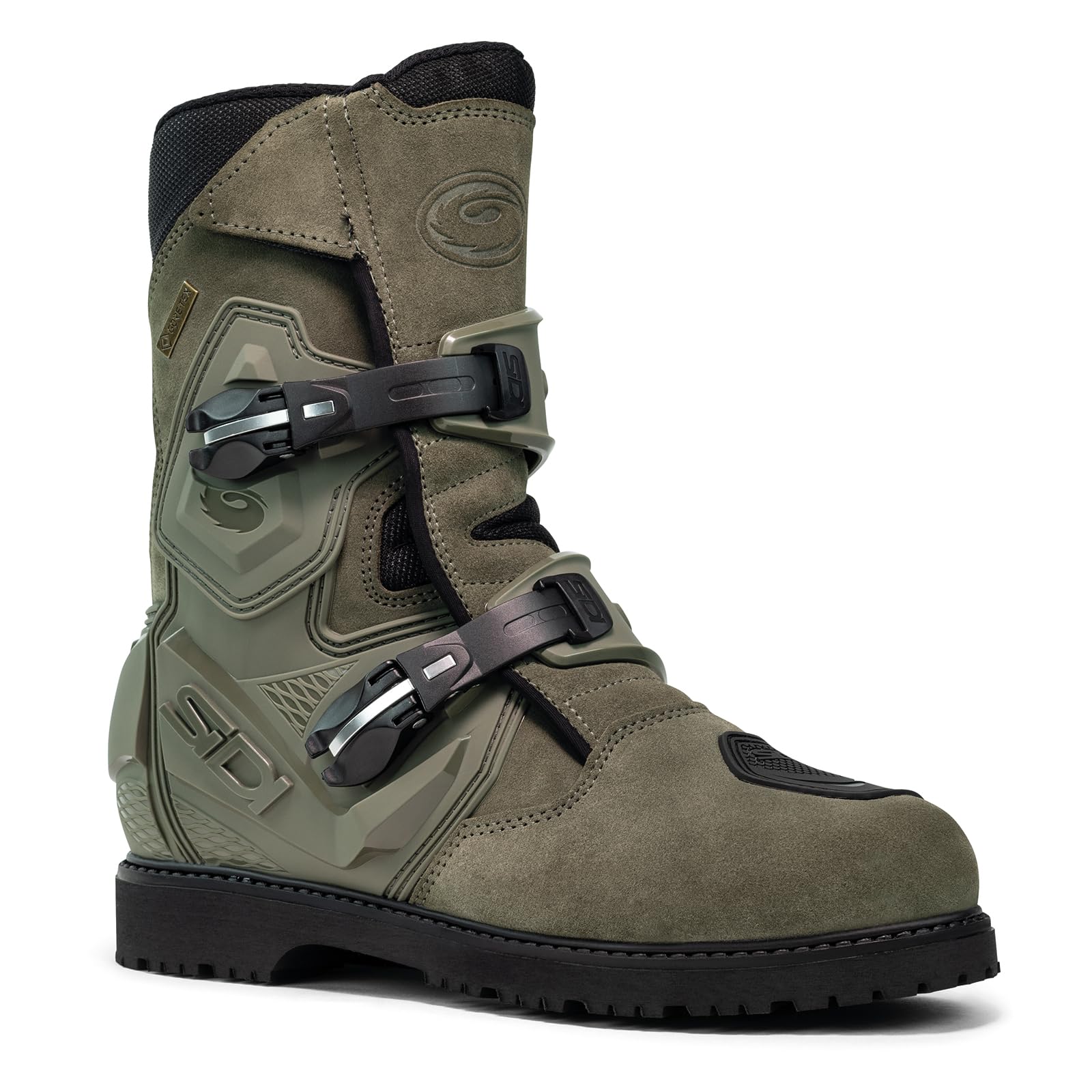
The single biggest mistake beginners make is thinking “leather is waterproof.” Untreated leather is porous — it absorbs water and stays wet for days. A real waterproof boot uses an internal membrane (a thin, sealed layer between the outer material and your foot) that blocks liquid water. The Alpinestars Radon Drystar and the Sidi Mid Adventure 2 Gore, for example, use proprietary Drystar fabric or Gore-Tex specifically because a membrane is the only reliable way to stay dry through a sustained downpour. If the product description doesn’t explicitly say “waterproof membrane” or name the technology (Gore-Tex, Drystar, Aqua-Barrier), it is almost certainly just water-resistant leather, which will fail in heavy or prolonged rain.
CE Certification: What the Rating Actually Means
CE certification is a safety standard that tests boots for impact protection, abrasion resistance, and transverse rigidity (how much the boot resists twisting in a crash). The most common standard in motorcycle boots is EN 13634:2017. A CE-certified boot — like the Noru Hakken Adventure, which carries this certification — has been physically tested in a lab to meet minimum thresholds for protecting your foot, ankle, and shin in a slide or impact. Boots without CE certification (some casual-style options like the Milwaukee Leather MBM9113) can still offer decent protection through thick leather and padding, but you are trusting the brand’s own design rather than an independent test. For highway speeds or serious off-road riding, CE certification is worth the extra money.
Boot Height and Sole Stiffness
Taller boots (around 10 to 12 inches) protect more of your lower shin and calf, which matters if you ride off-road or in heavy traffic where you might drop the bike on your leg. Shorter boots (around 6 to 8 inches) are more comfortable to walk in and fit under regular pants, making them better for commuting or urban riding. Sole stiffness is another trade-off: a stiff sole with a steel or reinforced shank gives you a stable platform on foot pegs and protects your foot from sharp impacts, but it makes walking feel clunky. Softer soles are easier to walk in but provide less support when standing on pegs for hours. The MSR Adventure Boots, for example, are praised by reviewers for being “flexible” and “comfortable to walk in” while still offering protection, which is the balance most adventure riders want.
Quick Comparison
| Model | Best For | Weight | Closure | Protection Standard | Amazon |
|---|---|---|---|---|---|
| O’Neal Sierra PRO WP★ Best Overall | Versatile Adventure/Touring | — | 3 Metal Buckles | TPU Shin & Heel Cup | Amazon |
| Sidi Mid Adventure 2 GorePremium ADV | All-Day Touring & Wet Weather | 5.6 lbs | Micro-Adjustable Buckles | PU Shin Plate + Gore-Tex | Amazon |
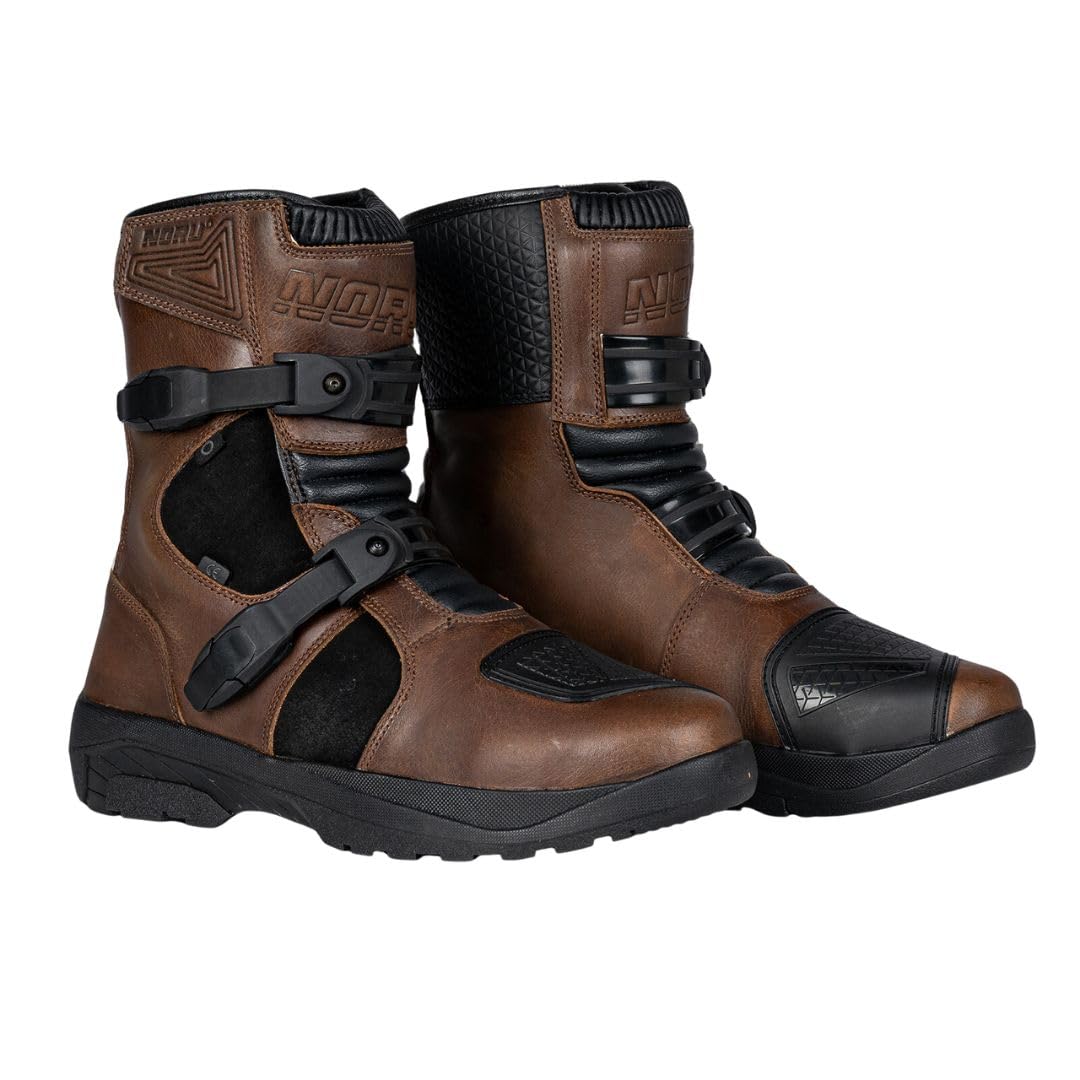
| Noru Hakken AdventureBest Value ADV | Budget-Friendly ADV | 2.3 lbs | Dual MX Buckles + Hook-and-Loop | CE Certified (EN 13634:2017) | Amazon |
| Alpinestars Radon Drystar | All-Weather Touring | — | Velcro | CE-Certified (Drystar) | Amazon |
| Alpinestars Andes V2 Drystar | Long-Distance Comfort | — | Buckles | CE-Certified (Drystar) | Amazon |
| MSR Adventure Boots | European-Made ADV | — | Buckles | European-Made Quality | Amazon |
| ILM MX3 | Dirt/ATV on a Budget | 3.1 kg (~6.8 lbs) | 4 Buckles | TPU Shin Plate | Amazon |
| Harley-Davidson Hustin | Classic Cruiser Style | 5 lbs | Lace-Up + Side Zipper | Oil-Resistant Sole | Amazon |
| Milwaukee Leather MBM9113 | Casual Street Riding | 8 lbs | Lace-Up + Zipper | Ankle Padding | Amazon |
In‑Depth Reviews
1. O’Neal Sierra PRO WP Boot
Our pick — over 4.5★ from 850+ verified ratings; the strongest balance of quality and price.
A tough touring boot that disappears once you start walking, built for flat, wide feet.
This is the boot that hits the balance between protection and everyday comfort. The upper is made from a mix of full-grain leather and suede microfiber, giving you the abrasion resistance of thick leather without the 20-mile break-in period most stiff boots demand. Inside, a waterproof membrane keeps rain and creek water out, while the high-grip rubber sole with its anti-slip pattern gives you confidence on wet pavement or loose gravel when you stop for gas. Three metal quick-action buckles make getting in and out fast, and a nylon inner sole with a steel shank provides the stiffness you need to stand on foot pegs for hours without feeling every bump through the sole.
Buyers report that “I have nothing but great things to say about these boots,” with one reviewer noting that after six months of daily riding the glued seams still look and feel as they did day one. The same reviewer pointed out that the only thing missing is more hard ankle protection, but accepted that trade-off given the mobility the boot offers. Another rider with flat, wide feet said they fit comfortably right from the start — a rarity in this category where most boots feel narrow. The boot runs true to size, and if you wear a 13 with normal boot socks, the 13 fits perfectly with room to spare.
Compared to the Alpinestars Tech 3s, the O’Neal Sierra PRO WP is less stiff and more walkable, making it a stronger choice for riders who split their time between highway miles and dirt roads. The boots are comically squeaky for the first few days, according to one owner, but that fades within the first week of wear. You get extreme material quality that shows little wear even after months of use, and the leather develops a nice patina instead of looking ragged.
Why It Earns the Top Spot
- Full-grain leather and suede microfiber upper provides excellent abrasion resistance
- Waterproof membrane stops water without trapping sweat
- Steel shank in the sole gives you a stable platform on pegs
- Buckles are sturdy and easy to latch even with gloves on
Trade-Offs Worth Knowing
- Lacks hard external ankle armor — protection is from thick leather and TPU alone
- Initial squeaking can be annoying for the first week
- Not CE-certified, so the protection level is unverified by an independent lab
Best for versatile riders: If you need one boot that handles light off-road, highway touring, and walking into a diner without looking like a motocross racer, the O’Neal Sierra PRO WP is the balanced pick.
Not for aggressive off-road: If you regularly go hard on rocky single-track trails, the lack of CE-rated ankle and shin armor means you should look at a stiffer, more armored adventure boot.
2. Sidi Mid Adventure 2 Gore Touring Motorcycle Boots
Italian-crafted Gore-Tex boots that kept one rider’s feet dry through a 1,000-mile trip.
The Sidi Mid Adventure 2 Gore is the kind of boot you buy when “waterproof” is non-negotiable and comfort over a full tank of gas matters more than style points. It uses a special Gore-Tex fabric that extends all the way to the top of the boot — not just a half-height lining — so even deep puddles and sustained highway spray don’t soak through. The outer shell is made from tough engineered microfiber that Sidi claims is built to last decades, and the mid-height cut means it offers more ankle and shin coverage than low-rise boots while still being easier to walk in than full-height racing boots. The enduro-style lugged sole is designed for grip on loose dirt and rocks, and the micro-adjustable buckle system lets you dial in the fit exactly so the boot doesn’t shift around when you are shifting gears.
One reviewer who rode 1,000 miles over two and a half days (10 to 12 hours per day) said their feet were still comfortable at the end and stayed perfectly dry after a heavy downpour and 15 minutes of road spray. The only learning curve is figuring out how to adjust the buckles the first time — once they’re set, you never need to touch them again. The boot weighs 5.6 pounds, making it noticeably more substantial than featherweight options like the Noru Hakken (2.3 pounds), but that extra weight comes from real protective structure: a rigid, shock-resistant heel cup and a sturdy PU shin plate for hyperextension protection during off-road riding.
This boot is a clear step up from the O’Neal Sierra PRO WP in terms of certified protection and waterproof integrity. The Gore-Tex membrane is the gold standard for a reason — it absolutely keeps water out while still breathing well enough that your feet don’t get clammy on a warm day. The catch is the price and the fact that the buckles require a few minutes of study to adjust correctly for the first time.
Peak waterproof and protection: The Gore-Tex membrane extending to the top of the boot gives you total confidence in sustained rain. The micro-adjustable buckles and CE-certified shin/ankle/heel protection make this the boot you want for multi-day trips in unpredictable weather. The catch is the high investment and the brief learning curve on the buckle system.
Pick this for long-distance wet-weather touring: If you ride through rain, puddles, and creek crossings regularly, the Sidi Mid Adventure 2 Gore is the most reliable dry-foot solution in this list.
skip it if you ride casually: The price and the initial buckle-tweaking hassle are not worth it if you only ride on dry weekend afternoons.
3. Noru Hakken Adventure Waterproof Motorcycle Boots
A featherlight certified ADV boot that costs a fraction of the premium competition.
At 2.3 pounds total, the Noru Hakken Adventure weighs 2.3 pounds versus the Milwaukee Leather MBM9113 at 8 pounds, making it the lightest boot in this lineup by a wide margin. That low weight comes from a synthetic leather and microfiber construction with a top-grain leather layer for abrasion resistance, rather than a heavy full-grain leather shell. The boot uses an Aqua-Barrier inner membrane — a waterproof, breathable layer that keeps water out while letting sweat vapor escape — and a gaiter-style top opening that seals against dust and debris when you hit a dusty trail. It carries CE certification to EN 13634:2017 for impact, abrasion, and transverse rigidity, which is rare at this weight class and price point.
Owners mention the boots are comfortable right from the start with no break-in period, and fit true to size even for larger feet (size 14 fits perfectly). One reviewer who purchased two pairs noted the boots are “noticeably wider inside than my old TCX,” making them a good option for riders with wider feet. Another rider who had previously worn Converse high-tops (not a recommendation, just a data point) said these boots are “fabulous value for the price point.” The dual MX-style buckles plus a hook-and-loop top strap provide a secure fit that accommodates a wide range of calf sizes. The trade-off, as several owners point out, is the Velcro top strap — one reviewer noted it may not hold up as long as the rest of the boot, and it is the weakest point of an otherwise solid design.
At 2.3 pounds versus the Sidi Mid Adventure 2 Gore at 5.6 pounds, which makes a huge difference when you are walking around a gas station or hiking a short trail. You give up some of the premium-feel buckles and the absolute long-term durability of a Sidi, but for a boot under the mid-range threshold, the CE certification alone makes this a standout value.
The Value Case
- CE certified to EN 13634:2017 at a budget-friendly price
- Weighs 2.3 pounds — Milwaukee Leather is 8 lbs
- Comfortable from the start with no break-in needed
- Wider toe box suits riders with wide feet
The Weak Points
- Velcro top strap is the least durable part of the boot
- Some internal stitching may rub until the boot is fully broken in
- Not a hard-core off-road boot — better suited for street and light trail
Best budget-friendly certified option: If you want a legitimately CE-certified waterproof adventure boot that won’t weigh you down on a long hike, the Noru Hakken is the clear winner at this price tier.
Look elsewhere for durability: If you plan to ride hard off-road every weekend, the Velcro and lighter construction may not hold up as well as a full-leather boot.
4. Alpinestars Radon Drystar Motorcycle Boots
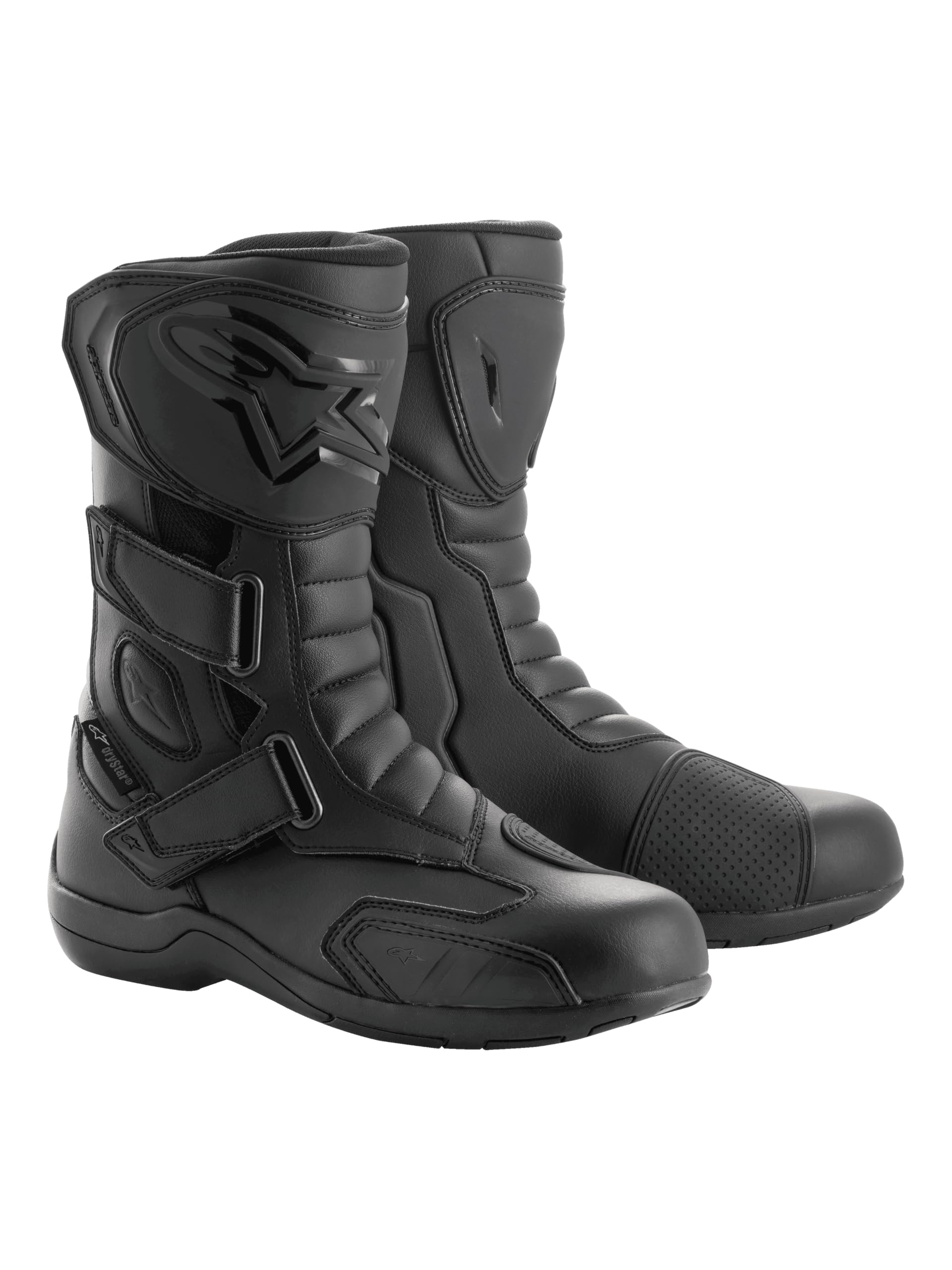
Alpinestars’ no-nonsense all-weather boot that hides real protection under a plain black exterior.
The Alpinestars Radon Drystar is the boot that proves you don’t need flashy logos to get serious protection. It is built with Alpinestars’ proprietary Drystar membrane — a waterproof and breathable barrier that stops rain and road spray cold while letting out the sweat from a hot summer ride. The upper is leather, which gives it the abrasion resistance you want in a slide, and it carries a CE certification for ankle, metatarsus, and shin protection. The closure is a simple Velcro system with a shin strap, meaning there are no buckles to bend or break. Reflective panels are built into the back of the boot so other drivers see your feet at night.
One reviewer who transitioned from the Alpinestars Tech 5s (a full MX boot) to the Radon Drystar said the Radon felt like the perfect medium — more protection than a casual zip-up boot but far more walkable than a rigid motocross boot. They noted the boot is “all black, just black. No frills, no cool lettering or flashy colors.” Another owner pointed out the shaft height is roughly 10 to 10.5 inches — taller than they expected — which means you need to make sure your pants fit over it. The boots are stiff when new, but customers note they become manageable after wearing them around the house for an afternoon. One reviewer accidentally wore them all day at work after forgetting their shoes and said it was “doable” but not recommended — proof of the toughness of the boot.
The trade-off is that the Velcro closure is not as secure or long-lasting as a buckle system. Multiple buckle-equipped boots in this list (like the O’Neal Sierra PRO WP or the Sidi Mid Adventure 2) will hold up better to repeated cycling and hard use. The Radon also runs very warm, according to one buyer, which is great in cold weather but can be stuffy in the summer. If you need a CE-certified boot for cold, wet commutes and don’t care about style, this is a solid, purpose-built choice.
Warm, waterproof, and protective: The Drystar membrane and CE-certified armor make this a dependable all-weather boot. The humble appearance and Velcro closure are the main trade-offs for the lower price compared to premium touring boots like the Sidi.
Best for cold-weather commuters: If you ride year-round in a wet climate and value warmth and proven protection over style, the Alpinestars Radon Drystar will keep you dry and safe.
Not for hot weather or style-conscious riders: The boot runs very warm in the summer, and the plain black Velcro design won’t win any fashion awards.
5. MSR Adventure Boots

European-made adventure boots that provide flexible, tactile feel on the controls without sacrificing waterproofing.
The MSR Adventure Boots are built in Europe and designed for the rider who wants to feel the bike’s controls through the sole without giving up waterproof protection. The boot is made from high-quality materials (the exact specs are lean in the product data, but the reviews speak volumes) and features a waterproof construction that held up through six creek crossings and dozens of mud puddles on a six-hour ride, as one buyer mentioned. The sole is flexible enough that you can feel the shift lever and brake pedal, but it is still stiff enough to provide foot support on the pegs. The boot is not too tall, with a toe that is not excessively long, so shifting on a Yamaha Tenere 700 was easy without having to lift your foot unnaturally high.
One reviewer who has ridden 5,000 miles in these boots — mostly hard off-road enduro riding — said they are very comfortable enough to walk over a mile in and have kept their feet completely dry. They noted the boots require a break-in period: they wore them in the shop while working on the bike for a full day, and that was enough. Another rider who normally wears a size 10 used the sizing chart (which recommended a size 9) and found the fit perfect with just enough room for a thicker winter sock.
The catch is that one reviewer found the boot’s shin plate dug painfully into the lower shin when flexing forward to shift, making the boots unwearable for them. This appears to be an individual fit issue — most owners love the comfort — but it is a real risk if you have a particular leg anatomy. The boot is also described as “a tad soft if you run into something sharp,” so it is better suited for adventure riding than for hard-core enduro racing.
Why Riders Love Them
- Flexible sole provides excellent tactile feedback on controls
- Waterproof membrane kept feet dry through six creek crossings in one ride
- European-made with high-quality manufacturing and materials
- Good adjustability for riders with larger calves
The Fit Risk
- Shin plate may dig into the lower shin for some riders — try before you buy or have a generous return policy
- Sole is flexible, which means less protection against sharp impacts
- Needs a deliberate break-in period (plan a day in the garage)
Best for riders who want feel and flexibility: If you love standing on the pegs and need to feel the bike’s feedback through the sole, the MSR Adventure Boots deliver that without sacrificing waterproofing.
Skip if you have long shins or a history of shin pain: The shin plate design may cause issues for some riders, so buying from a place with good returns is wise.
6. Alpinestars Andes V2 Drystar Boots
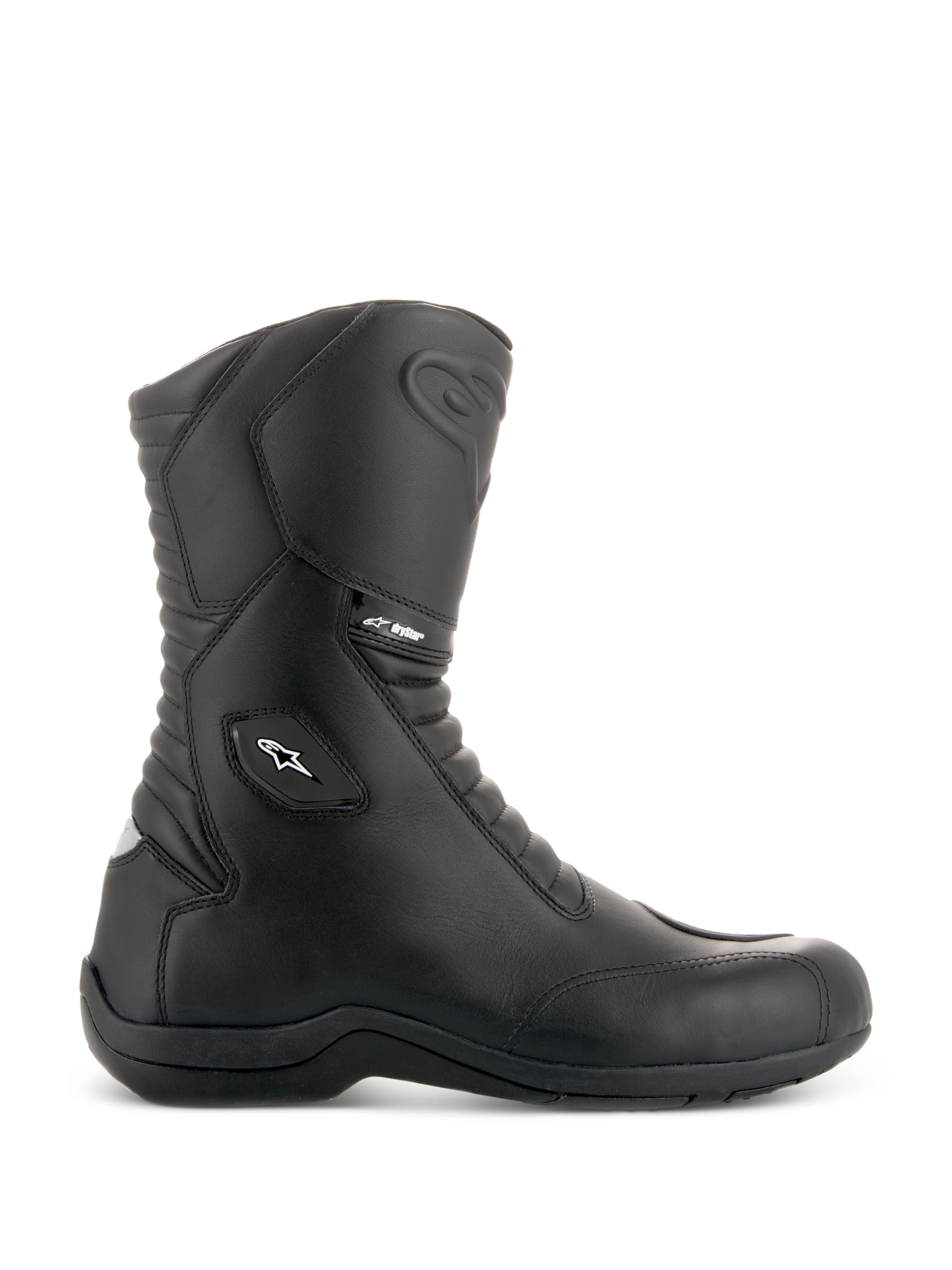
An Alpinestars touring boot that one owner hiked a mountain in after riding to the trailhead.
The Alpinestars Andes V2 Drystar is the touring-focused sibling of the Radon, designed for riders who log long highway miles and need a boot that doesn’t punish them when they finally get off the bike. It uses the same Drystar waterproof membrane as the Radon — proven to keep feet dry in rain — but the Andes V2 is cut for a lower profile that fits more easily under touring pants and jeans. The boot is CE-certified and built with a thick leather upper for abrasion resistance, and it uses a buckle closure system instead of the Radon’s Velcro, which gives you a more secure and durable fit over the long term.
One reviewer shared a remarkable story: they broke in the boots riding around Denver, then unexpectedly hiked Werner Peak in northwest Montana wearing them while huckleberry picking with their family. The boots trekked up and down the mountain through loose dirt and brush without any blistering or discomfort. Another owner reported wearing them “all day around Denver and Kalispell” in the summer heat and found them warm but manageable — not too hot to wear through a full day of riding and walking. A third reviewer with 10.5 Wide feet (the boot is not sold in a wide size) said the regular 10.5 fit perfectly, suggesting the Andes V2 runs slightly generous in the toe box. The boot is sized according to the Alpinestars sizing chart, and most owners recommend ordering a half-size smaller than your normal shoe size for a snug fit.
The main complaint is that these boots are warm in hot weather — the same Drystar membrane that keeps water out also traps more heat than a mesh boot. One rider who wore them all day in summer said it was fine, but it is something to consider if you ride primarily in 95°F+ conditions. The boot also requires a break-in period, with one owner clamping the left toe in a vise to help the leather loosen up for shifting (a common trick for stiff new motorcycle boots).
Long-Haul Champion
- Drystar waterproof membrane keeps feet dry in rain
- Comfortable enough for unplanned multi-mile hikes off the bike
- Buckle closure is more durable than Velcro
- Runs slightly generous in the toe box, fitting some wide feet without a wide size
The Heat Factor
- Warm in hot weather — not ideal for summer-only riders in hot climates
- Requires a proper break-in period before they feel comfortable
- Some owners recommend ordering a half-size smaller than normal
Best for touring riders who also walk: If your road trips include hikes, gas station walks, and exploring towns on foot, the Andes V2 Drystar is the most walkable CE-certified touring boot here.
Not for hot-climate riders: The warmth of the Drystar membrane is a liability if you ride in consistently high temperatures.
7. ILM Motorcycle Boots Waterproof ATV Motorcross Dirt Bike for Men Model MX3

A stiff, affordable dirt boot that offers solid protection for the price, as long as you don’t mind a little break-in.
The ILM MX3 is a no-frills motocross-style boot designed for ATV riders, dirt bikers, and dual-sport riders on a budget. It features a TPU (thermoplastic polyurethane) shin plate for impact protection, a microfiber leather upper for abrasion resistance, and four buckles for a secure closure that keeps the boot locked onto your foot. The boot is listed as “waterproof” and “dirt-resistant,” meaning the materials are designed to repel water and mud rather than absorb them. The adult model weighs 3.1 kg (roughly 6.8 pounds), which is substantial but expected for a full-coverage motocross boot at this price point. The inner ankle is protected by a microfiber leather and TPU combination.
One buyer who purchased these for their son said the boots are “stiff as they should be” for a motocross boot, and once broken in, the son stopped complaining during rides. Another owner noted that the boots are “stiff” but provide good protection for dual-sport and motocross riding, but they experienced a top buckle strap breaking. The same owner pointed out that the strap is replaceable, which is a minor relief. Most reviewers report the boots fit true to size and feel solid for the money, with one calling them “exactly what I was looking for” for occasional off-road use.
Compared to the O’Neal Sierra PRO WP, the ILM MX3 is stiffer, heavier, and more dedicated to off-road use — you wouldn’t want to walk around a city in these all day. The TPU shin plate provides more rigid protection than the O’Neal’s all-leather construction, but the overall build quality and materials are not in the same league as premium European boots. The broken buckle strap is a known weak point that multiple buyers have mentioned, so expect to potentially replace a buckle over the boot’s lifetime.
Budget Dirt Protection
- TPU shin plate provides solid impact protection for motocross and ATV use
- Four-buckle closure secures the boot firmly
- Waterproof and dirt-resistant upper repels mud and water
- Fits true to size, according to most owners
Known Weak Points
- Top buckle strap broke on one reviewer’s pair — check your buckles regularly
- Stiff construction requires deliberate break-in time
- Not built for walking comfort; primarily a riding-only boot
Best for occasional dirt riders: If you ride a dirt bike or ATV a few weekends a month and need a waterproof boot that won’t break the bank, the ILM MX3 gets the job done.
Not for daily commuters or walkers: The stiffness and weight make these a poor choice for boots you need to walk around in or wear all day.
8. Harley-Davidson Men’s Hustin Waterproof Harness Boot
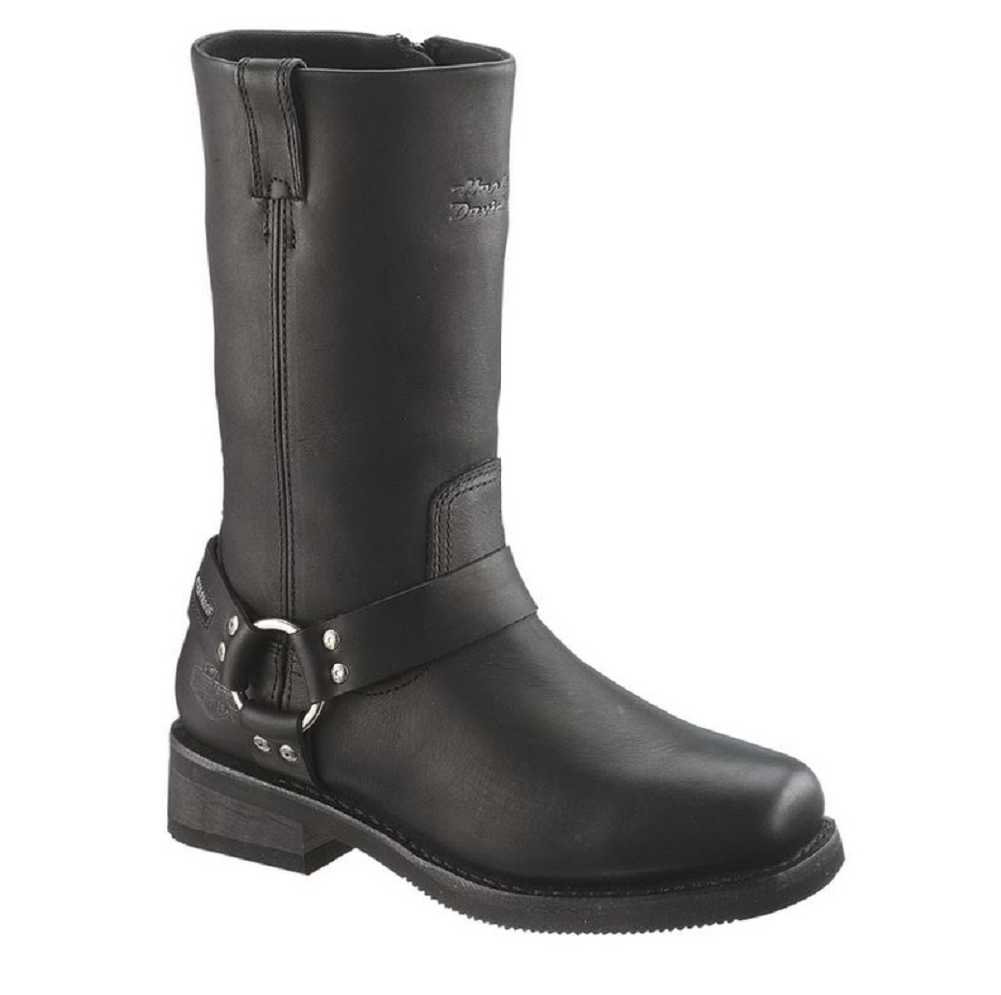
A classic American biker boot that prioritizes style and comfort over slide protection and certified armor.
The Harley-Davidson Hustin is not an adventure boot or a motocross boot — it is a classic cruiser boot designed for riders who want the iconic look of a high-shaft leather boot with a harness strap, plus the practical benefit of waterproofing. The upper is leather with Goodyear welt construction, a traditional method where the sole is stitched to the upper for durability, making the boot resoleable. The oil-resistant rubber outsole provides decent grip on pavement and smooth floors. A full-length cushioned sock lining reduces foot fatigue during long highway cruises. The boot has a side zipper for easy on/off, so you don’t have to lace it up every time.
One owner reported the boots “felt good from the very first minute” and broke in within a few hours of wear, conforming nicely to their feet. They praised the zipper sides for making the boots easy to get on and off, and noted there is no interior buckle or ring to foul the shifter or brake pedal — a common annoyance with harness-style boots. Another owner who rode at 80 mph in 50-degree weather said the boots kept water out and their feet from getting cold, which is a strong real-world test of both the waterproofing and insulation. The boots are described as fitting true to size for most, though some reviewers with wider feet found the regular width snug and recommend ordering the wide size if your foot is on the wider side of normal.
The honest trade-off is that this boot has no CE certification, no ankle armor, no shin plate, no steel shank — it is a fashion-forward waterproof boot for cruising, not for protection in a slide. One reviewer who loved the boots still noted they were “not nearly as wide as expected” and hoped break-in would loosen them up. If you ride a cruiser on paved roads and care more about style and comfort than certified crash protection, the Hustin is a legitimate option. If you corner hard or ride in traffic, choose a boot from earlier in this list.
The Style-and-Comfort Pair
- Classic Goodyear welt construction makes the boot resoleable
- Side zipper provides fast on/off access
- Waterproof and warm at highway speed in cold weather
- Breaks in quickly and conforms to your feet
The Protection Gap
- No CE certification, no ankle armor, no shin plate — minimal crash protection
- Runs narrow for some — consider ordering a wide size
- Not suitable for off-road or aggressive riding
Best for cruiser riders who value style: If you ride a Harley or a cruiser on paved roads and want a classic-looking waterproof boot that is comfortable for all-day riding, the Hustin fits perfectly.
Not for safety-conscious or aggressive riders: The lack of armor and certified protection makes this a poor choice for anyone who rides hard, corners fast, or ventures off-road.
9. Milwaukee Leather MBM9113 Men’s Brown Waterproof Leather Motorcycle Reinforced Riding Shoes w/Ankle Support
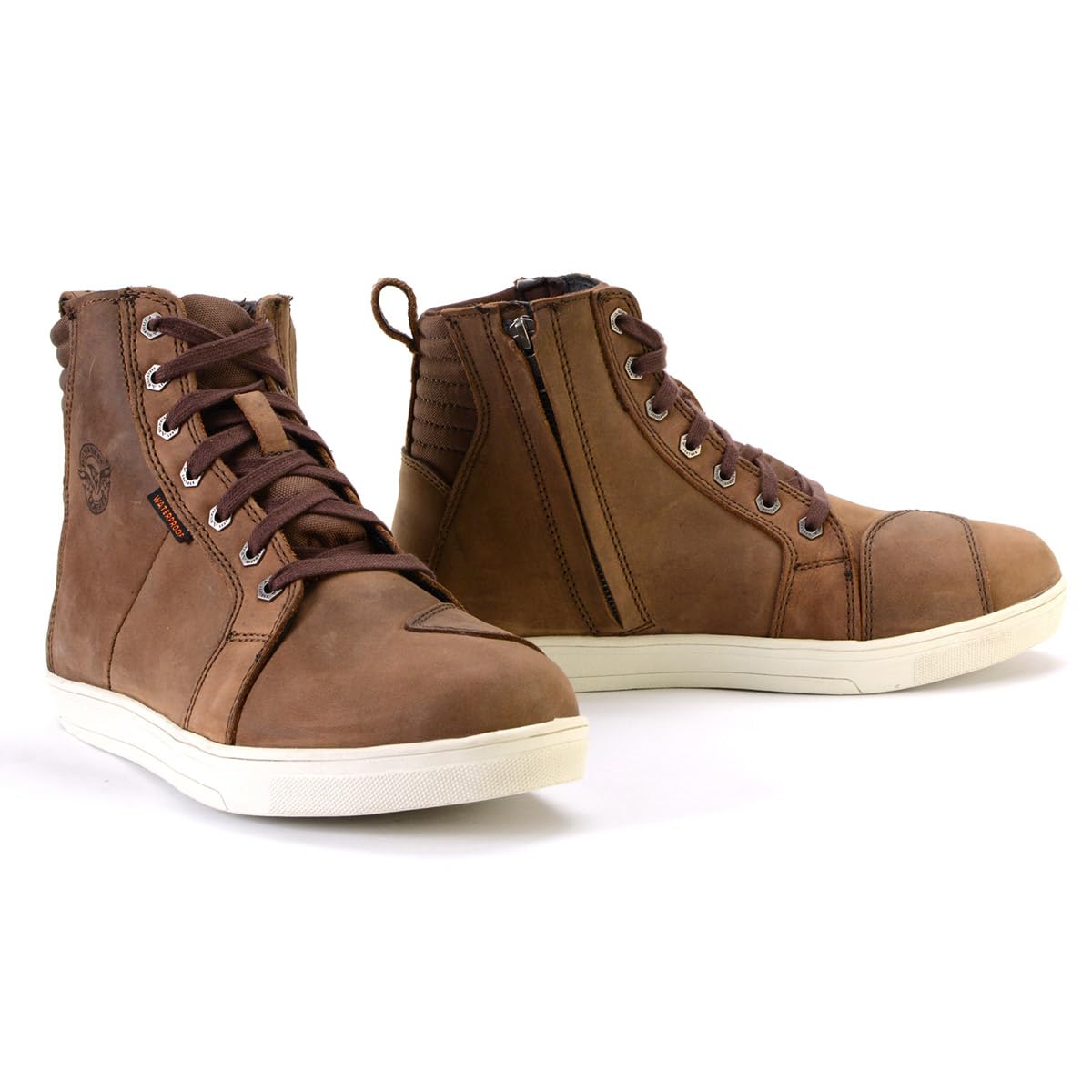
An 8-pound leather boot that feels more like a reinforced work shoe than a lightweight riding boot.
The Milwaukee Leather MBM9113 is the heaviest boot in this lineup at 8 pounds, compared to the Noru Hakken at 2.3 pounds. It is built from cowhide leather and is designed to look like a casual leather moto-shoe rather than a tall boot, offering reinforced protection (the brand’s term for extra padding around the ankle) and a waterproof construction. The closure is a lace-up system with a side zipper, so you can tie it once and use the zipper for daily on/off — a convenience that multiple owners praise. The boot features a cushioned ankle collar for comfort and is offered in brown leather that develops a soft patina over time.
One buyer who is an 8.5 women’s bought these in a men’s 7 (the standard rule for women’s-to-men’s sizing) and said “the fit is great, roomy and very comfortable.” They described the leather as “butter soft” and praised the tall ankle coverage and cushioning around the ankles. Another owner called the zipper “king” for convenience. The boot is not CE-certified, which means the ankle protection is from padding and thick leather rather than rigid armor, but several reviewers noted the boots are “sturdy and comfortable” for daily street riding. One critical review mentioned one boot fit tighter than the other, suggesting inconsistent QC across pairs.
The heaviness is the defining trade-off here. At 8 pounds, these boots will noticeably tire your feet during a long day of walking — one reviewer already noted they are “a bit heavier than a normal sneaker.” The boot is best suited for short urban commutes and casual rides where you want the look and feel of a sturdy leather shoe with waterproof capability, rather than for long-distance touring or off-road trips where weight matters.
Casual Street Appeal
- Soft cowhide leather breaks in quickly and feels comfortable
- Lace-up plus zipper closure is convenient for daily on/off
- Tall ankle coverage with cushioned padding feels secure
- Waterproof construction keeps feet dry in light rain
The Weight and Fit Issues
- 8 pounds is very heavy — will cause foot fatigue on long walks
- No CE certification or rigid armor — protection is from padding only
- Quality control issues: one reviewer found mismatched fit between left and right boots
Best for short urban rides: If you ride to the coffee shop or a short commute and want the look and feel of a substantial leather boot with waterproofing, the Milwaukee Leather MBM9113 is a solid entry-level choice.
Not for long-distance or foot-sensitive riders: The 8-pound weight and unverified protection level make these a poor pick for anything beyond casual street riding.
Understanding the Specs
Waterproof Membrane
The single most important spec for a “waterproof” boot. A waterproof membrane (like Gore-Tex, Alpinestars’ Drystar, or NORU’s Aqua-Barrier) is a thin, sealed layer between the outer material and your foot that blocks liquid water from getting in while allowing water vapor (sweat) to escape. Leather alone is not waterproof — it absorbs water and stays wet. If a boot’s description does not name a specific membrane technology, it is likely just water-resistant leather, which will fail in heavy or prolonged rain. The Sidi Mid Adventure 2 Gore, for example, has a Gore-Tex membrane that extends all
CE Certification
CE certification (specifically EN 13634:2017 for motorcycle boots) means the boot has been tested in a lab for impact protection, abrasion resistance, and transverse rigidity. A CE-certified boot like the Noru Hakken Adventure has proven it can withstand a certain level of force in a crash. Boots without CE certification can still offer good protection through thick leather and padding, but you are relying on the brand’s design rather than an independent test. For highway speeds or off-road riding, CE certification is worth prioritizing.
Sole Construction and Stiffness
The sole of a motorcycle boot serves two purposes: giving you a stable platform on the foot pegs and protecting your foot from sharp impacts when you put your foot down. A stiff sole with a steel or reinforced shank is better for off-road riding and long hours on the pegs, but it makes walking feel awkward. A flexible sole (like the MSR Adventure Boots) gives you more tactile feedback on the controls and is easier to walk in, but it provides less protection against sharp objects. If you do a mix of riding and walking, look for a boot in the middle of the stiffness spectrum.
FAQ
What is the difference between waterproof and water-resistant motorcycle boots?
How heavy should a motorcycle boot be for everyday riding?
Do I need CE certification in a motorcycle boot?
Will waterproof boots make my feet sweat in summer?
How do I know what size motorcycle boot to order?
Can I wear motorcycle boots for walking all day?
How long do waterproof motorcycle boots last?
Are there waterproof motorcycle boots for wide feet?
Final Thoughts: The Verdict
For most riders, the best waterproof motorcycle boots winner is the O’Neal Sierra PRO WP because it balances genuine waterproofing, full-grain leather protection, a comfortable walkable sole, and a price that beats the premium European options. If you want the lightest CE-certified option that still lets you walk easily, grab the Noru Hakken Adventure. And for non-negotiable wet-weather touring with the absolute best waterproof membrane, the standout is the Sidi Mid Adventure 2 Gore.
How We Picked
We do not accept paid placement. Every pick is matched to a real buyer and a real use-case; we do not hands-on test units.
Sources & Methodology
Specifications: manufacturer listings and product documentation. Review insights: verified customer reviews, as of July 2026. Pricing: not shown on this page (it changes often); check the current price via the retailer link.
As an Amazon Associate, Trending Car earns from qualifying purchases. This does not affect which products we feature.