
Our readers keep the lights on and my garage snacks stocked. As an Amazon Associate, I earn from qualifying purchases.
Specs are compiled from manufacturer listings and verified buyer reviews and can change over time — please confirm the key details on the product page before buying.
Whether your car shudders at a stoplight or your 75hp outboard can’t get on plane, carbon and varnish inside the combustion chamber are usually the quiet culprits. The right valve cleaner dissolves baked-on carbon and varnish without a wrench, but only if the formula matches your engine’s deposit type and you follow the maker’s application steps.
I’m Min Islam — the founder and writer behind Trending Car. This guide is built by comparing the manufacturers’ published specifications and the patterns across verified customer reviews, so you get each pick’s real strengths and trade-offs instead of marketing spin.
Long-term buyers report smoother idles and better throttle response after a single treatment, and the crowd favorite is Quicksilver Quickleen at 4.8 stars across 900+ owners. That’s the honest shortlist of the best valve cleaner for your gas or diesel engine.
Our Picks at a Glance


How To Choose The Best Valve Cleaner
The best valve cleaner for your garage depends on one question: how does the gunk get into your engine? Gasoline additives clean while you drive, while aerosol sprays clean a specific part directly. Matching the cleaner to your engine type—direct injection, port injection, or diesel—determines whether it actually reaches the deposits.
Know Your Engine: Direct Injection vs. Port Injection
Direct-injection engines spray fuel straight into the cylinder, so no fuel ever washes over the intake valves — that is where carbon collects. Look for a cleaner that explicitly says it works on GDI engines, or a professional-style additive like BG 44K that specifically cleans intake valves on those setups. Older port-injected engines benefit from simpler fuel-system cleaners that travel with the fuel stream.
Active Ingredients: PEA and Solvent Blends
Polyetheramine (PEA) is the chemical that breaks down carbon, and it survives the heat of combustion so it reaches the deposits. Some products deliver PEA in an aerosol spray for direct injection, while others use a liquid solvent that disperses moisture and dissolves gum and varnish as you drive. Both work, but only when the active chemistry matches your engine’s deposit problem.
How You Apply It Matters
A pour-in bottle added at fill-up is the easiest, but an aerosol that you spray into the intake while the engine idles reaches the valves directly. Some spray kits include adapters to hook into the throttle body, making a one-person job that dissolves deposits in the chamber. Pick the application you’ll actually finish, since a half-used treatment leaves deposits behind.
Quick Comparison
| Model | Best For | Engine Type | Form | Treats Up To | Amazon |
|---|---|---|---|---|---|
| Quicksilver Quickleen★ Best Overall | Outboard & marine engines | Gasoline | Liquid pour-in | 5 gallons per oz | Amazon |
| Quicksilver QuickareBest Value | Fuel stabilization & gum removal | Gasoline | Liquid pour-in | Every fill-up | Amazon |
| Liqui Moly Complete SystemTop Performer | Full system maintenance | Gasoline | Liquid pour-in | 500 ml bottle | Amazon |
| Liqui Moly Jectron | Fuel injection cleaning | Gasoline | Liquid pour-in | 2-pack | Amazon |
| Berryman 2611 | Direct injection valves | GDI gasoline | Aerosol spray | 16 oz can | Amazon |
| BG 44K 2-Pack | Professional-grade injectors | Gasoline | Liquid pour-in | 20 gallons per can | Amazon |
| Berryman B-12 12-Pack | Carburetor & small engines | Gasoline | Liquid pour-in | 1 oz per gallon | Amazon |
| Power Service Diesel Kleen | Diesel injectors | Diesel | Liquid pour-in | 9-pack | Amazon |
| BG 44K 3-Pack | Direct injection & high mileage | Gasoline | Liquid pour-in | 20 gallons per can | Amazon |
In-Depth Reviews
1. Quicksilver Quickleen Engine and Fuel System Cleaner
Our pick — over 4.5★ from 950+ verified ratings; the strongest balance of quality and price.
The marine-grade pour-in that brought a 75hp outboard back to life
If your boat motor has been idling rough or losing power, this is the bottle to reach for. The 12-fluid-ounce bottle treats 5 gallons of gasoline per ounce, so a single bottle stretches across several fill-ups.
Unlike some fuel additives, this one also handles the ethanol-related clogs that plague modern pump gas, clearing carburetors, injectors, intake valves, spark plugs, piston crowns, and cylinder heads. One owner avoided hundreds of dollars in carburetor repairs by adding it to every tank and letting it soak overnight. The crowd favorite — 4.8 stars across 900+ owners — gives it the top spot here over every other pour-in we considered.
The occasional complaint is leakage during shipping, so check the seal when the bottle arrives. For a weekend boat owner whose engine sits months between runs, this is the single most useful valve and fuel-system cleaner on the shelf.
What wins boaters over
- Clears carbon from valves, injectors, and piston crowns in one treatment
- Ethanol-blend safe — tackles clogs from modern pump gas
- Can be used at every fill-up for prevention, not just rescue
What to watch
- Bottle can leak in transit, so inspect the seal on arrival
- No fuel stabilizer included — add one separately for long storage
Grab it for: outboard owners whose motor stumbles at idle or lost top-end power — this is the rescue treatment that costs a fraction of a carb rebuild.
Think twice if: your engine is already running perfectly; some owners on healthy motors noticed no measurable difference, so this is a fixer more than a preventive.
2. Quicksilver Quickare Fuel Treatment
The every-tank stabilizer that keeps fuel fresh for up to three months
You get continuous protection, not just a one-time rescue, with Quickare. It removes varnish and gum from fuel lines, tanks, carburetors, injectors, intake valves, and spark plugs, and it keeps fuel fresh for up to three months — a real win if your boat sits in the driveway between weekend outings.
One long-haul owner added it to every tank for five years and reported zero issues across that entire span. Another, who calls himself a weekend warrior that can’t get out every weekend, says a stabilizer is vital for his routine. Developed by Mercury Marine to its own original-equipment standards, this is the quiet maintenance hero that prevents varnish from ever becoming a valve problem in the first place.
At just 12 ounces per bottle, it’s the entry point to the Quicksilver lineup — and the cheapest way to protect a marine or small gasoline engine from gummed-up valves between seasons.
Prevention-first pick: this earns its keep as the additive you never skip, not the one you reach for after an engine starts missing.
Honest limit: it prevents gum and varnish buildup but is not positioned as a heavy-duty carbon remover — pair it with a dedicated cleaner for a badly fouled engine.
3. Liqui Moly Truck Series Complete Gasoline System Cleaner
A full-system flush that cleans valves, injectors, and the combustion chamber
Liqui Moly’s Truck Series bottle is the complete package: it cleans the injection system, the intake valves, and the combustion chamber in one pour, while preventing corrosion in the fuel system. The 1.1-pound, 500 ml bottle is designed for a single full treatment — and the maker’s own maintenance sequence puts this first, followed by injector cleaner, then valve cleaner, added before a fill-up.
Owners running it every 2-3 months in trucks report it removes deposits left by inferior gas, and one notes it works fine on direct injection despite the label’s older spec. Another describes it as the annual fuel-system maintenance step, added at oil changes or every 7500 miles, with expert guidance behind the dosing. There is no snake-oil here — the green-hued liquid smells like a real fuel detergent, and the bottle even includes a screw-on funnel.
The one mixed note is engine smoothness: most owners see smoother operation, but a few report stalling after treatment. If your system is already clean, results are subtle — but as a scheduled maintenance pour, this is exactly how you keep a high-mileage truck’s valves from ever fouling.
Maintenance-grade chemistry: this is the annual-service pour-in that prevents deposits before they cause misfires, poor MPG, or RPM bounce.
The catch: a tiny share of owners mention stalling after use, so run it on a nearly empty tank and drive gently for the first few miles.
4. Liqui Moly Jectron Gasoline Fuel Injection Cleaner (2-Pack)

Two bottles that lifted a truck’s mileage and smoothed its idle
The Jectron 2-pack is the every-owner injector cleaner that targets the combustion side directly. The maker’s four promises are simple: lower fuel consumption, cleaner combustion, smoother idling, and better throttle response. The 1.39-pound twin pack gives you two full treatments, making it a natural buy for a two-vehicle garage or a second dose for a stubborn engine.
Owner reports back the claims: “I put 2 bottles in my truck on two seperate occasions, the mileage has increased and it runs smoother with a little more power.” Another buyer saw better mileage while towing, and one rescued a Can-Am Spyder that was missing and sluggish as if running out of gas — a single bottle had it running properly a couple of miles later. If you own a 4-cylinder turbo, expect the lifter quieting to be real but modest.
At the mid-range price point for a two-bottle set, this is the value play among Liqui Moly’s lineup — and the most direct route to a smoother idle without paying for a full system cleaner.
The measurable wins
- Real mileage gains reported on trucks, including while towing
- Fixes rough idle and sluggish acceleration on direct-injection motors
- Two full doses in one buy — enough for two vehicles
Keep expectations honest
- Lifter noise reduction is modest, not a cure-all
- One bottle may not fully clear a heavily fouled engine — budget for both
Reach for this if: your daily driver idles rough or lost throttle response and you want two reliable doses at a fair price.
Look elsewhere if: you need a full intake-valve and combustion-chamber flush — this focuses on injectors and the fuel side.
5. Berryman 2611 Intake Valve and Combustion Chamber Cleaner
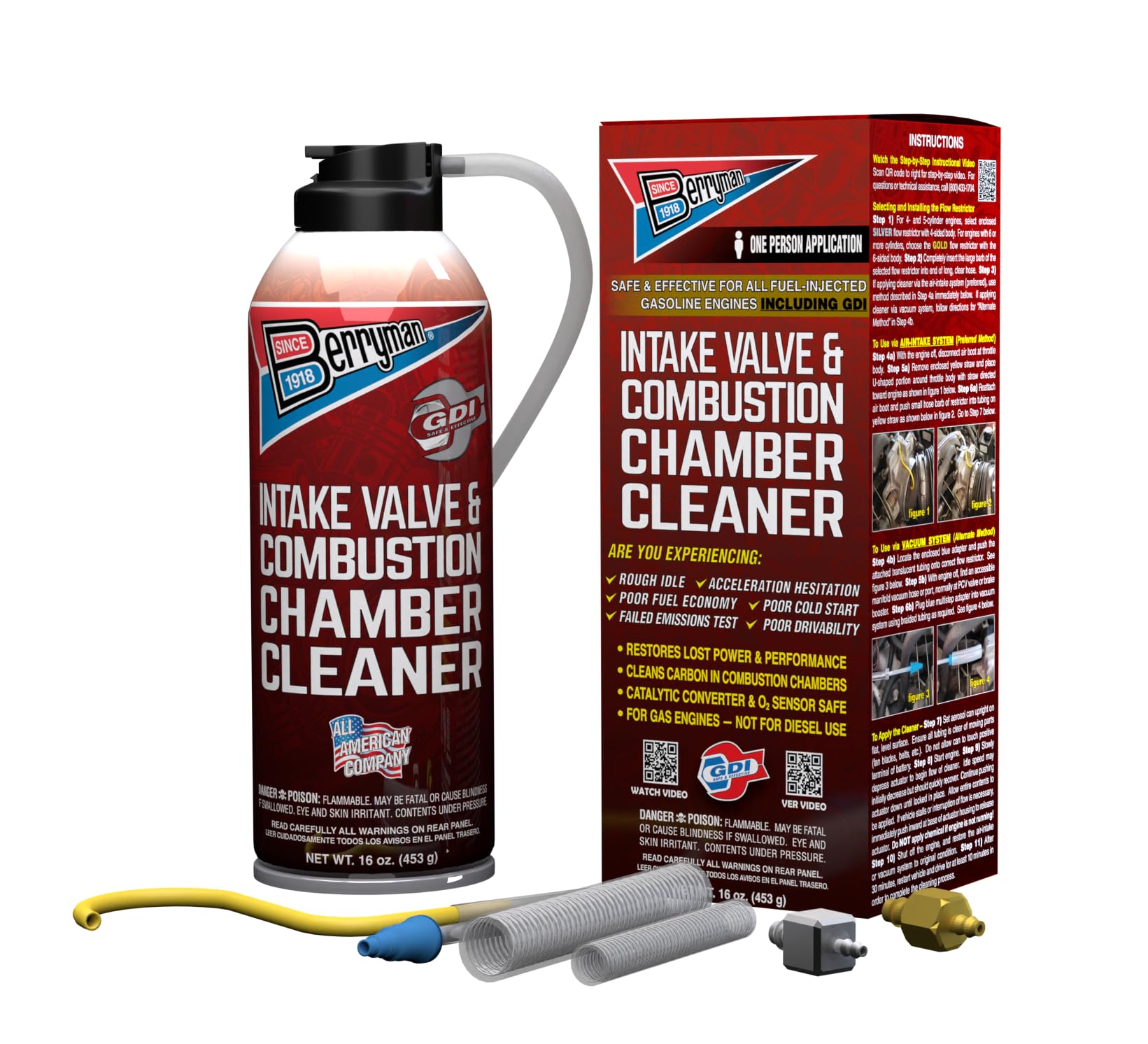
The spray that reaches GDI valves no pour-in ever will
Here is the honest fork in the road: a pour-in additive rides the fuel stream, but on a direct-injection engine the fuel never touches the intake valves. That is exactly why the Berryman 2611 exists — it is a 16-ounce aerosol that you spray into the intake while the engine idles, dissolving carbon directly on the valves and in the combustion chamber. It contains PEA, the chemical that breaks down carbon, and it is safe on catalytic converters and oxygen sensors.
The owner results are the most dramatic in this entire list. A 2012 Jeep Liberty at 118k miles jumped from 12-16 MPG to 15-19 MPG after two cans, with better acceleration. A 2016 Mazda CX-5 on a SKYACTIV GDI engine had the included adapters make it an easy one-person job. Owners describe heavy smoke during the soak — that is the carbon burning off — and on a 2013 Mini Cooper S, this fixed a persistent misfire that new plugs and coils could not cure. It also weighs in as roughly 10x cheaper than professional media blasting, according to an owner of a 2012 Porsche Cayenne who cleared his engine codes with a scanner afterward.
The mixed reality is the smoke. An occasional engine stumbles or throws a code mid-treatment, which clears once the carbon burns away. If you are comfortable following the included attachments and driving gently right after, this is the closest thing to a professional valve decarbonization you can do in your own driveway.
Why GDI owners love it
- Reaches intake valves on direct-injection engines — the one place pour-ins cannot
- Included flow-control kit makes it a one-person, no-helper job
- Fixes real misfires that new plugs and coils failed to solve
The messy trade-off
- Heavy smoke during treatment can alarm neighbors — do it outdoors
- Some engines stumble or throw a code mid-soak; have a scanner handy
Best if: you own a direct-injection car with a rough idle or lost MPG and want the professional valve cleaning without the shop bill.
Skip it for: a pure preventive routine on a healthy engine — the smoke show and mid-treatment codes are more drama than a pour-in delivers.
6. BG 44K Fuel System Cleaner Power Enhancer (2-Pack)

The dealership-proven pour-in that treats 20 gallons per can
When a former dealership employee calls BG 44K “the best injector system cleaner on the market,” you pay attention. This 2-pack of 11-ounce cans is the professional-grade standard — one can treats up to 20 gallons of gasoline, and the brand has been the choice of automotive professionals for over 40 years. It rapidly cleans fuel injectors, valves, and combustion chambers, and owners who work at dealerships confirm it clears valves and carbon deposits that other products leave behind.
The owner wins are consistent: a 2017 F-150 3.5 EcoBoost saw a felt misfire and hard idling clear up, and a regular every-6-months user reports increased MPG on his truck. Another owner uses it to keep a P-420 code cleared on an older vehicle, and one credits it with helping pass a state inspection.
The honest caveat is that carbon-removal opinions are mixed — some owners see dramatic results, others see subtle ones, depending on how badly fouled the engine was. Wear gloves and avoid the fumes; this is a strong solvent, not a gentle additive.
Dealership-endorsed: this is the pour-in that pros themselves buy, with enough solvent strength to clear carbon a generic additive cannot touch.
Fair warning: results scale with how dirty your engine is — a clean motor shows less drama than a rescued one.
7. Berryman B-12 Chemtool Carburetor/Fuel Treatment (12-Pack)
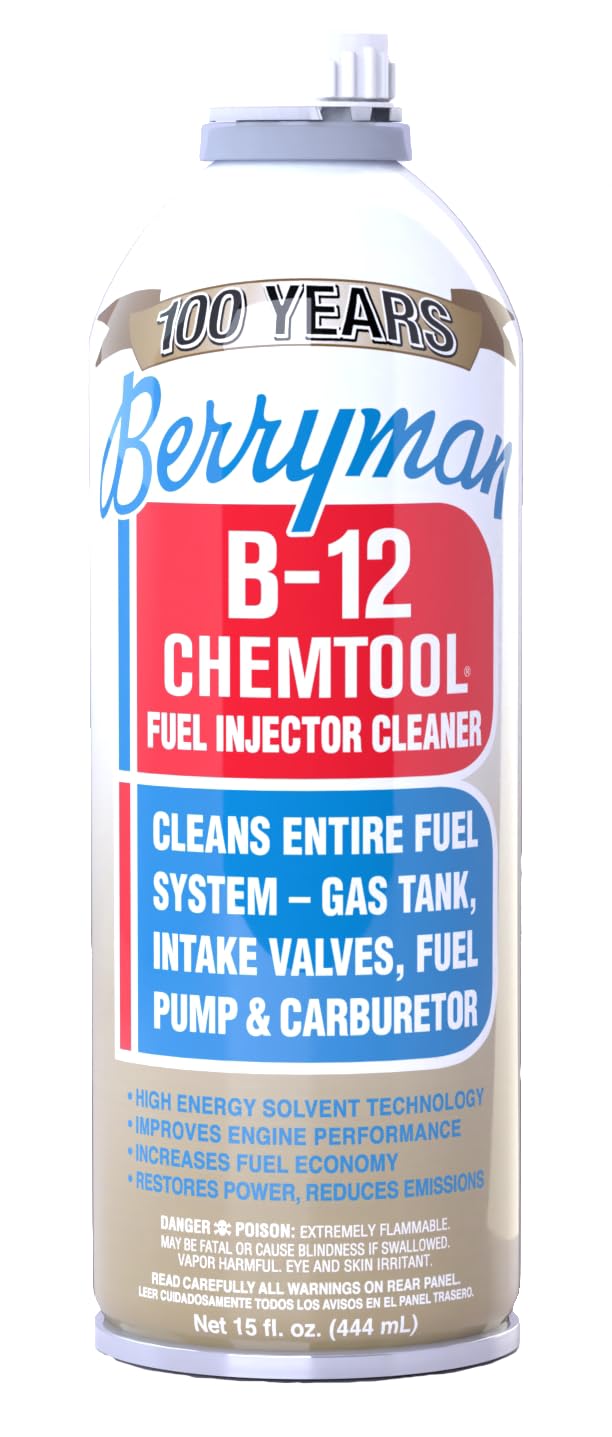
A 12-can case for every small engine and carburetor you own
This is the buy-once, use-forever option for anyone with a garage full of small engines. The 12-pack of 15-ounce cans runs the entire fuel system — tank, lines, injectors, valves, rings, and pistons — and it disperses moisture while dissolving gum, varnish, and other fuel residues. One owner with 20 years of use reports only a single carburetor failure across his boat, chainsaws, lawnmower, generator, trimmers, and wood splitter — at 1 ounce per gallon of gas.
The owner consensus is that B-12 performs better than Seafoam, with one reporting a 3 MPG increase and another calling it his go-to whenever any vehicle or small engine isn’t running at full potential. A 26-year-old truck owner adds it to keep injectors clean, and the case pricing works out to real savings over single-can buys.
It is catalytic-converter and oxygen-sensor safe, so you can use it freely on modern cars too. The only real question is if you need 12 cans at once — but for a household with multiple engines, this case is the smartest valve-and-fuel cleanup money in the list.
Fleet-friendly formula: one ounce per gallon keeps carburetors, injectors, and valves clean across every engine you own.
Best for: multi-engine households — the 12-can case pays off fast on small machinery, and the 15-ounce cans outlast most single treatments.
8. Power Service Diesel Kleen +Cetane Boost (9-Pack)

The Cummins-approved diesel cleaner that adds cetane with every pour
Diesel engines have their own deposit problems, and this is the product built for them. Power Service Diesel Kleen cleans dirty injectors and prevents injector sticking in both High Pressure Common Rail (HPCR) and older systems, removing internal and external deposits while restoring lost power and fuel economy. It is effective in all diesel fuels, including ULSD, biodiesel, and biodiesel blends — and it carries a Slickdiesel Lubricator to protect fuel pumps and injectors from the increased wear that poor-quality Ultra Low Sulfur Diesel causes.
One Cummins B67 owner logged over 150k miles in 13 years with zero issues, adding about half a bottle to a roughly 30-gallon fill-up. Another notes the added cetane provides a slight but noticeable increase in power, and a 2017 Ram owner says the truck sounds better as soon as it starts. The 8-pound 9-pack is a year-plus supply for a monthly treatment routine.
Cummins approval is the headline here — owners specifically call it out as a trusted brand for their trucks. If you drive a diesel, this is the one valve-and-injector cleaner that also boosts the fuel’s cetane number, which is the diesel equivalent of octane.
Cummins-endorsed: the cetane boost gives a real, felt power bump while the cleaner keeps injectors deposit-free across high-mileage diesel motors.
Diesel only: this does nothing for a gasoline engine — match it to your truck or skip it.
9. BG Products 44K Fuel System Cleaner (3-Pack)

Three cans of the 44K formula for direct-injection engines that need it most
The 3-pack is the same professional-grade BG 44K as the 2-pack above, but with a third can for engines that need repeated treatment. Each can treats up to 20 gallons (75 liters) of gasoline, and this version is specifically called out as great for Direct Injection Gas Engines — the same engines where carbon builds up on valves that fuel never washes. A mechanic-aided treatment on a high-mileage Concorde took MPG from 29 to 36, with better throttle response and more power.
One owner keeps a 5.0 Ford F150 running great on BG products used religiously, and another calls 44K the best fuel system cleaner he has tried on a 24-year-old GMC truck. A dealership mechanic reportedly uses this exact product, which is why owners trust it. The maker says it is compatible with all fuel system materials, alcohol-blended fuels, and common fuel additives.
The value debate is the only real split — some owners find the price worth it for the results, others find it expensive. For a direct-injection daily driver, three cans cover a full rescue and a maintenance dose, making this the highest-value way to buy the professional standard.
Pro-strength for GDI: this is the same 44K dealership standard in a 3-pack that suits direct-injection engines needing repeat treatments.
The split: owners agree it works but disagree on price — buy the 3-pack if you know your engine is fouled.
Understanding the Specs
PEA vs. Solvent Cleaners
Polyetheramine (PEA) is the active chemical that breaks down carbon deposits, and it survives combustion heat so it reaches the valves. Solvent-based cleaners use ingredients that disperse moisture and dissolve gum and varnish as you drive. For direct-injection engines, you want a PEA formula — either a pour-in designed for GDI or an aerosol that sprays the intake directly.
Pour-In vs. Aerosol Application
A pour-in additive travels with the fuel, so it cleans whatever the fuel touches — injectors, combustion chambers, and on port-injected engines, the intake valves. An aerosol sprays a specific part directly, which matters for GDI engines where the fuel bypasses the valves entirely. The right choice depends on how the gunk gets into your engine, not which is easier to pour.
FAQ
Will a pour-in valve cleaner fix a rough idle on my car?
What is the difference between a valve cleaner and a fuel injector cleaner?
How often should I use a valve cleaner?
Is BG 44K safe for direct-injection engines?
Can I use a gasoline valve cleaner in my diesel truck?
Why does my engine smoke after using an aerosol valve cleaner?
How much fuel does one can of BG 44K treat?
Is the Quicksilver Quickleen safe for ethanol-blended fuel?
Final Thoughts: The Verdict
For most buyers, the valve cleaner winner is the Quicksilver Quickleen because it blends a crowd-favorite 4.8-star reputation with a real rescue capability for the engines that suffer most — marine motors that idle for a year and then can’t get on plane. If you drive a direct-injection car and want a true valve cleaning without a shop visit, grab the Berryman 2611 aerosol. And for a diesel truck that hauls and tows, the Power Service Diesel Kleen is the one to reach for, with its cetane boost as a bonus. Start with a cleaner matched to your engine type, and the deposit problem resolves itself.
How We Picked
We do not accept paid placement. Every pick is matched to a real buyer and a real use-case; we do not hands-on test units.
Sources & Methodology
Specifications: manufacturer listings and product documentation. Review insights: verified customer reviews, as of August 2026. Pricing: not shown on this page (it changes often); check the current price via the retailer link.
As an Amazon Associate, Trending Car earns from qualifying purchases. This does not affect which products we feature.