
Our readers keep the lights on and my garage snacks stocked. As an Amazon Associate, I earn from qualifying purchases.
Specs are compiled from manufacturer listings and verified buyer reviews and can change over time — please confirm the key details on the product page before buying.
You want a helmet that keeps you safe, lights you up at night, and maybe even calls for help if you go down. But “smart” can mean anything from a simple blinking light to a full system with turn signals and crash detection. This guide compares seven real smart helmets — based on published specs and what actual buyers report — so you know exactly which features matter for your ride and which ones you can skip.
I’m Min Islam — the founder and writer behind Trending Car. This guide is built by comparing the manufacturers’ published specifications and the patterns across verified customer reviews, so you get each pick’s real strengths and trade-offs instead of marketing spin.
The key to choosing a smart bike helmet is matching its safety certification, battery life, and lighting features to the speed you ride and the conditions you face.
Our Picks at a Glance
How To Choose The Best Smart Bike Helmet
Your choice depends on three things: the crash protection your bike’s speed demands, the kind of lights you need to be seen, and whether extras like fall detection or Bluetooth audio matter to you. Here is what to look for in each area.
Safety Certifications: CPSC vs. NTA-8776
A basic CPSC (Consumer Product Safety Commission) certification covers standard bicycle use up to about 12-15 mph. If you ride a Class 3 e-bike or an electric scooter that goes up to 28 mph, look for a helmet that is also NTA-8776 certified — that standard tests for higher impact speeds and covers more of the back of your head. Some premium helmets meet both, giving you the widest protection range.
Lighting and Signals: What Visibility Actually Means
Not all lights are the same. A good smart helmet has a bright front light (look for at least 40-80 lumens for seeing the road ahead) and rear lights that other drivers can spot from hundreds of feet away. Turn signals controlled by a wireless handlebar remote let you keep both hands on the bars. An automatic brake light that gets brighter when you slow down suddenly adds another layer of safety, especially for city commuters.
Battery Life and Charging
Lights and Bluetooth speakers drain the battery at different rates. Some helmets run their LEDs for up to 10 hours on a charge, while adding music streaming can cut that to 4-6 hours. USB-C charging is the modern standard and means you can use the same cable you already have for your phone. If you commute daily, look for a model that lasts at least a week of typical use between charges.
Quick Comparison
| Model | Best For | Safety Cert | Weight | Battery Life | Amazon |
|---|---|---|---|---|---|
| XNITO Urbanite | High-speed e-bike safety | CPSC & NTA-8776 | 13.28 oz | Up to 10 hours | Amazon |
| ILM E3-12LS | Smart auto-lighting | CPSC, CE, NTA-8776 | 465 g | — | Amazon |
| LUMDEER 16F-01 | All-day battery and visor | CPSC & NTA-8776 | 400 g | Up to 19 hours | Amazon |
| LIVALL EVO21 | Fall detection and SOS | — | 350 g | — | Amazon |
| Lumos Ultra | TÜV-certified visibility | CPSC | 390 g | Up to 10 hours | Amazon |
| ASIEVIE LS01 | Built-in Bluetooth speakers | EN1078, CPC, FCC | 365 g | 4-18 hours | Amazon |
| Sena R1 | Group intercom rides | — | 380 g | — | Amazon |
In‑Depth Reviews
1. XNITO Bike Helmet with LED Lights
Our pick — over 4.5★ from 650+ verified ratings; the strongest balance of quality and price.

The one that survived a 20 mph crash without the rider missing a pedal stroke.
This helmet is the pick if you ride a Class 3 e-bike that hits 28 mph and you want high-speed crash protection you can trust. It carries both CPSC and NTA-8776 certifications, meaning it was tested to absorb impact at higher speeds than a standard bike helmet. A thicker layer of EPS foam (the material that crushes on impact to slow your head down) and extra coverage around the temples and rear of the skull give it a clear edge over basic commuter shells.
The front and rear custom-integrated LEDs improve visibility up to 100% at night or in fog, with three modes (flash, static, and wavy) and up to 10 hours of illumination on a USB-C charge. Owners mention the helmet “survived a 20 mph e-bike crash with no head injury; clasp unaffected” — proof of both the shell and the magnetic buckle holding firm. At 13.28 ounces it feels light on your head, and the dial-fit wheel makes dialing in a snug fit quick.
Compared to the ILM E3-12LS below, the XNITO weighs 13.28 oz versus the ILM’s 465 g, and gets consistent praise for ventilation, while the ILM runs heavier and hotter. The XNITO does not have automatic brake lights or gesture-based turn signals, but its straightforward USB-C rechargeable lights and lifetime accident replacement policy make it a no-brainer for riders who want certified high-speed protection without complications.
What stands out
- Dual CPSC and NTA-8776 certified for speeds up to 28 mph
- Lightweight at 13.28 ounces with good airflow
- Lifetime free replacement after a crash
One limitation
- No automatic brake light or handlebar-turn-signal remote
Reach for this if: you ride an e-bike or scooter up to 28 mph and want the lightest dual-certified helmet with solid integrated lights and a crash-replacement guarantee.
Look elsewhere if: you specifically want automatic turn signals or a brake light that activates without pressing a button.
2. ILM Smart Adult Bike Helmet with Automatic G-Sensor Turn Signal & Brake

The helmet that reads your head tilt and blinks your intentions for you.
This ILM model leans fully into automation. A built-in G-sensor (a small motion sensor that detects a bump) and tilt sensors mean you do not need to fumble for a remote — when you tilt your head left by more than 15 degrees, the left turn signal stays on for 10 seconds automatically. Emergency braking pushes the rear lights to 100% brightness, warning traffic behind you. The front and rear lights also adjust their brightness based on the ambient light level, switching to bright mode at night or in low light.
It carries triple certification (NTA-8776, CE, CPSC) for impact protection up to 28 mph. The detachable black visor is UVA-protective and blocks dust and flying stones. But customers note a real trade-off: at 465 grams it is noticeably heavier than others, and multiple owners mention it “causes fatigue on long rides; traps heat in warm weather.” The front light is also dimmer than some competing models — fine for being seen, not for illuminating the road ahead.
Compared to the LUMDEER below (400 g), the ILM weighs 465 g and lacks the long 19-hour battery runtime, but the automatic gesture-based signals are a genuine hands-free advantage for city riders who want to keep both palms on the grips at all times.
The big wins
- Automatic turn signals triggered by head tilt (no remote needed)
- Brake light boosts to full brightness during sudden stops
- Triple certified up to 28 mph
The honest trade-offs
- Heavy at 465 g; reviewers point out neck fatigue on longer rides
- Poor ventilation; traps heat in warm weather
Perfect if: you want fully automatic turn signals and brake lights without a handlebar remote, and your rides are short to medium in cooler weather.
skip it if: you ride long distances in warm climates or want a lightweight helmet you barely notice on your head.
3. LUMDEER Smart E Bike Helmet with LED Lights
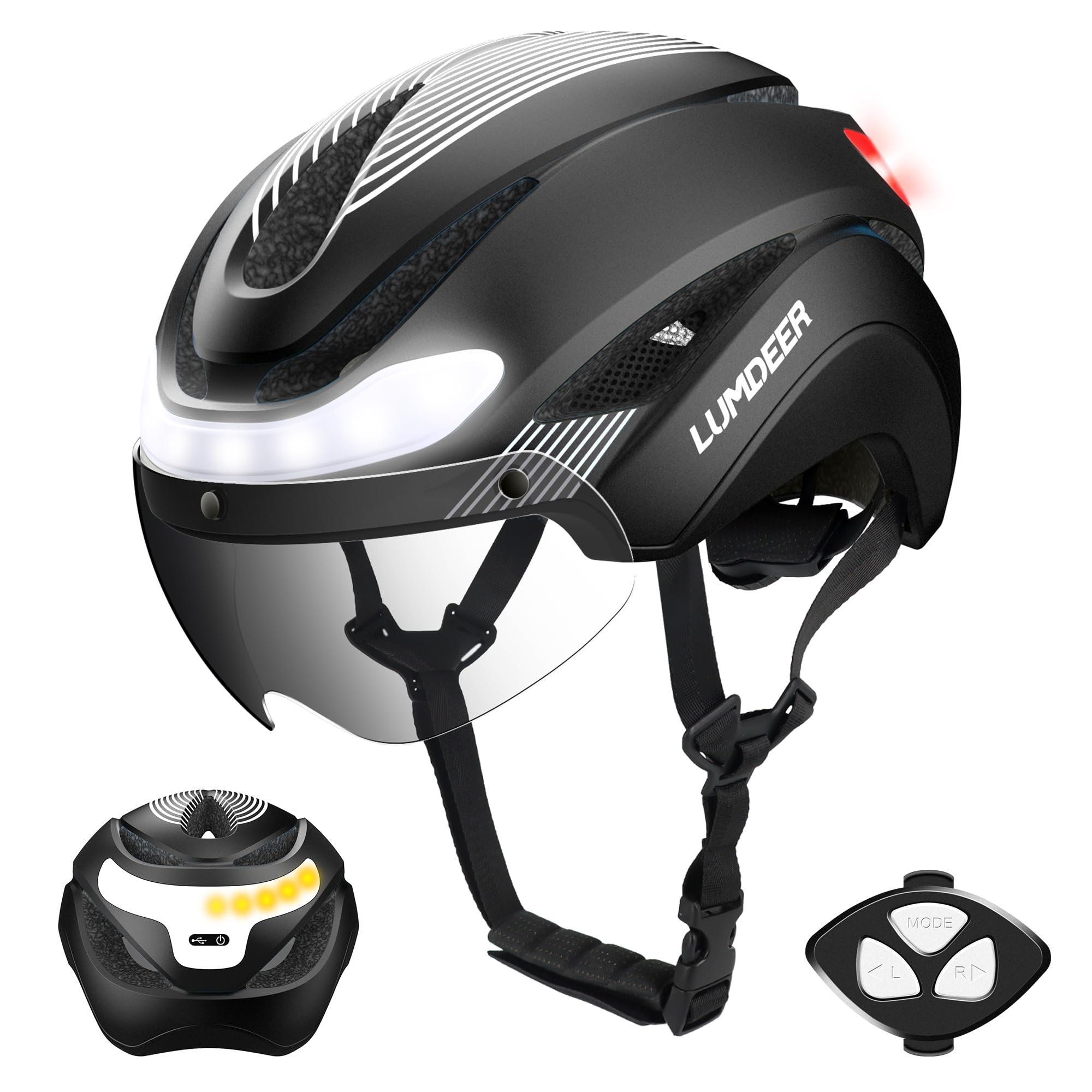
Nineteen hours of light means you charge this one roughly once a week, not every night.
The LUMDEER’s standout number is that 19-hour runtime — the longest of any helmet in this roundup, letting most daily commuters go a full work week between charges. It is certified to CPSC and NTA-8776 standards for e-bike speeds up to 28 mph, and the front and rear LEDs improve visibility by up to 100% at night. A wireless handlebar remote controls the turn signals, while the brake light kicks on automatically during sudden deceleration.
One genuinely unique feature here is the removable magnetic photochromic visor — the visor automatically tints darker in bright sunlight and clears up in cloudy or nighttime conditions. It works as both a sun shield and clear night shield in one piece. At 400 grams it is 65 grams lighter than the ILM above, and buyers consistently call it lightweight and comfortable with 10 ventilation vents. A reviewer noted they “used rubber bands to prevent handlebar control slipping” — a small DIY fix for a remote that does not have a firm grip from the start.
Compared to the LIVALL EVO21 further down, the LUMDEER gives you far more battery runtime and a photochromic visor but does not have fall detection or an SOS emergency alert system.
Why it stands out
- 19-hour battery life, best in this roundup
- Photochromic magnetic visor adjusts tint automatically
- Lightweight at 400 g with good ventilation
A couple of quibbles
- Handlebar remote may slip without a rubber band fix
- Face shield can touch your nose if the helmet isn’t adjusted properly
Grab it for: long commutes or multi-day tours where charging every night is a hassle, and you want the convenience of an auto-tinting visor.
Pass if: you need fall detection with SOS alerts — this helmet focuses on lights and battery, not crash-response features.
4. LIVALL EVO21 Smart Bike Helmet
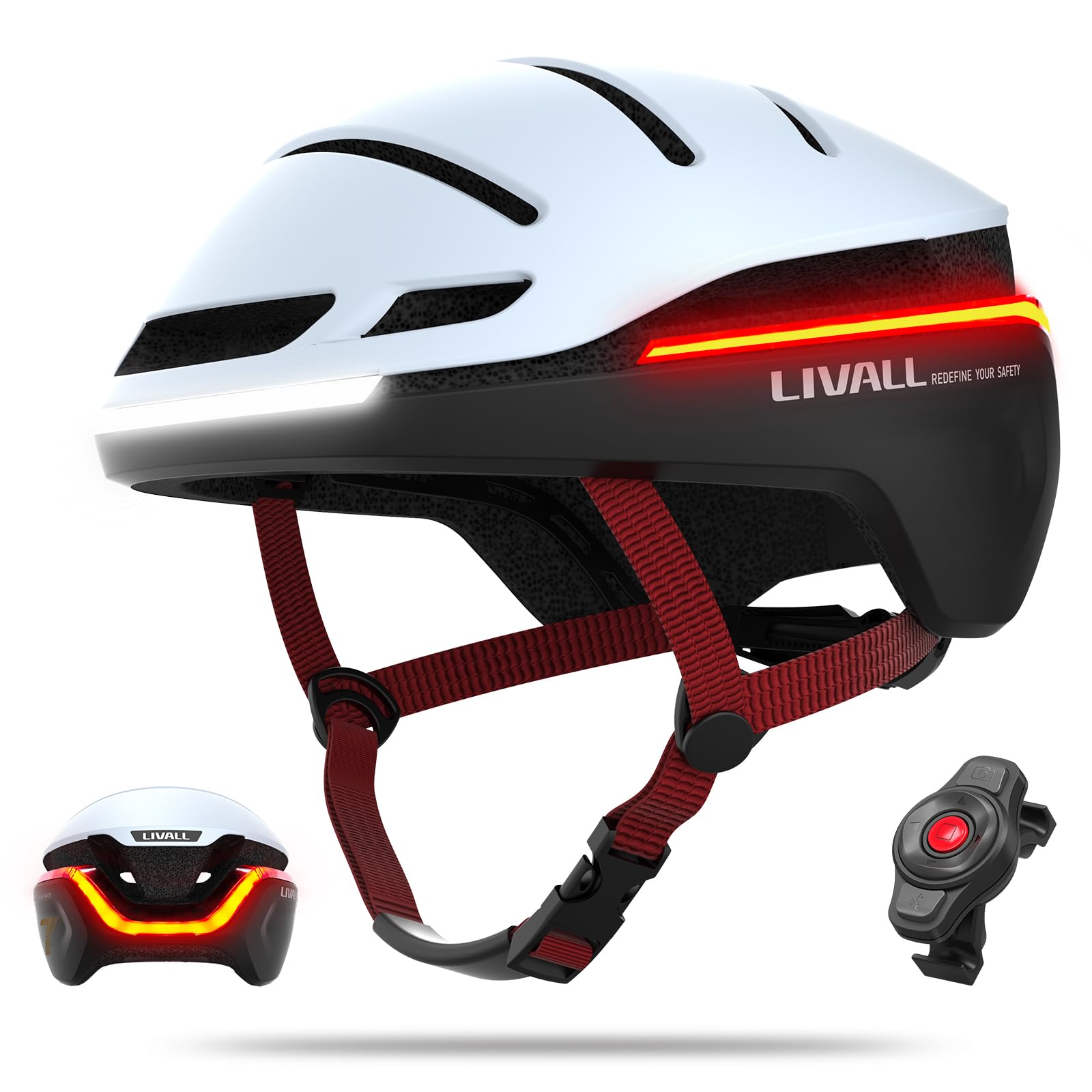
The lightest helmet here that also calls for help if you cannot get up.
At just 350 grams, the EVO21 is the featherweight champion of this list — nearly 115 grams lighter than the ILM. More importantly, it is the only helmet here with built-in fall detection: upon impact, it sends an SOS alert with your location to a pre-set emergency contact via the LIVALL app. For solo riders who hit remote trails or empty streets early in the morning, that feature alone could make the difference between a quick rescue and a long wait.
The helmet earned the iF Gold Design Award, and the 360-degree smart visibility system includes brake warning lights and turn signals controlled by a wireless remote. Intelligent power management puts the helmet into auto-standby when you stop moving and wakes it with a shake, saving battery during breaks. Shoppers say it is comfortable and has great ventilation — “30% more ventilation” than standard models — though a few note the front light reaches only about 10 feet at night, so you may want a supplemental headlamp.
Compared to the XNITO at the top, the LIVALL gives you fall detection and a lower weight (350g vs 13.28 oz) but does not carry NTA-8776 certification, making it less suited for Class 3 e-bike speeds above 20 mph.
Key strengths
- Patented fall detection with automatic SOS alert
- Ultra-light 350 g — barely noticeable on your head
- Auto-standby and wake modes extend real-world battery life
Watch out for
- Front light is limited to about 10 ft — not enough to see the road ahead
- No NTA-8776 certification for high-speed e-bike use
Best for: solo commuters and recreational riders who want a lightweight helmet with lifesaving fall detection and SOS alerts.
Not for: e-bike riders regularly exceeding 20 mph who need high-speed crash certification.
5. Lumos Ultra Bike Helmet
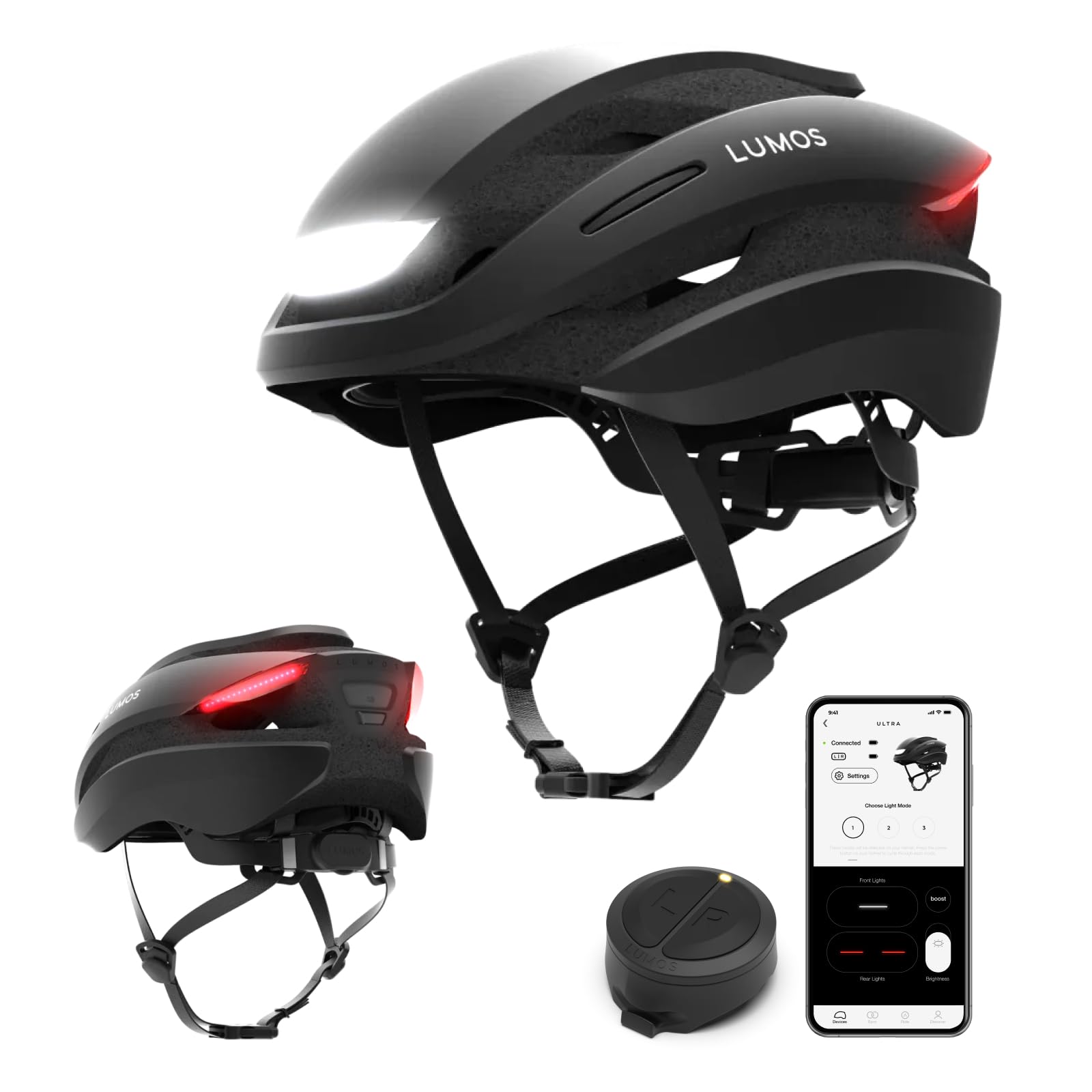
TÜV-tested visibility means an independent lab vouches for how well drivers see you.
The Lumos Ultra is the only helmet here with a TÜV certification for its lighting system — a German testing body confirmed the front and rear LEDs make you genuinely more visible in both day and night conditions. The built-in lights provide 360-degree coverage, and the included wireless Remote Lite activates rear turn signals. You can also buy the Lumos Remote separately to open up automatic brake lights and synchronized flashing with other Lumos lights.
At 390 grams it is reasonably light, and the CPSC-certified shell has a sleek, sporty profile that works for road cycling, commuting, and weekend recreational rides. The Lumos app lets you adjust brightness, switch light modes, and check the battery level. Battery life hits up to 10 hours depending on the mode you choose. Buyers appreciate the fit — one reviewer noted it works well for “Asian head syndrome,” meaning a rounder head shape that some helmets do not accommodate well.
Unlike the ASIEVIE LS01 below, the Lumos Ultra focuses purely on visibility and does not include Bluetooth speakers or a microphone. If you want music on your ride, you need a separate solution.
what separates it
- Independent TÜV certification for real visibility performance
- Comfortable fit for a wide range of head shapes, including rounder heads
- Adjustable light modes and brightness via the smartphone app
The limitation
- No built-in Bluetooth speakers or microphone for music or calls
Pick this if: certified, app-controlled visibility is your top priority and you do not need built-in audio.
pass on it if: you want Bluetooth speakers integrated into the helmet for music and turn-by-turn navigation.
6. ASIEVIE Smart Bike Helmet with Bluetooth
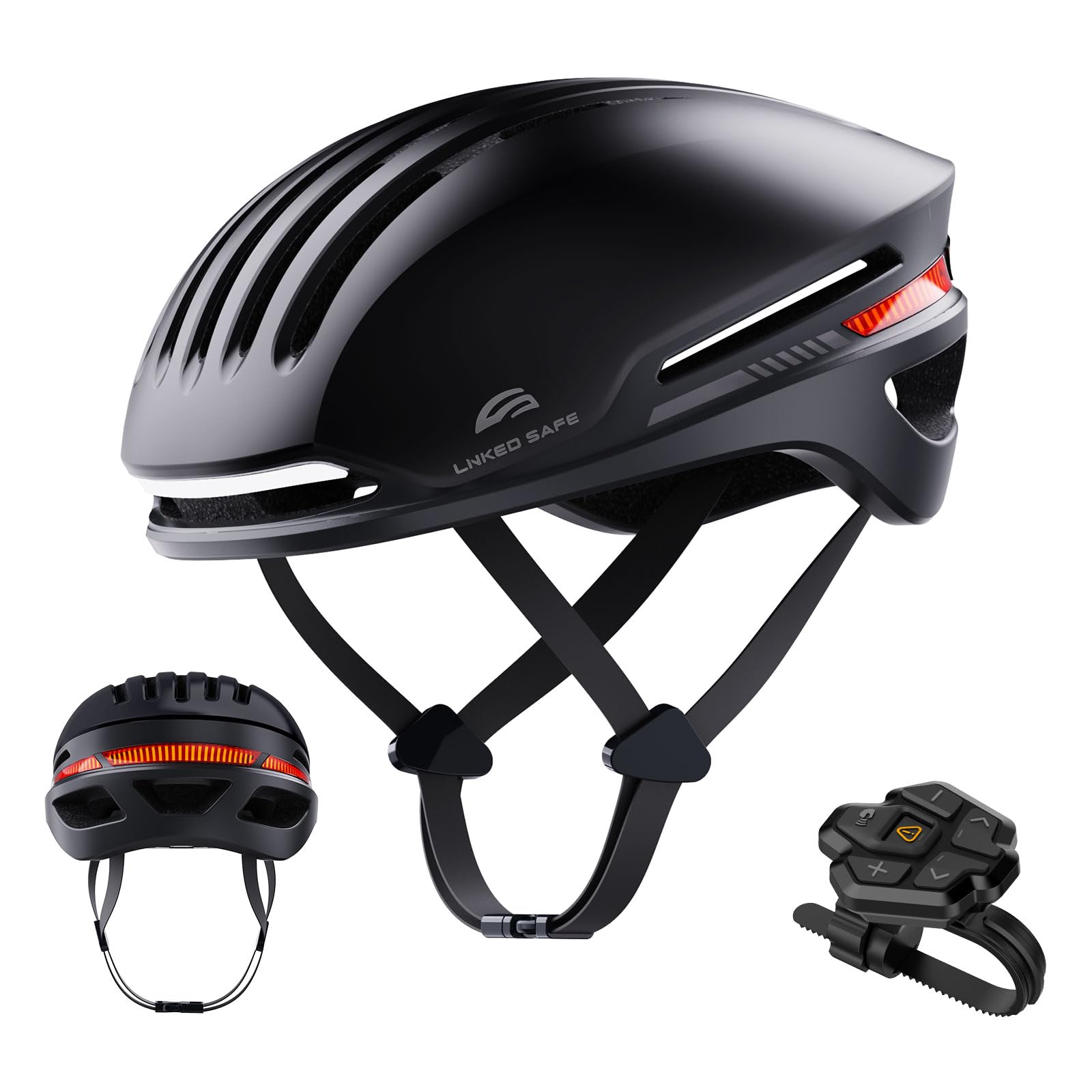
Listen to music through your helmet speakers while keeping your ears open for traffic.
The ASIEVIE LS01 is built for riders who want Bluetooth audio without wearing earbuds. Integrated speakers sit in the helmet straps, letting you stream music, take calls (via the 42dB microphone), or hear navigation prompts while staying aware of surrounding traffic. The Bluetooth 5.3 connection is stable, and the 1000mAh battery delivers 4-18 hours of music playback depending on light use — with 120 days of standby time when fully charged.
Safety features include an 80-lumen headlight for actually seeing the road ahead (a step up from the dimmer lights on some competitors), front and rear LED turn signals controlled by a handlebar remote, and an automatic brake flash alert that activates during sudden stops. The helmet is certified under EN1078, CPC, and FCC standards. At 365 grams it is among the lighter options here, and 19 ventilation holes keep airflow decent.
Buyers report the speakers sound surprisingly good for music and audiobooks, though call quality is mediocre. A reviewer noted the rear light has a “dark gap between segments” that breaks the continuous line, and the front light, while brighter than many, could still be stronger for busy streets at night.
The audio advantage
- Built-in Bluetooth 5.3 speakers and 42dB mic for music and calls
- 80-lumen front headlight — bright enough for road visibility
- 1000mAh battery with up to 120 days standby
Known downsides
- Rear light has a dark gap between LED segments
- Chin strap tends to loosen over time; some buyers glued loose interior parts
Reach for this if: you want a helmet that doubles as wireless headphones for music and calls without plugging your ears.
Look elsewhere if: you need a perfectly gap-free rear light or a chin strap that stays tight without occasional adjustment.
7. Sena R1 Smart Communications Cycling Helmet
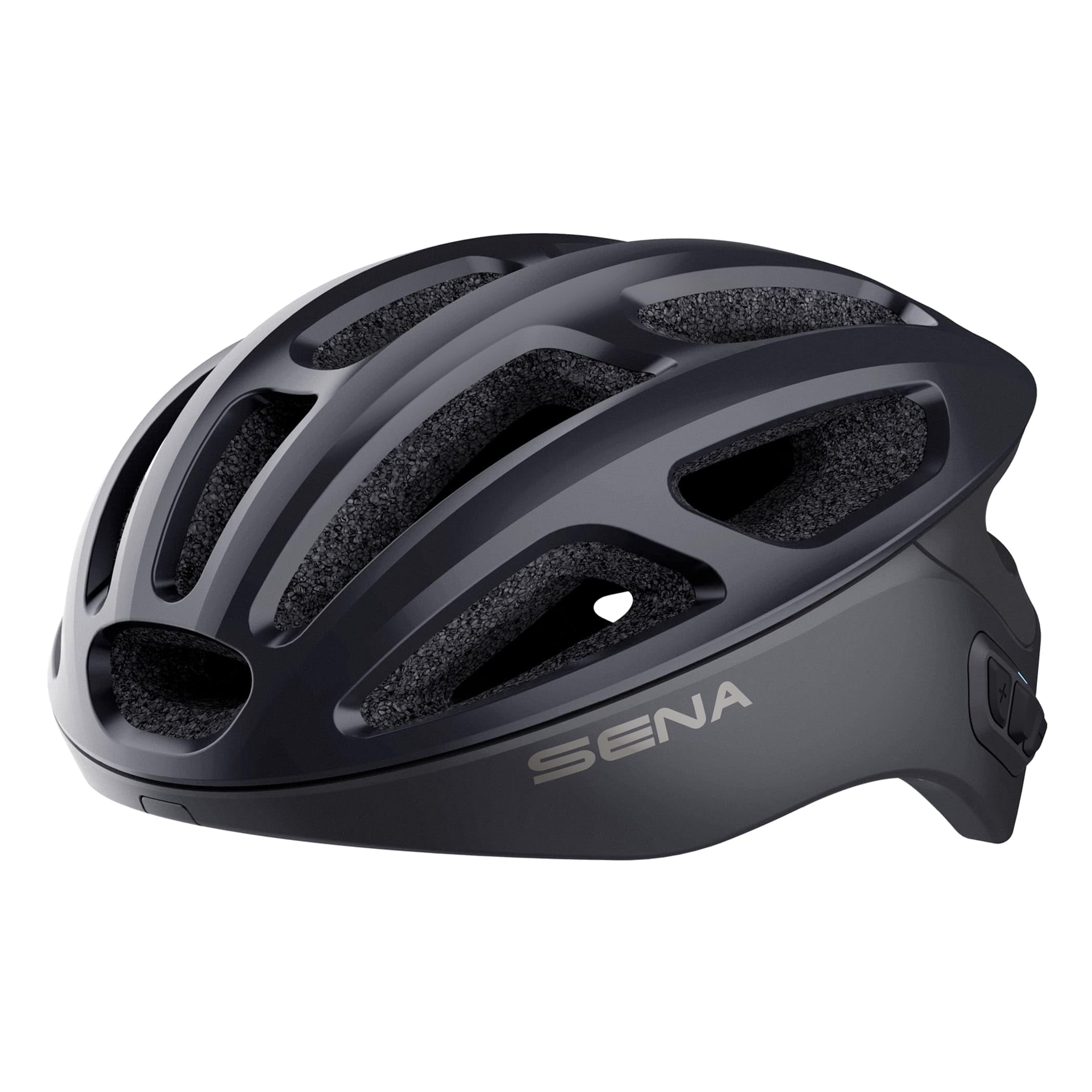
Talk to up to three riding buddies in real time without waving your hands.
The Sena R1 is built around its group intercom system, letting you communicate with up to three other riders simultaneously over Bluetooth. This is the helmet for family group rides, club training sessions, or any scenario where talking beats shouting. The integrated speakers and microphone handle music streaming and phone calls too, but the intercom is the headline act — owners mention clear communication with minimal wind noise and a range of about 0.3 miles between riders.
At 380 grams it is mid-weight, and the polycarbonate shell with EPS (expanded polystyrene) liner provides standard CPSC-level impact protection. The padding is removable and washable, and the spin-lock adjustment system keeps the fit secure. Battery life is strong enough for a full day of riding — one buyer mentioned 50 miles on a single charge and a “line-of-sight” range that works well on open trails.
The catch is that this helmet is designed for communication first and integrated lights second — it does not have the built-in front/rear LEDs or turn signals that the other helmets here offer. You get none of the smart lighting features that make the XNITO or LUMDEER so visible at night. Buyers also caution that sizing runs small, so consider ordering one size up from your usual fit.
The standout feature
- Group intercom connects up to 4 riders with clear audio and minimal wind noise
- Removable, washable padding and secure spin-lock fit
- Good battery life for full-day rides (up to 50 miles per charge per one report)
The trade-off
- No built-in LED lights, turn signals, or brake light — you still need separate bike lights
- Helmet runs small; many buyers advise ordering at least one size larger
Perfect for: group riders and families who want to talk to each other during the ride and do not need integrated lighting.
Not for: anyone who wants a helmet with built-in visibility lights — the R1 is a communications device that happens to be a helmet, not a smart lighting helmet.
Understanding the Specs
NTA-8776 Certification
This is a Dutch safety standard designed specifically for e-bikes and speed pedelecs that travel up to 28 mph. A standard CPSC (Consumer Product Safety Commission) bike helmet is only tested to about 12-15 mph. NTA-8776 means the helmet’s EPS foam liner is thicker and covers a larger area of the back and sides of your head. If you ride a Class 3 e-bike, an electric scooter, or any fast electric bike, NTA-8776 certification should be at the top of your checklist — a CPSC-only helmet may not offer enough protection at those speeds.
G-Sensor and Fall Detection
A G-sensor (a tiny accelerometer that detects sudden movement changes) is what makes a helmet “smart” rather than just lit. In helmets like the ILM, a G-sensor triggers automatic brake lights when it detects sudden deceleration and activates turn signals when you tilt your head. In the LIVALL EVO21, a more advanced G-sensor detects the sharp impact of a crash and sends an SOS alert with your GPS location to an emergency contact. Not all smart helmets have these — some just have always-on LEDs or manual remote controls — so decide if you want passive automation or just basic visibility.
FAQ
Do I need NTA-8776 certification if I only ride a regular bike?
How long do smart helmet batteries typically last?
Can I use a smart helmet in the rain?
Will a smart helmet fit my large or small head?
Is a smart helmet worth the extra cost over a regular helmet?
How do handlebar turn signal remotes attach?
What does CPSC certification mean for a bike helmet?
Can I pair a smart helmet with my phone for music?
What happens if my smart helmet gets damaged in a crash?
Are smart helmets heavier than regular bike helmets?
Final Thoughts: The Verdict
For most riders, the smart bike helmet to buy is the XNITO Urbanite because it pairs lightweight dual certification for high-speed e-bikes with bright integrated LEDs and a lifetime crash replacement policy — all in one streamlined package. If you want automatic turn signals and brake lights triggered by your head movement, grab the ILM E3-12LS. And for deep-battery longevity with an auto-tinting visor, the LUMDEER 16F-01 is the one to beat.
How We Picked
We do not accept paid placement. Every pick is matched to a real buyer and a real use-case; we do not hands-on test units.
Sources & Methodology
Specifications: manufacturer listings and product documentation. Review insights: verified customer reviews, as of July 2026. Pricing: not shown on this page (it changes often); check the current price via the retailer link.
As an Amazon Associate, Trending Car earns from qualifying purchases. This does not affect which products we feature.