
Our readers keep the lights on and my garage snacks stocked. As an Amazon Associate, I earn from qualifying purchases.
Specs are compiled from manufacturer listings and verified buyer reviews and can change over time — please confirm the key details on the product page before buying.
Your car’s 12V socket can power more than just phone chargers when paired with the right inverter. The right inverter converts that 12V power into a standard AC outlet for laptops, phones, and small fans. Match the inverter’s wattage to your devices, since the socket’s 10-15A fuse caps real output around 120-180W.
I’m Min Islam — the founder and writer behind Trending Car. This guide is built by comparing the manufacturers’ published specifications and the patterns across verified customer reviews, so you get each pick’s real strengths and trade-offs instead of marketing spin.
Inverters that plug into the lighter socket have a hard ceiling on output, so we focused on what genuinely works for daily commutes and road trips. Find the best fit among the power inverter for car cigarette lighter.
Our Picks at a Glance

How To Choose The Best Power Inverter for Car Cigarette Lighter
Choosing the wrong inverter usually means blowing a fuse or watching your laptop refuse to charge. The safety rule is simple: the cigarette lighter socket is typically fused around 10 to 15 amps, which translates to roughly 120 to 180 watts of real usable power. A 400-watt inverter still only gets what that fuse allows.
Match the wattage to the fuse, not the sticker
Every inverter in this list advertises a continuous wattage number, but that only matters if the plug can actually deliver it. A 150W or 200W unit sits comfortably within the socket’s limits. A 400W or 500W unit needs the engine running and a thick enough circuit, otherwise you will trip the fuse the moment you plug in a high-draw device.
Check the charging ports before you count the AC outlets
Most modern inverters bundle USB-C and USB-A ports that can charge a phone faster than a wall adapter. Look for USB-C Power Delivery (PD) wattage — a 65W PD port handles a MacBook directly, while a 30W port tops off tablets and phones. The AC outlets are for anything with a physical wall plug.
Quick Comparison
| Model | Best For | Continuous Power | USB-C Port | Waveform | Amazon |
|---|---|---|---|---|---|
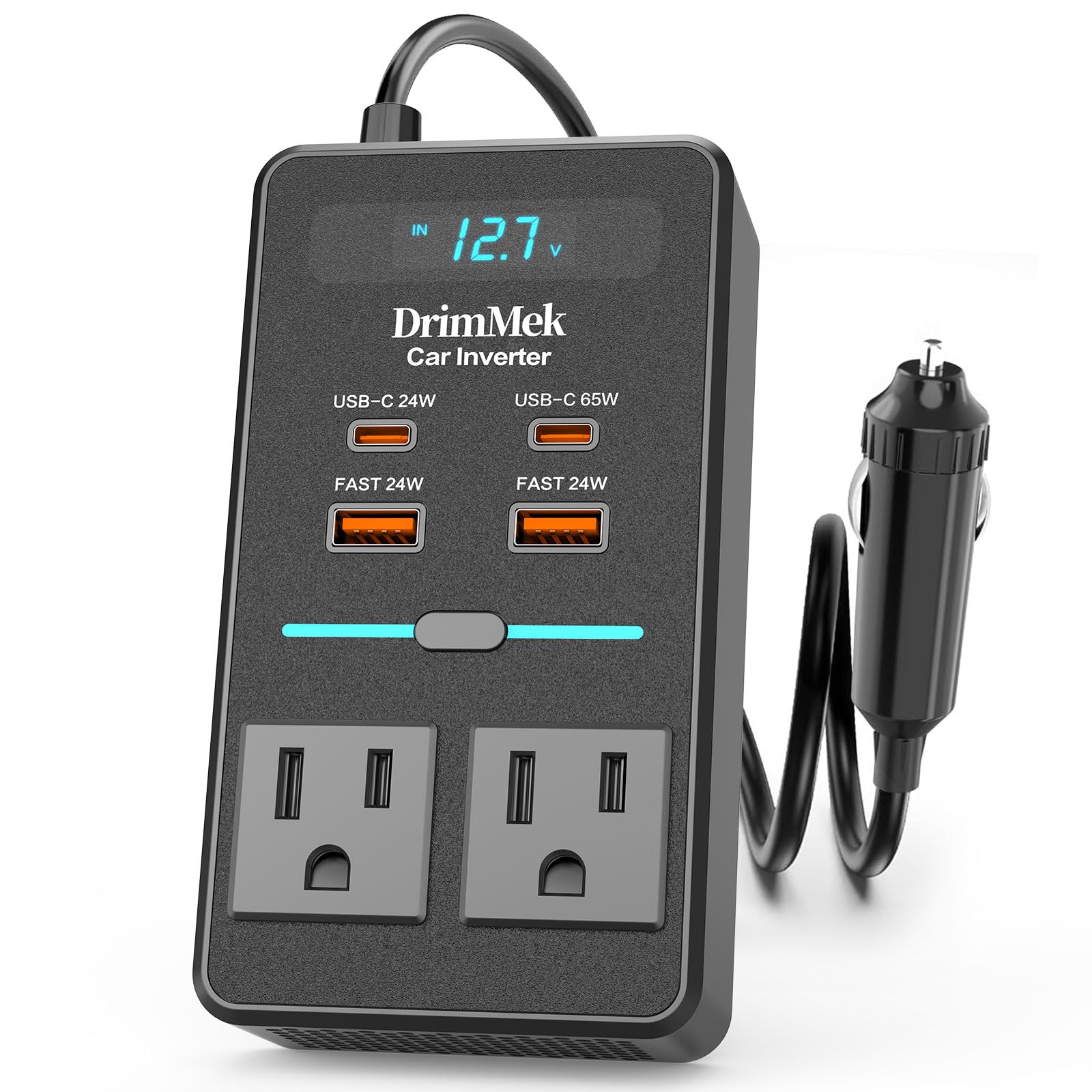
| DrimMek 300W★ Best Overall | Best Overall | 300 watts | 65W + 24W | Modified Sine | Amazon |
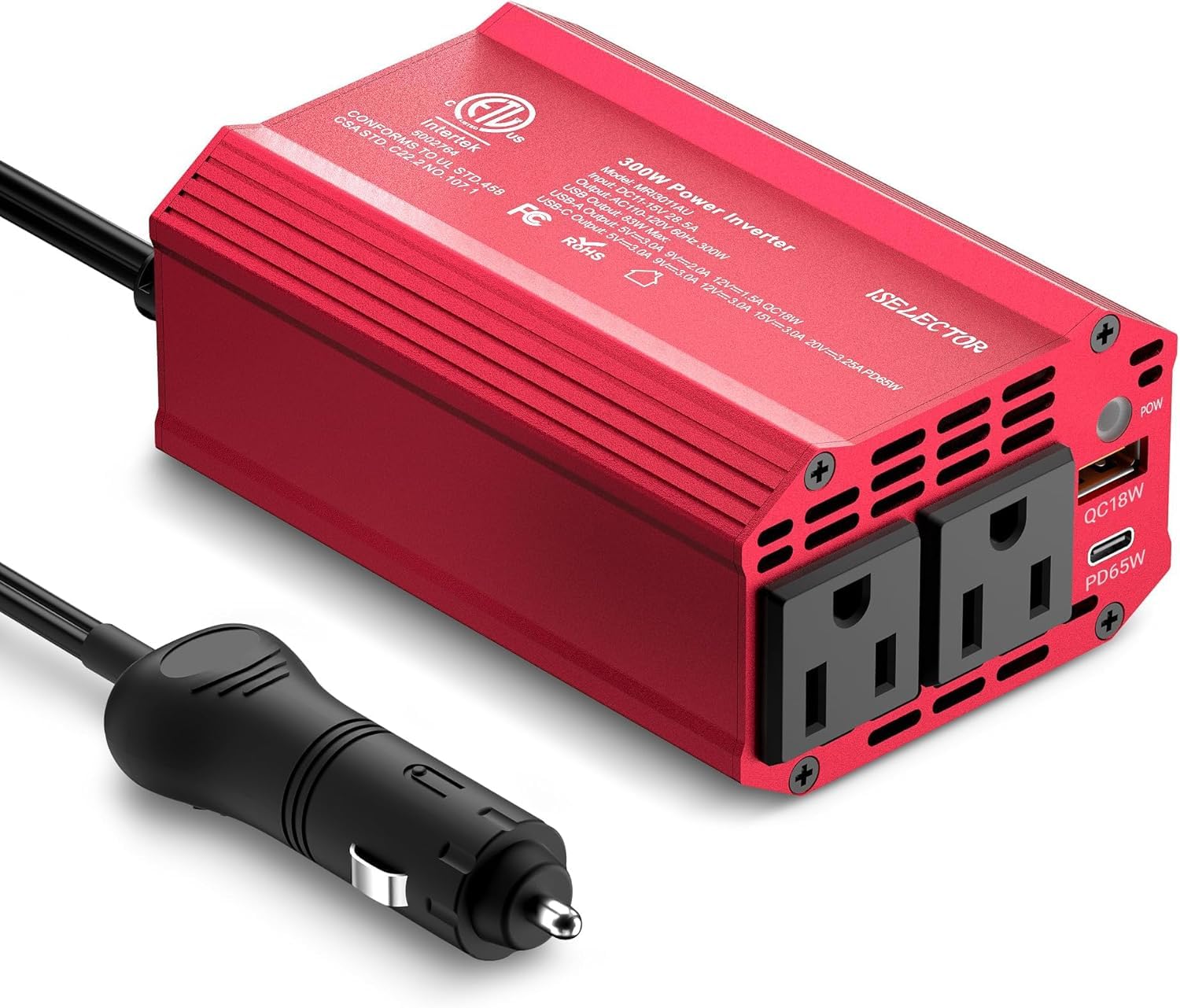
| ISELECTOR 300WCompact Pick | Compact Pick | 300 watts | 65W PD | Modified Sine | Amazon |
| FSATBTNE 400WTop Performer | Top Performer | 400 watts | 65W PD | Modified Sine | Amazon |
| BYGD 150W | Budget Champion | 150 watts | — | Modified Sine | Amazon |
| vansoet 200W | Value Pick | 200 watts | 65W + 30W | Modified Sine | Amazon |
| Pro Chaser 400W | Premium Pick | 400 watts | — | Modified Sine | Amazon |
| POTEK 500W | High Output | 500 watts | — | Modified Sine | Amazon |
| BYGD 200W | Multi-Device | 200 watts | 1 Type-C | Modified Sine | Amazon |
| Giandel 300W | Pure Sine Pick | 300 watts | PD 30W | Pure Sine Wave | Amazon |
In‑Depth Reviews
1. DrimMek 300W Car Power Inverter
Our pick — 4.5★ from 700+ verified ratings; the strongest balance of quality and price.
A glove-box-sized 300W inverter with a 65W USB-C port for fast laptop charging.
The thing that wins people over here is the build quality and the sheer speed of that 65W USB-C port, both earning the loudest praise in owner feedback. You can charge a laptop right from the USB-C port without burning an AC outlet, and the dual 110V AC outlets keep a second device like a camera battery going at the same time.
It handles anything under 300 watts without complaint, which covers laptops, tablets, and small appliances. The quiet fan keeps noise down during long drives, and its compact, lightweight frame at just 8 ounces slips into a center console or door pocket easily.
One small quirk in the feedback: you press a manual button to activate it, which some owners actually like because it prevents battery drain when the car is off. The “Great car inverter! It works exactly as advertised” line from buyers sums up the sentiment — reliable, fast, and genuinely portable for trips and emergencies.
What Owners Rave About
- Fast 65W USB-C charging for laptops and phones
- Multiple ports — 2 AC outlets, 2 USB-C, 2 USB-A
- Compact and lightweight enough to hide in the car
- Quiet operation for a fan-cooled inverter
The Trade-Offs
- Requires a manual button press to power on
- Modified sine wave output, not for ultra-sensitive gear
- The second AC outlet is more limited for high-draw items
Reach for this if: you want one inverter that does it all — fast USB-C laptop charging, multiple AC outlets, and a size that disappears in the glove box.
Look elsewhere if: you need pure sine wave output for sensitive medical or audio equipment, since this runs modified sine.
2. ISELECTOR 300W Power Inverter
A compact 300W inverter that fits tight consoles without scratching surfaces.
At 4.37″L x 3.47″W x 1.89″H, this is the most compact 300W option in the lineup — noticeably smaller than the DrimMek above, which measures 5.5″L x 3″W x 1.4″H. That footprint matters when you keep it plugged in permanently, since several owners swapped out a finned converter that was scratching their center console for this smoother design.
The fast-charging story is strong: the USB-C port hits 65W PD max and the USB-A port delivers 18W QC, with the PD port rated 6X faster than a standard 2.4A charger. Buyers report the conversion is efficient and the device draws very little power when idle, which is exactly what you want in a unit that stays connected.
It’s ETL-certified and adds a 40-amp fuse plus short-circuit, under-voltage, and over-voltage protection to keep your gear safe. The smart cooling fan ramps its speed based on load and temperature, which is why owners describe it as quiet even during extended use.
Standout trait: The tiny footprint plus a 23.8-inch cable makes it an easy fit for tight center consoles.
Honest caveat: Some AC plug shapes don’t seat fully due to the compact outlet design, so bulky adapters might need a short extension cord.
Best for: anyone who leaves an inverter plugged in daily and wants minimal bulk with reliable 65W USB-C output.
Who should skip: drivers using oversized wall-wart adapters that may not fit flush into the AC outlets.
3. FSATBTNE 400W Power Inverter
A rugged 400W continuous inverter with an aluminum housing for heat dissipation.
This one jumps the wattage ladder — 400 watts continuous and 800 watts peak, a full 33% more output than the 300W units from DrimMek and ISELECTOR above. That extra headroom means it can run a small fan, a laptop, and a phone charger all at once without breathing hard.
Reliability is the number one thing owners single out, and the design backs it up: an aluminum alloy housing sheds heat efficiently, while an MCU smart chip auto-detects the voltage and current each device needs. The intelligent cooling fan adjusts speed by temperature and load, so it stays quiet in normal driving.
You get fast charging for your laptop — the brand claims a MacBook Pro 14″ hits 50% in about 37 minutes through the 65W USB-C port — and most buyers agree, though a few found the USB-C port wouldn’t charge certain items. Buyers also report it handled direct Florida sun mounted on a boat without issue, which speaks to the heat tolerance.
Why It Leads
- 400W continuous power with 800W surge headroom
- Rugged aluminum housing for heat dissipation
- Fast 65W USB-C charging for modern laptops
- 24-month warranty included
Watch Out For
- USB-C charging speed gets mixed feedback from owners
- Modified sine wave output limits sensitive electronics
- The 24-inch cord is fine but not generous for rear-seat use
Pick this one if: you want maximum continuous wattage from a lighter-plug inverter to run multiple devices on long hauls.
Think twice if: you rely heavily on the USB-C port — a few owners reported inconsistent charging across different devices.
4. BYGD 150W Car Power Inverter

A budget 150W inverter with three AC outlets and a long 35.5-inch cable for rear-seat reach.
This entry-level inverter keeps things straightforward: 150 watts continuous, three 110V AC sockets, two 2.4A USB ports, and a long 35.5-inch cable that reaches the back seat. It weighs 1.1 pounds and measures 9.4″L x 2.5″W x 1.9″H, making it a slim, durable brick you can toss in a door pocket.
For a budget unit, the build quality earns consistent praise, and owners note it charges phones reliably for three people on long drives. The ABS high-temperature housing and isolation transformer add a layer of protection, while the silent auto-control fan keeps heat in check.
Honest truth: this one shows the most variation in owner experience. Some units reportedly arrived faulty or failed to power a 130W laptop despite the 150W rating, and a few found the plug needed the metal contacts pressed inward to seat properly in the socket. It’s the classic budget trade-off — great value when you get a good unit, but quality control isn’t as consistent as pricier options.
Best angle: The three AC outlets at this price point is genuinely rare, and the 35.5-inch cord beats most rivals for reach.
Fair warning: Keep loads well under 150W — reviewers found it struggles near its rated ceiling, and the fan is audibly louder than premium units.
Great for: budget buyers who need multiple AC outlets for small electronics and don’t push wattage limits.
Not for: anyone planning to run high-draw gear near the rated capacity, where the fuse becomes the bottleneck.
5. vansoet 200W Car Power Inverter
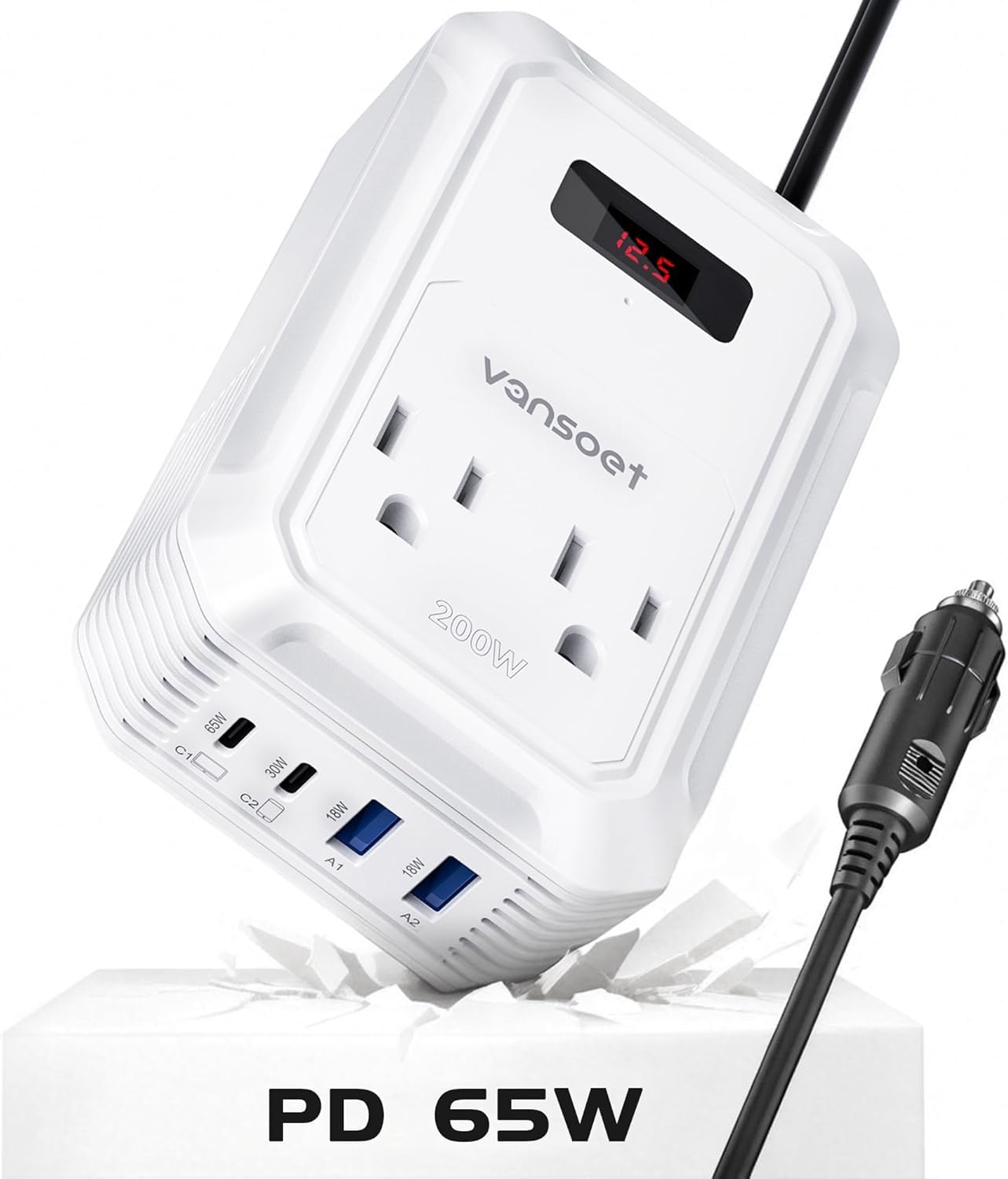
A 200W inverter with 131W total USB output to charge laptops and phones simultaneously.
If your real need is charging speed, this 200W unit throws the most USB firepower at you: two USB-C PD ports at 65W and 30W plus two QC 18W USB-A ports, all totaling 131W. That means you can fast-charge a laptop, two phones, and earbuds simultaneously through USB alone, leaving the dual AC outlets free for something like a small monitor.
Beyond the ports, you get a voltage LED monitor (a small display that shows your car’s battery level) and ETL certification (a safety standard from a recognized testing lab) for confidence. Owners highlight how well it works in Teslas and EVs with 15V systems, and one detail stands out — someone runs a Blueair air purifier through it in a 2010 Toyota Prius for wildfire smoke season, which shows the real-world versatility.
Performance is the most-praised aspect, followed closely by charging capability. The quiet cooling fan adjusts automatically, and the whole unit stays cool under normal load. One honest caveat: pushing past 200 watts blows fuses, so it’s not for high-watt appliances like mini-fridges, despite what the marketing list suggests.
What Makes It Great
- 131W total USB output — the best in this lineup
- LCD voltage display lets you watch battery health
- Fits smugly into the cigarette lighter outlet
- 180-day refund window from the maker
Know Before Buying
- 200W ceiling means no high-watt appliances
- Modified sine wave limits sensitive gear
- 24-inch cable from the specs
Reach for this if: you have a modern phone and laptop ecosystem that charges over USB-C and want one compact hub to feed them all.
skip it if: you need to run AC appliances that draw more than 200 watts, where the fuse trips fast.
6. Pro Chaser 400W Power Inverter

The UL-certified road warrior that powers a raft pump at the beach and a laptop in the cab.
Performance is what owners rave about most here, and the specs justify it: 400 watts continuous, 800 watts peak, dual 110V AC outlets, and two USB ports delivering 6.2A total. The 30-inch cord extends reach beyond most rivals, and the compact 4.85″L x 3.1″W x 1.81″H frame sits easily under a seat.
A nice touch in the box: USB-to-USB-C adapters included, plus green and red status lights that give instant power feedback. UL certification adds a layer of trust, and the built-in protections cover short-circuits, overloads, and extreme temperatures.
Owner stories paint a picture of real utility — someone brought an electric raft pump to the beach and realized the outlet was in the console, and the inverter saved the day. That said, reliability gets the harshest feedback in this lineup, with a chunk of owners reporting units failing after minimal use. It performs while it works, but durability is the risk you take.
Where it shines: The included USB-C adapters and 30-inch cord make it the most flexible pick for back-seat and tailgate use.
The real risk: A meaningful share of owners mention units breaking early — the performance is there, but longevity is inconsistent.
Best for: drivers who want premium power output with generous reach and don’t mind the occasional durability gamble.
Think twice if: you need a set-and-forget unit; the reliability complaints suggest treating this as a travel tool, not a permanent install.
7. POTEK 500W Power Inverter

The heaviest hitter in the socket family, built to run a drill or a CPAP from the lighter plug.
This is the most powerful unit that still connects purely through the cigarette lighter socket — 500 watts continuous and 1000 watts surge. It converts 12V DC to standard 115V AC and handles serious loads; customers note running power tools through an extension cord without issue.
At 2.2 pounds and 6.7″L x 4.1″W x 2.2″H, it’s the largest of the plug-in group, but that weight buys a beefy design with UL certification. The dual AC outlets plus a 2A USB port cover most road-trip needs, and the digital display shows output status at a glance.
Buyers describe it as quiet and capable, with one noting it handled heavy loads up to 400W without complaint. The build quality feels solid, and it gets warm but not hot under load. If you’re upgrading from a 150W unit, this is the jump that finally lets you run real appliances.
The Power Play
- 500W continuous with 1000W surge headroom
- Runs power tools and CPAP machines via lighter plug
- UL certified with overload, overheat, and short-circuit protection
- Quiet operation for the power class
Brace For
- Heaviest and bulkiest of the plug-in inverters
- Only 2A USB ports — no fast charging here
- Needs engine running for full 500W draw
Choose this for: serious power needs from a lighter plug — tools, CPAP, and multi-device setups that smaller units can’t touch.
Pass if: you want USB-C fast charging or a compact footprint, since this is the biggest and the USB ports are dated.
8. BYGD 200W Car Power Inverter

The grandkid-transport solution with enough USB ports to charge a whole back seat.
Four 2.4A USB ports is the headline here — more than any other unit in this list — plus a Type-C port and dual AC outlets. That’s the setup for a family where everyone has a phone, and owners confirm it: “Perfect for when I have my granddaughters in the car with me and everyone needs to be charging something.”
The build quality gets consistent praise, and the inline form factor is convenient for tucking along a seat. It uses an ABS fire-resistant housing with an isolating transformer and long-press power button (hold 3 seconds to toggle). The 35.5-inch cable matches the budget BYGD 150W above, giving solid reach.
A few quirks surface: the power switch isn’t a physical toggle, so after the car ignition cycles you must manually reset it, and the button can be hard to locate. The cooling fan runs quiet, and owners rate the charging speed as excellent across all the ports.
Defining strength: The four 2.4A USB ports plus Type-C is class-leading for carloads of devices needing simultaneous charging.
Minor friction: The non-toggle power switch resets after ignition cycles, so you’ll be pressing the button more than you expect.
Best for: families and carpool drivers who need max USB ports for phones, tablets, and game consoles on the road.
Not ideal for: commuters who want a set-and-forget unit, given the manual reset dance after every engine start.
9. Giandel 300W Pure Sine Wave Inverter

The clean-power specialist that treats sensitive electronics with a true sine wave.
Every other unit in this guide runs modified sine wave, but the Giandel is the one exception — it delivers pure sine wave output that matches your home wall current. That’s the spec that matters if you’re powering CPAP machines, sensitive audio gear, or any device with a fussy power supply that hums or glitches on modified wave.
It converts 12V DC to 120V AC at 300 watts continuous with 600 watts peak, and reliability earns the most praise of any aspect in this entire list. Reviewers point out clean, stable voltage in the 117-122V range on a steady 60Hz, which is exactly what sensitive gear wants.
The honest catch is real-world wattage: the cigarette lighter plug naturally limits you to around 120W despite the 300W rating, because the socket’s 10A fuse and 16AWG wire can’t safely deliver more. Owners who measured it with an oscilloscope confirm the output is genuinely clean — but pushing toward 300W through that plug is unsafe. The aluminum housing and isolated input/output design add durability and protection.
The Clean Power Case
- Pure sine wave output — the only one in this lineup
- Reliability is the single most-praised aspect across all 9 products
- Aluminum alloy housing for drop protection
- Quiet fan that runs intermittently under load
The Reality Check
- Cigarette plug limits real output to ~120W despite 300W rating
- 16AWG cord runs hot under heavy load
- No battery clamps included for higher-draw setups
Reach for this if: you’re powering sensitive electronics like CPAP machines or high-end audio that demand clean pure sine wave power.
Look elsewhere if: you need full 300W output — the lighter socket physically can’t deliver it, so consider this a ~120W clean-power tool.
Understanding the Specs
Continuous vs Surge Watts
Continuous watts is what an inverter can feed a device indefinitely — that’s the number to match against your laptop’s charger rating. Surge watts is the brief burst of power it can supply for a second or two when a device first spins up, like a fan starting or a compressor kicking in. Always match your sustained load to the continuous rating, not the surge number, or you’ll trip the fuse on a regular basis.
Modified vs Pure Sine Wave
This describes the shape of the electrical current coming out of your 110V outlet. Modified sine wave is a stepped approximation that works fine for laptops, phone chargers, and most small electronics. Pure sine wave is a smoother, cleaner current that matches home wall power — it matters for CPAP machines, medical devices, and sensitive audio gear that can hum, glitch, or run hot on modified wave. If a device has a name-brand power brick, modified is usually fine.
FAQ
Will a 400W inverter actually deliver 400 watts from the cigarette lighter socket?
What’s the difference between a 65W USB-C port and a regular USB port on an inverter?
Can I leave the inverter plugged in when the car is off?
Will a modified sine wave inverter damage my laptop or phone?
What size inverter do I need to charge a laptop while driving?
Why does my inverter smell like burning plastic the first time I use it?
Can I run a mini-fridge through a cigarette lighter inverter?
What does the LCD display on some inverters actually show?
Is a 500W inverter with a cigarette plug worth buying or just marketing?
Final Thoughts: The Verdict
The wholesale crowd favorite here is the power inverter for car cigarette lighter from DrimMek — it’s the 300W DrimMek because it pairs a 65W USB-C port, dual AC outlets, and a compact frame with the strongest build-quality reputation in the group. If fast USB-C charging for a modern laptop ecosystem matters more than raw wattage, the vansoet 200W throws 131W of USB power at you with an LCD display. And for sensitive electronics that demand clean current, the Giandel 300W pure sine wave is the one to reach for — just remember the lighter socket caps real output around 120W.
How We Picked
We do not accept paid placement. Every pick is matched to a real buyer and a real use-case; we do not hands-on test units.
Sources & Methodology
Specifications: manufacturer listings and product documentation. Review insights: verified customer reviews, as of August 2026. Pricing: not shown on this page (it changes often); check the current price via the retailer link.
As an Amazon Associate, Trending Car earns from qualifying purchases. This does not affect which products we feature.