
Our readers keep the lights on and my garage snacks stocked. As an Amazon Associate, I earn from qualifying purchases.
Specs are compiled from manufacturer listings and verified buyer reviews and can change over time — please confirm the key details on the product page before buying.
A dull, scratched paint job eats away at a car’s pride and joy. The wrong polishing kit can make things worse, leaving holograms or burning through the clear coat. This guide cuts through the noise to find the setup that actually restores your finish without the risk.
I’m Min Islam — the founder and writer behind Trending Car. This guide is built by comparing the manufacturers’ published specifications and the patterns across verified customer reviews, so you get each pick’s real strengths and trade-offs instead of marketing spin.
We have looked at seven of the most popular options on the market, from cordless mini units to full-size corded machines, to help you find the best polishing kit for car detailing for your specific skill level and garage setup.
Our Picks at a Glance

How To Choose The Best Polishing Kit for Car Detailing
Picking a polishing kit is not just about grabbing the one with the highest RPM. You need to match the tool to the size of the panel, your own physical comfort, and whether you value freedom of movement over unlimited runtime. Here are the three specs that matter most.
Orbital Throw and Motion Type (DA vs. Rotary)
The most important safety feature is dual-action (DA) motion, where the pad both spins and oscillates. This prevents you from burning the paint even if you linger in one spot, which is why it is perfect for beginners. The throw — usually 9mm or 15mm — determines how fast you cover a panel; a longer throw like 15mm corrects faster but is harder to control on tight curves.
Power Source and Weight
Corded machines never run out of juice, making them ideal for longer full-car sessions. Cordless units let you work anywhere without a tangle, but you have to plan around battery life. Weight is critical because you will hold the machine for hours. A 9-pound polisher can fatigue your arms on a roof, while a 3-pound unit is easy to handle.
Pad System and Included Accessories
The best kit saves you a second trip to the store. Look for a set that includes a variety of foam pads (cutting, polishing, finishing) and a decent backing plate. Wool pads are aggressive for heavy correction, while microfiber bonnets are for wax removal. A solid kit also includes a carrying bag, microfiber towels, and extra backing plates for different pad sizes.
Quick Comparison
| Model | Best For | Power | Speed | Weight | Amazon |
|---|---|---|---|---|---|
| BATOCA 6″ DA★ Best Overall | Best overall kit value | 700 W (Corded) | 3800 RPM | 9.15 lbs | Amazon |
| Adam’s Polishes 9mm DATop Performer | Flawless pro-level correction | 1000 W (Corded) | 6500 OPM | 5.5 lbs | Amazon |
| BATOCA S5 Cordless | Tight spots and detail work | 12V Battery | 5500 RPM | 2.04 lbs | Amazon |
| Vkdemer Cordless 6″ | Cordless all-rounder | 21V Battery | 5500 RPM | 3 lbs | Amazon |
| THINKWORK 10″ | Large surface area waxing | 20V Battery | 3600 RPM | 7.28 lbs | Amazon |
| LotaTools (Dewalt) | Dewalt battery users | 20V Battery | 5500 RPM | — | Amazon |
| SPTA Mini Polisher | Motorcycle and tight areas | 12V Battery | 4500 RPM | — | Amazon |
In‑Depth Reviews
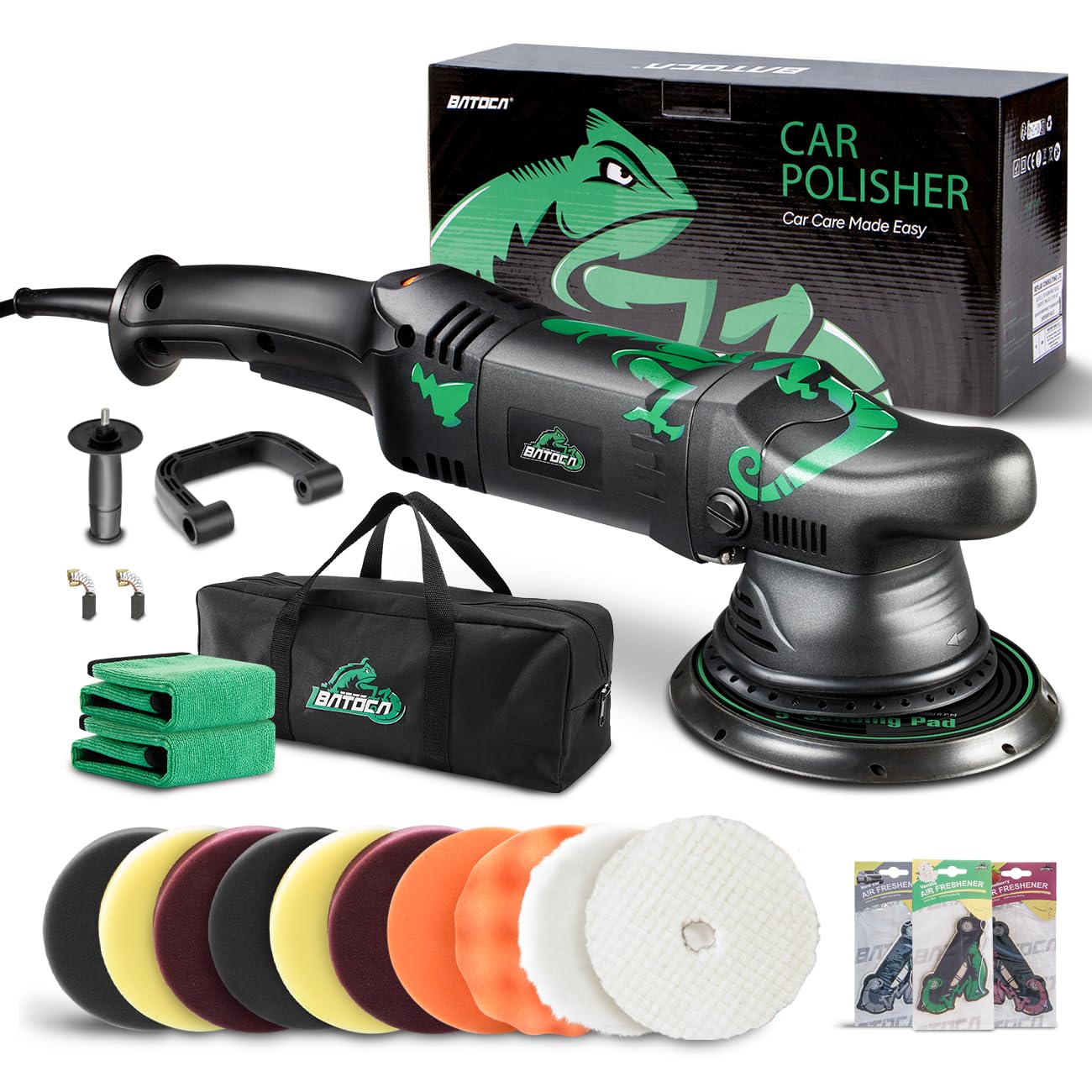
1. BATOCA 6″ Dual Action Random Orbital Car Polisher
Our pick — 4.5★ from 900+ verified ratings; the strongest balance of quality and price.
A heavy-duty corded workhorse that comes with everything a beginner needs to finish a full car.
If you want one box that contains the tool, the pads, and the extras, this is it. The BATOCA kit includes foam pads, wool pads, sanding papers, a microfiber towel, and even a pair of carbon brushes for replacement. The 700W motor and 6 variable speeds, from 1000 to 3800 OPM, let you dial in the right aggression for waxing at low speed or defect removal at high speed. It is a substantial 9.15 pounds, which is noticeably heavier than the 5.5-pound Adam’s Polishes unit, but that heft gives it stability on flat panels.
The eccentric shaft design uses an orbital vibration motion that ensures wax is deeply absorbed into the paint, and beginners report no issues with burning the clear coat. One reviewer noted they “used to detail 3 cars for 8 hours total” without any hiccups, which speaks to its thermal endurance.
What makes it a great starter
- Complete kit with foam, wool, sanding, and tools included
- 6 variable speeds from 1000 to 3800 OPM tailored for every stage
- Corded power means no battery anxiety for long sessions
The heavy-consideration
- At 9.15 pounds, it will fatigue your arms on vertical panels and roofs
- Pads are stiff from the start and need a break-in period
Who it fits: A first-time buyer who wants an everything-included pack for full-car paint correction. Who should skip it: Anyone who wants a lightweight or cordless tool for quick touch-ups.
2. Adam’s Polishes 9mm Dual Action Car Polisher Kit
The serious enthusiast’s choice that blends pro-grade power with beginner-friendly safety.
This is a machine built for people who care about the final 10% of the finish. The 9mm long-throw orbit paired with a 1000W motor and a max speed of 6500 OPM delivers the kind of paint-correction speed that turns a neglected sedan into a show-ready surface. Unlike the BATOCA’s 700W corded unit, this one has 300 more watts on tap for tackling deeper scratches without bogging down. Weighing 5.5 pounds, it strikes a comfortable middle ground between the heavy 9.15-pound BATOCA and lightweight cordless models, making a full-day detail session on a 2021 Jeep Wrangler (which one reviewer reports finishing in 4.5 hours) feel manageable.
The ergonomics also stand out. The concave rubber contact points absorb vibration, and a 16-foot cord means you are not constantly hunting for another outlet. This kit covers the essentials with a backing plate and the polisher itself, but you will want to buy additional pads for a three-step correction.
Real-world verdict: Buyers rave about the smooth glide and minimal vibration — one owner said it produced a “gorgeous shine” on a 2012 car with very little effort. This is the pick if you want professional results and are ready to invest in the tool that makes it possible.
Reach for this if: You plan to correct multiple cars or want the closest thing to a pro buffer without the rotary risk. Look elsewhere if: You only need a quick wax job and want a cordless, all-in-one kit with pads included.
3. BATOCA S5 Cordless Mini Polisher

A tiny, precise machine that reaches places a full-size polisher cannot touch.
This is the tool you pull out when you need to polish around emblems, door handles, headlights, and tight body lines. The BATOCA S5 is a 2-in-1 system that switches between a rotary shaft and a 12mm random orbital shaft in about 5 seconds without tools. It comes with both a 1-inch and a 3-inch backing plate, so you can work on very small areas (the 1-inch plate is for the rotary shaft only).
The two 12V 2.0Ah batteries run for 20-30 minutes each under no load, and the batteries are interchangeable with the BATOCA S3 and S6 models. Reviewers love it for spot correction on rock chips and polishing intricate areas. Note that the sound pressure level is 80.6 dB(A) and the vibration is 10.976 m/s², both standard for a tool this size.
Unsung strength: One owner called it “surprisingly good” and praised how quiet it runs compared to larger machines. The variable speed (2000-5500 RPM) offers fine control for delicate work.
Reach for this if: You need to polish tight areas on cars, motorcycles, or boats. Look elsewhere if: You want to polish entire doors or hoods efficiently — this is a detailer’s sidearm, not a primary tool.
4. Vkdemer 6″ Cordless Car Buffer Polisher

The cordless freedom of a 3-pound body paired with powerful 21V batteries that last an hour each.
This kit solves the most common frustration with corded polishers — the cord that always finds a way to snag on a mirror or a tire. At just 3 pounds, the Vkdemer is the lightest full-size polisher on this list, making it a huge relief if you have ever wrestled with a 9-pound machine on a roof. The two included 21V 2000mAh batteries are the real story here; buyers report the battery lasts about 1 hour at full speed, and the LCD display shows the remaining charge so you are never caught off guard.
It offers 8 variable speeds up to 5500 RPM, which matches the top speed of the LotaTools unit but with a much larger battery platform. The dual-action random orbit prevents heat buildup and paint damage, making it suitable for beginners. Note that one reviewer with larger hands found the switch position problematic, causing accidental shut-offs during work.
Cordless freedom perks
- Ultralight 3-pound body reduces fatigue on vertical panels
- Two batteries provide extended runtime, each lasting roughly 1 hour
- LCD display gives you clear battery status mid-job
Design nuance
- Switch placement may be awkward for people with larger hands
- Not intended for removing deep scratches
Best for: The DIY enthusiast who wants cordless convenience and a complete kit of pads. Not for: Heavy paint correction jobs that require sustained aggressive cutting.
5. THINKWORK 10″ Cordless Buffer Polisher

A 10-inch pad that covers big surfaces quickly, perfect for waxing entire boats and SUVs.
When you are waxing a large vehicle, every extra inch of pad diameter cuts down your time significantly. The THINKWORK has a 10-inch pad, which is larger than the standard 6-inch pads on most other kits. It runs on a 20V rechargeable battery and offers 6 variable speeds from 1500 to 3600 RPM. The company claims it can run continuously for up to 30 minutes per charge, and the fast charger brings the battery back to full in about 1 hour. The design includes two handles, which makes it much easier to control on a hood or a boat hull compared to a single-handle machine.
Weighing 7.28 pounds, it is heavier than the 3-pound Vkdemer but lighter than the 9.15-pound BATOCA. Owners mention it is “lightweight and easy to use” and worked well for ceramic coating on two cars. However, customers also report that the included pads wear quickly and need aftermarket replacements for ongoing use.
What real users say: One owner said it is “perfect for the human body” and even used it for massage work, which is proof of its comfortable grip and smooth motion. The two-handle setup makes it easy to apply even pressure.
Reach for this if: You are waxing large, flat panels on a boat, RV, or SUV. Look elsewhere if: You need a precision tool for tight body lines or small cars.
6. LotaTools 6″ Dual-Action Polisher (Dewalt)
The perfect tool for anyone already invested in Dewalt 20V batteries and tools.
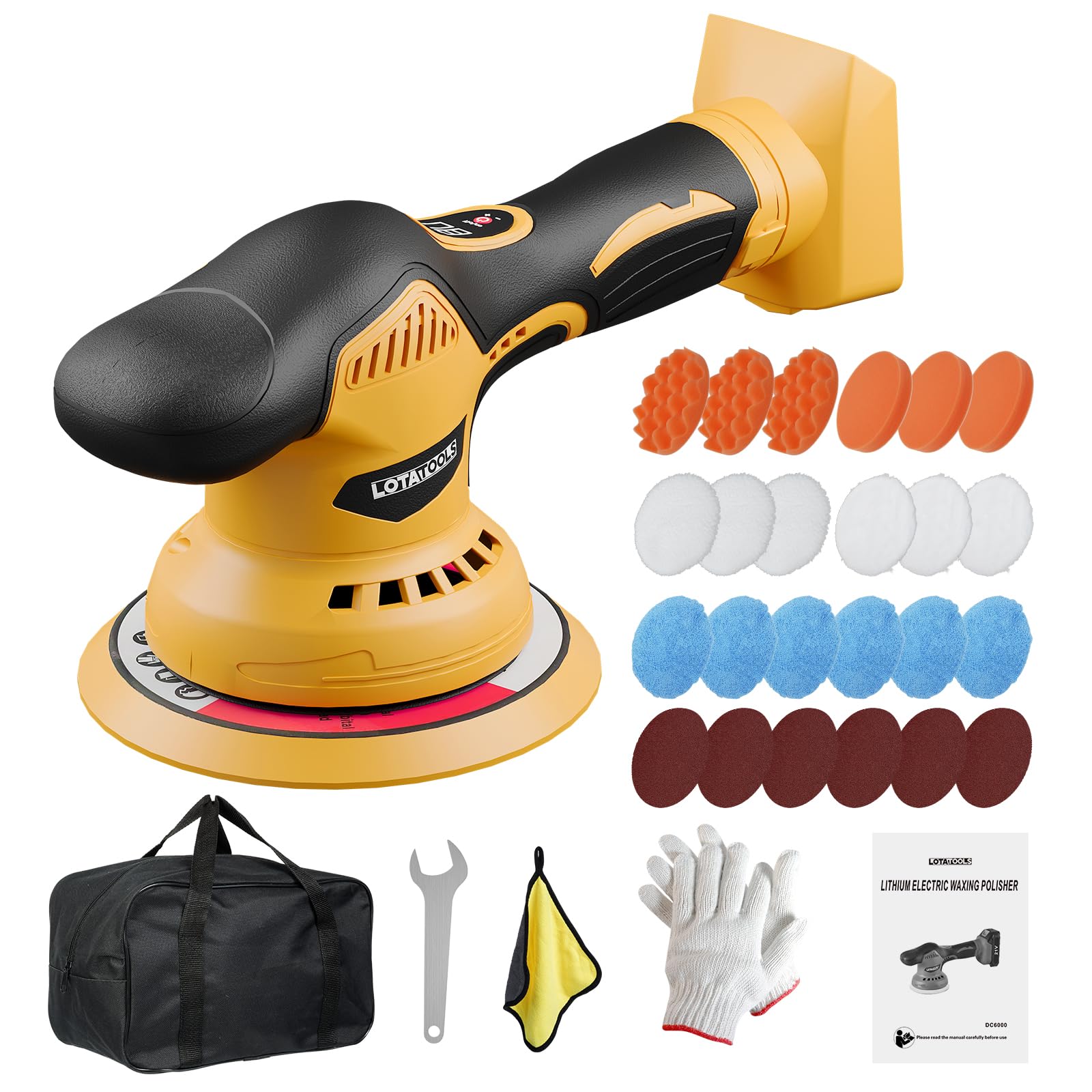
This kit solves a specific pain point: if you own Dewalt 20V batteries, you can skip the proprietary battery system. The LotaTools polisher runs on Dewalt 18V or 21V batteries (battery not included), which means you can pull from your existing stash of drill and saw batteries. The motor spins up to 5500 RPM with 8 variable speeds, giving you precise control from gentle waxing to aggressive paint correction. At 5500 RPM versus the BATOCA’s 3800 RPM, this polisher has a clear edge for fast correction work.
The kit is generous, with 6 microfiber covers, 3 wool covers, 3 flat foam pads, 3 wavy foam pads, and a storage bag. One reviewer used a 6.5 amp-hour battery to polish a 21-foot boat on a single charge and still had one bar left. Another reported using the machine for more than 4 hours straight without issues, noting the motor gets hot but does not fail.
Smart-buy angle: If you already have Dewalt batteries, this is the most economical way to get a powerful cordless polisher. The 5500 RPM top speed is genuinely fast for paint correction.
Drawback to note: The polisher itself is not a premium build; one review noted it shows its budget limits after extended use. Also, you get no batteries included, so the upfront cost may be higher than a full-kit competitor.
7. SPTA Cordless Mini Polisher
The ultimate tool for motorcycles, chrome, and the tightest crevices on a car.
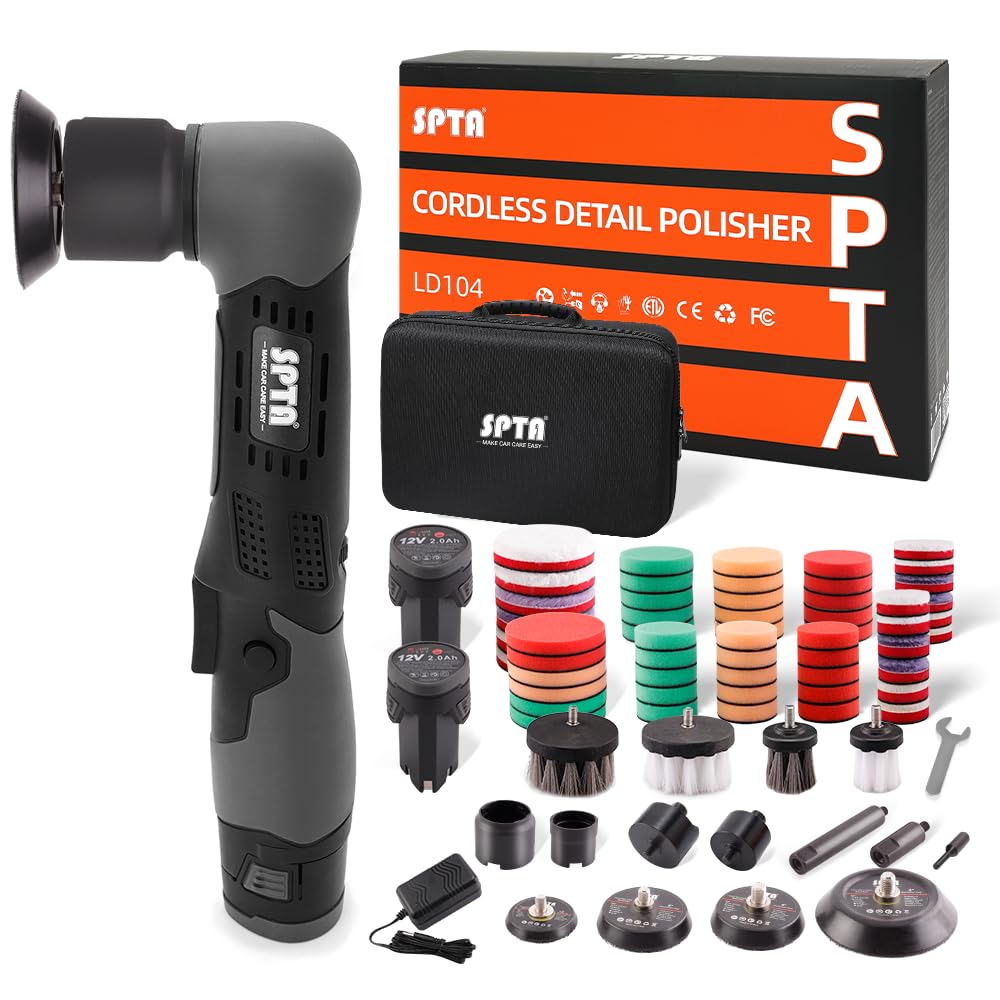
When you need to polish a motorcycle frame, a set of chrome exhaust pipes, or the tight gap between a headlight and the bumper, the SPTA mini polisher is the right weapon. It comes with three backing plate sizes — 25mm, 50mm, and 80mm — so you can match the pad exactly to the area. The dual-action free-spinning rotation runs at 4500 OPM, and you can also lock it into rotary mode for heavy cutting or using a carpet-drilling attachment. The kit is incredibly complete, including 21 pads in 25mm, 21 pads in 50mm, and 12 pads in 76mm, along with two 12V batteries.
Customers note it is pro-quality for the price, ideal for removing light scratches and restoring shine on small areas. One owner mentioned using it on a motorcycle and praised how it fits into tight spots where full-size polishers simply cannot go. The only consistent complaint is that the included case is too small, forcing you to disassemble the machine and pads to store everything.
Why it wins for detailers
- Three backing plate sizes (25/50/80mm) cover every tiny area
- Huge pad selection: 54 polishing pads included in the kit
- Dual action and rotary modes in one compact body
The space trade-off
- Case is too small for storage with everything assembled
- Battery life drops after about 10 charge cycles, per some reviews
Who it fits: Motorcycle owners, marine detailers, and anyone who works on trim, badges, and headlights. Who should pass: Someone looking for a primary polisher for full-body correction on a sedan.
Understanding the Specs
Dual-Action vs Rotary
Dual-action (DA) means the pad spins in a random orbit while also oscillating side-to-side. This motion prevents heat buildup and holograms, making it safe for beginners. Rotary polishers spin in a fixed circle and cut faster, but they can easily burn through clear coat if you are not experienced. For 99% of home detailers, a DA polisher is the correct choice.
Orbital Throw
The “throw” is the diameter of the oscillating circle. A 9mm throw (like the Adam’s Polishes unit) is more controllable and generates less heat, ideal for finishing and one-step corrections. A 12mm or 15mm throw covers more surface area per pass, speeding up heavy paint correction, but requires more skill to avoid marring the paint. You do not need a long throw unless you are compounding regularly.
RPM vs OPM
These terms are interchangeable — both describe how fast the pad rotates per minute. Higher RPM (like 5500 or 6500) means faster material removal, but it also generates more heat. Lower RPM (like 1000-2000) is best for spreading wax and sealants. A good variable-speed polisher lets you set the exact speed for the job.
Pad Material
Foam pads (flat or waffle) are the most common for polishing and waxing. Wool pads are more aggressive and used for heavy cutting or on neglected paint. Microfiber bonnets slip over the pad for buffing off wax or applying glaze. The thickness and density of the pad affect the cut: a firm pad cuts harder, a soft pad finishes finer.
FAQ
Can I use a dual-action polisher on ceramic coated cars?
How do I know if a cordless polisher will fit my battery?
What is the difference between a 6-inch and 10-inch pad?
How long does a polishing kit battery last on a single charge?
Will a dual-action polisher remove deep scratches?
What is the correct speed setting for waxing?
Can I use a car polisher on wood furniture?
Why does my polisher get hot during use?
What does the “throw” number mean on a DA polisher?
Do I need a cutting pad or a polishing pad?
Final Thoughts: The Verdict
Across the board, the polishing kit for car detailing winner is the BATOCA 6″ Dual Action Polisher because it delivers a complete, ready-to-go kit with a powerful 700W motor and 6 variable speeds, all at a price that undercuts pro-level equivalents. If you want uncompromising pro performance and have the budget, grab the Adam’s Polishes 9mm DA Polisher. And for cordless freedom and light weight, the standout is the Vkdemer 6″ Cordless Polisher with its two 21V batteries and 3-pound body.
How We Picked
We do not accept paid placement. Every pick is matched to a real buyer and a real use-case; we do not hands-on test units.
Sources & Methodology
Specifications: manufacturer listings and product documentation. Review insights: verified customer reviews, as of July 2026. Pricing: not shown on this page (it changes often); check the current price via the retailer link.
As an Amazon Associate, Trending Car earns from qualifying purchases. This does not affect which products we feature.