
Our readers keep the lights on and my garage snacks stocked. As an Amazon Associate, I earn from qualifying purchases.
Specs are compiled from manufacturer listings and verified buyer reviews and can change over time — please confirm the key details on the product page before buying.
If you are shopping for an on-road RC car, the biggest decision is if you want to drift corners with a plume of tire smoke or grip the pavement and chase top speed. A parking lot, a smooth cul-de-sac, or even an empty tennis court is the true stage for these machines — they are built for flat, hard surfaces, not grass or gravel. The specs that matter most are the motor type (brushed vs brushless), the scale size (1/10 is a common garage-friendly size), and whether it comes ready-to-run (RTR) or as a kit you build yourself.
I’m Min Islam — the founder and writer behind Trending Car. This guide is built by comparing the manufacturers’ published specifications and the patterns across verified customer reviews, so you get each pick’s real strengths and trade-offs instead of marketing spin.
if you want a licensed NASCAR replica for driveway laps or a blistering 70+ mph chassis for speed runs, the best on-road rc car depends on how you plan to drive — and which trade-off you are willing to live with.
Our Picks at a Glance


How To Choose The Best On-Road RC Car
An on-road RC car lives or dies by its chassis and electronics. A touring chassis handles flat corners at speed with four-wheel drive grip; a drift chassis slides the rear axle with a rear-wheel-drive gyro. Brushless motors deliver more top speed and run hotter, while brushed motors cost less and are easier to manage for a beginner. The table below lays out the essential specs side by side so you can see the trade-offs at a glance.
Speed vs. Control
A brushless motor without a gyroscope can be twitchy and hard to keep straight. Many cars now include a built-in gyro that you can adjust or turn off, which helps new drivers keep the nose pointed forward at high speed. If you are buying for a first-time driver, look for a car with a speed limiter switch and a gyro system.
Ready-to-Run vs. Kit
A ready-to-run (RTR) car comes with everything — battery, charger, transmitter, and the car itself. A kit, like the Tamiya TT-02, requires you to assemble the chassis and supply your own electronics, battery, and charger. Kits teach you how the car works and are easier to upgrade, but they demand tools, patience, and a separate budget for the missing parts.
Quick Comparison
| Model | Best For | Motor Type | Scale | Battery Capacity | Amazon |
|---|---|---|---|---|---|
| MJX Hyper GO 14303★ Best Overall | Best Overall Speed | Brushless | 1/14 | 2000 mAh | Amazon |
| Traxxas 4-Tec 2.0 VXLSpeed Demon | Blistering 70+ mph | Brushless Velineon 3500 | 1/10 | Not Included | Amazon |
| Losi NASCAR No. 24NASCAR Replica | NASCAR RTR Fun | Brushed MEGA 380 | 1/12 | 1400 mAh | Amazon |
| Losi NASCAR No. 9 | Race-Ready RTR | Brushed MEGA 380 | 1/12 | 1400 mAh | Amazon |
| Tamiya TT-02 Porsche 911 GT3 | Kit Build + Porsche Look | 540 Brushed | 1/10 | Not Included | Amazon |
| Tamiya TT-02 First Try | Beginner Kit Build | 540 Brushed | 1/10 | Not Included | Amazon |
| FLYCOLOR LD1898 GTR R34 | Compact Drift Car | Brushed (RWD) | 1/18 | Not Specified | Amazon |
| GoolRC Drift Car | Budget Drift Entry | Brushed | 1/16 | 1300 mAh | Amazon |
In‑Depth Reviews
1. MJX Hyper GO 14303 1/14 Citroen C3
Our pick — over 4.5★ from 450+ verified ratings; the strongest balance of quality and price.
The licensed rally car that delivers 40 mph right from the start
This MJX Hyper GO is the crowd favorite for a reason — it comes with two 2000 mAh batteries, a brushless motor, and a fully independent gyro/ESC that you can adjust for drifting or high-speed straight lines. The car is a 1/14 scale replica of the 2017 Citroen C3 WRC, and it includes three different tire sets for asphalt, drift, and wet-surface grip. The all-aluminum 6061 chassis and hardened drivetrain gears make it tough enough for daily bashing.
Speed tops out at 26+ mph on the included 2S batteries, and the gyro keeps it stable enough that newcomers do not spin out at every turn. A 70% speed limit on the transmitter lets beginners build confidence before unleashing full power. The body has working brake lights and turn signals that you control from the remote, which feels like a small detail but adds a lot of drama when you drift past a curb.
Buyers report a 4-5 hour charge yields a 30+ minute run time, and the spare parts included (wheels, cooling fan, extra battery) mean you can keep driving while one pack recharges. The caveat is clearance — this car sits low and is best on pavement or packed dirt; tall grass will stop it cold.
What Wins People Over
- Two included batteries for extended play
- Adjustable gyro helps new drivers stay straight
- Full metal chassis and drivetrain
- Working brake and turn signal lights
The Honest Trade-off
- Low ground clearance — pavement only
- Parts support is not as widespread as Traxxas
Reach for this if: you want a brushless RTR that drifts, grips, and runs for over half an hour on a single set of batteries.
Look elsewhere if: you need a larger 1/10 scale chassis or plan to race on a sanctioned track where parts availability matters.
2. Traxxas 4-Tec 2.0 VXL 1/10
The chassis that pushes 70+ mph on a 3S LiPo battery
This is not a toy for the faint-hearted. The Traxxas 4-Tec 2.0 VXL is a 1/10 scale race chassis with a Velineon 3500 brushless motor and a waterproof VXL-3s ESC, meaning you can run it in the wet without worry. With a 3S LiPo battery (sold separately), owners mention a genuine 70+ mph top speed — a number that demands a wide, open space and a steady thumb. The chassis is fully adjustable with interchangeable wheelbases to fit 200mm touring car bodies, so you can swap shells whenever the mood strikes.
The Traxxas Stability Management (TSM) system is the standout feature here — it uses the receiver’s gyro to keep the car planted during acceleration and cornering, which is essential at these speeds. The TQi 2.4GHz transmitter delivers lightning-quick response, and the included speed pinion gear lets you dial up the top end when you are ready. On standard gearing, the car is already fast enough that the stock rubber tires wear down in an hour of hard driving, as experienced owners note.
This is a chassis-only purchase — the body, battery, and charger are not included, so your total investment goes higher than the list price. The review pages echo that this is an expensive hobby: replacement tires cost per set, and the car demands maintenance. But for pure, on-road speed in a 1/10 package, nothing else on this list keeps up.
What It Delivers
- True 70+ mph on 3S battery
- TSM gyro keeps high-speed runs stable
- Waterproof electronics for all-weather driving
What You Give Up
- No body, battery, or charger included
- Stock tires wear quickly (1 hour of hard use)
- High-cost consumables
Best for: the RC hobbyist who already owns LiPo batteries and is chasing top speed records on empty parking lots.
skip it if: you want a complete RTR package or are on a tight budget.
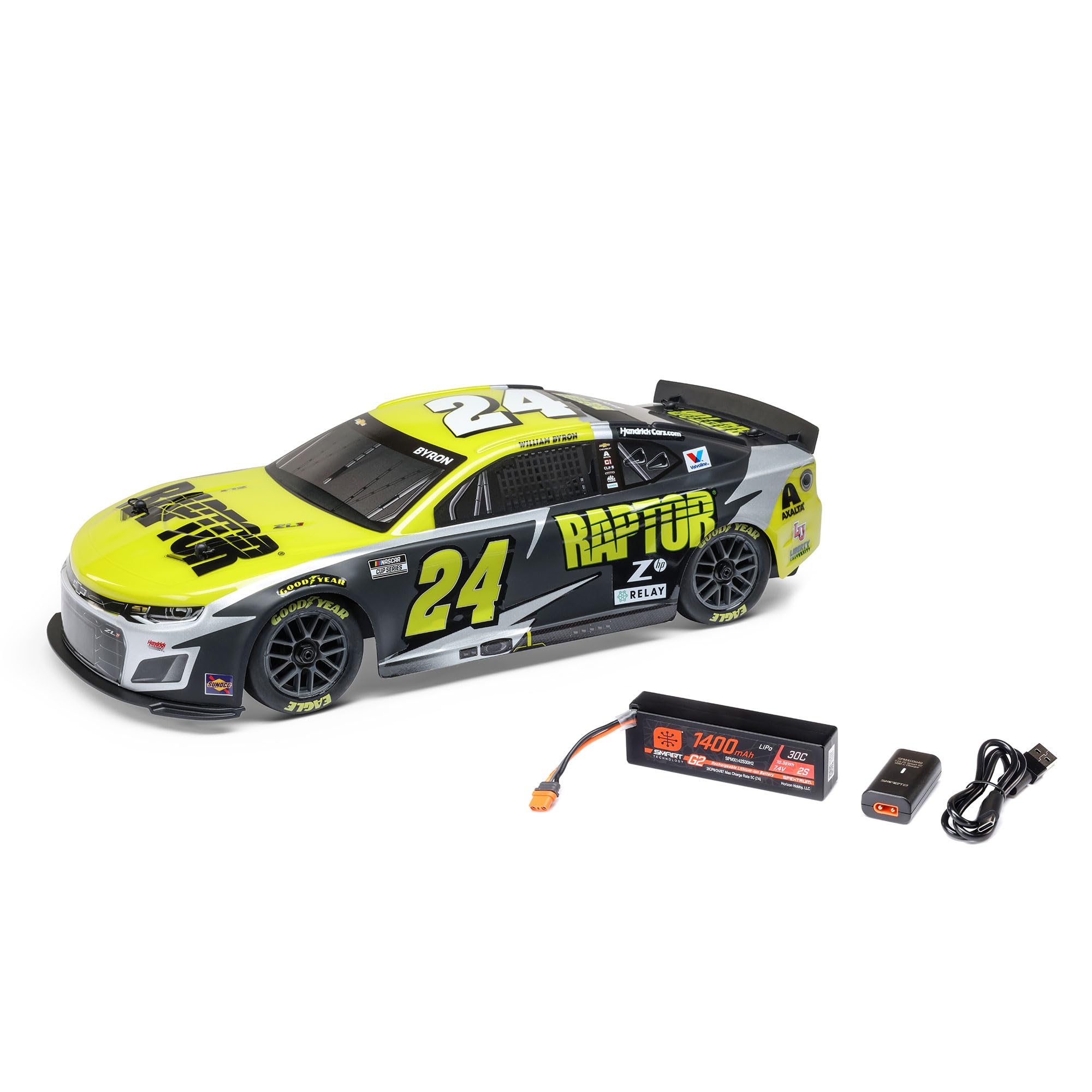
3. Losi 1/12 NASCAR William Byron No. 24
A fully assembled NASCAR replica that runs for 20 minutes on a one-hour charge
The Losi 1/12 NASCAR line is the closest you can get to a real Cup car without a pit crew. The William Byron No. 24 arrives fully assembled — just drop in the included 7.4V 1400mAh LiPo, plug in the USB-C charger, and you are lapping the driveway in an hour. Speeds reach 20+ mph, which feels fast at this scale, and the brushed MEGA 380 motor is smooth enough that kids can handle it without drama.
What impresses owners is the durability. The car is designed to survive a full-speed crash into a curb, and the body shell takes a beating. The Spektrum waterproof electronics include a metal-geared servo and a 25A ESC/receiver combo, so a light rain or a puddle does not end the session. The car can be tuned with oil-filled shocks and adjustable suspension links, just like a real Cup car, which adds depth for more experienced owners.
The battery charges in one hour and delivers 20 minutes of run time. Several owners recommend buying one or two spare batteries (sold separately) to keep the fun going longer. It is slower than the brushless cars on this list, but for a casual driver who wants a turn-key NASCAR experience, this is the balance.
One-Line Verdict: The best RTR NASCAR replica for the money — durable, fast enough for real fun, and ready to race in under five minutes.
Reach for this if: you want a ready-to-run on-road car with a licensed NASCAR body and Spektrum electronics you can trust.
Look elsewhere if: you need 40+ mph top speed or plan to run on rough surfaces.
4. Losi 1/12 NASCAR Chase Elliott No. 9
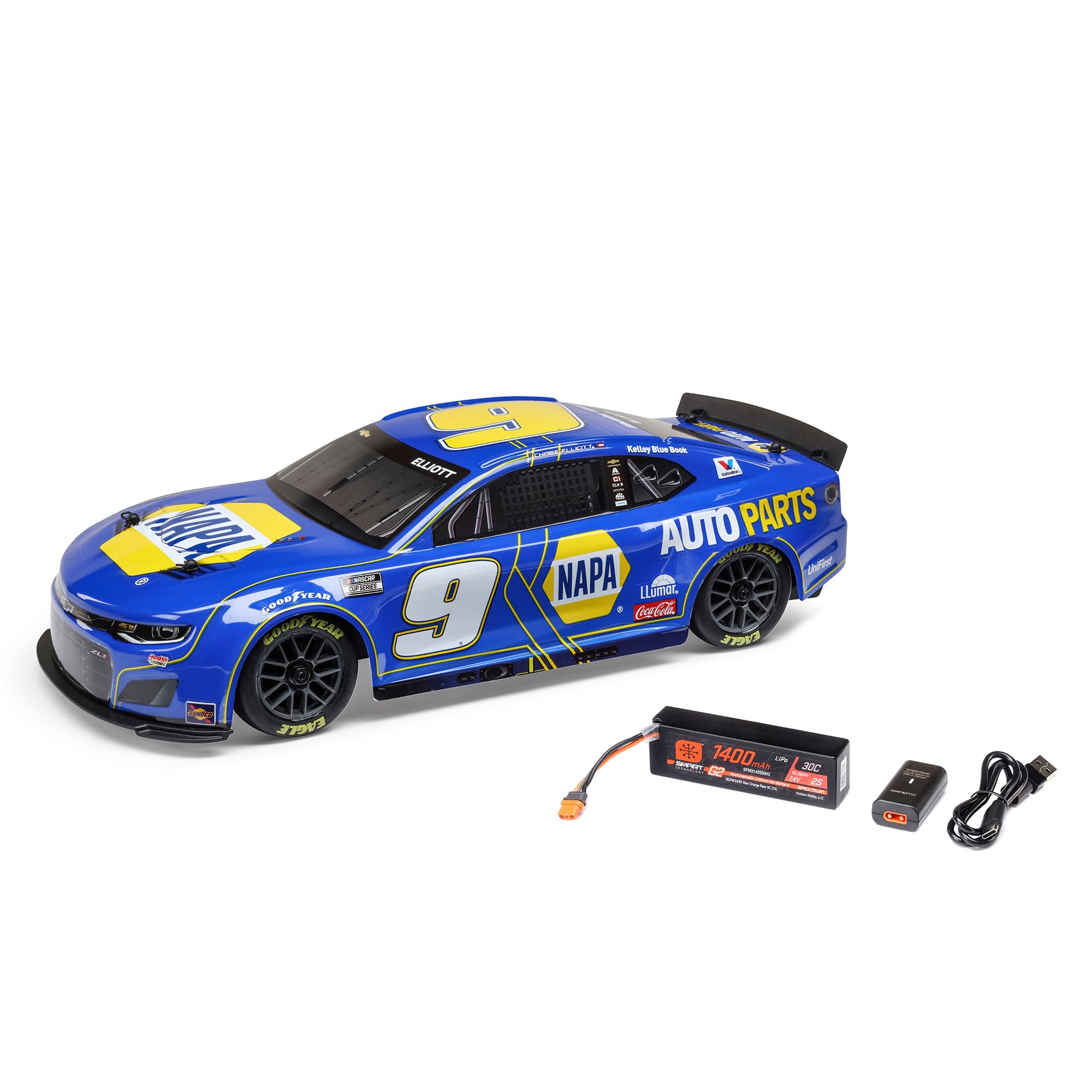
The Chase Elliott No. 9 that corners flat and takes a beating
This is essentially the same chassis as the William Byron car but with the iconic NAPA blue and yellow livery. It shares the 20+ mph top speed, the Spektrum 2.4GHz transmitter, and the waterproof electronics. The oil-filled shocks and independent suspension give it a planted feel through corners that the drift-oriented cars lack. Owners praise the build quality and note the car is durable enough to survive being run over by a full-size truck, according to one review.
The 7.4V 1400mAh LiPo charges via USB-C in about an hour and provides 20 minutes of run time. The car has independent suspension on all four wheels and a metal-geared servo, so steering stays sharp even after hard hits. It weighs 3.5 pounds, which is light enough to carry easily but heavy enough to feel stable at speed. Some owners wish it were a little faster, but the brushed motor keeps costs low and run times reasonable.
The one recurring buyer note is that the car is not for novices who expect a toy — at 20+ mph, it demands a large paved space. But for a NASCAR fan or a parent who wants a hobby-grade car that will survive a 14-year-old’s driving, this is the one.
Strongest Point: The durability and ready-to-run convenience — the car can go from box to racing in five minutes, and the parts support from Horizon Hobby is excellent.
Best for: families who want a single RTR purchase that includes everything and will survive teenage driving errors.
pass on it if: you want a brushless speed machine or prefer a build-it-yourself kit.
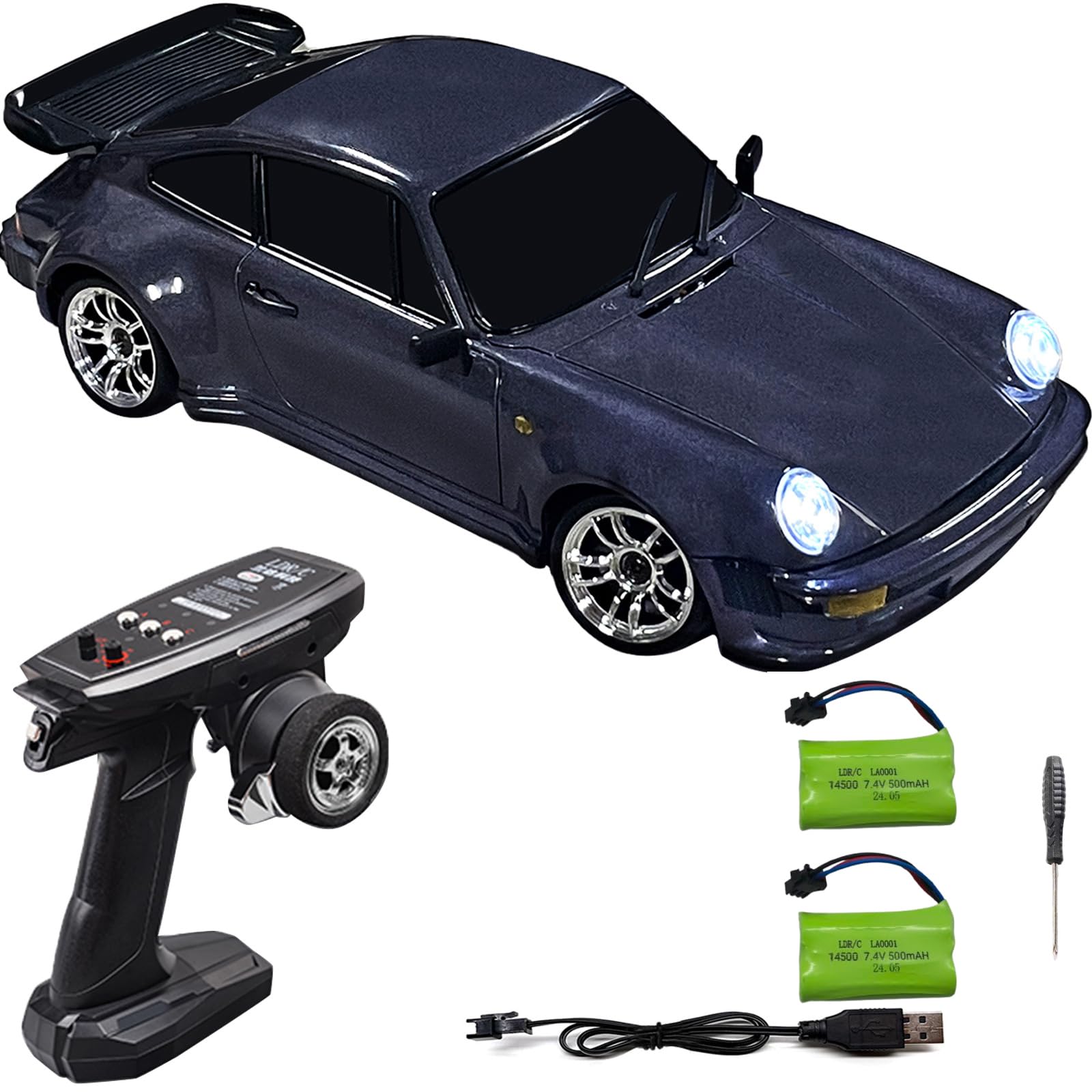
5. Tamiya TT-02 Porsche 911 GT3 992

A 1/10 Porsche kit that builds your skills and your collection
If you enjoy the process as much as the driving, the Tamiya TT-02 Porsche 911 GT3 (992) is the most satisfying build on this list. It is a 1/10 scale on-road chassis kit that requires assembly — you get the ESC, the 540 brushed motor, the body shell with separate rear wing and light cases, and decals. The TT-02 chassis uses a shaft-driven 4WD system with independent suspension on all four corners, and the body is finished in dark gun metal with a carbon-fiber reinforced plastic front hood.
The kit is beginner-friendly but highly customizable. Owners note that it is easy to assemble with basic tools, and the instructions are clear. The car uses a 7.2-7.4 volt battery (not included), and many builders upgrade to a brushless system over time. The body detail is impressive for the price — the Porsche 992 shape is accurate, and the window masking tape and trim stickers are included. Some owners point out that the Amazon listing says an ESC is included, and it is, but it is worth double-checking the box contents if you buy from a third-party seller.
This is not a speed machine from the start. The 540 brushed motor is adequate for learning and cruising, but experienced drivers will outgrow it fast. The real value is the platform — the TT-02 has a huge aftermarket, so you can gradually upgrade to full ball bearings, oil-filled shocks, and a brushless motor.
What You Get
- Beautiful licensed Porsche body
- ESC and motor included in the box
- Highly upgradeable TT-02 platform
The Catch
- Requires assembly and a separate battery/charger
- Stock brushed motor is mild
Best for: a building enthusiast who wants a Porsche on-road car and the satisfaction of assembling it themselves.
it’s not for you if: you want a ready-to-run car or high speed without upgrades.
6. Tamiya 57986 1/10 RC TT-02 Chassis First Try

The build-it-yourself chassis that teaches you how an RC car works
The Tamiya TT-02 “First Try” is exactly what the name suggests — a partially pre-assembled kit designed to introduce beginners to the mechanics of an RC car. It comes with the TBLE-02 electronic speed controller (works with both brushed and brushless motors), a 540 brushed motor, and an encapsulated 4WD drivetrain. The chassis is already assembled at the steering and differential stages, so you build the suspension, shock towers, and roll cage around it. The body is not included, which is actually a plus for builders who want to fit their own shell.
Owners appreciate that the stock kit is fast enough to have fun right away, even before upgrades. The independent suspension on all four corners keeps the car composed on smooth pavement, and the shaft-driven 4WD system is reliable. The kit requires a separate battery and charger, and the manual is decent but some owners recommend looking up the Japanese instructions online for better detail. A 5 yen coin included by the seller as a thank-you is a nice touch that appears in several reviews.
The trade-off is that the plastic bushings and stock shocks are budget components. Most owners upgrade to full ball bearings and oil-filled shocks after the first few builds. But for the price, this is the cheapest way into the Tamiya ecosystem, and the TT-02 platform has massive community support.
One Sentence: The cheapest entry ticket to 1/10 on-road RC — you build it, you learn it, you upgrade it later.
Reach for this if: you want a budget kit that teaches real RC mechanics and leaves room to customize the body.
Look elsewhere if: you want a complete RTR car with a body and battery included.
7. FLYCOLOR LD1898 1/18 RC Drift Car GTR R34
A 1/18 rear-wheel-drive drifter with a gyro and a metal body
The FLYCOLOR LD1898 is a compact on-road drift car that fits in a small backpack. At 1/18 scale and weighing just 1.1 pounds, it is the smallest car on this list, but it packs a surprising amount of detail — the GTR R34 body is made of metal alloy, and the chassis uses ball bearings throughout for smooth operation. The built-in gyroscope system helps new drifters hold slides, and the 2.4GHz 3-channel remote gives full-proportional throttle and steering. The metal drive shaft and all-nylon chassis keep it lightweight and durable.
Owners praise the build quality and detail, with several calling it one of the best mini drift cars they have owned. The metal body feels heavy and slides well, and the independent suspension on all four wheels smooths out rough pavement. The battery compartment latch is a minor gripe — some owners say it could be more sturdy. The car comes with the battery and charger included, so it is ready to drift in minutes. The adjustable speed and gyro sensitivity let you dial in the drift angle from fun slides to serious precision corners.
The short wheelbase means it is more twitchy than a larger drift car, and the plastic mirrors and spoiler are fragile in a crash. This is a car for controlled sessions on smooth floors, not fight-for-your-life bashing. But for the price, it is a fantastic entry into RWD drifting.
Verdict: A well-balanced mini drifter with a metal body and a gyro that flattens the learning curve.
Best for: new drifters or collectors who want a detailed 1/18 GTR that drifts straight from the start.
look elsewhere if: you need a larger 1/10 scale, high top speed, or extreme durability.
8. GoolRC 1/16 RC Drift Car 4WD

The budget 4WD drifter that handles flat surfaces and skate parks
If the price of entry is your main concern, the GoolRC 1/16 drift car offers 4WD, 35 km/h top speed, and twin Li-ion 1300 mAh batteries at a very accessible price point. It is a 1/16 scale car that comes with an extra set of drift tires, cool LED lights with 7 modes (including devil and angel eye patterns), and a 2.4GHz remote that works up to 262 feet. The car uses a dual wishbone independent suspension and a 30A integrated ESC/receiver. For the money, you get a lot of plastic, but the chassis is surprisingly durable — one owner reported it survived multiple crashes at a skate park.
The drive system uses a front wheel cross ball joint and rear split dog bone transmission shaft, with 16 ball bearings throughout. The car includes two 7.4V 1300mAh Li-ion batteries, which customers note give between 30 and 40 minutes of run time total. The speed limiter toggle on the remote is a smart touch for beginners or for letting kids drive it safely. The drift wheels work well on hard floors like polished concrete or linoleum, and the car can handle low bumps but not high curbs or grass.
The downsides are honest and predictable at this price tier. The plastic body is thin and some units arrive with scuffed paint. The battery life is mixed in reviews — six owners mention it and the take is mixed rather than uniformly positive. If you want a cheap way to learn 4WD drifting and do not mind a few cosmetic imperfections, this is the car for you.
Why It Makes Sense
- Two batteries included = extended run time
- Speed limiter for beginner control
- Drift wheel set included in the box
The Realities
- Thin plastic body may arrive scuffed
- Battery life is average; buy extras for track days
Reach for this if: you want the cheapest 4WD drift car with twin batteries and a speed limiter for learning.
Look elsewhere if: you value premium fit/finish or need a scale larger than 1/16.
Understanding the Specs
Brushed vs. Brushless Motor
A brushed motor uses physical brushes to transfer power to the rotor. They are cheaper, easier to maintain, and draw less current, meaning longer run times. A brushless motor uses magnets and an electronic controller — no brushes to wear out and much higher power output. Brushless cars reach higher top speeds (40+ mph is common) but run hotter and drain batteries faster. If you just want to cruise the driveway, brushed is fine. If you want to hit 70+ mph, go brushless.
Gyroscope (Gyro)
A gyro is a small electronic sensor inside the car that detects when the rear end starts to slide and automatically corrects the steering to keep the car straight. In a drift car, a gyro can be adjusted to allow controlled slides without spinning out. In a high-speed touring car, it keeps the nose pointed forward during acceleration. Some cars let you dial the gyro sensitivity from the transmitter; others have a fixed setting. For a first-time driver, a car with a gyro is dramatically easier to drive.
Scale Size (1/10, 1/14, 1/16, 1/18)
The scale ratio tells you how big the model is compared to the real car. A 1/10 car is roughly 18 inches long and is the most common size for on-road racing — large enough to handle road imperfections and fit batteries with high capacity. 1/14 and 1/16 cars are smaller, lighter, and cheaper but require smoother surfaces. 1/18 cars are mini drifters that fit in a backpack but are twitchy at speed. Your driving surface determines the right scale: smooth driveway = 1/10 or 1/12; small apartment floor = 1/18.
Ready-to-Run (RTR) vs. Kit
An RTR car includes everything you need: the car, a transmitter, a battery, and a charger. You open the box, charge the battery, and drive. A kit requires you to assemble the chassis, install the electronics (if included or purchased separately), paint the body, and supply your own battery and charger. Kits teach you the mechanics and are easier to upgrade, but they demand tools and time. For a first car, most people should buy RTR. For a second or third car, a kit is more rewarding.
FAQ
Can I drive an on-road RC car on grass or gravel?
What is the difference between a touring car and a drift car?
Do I need a gyro to drift?
What battery and charger do I need for a kit?
How fast is 20+ mph in an RC car?
Can I use LiPo batteries in a brushed car?
What scale is easiest to drive for a beginner?
Are parts available for these cars?
How long does a battery charge last?
Can I upgrade a brushed car to brushless later?
Final Thoughts: The Verdict
For most buyers, the on-road rc car winner is the MJX Hyper GO 14303 because it delivers brushless speed, two batteries, adjustable gyro, and a licensed rally body at a price that undercuts the competition by a huge margin. If you want a turn-key NASCAR experience that is ready to race in under five minutes, grab the Losi No. 24. And for the builder who loves the process, the Tamiya TT-02 Porsche is the most satisfying on-road kit you can buy at this scale.
How We Picked
We do not accept paid placement. Every pick is matched to a real buyer and a real use-case; we do not hands-on test units.
Sources & Methodology
Specifications: manufacturer listings and product documentation. Review insights: verified customer reviews, as of July 2026. Pricing: not shown on this page (it changes often); check the current price via the retailer link.
As an Amazon Associate, Trending Car earns from qualifying purchases. This does not affect which products we feature.