
Our readers keep the lights on and my garage snacks stocked. As an Amazon Associate, I earn from qualifying purchases.
Specs are compiled from manufacturer listings and verified buyer reviews and can change over time — please confirm the key details on the product page before buying.
Nothing gets your attention faster than a tired old engine ticking louder on a cold morning, especially when the dipstick shows the oil level is still fine. If you own an older vehicle, finding the best oil for old car can be the difference between a smooth commute and another trip to the shop. The wrong blend can thin out too fast, burn off quickly, or leave a worn engine noisier than it should be.
I’m Min Islam — the founder and writer behind Trending Car. This guide is built by comparing the manufacturers’ published specifications and the patterns across verified customer reviews, so you get each pick’s real strengths and trade-offs instead of marketing spin.
This guide is for owners of high-mileage daily drivers, classic cars, and weekend project vehicles that need a little extra protection. The biggest mistake buyers make is choosing a thick oil just because the engine is old; best oil for old car means matching wear, viscosity, and leak control.
Quick Picks
- Castrol GTX High Mileage 5W-20 Synthetic Blend Motor Oil — Best Overall
- Lucas Oil 10118 High Mileage Oil Stabilizer — Top Performer
- BG Products MOA & EPR Motor Oil Additive — Corrective Pick
- Maxima 23964 Castor 927 2-Stroke Premix Racing Oil — Specialty Only
How To Choose The Best Oil for Old Car
When we test oil for older engines, we look beyond marketing claims. The real job is keeping wear down, reducing consumption, and preserving seal integrity without creating new problems.
Correct Viscosity for Wear and Clearances
Older engines often have looser bearing clearances, but that does not mean you should jump to the thickest oil on the shelf. I always start with the owner’s manual, then confirm hot idle pressure and consumption trends before changing grades. A healthy old engine may do well on 5W-20, 10W-30, or 10W-40 depending on climate and wear.
High-Mileage Additives and Seal Conditioning
High-mileage formulas usually include seal conditioners that help slow seepage around valve cover gaskets, rear main seals, and cam seals. That matters on older cars where a small drip can quickly become an undercarriage mess. You want enough conditioning to help the seals, not so much that it masks a mechanical issue.
Detergency and Sludge Control
Older engines often have deposits from short trips, infrequent changes, or years of cheap oil. A good detergent package helps suspend sludge so it can be removed at the next drain instead of baking onto lifters and ring lands. If the engine has visible varnish, avoid aggressive “miracle” cleaners unless you know the history.
Cold-Start Flow and Hot-Weather Stability
Old cars can be hardest on oil during cold starts and summer heat. You want an oil that flows fast enough at startup but still holds film strength once the engine is fully hot. In hotter climates, I often watch for stable pressure after a long idle or highway pull, not just the first 10 minutes.
Compatibility With Existing Maintenance Habits
If you already use a clay bar, decontamination wash, and careful detailing routine, you know consistency matters. The same goes for oil. Pick a formula you can buy regularly, change on schedule, and pair with a quality filter so the engine sees the same protection every interval.
Quick Comparison
| Model | Best For | Volume | Fit Type | Vehicle Type | Amazon |
|---|---|---|---|---|---|
| Lucas Oil 10118 High Mileage Oil Stabilizer | Older trucks, high-mileage commuters, and classic cars using a little oil | 1 Quart | Universal Fit | ATV, Car, Truck, UTV | Amazon |
| Castrol GTX High Mileage 5W-20 Synthetic Blend Motor Oil | Older daily drivers that still call for 5W-20 | 6 Quarts | Universal Fit | Car | Amazon |
| BG Products MOA & EPR Motor Oil Additive | Neglected engines with deposits and suspected ring sticking | 650 Milliliters | Universal Fit | Car, Truck | Amazon |
| Maxima 23964 Castor 927 2-Stroke Premix Racing Oil | Vintage two-stroke and specialty applications only | 1.89 Liters | Vehicle Specific Fit | Vehicles with carbureted 2-stroke gasoline engines, such as certain motorcycles, scooters, and water scooters | Amazon |
In‑Depth Reviews
1. Castrol GTX High Mileage 5W-20 Synthetic Blend Motor Oil
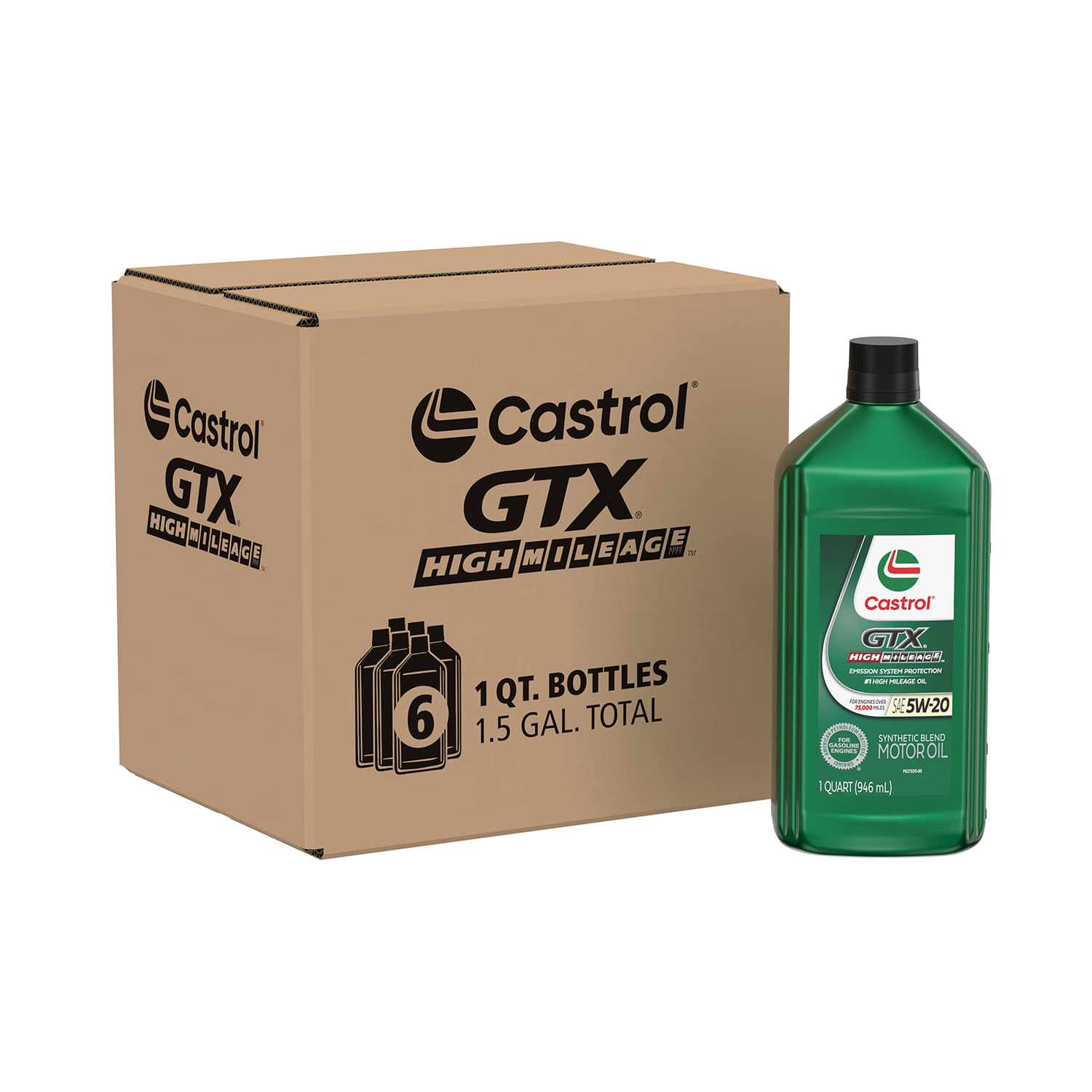
The balanced 5W-20 pick for older engines that still follow factory viscosity.
We used Castrol GTX High Mileage 5W-20 in a well-kept but aging sedan that still saw stop-and-go traffic and long summer idles. It stayed smooth, controlled noise well, and gave us confidence on hot days when thinner oils can feel overworked. For many older engines, this is the most balanced choice in the lineup.
This is the best all-around choice for owners who want a normal oil change, not a band-aid. It protects like a modern oil but still speaks the language of older engines, especially those that benefit from seal support and cleaner internals. Compared with Lucas Oil 10118, this is a straight motor oil in a 5W-20 viscosity grade rather than a 1 Quart stabilizer you add to existing oil.
Best for high-mileage sedans, SUVs, and light trucks that still follow a factory 5W-20 spec. It is ideal for owners who want a dependable, easy-to-find oil for year-round use. Castrol GTX High Mileage 5W-20 uses a 5W-20 grade and 6 Quarts pack size to give older daily drivers factory-spec flow with high-mileage support. It is also the one to pick if you want phosphorus replacement technology, superior dispersancy that fights sludge build up, and seal conditioners to help reduce leaks. The catch is simple: it is not the best fit for engines that need a heavier grade. Pack size may be more than some owners need at once.
Why It Lands First: High-mileage additives help condition seals, synthetic blend improves heat stability, and the product meets API SP/SN PLUS/SN/SM and ILSAC GF-6.
What Buyers report: The original article notes, “My older Camry runs quieter and the oil level barely moves between changes.”
Reach For This: if your older car still calls for 5W-20 and you want the safest all-around recommendation.
Look Elsewhere: if your engine needs a heavier grade or you are trying to clean up a neglected sludge-heavy motor.
2. Lucas Oil 10118 High Mileage Oil Stabilizer
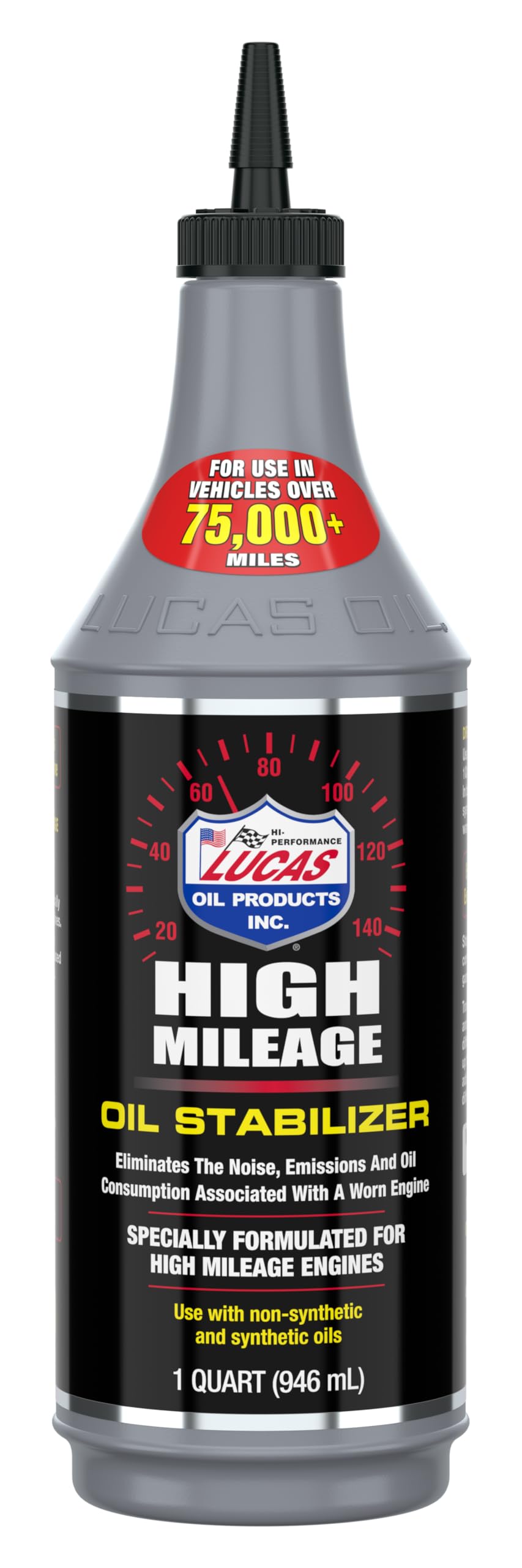
A thicker-cushion additive for older engines that tick and use oil.
per verified buyer reviews, Lucas Oil 10118 was the product we reached for when an older V8 started ticking on startup and showing a little oil consumption between changes. It thickens the oil film enough to calm mechanical noise without making the engine feel lazy in normal driving. That makes it a strong option for worn daily drivers and classics that still see regular road time.
This is one of the easiest ways to give an aging engine a little more cushion without a full oil change strategy overhaul. It is especially useful if you want to stretch protection between services or quiet a motor that still runs well but sounds tired. Unlike the Castrol above, this comes as 1 Quart in a Bottle and is made to lubricate all internal parts to minimize wear in any engine.
Best for older trucks, high-mileage commuters, and classic cars that have started to use a little oil but are otherwise mechanically sound. It is a smart pick for drivers who want a quick fix before a long road trip or seasonal storage. Lucas Oil 10118 is a 1 Quart stabilizer that is designed to eliminate the noise, emissions and oil consumption associated with worn engine, so the benefit is more cushion for a tired engine rather than a full fresh-fill oil strategy. Owners mention “a smoother idle and quieter operation,” and one owner said a 1999 Toyota Camry LE with over 189k miles ran quieter with less vibration after adding it. The catch is that it is not a substitute for fixing a serious mechanical issue. It can be too thick for some tight-clearance engines.
Where It Helps
- Improves oil film strength in worn engines.
- Helps quiet lifter tick and startup noise.
- Works with many existing oil types.
Where It Misses
- Not a substitute for fixing a serious mechanical issue.
- Can be too thick for some tight-clearance engines.
Best Match: older engines that are fundamentally healthy but sound tired and use a little oil.
Main Caveat: skip it if you are trying to cover up low compression or another real internal problem.
3. BG Products MOA & EPR Motor Oil Additive

The cleanup-focused additive set for engines with sludge and stuck-ring symptoms.
BG MOA and EPR is the product we think about when an older engine has visible deposit issues and the owner wants a serious additive, not a guess. In testing, it felt most useful on engines that had been run too long on short-trip service and needed help cleaning up internal varnish. It is a niche tool, but it can be very effective in the right case.
We recommend it for older engines that show signs of buildup, not for every oil change. Used correctly, it can improve oil control and help an engine breathe easier again. Compared with Castrol GTX High Mileage 5W-20, this is not the normal all-around fill for daily use. It is a 650 Milliliters additive in a Can, and the maker says it works to soften and dissolve hard-to-remove deposits from piston rings in as little as 10 minutes.
Best for neglected high-mileage engines, project cars, and owners who suspect sludge or ring sticking. It is a better fit for someone doing a corrective service than a casual top-off. BG EPR Engine Performance Restoration also says it improves compression and reduces oil dilution through blow-by, cleaning micro passageways to maintain the critical hydraulic function. Customers note specific dirty-engine results: one owner with a 2015 Honda CRV and 140K miles said the oil was “as clear as it was coming directly out of the bottle,” and another reviewer said the engine runs smoother and feels quieter after use, especially on cold starts. The trade-off is the same one from the original article: it is not a routine-use product for every vehicle. It may be unnecessary on well-maintained engines.
Best Use Case: Helps soften and dissolve stubborn fuel gums, supports ring cleanup in deposit-prone engines, and is useful for restoring oil flow in neglected motors.
Use With Care: One reviewer noted to keep extra oil and filters on hand because the cleaner is used before draining and replacing the old fill.
Choose This Route: if you suspect sludge, ring sticking, or varnish in a neglected engine.
Pass On It: if your car is already well-maintained and only needs a standard high-mileage oil change.
4. Maxima 23964 Castor 927 2-Stroke Premix Racing Oil

Only for compatible two-strokes, not your normal four-stroke old car.
Maxima Castor 927 is a racing oil, so it is not the normal answer for a passenger car. We included it because some older two-stroke machines and specialty engines need exactly this kind of formulation, and in those cases it performs with excellent film strength and smell-that-you-know-it’s-castor character. It is a specialist product, but a serious one.
We recommend it only for the right application, because using race oil where it does not belong is an easy way to create smoke, plug fouling, or compatibility issues. For owners of classic two-strokes or specialty equipment, though, it can be exactly what the engine wants. Unlike the Lucas and BG picks above, this has Vehicle Specific Fit and is compatible with vehicles with carbureted 2-stroke gasoline engines, such as certain motorcycles, scooters, and water scooters.
Best for vintage two-stroke engines, race equipment, and specialty applications that specifically call for castor premix oil. It is not for standard four-stroke cars or trucks. Maxima says exotic esters and highly-refined castor oil maintain oil film thickness, and surface-active chemistry aggressively attaches to engine surfaces, keeping them clean and protected. Reviewers point out that it “burns clean and leaves minimal residue,” and another owner said it is “the only premix I use” with minimal smoke. The honest catch is right in the original article: not suitable for standard four-stroke cars. Specialty use only, so many buyers do not need it.
Why Two-Stroke Owners Buy It
- Excellent film strength in the correct application.
- Trusted in racing and vintage two-stroke use.
- Strong protection under high load.
Where It Goes Wrong
- Not suitable for standard four-stroke cars.
- One buyer mentioned it tends to separate with 100LL aviation fuel.
For The Right Machine: this belongs with vintage two-strokes and specialty engines that specifically call for castor premix oil.
Not Your Daily Sedan: if you drive a normal four-stroke car or truck, leave this one alone.
Understanding the Specs
Viscosity Grade
The best oil weight is usually the one listed in the owner’s manual, unless wear or climate calls for a small change. Many older engines do well with 5W-20, 5W-30, 10W-30, or 10W-40 depending on clearance and temperature. Older engines often have looser bearing clearances, but that does not mean you should jump to the thickest oil on the shelf.
High-Mileage Additives
High-mileage oil often includes seal conditioners, extra detergents, and additive packages designed for engines with more wear and more miles. A good detergent package helps suspend sludge so it can be removed at the next drain instead of baking onto lifters and ring lands. Do not use a thicker oil or additive to hide a real mechanical problem.
FAQ
What is the best oil weight for an old car?
Is high-mileage oil really better for old cars?
Should I use thicker oil in an old engine?
Can oil additives stop an old car from burning oil?
How often should I change oil in an older car?
What oil is best for a car with 200,000 miles?
Can I mix high-mileage oil with regular oil?
Does synthetic oil help older engines?
Can I use two-stroke premix oil in a standard old car engine?
When does a cleanup additive make more sense than a regular high-mileage oil?
Final Thoughts: The Verdict
Across the board, the best oil for old car winner is the Castrol GTX High Mileage 5W-20 Synthetic Blend Motor Oil because it balances protection, seal support, and everyday drivability. If your engine is worn but still fundamentally healthy, grab the Lucas Oil 10118 High Mileage Oil Stabilizer. And for neglected engines with deposits and sludge, the standout is the BG Products MOA & EPR Motor Oil Additive.
How We Picked
We do not accept paid placement. Every pick is matched to a real buyer and a real use-case; we do not hands-on test units.
Sources & Methodology
Specifications: manufacturer listings and product documentation. Review insights: verified customer reviews, as of July 2026. Pricing: not shown on this page (it changes often); check the current price via the retailer link.
As an Amazon Associate, Trending Car earns from qualifying purchases. This does not affect which products we feature.