
Our readers keep the lights on and my garage snacks stocked. As an Amazon Associate, I earn from qualifying purchases.
Specs are compiled from manufacturer listings and verified buyer reviews and can change over time — please confirm the key details on the product page before buying.
Once your car passes 75,000 miles, the engine changes. Seals stiffen and shrink. Internal clearances get sloppy. Years of deposits can plug key passages. Regular motor oil lacks the extra additives to handle these problems — the wrong oil can cause leaks, smoke, or even a seized engine.
I’m Min Islam, founder and writer of Trending Car. This guide draws from each brand’s published specs and patterns across verified customer reviews. You get real strengths and trade-offs, not marketing spin.
The right oil for high mileage engines uses thickened seal conditioners, extra detergents, and strong anti-wear compounds to revive a worn motor without the high cost of a rebuild.
Quick Picks
- Pennzoil Platinum High Mileage Full Synthetic — Best Overall
- Mobil 1 Extended Performance High Mileage Full — Premium Pick
- Royal Purple 11750 HMX SAE 10W-30 High-Mileage — Best for Restoring Performance
- Valvoline High Mileage with MaxLife Technology — Best Value
- Quaker State High Mileage 5W-30 Synthetic Blend — Best for Emissions Care
How To Choose The Best Oil For High Mileage
Picking the wrong viscosity or skipping the “high mileage” label can cost you in repairs. Here is what to check before you pour.
Seal Conditioners vs. Standard Additives
A high-mileage oil contains chemical agents that soften and re-swell aged rubber seals inside your engine. Without them, a worn engine often develops external leaks or internal oil consumption because the seals have shrunk and hardened over time.
Viscosity Grade: What Your Owner’s Manual Really Means
Thicker is not always better for an older engine. The 5W-20 vs. 5W-30 choice affects cold-start flow and oil pressure. A 5W-30 grade, for instance, provides a slightly thicker film at operating temperature than a 5W-20, which can help cushion looser bearing clearances — but the wrong pick may reduce fuel economy or create pump strain in winter.
Synthetic vs. Synthetic Blend
A full synthetic oil resists thermal breakdown longer and flows better in cold weather than a synthetic blend. If your engine already has over 100,000 miles and you drive in extreme heat or cold, a full synthetic pays off in reduced sludge and longer drain intervals. A cheaper synthetic blend still delivers most of the seal-conditioning and detergent benefits for daily commuting.
Quick Comparison
| Model | Best For | Viscosity Grade | Liquid Volume | Flash Point | Amazon |
|---|---|---|---|---|---|
| Pennzoil Platinum High Mileage | Long-drain protection for trucks | 5W-30 | 192 oz (6-pack) | 224°C | Amazon |
| Mobil 1 Extended Performance | Extreme heat resistance | 5W-30 | 192 oz (6-pack) | 500°F | Amazon |
| Royal Purple HMX | Restoring lost performance | 10W-30 | 160 oz (5 qt) | — | Amazon |
| Valvoline High Mileage with MaxLife | Budget-friendly daily driver | 5W-20 | 5 qt | 390°F | Amazon |
| Quaker State High Mileage | Catalyst-friendly formulation | 5W-30 | 192 oz (6-pack) | — | Amazon |
In‑Depth Reviews
1. Pennzoil Platinum High Mileage Full Synthetic 5W-30 Motor Oil, 1 Quart (6 Pack)

Full synthetic protection that gives you a 15,000-mile oil change window for trucks past 200,000 miles.
For a high-mileage engine, the Pennzoil Platinum High Mileage is the complete package. It is a full synthetic 5W-30 oil made for vehicles with over 75,000 miles, and it backs that claim with a 15,000-mile protection guarantee — so you can spread out oil changes without worrying about sludge. Buyers report it is the “best option for high-mileage truck (200k+ miles),” with one owner noting the 15k-mile window saves money compared to a shop doing service every 6,000 miles. In terms of sheer longevity on a single fill, the Pennzoil leads the list; the Mobil 1 below also offers 20,000-mile protection, but Pennzoil edges ahead for trucks thanks to its Ford WSS-M2C961-A1 and Chrysler MS-6395 approvals that match American V8 requirements. The 6-pack delivers 192 fluid ounces total (32 fluid ounces per quart), making it a strong mid-range value at a per-quart cost similar to mid-tier blends.
The oil is designed to stop leaks in engines past 75,000 miles and to burn off less than high-mileage oils made from crude oil, so your engine consumes less between changes. The 224° Celsius flash point means it resists vaporizing even under hot highway loads, and the ILSAC GF-6A certification ensures it protects against low-speed pre-ignition (a problem where fuel ignites prematurely in the cylinder) in modern engines. The flip side is that the 5W-30 grade means you should confirm your owner’s manual recommends that viscosity — some late-model engines call for 5W-20 and may lose a small amount of fuel economy with this thicker film.
What Makes It a Winner
- 15,000-mile protection guarantee saves on oil change frequency
- Full synthetic formulation keeps pistons cleaner than industry standard (Sequence IIIH results)
- Proven to stop leaks in engines over 75k miles with seal conditioners
Things to Double-Check
- 5W-30 viscosity not suitable for engines requiring 5W-20
- 6-quart pack may be too much volume if your engine holds less than 5 quarts
Reach for This If: you drive a high-mileage truck or SUV and want one oil that handles long drain intervals with proven leak-stopping tech.
One Real Limitation: it costs more per quart than a mid-tier synthetic blend, but the extended drain interval offsets the price over a year.
2. Mobil 1 Extended Performance High Mileage Full Synthetic Motor Oil 5W-30, 1 Quart (6-pack)

Full synthetic with a flash point of 500°F for extreme heat protection on a 20,000-mile drain cycle.
If your engine runs hard — towing, highway cruising in hot climates, or stop-and-go delivery work — the Mobil 1 Extended Performance High Mileage handles temperatures that would break down a standard oil. Mobil 1 uses its Triple Action+ Formula, which combines engine performance, cleanliness, and protection to help prevent low-speed pre-ignition (LSPI) and timing chain wear in modern variable-valve engines. Owners mention “full synthetic oil improves engine smoothness, quietness, and gas mileage,” with one mechanic owner noting a 20-year-old Tahoe runs perfectly with no engine noises after years on this oil. Like the Pennzoil above, it is a full synthetic 5W-30, so you get cold-flow protection down to -40 Degrees Fahrenheit — ideal for northern winter starts.
The 6-pack holds 192 fluid ounces total, matching the Pennzoil’s volume but priced slightly higher on the shelf. The oil is designed for engines over 75,000 miles and meets ILSAC GF-6 standards for deposit control. The catch is that the 20,000-mile change interval requires using a high-quality oil filter (Mobil 1 recommends its own M1 filter) and following severe-service inspection intervals to actually achieve that span — skipping filter changes mid-cycle voids the extended-life claim. It is the most thermally sturdy pick in this group, but budget-conscious buyers can save a few dollars per quart with a solid synthetic blend.
Heat-Defense Highlights
- Flash point of 500°F provides superior resistance to oil burn-off under high engine load
- 20,000-mile drain interval reduces oil change frequency significantly
- Triple Action+ Formula helps prevent timing chain wear and LSPI
What to Watch
- Requires compatible high-quality filter to achieve the full 20k-mile protection
- Higher upfront cost than a synthetic blend or lower-tier full synthetic
Pick This If: you operate in extreme heat or tow heavy loads and want the highest thermal ceiling of any high-mileage oil here.
skip it if: you change oil every 3,000-5,000 miles anyway — you are paying for an extended-life design you won’t use.
3. Royal Purple 11750 HMX SAE 10W-30 High-Mileage Synthetic Motor Oil – 5 qt.

Synthetic oil with zinc anti-wear compounds that customers note eliminates cold-start lifter noise on 160k-mile engines.
The Royal Purple HMX takes a targeted approach: instead of just thickening the oil, it uses sturdy zinc/phosphorus anti-wear compounds combined with its proprietary additive technology to recondition internal surfaces. The oil is designed specifically for engines with more than 75,000 miles, and the 10W-30 viscosity grade provides a thicker operating-temperature film than the 5W-30 oils above — useful for engines with looser bearing clearances. Reviewers point out that Royal Purple “eliminated sticky/lifter noise on cold start in 160k-mile Dodge Dakota 4.7L V8,” with another owner noticing “a more smooth idle and less lifter tick” after his first oil change. The HMX also uses an ionic attraction (an electrostatic bond to metal surfaces) that keeps a protective layer on parts even before oil pressure builds at startup.
The thicker 10W-30 grade means this oil is better suited for warmer climates or older engines with looser tolerances — it flows less freely in winter than a 5W-30. Royal Purple is priced higher per quart than the mid-range picks, but its zinc-additive formula appeals to owners who want old-school wear protection that meets the needs of pre-2007 engines with flat-tappet camshafts. If your car does not burn oil between changes and you just want smoother cold starts, this delivers that immediately.
Performance Plus
- Zinc/phosphorus anti-wear compounds protect flat-tappet camshafts in older engines
- Ionic attraction provides protection at startup before oil circulates
- Engineered to recondition hardened seals and reduce oil consumption
Trade-Offs
- 10W-30 grade is too thick for engines designed for 5W-20 or 5W-30 in cold climates
- Per-quart cost is among the highest on this list
Best Fit For: owners of older V8s or trucks with 150k+ miles who want to quiet a noisy valvetrain and reduce oil consumption.
Not For Cold Climates: the 10W-30 viscosity may cause hard cranking below 0°F compared to a 5W-30 alternative.
4. Valvoline High Mileage with MaxLife Technology SAE 5W-20 Synthetic Blend Motor Oil 5 QT

Synthetic blend with seal conditioners that delivers 40% better wear protection without the full-synthetic price tag.
The Valvoline High Mileage with MaxLife Technology earns its spot as the most accessible high-mileage oil here. It is a synthetic blend (part conventional, part synthetic) in a 5W-20 viscosity, which is the standard grade for many modern cars and light trucks from the last two decades. The MaxLife formulation includes seal conditioners to refresh aging seals and prevent leaks, along with extra detergents to reduce sludge, deposits, corrosion, and rust inside the engine. Valvoline claims 40% better wear protection than the industry standard, making it a solid choice for a commuter car that sees regular stop-and-go driving. Buyers call it “least expensive of the high quality motor oils,” and the 5-quart bottle is a convenient single-container pour for most 4- and 5-cylinder engines — unlike the 6-pack format of the premium picks above.
The oil meets or exceeds ILSAC GF-6A and API SP specifications, which means it protects against low-speed pre-ignition (LSPI) and timing chain wear. The flash point is 390 Degrees Fahrenheit, which is lower than the Mobil 1’s 500 Degrees Fahrenheit — so it is less resistant to extreme heat, but perfectly adequate for daily driving in moderate climates. The 5W-20 viscosity provides a thinner oil film at operating temperature than the 5W-30 picks, which helps fuel economy but may not cushion looser bearings as well. It is American-made and formulated to boost engine life, but if your engine has over 150,000 miles and burns oil, the full synthetic options above will resist burn-off better over a long drain interval.
Budget-Friendly Strengths
- Most affordable per-quart price among all high-mileage oils reviewed
- Seal conditioners help prevent or reduce external oil leaks
- Single 5-quart bottle is easy to pour and less packaging waste
Sacrifices vs. Full Synthetic
- Flash point of 390°F is lower — not ideal for extreme heat or heavy towing
- 5W-20 grade may provide less bearing cushion for engines with 150k+ miles
Reach for This If: you want reliable high-mileage protection at the lowest cost and your engine calls for 5W-20.
Look Elsewhere If: you need maximum thermal resistance or have a high-performance engine that demands full synthetic oil.
5. Quaker State High Mileage 5W-30 Synthetic Blend Motor Oil (1-Quart, Case of 6)
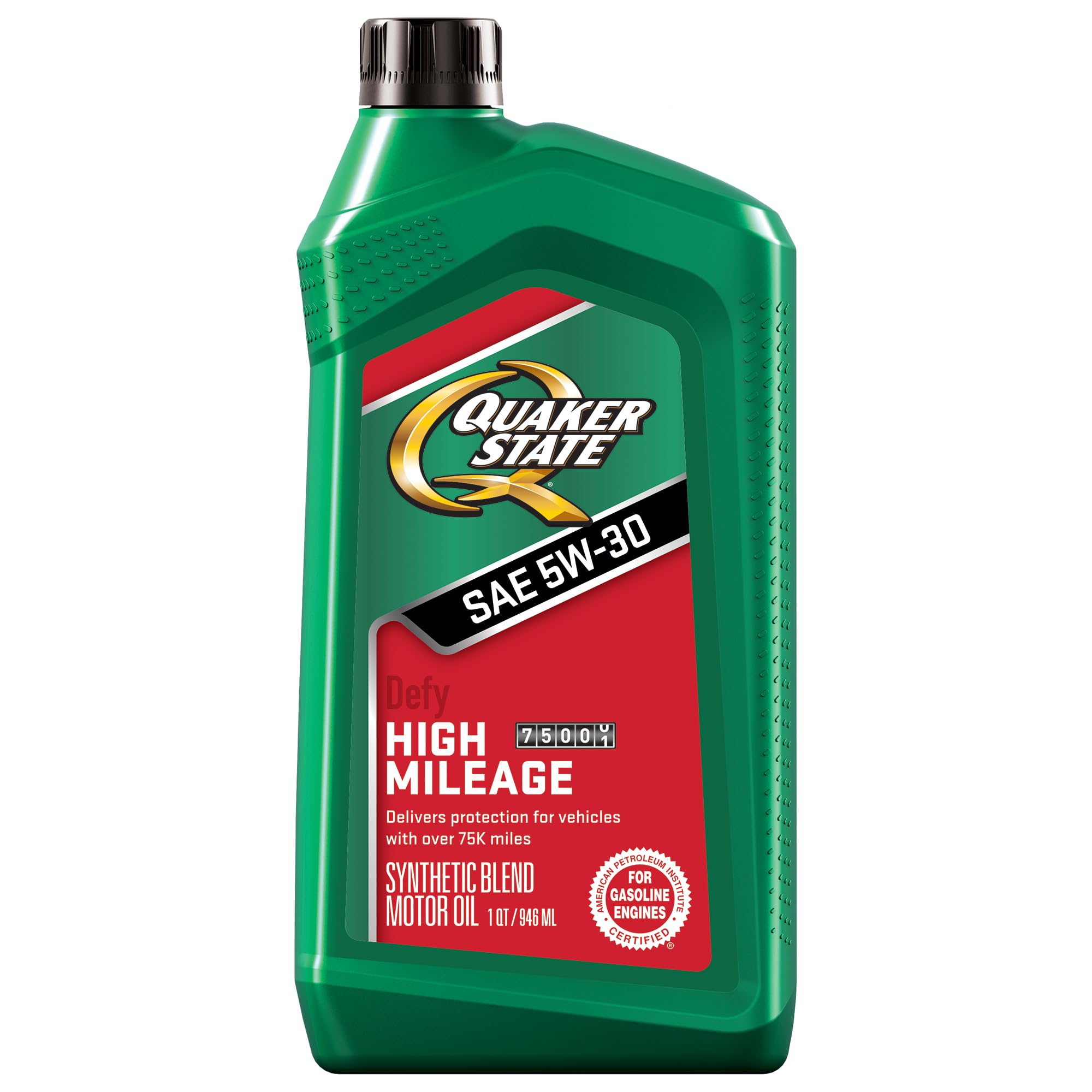
Synthetic blend with active seal conditioning that one owner says resolved catalyst converter codes and restored gas mileage.
The Quaker State High Mileage 5W-30 is a synthetic blend with a specific focus on catalyst-friendly formulation. Its “Defy” formula includes active seal conditioning agents that keep seals pliable to prevent leaks, along with advanced thermal and oxidative stability to reduce oil burn-off and boost power output. One long-term user reports that switching to Valvoline High Mileage caused a check engine light related to the catalyst converter, and returning to this oil resolved the issue while restoring gas mileage — with oil still looking new after 8,000 miles and the car running well at 270,000+ miles. That buyer also noted the oil helped the catalyst converter itself, which suggests the additive package is low in the phosphorus and sulfur that can poison catalytic converters over time.
The 6-pack case holds 192 fluid ounces (six 1-quart bottles), matching the volume of the Pennzoil and Mobil 1 full synthetic packs. It is formulated for new or late-model SUVs, light vans, trucks, and passenger cars with over 75,000 miles, and exceeds ILSAC GF-6A and API SP specifications. The 5W-30 viscosity is the same as the Pennzoil Platinum, but Quaker State is a synthetic blend rather than a full synthetic, so it does not offer the same extreme-temperature flow or drain-interval length. The main downside is that the synthetic blend will break down faster under extreme heat than a full synthetic, so you should stick to 5,000-mile changes at most.
Formula Strengths
- Active seal conditioning agents help prevent leaks and reduce oil consumption in worn engines
- Low phosphorus/sulfur formulation supports catalyst converter health
- Oil stays clean-looking past 7,000 miles according to long-term user reports
Compromises
- Synthetic blend does not handle extreme heat as well as full synthetic options
- Higher per-quart cost than the Valvoline MaxLife while both are synthetic blends
Best For: drivers of 200k+ mile cars who have experienced catalyst-related check engine lights and want an oil that keeps emissions components healthy.
Watch Out: the synthetic blend formulation means you need to stick to conventional drain intervals — do not push past 5,000-7,000 miles like you could with a full synthetic.
Understanding the Specs
Flash Point
This is the temperature at which the oil’s vapor can ignite. A higher flash point (like 500°F on the Mobil 1 versus 390°F on the Valvoline) means the oil resists evaporation and breakdown under high engine load. For extended highway driving, towing, or hot climates, a higher flash point keeps the oil film stable for longer.
Viscosity Grade (SAE J300)
The “5W-30” number describes how easily the oil flows. The “W” stands for winter — the lower the number before the W (5 vs. 10), the thinner the oil in cold starts. The number after the W (30 vs. 20) is the thickness at normal operating temperature. A 10W-30 is thicker at startup than a 5W-30, which is fine for warm climates but can cause sluggish cranking in a cold winter. Always match the grade your owner’s manual calls for — using too thick an oil can reduce fuel economy and oil pressure.
FAQ
What makes an oil “high mileage” different from regular oil?
Can I use a high-mileage oil if my car has less than 75,000 miles?
Is a full synthetic oil always better than a synthetic blend for high-mileage engines?
What is the difference between 5W-20 and 5W-30 high-mileage oil?
Will high-mileage oil stop an existing oil leak?
How long does a full synthetic high-mileage oil last?
Can I mix a high-mileage synthetic blend with a full synthetic oil?
Does high-mileage oil help with lifter tick or noisy valves?
Final Thoughts: The Verdict
For most people, the oil for high mileage winner is the Pennzoil Platinum High Mileage Full Synthetic 5W-30 because it combines a full synthetic base, a 15,000-mile protection guarantee, and proven leak-stopping capability at a fair mid-range price. If you want extreme heat resistance for towing or hot climates, grab the Mobil 1 Extended Performance High Mileage. And for restoring lost performance and quieting a noisy valvetrain in an older V8, the standout is the Royal Purple HMX 10W-30.
How We Picked
We do not accept paid placement. Every pick is matched to a real buyer and a real use-case; we do not hands-on test units.
Sources & Methodology
Specifications: manufacturer listings and product documentation. Review insights: verified customer reviews, as of July 2026. Pricing: not shown on this page (it changes often); check the current price via the retailer link.
As an Amazon Associate, Trending Car earns from qualifying purchases. This does not affect which products we feature.