
Our readers keep the lights on and my garage snacks stocked. As an Amazon Associate, I earn from qualifying purchases.
Specs are compiled from manufacturer listings and verified buyer reviews and can change over time — please confirm the key details on the product page before buying.
If you own a classic car built before the mid-1990s, the modern motor oil on auto-parts shelves is silently wearing out your engine. That is because emissions regulations forced oil makers to slash zinc and phosphorus, the two additives flat-tappet camshafts and lifters absolutely need to survive. Buy the wrong bottle and you risk a wiped cam lobe and a rebuild that costs thousands. This guide picks seven oils that still carry the high zinc levels your vintage engine actually requires.
I’m Min Islam — the founder and writer behind Trending Car. This guide is built by comparing the manufacturers’ published specifications and the patterns across verified customer reviews, so you get each pick’s real strengths and trade-offs instead of marketing spin.
Whether you own a classic British roadster, a vintage American V8, or an air-cooled Porsche, finding the right oil for classic cars means choosing one that delivers enough ZDDP to protect flat-tappet components without causing other problems in your older engine.
Our Picks at a Glance


How To Choose The Best Oil for Classic Cars
Buying oil for a classic car is not the same as picking a bottle for a modern daily driver. You need three things that most modern oils lack: high zinc for cam protection, the right thickness for loose bearing clearances, and a formula that does not shrink old seals. Here is what matters most.
Zinc and ZDDP Levels — The Flat-Tappet Lifeline
Classic engines use flat-tappet camshafts where the lifter slides across the cam lobe. Without enough zinc dialkyldithiophosphate (ZDDP — a friction-fighting additive that forms a protective layer on metal surfaces), the cam and lifters wear down rapidly. Look for oils that explicitly state high ZDDP or zinc levels above 1200 ppm — every pick in this list meets that requirement.
Viscosity — 20W-50 Is Not Optional
Most classic engines were designed for thicker oil than modern cars. A 20W-50 grade (meaning it flows like a winter-grade 20-weight when cold and acts like a 50-weight at full operating temperature) is the standard recommendation for pre-1980 engines, British cars, and air-cooled VWs. A 10W-40 can work in cooler climates, but the wider spread means less film strength at high temperatures.
Mineral vs. Synthetic vs. Synthetic Blend
Full synthetic oils flow better and resist heat, but they can leak past old seals and gaskets that have hardened over decades. A synthetic blend (like the PennGrade oils) or a high-quality mineral oil (like the Castrol Classic) often suits older engines better because the base stock is closer to what the engine was originally designed for.
Quick Comparison
| Model | Best For | Viscosity | Volume | Item Weight | Amazon |
|---|---|---|---|---|---|
| PENN GRADE 1 20W-50 (12 Pack)★ Best Overall | British & air-cooled flat-tappet cars | 20W-50 | 12 Quarts | 25 Pounds | Amazon |
| PENN GRADE 1 10W-40 (2 Pack)Best Value | Cooler climates & flat-tappet Corvettes | 10W-40 | 2 Quarts | — | Amazon |
| Lucas Oil 10684 20W-50 | Hot rods & air-cooled Baja bugs | 20W-50 | 5 Quarts | 4.35 Kilograms | Amazon |
| Lucas Racing 20W-50 | High-RPM racing engines & Harleys | 20W-50 | 5 Quarts | 4.36 Kilograms | Amazon |
| Castrol Classic XL20w/50 | Pre-1980 cars & wet-clutch bikes | 20W-50 | 5 Liters | 10 Pounds | Amazon |
| Kendall GT-1 Competition 20W-50 | High-performance vintage engines & HDs | 20W-50 | 12 Quarts | — | Amazon |
| Valvoline VR1 20W-50 | Break-in & high-wear protection | 20W-50 | 12 Quarts | 24 Pounds | Amazon |
In‑Depth Reviews
1. PENN GRADE 1, Synthetic Blend High Performance Oil SAE 20W-50,1 Quart (Twelve Pack)
Our pick — over 4.5★ from 950+ verified ratings; the strongest balance of quality and price.
The synthetic blend that keeps British flat-tappet engines alive without the leak issues.
The stand out feature here is the ZDDP content paired with a synthetic blend base. This gives you the anti-wear protection your camshaft needs without the seal-shrinking downsides of a full synthetic. Buyers report this is the only oil used for classic British cars because it contains the ZDDP needed for flat tappet engines, and the 20W-50 weight is what old British engines recommend. The semi-synthetic formula also leaks less than full synthetic in hand-built engines, which is a common frustration with older engine seals.
At 25 pounds for the twelve-pack, the case is heavier than the Lucas 5-quart options by roughly 2.5x, so expect a bulky shipment. But with a 4.8-star average from 964 ratings, the shop favorite for air-cooled Porsches and race engines alike is hard to argue with. One reviewer who runs 50/50 of the 10W-40 and 20W-50 for climate tuning confirms its versatility.
What Makes It The Pick
- Synthetic blend means less leakage past old gaskets compared to full synthetics.
- 24 fluid ounces per quart provides excellent shock load protection for heavily stressed parts like camshafts and bearings.
- 12 quarts gives you two complete oil changes for most inline-six or small-block V8s.
The Real Trade-Offs
- The 25-pound case weight is noticeably heavier than the Lucas 5-quart options at around 4.35 kilograms.
- Some users report it is expensive, though annual oil changes justify using the best available.
Reach for this if: you own a classic British roadster, an air-cooled Porsche, or any flat-tappet engine that needs 20W-50 and you want the semi-synthetic balance between protection and seal compatibility.
Look elsewhere if: you only need a single oil change and do not want to store 12 quarts, or your engine requires 10W-40 for colder climates.
2. PENN GRADE 1 Synthetic Blend High Performance Oil SAE 10W-40 (2, Quart)
The same PennGrade protection in a thinner viscosity for cooler climates.
If your engine runs in a region where 20W-50 is too thick on cold mornings, this 10W-40 (with a SAE J300 viscosity grade of exactly 10W-40, compared to the 20W-50 of the rest of the picks) provides the same high ZDDP and additive package. Owners mention that Brad Penn 1 has high ZDDP, detergents, anti-corrosion and is safe for more than 3 months or 1000 miles. One owner ran it for 2000 miles in a 1976 Corvette 350/350 with no sludge, just a thin green film, and no leaks — calling it cost-effective compared to Amsoil or Royal Purple.
This is also the go-to recommendation for VW Type 1 engines with flat tappet cams. You do not need any extra additives; it is ready to use as is. Just note that the 2-quart pack is a smaller buy-in, so you will need multiple packs for a full oil change if your engine holds 5 quarts or more.
The one-liner: The same trusted PennGrade ZDDP protection in a 10W-40 viscosity that is safer for cooler starts and looser-tolerance engines.
Grab it for: a 1976 Corvette, a VW Beetle, or any flat-tappet engine that runs better on 10W-40 in cold weather.
skip it if: your classic car manual explicitly calls for 20W-50, or you need enough oil for a complete change in one purchase.
3. Lucas Oil 10684 Hot Rod & Classic Car HP Motor Oil SAE 20W-50-5 Quart

A 5-quart jug built for hot rods that need high zinc without the synthetic price.
This Lucas Oil formula contains the high levels of ZDDP necessary to protect flat tappet cams, lifters, and pushrods. It is a long-lasting, high-performance lubricant that provides a tougher, thicker additive film for maximum protection even under severe conditions. Customers note it is quality oil for a 1965 MGB engine and transmission, with no oil-related issues and great value for the cost. The 5-quart jug at 4.35 kilograms gives you a practical size for one standard oil change on most V8s.
Lucas also claims it lowers oil temperatures, extends oil life, slows oil burning, and improves pressure in worn engines. One owner using it on a 1936 Hot Rod for a full season reported no problems, confirming it stands up to high operating temperatures and makes startups easier in colder climates.
Strong Points
- Single 5-quart jug covers most classic car oil changes without leftovers.
- At 4.35 kilograms, it is essentially the same weight as the Lucas Racing 20W-50 at 4.36 kilograms, making it just as portable.
- Explicitly formulated to improve pressure in worn engines.
Downsides
- Standard mineral base may not provide the same high-temperature film strength as the synthetic blend PennGrade oils.
- Some classic car specialists still prefer a semi-synthetic for older seals.
Choose this for: a 1965 MGB, a 1936 Hot Rod, or any classic car needing a budget-friendly 20W-50 with proven ZDDP levels.
Consider another if: your engine has known seal issues that a synthetic blend might better accommodate.
4. Lucas Oil SAE 20W-50 Racing Engine Oil, 5 Quart (Pack of 1)

High-zinc racing oil that cuts start-up noise and drops oil temps in high-RPM engines.
This Lucas Racing variant is high-zinc fortified and designed for high-RPM engines. Reviewers point out that Lucas synthetic oil outperforms expectations and reduced start-up crank noise, noting that 70% of engine wear occurs at start-up. The same owner also saw improved oil temperature and slightly higher oil pressure, all at a lower price than top-tier synthetics. This aligns with Lucas’s claim that the formula lowers oil temperature and creates less drag for more horsepower.
It weighs 4.36 kilograms, essentially identical to the Lucas Hot Rod 10684 at 4.35 kilograms, so you get the same convenient 5-quart size. It is also compatible with methanol or racing gas, making it a strong fit for dedicated track cars or Harleys with modified engines. One rider runs it in a Sportster 1200 and notes the new cams are quiet and smooth sounding.
The short take: If your engine sees sustained high RPM or you race on methanol, this zinc-packed 20W-50 is purpose-built for that abuse.
Reach for it if: you have a high-RPM racing engine, a Harley with aftermarket cams, or a vehicle that runs on methanol.
Look elsewhere if: you just need a daily driver oil for a stock classic car — the Hot Rod formula is more suited for that use case.
5. Castrol Classic XL20w/50 Engine Oil – 5L
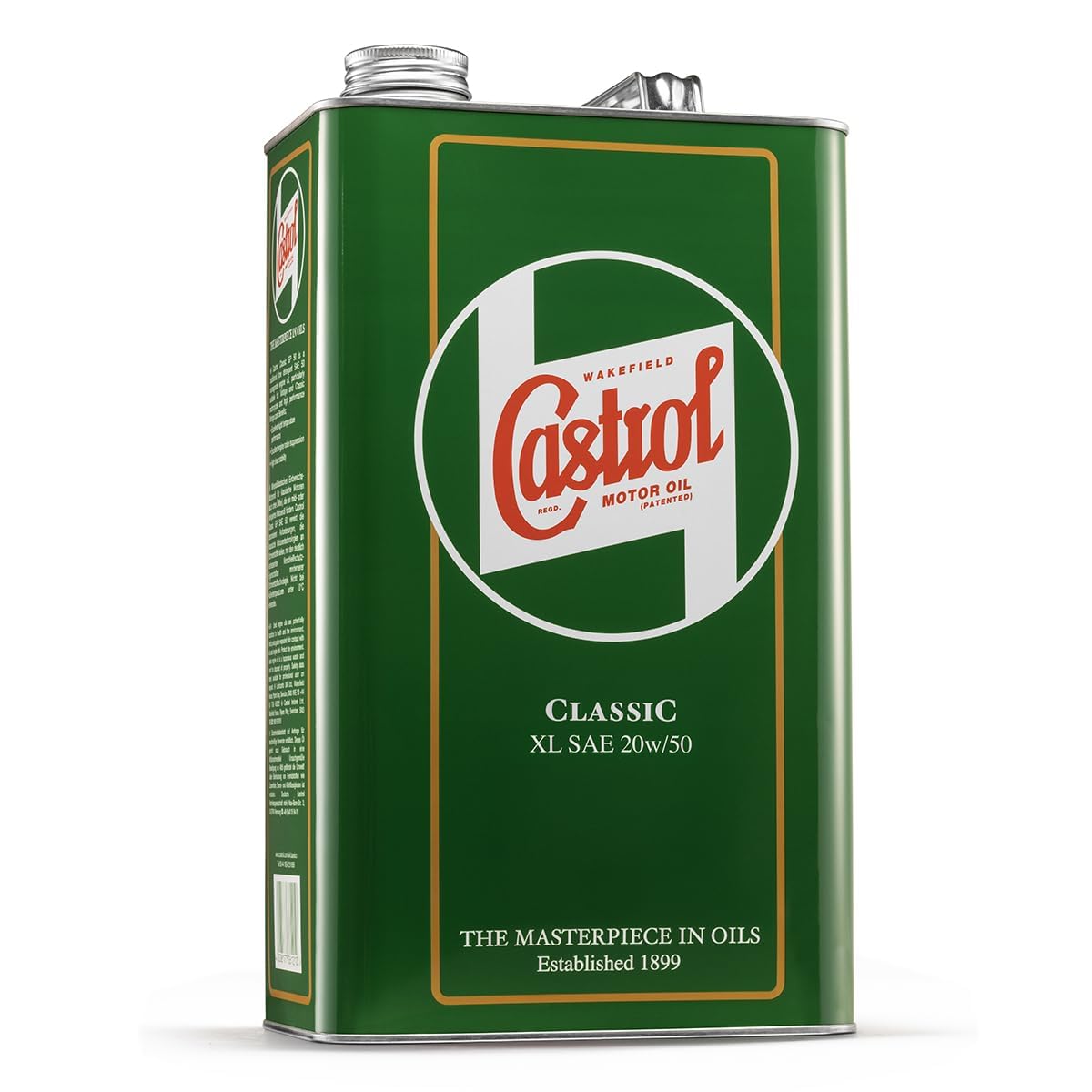
The mineral 20W-50 that is compatible with motorcycle wet clutches and pre-1980 engines.
Castrol formulated this specifically for pre-1980 classic cars and motorcycles with older engine technologies. It is a conventional 20W-50 multigrade mineral engine oil made with high quality mineral oils and selected additives. The high zinc formulation is designed to provide enhanced protection for vintage engines with older metallurgy. Crucially, it is suitable for motorcycles with wet clutches, providing reliable performance for classic bike applications.
At 10 pounds for the 5-liter tin, it is significantly lighter than the PennGrade 12-pack at 25 pounds, making it easier to handle. Some buyers have noted the tin can arrive with minor leakage, so check the packaging on delivery. The vintage collectible tin is a nice bonus for display, but the real value is a correct mineral oil for old BMW motorcycle engines requiring 20W-50.
Why It Stands Out
- Specifically designed for pre-1980 cars and motorcycles, including wet clutches.
- Mineral base is less likely to leak past old seals than full synthetics.
- 5-liter tin provides enough for most single oil changes.
Watch For
- Some shoppers say the tin can arrive with oil seepage.
- Mineral oil may need more frequent changes than a premium synthetic blend in high-heat environments.
Best suited for: owners of pre-1980 BMW motorcycles, classic British bikes with wet clutches, or any vintage car where the manual specifies mineral 20W-50.
Not the pick if: you want a full synthetic blend or need 12 quarts for multiple changes.
6. Kendall GT-1 Competition 20w-50 w/Ti – 12/1 qt. Case

The titanium-infused 20W-50 that is the only oil some VW and Harley owners will use.
Kendall’s GT-1 Competition formula uses titanium technology to add an extra layer of protection under extreme pressure. It has a SAE J300 viscosity grade of 20W-50, matching the rest of the heavyweights on this list, and comes in a 12-quart case — the same large volume as the PennGrade 12-pack and the Valvoline VR1, but at 12 Quarts it holds 2.4x the volume of the Lucas 5-quart bottles. Buyers report it is the only oil used on a VW bug, and another owner runs it in a Harley because it is superior to Syn 3.
With a perfect 4.9-star average from 129 ratings, it is the highest-rated product in this guide. The liquid volume of 12 quarts lasts a long time, and one reviewer noted a specialist mechanic recommended it for old foreign cars. The case is ideal for topping off between changes or performing two oil changes on most classic engines.
The verdict in one line: A race-proven 20W-50 with titanium additive technology, perfect for high-performance vintage builds and Harleys.
Pick this if: you run a high-performance vintage engine, a modified Harley, or a VW bug and want the titanium-infused protection that other brands do not offer.
pass on it if: you only need 5 quarts for a single change and do not want to store a 12-quart case.
7. Valvoline VR1 Racing 20W-50 Motor Oil, 1 Quart (Pack of 12)

A trusted break-in oil for vintage motors with the zinc modern oils leave out.
Valvoline VR1 is a classic car staple because it supplies the high zinc additives that modern oils have removed to protect older engines from excess wear and premature failure. At 24 pounds for the 12-quart case, it is comparable in heft to the PennGrade 12-pack at 25 pounds, so expect a substantial box. Owners mention using it as break-in oil for vintage motors per engine builder’s advice — it increases break-in time but reduces high temperatures due to great lubrication, leading to tighter tolerances, less oil consumption, and longer engine life.
The package weight of 11.068 kilograms and dimensions of 24.13 L x 33.02 H x 30.48 W (centimeters) make it a bulky shipment. Classic car owners note it meets old engine requirements and is available at a fair price with fast Amazon delivery, though one customer received a box soaked in oil due to shipping damage, so inspect the packaging.
What Works
- Engineered for the high-zinc requirements of pre-1990s flat-tappet engines.
- 12-quart case gives you ample oil for multiple changes or one big engine.
- Trusted as a break-in oil for rebuilt vintage motors.
Potential Issues
- Shipping damage reported by some buyers — quart bottles can arrive leaking.
- Not ideal for engines with very tight tolerances that need a thinner viscosity.
Grab it for: breaking in a freshly rebuilt vintage V8, or as a reliable high-zinc oil for any classic car with a flat-tappet cam.
Think twice if: your engine needs a synthetic blend for seal compatibility or you cannot store a 12-quart case.
Understanding the Specs
SAE Viscosity Grade (20W-50)
The Society of Automotive Engineers viscosity grade tells you how thick the oil is. 20W-50 means the oil behaves like a 20-weight when cold (the ‘W’ stands for winter) and like a 50-weight at full operating temperature. Most classic car engines from the 1960s through the 1980s were designed for this thicker oil because their bearing clearances are larger than modern engines. A 10W-40, like the PennGrade option, is thinner when cold and can be useful in cooler climates but provides less film strength at high heat.
Zinc & ZDDP Content
Zinc dialkyldithiophosphate (ZDDP) is the anti-wear additive that forms a sacrificial layer on cam lobes and lifters. Modern oils have reduced ZDDP to around 800 ppm to protect catalytic converters, but classic flat-tappet engines need at least 1200 ppm to avoid camshaft wear. Every product in this guide is formulated with improve zinc levels — look for labels that say “high zinc” or “flat tappet safe” to know you are getting the protection your engine needs.
FAQ
Can I use modern 5W-30 synthetic oil in my classic car?
What is the difference between synthetic blend and full synthetic for classic cars?
How often should I change oil in a classic car?
Will 20W-50 oil damage a modern engine?
What does “high zinc” mean in terms of ppm?
Can I use classic car oil in a motorcycle with a wet clutch?
Is it safe to mix different brands of 20W-50 oil?
How many quarts does a typical classic car engine need?
Why does some classic car oil look green?
Final Thoughts: The Verdict
For most people, the best oil for classic cars is the PENN GRADE 1 20W-50 12-Pack because it delivers the right ZDDP levels in a synthetic blend that seals better in old engines. If you want a budget-friendly 5-quart option for a single change, grab the Lucas Oil 10684 Hot Rod 20W-50. And for a high-RPM racing build or a Harley with aftermarket cams, the titanium-infused protection of the Kendall GT-1 Competition 20W-50 is a top choice.
How We Picked
We do not accept paid placement. Every pick is matched to a real buyer and a real use-case; we do not hands-on test units.
Sources & Methodology
Specifications: manufacturer listings and product documentation. Review insights: verified customer reviews, as of July 2026. Pricing: not shown on this page (it changes often); check the current price via the retailer link.
As an Amazon Associate, Trending Car earns from qualifying purchases. This does not affect which products we feature.