
Our readers keep the lights on and my garage snacks stocked. As an Amazon Associate, I earn from qualifying purchases.
Specs are compiled from manufacturer listings and verified buyer reviews and can change over time — please confirm the key details on the product page before buying.
Changing your own oil usually means crawling under the car, wrestling with a drain plug, and hoping the pan doesn’t tip. An oil extractor pulls the old fluid up through the dipstick tube, so you stay clean and on your feet the whole time. Your choice depends on tank size, if you want a manual hand pump or one that runs on an air compressor, and how far its tubes can reach.
I’m Min Islam — the founder and writer behind Trending Car. This guide is built by comparing the manufacturers’ published specifications and the patterns across verified customer reviews, so you get each pick’s real strengths and trade-offs instead of marketing spin.
Tank capacity and hose reach separate a tool you’ll use for years from one you’ll fight every time. Here is the plain-English breakdown of the best oil extractor options for DIYers, top-side service, and shop-grade fluid swaps.
Our Picks at a Glance


How To Choose The Best Oil Extractor
An extractor creates a vacuum that pulls old fluid out of an engine, transmission, or reservoir and stores it in a sealed tank. Since the physics are the same across brands, your choice depends on capacity, power source, and whether the tubes will actually reach your vehicle’s dipstick. Getting those three right means the difference between a five-minute service and a frustrating afternoon.
Capacity: Match the Tank to Your Engine
The tank holds everything you extract, so it needs to fit at least one full oil change. A 6.5L tank handles most passenger cars, but a full-size truck or large SUV can drain 8 quarts or more, which overflows a 6.5L tank mid-job and forces you to pause and empty it. If you drive something big, look for a 9.5L or 10.5L tank so you finish in one pass.
Manual vs. Pneumatic: How Much Effort Do You Want?
Manual extractors run entirely on a hand pump you work yourself — no electricity or air needed, which makes them ideal for the driveway or a boat dock. Pneumatic models connect to an air compressor and pull fluid much faster, but they only work where you have compressed air available. Some extractors offer both modes, giving you speed at home and portability everywhere else.
Hose Length and Dipstick Access
The suction tube must slide down your dipstick tube to reach the oil pan, so its length and stiffness matter a lot. A short or overly stiff tube can fail to reach the bottom, leaving old oil behind, or refuse to navigate tight bends in certain engines. Check that the kit includes multiple tube diameters so you can match the one that fits your vehicle’s dipstick opening.
Quick Comparison
| Model | Best For | Capacity | Operation | Weight | Amazon |
|---|---|---|---|---|---|
| OEMTOOLS 24936★ Best Overall | All-around reliability | 8L | Manual | 7.3 lb | Amazon |
| VEVOR 6.5LBest Value | Budget-friendly value | 6.5L | Manual | 5.07 lb | Amazon |
| SUPERFASTRACING 6.5LTop Performer | Simple fluid removal | 6.5L | Manual | 7.83 lb | Amazon |
| Powerbuilt 6.3 Quart | Light-duty portability | 6.3 quarts | Manual | — | Amazon |
| EWK 6.5L | Long suction reach | 6.5L | Manual | 6.09 lb | Amazon |
| FOUR UNCLES 6.5L | Dual-mode flexibility | 6.5L | Manual / Pneumatic | 7.43 lb | Amazon |
| DURATECH 6.5L | Complete accessory kit | 6.5L | Manual / Pneumatic | 7.33 lb | Amazon |
| EWK 10.5L | Large engines, fast drain | 10.5L | Manual / Pneumatic | 7.43 lb | Amazon |
| OEMTOOLS 24397 | Maximum capacity, fast drain | 9.5L | Manual | 8 lb | Amazon |
In-Depth Reviews
1. OEMTOOLS 24936 Manual Fluid Extractor Pump
Our pick — 4.5★ from 900+ verified ratings; the strongest balance of quality and price.
The garage workhorse that balances reach, capacity, and build quality for serious DIYers.
If you want one extractor that handles cars, trucks, and motorcycles without complaint, this OEMTOOLS is the one. Its 8L tank covers most passenger vehicles comfortably, with room to spare before you need to empty it. The 41-inch dipstick hose gets down into tight engine bays and marine engines where shorter tubes simply can’t reach.
What wins people over here is pure functionality — it makes the job genuinely easy. Owners drain a 7.5L sump in about 10 minutes with no leaks or mess., and the vacuum holds well enough to walk away while it finishes the job. The built-in overflow shutoff valve stops extraction automatically when the tank is full, which protects your workspace from surprise spills.
At 7.3 pounds it isn’t the lightest, but that heft reads as durability in hand. The included adapters let it fit various dipstick tubes, and the leak-proof bottom means you can set it down on a clean garage floor without worrying. It works with low-viscosity fluids like water, power steering fluid, and gear oil, making it a genuinely versatile shop tool.
What owners love
- Holds vacuum for walk-away operation
- Overflow shutoff valve prevents spills
- 41-inch hose reaches tight engine bays
Where it trips up
- Some units arrive with suction or sealing quirks
- Instructions are sparse, so test with water first
Grab it for: reliable, mess-free top-side oil changes on most cars and light trucks, backed by a manual pump that needs no electricity.
Think twice if: you own a vehicle with an unusually deep or awkward dipstick tube that a 41-inch hose might not fully reach.
2. VEVOR 6.5L Manual Fluid Extractor Pump
A budget-friendly kit that punches above its price with a generous accessory bundle.
The VEVOR is the definition of value — it ships with a 6.5L tank, main tube, dipstick, two extension tubes, a liquid suction hose, and two sealing rings, so you have everything to start working immediately. That all-in-one approach is why owners call it “better than electric pumps” for small-engine work. The four suction tube sizes let you reach deep into sumps and leave tanks dry.
It’s noticeably lighter than the OEMTOOLS at 5.07 pounds, making it easier to carry around the garage or out to the boat. Owners consistently report a clean oil change in 15-20 minutes with no spills and no need to get under the car. The manual pump is simple to maintain, and the sealed design keeps used oil contained for easy recycling.
The key trade-off is capacity — at 6.5L, it handles standard cars but falls short on full-size trucks that drain more. Buyers report using it on everything from 0w20 to 15w40 oil as long as the fluid is warmed first. The fill lines on the tank are a bit hard to read, but that’s a minor quibble on an otherwise solid tool.
Why it wins
- Complete kit includes hoses, tubes, and rings
- Weighs just 5.07 pounds for easy carrying
- Simple manual pump with no extra equipment needed
The compromise
- 6.5L capacity won’t cover full-size truck drains
- Fill lines are difficult to read clearly
Best suited for: the weekend DIYer who wants a clean, easy oil change on a standard car or small engine without spending a lot.
Look elsewhere if: you regularly service large trucks, SUVs, or anything draining more than 6.5L in one go.
3. SUPERFASTRACING 6.5L Manual Vacuum Fuel Petrol Pump
A transparent-hose extractor that makes it easy to watch your fluid as it flows.
The transparent hose lets you see exactly what’s being pulled out of the engine — a real advantage when you’re extracting power steering fluid or coolant and want to monitor color and flow. Owners remove power steering fluid in about 10 minutes with no fuss.. The durable metal pedal fixes the tank to the ground while you pump, adding welcome stability.
Functionality is the most-praised aspect, and it’s easy to see why. The multiple hose diameters fit a range of dipstick openings, and the vacuum continues suction until you release it — meaning you don’t have to pump constantly. Owners have used it for engine oil, brake fluid, and even water from a fish tank, so it’s genuinely versatile around the garage and home.
At 7.83 pounds, this is the heaviest of the 6.5L options, which gives it a solid, sturdy feel but makes it less portable. The honest caveat is that some owners hit suction and oil-extraction issues, with a few reporting the couplers feel cheap or tubes pop off the container during use. It’s a capable tool, but the fit-and-finish isn’t quite as polished as the top pick.
What stands out
- Transparent hose for visual fluid monitoring
- Durable metal pedal keeps tank stable
- Multiple hose diameters for different dipsticks
What to watch
- Some couplers feel cheap and can pop off
- Occasional suction loss reported during use
Choose this when: you want to visually track fluid extraction and value a stable, foot-anchored pump for multi-fluid jobs.
Pass on it if: you need maximum portability — the 7.83-pound build is the heaviest in its class.
4. Powerbuilt Oil and Fluid Extractor 6.3 Quart

The lightweight extractor with a long transparent tube for easy fluid monitoring.
With its 59-inch transparent main tube and a flexible 42-inch metal suction probe, the Powerbuilt gives you plenty of reach to get to the bottom of an oil pan. Performance is the top praised aspect here, and the wide base lets you stabilize the tank with your foot while you pump — a thoughtful touch for safer, easier operation. It’s built for on-the-go extraction from cars, motorcycles, lawnmowers, boats, and jet skis.
Owners love it for personal watercraft, with one noting it drained a Waverunner’s recessed oil tank in just 8-10 pumps and lasted 13 years before the tube deteriorated. The sealing cap keeps the tank airtight, while the pour spout allows smooth, spill-free disposal. It’s a compact, portable design that fits easily in a garage or boat locker.
The honest trade-off is speed. Because the tank is smaller at 6.3 quarts and the manual pump takes effort, owners mention cold fluid extraction taking around 30 minutes. Warm oil flows much faster, so the recommendation is to run the engine briefly first. It’s also slower than a traditional drain plug, but the cleanliness and convenience more than make up for it.
Why it’s a favorite
- 59-inch transparent tube for easy monitoring
- Wide foot-stabilized base for safety
- Proven reliability — one unit lasted 13 years
Know before you buy
- Slower extraction, especially with cold oil
- 6.3-quart capacity is on the smaller side
Ideal for: jet ski and small-engine owners who want a dependable, portable extractor that’s easy to store and use anywhere.
Not ideal if: you service large vehicles regularly and need fast drain times — this one rewards patience.
5. EWK 6.5L Manual Oil Extractor Pump
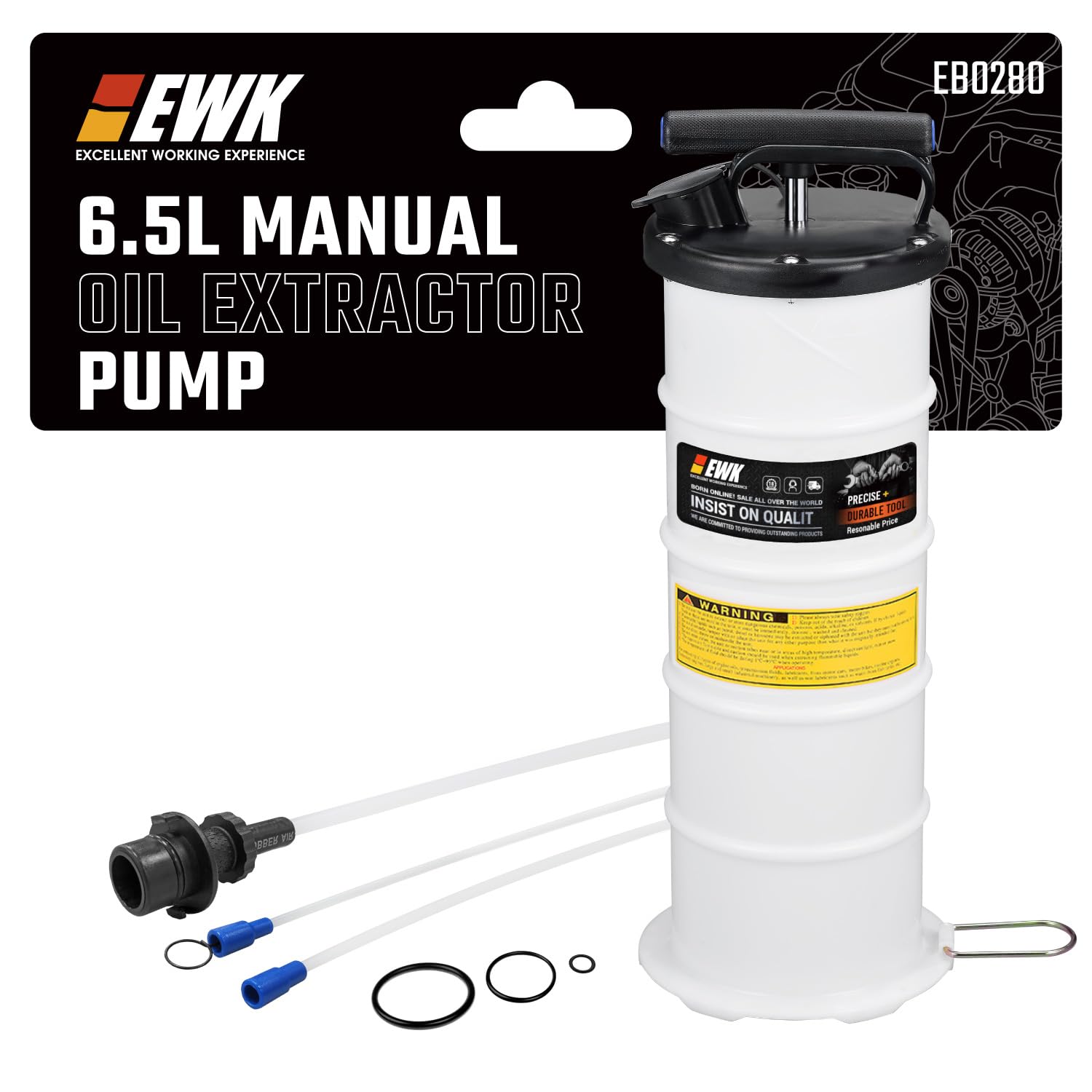
The long-reach extractor that slides deep into tight sumps without jacks or ramps.
The standout spec here is the extra-long 102-inch suction tube, which slides deep into tight sumps where you can’t reach a drain plug from below. That length makes it ideal for low-clearance cars, jet skis, inboard and outboard marine engines, lawnmowers, and generators — anything where topside access is your only option. The frosted translucent reservoir lets you see the oil level as it climbs.
Functionality is the most-praised aspect, and customers note it works “like a charm” on Audi models, delivering an easy top-side oil change with no spills and just 2-3 pumps to get the flow started. The high-density, heat-resistant polyethylene tank handles fluids up to 140°F, so it’s built for common automotive and marine jobs. It’s compact at 6.5L, yet light enough to carry with one hand.
The main limitation is stiffness — the tubes can be stiff and need straightening after storage, and some owners note the 6.5L capacity isn’t enough for 8-quart oil changes, requiring a pause to empty mid-job. It’s also note that the measurement lines help avoid overfilling, but the design works best when you warm the oil first. For most passenger cars and small engines, this reach is a genuine advantage.
Why owners rave
- 102-inch tube reaches deep sumps easily
- Warm-oil safe up to 140°F
- Light enough to carry with one hand
The drawbacks
- Stiff tubes need straightening after storage
- 6.5L may require emptying for 8-quart changes
Reach for it if: you work on boats, jet skis, or low-clearance cars where a long suction tube is a must-have.
skip it if: you drive a full-size truck that drains more than 6.5L — you’ll be emptying the tank mid-job.
6. FOUR UNCLES 6.5L Oil Extractor Pump with Main Tube Extension
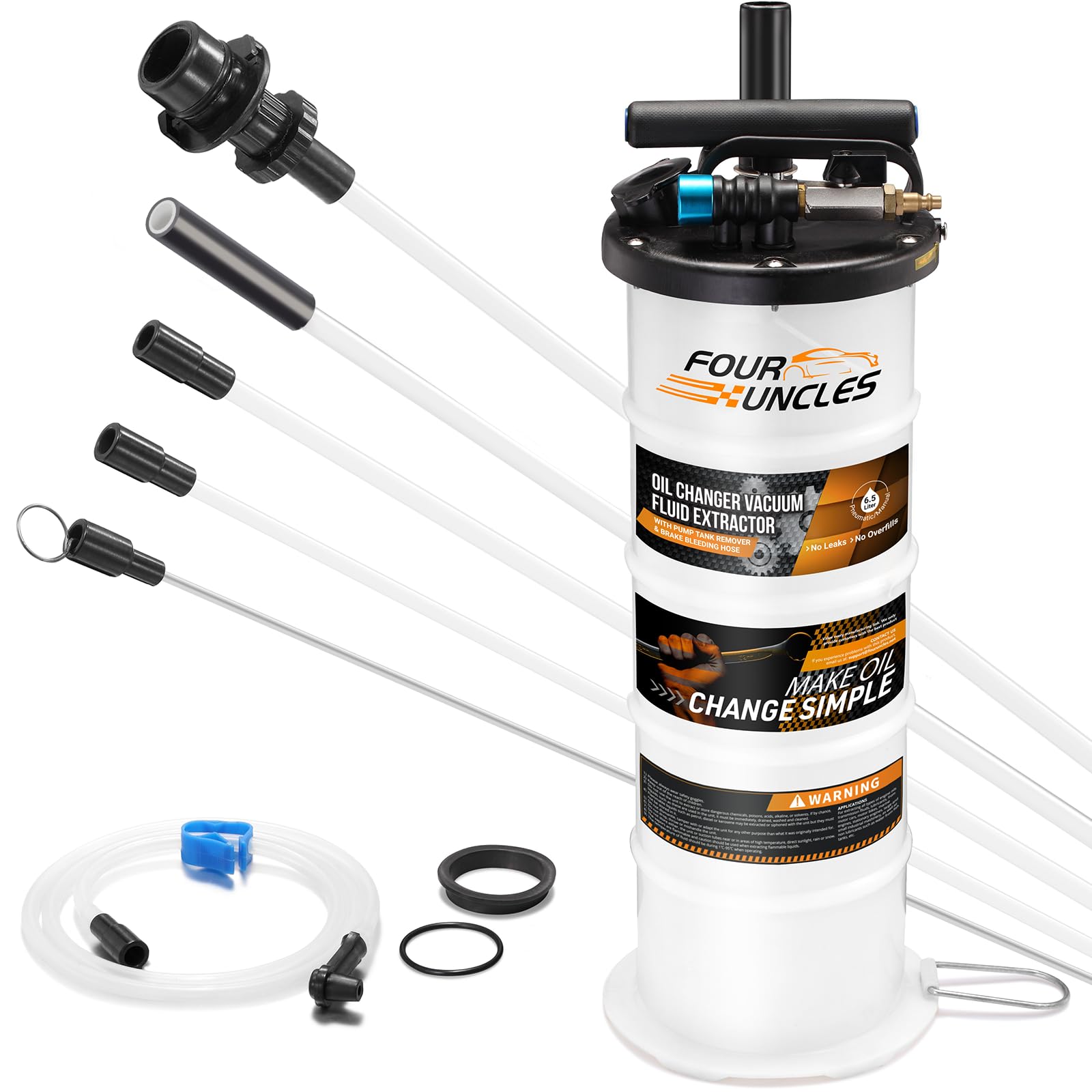
A dual-mode extractor with a rigid extension that reaches deeper service points.
The FOUR UNCLES stands out by offering both manual and pneumatic operation, so you can use compressed air when you want speed or the hand pump when you’re away from shop equipment. The included main tube extension increases the rigid extraction path, which helps reach deeper dipstick passages and larger engine compartments. This is a kit designed for flexibility across very different vehicles.
The kit includes a rigid main tube, extension, 3 suction tubes in different diameters, and a separate brake bleeding hose. Reviewers point out it holds a perfect vacuum with powerful suction, making oil changes on a 2010 Honda Fit quick and mess-free. It’s also handled thick gear oil from a 1950s differential, which is a serious test of suction power. The sealed reservoir keeps everything clean during transfers.
The honest caveat is durability, as some units broke on first use according to the review patterns. Owners also note that the stock tubes can be too short for very large vehicles like a 2015 Suburban, where a 5-foot fill port needed extra 7-foot tubing. If you can look past those quirks, the dual-mode versatility and included accessories make this a strong mid-range pick.
The big wins
- Manual and pneumatic modes for any setup
- Rigid extension adds reach to deep service points
- Handled thick gear oil with ease
Where it struggles
- Some units fail on first use — check yours early
- Tubes too short for very large vehicles
Best for: DIYers who want one extractor that works both with an air compressor and as a manual pump for on-the-go service.
Consider another if: you only work on full-size trucks and need longer stock tubes from the start.
7. DURATECH 6.5L Oil Extractor Pump
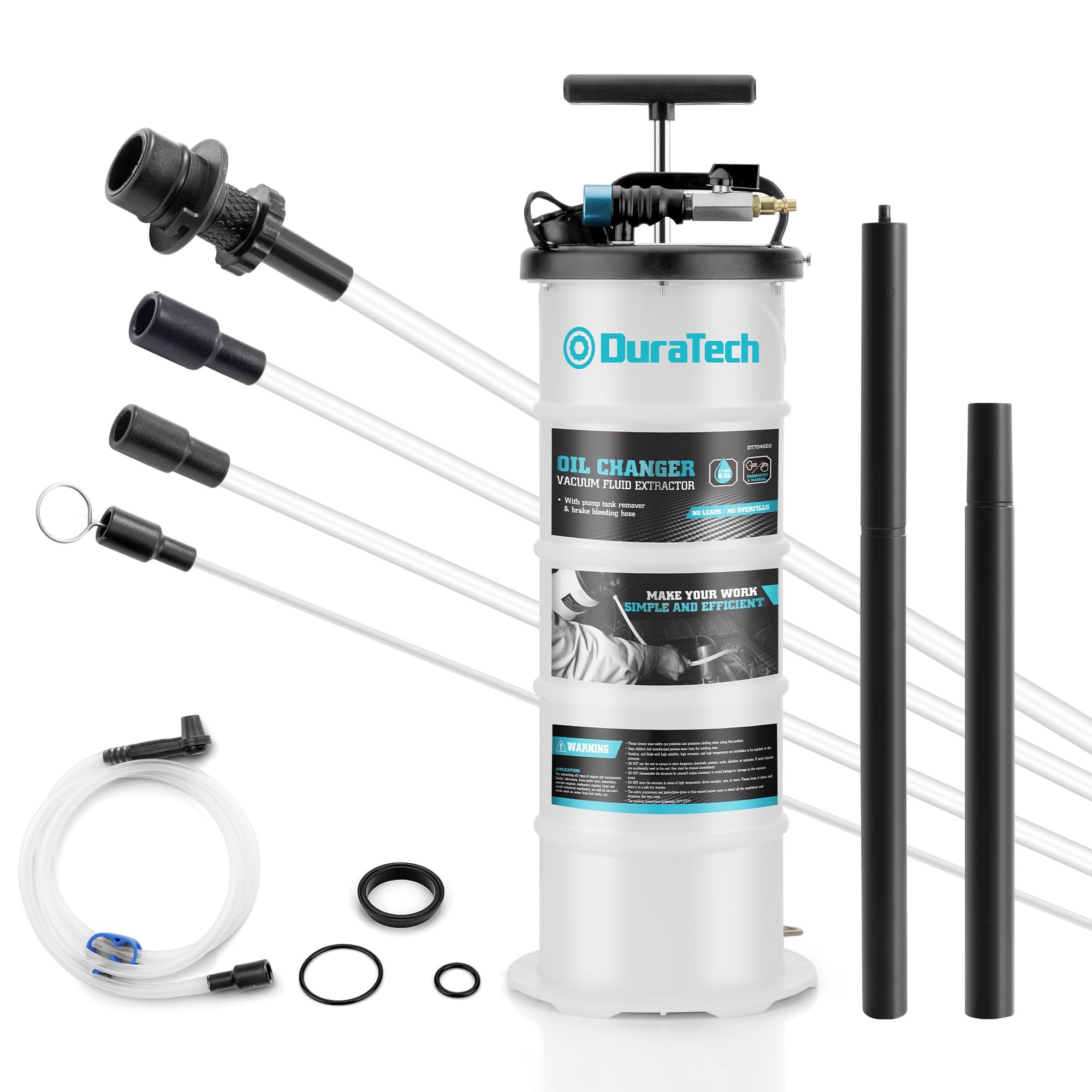
A fully-equipped dual-mode extractor with upgraded storage for the cleanest workflow.
The DURATECH sets itself apart with upgraded suction tube storage units that let you insert the hose after use, preventing residual oil from flowing out and causing a mess — a thoughtful detail most extractors ignore. It supports both pneumatic and manual operation, so you can hook up an air compressor for efficiency or use the hand pump anywhere. The kit includes the tank, main tube, 3 extension tubes, a brake bleeding hose, and 3 alternate rubber rings.
Owners call it the easiest oil change in 45 years, completing one in about 20 minutes with an air compressor. The included hoses, adapters, and brake bleeder hose make it a complete package for transmission fluid, antifreeze, power steering fluid, gear oil, and brake fluid. A 5-10 second compressor run holds vacuum for minutes, which is a strong performance signal. The pour spout makes emptying spill-free.
The recurring gripe is the hose storage design, which some find poor, and the lack of caps or plugs to prevent oil leaks when stored. A few owners also found the manual vacuum weak and the tubes too short for certain trucks like a 2014 GMC Sierra. For the money, this is a well-equipped kit with genuinely useful features, but it rewards a buyer who’ll use the compressor mode.
What impresses
- Tube storage units keep residual oil contained
- Includes brake bleeding hose and spare rings
- Holds vacuum for minutes after a short compressor run
What disappoints
- Hose storage still lets some oil leak
- Manual vacuum is weaker than the pneumatic mode
Pick this for: a fully-loaded kit that does fast compressor-driven fluid changes and includes brake bleeding capability.
Look past it if: you need the manual pump to be your primary mode — the pneumatic mode is clearly the stronger one here.
8. EWK 10.5L Pneumatic/Manual Oil Extractor Pump
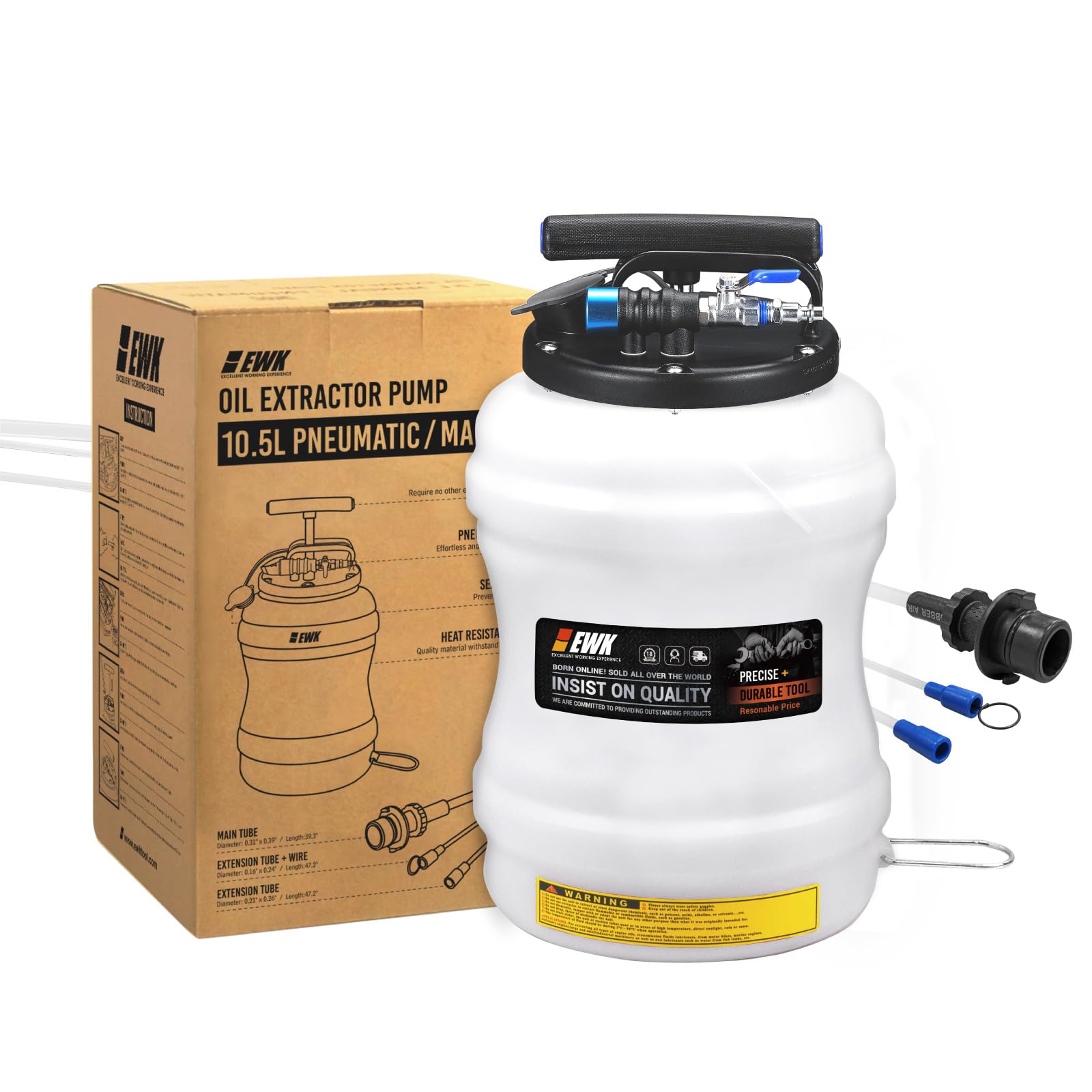
The big-tank speedster that drains engines fast without lifting the vehicle.
Need to handle full-size engines in one go? The EWK 10.5L is your answer. Its dual power setup lets you switch between manual and pneumatic modes, with air power delivering extraction up to 1.8 L/min — enough to drain 8 quarts in about 10 minutes according to owners. The large tank means you won’t pause to empty mid-change on most vehicles, and it’s big enough for a transmission fluid drain too.
It’s particularly effective on European and Japanese cars, pumping out 8 quarts of old oil in a single pass.. It works without needing a compressor, though it shines when you have air available. The upgraded vacuum system and extra-long tubes reach the bottom of the reservoir, and the clear tank lets you see the oil level as it climbs. It’s tidy, neat, and designed for repeated use in a home garage or workshop.
The honest downside is that a full 10.5L tank gets heavy, and the pump-handle design makes draining awkward and prone to spills — owners wish it had a bottom faucet. The thick plastic also obscures the liter marks, making it hard to read the level. And like any extractor, it won’t work with every vehicle’s dipstick; a sharp bend in a 2018 Ford F150 5.0 prevented tube insertion for one owner. If you have a large-engine garage setup with air, this is a serious time-saver.
Why it’s a powerhouse
- 10.5L tank handles full-size engines in one pass
- Pneumatic mode drains up to 1.8 L/min
- Works without a compressor if needed
The trade-offs
- Heavy when full, awkward to drain
- Liter marks hard to read through thick plastic
Go with this if: you service trucks, SUVs, or European cars and want a fast, large-capacity extractor for your garage.
Think twice if: you need to read fluid levels at a glance — the cloudy plastic makes the marks hard to see.
9. OEMTOOLS 24397 Manual Fluid Extractor Pump

The 9.5L tank that drains up to 5 liters in under a minute with low-effort pumping.
For the biggest capacity in a manual pump, this OEMTOOLS 24397 is the one. It drains up to 5 liters in under a minute, making oil changes, coolant flushes, and brake bleeds quick and mess-free. The 9.5L tank handles even oversized engines without needing to empty mid-change, and shoppers say removing 8.5L in about 10 minutes. The 5-foot dipstick hose gives you generous reach.
What wins people over is the sheer capability. Owners use it for brake bleeding on a Dodge Cummins, oil changes on a Prius, and even sailboat maintenance — it’s genuinely a one-man brake bleeder with its large tank. The ergonomic handle and tune pump design make extraction less effort, even on extended service jobs. High-quality brass connectors and precision O-rings deliver a reliable vacuum hold that prevents drips and air leaks.
The caveat is durability — the most common negative mention is durability concerns, so treat the build with reasonable care. Owners also note the suction tube can be too short for large or tall vehicles, and the cap is hard to remove. The manual is widely considered useless, but the tool itself works well enough to not need it. If you want maximum capacity from a manual pump, this delivers.
What earns its keep
- Drains 5 liters in under a minute
- 9.5L tank covers oversized engines
- Brass connectors resist leaks and drips
What to expect
- Durability gets mixed feedback in reviews
- Suction tube may be short for tall vehicles
Reach for it when: you want the largest manual-pump capacity available to avoid mid-change emptying on big engines.
Consider another if: you primarily need maximum portability — the 8-pound build and large tank are less travel-friendly than compact 6.5L models.
Understanding the Specs
Vacuum and Suction Power
The core of any extractor is its ability to create and hold a vacuum. A hand pump builds suction through repeated strokes, while a pneumatic model uses compressed air to pull fluid much faster. The strength of the vacuum determines how much oil you can pull in a single pass, which is why dual-mode extractors offer the best of both worlds — speed with air and portability without it.
Dipstick Tube Compatibility and Reach
Your extractor’s suction tube must slide down your vehicle’s dipstick opening to reach the oil pan bottom. Longer tubes like the 102-inch option on the EWK reach deep sumps in boats and low-clearance cars, while shorter tubes may fall short on tall trucks. Multiple tube diameters help match different dipstick sizes, so a kit with several options is almost always worth the extra flexibility.
FAQ
Will an oil extractor remove all the old oil from my engine?
How long does an oil change take with an extractor?
Can I use an extractor for transmission fluid and coolant?
What is the difference between manual and pneumatic extractors?
How do I choose the right tank capacity?
What does “topside oil change” mean?
Why does my extractor have trouble sucking cold oil?
Can an extractor drain my oil pan completely?
Final Thoughts: The Verdict
For most buyers, the oil extractor winner is the OEMTOOLS 24936 because its 8L capacity, 41-inch hose, and walk-away vacuum reliability cover the widest range of vehicles with the fewest compromises. If you want budget-friendly simplicity, grab the VEVOR 6.5L. And for large-engine owners who want speed, the EWK 10.5L pneumatic model is the one to reach for — it’s the crowd favorite with a 4.6-star score across 200+ owners, and its 10.5L tank drains 8 quarts in a single pass.
How We Picked
We do not accept paid placement. Every pick is matched to a real buyer and a real use-case; we do not hands-on test units.
Sources & Methodology
Specifications: manufacturer listings and product documentation. Review insights: verified customer reviews, as of August 2026. Pricing: not shown on this page (it changes often); check the current price via the retailer link.
As an Amazon Associate, Trending Car earns from qualifying purchases. This does not affect which products we feature.