
Our readers keep the lights on and my garage snacks stocked. As an Amazon Associate, I earn from qualifying purchases.
Specs are compiled from manufacturer listings and verified buyer reviews and can change over time — please confirm the key details on the product page before buying.
That glowing check-engine light on your dashboard does not automatically mean an expensive trip to a mechanic. A good OBD2 tool gives you the real story — the exact trouble code — so you can decide if it is just a loose gas cap or something that needs a shop. The catch in this category is that cheap readers only scan the engine, while pricier models also check your airbags (SRS), brakes (ABS), and transmission. This guide covers seven tools, from a simple code eraser to a full-system diagnostic tablet, so you match the tool to the cars you own.
I’m Min Islam — the founder and writer behind Trending Car. This guide is built by comparing the manufacturers’ published specifications and the patterns across verified customer reviews, so you get each pick’s real strengths and trade-offs instead of marketing spin.
For most people, the best all-around pick is the XTOOL AD20 Pro — it scans every system in your car wirelessly with no subscription. If you want a standalone tablet, grab the TOPDON AD600S. And for a simple code reader, the ANCEL AD310 does one job and does it well.
Our Picks at a Glance


How To Choose The Best OBD2 Tools
Picking the right OBD2 scanner starts with knowing what you want to fix. A basic code reader that clears a check-engine light costs very little and works on any car from 1996 onward. But if you work on newer vehicles or need to diagnose airbag (SRS) or anti-lock brake (ABS) issues, you need a scanner that talks to those specific computer modules. Your choice also depends on screen size, wireless capability, and if you want maintenance resets like Oil Reset or TPMS.
System Coverage: Engine Only vs. Full System
The most basic OBD2 scanners, like the ANCEL AD310, only read and clear codes from the engine/emissions system. That is fine if your only goal is to handle a check-engine light. But if you need to diagnose an airbag light or a transmission fault, you must step up to a scanner that covers ABS and SRS systems — such as the INNOVA 5310 or TOPDON AD600S. Some tools, like the XTOOL AD20 Pro and KINGBOLEN Ediag Elite, scan every computer module on the vehicle, giving you a full health report in one pass.
Handheld vs. Wireless Dongle
A handheld scanner has its own screen and buttons. Devices like the A-Premium AD200 and TOPDON AD600S let you work without a phone. A wireless dongle like the XTOOL AD20 Pro or KINGBOLEN Ediag Elite plugs into your car’s OBD2 port and sends data to an app on your phone via Bluetooth. Dongles are more compact, but they depend on your phone’s battery and a stable app. Handheld units are self-contained and often more durable in a shop environment.
Resets and Special Functions
Many modern scanners include maintenance resets that once required a dealer-level tool. The TOPDON AD600S gives you 9 reset services, including oil, brake, and TPMS resets. The KINGBOLEN Ediag Elite offers 15 service resets such as Injector Coding and SAS Reset. If you do your own oil changes or brake jobs, a scanner with these resets pays for itself by letting you clear the service light without a shop visit.
Quick Comparison
| Model | Best For | Systems Scanned | Screen Size | Connection | Amazon |
|---|---|---|---|---|---|
| ANCEL AD310★ Best Overall | Quick code reader | Engine only | — | Corded | Amazon |
| TOPDON AL400Smart & Simple | Beginner with DTC lookup | Engine only | 2.4 Inches | Corded | Amazon |
| XTOOL AD20 Pro | Wireless full-system scan | All systems (ABS, SRS, TCM) | Phone app | Bluetooth 5.0 | Amazon |
| A-Premium AD200 | Detailed data curves | Engine only | 1.77 Inches | Corded | Amazon |
| KINGBOLEN Ediag Elite | Bi-directional testing | All systems | Phone app | Bluetooth 5.2 | Amazon |
| INNOVA 5310 | ABS & SRS focus | Engine, ABS, SRS, Transmission | 2.8 Inches | Bluetooth + corded | Amazon |
| TOPDON AD600S | Standalone tablet diagnostics | Engine, ABS, SRS, Transmission | 5 Inches | Standalone + Wi-Fi | Amazon |
In‑Depth Reviews
1. ANCEL AD310
Our pick — over 4.5★ from 65,000+ verified ratings; the strongest balance of quality and price.
The budget-friendly code reader that does one job — reading and clearing a check-engine light — and does it extremely well.
If your main goal is to figure out why that yellow engine icon is glowing and then turn it off after a simple fix, the AD310 is the tool for you. It reads and clears emission-related trouble codes (DTCs) for any 1996 or newer vehicle that uses OBD2 protocols (KWP2000, J1850 VPW, ISO9141, J1850 PWM, and CAN). You do not need batteries or a charger because it pulls power from the OBD2 port itself. Buyers report that this simple scanner reads and clears a check engine light effectively. One user identified a gas cap issue in minutes. The 2.5-foot cable is thick and flexible, and the compact body measures 8.9″ x 6.9″ x 1.4″ — noticeably bigger than the TOPDON AL400’s slim 2.95″ x 0.96″ x 5.67″ profile, but still easy to stash in a backpack.
The clear limitation: the AD310 only supports diagnosis of emission-related issues. If the engine fault is unrelated to the emission system, this scanner cannot read the codes. You also need an OBDII interface — not an older OBDI connector. For a pure check-engine-light tool at this entry-level price, it is tough to top, but it will not help with airbag, ABS, or transmission codes.
What Makes It Work
- Supports all OBD2 protocols, including CAN
- Large screen displays results clearly at a 128×64 resolution
- No batteries or charger needed — powered by the vehicle’s OBD2 port
Where It Stops Short
- Only reads and clears emission-related codes, not ABS or SRS
- Will not work with older OBDI vehicles
- One reviewer noted the clear-codes function failed on their car
Reach for this if: you want a dead-simple, low-cost tool to handle check-engine lights on any 1996+ vehicle — no phone, no apps, just plug and read.
Look elsewhere if: you need to diagnose airbag, brake, or transmission faults, or you drive a pre-1996 vehicle.
2. TOPDON AL400
A slim code reader that explains each fault code on its built-in screen instead of making you search online.
The TOPDON AL400 packs a 2.4-inch color screen into a body measuring just 2.95″ x 0.96″ x 5.67″ — a much smaller footprint than the ANCEL AD310 — and weighs only 7.8 ounces. what separates it at this price is the DTC lookup library (the scanner shows you what the code means on its screen, not just a number). One buyer wrote, “I was able to pull codes on multiple vehicles with the device itself telling me what the codes meant on its screen rather than me having to look them up.” That saves you the extra step of grabbing your phone. The device covers 10 OBDII functions, including reading and erasing DTCs, freeze frame data, and I/M readiness tests that help you check whether your car will pass a smog test. A status LED gives you a quick visual check: green means no fault, yellow means a pending code, and red flags a permanent DTC.
Like the ANCEL AD310, the AL400 also only handles engine-related emissions systems. If you need to diagnose ABS, SRS, or transmission issues, this is not enough. The free lifetime updates help keep the software current, but the tool itself stays limited to basic OBDII functions. It is a smart entry point for the beginner who wants clear explanations without the complexity.
Instant answers: The on-board DTC library means you get the code’s meaning right on the 240×320 color screen, no phone required.
The trade-off: It only covers engine/emissions systems — no ABS, SRS, or transmission scanning.
Pick this for: a beginner who wants clear, immediate code definitions on the device and a compact tool that slips into a glove box.
Skip it for: diagnosing airbag or brake system faults, or if you need wireless operation.
3. XTOOL AD20 Pro
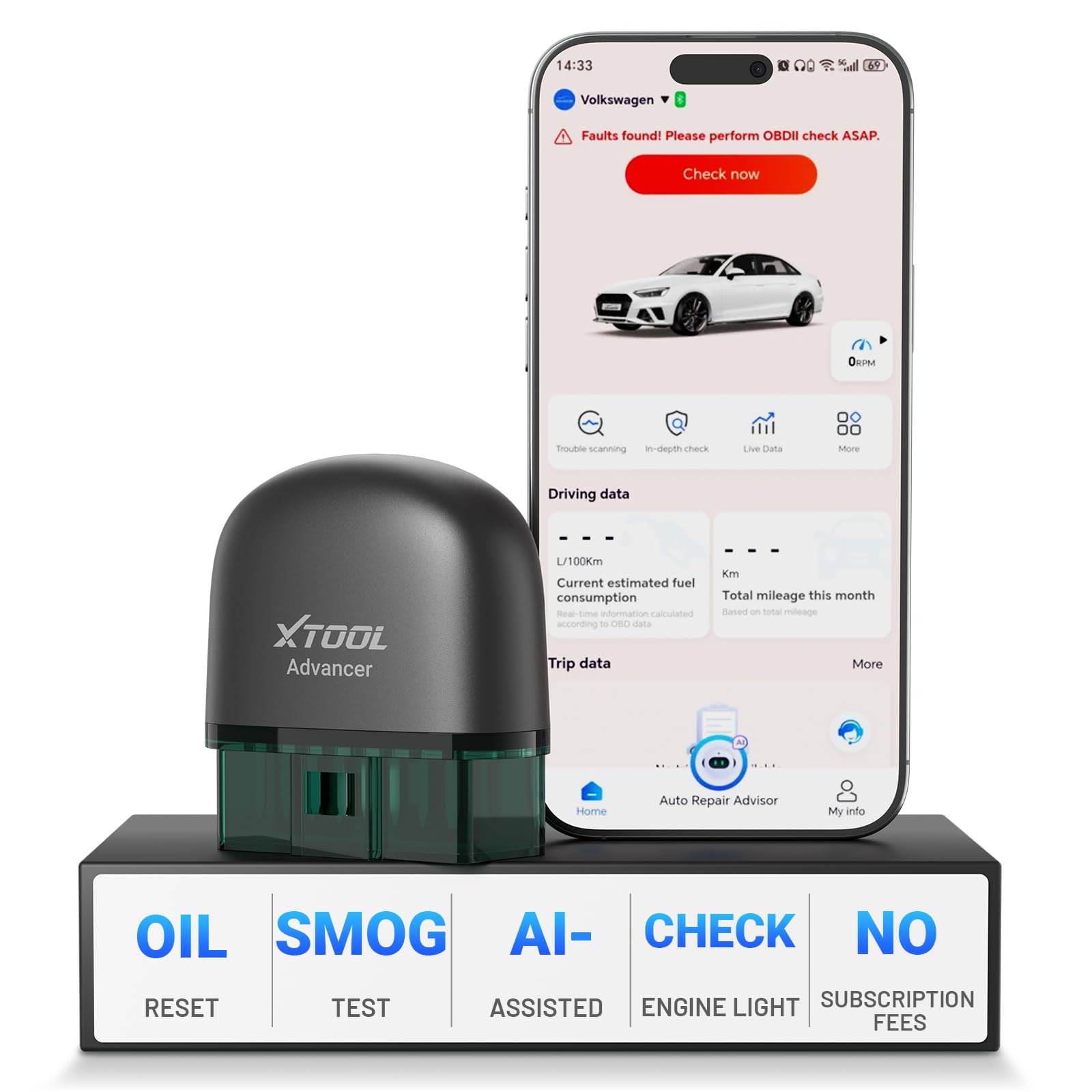
A wireless dongle that scans all your car’s systems — engine, brakes, airbags, and transmission — with no annual subscription.
The AD20 Pro is a Bluetooth 5.0 dongle that turns your smartphone into a full-system diagnostic tool. Unlike basic readers that only visit the engine module, this one performs a deep dive of ABS (brakes), SRS (airbags), transmission, TPMS (tire pressure monitoring system), and A/C systems. It also has built-in CAN FD hardware (Controller Area Network Flexible Data-rate, a faster protocol for newer cars), so it works with newer 2020+ GM, GMC, and Chevrolet vehicles that many older scanners cannot communicate with. Owners mention that “it scanned 6 cars (2003-2011)” and found codes across emission, ABS, SRS, TPMS, and A/C systems — a breadth the ANCEL AD310 and TOPDON AL400 simply cannot match. At just 1.13 ounces, you can leave it plugged into the OBD2 port continuously thanks to a Low-Power Sleep Mode that prevents battery drain. It also includes a Performance Test mode that measures 0-60 mph acceleration times and braking distance.
The main catch is that it is an app-based tool: you must use the XTOOL app on your iOS or Android phone, and one buyer mentioned “minor difficulty switching vehicles.” The wireless range is up to 33 feet, but the dongle has no bi-directional controls (the ability to send commands to car parts) or advanced reporting. It also lacks some pro-level features like ECU coding. Still, for a one-time purchase with no subscription fees and full system access, it delivers a lot.
The Big Upsides
- Full system scan of ABS, SRS, transmission, TPMS, and A/C
- Built-in CAN FD support for newer GM/GMC/Chevrolet vehicles
- Low-Power Sleep Mode for 24/7 plug-in without draining the battery
Where It Falls Short
- Relies entirely on a smartphone app — no built-in screen
- Switching between vehicles is not smooth
- No bi-directional controls or ECU coding
Best for: the DIYer who wants comprehensive wireless diagnostics across every system in the car without paying a yearly subscription.
Not for: people who prefer a standalone handheld unit and dislike using a phone for diagnostics.
4. A-Premium AD200
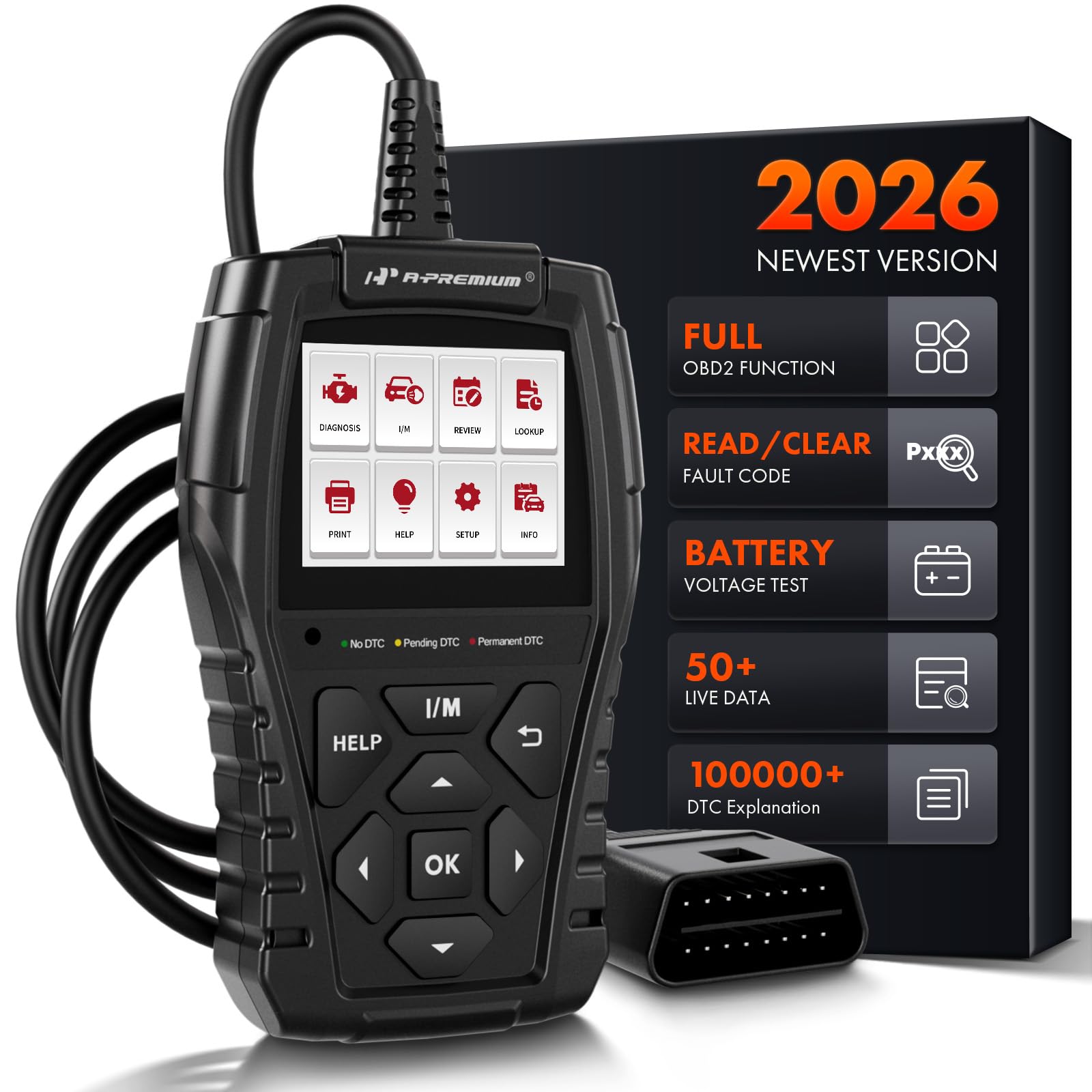
A handheld scanner that turns boring sensor data into real-time curves so you spot problems at a glance.
The AD200 steps beyond basic code reading by converting live data — battery voltage, coolant temp, engine RPM, fuel rail pressure, and oil temperature — into visual graphs on its 1.77-inch screen. The built-in “one-click get vehicle information” feature retrieves VIN (Vehicle Identification Number), CID (Calibration ID), and CVN (Calibration Verification Number) instantly. A three-color warning light system tells you the severity: green for healthy, yellow for minor issues that do not affect driving, and red for serious faults. The 3.9-foot cable gives you enough length to operate the tool comfortably even in tight engine bays. One first-time buyer reported the scanner “diagnosed Prius code, researched causes online, tried simple HEET fix, cleared code, problem solved” — saving them hundreds at a dealer.
Like the entry-level options, the AD200 focuses on the engine/emissions system. It does not diagnose ABS, SRS, or transmission modules. Some users also noted that the instructions are sparse, though the menu navigation is intuitive enough to figure out without the manual.
Graph view: See real-time data as visual curves on the screen — helpful for spotting abnormal sensor fluctuations.
Coverage gaps: Still only reads engine/emissions systems; no access to airbag or brake modules.
Reach for this if: you want more detailed live data, graphing capabilities, and a print-ready diagnostic report without jumping to a phone-based tool.
Look elsewhere if: you need to scan ABS, SRS, or transmission systems.
5. KINGBOLEN Ediag Elite
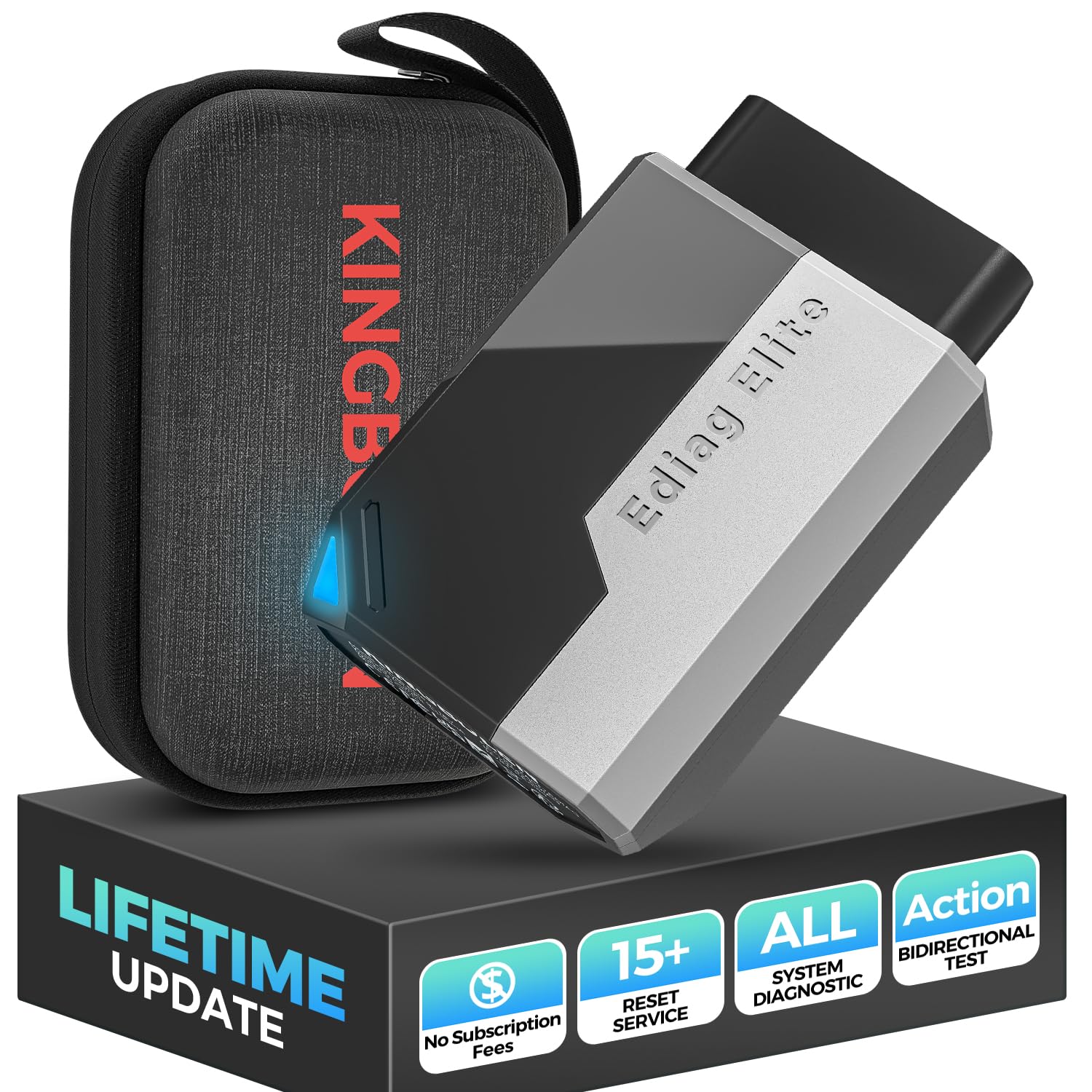
A Bluetooth dongle with bi-directional control — you can command parts like the AC clutch or fuel pump to turn on from your phone.
The Ediag Elite gives you two-way communication with your car’s modules. That means you can actively test components by sending a command from the app. If you suspect a bad AC clutch or a stuck window regulator, you can command it from your phone rather than just reading a code. The tool scans every system on the vehicle — engine, transmission, ABS, SRS, and more — and includes 15 maintenance resets such as Oil Reset, TPMS Reset, BMS Reset (Battery Management System), and Injector Coding. It uses Bluetooth 5.2 for a stable wireless connection up to 33 feet, and the exclusive EDIAG app works on both Android and iOS. Buyers highlight that it is a “must-have for top-tier functionality without subscriptions,” and that “AutoAuth open up SGW for FCA vehicles” — a critical feature for Chrysler, Dodge, Jeep, and Ram owners who otherwise need a dealer tool to access some modules. The tool also supports CANFD Protocol (a faster data protocol) for newer vehicles.
The key limitation is that this tool does not perform ECU coding (modifying the engine control unit’s software), TPMS programming, or key fob programming. One owner reported it has “no ECU coding!!” — so if you need to flash a new ECU map, this is not the tool. The dongle also does not have a rubberized exterior, so keeping it in the included hard case is wise. It is an excellent gap-filler between basic code readers and a full dealer-level scan tool.
Why It Stands Out
- Bi-directional control lets you command components (fuel pump, AC clutch) to test operation
- 15 service resets including Injector Coding and SAS Reset
- FCA AutoAuth open up SGW for Chrysler/Dodge/Jeep/Ram vehicles
What It Cannot Do
- No ECU coding, TPMS programming, or key fob programming
- App-dependent — no built-in display
- Lacks a rubberized body; keep it in the case
Ideal for: the advanced DIYer who wants to actively test car components and perform multiple maintenance resets without subscription fees.
Not for: those who need to program keys or flash the ECU — this tool focuses on diagnostics and resets, not coding.
6. INNOVA 5310
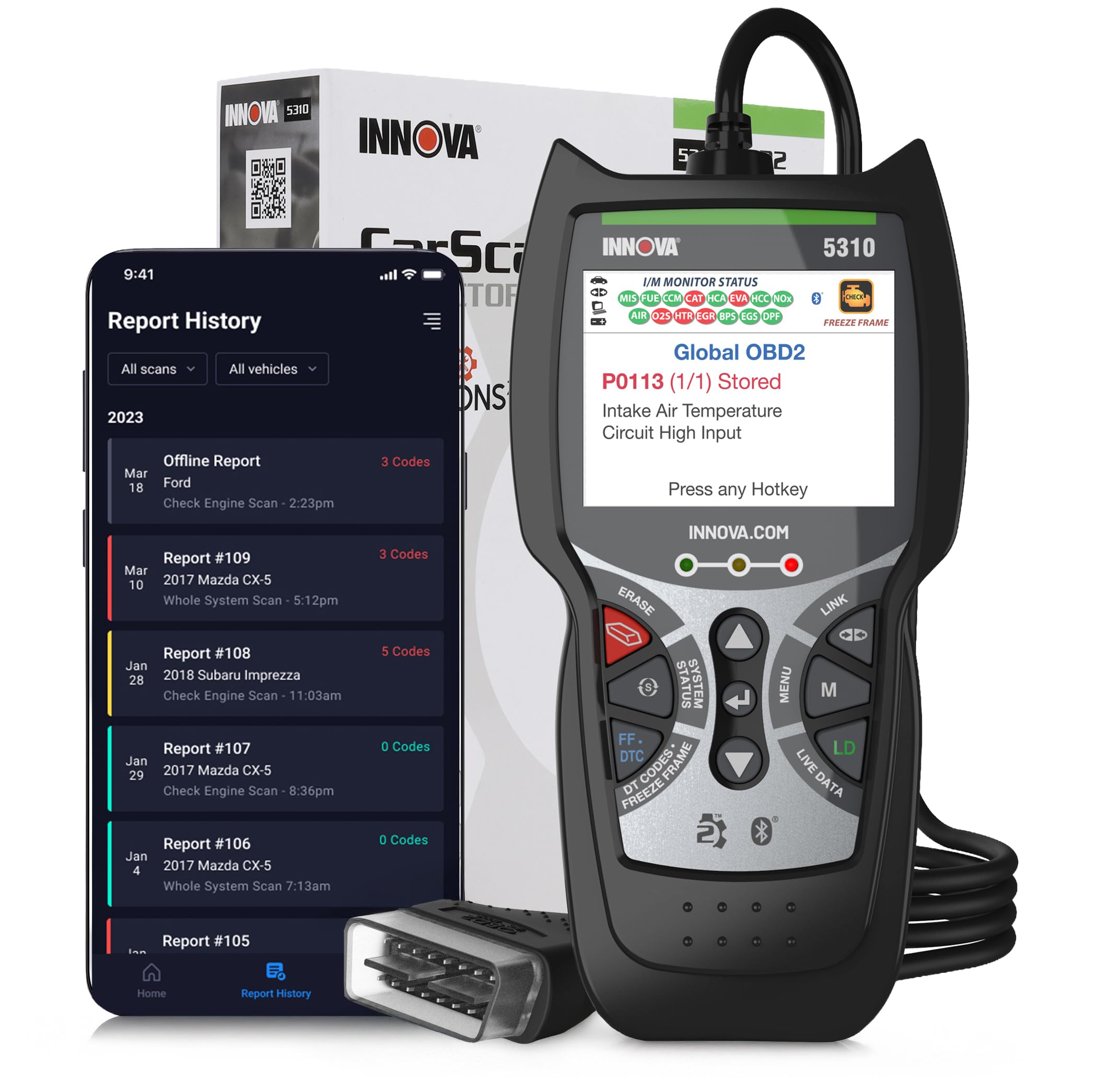
A handheld scanner with ABS and SRS support that finally cracked an airbag code two other scanners missed on a Jeep TJ.
The INNOVA 5310 is designed to read and clear codes from the engine, transmission, ABS (anti-lock brakes), and SRS (airbag) systems — a step up from the engine-only models above. It pairs with the RepairSolutions2 app on your phone (via Bluetooth) to show verified fixes and links to the exact parts you need. The built-in 2.8-inch screen gives you live data like RPM, speed, and oil temperature, and the tool also performs battery and alternator tests. One buyer shared a telling story: “I had a frustrating airbag light on my 2004 Jeep Wrangler TJ… I tried scanning it with two different Topdon scanners that both had SRS capability but would not show me the SRS codes on my TJ. This scanner did!” That real-world compatibility edge matters if you own a less common platform. The device measures 5.99″ x 3″ x 1″ and weighs 12.8 ounces, with a bright screen and a long cable for easy reach.
A couple of drawbacks: the scanner does not include a paper quick-start guide, and the online manual is difficult to use during the Bluetooth pairing process. Some functions — like oil life level and hybrid diagnostics — may not work on every vehicle, so INNOVA recommends using their Coverage Checker online before buying. It is a focused tool for people who need engine + safety-system diagnostics without stepping up to a full tablet scanner.
SRS success: Tested on a Jeep TJ where two other SRS-capable readers failed to pull airbag codes — this one worked.
Manual issue: No printed guide in the box; the online manual is hard to navigate during setup.
Pick this for: diagnosing engine, ABS, and SRS codes on 1996+ vehicles — especially if you own a Jeep or other platform where generic readers stumble.
Skip it for: advanced resets like injector coding or bi-directional control; this is a diagnostic reader, not a full re-learn tool.
7. TOPDON AD600S

A standalone tablet with a 5-inch high-res screen and Android 11.0, giving you professional diagnostics without needing a phone or laptop.
The TOPDON AD600S is a self-contained diagnostic tablet. It runs Android 11.0 with a 5-inch display at 1280×720 resolution and a 32GB ROM (built-in storage) for fast performance and ample space. Unlike the phone-dependent dongles, this unit works all on its own — you plug it in, and the AutoVIN function automatically reads your vehicle’s VIN to get started. It covers four systems: engine, transmission, ABS, and SRS, and includes 9 hot reset functions: Oil, BMS, ABS, SAS, EPB, DPF, TPMS, Throttle, and Injector Coding. So when you change brake pads or swap tires, you can reset those warning lights yourself. Buyers describe it as an “amazing high-end scanner on a budget,” noting that the “easy interface, lifetime free Wi-Fi updates” make it a reliable investment for both DIYers and small shops. The device supports 67+ global brands and 10,000+ car models.
The AD600S is battery-powered (not vehicle-powered) so you need to keep it charged. A couple of reviewers noted the AutoVIN function occasionally struggles, and the built-in storage is limited if you load up on software updates. It also lacks bi-directional control — you cannot command components to turn on like the KINGBOLEN Ediag Elite can. For a standalone unit that handles everyday diagnostics and resets without a subscription, it delivers the most complete package in this list.
The Standalone Advantage
- 5-inch 1280×720 display with Android 11.0 — no phone needed
- 9 reset services including Oil, EPB, and Injector Coding
- Lifetime free Wi-Fi updates with support for 10,000+ models
Limits to Know
- No bi-directional control for component testing
- AutoVIN can occasionally fail to read the vehicle VIN
- Limited storage and battery-powered — must recharge
Best for: the serious DIYer or small-shop owner who wants a standalone tablet with 4-system diagnostics and 9 reset functions — no phone, no subscription, no computer.
Not for: someone who needs bi-directional control or ECU coding; this is a diagnostic and reset tablet, not a full bench tool.
Understanding the Specs
OBD2 Protocols (CAN, KWP2000, ISO9141)
The OBD2 standard includes several communication protocols. The most modern and common one is CAN (Controller Area Network), used in most cars from 2008 onward. Older cars may use KWP2000, ISO9141, J1850 VPW, or J1850 PWM. A good tool like the ANCEL AD310 or TOPDON AL400 supports all of these protocols, so it will work on virtually any 1996+ vehicle. If you buy a scanner that does not support all protocols, you may plug it into an older or European car and get no data at all.
System Coverage: Engine vs. Full System
Basic code readers only talk to the engine/emissions module. That is fine for a check-engine light. But modern cars have separate computers for the brakes (ABS), airbags (SRS), transmission, and tire pressure (TPMS). Tools like the XTOOL AD20 Pro, KINGBOLEN Ediag Elite, INNOVA 5310, and TOPDON AD600S can scan those other modules. If you see an airbag light on your dash, you need a scanner that lists “SRS” or “airbag” in its system coverage — otherwise, you will never be able to read or clear it.
FAQ
Will any OBD2 scanner work on my 1996 car?
Can I clear an airbag light with a basic OBD2 scanner?
What is the difference between a code reader and a diagnostic scanner?
How long does a wireless OBD2 dongle last if I leave it plugged in?
Will these tools work on diesel cars and trucks?
Can I program a new key fob with an OBD2 scanner?
What is a bi-directional scan tool and do I need one?
How do I know if a scanner works with my Chrysler, Dodge, Jeep, or Ram vehicle?
What does the “I/M Readiness” function do?
Can I update my OBD2 scanner’s software for new vehicles?
Final Thoughts: The Verdict
For most people, the best obd2 tools winner is the XTOOL AD20 Pro because it gives you full-system wireless scanning with no subscription — at a price that undercuts many standalone handhelds. If you want a standalone tablet with professional-grade resets, grab the TOPDON AD600S. And for a simple, well-reviewed code reader that handles the basics like a champ, the standout is the ANCEL AD310.
How We Picked
We do not accept paid placement. Every pick is matched to a real buyer and a real use-case; we do not hands-on test units.
Sources & Methodology
Specifications: manufacturer listings and product documentation. Review insights: verified customer reviews, as of July 2026. Pricing: not shown on this page (it changes often); check the current price via the retailer link.
As an Amazon Associate, Trending Car earns from qualifying purchases. This does not affect which products we feature.