
Our readers keep the lights on and my garage snacks stocked. As an Amazon Associate, I earn from qualifying purchases.
Specs are compiled from manufacturer listings and verified buyer reviews and can change over time — please confirm the key details on the product page before buying.
That glowing check engine light on your dashboard doesn’t have to mean a costly trip to the repair shop. A good OBD scanner lets you pull the exact fault code yourself, see what’s really wrong, and decide whether it’s a loose gas cap or something serious — all from your driveway. The challenge is finding a scanner that matches your car’s protocols, delivers the diagnostic depth you need, and avoids costly subscriptions.
I’m Min Islam — the founder and writer behind Trending Car. This guide is built by comparing the manufacturers’ published specifications and the patterns across verified customer reviews, so you get each pick’s real strengths and trade-offs instead of marketing spin.
Whether you drive a 1996 sedan or a 2024 truck, the best obd scanner for all cars should offer broad protocol support, clear data display, and the right balance of diagnostic depth for your needs — no mechanic degree required.
Our Picks at a Glance

How To Choose The Best OBD Scanner for All Cars
A cheap code reader may lack live sensor data or ABS diagnostics, leaving you stranded on certain vehicles.
Protocol Support — The Real Compatibility Key
The phrase “works with all OBD2 vehicles” only matters if the scanner actually supports the five major OBD2 protocols: KWP2000, J1850 VPW, ISO9141, J1850 PWM, and CAN. A scanner that only reads basic CAN codes will fail on older European or Asian cars that use other protocols. For a true universal fit, make sure the manufacturer lists all five protocols in the specs.
Live Data vs. Just Codes
Basic code readers simply pull the fault code number (like “P0301”) so you can look it up. More capable scanners go further by showing live data — real-time readings from your engine’s sensors, such as coolant temperature, RPM, and fuel pressure. Models that display this data as a graph make it far easier to spot an intermittent problem, like a sensor that drifts in and out of range.
Enhanced Diagnostics — beyond the Engine
Many budget OBD scanners are limited to emission-related engine codes only. If the problem is in your ABS, airbag system, or transmission, a basic reader won’t see it. Mid-range and premium scanners offer “enhanced” or “system-specific” diagnostics that reach into those other modules, giving you a fuller picture of your car’s health — especially useful when buying a used vehicle.
Screen Size and Resolution
A larger, higher-resolution screen makes live data readable when you are crouched in a parking lot. A 2.8-inch color display with higher resolution (like 320×240) shows more data at once and is much easier on the eyes than a small, low-contrast monochrome screen. For regular use, screen quality becomes the top quality-of-life factor.
Quick Comparison
| Model | Best For | Screen Size | Special Functions | Protocol Support | Amazon |
|---|---|---|---|---|---|
| ANCEL AD310★ Best Overall | Entry-level code clearing | — | Basic read/clear codes, live data | All OBD2 (1996+) | Amazon |
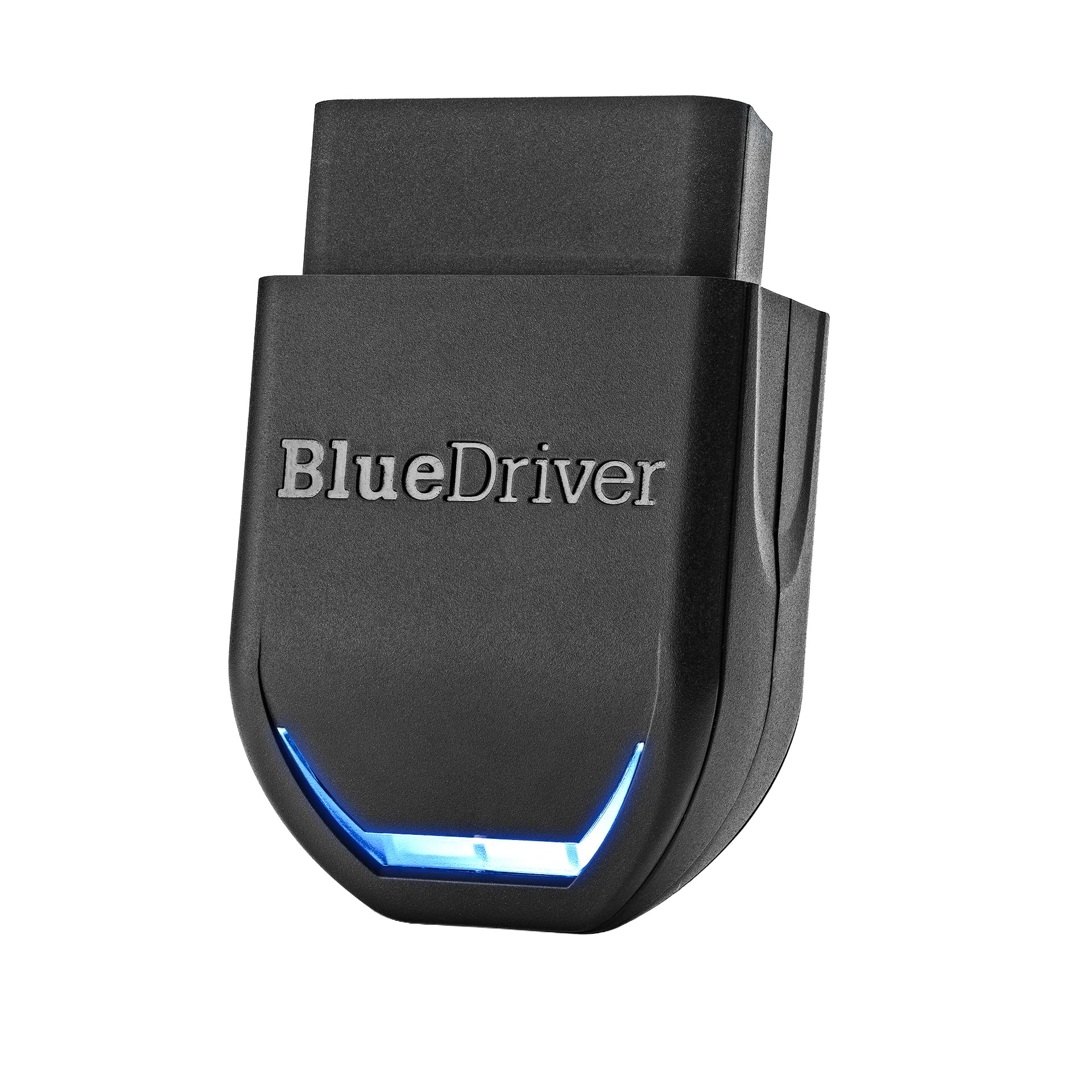
| BlueDriver Pro Next GenProfessional Grade | Smartphone-based pro diagnostics | App-based (phone) | ABS, SRS, TPMS, 8000+ codes | All OBD2 (1996+) | Amazon |
| Autel AutoLink AL549 | ABS + battery & alternator check | 2.8 Inches | ABS codes, battery/alternator test | All OBD2 (1996+) | Amazon |
| VDIAGTOOL VD31 | 3-in-1: scanner + battery + key fob tester | 2.8 Inches | Battery tester, key fob tester, 198869+ DTC | All OBD2 (1996+) | Amazon |
| VDIAGTOOL VD30 Pro | Comprehensive DIY with graphing | 2.8 Inches | 4-in-1 live data graphing, 98k+ DTC library | All OBD2 (1996+) | Amazon |
| A-Premium AD200 | 50 live data parameters on a budget | 1.77 Inches | 50 data parameters, 3-color warning lights | All OBD2 (1996+) | Amazon |
| ZMOON ZM301 | DIY basics with cloud printing | 2.8 Inches | 50k+ DTC library, QR cloud printing | All OBD2 (post-1996) | Amazon |
In‑Depth Reviews
1. ANCEL AD310
Our pick — over 4.5★ from 65,000+ verified ratings; the strongest balance of quality and price.
The most popular code reader on Amazon — simple, compact, and recommended by a famous mechanic for basic check-engine light diagnosis.
The ANCEL AD310 does one thing and does it well: it reads and clears emission-related check engine codes quickly, and it does so at a price that makes it an easy impulse buy. It supports all five major OBD2 protocols including KWP2000, J1850 VPW, ISO9141, J1850 PWM, and CAN, so it works with 1996 US-based cars, 2000 EU-based and Asian cars, plus newer OBD2 and CAN vehicles. The 2.5-foot cable is thick and flexible, and the unit is compact enough to slide into a backpack. It draws power directly from the OBD2 port — no batteries or charger needed.
Reviewers point out the AD310 is “simple to use and view live data for that extra accuracy when diagnosing.” One reviewer with a 15 Equinox found it cleared codes easily and appreciated the small size. The AD310 is also recommended by Scotty Kilmer, the popular YouTuber and auto mechanic, which speaks to its reliability for basic tasks. The honest catch: it only supports emission-related engine codes. If the fault is in your ABS, transmission, or airbag system, the AD310 cannot read it. And it only works with the 16-pin OBD2 interface — no OBD1 adapters. But if all you need is to check and clear that check engine light, this is the most affordable path.
What You Get
- Supports all five OBD2 protocols for universal compatibility
- Compact design — 12 ounces, fits in a backpack
- No batteries or charger required
- Highly rated (4.6/5) with over 65,000 reviews
What It Can’t Do
- Only reads emission-related engine codes — no ABS, SRS, or transmission
- No graphing or advanced live data features
- Will not work with OBD1 vehicles even with an adapter
Perfect entry point for: The driver who just wants to know why the check engine light is on, clear it, and move on — without extra features or cost.
Not enough if: You need to diagnose transmission, ABS, or airbag systems, or you want live data graphing.
2. BlueDriver Pro Next Gen
The Bluetooth scanner that turns your phone into a professional diagnostic bay — no subscriptions, no cables.
If your car has a problem beyond a basic check-engine code — say an ABS module fault, an airbag warning, or a TPMS sensor that went silent — the BlueDriver Pro Next Gen is built to find it. It reads and clears codes for Check Engine, ABS, SRS, Airbag, TPMS, and Transmission on supported vehicles, something entry-level handhelds cannot touch. The entire experience runs on your phone through the free app.: plug the Bluetooth unit into your OBD2 port (it works with gas vehicles from 1996 onward, plus select light-duty trucks like F-250 and Silverado), and the app shows live sensor data while you drive, freeze frames, smog readiness, and Mode 6 test results. Buyers report that after three years of use, the scanner still saves diagnostic costs by pulling codes and showing likely fixes with user-reported success rates — no subscription fee, ever.
The standout feature is the repair reports. The app serves up technician-verified fixes matched to your specific VIN, so you are not guessing what “P0420” means. The unit covers GM, Ford, Stellantis, Toyota, Honda, Nissan, Mazda, Subaru, Hyundai, Mercedes-Benz, BMW, and VW with enhanced coverage. The trade-off is that you need your phone for the display — there is no standalone screen. But for anyone who wants to inspect a used car or diagnose a modern vehicle properly, this is the most capable tool in the list.
Why It Stands Out
- Reads enhanced codes for ABS, SRS, Airbag, TPMS, and Transmission
- Unlimited, VIN-matched repair reports with verified fixes
- No subscription fees, no accounts required, free app updates
- Bluetooth wireless connection — no cable to your phone
What to Keep in Mind
- Requires a smartphone or tablet for display and operation
- Expanded coverage on some newer models (2024+ Nissan/Mazda) is partial
- Not for heavy-duty diesel or hybrid diagnostics beyond basic codes
Reach for this if: You want the deepest scan possible across your car’s systems — engine, brakes, airbags, tires — without paying a monthly fee.
Consider another if: You prefer a standalone screen and do not want to rely on your phone for every scan.
3. Autel AutoLink AL549
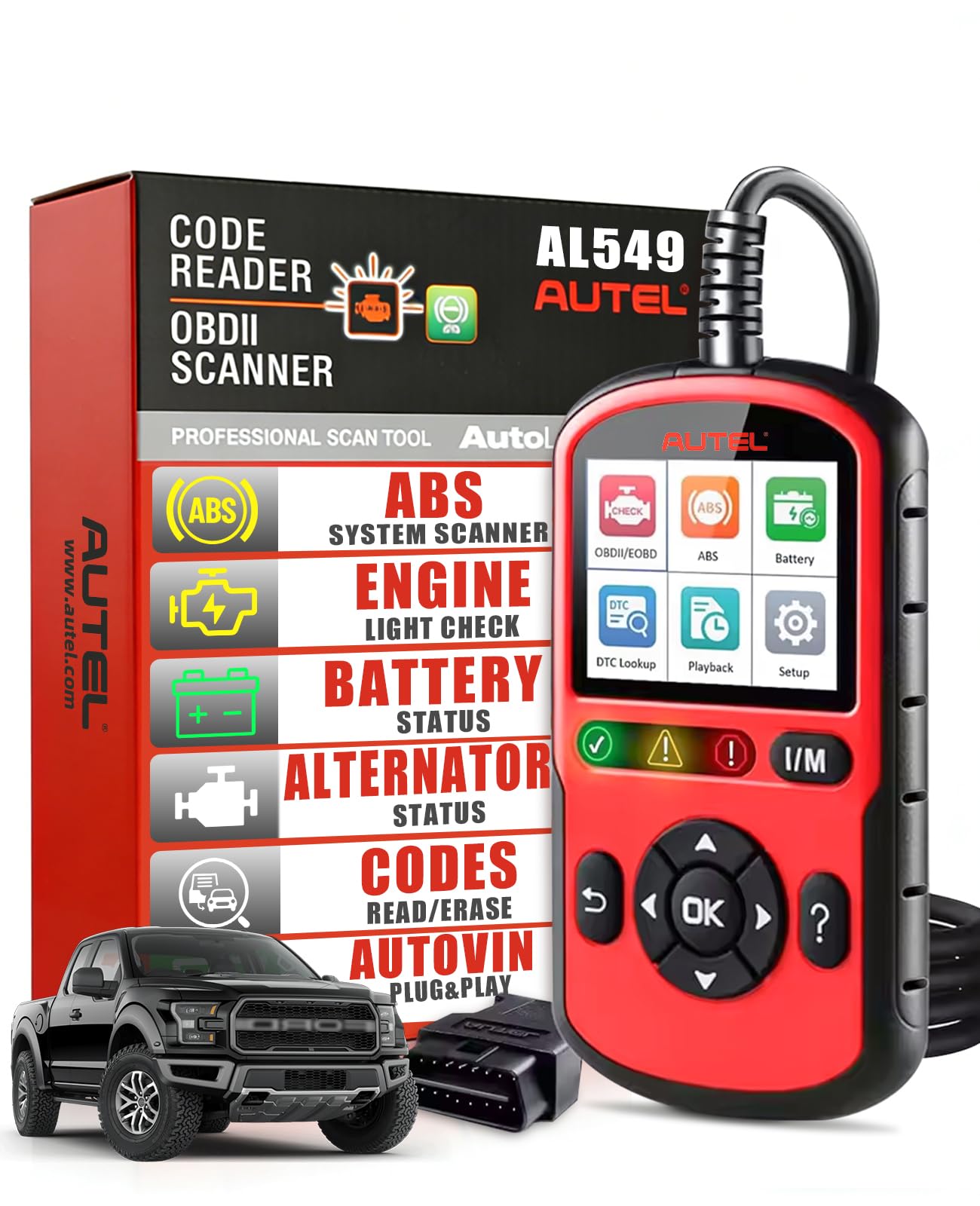
The handheld that adds ABS code reading and battery health checks to a full OBD2 toolkit — all in one compact unit.
Most code readers in the mid-range stop at engine codes. The Autel AutoLink AL549 goes further by reading and erasing ABS codes and turning off those ABS warning lights, which is a rare feature at this level. It also includes a dedicated car starting and charging system test — so you can check whether your battery or alternator is on the way out, not just guess. The screen is 2.8 inches, which gives you a clear look at live data and the patented one-click I/M readiness screen for smog checks. It supports all 10 modes of OBDII testing on 1996-and-newer vehicles, plus it reads enhanced Powertrain codes for Ford, GM, and Chrysler models.
Owners mention that the AL549 is their “go-to” scanner despite owning more expensive units, praising the compact size and ease of use for basic diagnostics. The unit records and plays back live data, and it supports printing DTC reports via a Type-C connection to a Windows PC (though you must supply your own cable). The only limitation: ABS diagnosis only works for vehicles made between 1996 and 2020, and the tool does not include a Type-C cable for updates. But for the price, you are getting capabilities that usually cost twice as much.
What You Get
- ABS code reading and clearing — not just engine codes
- Built-in battery and alternator test with guided on-screen steps
- 2.8-inch screen for live data and I/M readiness
- Lifetime free updates via Maxi PC Suite
Trade-Offs
- ABS coverage limited to 1996–2020 vehicles
- Does not include a Type‑C cable for software updates
- No TPMS, SRS, or airbag diagnostics
the balance for: DIYers who want ABS diagnostics plus a battery test, all in a single handheld that fits in a glove box.
Not for you if: You need to scan airbag or transmission codes — this unit stays focused on engine, ABS, and charging systems.
4. VDIAGTOOL VD31 Enhanced OBD2 Scanner
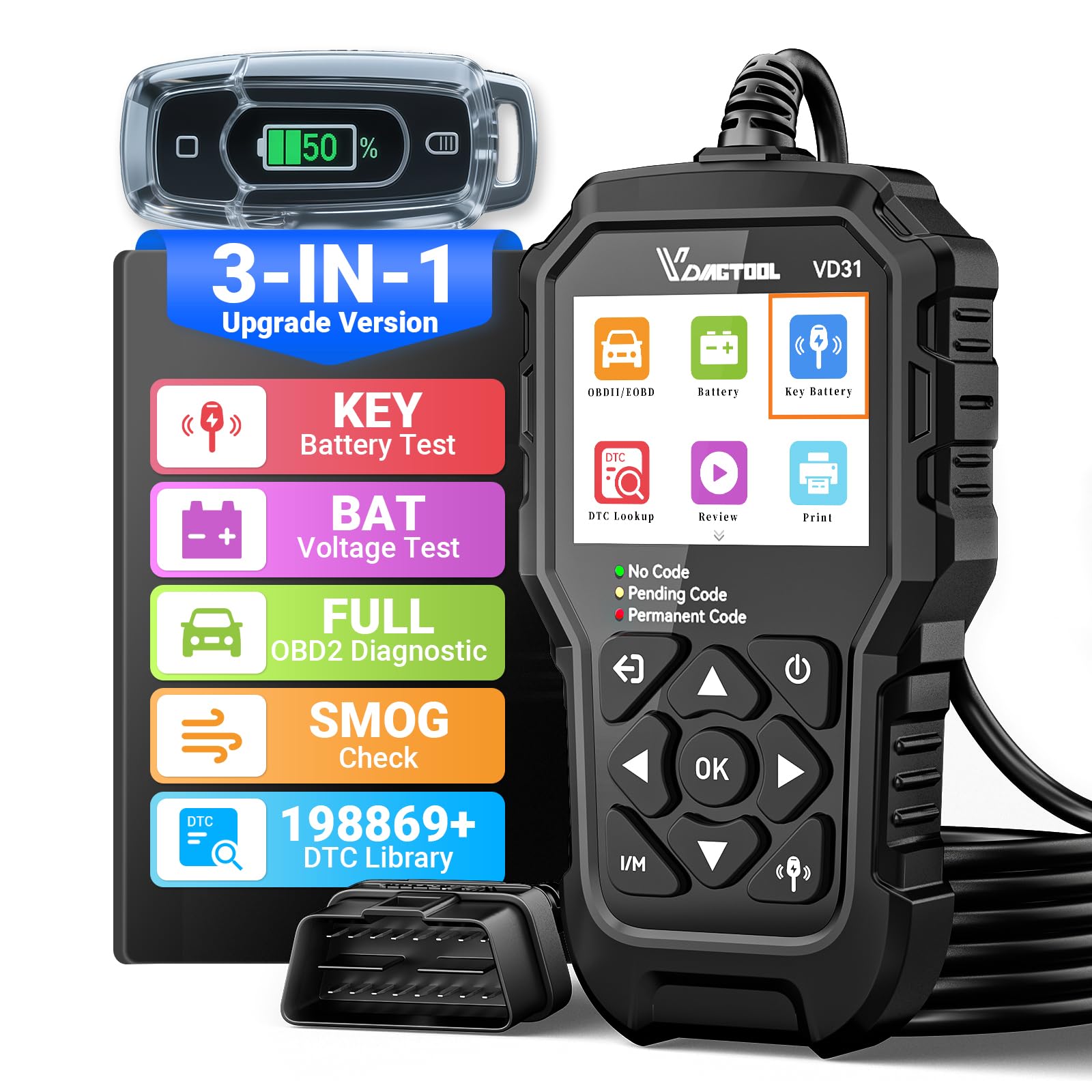
A code reader, a car battery tester, and a key fob battery tester rolled into one device — the only 3-in-1 in this lineup.
The VDIAGTOOL VD31 is the oddball here in a good way. Along with performing all 10 essential OBD2 tests — reading and clearing codes, showing 4-in-1 live data graphing, freeze frames, and a one-click I/M readiness hotkey — it also includes a dedicated car key fob battery voltage tester. That means you can check whether your remote is about to die before you get locked out. The key tester runs on a separate 9V battery (included), so you can test any key remote without plugging into a car. The unit also acts as a car battery tester, checking your vehicle’s battery health during a scan. It has a built-in DTC library of over 198,869 definitions, so you do not need to look up codes on your phone.
Customers note that the VD31 diagnosed bad key fob batteries and engine codes like P0031 and P0500 with ease, and they appreciate the Mode 6 data access that even expensive tool-truck scanners sometimes lack. The 2.8-inch color screen is crisp and responsive. The catch: the VD31 does not diagnose ABS, SRS, TPMS, or airbag systems — it stays focused on engine, battery, and key fob duties. It also requires a Windows PC for the lifetime free software updates. But if you want one tool that covers the basics plus the surprising extras (especially that key fob check), this is a genuinely unique option.
Unique Perks
- Integrated key fob battery tester with standalone 9V power
- 198,869+ DTC built-in library — no phone lookup needed
- 4-in-1 live data graphing on a 2.8-inch screen
- One-click I/M readiness for smog checks
Limitations
- No ABS, SRS, TPMS, or airbag diagnostics
- Updates require a Windows 7/8/10 PC and a USB cable
- 9V battery must be removed when not testing key fobs to preserve charge
Smart buy for: Drivers who want to check everything — engine codes, car battery, and even that key fob — without juggling three separate tools.
skip it if: You need to read ABS or airbag codes, or you do not want to fuss with a 9V battery for the key tester.
5. VDIAGTOOL VD30 Pro
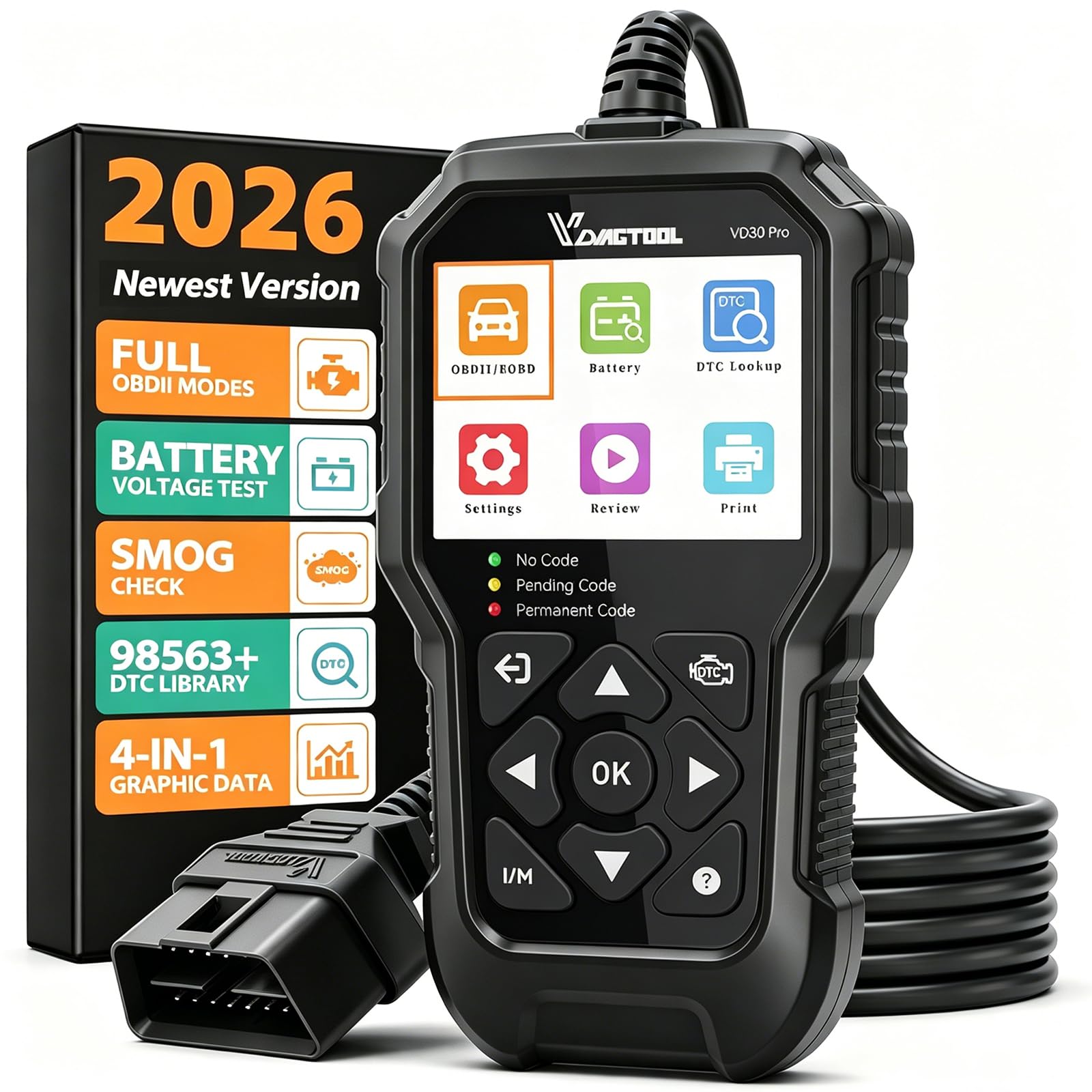
A 2.8-inch color-screen code reader with graphing and a 98,000-code library — built for the serious DIYer who wants pro-level data.
The VDIAGTOOL VD30 Pro is essentially the VD31’s sibling without the key fob tester, but it keeps everything else that matters for deep engine diagnostics. It performs all 10 essential OBD2 tests, displays live data with 4-in-1 graphing (so you can watch sensor readings rise and fall on one screen), and includes a one-click I/M readiness hotkey for smog checks. The built-in DTC library holds over 98,000 fault definitions, so the scanner explains what “P0300” means in plain English on the screen — no scrolling on your phone. It also includes a voltage test, data playback, and data printing for service reports.
Reviewers point out that the VD30 Pro “cleared codes on Chevy Cruz turbo” and diagnosed issues with turbo, O2, throttle, MAP, MAF, and misfire — saving the owner a dealer diagnostic fee. The rugged housing and long, flexible cable make it easy to use in tight engine bays. The main trade-off: like the VD31, it does not read ABS, SRS, TPMS, or airbag codes. It also requires a Windows PC for lifetime free firmware updates. But for pure engine and emission diagnostics with a high-resolution screen and graphing, this is the most capable handheld in the budget-to-mid-range bracket.
What Makes It Strong
- 4-in-1 live data graphing for spotting intermittent sensor problems
- 98,000+ DTC definitions built in — no phone required
- One-click I/M readiness screen
- Data recording, playback, and printing for service reports
Where It Falls Short
- No ABS, SRS, TPMS, or airbag diagnostics
- Updates need a Windows PC and USB cable
- Some shoppers say it lacks troubleshooting tips you get on pricier units
Grab this for: A detailed, graphing-rich engine diagnostic tool that saves you money on dealer visits — especially if you work on multiple cars.
Pass if: You need to scan beyond the engine, or you want a Bluetooth unit that works from your phone.
6. A-Premium AD200
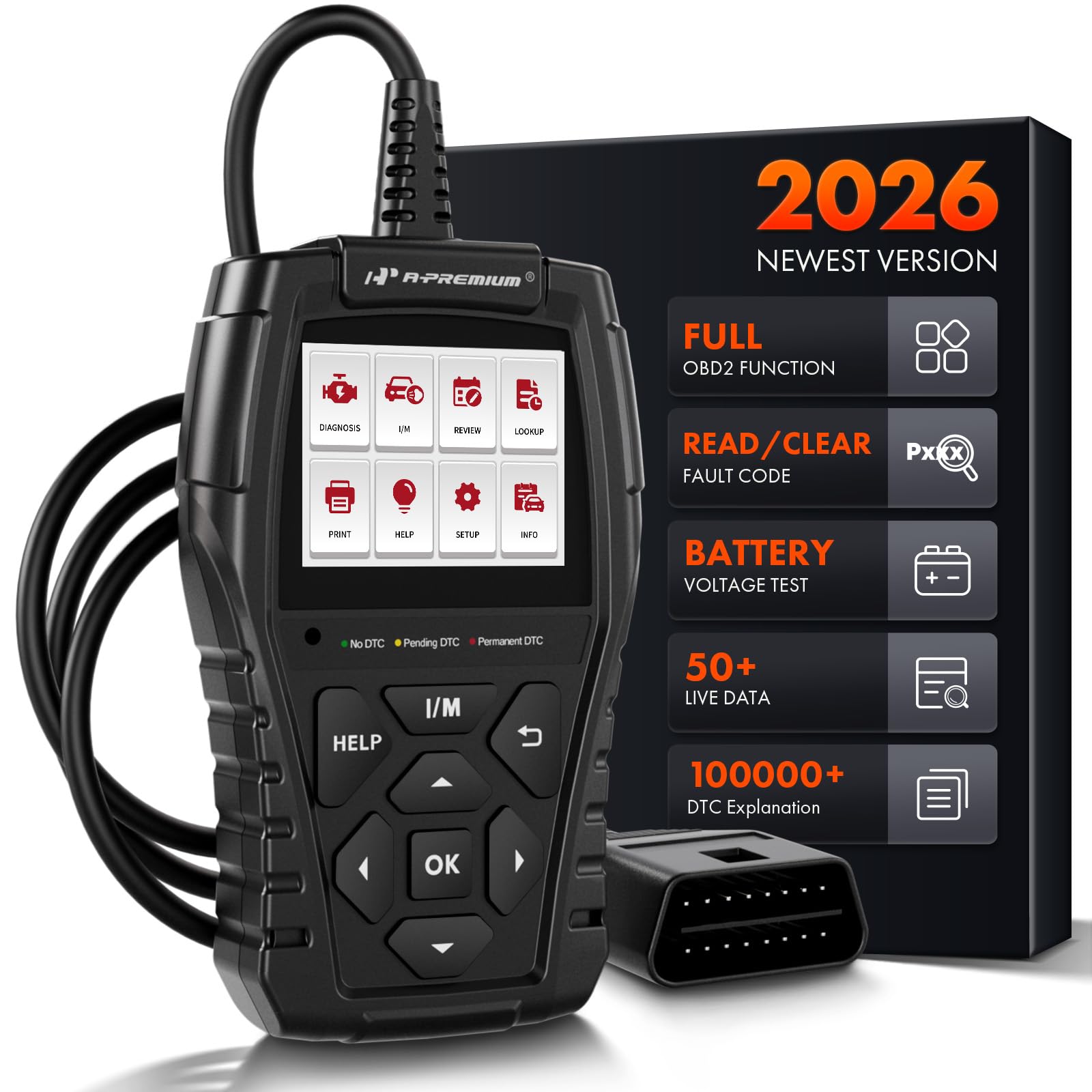
Reads up to 50 live data parameters and uses a three-color warning light to tell you how serious the trouble is at a glance.
The A-Premium AD200 takes a slightly different approach to diagnostics: it can read up to 50 data points from your engine, including battery voltage, coolant temperature, engine RPM, load value, air flow rate, oil temp, fuel rail pressure, and transmission gear status. That is a lot of numbers, but the device helps you make sense of them by converting the data into real-time visual curves on its 1.77-inch screen. It also has three warning lights (green, yellow, red) that tell you the severity of any fault after a scan — green means healthy, yellow means minor issue, red means serious problem. The unit can also generate and print diagnostic reports to share with a mechanic.
Buyers report that the AD200 has saved them hundreds of dollars in dealer diagnostic fees, especially on European cars like a 2001 Range Rover, where simply tightening a gas cap solved the issue. The 3.9-foot-long cable gives you room to work, and the manufacturer claims an ARM CPU that is 3X as fast as entry-level scanners. The main drawbacks: the 1.77-inch screen is noticeably smaller than the 2.8-inch units above, and the native resolution of 160×128 means less detail in graphs. Also, some owners mention the instructions are sparse, though the interface is intuitive enough to figure out.
Strengths
- Reads 50 live data parameters — one of the highest counts at this price
- Three-color warning lights (green/yellow/red) for quick fault severity
- Real-time data curve display and printable reports
- 3.9-foot cable for flexible positioning
Weaknesses
- Small 1.77-inch screen with 160×128 resolution
- No ABS, SRS, or TPMS diagnostics
- Instructions are minimal — you learn by pressing buttons
Best for: Anyone who wants to monitor a large number of engine parameters and get a simple green/yellow/red verdict on their car’s health.
Look elsewhere if: Screen size matters to you, or you need to scan non-engine systems like ABS or airbags.
7. ZMOON ZM301

A 2.8-inch scanner with a 50,000-code database and a clever QR cloud-printing system that helps prevent mechanics from overcharging.
The ZMOON ZM301 tackles a common problem: once you get a code, how do you prove to a shop what you found? This scanner can generate QR codes from real-time data, freeze frames, and DTC playback. You take a screenshot of the QR code with your phone, and it saves the diagnostic session for you. The idea is that you walk into a repair shop with documented evidence, so they cannot inflate the repair. The unit itself packs a 2.8-inch screen and has shortcut keys for quick access to the VIN number, DTC definitions, I/M readiness, and a performance test that checks acceleration, braking distance, and horsepower.
Customers note that the ZM301 “works instantly” and displayed an error code immediately, saving one owner a bundle by identifying a part instead of paying for mechanic guesses. The built-in DTC database holds over 50,000 definitions — a big jump from the 3,000 to 10,000 on older models. The included canvas storage bag is a nice touch for the glove box. The catch: it is not compatible with new energy vehicles, hybrids, or any car that does not use the OBD2 protocol. And some users note the backlighting could be brighter. But for straightforward code reading with a paper trail, this is a well-thought-out option.
Why It’s Different
- QR cloud-printing system saves diagnostic data for proof
- 50,000+ DTC definitions built in
- 2.8-inch color screen with shortcut keys
- Includes canvas storage bag
Limitations
- Not compatible with hybrids, EVs, or non-OBD2 vehicles
- Backlighting could be brighter according to some users
- Performance test (acceleration, braking) is a rough guide, not a professional tool
Ideal for: DIYers who want a documented diagnostic record to take to a repair shop and avoid unnecessary work.
Skip if: You own a hybrid or EV, or you need a scanner that works without a screen (Bluetooth-only would be better).
Understanding the Specs
OBD2 Protocols — The Real “Will It Work” Check
When a scanner says it works with “all OBD2 vehicles,” it means it supports the five communication protocols cars use to talk to the diagnostic tool. CAN (Controller Area Network) is the standard on most cars after 2008, but older vehicles from the late 1990s and early 2000s often used J1850 VPW (Ford and GM), ISO9141 (European and Asian), J1850 PWM (Ford), or KWP2000. A scanner that lists all five protocols is your best bet for a truly universal device that works across decades and brands.
Live Data and Graphing — Seeing the Problem in Action
A simple code reader tells you the fault number, but live data shows you what your sensors are doing right now — things like engine RPM, coolant temperature, and oxygen sensor voltage. When that data is displayed as a moving graph, you can spot sensors that are stuck, slow to respond, or reading out of range. This is far more useful than a static code number because many problems only show up under specific driving conditions, like a temperature sensor that reads fine when cold but fails at operating temperature.
I/M Readiness — The Smog Check Helper
Before you take your car for an emissions inspection, the I/M Readiness test tells you whether all the vehicle’s self-monitoring systems have completed their internal checks (called “monitors”). If a monitor says “Not Ready,” the inspection computer will fail your car even if no check engine light is on. A scanner with a dedicated I/M Readiness button — like the one-click hotkey on the VDIAGTOOL units — lets you check this in seconds so you know whether your car is inspection-ready before you arrive at the station.
Enhanced vs. Generic OBD2 Codes
Generic OBD2 codes (P0xxx) apply to all cars and cover emission-related engine problems. Enhanced codes (P1xxx, P2xxx, Uxxxx, Cxxxx, Bxxxx) are manufacturer-specific and can reach into the transmission, ABS, airbag, and body control systems. A basic scanner only reads generic codes, which is fine for a check-engine light. But if you want to diagnose why your ABS warning light is on or why your airbag light is flashing, you need a scanner like the BlueDriver Pro or Autel AL549 that reads those enhanced codes — that is where the real diagnostic power lives.
FAQ
Can an OBD scanner clear codes on any car?
Will any OBD scanner work with my diesel truck?
What does “I/M Readiness” mean on a scanner?
Does a Bluetooth OBD scanner need a subscription?
Can I use an OBD scanner to check a used car before buying?
What is the difference between a basic code reader and a diagnostic scanner?
Does the VDIAGTOOL VD31 key fob tester work on any car remote?
Why won’t my scanner connect to my car?
Can I update the software on an OBD scanner?
What does Mode 6 data tell me that regular codes do not?
Final Thoughts: The Verdict
For the majority of shoppers, the best obd scanner for all cars winner is the Autel AutoLink AL549 because it gives you ABS diagnostics, a battery and alternator test, and full OBD2 coverage in a single handheld — without needing a phone. If you want the deepest scans possible across your car’s systems (including ABS, SRS, and TPMS) and prefer using your phone, grab the BlueDriver Pro Next Gen. And for the best pure value with a large color screen and live data graphing, the standout is the VDIAGTOOL VD30 Pro.
How We Picked
We do not accept paid placement. Every pick is matched to a real buyer and a real use-case; we do not hands-on test units.
Sources & Methodology
Specifications: manufacturer listings and product documentation. Review insights: verified customer reviews, as of July 2026. Pricing: not shown on this page (it changes often); check the current price via the retailer link.
As an Amazon Associate, Trending Car earns from qualifying purchases. This does not affect which products we feature.