
Our readers keep the lights on and my garage snacks stocked. As an Amazon Associate, I earn from qualifying purchases.
Specs are compiled from manufacturer listings and verified buyer reviews and can change over time — please confirm the key details on the product page before buying.
Your hands go stiff, tools feel clumsy, and you end up quitting early when your garage or workshop is freezing in winter. A natural gas shop heater solves that—it hooks directly to your existing gas line and pumps out steady warmth without needing refilled bottles or a power cord across the floor. The real trick is picking the right BTUs (British Thermal Units, the heat output measurement) for your space size and knowing which safety features actually matter.
I’m Min Islam — the founder and writer behind Trending Car. This guide is built by comparing the manufacturers’ published specifications and the patterns across verified customer reviews, so you get each pick’s real strengths and trade-offs instead of marketing spin.
You’ll find a heater that fits if you need to warm a small cabin or a three-car workshop that gets hammered by freezing drafts. Here are the best natural gas shop heater options available right now.
Our Picks at a Glance

How To Choose The Best Natural Gas Shop Heater
Pick the wrong heater and you will either freeze while it struggles or sweat because it is too powerful. The main things to nail down are the heat output in BTUs, the venting type that fits your building’s layout, and if you want automatic temperature control or a simple on/off dial.
BTU Output—Match the Heat to Your Square Footage
BTU stands for British Thermal Unit, the standard way to measure how much heat a gas appliance produces. A common rule of thumb is you need about 30 BTUs per square foot for a moderately insulated garage or shop. For your 700-square-foot workshop, that means roughly 20,000 BTUs to keep it comfortable. If your shop has poor insulation or very high ceilings, bump that number up. A 45,000 BTU heater like the Modine Hot Dawg can handle a three-car garage with high ceilings easily, while a 20,000 BTU model like the Mr. Heater is plenty for a well-insulated single-car bay.
Venting Type—Vented, Direct Vent, or Ventless
This is the biggest safety and installation decision. Ventless heaters burn gas and release warmth and moisture directly into the room—they are easy to install since they don’t need a chimney or wall pipe, but they require an Oxygen Depletion Sensor (ODS, a device that shuts off the gas if oxygen levels get low) and good room ventilation to be safe. Direct vent heaters draw combustion air from outside and exhaust fumes back outside through a sealed pipe, making them safer for closed spaces since they don’t affect your indoor air quality. Traditional vented heaters like the Modine Hot Dawg use a flue pipe to push exhaust outside and a fan to blow warm air into the room, which works best for large, open shops.
Thermostat vs. Manual Control
A built-in thermostat or programmable control lets you set your target shop temperature and forget it—the heater cycles on and off automatically to maintain that level, which saves gas and keeps the temperature steady. Manual control models just have a dial with a few heat settings (low, medium, high), so you have to adjust them by hand as the temperature changes. For a workshop you use every day, a thermostat model often pays for itself in gas savings within one season.
Quick Comparison
| Model | Best For | BTU Output | Heating Coverage | Venting Type | Amazon |
|---|---|---|---|---|---|
| Mr. Heater 20,000 BTU★ Best Overall | Easy DIY install in a basement or cabin | 20,000 BTU | 700 sq ft | Ventless (Radiant) | Amazon |
| Modine Hot Dawg HD45AS0111Also Great | Large garages & workshops needing rapid heat | 45,000 BTU | — | Vented (Forced Air) | Amazon |
| Rinnai FC824N Ventless | Programmable warmth in a mid-sized shop | 24,000 BTU | — | Ventless (Convection) | Amazon |
| Dyna-Glo BF20NMDG | Budget-friendly supplemental heating | 20,000 BTU | 700 sq ft | Ventless (Blue Flame) | Amazon |
| ProCom MN300HBA-B | Heating a large open space without electricity | 30,000 BTU | 1400 sq. ft. | Ventless (Blue Flame) | Amazon |
| Comfort Glow 17,000 BTU Direct Vent | Permanent wall-install in a well-insulated room | 17,000 BTU | 500 sq ft | Direct Vent (Convection) | Amazon |
In‑Depth Reviews
1. Mr. Heater 20,000 BTU Vent Free Radiant Natural Gas Heater
Our pick — 4.5★ from 500+ verified ratings; the strongest balance of quality and price.
The go-to backup heater that works in a power outage because it needs zero electricity.
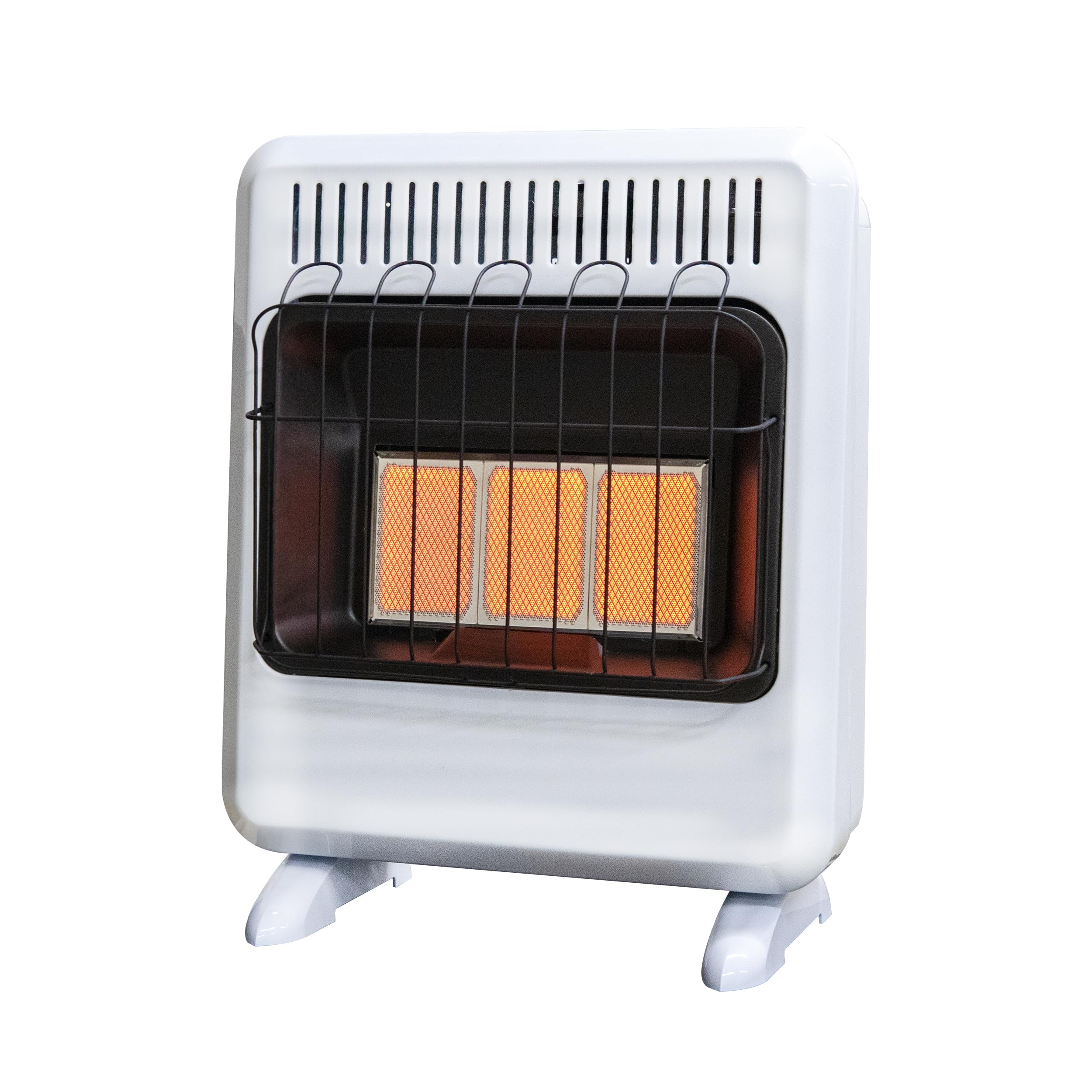
This Mr. Heater is the simplest route to natural gas warmth for a cabin, basement, or small workshop that loses power regularly. The electronic ignition lights the burner without a match, and the built-in thermostat automatically cycles the heat on and off to maintain your set temperature—no fan, no electricity, no problem. The 20,000 BTUs cover up to 700 square feet, and customers note it easily heats a 900-square-foot New England basement without a hitch. It also includes a low-oxygen safety shut-off, so the flame cuts out before the air quality gets dangerous in a sealed room. However, buyers do note it struggles as primary heat in a 1200-square-foot apartment when the temperature outside drops to 26°F, so treat it as supplemental warmth for larger spaces.
The main installation headache is that connecting the natural gas line requires removing the cabinet, and some owners have had to buy a custom part to secure the piping properly. But once it is hung on the wall, the radiant heat warms you and your tools directly—less waiting for the air to warm up, more feeling it on your skin immediately. Unlike the Dyna-Glo which uses blue flame to heat the air, this radiant heater focuses heat on objects and people, so it feels warmer faster in a drafty space even if the ambient air temperature lags behind.
Power-outage proof: No electricity means no pump, no fan, no control board to fail—just a gas valve and a thermocouple keeping you warm when the grid goes dark.
Install note from buyers: The gas connection is inside the cabinet, so budget for a flexible gas line or a plumber if you are not comfortable disassembling the unit.
Get this for: a workshop or bonus room where power outages are common and you want automatic temperature control without needing batteries or a generator.
Pass on it for: any space larger than about 900 square feet of well-insulated area—the BTUs run out of steam when the square footage climbs.
2. Modine HD45AS0111 Natural Gas Hot Dawg Garage Heater 45,000 BTU
The heavyweight that takes a frozen three-car garage to t-shirt warmth in minutes.
You want this heater when your workshop is a real challenge—think uninsulated walls, high ceilings, and winter temperatures well below freezing. The 45,000 BTU output shoves a massive amount of warm air into the room using a fan. At 26 inches deep, 12 inches wide, and 16.5 inches tall, its low profile lets it hang close to the ceiling without getting in your way. Buyers report it heats a three-car garage from the low 30s to the low 60s in 15 to 20 minutes—that is the fast recovery you need when you only have an hour to work after dinner. It beats smaller units handily: while the Comfort Glow puts out 17,000 BTUs, the Modine delivers 45,000 BTUs
You need to install it properly with a vent pipe through the wall or roof, and you will need a thermostat (not included) to control it automatically. Reviewers mention the grey color is more “ugly green/grey” than neutral, but given how well it performs, that is easy to overlook. The 60-pound weight means you definitely want a helper for rafter mounting—but that solid build is why you pay a premium for confidence.
Where it shines: The 45,000 BTUs and forced air fan heat a drafty, oversized shop faster than any ventless model on this list—and the sealed combustion means zero fumes in your breathing air.
The needle-mover: At 60 pounds compared to the Dyna-Glo at 20.21 pounds, so plan for a sturdy mount and a second pair of hands.
Grab it if: you have a large (three-car or bigger) garage or workshop with typical insulation and you want it warm fast without smelling gas.
Skip it for: a quick weekend project in a tight, well-insulated room—you would be paying for power you don’t need.
3. Rinnai FC824N Ventless Natural Gas Heater

A whisper-quiet, smart ventless heater that feels more like a premium appliance than a shop furnace.
If your workshop is attached to the house or you just want set-and-forget precision, this Rinnai is the most polished pick. It uses a programmable thermostat with a digital display so you can dial in the exact temperature and let the heater self-regulate—it even has a self-diagnostics feature to flag issues before they become big problems. The 24,000 BTU output easily handles a three-car garage. Reviewers in Michigan say it keeps a three-car garage with 10-foot ceilings at 60°F without struggling, and it does so almost silently except for a brief buzzing sound during ignition.
Installation requires a professional per the manufacturer’s recommendation, and the upfront cost sits firmly in premium territory. But that price includes a 10-year warranty on the heat exchanger, a 5-year parts warranty, and a 2-year labor warranty—better coverage than most car warranties. The cool-to-touch cabinet and safety lock make it a comfortable choice if kids or pets roam through the shop. Unlike the Modine’s 45,000 BTUs, this unit runs at 24,000 BTUs, so it is better for a well-insulated, medium-sized space where you want long-term efficiency rather than raw blasting power.
Smartest control: The programmable thermostat display and digital adaptive control let you schedule heat for your work hours and save gas the rest of the day—no other ventless model here offers that.
Installation fine print: Rinnai strongly recommends a certified technician for hookup, so factor that into the total project cost.
Reach for this if: you want a low-maintenance shop heater with minimal noise and a full safety suite (flame failure device, overheat switch, oxygen depletion sensor, tilt switch).
Look elsewhere for: an emergency heater that works when the power is out—this needs 0.24 Amps to run its electronics.
4. Dyna-Glo 20,000 BTU Natural Gas Blue Flame Vent Free Wall Heater

The no-frills workhorse that turns a cold cabin warm in nothing flat without breaking your budget.
Priced well below the premium tier, this wall-mounted unit uses blue flame technology—it works like your home’s central heating by warming the air directly rather than just radiating heat at objects. The variable heat output goes from 10,000 BTUs on low up to 20,000 BTUs on high, so you can dial it back for a milder day or crank it when the snow is piling up. Owners mention it warms a 900-square-foot cabin in no time and heats a three-car garage “in nothing flat.” At 20.21 pounds it is the lightest heater here—compared to the Modine at 60 pounds—so wall-mounting solo is perfectly manageable.
The catch is that this model (BF20NMDG) uses manual control with three settings—low, medium, high—but no thermostat, so you need to be around to adjust it as the temperature changes. Dyna-Glo does offer a thermostatically controlled version (model BFSS20NGT-2N) if you prefer automation. Like all ventless heaters, it releases moisture and combustion byproducts into the room, so it includes an oxygen depletion sensor for automatic shut-off. You will want to keep a carbon monoxide detector nearby for confidence.
Where it earns its keep
- Three selectable heat settings (10K / 15K / 20K BTU) let you match output to the weather
- Light enough at 20.21 pounds for one-person wall installation
- Blue flame technology provides more even air heating than radiant models
The missing feature
- No thermostat—you have to manually turn the knob up or down
- Ventless design means interior air quality is an ongoing concern in a tightly sealed shop
Verdict for the money: If your shop is well-insulated and roughly 700 square feet or under, this is the most affordable way to get reliable gas heat on the wall.
One honest trade-off: No thermostat means you are the thermostat—plan to be in the room to adjust it.
5. ProCom Heating Natural Gas Ventless Blue Flame Heater 30,000 BTU

The ventless champ that heats a whole two-story home on low in a Michigan winter.
If your shop or workspace spills over 1,000 square feet and you want a single heater that can cover it without complex ductwork, the ProCom is your strongest ventless candidate. It pushes 30,000 BTUs and claims 1400 square feet of coverage. Real reviewers point out it heats an 1800-square-foot two-story home effectively on the low setting in cold Michigan winters, suggesting the listed rating is actually conservative. The manual control gives you three heat settings (low, medium, high), and the push-button piezo ignition lights the burner without a pilot light wasting gas all day. Like the Mr. Heater, it requires zero electricity, so it works as a backup when the grid goes down.
The downside is that this model is strictly manual control—you need to be at the heater to switch between low, medium, and high, and it lacks a built-in thermostat. The blower accessory (model PF06-YJLF-B) is sold separately if you want a fan to push warm air deeper into the space. One reviewer noted their unit arrived with a manufacturer defect that caused a gas leak when turned off, though the seller handled the return smoothly. Stick to a reliable dealer and test the heater with a gas leak detector before relying on it.
Why it stretches further
- 30,000 BTUs—the highest output among the ventless models on this list
- No electricity needed at all, so it works during power outages
- Three heat settings (Low / Med / High) give you flexibility across seasons
What you trade off
- No thermostat—you manually select the heat level each time
- A few buyers reported quality-control issues with internal gas valves, so inspect carefully at setup
Best match: A large open-plan shop, warehouse, or two-story residential space where you can hang this on a wall and get wide heat distribution without running a vent pipe through the roof.
Mind the gap: The coverage rating is 1400 square feet, but real-world performance from buyers suggests it can handle more—just keep a CO detector in the room either way.
6. Comfort Glow 17,000 BTU Direct Vent Natural Gas Wall Heater
The sealed-combustion solution that keeps exhaust outside and your shop air perfectly clean.
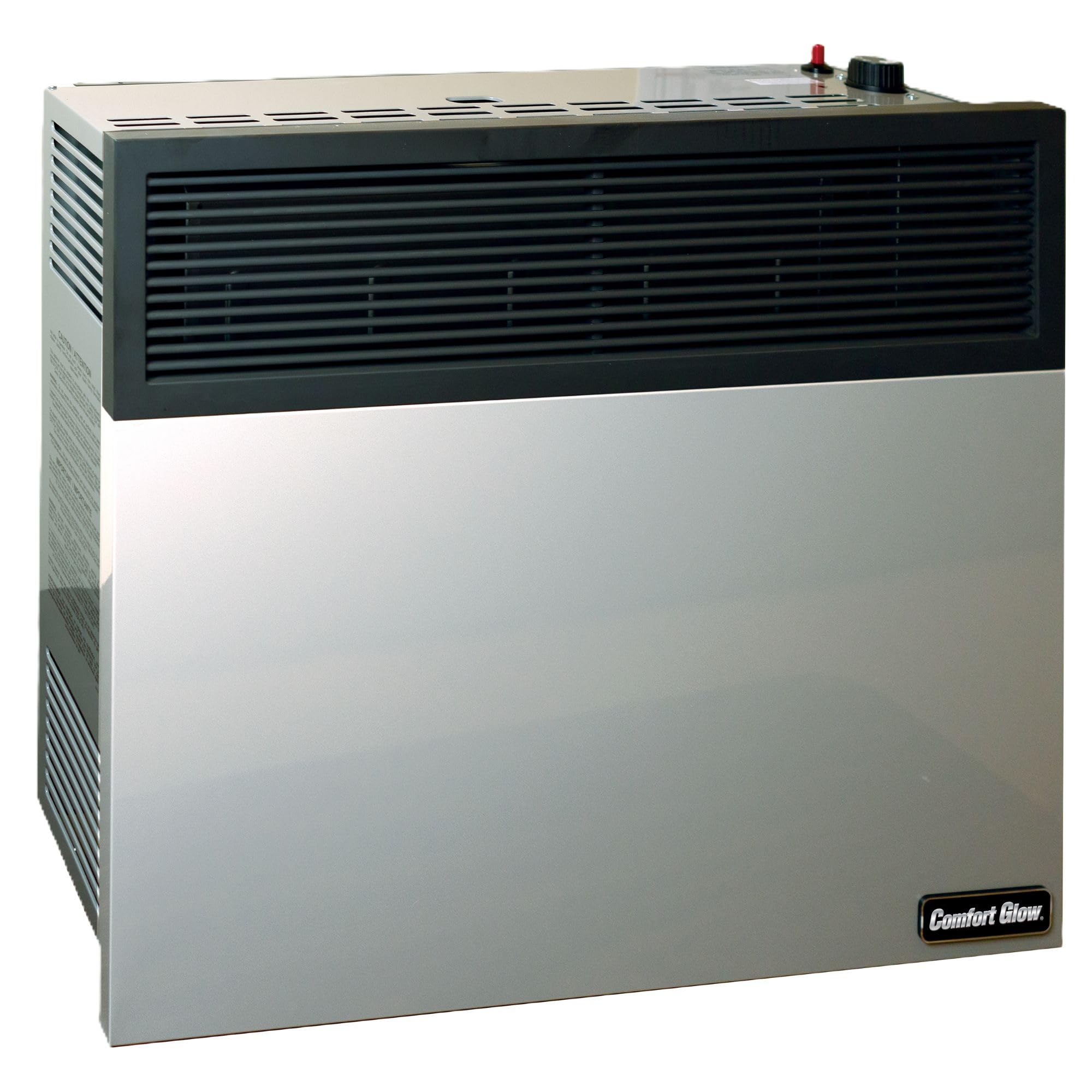
If you worry about indoor air quality when burning gas in a closed workshop, this direct vent heater solves it completely. It draws combustion air from outside and vents all exhaust back outside through a sealed pipe—no fumes, no moisture, no oxygen depletion in your shop air. The 17,000 BTUs cover up to 500 square feet, making it ideal for a well-insulated single-car garage or a dedicated workshop room. With 17,000 BTUs versus the Modine’s 45,000 BTUs, this confirms it’s for smaller spaces. The electronic ignition and safety pilot stop the gas flow if the pilot ever goes out, and the built-in pressure regulator keeps the gas supply steady. Shoppers say being very pleased after running it daily for about three months straight, calling it a “very nice unit.”
The trade-off is the 43-pound weight and 6.61-inch depth, which is surprisingly slim but still a bit of a challenge during wall mounting. The direct vent kit is included—heat shield, vent pipe, air intake pipe, vent cap, flashing, and connection rod—which saves you a separate purchase. One buyer mentioned that if you cut the pipes flush with the wall, the pilot light can blow out in windy areas, so keep both tubes long to avoid that issue. The manufacturer backs it with a 2-year limited warranty.
Best for air quality: The sealed burn system means zero indoor combustion gases—no carbon monoxide risk, no extra humidity, no odd smells—just clean electric-like heat from burning gas.
Wind-sensitive pilot: Leave the vent pipes long per buyer advice, or the pilot may not stay lit on gusty days.
Ideal for: a smaller, well-insulated workshop where you want the safety of a fully sealed system and a neat wall-mounted look with the vent kit included.
Not for: quickly heating a large, drafty garage—17,000 BTUs will run continuously and still feel chilly on the far side of the room.
Understanding the Specs
BTU Output
BTU stands for British Thermal Unit, the standard unit for measuring heat output from a gas appliance. The higher the BTU number, the more heat the heater can push into your space. For a typical garage with average insulation, you need about 30 BTUs for every square foot of floor area. That means a 20,000 BTU heater is a good match for roughly 700 square feet, while a 45,000 BTU unit handles a bigger, draftier space like a three-car garage. Oversizing your heater can make the room feel stuffy and wastes gas, while undersizing means it runs constantly without ever getting truly comfortable.
Vent Free vs. Direct Vent vs. Vented
This is the most important safety and installation distinction. Vent free or ventless heaters burn gas and release all warmth and moisture into the room—they are easy to install because there is no pipe to the outside, but they require an Oxygen Depletion Sensor (ODS) and should only be used in rooms with good airflow. Direct vent models have a sealed combustion chamber that pulls air from outside and sends exhaust outside through a small wall pipe—they are safer for tight spaces but require cutting a hole in the wall. Traditional vented heaters use a flue pipe and a fan to push exhaust outside, which is the most effective method for large shops but needs proper venting through the roof or side wall.
FAQ
Can I install a natural gas shop heater myself or do I need a professional?
How many BTUs do I need for a 2-car garage?
Is a ventless natural gas heater safe in a closed garage or workshop?
Will a natural gas shop heater work during a power outage?
What is the difference between blue flame and radiant natural gas heaters?
Can I convert a natural gas heater to propane or vice versa?
How high should I mount a shop heater from the floor?
How do I clean and maintain a natural gas shop heater?
Does a ventless heater add moisture to my shop and cause rust on tools?
What does the Oxygen Depletion Sensor (ODS) do and is it reliable?
Final Thoughts: The Verdict
If you want one dependable pick, the natural gas shop heater winner is the Modine Hot Dawg HD45AS0111 because it delivers 45,000 BTUs of forced-air warmth to a large garage or workshop in 15-20 minutes with zero fumes inside the space. If you want a ventless, programmable unit that keeps a mid-sized shop at a precise temperature with minimal noise, grab the Rinnai FC824N. And for a budget-friendly, no-electricity-needed solution that heats a cabin or basement surprisingly well, the Dyna-Glo BF20NMDG is a strong pick.
How We Picked
We do not accept paid placement. Every pick is matched to a real buyer and a real use-case; we do not hands-on test units.
Sources & Methodology
Specifications: manufacturer listings and product documentation. Review insights: verified customer reviews, as of July 2026. Pricing: not shown on this page (it changes often); check the current price via the retailer link.
As an Amazon Associate, Trending Car earns from qualifying purchases. This does not affect which products we feature.