
Our readers keep the lights on and my garage snacks stocked. As an Amazon Associate, I earn from qualifying purchases.
Specs are compiled from manufacturer listings and verified buyer reviews and can change over time — please confirm the key details on the product page before buying.
If your mountain bike brakes wobble, hum, or simply don’t grab the way they used to, the rotor is the first place to look. A warped or worn disc turns every descent into a wrestling match, and the wrong one can leave you with a handful of lever and no stopping power. This guide covers nine MTB brake rotors, from budget replacements to World Cup-proven stoppers.
I’m Min Islam — the founder and writer behind Trending Car. This guide is built by comparing the manufacturers’ published specifications and the patterns across verified customer reviews, so you get each pick’s real strengths and trade-offs instead of marketing spin.
Whether you ride a hardtail on local singletrack or a heavy e-bike on steep commutes, selecting the right mtb brake rotors is the single cheapest upgrade you can make to your bike’s stopping confidence.
Our Picks at a Glance


How To Choose The Best MTB Brake Rotors
A few key specs separate a silent, powerful rotor from a squealing headache. Here is what to look for.
Rotor Size: Diameter Dictates Leverage
Larger rotors (180mm, 203mm) give the caliper more mechanical leverage, meaning you need less finger force to stop. Riders over 200 lb, e-bike owners, and aggressive trail riders should gravitate toward 180mm and up. Smaller 140mm and 160mm rotors save weight and suit cross-country bikes or lighter riders who don’t punish the brakes on every descent.
Mounting Standard: 6-Bolt vs. Center Lock
Six-bolt rotors use six small screws to attach directly to the hub — they are universal and fit almost any wheel. Center Lock rotors use a splined interface and a single lock ring; they are faster to swap mid-ride but only compatible with Center Lock hubs (common on Shimano and some aftermarket wheels). Check your hub before buying.
Construction: Solid vs. Floating
A solid one-piece rotor is simple, cheap, and works fine for most riding. A floating rotor (two pieces: an aluminum carrier riveted to a steel braking band) lets the braking surface expand radially under heat without warping. Floating designs also vibrate less, which reduces noise and keeps pad contact consistent during long descents.
Quick Comparison
| Model | Best For | Mount Type | Weight | Thickness | Amazon |
|---|---|---|---|---|---|
| Sram Centerline★ Best Overall | Quiet, true-out-of-box performance | 6-Bolt | 3.52 oz | — | Amazon |
| BUCKLOS FloatingValue Champion | Budget-friendly stopping power | 6-Bolt | ~0.2 lb | 2.0 mm | Amazon |
| BUCKLOS IIIPROAggressive Stopper | Aggressive e-bike & enduro use | 6-Bolt | — | 2.0 mm | Amazon |
| Shimano RT10 | Simple Center-Lock replacement | Center Lock | 7.04 oz | — | Amazon |
| Magura Storm HC | Fade-free heavy braking | 6-Bolt | ~5.2 oz (180mm) | 2.0 mm | Amazon |
| Shimano SM-RT56 | Resin-pad-only Shimano builds | 6-Bolt | 250 g | — | Amazon |
| TEKTRO TR-52 | Noise-cancelling e-bike swap | 6-Bolt | — | 1.8 mm | Amazon |
| TRP RS01E | World Cup winning stiffness | 6-Bolt | 16 oz (203mm) | 2.3 mm | Amazon |
| Hope Floating | Premium alloy-carrier bling | 6-Bolt | 4.48 oz | — | Amazon |
In‑Depth Reviews
1. Sram Centerline Rounded Brake disc
Our pick — over 4.5★ from 900+ verified ratings; the strongest balance of quality and price.
The crowd-favorite 4.8-star rotor that riders call “true out of box.
This SRAM rotor is half the weight of a comparable Shimano piece — 3.52 ounces versus 7.04 ounces — so you feel the difference every time you lift the bike onto the rack. The Centerline design keeps the friction zone consistent through the whole rotation, which buyers report delivers “decent stopping power” and a very quiet ride. A 180mm front paired with a 140mm rear runs almost silent; the rear can pick up a slight noise if pads get contaminated, but the front stays whisper-quiet.
What wins people over is the quality — buyers consistently praise how true every rotor arrives. One owner noted it helped diagnose a sticky caliper because it was so perfectly straight, isolating the problem. The 140mm version does overlap a BB7 caliper pad by about 2-3mm, so check your caliper’s braking path if you run mechanical discs. This is the smart-money pick for anyone who wants proven, quiet stopping power from a name that dominates the pro peloton.
Why it wins: You get genuine SRAM quality right out of the blister pack — laser etching, finished surface, and included screws. The 4.8-star crowd favorite rating across nearly a thousand owners is hard to argue with.
One honest note: The 140mm size can overhang certain calipers by a few millimeters, causing a faint pulsation under hard braking. Stick to 160mm or 180mm for a universal fit.
Grab this if: You want a quiet, true rotor that bolts on and fades into the background — no drama, just consistent braking.
Think twice if: You run mechanical disc brakes with a narrow braking path (BB7 calipers specifically); the profile may overhang.
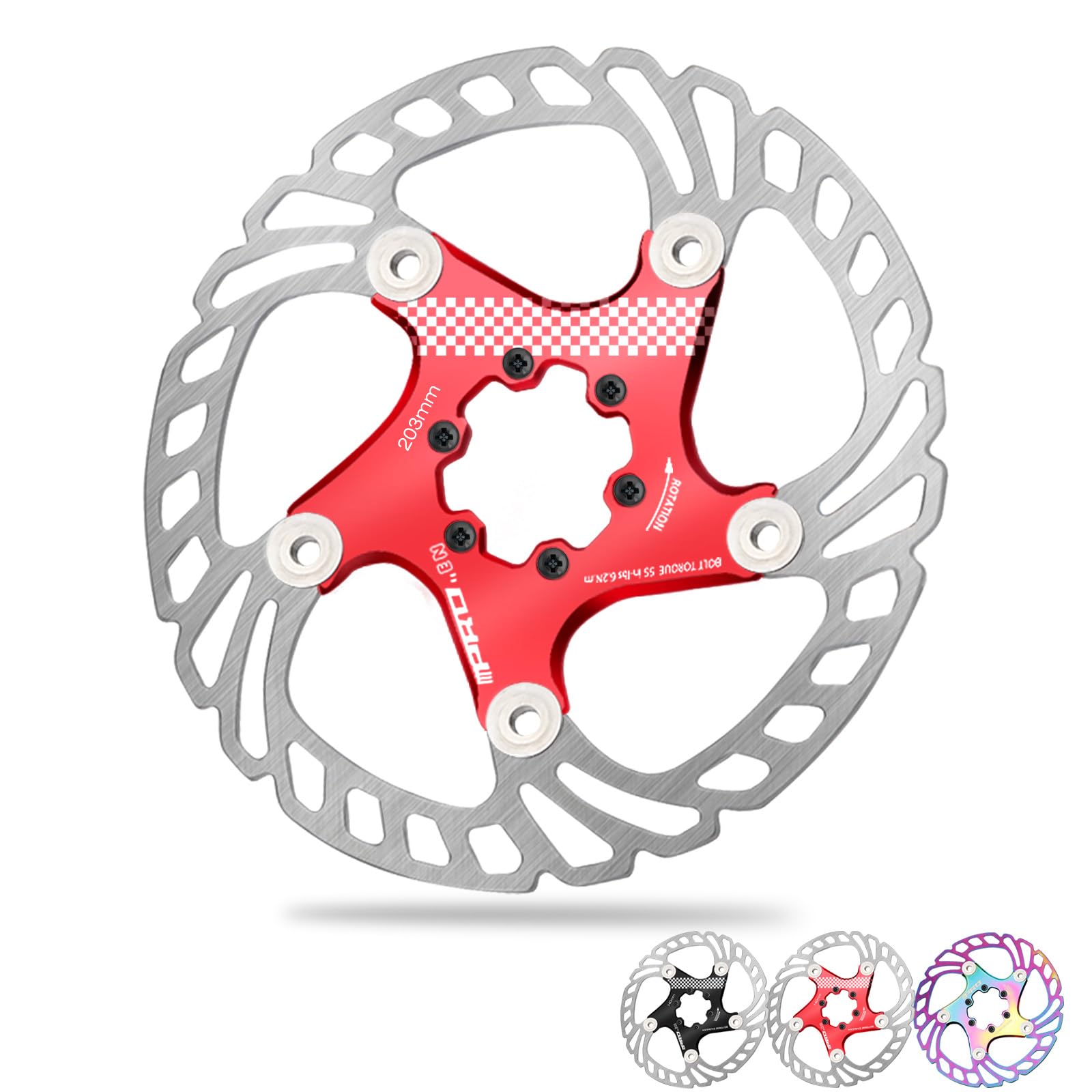
2. BUCKLOS 160mm 180mm 203mm Floating Disc Brake Rotor
A floating rotor at a solid-rotor price that holds up to loaded tours.
The BUCKLOS uses a two-piece design — a stainless steel braking track riveted to an aluminum alloy 7075 T6 carrier — which is typically reserved for rotors costing twice as much. This floating system lets the outer ring expand under heat without buckling, which is exactly what you need on a long descent. Buyers who put it through a loaded bike tour reported no warping, no squealing, and quiet operation across mostly dry conditions.
The thickness is 2.0mm, matching the standard for most modern calipers. It comes in three sizes (160mm, 180mm, 203mm) and two colors (black and red). One caveat: on certain Cannondale Lefty forks, the floating outer edge can rub against the caliper mount. Check your fork clearance if you ride a Scalpel or similar. For the price, this is the best heat-management upgrade you can bolt on.
What owners love
- Floating construction resists warping from repeated hard stops
- Weighs only about 0.2 lb — lighter than many stock steel rotors
- Quiet after proper bed-in, even in wet conditions
Watch for
- Floating profile rubs caliper mounts on some suspension forks (Cannondale Lefty)
- Noise level is mixed — most report silence, a few report squeal
Reach for this if: You run a heavy touring bike or e-bike on a budget and want floating-rotor heat protection without the premium price.
Look elsewhere if: Your front fork uses a non-standard caliper mount shape; check clearance first.
3. BUCKLOS IIIPRO 140/160/180/203mm Floating Bike Disc Brake Rotor
Extremely aggressive bite that will eat organic pads for breakfast.
While the standard BUCKLOS floating rotor is a balanced all-rounder, the IIIPRO variant turns up the aggression significantly. Owners describe it as having massive stopping power under load, but the trade-off is pad wear — this rotor will chew through resin and semi-metallic pads noticeably faster than a smoother surface. If you run sintered metal or ceramic pads, the IIIPRO quiets down and delivers excellent cold and wet performance, making it a legit contender for enduro and downhill use.
The floating system uses a full CNC-machined and anodized aluminum carrier, and it comes in four sizes from 140mm all the way to 203mm. One e-bike owner reported 1000 km of city riding on a Segway Xafari with no issues, and multiple owners mention the rotors arrive perfectly flat with zero warping. The 44mm hole spacing is standard 6-bolt, so installation is straightforward.
Best for heavy braking: The aggressive surface offers massive stopping power for riders who prioritize bite over pad lifespan. The 2.0mm thickness keeps it compatible with virtually all 6-bolt calipers.
Grab this if: You ride enduro, downhill, or a heavy e-bike and want maximum stopping power under load, pairing it with sintered pads.
Think twice if: You prefer long-lasting organic pads; this rotor will eat them fast.
4. Shimano Brake Disc 160mm Centre Lock RT10 Solo Resin

A basic, heavy, bombproof Center Lock rotor that just works.
At 7.04 ounces, this Shimano is the heaviest rotor on this list — more than double the SRAM Centerline’s weight. But weight weenies should look elsewhere; this rotor is built for riders who want something that simply will not bend or break. It is a solid one-piece stainless steel disc designed specifically for resin brake pads, and it comes with the Center Lock retaining nut already in the box. Buyers describe it as “super sturdy” and note it arrived perfectly true, which helped one owner diagnose a sticky caliper by comparing it to the warped rotor they replaced.
The 16cm diameter (160mm) is tuned for cross-country and trail riding where absolute leverage is less important than simplicity. It is not a floating design, so extended downhill runs with heavy braking may eventually cause fading, but for everyday trail riding and commuting, it stops reliably with zero fuss.
Solid points
- Genuine Shimano quality — a known quantity for reliability
- Center Lock format with lock ring included simplifies installation
- “A little on the heavy side but built well and super sturdy”
Limitations
- Heavier than most rotors at 7.04 oz
- Resin-pad-only compatibility limits pad choice
Reach for this if: You have a Center Lock hub, run resin pads, and want a straightforward replacement that requires zero thought.
Look elsewhere if: You want to save rotational weight or run metallic/sintered pads.
5. Magura Storm Hc Disc Brake Rotor

A 2.0mm thick rotor that survives taco’d rotors and keeps stopping.
One owner reported tacoing (badly bending) a Hayes 203mm rotor on an enduro ride, replacing it with this Magura Storm HC. Their verdict: “The magura seems stronger.” At 2.0mm thick — 0.2mm thicker than many Shimano rotors — the extra material delivers noticeable resistance to warping under heat. Magura recommends this rotor specifically for their MT5e hydraulic brakes, and owners confirm it pairs perfectly with Dominions and Magura calipers.
The trade-off is noise. The Storm HC’s slotted shape creates more audible braking, especially in damp or muddy conditions. Buyers comparing it to Shimano Ice Tech rotors note those remained nearly silent in the same conditions, while the Magura gets “more noisy.” But the noise is a sign the rotor is shedding heat and pad material effectively. One buyer ran the 203mm version on an enduro bike and praised the solid, no-fade braking experience when paired with Galfer pads.
Built for punishment: The thicker profile and steel construction resist bending that would total a thinner rotor. At 5.2 oz for the 180mm version, it is not the lightest, but you do not buy this rotor for gram-counting.
Grab this if: You are a heavier rider or you repeatedly destroy rotors on rocky descents and need something that survives impacts.
Think twice if: You hate brake noise; this rotor is noticeably louder than smooth-surface rotors, especially in wet mud.
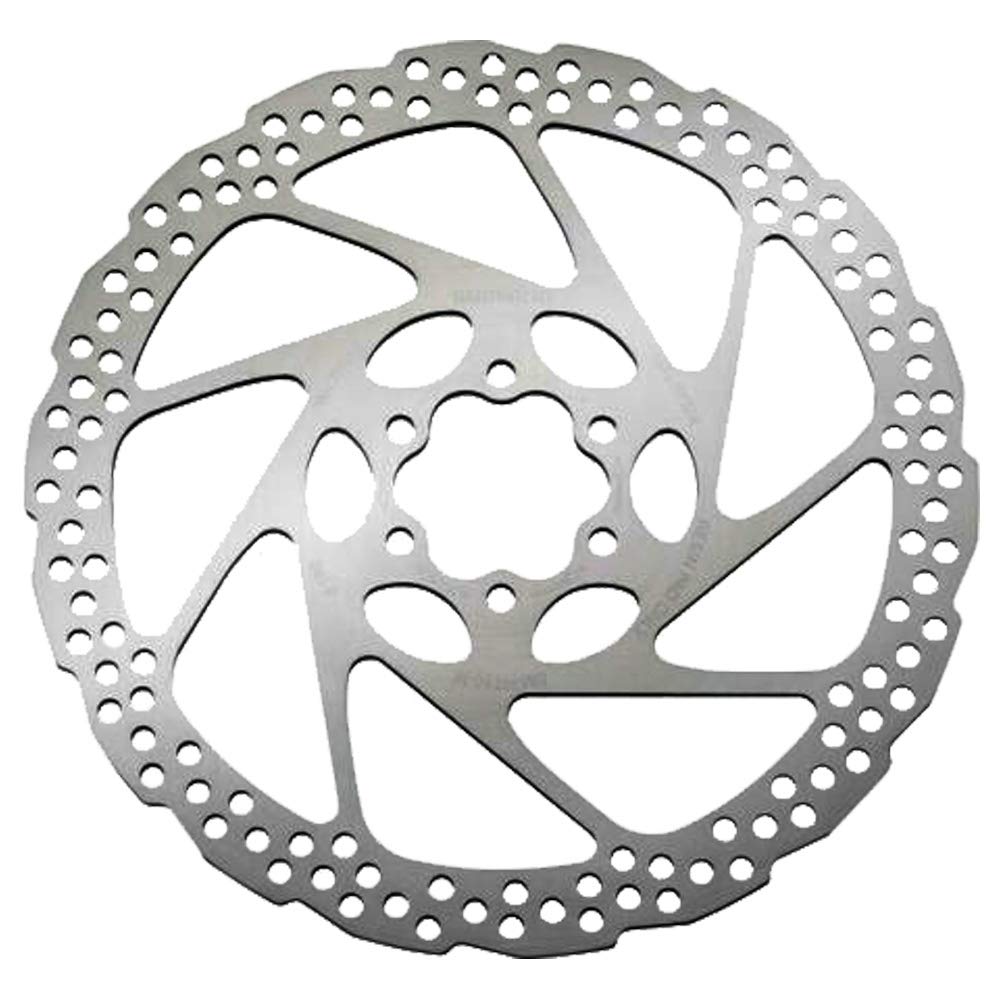
6. Shimano SM-RT56 Disc Brake Rotor 6-Bolt (180mm)
Shimano’s reliable six-bolt option for resin pad riders.
If you have 6-bolt hubs but want genuine Shimano quality, the SM-RT56 is the answer. It is built exclusively for resin pads — printed right on the rotor — so you cannot switch to metallic or sintered pads without replacing the rotor. The 180mm size provides excellent leverage for trail bikes; one owner swapped to a 180mm front paired with a 160mm rear and found the bike could skid the front tire on gravel after bedding, with no squeak or vibration at all.
The package includes rotor fixing bolts with an anti-loosen plate, a small detail that prevents screws backing out over rough terrain. Buyers consistently praise the exact fit and note the rotors arrive well-finished and perfectly true. The 250-gram weight (just under 9 ounces) puts it on the heavier side, but the combination of Shimano’s corrosion-resistant stainless steel and the anti-loosen hardware makes it a set-and-forget upgrade.
Perfect for Shimano purists: The 180mm SM-RT56 delivers OEM-grade fitment for 6-bolt hubs. One owner specifically noted “smooth, powerful after bedding” with no vibrations across hundreds of test miles.
Reach for this if: You run resin pads on a 6-bolt Shimano build and want a rotor that is guaranteed to fit perfectly.
Look elsewhere if: You plan to try metallic or sintered pads; the resin-only label is strict.
7. TEKTRO Road & Gravel Disc Brake Rotor, TR-52

A 1.8mm thick replacement that silenced one e-bike’s “ear piercing” squeal.
The TR-52 is a 203mm 6-bolt rotor with a 1.8mm thickness designed for 2-piston calipers. It ships with star-bit pattern screws (make sure you have that bit ready). While the rotor shape is a reliable workhorse, a small but notable number of buyers have received rotors that arrived slightly bent — so inspect it before installation and return any obvious warp.
When it arrives straight, the result is excellent. One Rad Rover 6+ e-bike owner reported an ear-piercing rear brake squeal that was resolved completely after swapping the factory rotor for this Tektro and replacing the pads. The 1.8mm thickness is slightly thinner than the 2.0mm standard, which can be a tight fit in some calipers but also reduces weight. It is a budget-friendly OEM replacement for Rad Rover, Aventon, and other e-bikes that ship with Tektro components.
What works
- Eliminated brake squeal on an e-bike, according to buyer reports
- Easy to install and functions as described
- Affordable OEM-style replacement for many Chinese e-bikes
What to watch
- Some units arrive with a slight bend — inspect before mounting
- 1.8mm thickness may be too thin for some 4-piston calipers
Grab this if: You own a Rad Rover, Aventon, or similar e-bike and need a quiet, affordable replacement that fits the factory mount.
Think twice if: You run 4-piston brakes that require a thicker 2.0mm+ rotor.
8. TRP RS01E One-Piece Bicycle Brake Rotor, 2.3mm Width, 203mm

A World Cup-winning rotor with a 47% stiffness increase over standard designs.
TRP claims a 47% increase in torsional stiffness and an 8% improvement in cooling capacity, backed by World Cup podium finishes. The 2.3mm width reduces brake fade and minimizes vibration under hard, repeated braking. It comes in 180mm, 203mm, 220mm, and 223mm sizes, all using a standard 6-bolt mount with included hardware.
Owners praise the build quality, noting each rotor arrives “straight as an arrow right outta the box.” The 203mm version weighs 16 ounces, making it a heavy-duty option for e-bikes and aggressive riders. One buyer uses it in calipers designed for 1.8mm rotors to take up the free stroke (the slack in the lever before the brake bites), effectively reducing lever throw without changing the caliper. The wear indicators let you check thickness at a glance; when it reaches the minimum 1.8mm, you swap it.
World Cup proved: The 47% higher torsional stiffness reduces flex under hard braking for a more consistent lever feel. The 2.3mm thickness also runs cooler, shedding heat from aggressive descents.
Reach for this if: You ride heavy enduro, e-bike, or cargo setups and want the stiffest, most fade-resistant rotor available at a reasonable price.
Think twice if: Your calipers are designed specifically for 1.8mm rotors; the 2.3mm thickness requires careful clearance checking.
9. Hope Floating Disc Rotor

British engineering that combines a laser-cut steel braking surface with a CNC-machined alloy carrier.
Hope’s floating rotor is the premium choice for riders who want a beautifully machined, lightweight stopper with genuine heat-dissipation engineering. The braking surface is laser-cut stainless steel riveted to an anodized aluminum carrier, and the floating design allows the steel ring to expand and contract independently of the carrier, preventing the warping that plagues solid one-piece rotors under sustained braking. The 180mm version weighs just 146 grams (about 5.1 oz), competitive with much less expensive rotors.
Quality is the most-praised aspect of the Hope. Customers note the machining is exceptional, with one describing it as “absolutely beautiful.” The rotor works with all pad types and fits standard 6-bolt IS mounts. There is a specific compatibility note: the rivets that join the steel to the carrier are slightly wider than the braking surface, so certain narrow-profile calipers (like Shimano SLX) may rub. Owners confirm the rubbing only happens with certain calipers — Hope brakes obviously fit perfectly, and TRP Spyre and Tektro also clear without issue.
The highlights
- Floating design prevents heat-induced warping and maintains consistent stopping power
- Beautiful CNC-machined finish and anodized carrier
- “Doesn’t warp when hot” — upgrade over OEM rotors
The catch
- Rivet width can rub against narrow calipers like Shimano SLX; measure before buying
- Premium pricing — costs roughly double the BUCKLOS floating rotor
Reach for this if: You ride a Santa Cruz, Yeti, or other high-end build and want a beautiful, quiet, warp-resistant rotor from a legendary British brand.
Think twice if: You run Shimano SLX or other narrow-profile calipers; the rivet clearance may be tight.
Understanding the Specs
Rotor Thickness (1.8mm vs 2.0mm vs 2.3mm)
Rotor thickness directly affects heat capacity and stiffness. A 2.3mm rotor absorbs more thermal energy before warping, ideal for heavy e-bikes or long alpine descents. A 1.8mm rotor saves weight but is more likely to warp under sustained braking. The 2.0mm middle ground suits most trail and enduro riders.
Floating vs. Solid Rotors
A solid rotor is a single metal disc — cheaper, lighter, and fine for most riding. A floating rotor has a steel braking surface attached to an aluminum carrier via rivets. The gap allows the steel to expand radially when hot without buckling. Floating rotors also dissipate heat faster and tend to run quieter because the two-piece construction dampens vibration.
Pad Compatibility (Resin vs. Sintered)
Resin pads are quieter and bite softer but wear faster and should not be used on rotors marked “resin only.” Sintered (metallic) pads last longer and stop better in wet conditions but can be noisy. Most rotors accept both types, but some Shimano models (SM-RT56) explicitly restrict to resin pads only — check before you buy.
Mount Standard: 6-Bolt vs. Center Lock
Six-bolt rotors use six small Torx screws and are universal across brands. Center Lock uses a splined interface with a single lock ring — faster to swap but requires a Center Lock compatible hub and a special tool (or a cassette lockring tool). Shimano dominates the Center Lock ecosystem, but adapters exist to convert between standards.
FAQ
What size rotor should I get for my mountain bike?
Can I use a 203mm rotor with my existing brakes?
What happens if I use a metallic pad on a resin-only rotor?
How do I tell if my rotor is warped?
Does a larger rotor make my brakes stronger?
Can I use a floating rotor on a road or gravel bike?
How often should I replace brake rotors?
What is the difference between the SRAM Centerline and SRAM Centerline X rotors?
Can I install a 6-bolt rotor on a Center Lock hub?
Why does my new rotor squeal after installation?
Final Thoughts: The Verdict
For most riders, the best MTB brake rotors choice is the Sram Centerline because it delivers true-out-of-the-box performance, quiet operation, and a proven 4.8-star reputation from hundreds of owners. If you run an e-bike or heavy-enduro setup and want maximum fade resistance, the TRP RS01E with its 47% stiffness increase is the upgrade to trust. And for budget-conscious builders who still want floating-rotor heat protection, the BUCKLOS Floating rotor punches well above its price tag.
How We Picked
We do not accept paid placement. Every pick is matched to a real buyer and a real use-case; we do not hands-on test units.
Sources & Methodology
Specifications: manufacturer listings and product documentation. Review insights: verified customer reviews, as of July 2026. Pricing: not shown on this page (it changes often); check the current price via the retailer link.
As an Amazon Associate, Trending Car earns from qualifying purchases. This does not affect which products we feature.