
Our readers keep the lights on and my garage snacks stocked. As an Amazon Associate, I earn from qualifying purchases.
Specs are compiled from manufacturer listings and verified buyer reviews and can change over time — please confirm the key details on the product page before buying.
Getting your mountain bike’s suspension pressure exactly right is the difference between a bike that carves through rock gardens and one that bucks you off. But if you have ever unscrewed a shock pump only to hear a hiss of escaping air, you know the frustration of losing the exact pressure you just spent minutes dialing in. This guide finds the pump that holds pressure, reads accurately, and fits tight frame spots.
I’m Min Islam — the founder and writer behind Trending Car. This guide is built by comparing the manufacturers’ published specifications and the patterns across verified customer reviews, so you get each pick’s real strengths and trade-offs instead of marketing spin.
Whether you ride a trail hardtail or a downhill sled, finding the right pump is critical — and this is your definitive look at the best mountain bike shock pump options available right now.
Our Picks at a Glance


How To Choose The Best Mountain Bike Shock Pump
Choosing a shock pump depends on three things: accuracy, air-free connection, and maximum pressure for your fork or shock. A pump that bleeds air on disconnect or has a gauge that wobbles by 5 psi makes every ride setup a guessing game.
Maximum Pressure (PSI)
Most mountain bike air forks and rear shocks operate between 80 and 200 psi. A pump rated to at least 300 psi covers nearly every modern suspension setup, from an XC fork to a heavy-duty downhill shock. Going higher, like 350 or 400 psi, gives you a safety margin for very firm settings or motorcycle use.
Bleeder Button
A pressure-release, or bleeder, button lets you micro-adjust the air pressure downwards by releasing a tiny amount of air at a time. Without it, you have to unscrew the pump entirely to lower the pressure, which almost always results in overshooting your target on the next re-attempt.
Valve Connection
The connector attaches to your fork or shock’s Schrader valve. A quality chuck uses a lever or screw-down mechanism to depress the valve pin inside, letting air flow in. A poor connection can leak air the moment you detach the pump, losing the pressure you just set. Look for models that specifically address air loss on disconnect.
Quick Comparison
| Model | Best For | Max Pressure | Weight | Bleeder Button | Amazon |
|---|---|---|---|---|---|
| Rockshox High Pressure★ Best Overall | Shop-grade durability | — | Lightweight | Yes | Amazon |
| Fox Factory HPPremium Pick | Fox shock owners | 350 psi | 204 g | Yes | Amazon |
| Optio Cycle Shock PumpFastest Fill | Fast, dual-action pumping | 300 psi | 6.3 oz | — | Amazon |
| JACO ShockPro | Lifetime warranty value | 300 psi | 0.2 kg | Yes | Amazon |
| Topeak Pocket Shock DXG | Air-loss prevention | 360 psi | 170 g | — | Amazon |
| Beto Precision (SP-002AGN) | Ultra-high 400 psi ceiling | 400 psi | 0.18 kg | Yes | Amazon |
| GIYO High Pressure | Lightweight build | 350 psi | 144 g | Yes | Amazon |
| ROCKBROS High Pressure | Budget-friendly entry | 300 psi | 5.92 oz | Yes | Amazon |
| Beto Dual Function (SP-005AG) | Dual shock/tire duty | 21 bar (300 psi) | 9.3 oz | Yes | Amazon |
In‑Depth Reviews
1. Rockshox High Pressure, Unisex High Pressure Fork and Shock Pump – Black
Our pick — over 4.5★ from 850+ verified ratings; the strongest balance of quality and price.
The shop-proven workhorse keeps your suspension dialed for years.
This pump is the one that mechanics reach for day in and day out. Its digital gauge reads in increments of 0.5 psi, so you can set your fork sag to the exact single pound that transforms how your bike handles a rooty climb. The overall build quality and ease of use are what win people over here — the crowd favorite across nearly 900 owners puts quality at the top, and owners consistently say it pumps consistently from 10 psi all the way up to 150 psi without a change in effort.
A key difference from the mid-tier options is the two-year warranty from Rockshox. Compared to the ROCKBROS at 5.92 ounces, this one is only slightly heavier at 6.3 ounces, but the trade-off for the digital precision and brand backing is significant. The main honest caveat is the battery compartment: changing the CR2032 battery requires removing 1.5mm hex screws that can strip if you are not careful. Budget options like the Beto Precision have a 400 psi ceiling, but this Rockshox holds a tighter accuracy that owners trust for shock maintenance week after week. As buyers report, “My last RS lasted 8 years of heavy shop use” — that kind of durability is rare.
What Makes It the Top Pick
- Digital gauge with 0.5 psi resolution for ultra-fine adjustments.
- Consistent pumping effort from low to high pressure — no sudden stiffness.
- Rockshox two-year warranty adds confidence over unbranded alternatives.
What to Watch For
- Battery replacement involves tiny hex screws that can strip.
- Premium price over similar-looking generic models — you pay for the warranty and quality control.
Built for the long haul: Buy this if you want a pump that will last through years of weekly suspension service and you value precise digital readouts over saving a few dollars.
skip it if: You only need a pump for a single fork setting once a season — a simpler analog model would serve you fine.
2. Fox Factory HP Shock Pump 350PSI w/Swivel Head
The dedicated pump for Fox riders swivels into tight frame spaces with ease.
If you ride Fox suspension, this pump is the natural partner. Its stainless steel swivel pump head (UP-SA) bends to access shocks where linkages would block a rigid head — a real-world benefit when your rear shock is tucked behind the seat tube. The maximum 350 psi covers every Fox shock, including the DPS and DPX2 models that hit that ceiling. The micro-adjust bleeder lets you fine-tune pressure in 2-3 psi increments.
Build quality is what owners consistently praise, with the 6063 aluminum barrel and handle giving it a premium feel. At 204 grams it is noticeably heavier than the GIYO’s 144g, but the swivel head and brand-specific compatibility justify the weight for Fox loyalists. The honest trade-off is that pumping above 200 psi requires significant effort — the small internal volume that makes high-pressure possible also makes each stroke harder at the top end. For kids’ bikes and general use, it works well, but for a shop-grade do-everything pump, the Rockshox above is a better all-rounder.
top-tier Feature
- Swivel pump head accesses shocks in cramped frame locations.
- Micro-adjust bleeder for precise 2-3 psi fine-tuning.
- Rated to 350 psi — covers all Fox DPS and DPX2 models.
A Minor Grumble
- Hard to pump above 200 psi — requires significant upper-body effort.
- Heavier than compact competitors at 204 grams.
Best for Fox owners: If your fork and shock are both Fox, this pump’s swivel head and bleeder make setup a one-tool job with no guesswork.
Look elsewhere if: You need a pump for mixed-brand suspension or want the lightest possible trail pack tool.
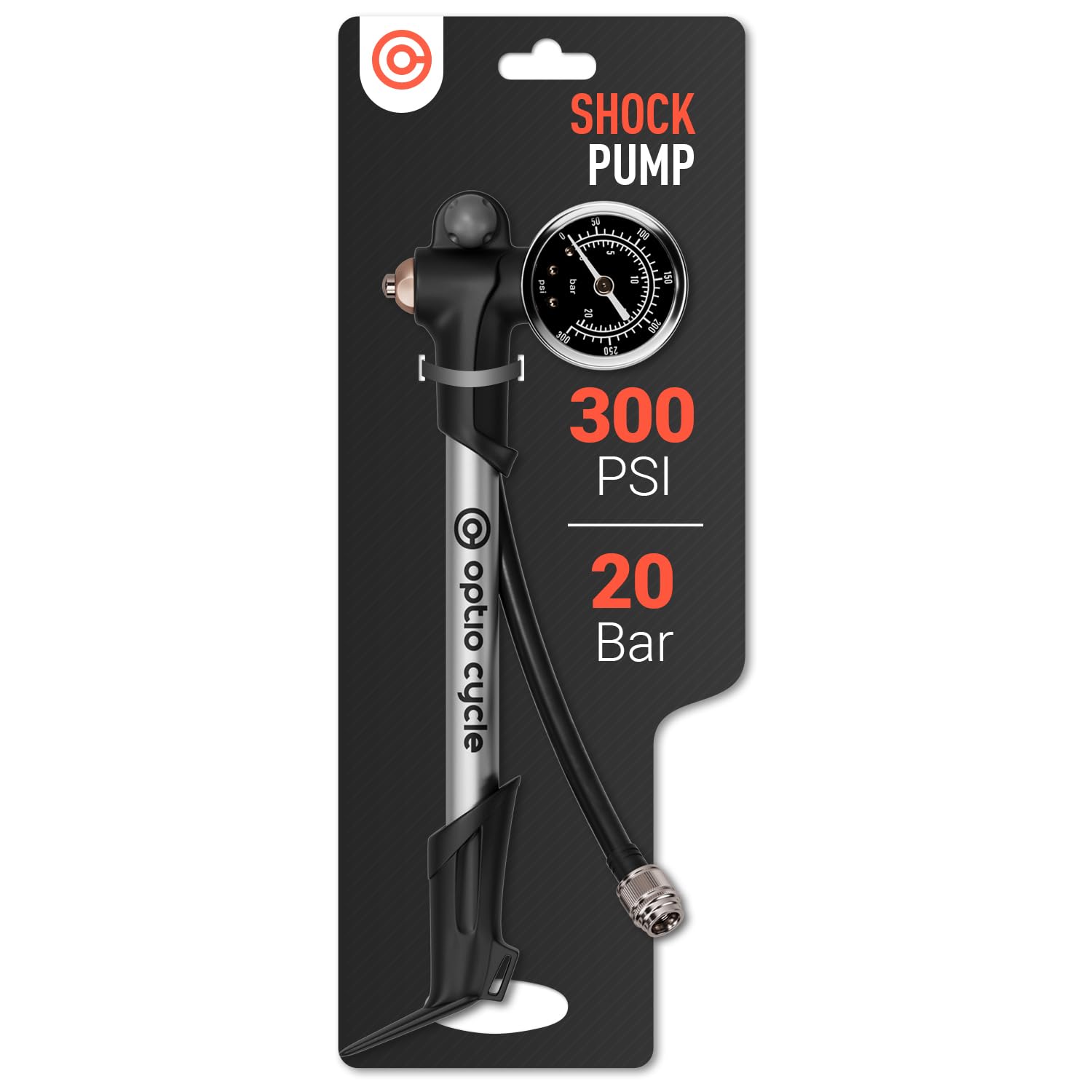
3. Optio Cycle Shock Pump – High Pressure Bike Pump with Pressure Gauge
A dual-action pump fills your fork on both the push and pull stroke.
This is the pump for anyone who hates pumping. The dual-action design moves air on both the in-stroke and out-stroke, which means your fork or rear shock reaches pressure noticeably faster with less arm fatigue. The Schrader valve connection is solid and prevents cross-threading — a common issue on cheaper pumps where the threads strip after a season. The gauge reads in both PSI and Bar for clear sag adjustment.
Owners love the sealing and smooth pumping action. At 6.3 ounces it is almost identical in weight to the Rockshox, but it lacks a bleeder button, so you cannot fine-tune downwards without disconnecting. The maximum 300 psi is standard for most MTB applications, though the Beto Precision below offers a higher 400 psi ceiling for those who need it. For the dual-action speed alone, this is a strong mid-range value that keeps you from fighting the pump on the trail.
Fast and reliable: Dual-action pumping cuts fill time in half. No bleeder button means you disconnect to release pressure, which is the only real workflow friction.
Reach for this if: You want to pump up a shock quickly without tiring your arms, especially after a long ride when you are already spent.
Better options exist if: You need micro-adjustment via a bleeder button or you regularly service multiple bikes in a shop setting.
4. JACO ShockPro MTB Shock Pump – 300 PSI

A lifetime-backed pump packs pro-level accuracy without the pro-level price.
Engineered by MTB enthusiasts with over 35 years of combined experience, the JACO ShockPro is built from aircraft-grade aluminum and ABS for real durability. The 300 psi gauge is calibrated to ANSI B40.1 accuracy standards, meaning it reads true to within a tight tolerance that matters when you are setting sag by the pound. The bleeder button lets you release pressure in tiny puffs, and owners find it accurate and compact enough for a trail bag.
The standout here is the lifetime warranty — a rare promise at this price point. What makes this a top value is the combination of ANSI-calibrated accuracy and that warranty. The functional downsides are mixed: some find the airflow takes out a little air on disconnect, and durability reports are split, with most positive but occasional failures after one use. At 0.2 kg it is heavier than the GIYO but still packable.
Pro-grade guarantee: ANSI B40.1 calibrated gauge ensures you set pressure exactly. Lifetime warranty covers you for the long term. Sensitivity on disconnect requires a careful hand.
Pick this if: You want professional-level gauge accuracy and the security of a warranty that never expires, all at a mid-range cost.
Think twice if: You prefer a digital readout or need the absolute lightest pump for a minimal trail pack.
5. Topeak Pocket Shock DXG Bike Pump

The pump that solved air loss on disconnect for riders tired of re-pumping.
The Topeak Pocket Shock DXG solves the most annoying problem in shock pumping: losing pressure when you unscrew. Its patented Pressure-Rite connector uses a two-stage valve that depresses the Schrader pin only when the pump is ready, so when you disconnect, almost no air escapes. That makes setting precise sag a low-maintenance process rather than a frustrating cycle of overpump-and-hiss. It handles up to 360 psi, which is more than enough for any MTB fork or rear shock.
Owners consistently report that it works better than both RockShox and Fox pumps at retaining air, and the compact aluminum construction with a dual-density polymer handle keeps it trail-pack friendly at 170 grams. The main gripes are the small gauge, which is hard to read in dim light, and the handle that can unscrew from the cylinder over time — requiring occasional tightening. It also requires a direct line to the valve, so it will not work with frame-facing valves.
Why It Excels
- Pressure-Rite connector minimizes air loss on disconnect.
- Rated to 360 psi — a generous margin for any shock.
- Compact and lightweight at 170 g for trail carrying.
What to Note
- Small gauge is hard to read, especially in low light.
- Handle can unscrew from cylinder and needs periodic tightening.
For air-loss haters: If the hiss of escaping pressure drives you crazy, this pump’s connector is the most effective fix among the picks here.
Not for you if: You need a large, easy-to-read gauge or your shock valve faces the frame.
6. Beto Precision High Pressure Shock Pump (SP-002AGN) – 400 PSI

The pump that goes to 400 psi for riders who need extreme pressure headroom.
This Beto model is for the rider who wants a 33% higher ceiling than the standard 300 psi — its 400 psi maximum covers everything from MTB shocks to motorcycle suspension and dropper posts that need serious pressure. The 1.5-inch industry-class gauge provides clear PSI and Bar readouts, and the patented Pinch-Free T-handle makes high-pressure pumping comfortable even for larger hands. The 6-inch swivel hose gets into tight spots.
The fine-tuning bleeder button works well, and owners praise the no-air-leak performance and accuracy. The honest durability concern is real: several owners mention the pump failing after about two years of use. As one put it, “had it for 2 years and it died just like that.” While some chalk it up to a defective unit, the pattern appears more than once. For occasional or moderate use, it is a solid performer with class-leading pressure range, but for daily shop work it may not hold up like the Rockshox.
Massive headroom: 400 psi beats every other pick here by a wide margin. The trade-off is durability that some owners found disappointing after two years.
Best for: Riders who also pump motorcycle suspension or want a safety margin well above standard MTB needs without spending premium money.
Consider alternatives if: You plan to use this pump multiple times a week for years — the Rockshox or Topeak may last longer.
7. GIYO High Pressure Shock Pump (350 PSI)

The lightest pump on this list at just 144 grams for weight-conscious trail riders.
At 144 grams, the GIYO is the featherweight of the group — easily the lightest pump you can stash in a hip pack or jersey pocket without noticing it. Despite the low weight, it delivers 350 psi maximum, so it is no lightweight in performance. The aluminum barrel and non-scratch pump head ensure it does not damage your fork stanchions, and the 1.5-inch dial gauge with a micro-adjustment button lets you fine-tune within a couple of psi. Owners praise its ability to easily pump up to 225 psi for e-bike rear shocks.
The GIYO is proudly Taiwan-made, which adds to its quality reputation. The mixed feedback focuses on pressure control — some customers note the gauge is not perfectly accurate, and a small number experienced the pump failing entirely after some use. The lever-action nozzle works well to minimize air loss, though some still report a small release when detaching. For the weight-conscious rider who wants a compact, high-pressure tool, this is a great choice, but durability is slightly less proven than the heavier competitors.
Trail-pack champ: At 144g you barely feel it. The 350 psi ceiling and micro-adjust button make it genuinely useful, not just a lightweight gimmick.
Reach for it if: Every gram matters in your pack and you want a compact pump that still delivers full shock pressure.
Look elsewhere if: You need the most durable pump for daily shop use or you have had bad luck with lightweight components failing.
8. ROCKBROS High Pressure Shock Pump 300 PSI Max

A genuinely functioning budget pump that does not leak pressure when you detach it.
For a budget pick, the ROCKBROS delivers where it matters most: holding pressure. The owner feedback is consistent — reviewers point out it “worked great on my Sr Suntour forks” pumping up to 140 psi with no air loss on removal. That is the fundamental job of a shock pump, and at this price, the fact that it nails that makes it a reliable entry-level tool. The CNC aluminum head and barrel give it a solid feel, and the ergonomic handle makes pumping comfortable.
At 5.92 ounces, it is slightly lighter than the Optio Cycle pump (6.3 ounces) but heavier than the GIYO. The 1.5-inch industrial gauge reads in both PSI and Bar, and the bleeder button allows fine-tuning. The mixed quality feedback is the main caveat — some owners describe it as a nice little pump, while others find it feels cheap. For a first pump or a spare to keep in the car, it is a solid choice, but for heavy regular use, the more expensive picks will likely last longer.
Why It Works
- Holds pressure on disconnect — the critical job for a shock pump.
- CNC aluminum construction at a very low cost.
- 360° rotatable hose for easy access to tight shock valves.
The Trade-Off
- Mixed quality feedback — some units feel cheap.
- Lacks the long-term durability of premium brands for heavy shop use.
Who it fits: Riders on a tight budget who need a functional pump that does the basic job of pressurizing and holding air while staying affordable.
Who should pass: Mechanics or frequent riders who want a pump that will survive years of daily use without worry.
9. Beto Bike Tire/Shock Pump MTB, 300psi Dual Function (SP-005AG)

A single pump that switches between high-volume tire filling and high-pressure shock setting.
This Beto is the Swiss Army knife of bike pumps. It has a button on the handle bottom that switches between High Volume (HI-V) mode for filling tires and High Pressure (HI-P) mode for shocks. In HI-V mode, it moves more air per stroke to get your tire from flat to rideable quickly. In HI-P mode, the stroke gets easier and you can dial up the shock with fine control. The included mounting bracket lets you attach it under your water bottle cage for on-trail access.
The versatility is real, but there are trade-offs. Shoppers say losing about 0.5 psi when disconnecting, and the screw-on Schrader adapter lacks a quick-release, so you will lose a bit of pressure from high-pressure applications. The gauge can be hard to read for high volume mode, and some owners find the quality mixed — it works well for shocks but requires significant effort for full tire inflation. At 9.3 ounces, it is the heaviest pick here, so it is better suited for frame mounting than pocket carry. It is a great two-in-one tool for riders who want to carry one pump, not two.
Clever two-in-one: HI-V and HI-P modes are genuinely useful. The weight and minor air loss on disconnect are the costs of that versatility.
Perfect for: Riders who want one tool to handle both tire inflation and shock setup, especially for bikepacking where every gram of gear counts.
Not ideal if: You are a weight weenie who wants the lightest possible shock-only pump, or you need zero air loss on the valve.
Understanding the Specs
PSI and Maximum Pressure
PSI (pounds per square inch) measures the air pressure your suspension needs. Most MTB forks run between 80 and 150 psi, while rear shocks can go higher. A pump rated to at least 300 psi is standard for modern bikes. Going higher, like 350 or 400 psi, gives a safety margin for firm settings or motorcycle use.
Bleeder Button
A bleeder button lets you release a tiny puff of air to drop the pressure by a single psi without disconnecting the pump. This is essential for fine-tuning your sag — the amount your suspension compresses under your weight — without the hassle of re-attaching and over-pumping.
Valve Connection and Air Loss
The pump head (or chuck) connects to your shock’s Schrader valve. A quality design depresses the valve pin inside to let air in and seals tightly so no air escapes when you detach. Pumps that lose air on disconnect make it nearly impossible to set an exact pressure, which defeats the whole purpose of a shock pump.
Dial vs Digital Gauge
A dial gauge uses a needle and numbered face, while a digital gauge shows a number on a screen. Dial gauges are reliable and never need batteries, but they can be harder to read precisely. Digital gauges often show fractions of a psi (like 0.5 psi) for greater accuracy, but they require a battery, and changing it can be fiddly on some models.
FAQ
Can I use a normal tire pump for my mountain bike shock?
How much pressure does my mountain bike shock need?
Why does my shock pump lose pressure when I disconnect it?
What is a bleeder valve for on a shock pump?
How long does a shock pump usually last?
Does brand matter for a shock pump, or are they all the same?
What is the difference between a Presta and Schrader valve on a shock pump?
How do I know if my shock pump gauge is accurate?
Can I use a shock pump to inflate my bike tires in an emergency?
Should I get a digital or analog gauge shock pump?
Final Thoughts: The Verdict
For most buyers, the best mountain bike shock pump winner is the Rockshox High Pressure Pump because it combines a precise digital gauge, consistent pumping feel, and a two-year warranty in a package that owners trust for years of heavy use. If you want a pump specifically for Fox suspension with a handy swivel head, grab the Fox Factory HP. And for a fast-filling dual-action design that saves your arms on the trail, the Optio Cycle Shock Pump is the one to reach for.
How We Picked
We do not accept paid placement. Every pick is matched to a real buyer and a real use-case; we do not hands-on test units.
Sources & Methodology
Specifications: manufacturer listings and product documentation. Review insights: verified customer reviews, as of July 2026. Pricing: not shown on this page (it changes often); check the current price via the retailer link.
As an Amazon Associate, Trending Car earns from qualifying purchases. This does not affect which products we feature.