
Our readers keep the lights on and my garage snacks stocked. As an Amazon Associate, I earn from qualifying purchases.
Specs are compiled from manufacturer listings and verified buyer reviews and can change over time — please confirm the key details on the product page before buying.
Treating a house battery like a car battery is the fastest way to shorten its life. A starting battery delivers one big burst; a deep-cycle battery like the ones here is built to deliver steady power all night and survive being drained again and again. That’s the core of what makes a good motorhome battery.
I’m Min Islam — the founder and writer behind Trending Car. This guide is built by comparing the manufacturers’ published specifications and the patterns across verified customer reviews, so you get each pick’s real strengths and trade-offs instead of marketing spin.
The right battery keeps your fridge cold, furnace blowing, and lights on without a generator, whether you boondock for a weekend or live off-grid for months. This breakdown of the best motorhome battery options zeroes in on real capacity, weight, and the exact trade-offs between lead-acid and lithium.
Our Picks at a Glance


How To Choose The Best Motorhome Battery
Before you compare prices, you need to match the battery chemistry to how you actually camp. If you stay at campgrounds with hookups, an AGM battery is a simple, affordable upgrade. If you spend nights without shore power, a lithium battery pays for itself in weight savings and usable capacity.
Understand the Chemistry: Lead-Acid vs. Lithium
The two main types here are AGM (Absorbent Glass Mat), which is a sealed lead-acid battery, and LiFePO4 (Lithium Iron Phosphate). AGM is cheaper upfront, but you can only safely use about 50% of its rated capacity. Lithium lets you use 80% to 100% without damage, which effectively doubles your usable power. That means a 100Ah lithium battery often replaces a 200Ah AGM in real-world use.
Weight and Payload Constraints
Your motorhome has a limited cargo capacity, and batteries are heavy. A standard lead-acid battery can weigh 60 pounds or more. Lithium batteries like the Power Queen 100Ah weigh in at just 24.25 lb — roughly a third of the weight — which frees up payload for water, gear, or passengers.
Cold Weather Charging
Lithium batteries cannot be charged below freezing, and some BMS units will shut down charging to protect the cells. If you camp in winter, look for a self-heating feature or a low-temperature cutoff so you aren’t left without power on a cold morning.
Quick Comparison
| Model | Best For | Capacity | Weight | BMS Protection | Amazon |
|---|---|---|---|---|---|
| Power Queen 100Ah★ Best Overall | Drop-in replacement | 100Ah | 24.25 lb | 100A | Amazon |
| Mighty Max 100AhBudget Champion | Budget lead-acid | 100Ah | ~63 lb | None | Amazon |
| WEIZE 100AhProven Performer | Reliable AGM | 100Ah | 60 lb | None | Amazon |
| dumfume 200Ah | High capacity | 200Ah | 58.56 lb | 200A | Amazon |
| ECO-WORTHY 280Ah | Bluetooth monitoring | 280Ah | ~68.5 lb | 200A | Amazon |
| yeagulch 314Ah | Long cycle life | 314Ah | 57.3 lb | 200A | Amazon |
| Litime 230Ah | Group 4D fit | 230Ah | 45.3 lb | 200A | Amazon |
| Power Queen 300Ah | Big off-grid power | 300Ah | 59.9 lb | 200A | Amazon |
| VATRER POWER 460Ah | Maximum autonomy | 460Ah | 104.7 lb | 300A | Amazon |
In‑Depth Reviews
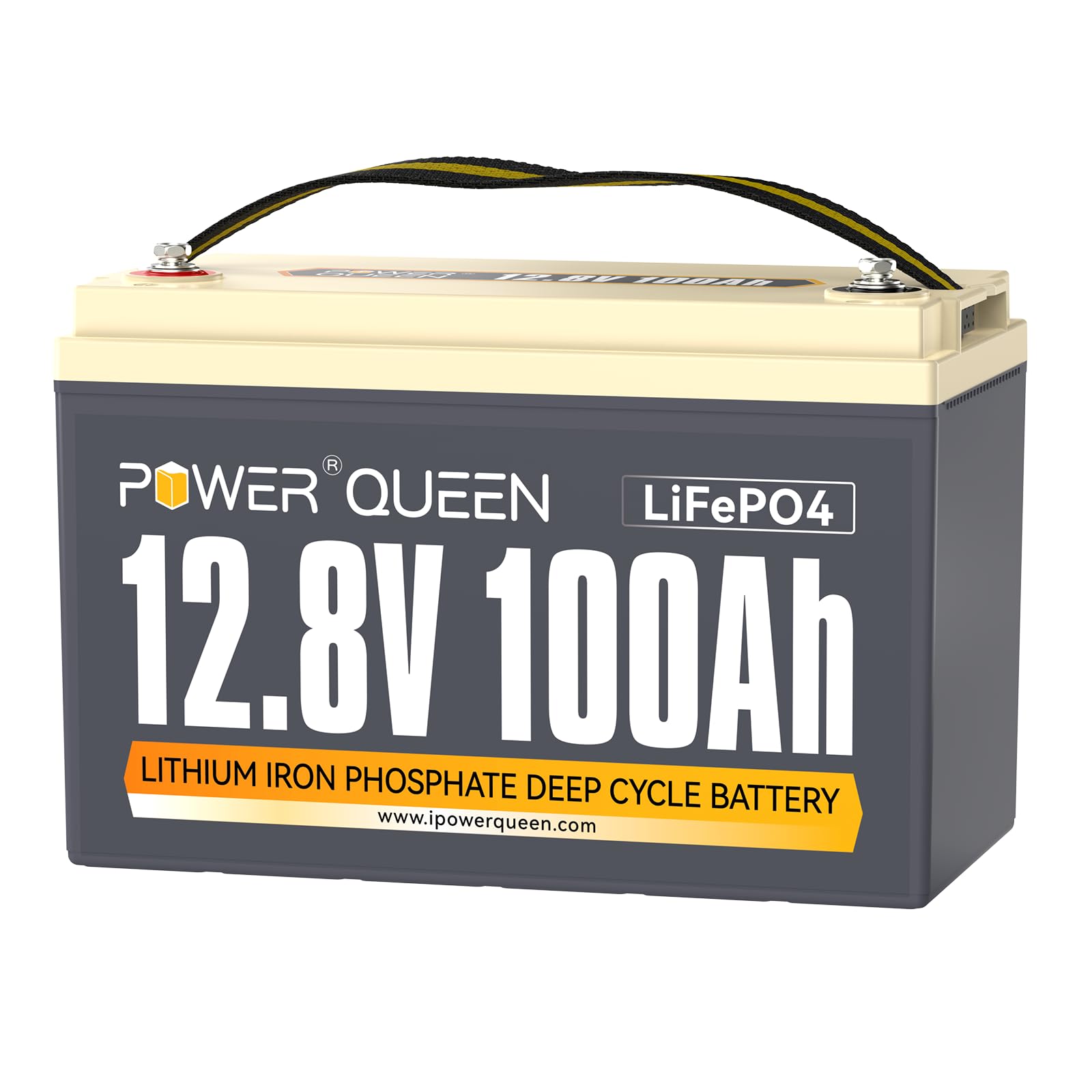
1. Power Queen 12V 100Ah LiFePO4 Battery
Our pick — over 4.5★ from 200+ verified ratings; the strongest balance of quality and price.
The featherweight that makes a motorhome battery swap feel easy.
The Power Queen 100Ah is the pick for most owners because it nails the two things that matter most: weight and usable capacity. At just 24.25 lb, it’s about a third the weight of a comparable lead-acid battery, which means you can carry it with one hand and free up serious payload for your rig. It’s a Group 31 size, so it drops into many standard RV trays without modification.
This is a 12.8V lithium battery with a 100A BMS that guards against overcharge, over-discharge, over-current, and short circuits. That protection is the peace-of-mind layer. Buyers report outstanding results, and the build quality is consistently praised, with no maintenance like checking water levels or cleaning corrosion. It’s rated for 4,000 cycles at 100% depth of discharge, which translates to a 10+ year service life for most campers — far outlasting AGM alternatives and lowering the long-term cost.
Owners mention this battery holds its charge remarkably well; one used it on a 17.5 ft deep V boat for 18 hours of fishing in choppy water and noted it “hardly lost any juice” after that long day. The ecosystem is also expandable — you can build up to a 4P4S setup for 51.2V and 400Ah if your power needs grow. Just note that to install this, you’ll want 6-gauge cable; that requirement sends some buyers back to the drawing board if their trailer uses 8-gauge.
Why It Wins
- 24.25 lb weight makes installation genuinely easy
- 4,000 cycles at 100% DOD means years of service
- Expandable to 4P4S for future power needs
The Trade-offs
- Needs 6-gauge cable — check your rig’s wiring
- Some BMS units cut off around 14.2V, which may prevent full charge with certain chargers
The right call: The best overall choice for most motorhome owners who want a light, safe, long-lasting upgrade.
Think twice if: Your existing trailer uses 8-gauge cable; you’ll need to run new wiring to get the full benefit.
2. Mighty Max Battery 12V 100AH VRLA
The affordable lead-acid workhorse that still gets the job done without the lithium price tag.
If you’re on a budget or just want a simple replacement for an old flooded battery, the Mighty Max ML100-12 is a 12V 100AH Group 27 sealed lead-acid battery. It’s UL Certified and maintenance-free, meaning you never check water levels or clean terminals. The AGM design is spill-proof, resists shocks and vibration, and can be mounted in any position — flexible for tight under-seat compartments.
This is a 12V battery with a high discharge rate and wide operating temperature range, so it performs in both summer heat and winter cold. One buyer reports it lasts 8+ hours on a 44lb trolling motor and ends the day at about 35% charge, which beats their old 4-6 hour battery. It runs a 32″ TV and Roku on a 500W inverter for 4 hours and only drained 1%, showing solid power delivery for entertainment loads.
It’s not premium, but it’s a proven, budget-friendly workhorse. The biggest caveat from owners is the weight — it’s heavy compared to lithium — and the fact that it’s a lead-acid battery with a 1-year warranty, so you’re trading long-term longevity for a lower upfront cost. For weekend campers who don’t need maximum capacity, this is a smart, pragmatic pick that works on a 12ft Jon boat or as a van house battery.
Solid value: A reliable, budget-friendly AGM that outperforms old flooded batteries and holds a charge well.
Know the limits: It’s heavy, and the 1-year warranty means longevity is less proven than lithium options.
3. WEIZE 12V 100Ah Deep Cycle Battery
The drop-in replacement that owners describe as a straight factory upgrade for their motorhome.
One owner used it as a replacement house battery for a motorhome and called it “that factory install one,” which says a lot about fit and finish. This WEIZE is a 12V 100Ah sealed lead-acid AGM battery in a Group 31 size, and it’s built for deep-cycle duty. It has a 3% self-discharge rate, so it holds its charge well during storage — a key feature for seasonal campers who park the rig for months.
Performance is the most-praised aspect here, with owners noting it runs a 2000W inverter with power to spare. In a parallel setup of 4 batteries, it powers a 4.8kWh backup system that runs 120V outlets, fans, and a garage door, though not high-draw appliances like a stove or microwave. The AGM construction is maintenance-free and spill-proof, so you don’t have to babysit fluid levels — a real convenience for owners who prefer a low-maintenance setup.
The trade-off is its 60 lb weight and lead-acid chemistry. At 60 pounds (battery weight listed as 63 pounds), it’s heavy to haul in and out of a compartment. It’s also a lead-acid battery, so you get about 50% usable capacity compared to 80-100% with lithium. Owners who run it off-grid for 2 years with 2x150W solar report no issues, but if you need maximum usable capacity in a light package, this isn’t the lithium answer.
What Impresses
- Runs a 2000W inverter with power to spare
- 3% self-discharge rate keeps it ready after storage
- Quality AGM that outperforms flooded lead-acid
What to Expect
- 60 lb weight is a workout to move
- Lead-acid chemistry means only ~50% usable capacity
Best for: Motorhome owners who want a proven, affordable AGM replacement that fits standard trays.
Look elsewhere if: You’re chasing maximum usable capacity or need to trim weight for payload.
4. dumfume 12V 200Ah LiFePO4 Battery
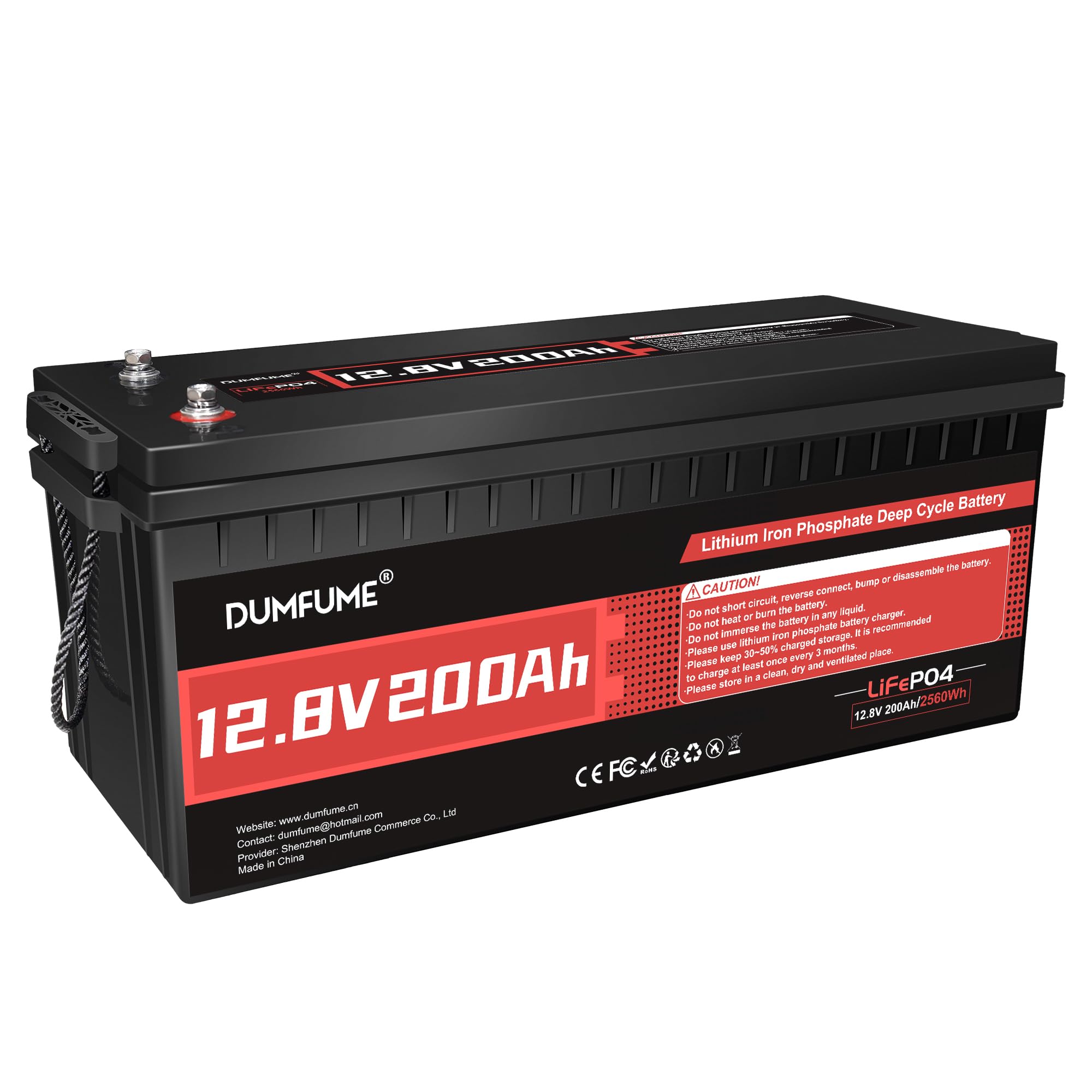
Double the capacity of the entry-level pick while staying compact enough for tight RV compartments.
The dumfume 200Ah is a 12V lithium battery that measures 21.06 x 8.07 x 8.46 inches with the handle and weighs 58.56 lbs. That’s a 200Ah capacity in a package that slides into RV compartments, camper vans, and truck campers without eating your entire storage bay. It’s a meaningful step up in energy storage from a 100Ah unit — enough to run a fridge for days or power a 2500W inverter.
What sets this one apart is the IP65-rated casing, which offers dust-tightness and resistance to water mist and wind, making it suitable for marine vessels and outdoor solar installations in variable weather. It also has a low-temperature cutoff that allows discharging down to -20°C (-4°F) for cold-weather use, while locking out charging below 0°C (32°F) to protect the cells. That’s a real advantage for four-season campers who don’t want to worry about winter damage.
The 200A BMS guards against overcharge, over-discharge, overcurrent, and short circuits, and the battery supports 4S4P expansion up to 16 units for a 40.96kWh storage system. Owners describe it as a “monster lithium battery” and note it has “lot of energy in a small package.” However, some customers note mixed battery life, so treat longevity claims with a bit of caution. It’s a versatile mid-range option balancing capacity, protection, and price.
Capacity champion: A 200Ah lithium that fits tight spaces and handles weather, with a 200A BMS for safety.
Heads-up: Some reviewers point out battery life is mixed, so monitor your first few charge cycles.
5. ECO-WORTHY 12V 280Ah Metal Case LiFePO4
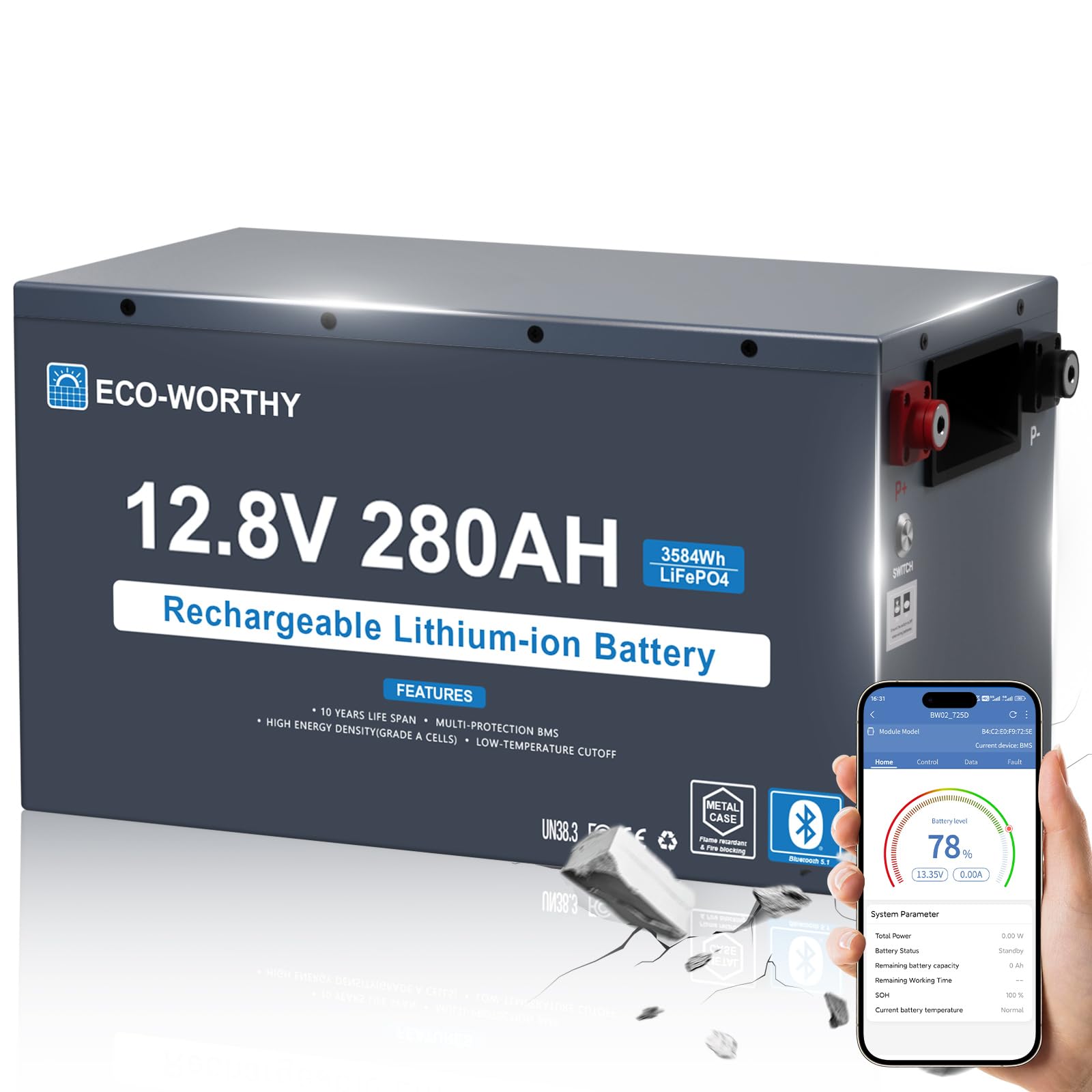
The big-capacity battery that lets you check your power from your phone, no wiring guesswork needed.
You can mount this ECO-WORTHY 280Ah LiFePO4 battery directly in your RV without a separate battery box, thanks to its rugged metal case with 4 mounting feet that handle road vibration and impacts. The metal enclosure also boosts fire safety and heat resistance, and the built-in 200A BMS (a battery management system that protects against overcharging and overheating) keeps it safe. It’s rated at 12.8V, so it delivers steady power for your motorhome’s systems.
The standout feature is Bluetooth monitoring. You can check voltage, capacity, and charge/discharge status in real time from your phone, which is a genuinely useful tool for tracking your power budget on a long trip. It also has a low-power on/off switch for one-touch cut-off during installation or maintenance, and low-temperature protection that automatically cuts off charging to protect the cells in cold weather.
Owners running two of these in a 560Ah parallel setup report flawless performance, and one verified the app shows about 279Ah when fully charged — close to the rated 280Ah. It powers a microwave, instant pot, and induction burner with a 2000W inverter, so it’s not just for lights and a fridge. The main consideration is the design; some units ship in two packages, and the Bluetooth range can be affected by the metal case acting as a shield. Weighing around 68.5 lb, it’s not light, but it’s the smart pick for power-hungry off-grid setups.
The Wins
- Bluetooth app shows live charge status on your phone
- Metal case means no separate battery box required
- 200A BMS handles high-draw appliances
Watch For
- Metal case can weaken Bluetooth signal range
- Batteries arrive partially charged (~25%) and need time before parallel wiring
Reach for it if: You want big capacity (280Ah) with phone-based monitoring and a safe metal enclosure for direct floor mounting.
Consider the size: At ~68.5 lb it’s heavy, so plan your installation route before you buy.
6. yeagulch 12V 314Ah LiFePO4 Battery
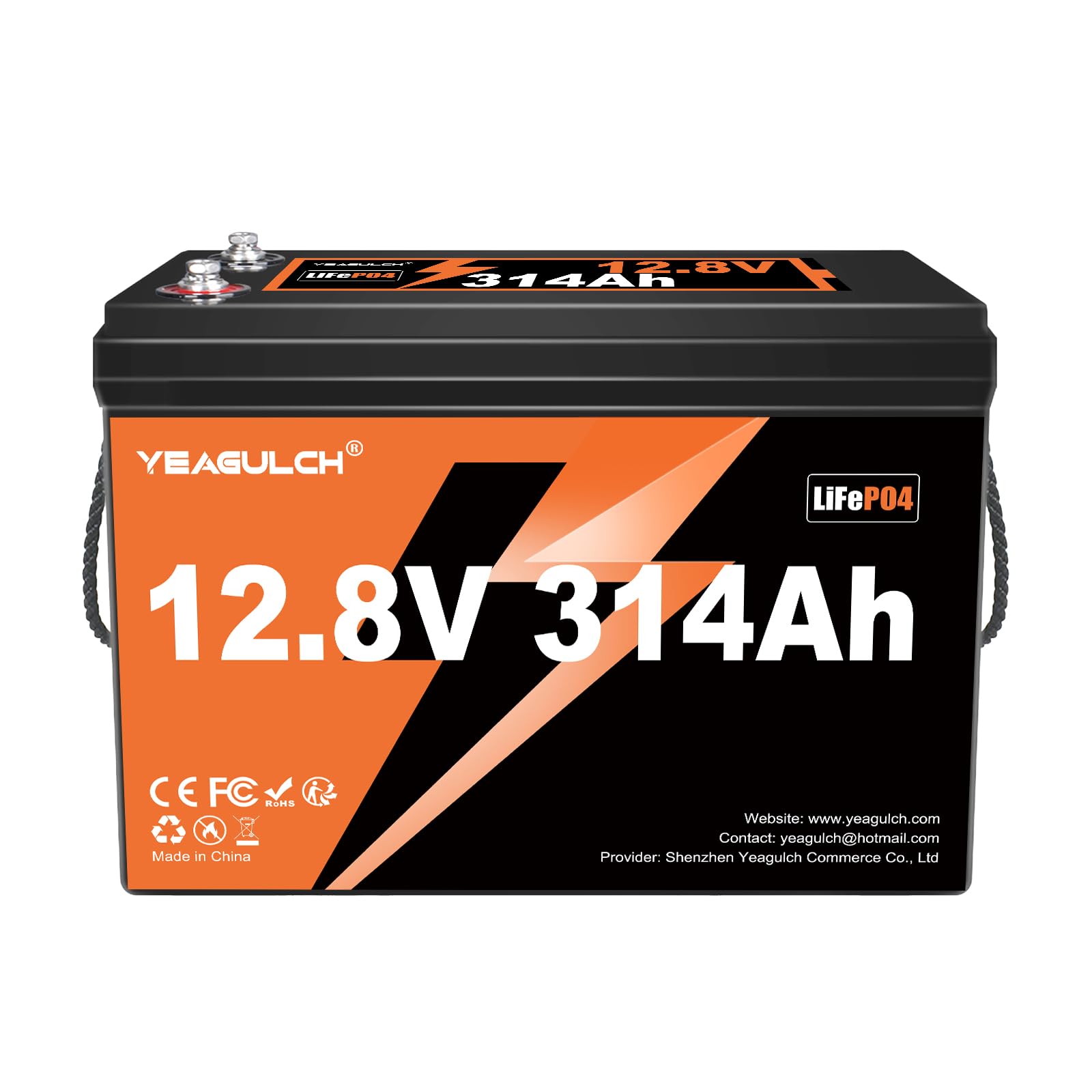
A high-capacity lithium pack rated for 6,000 cycles that keeps heavy appliances humming.
For owners who need serious energy reserves, the yeagulch 314Ah is a 12V LiFePO4 battery with a 200A BMS and an IP65 waterproof certification. It’s rated for approximately 6,000 charge/discharge cycles at up to 80% depth of discharge, which is designed to support daily solar or RV use far longer than standard lead-acid batteries. At 57.3 pounds, it’s roughly one-third the weight of many lead-acid batteries at the same capacity, helping you save space and reduce load.
The 200A BMS provides multiple protections against overcharge, over-discharge, overcurrent, and short circuits, plus high/low temperature cut-off. It automatically halts charging or discharging when temperatures exceed critical thresholds, so the cells stay protected in extreme weather. Shoppers say it runs an air conditioner and powers an 80lb trolling motor on a pontoon, with one noting it delivers an extra 10% speed boost due to the higher lithium voltage.
With 314Ah capacity, you can run your motorhome’s furnace, fridge, and lights for multiple nights without shore power. The IP65 rating (meaning it’s protected against dust and low-pressure water jets) gives you confidence in damp or dusty environments. However, this battery is not for starting gasoline engines—it’s built for deep-cycle energy storage, not high-cranking amps. Full-time or frequent off-grid users will find it a sturdy, weatherproof choice.
Powerhouse: A 314Ah lithium that runs AC units and trolling motors, with a 200A BMS and IP65 weather resistance.
Don’t use it for: Starting engines or high-cranking-amp loads; this is strictly for energy storage.
7. Litime 12V 230Ah Deep Cycle LiFePO4 Battery
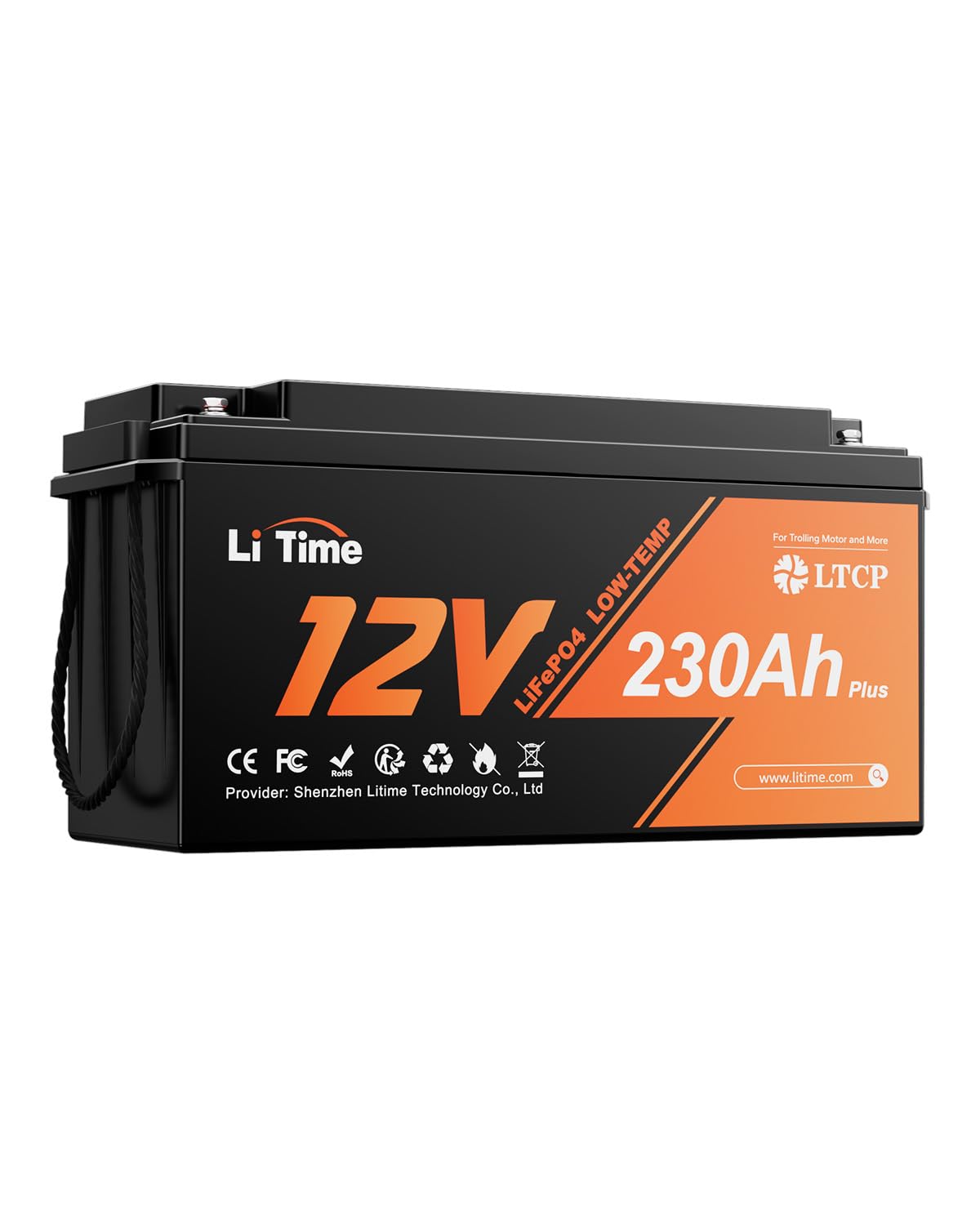
The Group 4D drop-in that gives travel trailers a full week of off-grid freedom.
The Litime 230Ah is a 12V lithium battery designed to fit Group 4D boxes — a common size in travel trailers and campers — while weighing only 45.98 lbs, about one-third of a lead-acid equivalent. That makes it manageable to install and easy on your payload. It delivers 4,000+ cycles at 100% depth of discharge, which the manufacturer rates as a 10-year lifetime, far outlasting AGM batteries that typically last 3 years with 200-500 cycles.
It has a built-in 200A BMS with 20+ safeguards, including advanced low-temperature protection that pauses charging below 0°C (32°F) to protect the cells. The IP65 waterproof rating means it handles damp environments, and the battery supports expansion up to 16 units (4P4S) for a 48V 920Ah system with a 47.1kWh max output. Owners running two in parallel report a full week off-grid, with one noting it powers their fridge for 6-7 months of the year.
The Bluetooth app shows charge rate and discharge rate, which owners love for monitoring, though some report the app can be finicky and requires location permissions. The main switch is a nice touch for cutting power during installation. If you’re converting from lead-acid, note that this battery can overwhelm an old trailer charger, so you may need a charger upgrade to get the full benefit. For serious RVers balancing capacity, weight, and smart features, this is a top contender.
Why It Shines
- 45.98 lb weight fits Group 4D boxes with ease
- 4,000+ cycles at 100% DOD means a 10-year life
- IP65 waterproof for damp environments
Things to Know
- Bluetooth app can be finicky and needs location access
- Old RV chargers may need an upgrade to charge it properly
Who it’s for: Travel trailer owners who want a true drop-in 230Ah lithium with smart monitoring and a 10-year design life.
Plan ahead: Budget for a charger upgrade if your current converter is old lead-acid spec.
8. Power Queen 12V 300Ah LiFePO4 Battery
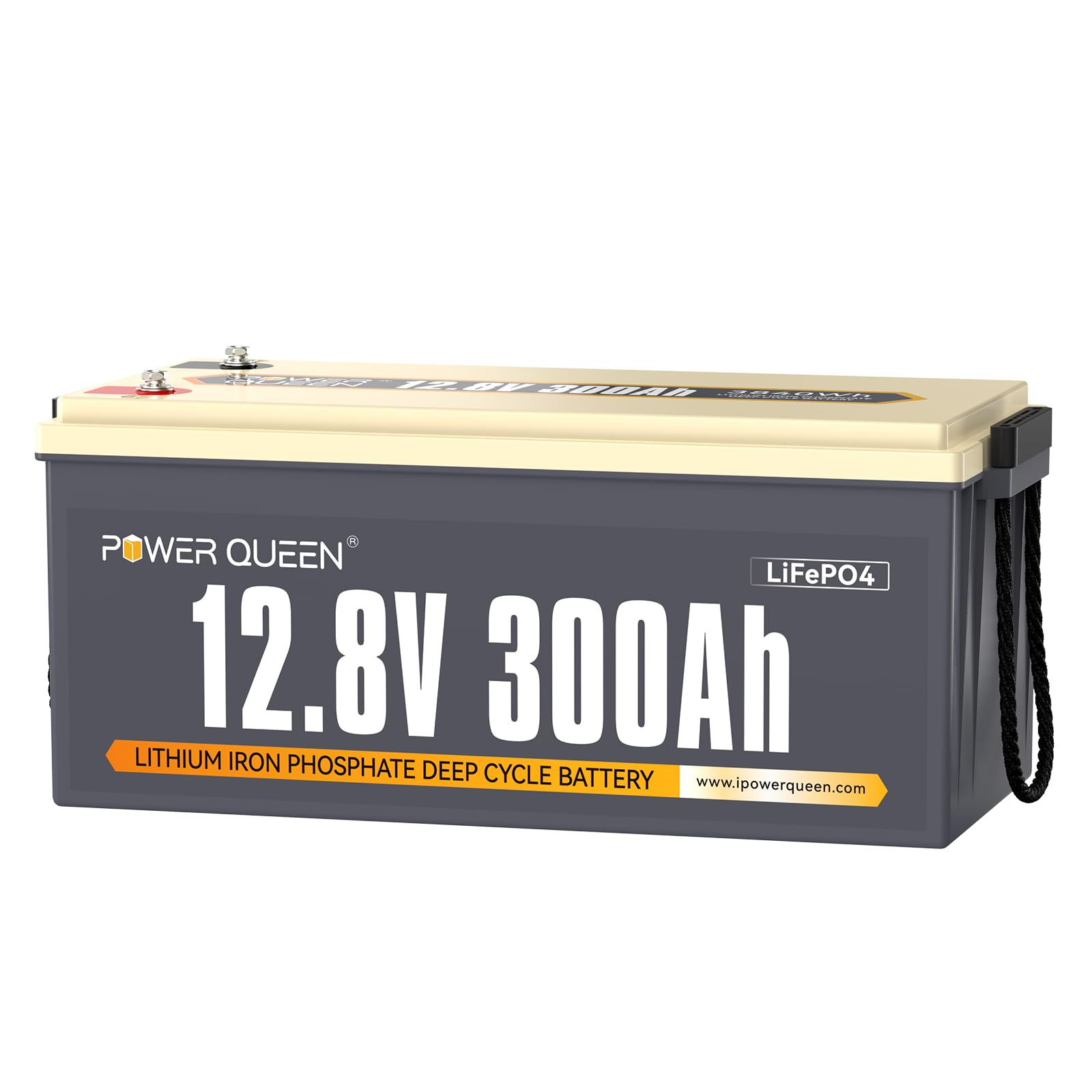
Triple the capacity of the entry pick, with 3840Wh of stored energy for true off-grid living.
The Power Queen 300Ah is a serious energy bank for motorhome owners who want to run big loads without shore power. It stores 3840Wh of energy and delivers 2560W of load power, which is enough to run a fridge, furnace, lights, and even a microwave for extended periods. It uses Grade-A LiFePO4 cells with an EV-grade 200A BMS that protects against overcharge, over-discharge, over-current, and short circuit — safer, steadier power for RV, marine, solar, and backup loads.
This battery weighs about one-third of a same-capacity lead-acid unit, giving you 61.14Wh/lb—so you get plenty of energy per pound. It’s rated for 4,000 cycles at 100% depth of discharge, which means a 10+ year design life for full-time RV use. You can also expand it with 4P4S (a parallel-series configuration) to scale up to 40.96kW for a whole-home backup system. One owner hooked up an inverter and ran a battery charger for over 50 hours, showing the stored power depth; another installed it on a 2025 Cherokee Gray Wolf 25RRT and was very happy with the fit.
The trade-off is size and weight — at 9.33″D x 20.55″W x 8.58″H and 59.9 lb, measure your compartment before buying. It also has no built-in heaters, and the BMS may block charging in freezing temperatures, so it’s best for climates above freezing. For those who need maximum capacity in a single battery that can expand later, this is a powerful and reliable workhorse.
Serious capacity: A 300Ah lithium with 3840Wh of energy and a 200A BMS, built for full-time off-grid use.
Cold caveat: No built-in heaters, and freezing temps can block charging — keep it in a heated space.
9. VATRER POWER 12.8V 460Ah Self-Heating LiFePO4
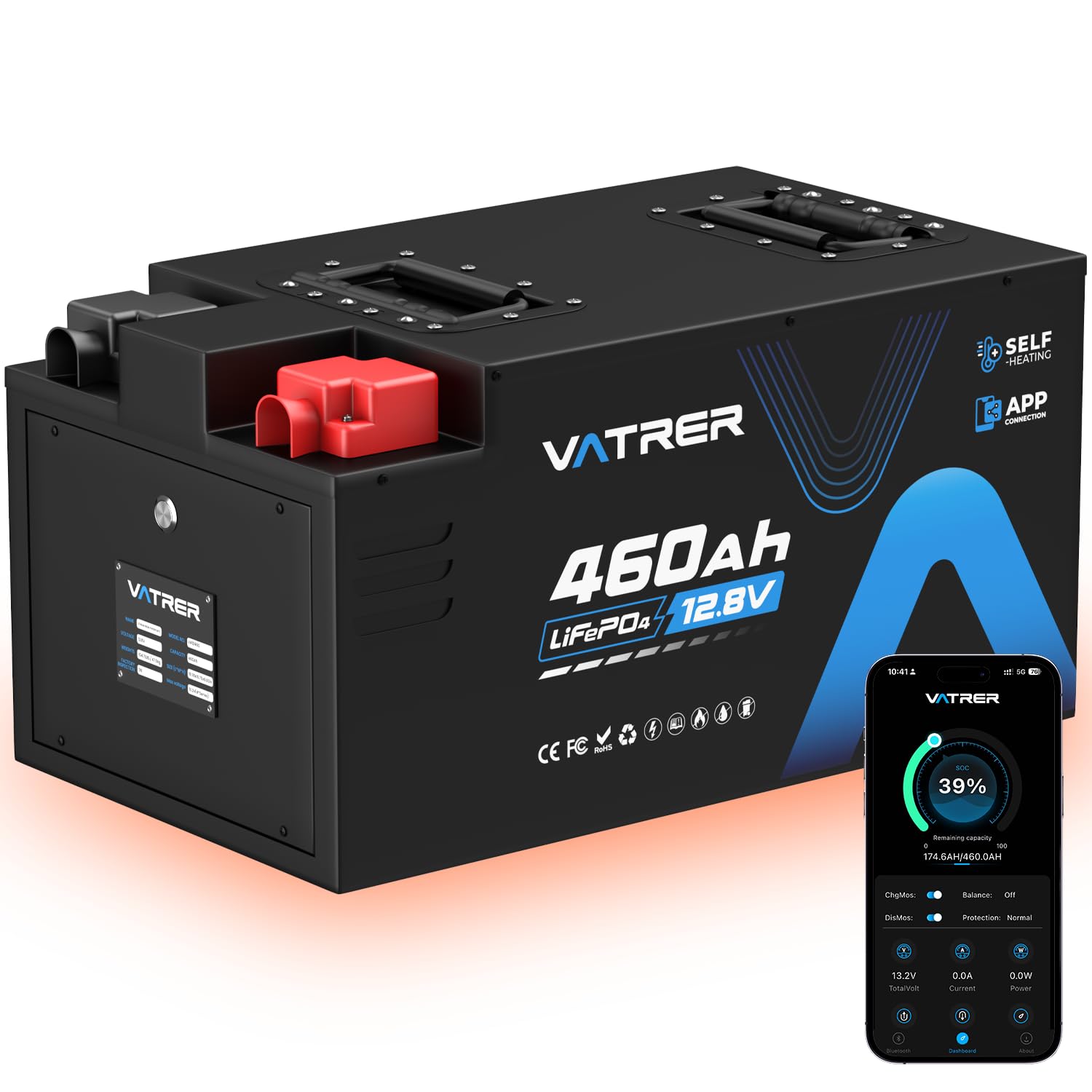
The self-heating giant that turns a motorhome into a true winter-ready off-grid home.
The VATRER POWER 460Ah is the ultimate battery for serious overlanders and full-time RVers. It has a capacity of 460Ah with 5880Wh of usable energy, which is equivalent to the energy of 5 x 100Ah batteries — but it takes up only 1.1ft³ of space. It’s rated for 5,000+ cycles and delivers a max of 3840W of load power through a 300A BMS, so it can comfortably run air conditioners, TVs, and ovens.
The defining feature here is automatic self-heating. When the battery is connected to a charger at temperatures from -4°F to 41°F, the BMS activates an internal heater. Once the battery reaches 41°F, heating stops and charging begins normally. That means you can charge this battery in freezing conditions — a huge advantage for winter campers who would otherwise be stuck with a dead lithium pack.
The upgraded 300A BMS (battery management system) and the high-quality SPCC (cold-rolled steel) case provide sturdy protection and durability. A built-in app module lets you monitor current, voltage, temperature, and cycle life in real time. Owners who tested it for a year report zero issues, and one capacity test discharged 477Ah—exceeding the rated 460Ah. The Bluetooth signal is a bit weak because the metal case acts as a shield, but the app dashboard is intuitive. This premium investment delivers maximum autonomy and cold-weather reliability.
The Big Wins
- Self-heating lets you charge down to -4°F
- 460Ah capacity replaces 5 x 100Ah batteries in 1.1ft³
- 300A BMS powers air conditioners and ovens
The Cost
- 104.7 lb weight is a two-person lift
- Premium price point for maximum capacity
For the serious boondocker: This is the pick for winter camping and long off-grid stays where self-heating and huge capacity are non-negotiable.
Budget check: It’s the most expensive battery here, so it’s best for those who truly need the autonomy, not weekend hookup campers.
Understanding the Specs
Capacity (Amp Hours)
Amp hours (Ah) tell you how much energy the battery can store. A 100Ah battery can deliver 1 amp for 100 hours, or 10 amps for 10 hours. For motorhomes, higher Ah means more nights of boondocking without needing to recharge. Keep in mind that you should only drain about 50% of a lead-acid battery’s capacity, but you can safely use 80-100% of a lithium battery’s capacity.
Battery Management System (BMS)
A BMS is the battery’s internal safety computer. It monitors voltage, current, and temperature to protect against overcharge, over-discharge, overcurrent, and short circuits. A 100A or 200A BMS rating tells you how much continuous current the battery can safely deliver, which matters when you’re running high-draw appliances like a microwave or air conditioner.
FAQ
How many amp hours do I need for my motorhome?
What is the difference between AGM and lithium batteries?
Can I charge a lithium battery with my existing RV charger?
Why is the weight of the battery important?
What is a BMS and why does it matter?
Can I use a motorhome battery as a starting battery for my engine?
How long will a LiFePO4 battery last?
What happens if the temperature drops below freezing?
Final Thoughts: The Verdict
For most motorhome owners, the motorhome battery winner is the Power Queen 100Ah because it nails the essential balance of light weight, safety, and long life at a price that makes sense. If you want a huge capacity reserve with phone monitoring, grab the ECO-WORTHY 280Ah. And for winter campers who refuse to let cold weather stop them, the VATRER POWER 460Ah is the one to reach for.
How We Picked
We do not accept paid placement. Every pick is matched to a real buyer and a real use-case; we do not hands-on test units.
Sources & Methodology
Specifications: manufacturer listings and product documentation. Review insights: verified customer reviews, as of August 2026. Pricing: not shown on this page (it changes often); check the current price via the retailer link.
As an Amazon Associate, Trending Car earns from qualifying purchases. This does not affect which products we feature.