
Our readers keep the lights on and my garage snacks stocked. As an Amazon Associate, I earn from qualifying purchases.
Specs are compiled from manufacturer listings and verified buyer reviews and can change over time — please confirm the key details on the product page before buying.
You check your tire pressure only when you remember, but a slow leak can turn a smooth curve into a wobble at speed. A motorcycle TPMS (a tire pressure monitoring system) shows real-time pressure and temperature on your handlebars or phone, so you get a heads-up before a leak becomes a hazard. Choose a bar-mounted display for at-a-glance readings, a phone app for minimal hardware, or an all-in-one navigation screen for integrated data.
I’m Min Islam — the founder and writer behind Trending Car. This guide is built by comparing the manufacturers’ published specifications and the patterns across verified customer reviews, so you get each pick’s real strengths and trade-offs instead of marketing spin.
Every pick here was chosen because real owners confirm it delivers live readings you can trust, and the motorcycle tpms lineup below covers eight distinct ways to keep your tires honest on every ride.
Our Picks at a Glance
How To Choose The Best Motorcycle TPMS
Your riding style determines if you need a bar-mounted display or a phone-based app. If you never want to glance at your phone while moving, a dedicated display on the bars keeps your eyes on the road. If you already use your phone for GPS, an app-based sensor set adds minimal clutter and keeps everything in one screen.
Check the battery and power story first
The display and the sensors each have their own power needs. Some displays run off a USB charger you plug in as needed, while others hardwire to your bike’s 12V. Sensor batteries can last from weeks to roughly two years depending on the design, and whichever you choose, you want batteries you can actually replace instead of a sealed unit you toss.
Know your valve stems before you buy
External sensors screw onto your existing valve stems, which makes installation simple, but it demands clearance. If your rear brake caliper sits close to the valve, a protruding sensor can collide with it at speed. Check the angle of your valve stems and the space around them before committing to a screw-on design.
Match the alert style to your gear
Some systems alert you with beeps from a small display, others push notifications to your phone, and a few even send voice warnings to a Bluetooth helmet headset. Match the alert type—beep, phone notification, or helmet voice—to your riding environment so you notice it over road noise.
Quick Comparison
| Model | Best For | Display Style | Max Pressure | Water Rating | Amazon |
|---|---|---|---|---|---|
| FOBO Bike 2★ Best Overall | App-first riders | Smartphone | Not specified | Not specified | Amazon |
| Wonsidary W622Best Value | Smart display + TPMS | 6.25″ Touchscreen | Not specified | IP67 | Amazon |
| Tenbaba 7″Premium Pick | Full navigation + TPMS | 7″ Touchscreen | Not specified | IP69K | Amazon |
| GoolRC TPMS | Budget bar display | LCD Monitor | Not specified | Not specified | Amazon |
| EOHMAK M5 | Basic reliable monitor | Oversized LCD | 0~6.6bar | Waterproof | Amazon |
| KEMIMOTO 2-Pack | Multi-bike phone alerts | Smartphone | Not specified | IP67 | Amazon |
| B-Qtech TPMS | Compact phone-based | Smartphone | 0–116 PSI | IP67 | Amazon |
| OBEST M3 | USB-C bar display | Color LCD | Not specified | IP67 | Amazon |
| FOBO Bike LITE | QR setup minimalists | Smartphone | 116 psi (800 kPa) | Not specified | Amazon |
In‑Depth Reviews
1. FOBO Bike 2
Our pick — over 4★ from 2,000+ verified ratings; the strongest balance of quality and price.
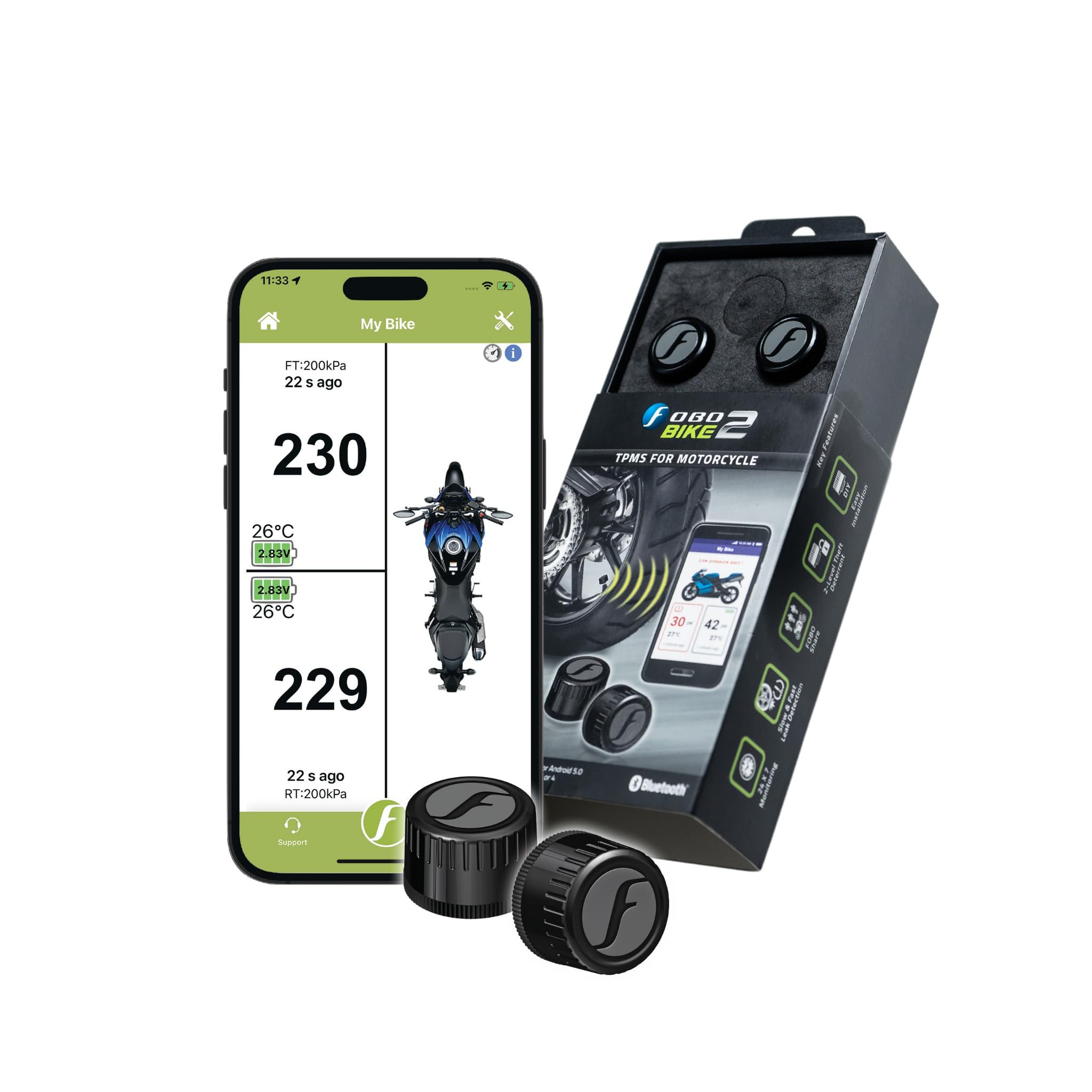
The app-first system that turns your phone into a full tire dashboard.
FOBO Bike 2 skips the separate display entirely, sending tire pressure and temperature straight to your phone over Bluetooth 5.0. With no receiver to mount and no tools for installation, you simply pair through the FOBO app and start monitoring, which is why ease of setup is the second-most-praised thing about it across the review history.
Accuracy is the headline here — buyers report it lands within 0.1–0.3 psi of a trusted gauge, which is remarkable for a wireless sensor. It keeps watching your tires 24/7, even when parked, and fires instant alerts for low pressure, slow or fast leaks, and abnormal temperature changes. The stainless steel sensor body weighs just 7.6 g, so it adds almost nothing to your valve stem.
The trade-off is the app’s appetite for location tracking and the occasional sensor pairing hiccup, which some owners call out. The sensors aren’t the prettiest addition to a wheel, but the functionality is what wins people over here, hands down.
What Owners Love
- Accuracy within 0.1–0.3 psi of a trusted gauge
- Background alerts on low pressure without opening the app
- Sensors stay leak-free across multiple bikes
Where It Falters
- App demands constant location tracking
- Pairing can occasionally be finicky
- Watch for sensor seal wear over time
Reach for this if: you live on your phone and want zero extra hardware cluttering your bars.
Look elsewhere if: you want a glanceable screen without pulling out your phone mid-ride.
2. Wonsidary W622
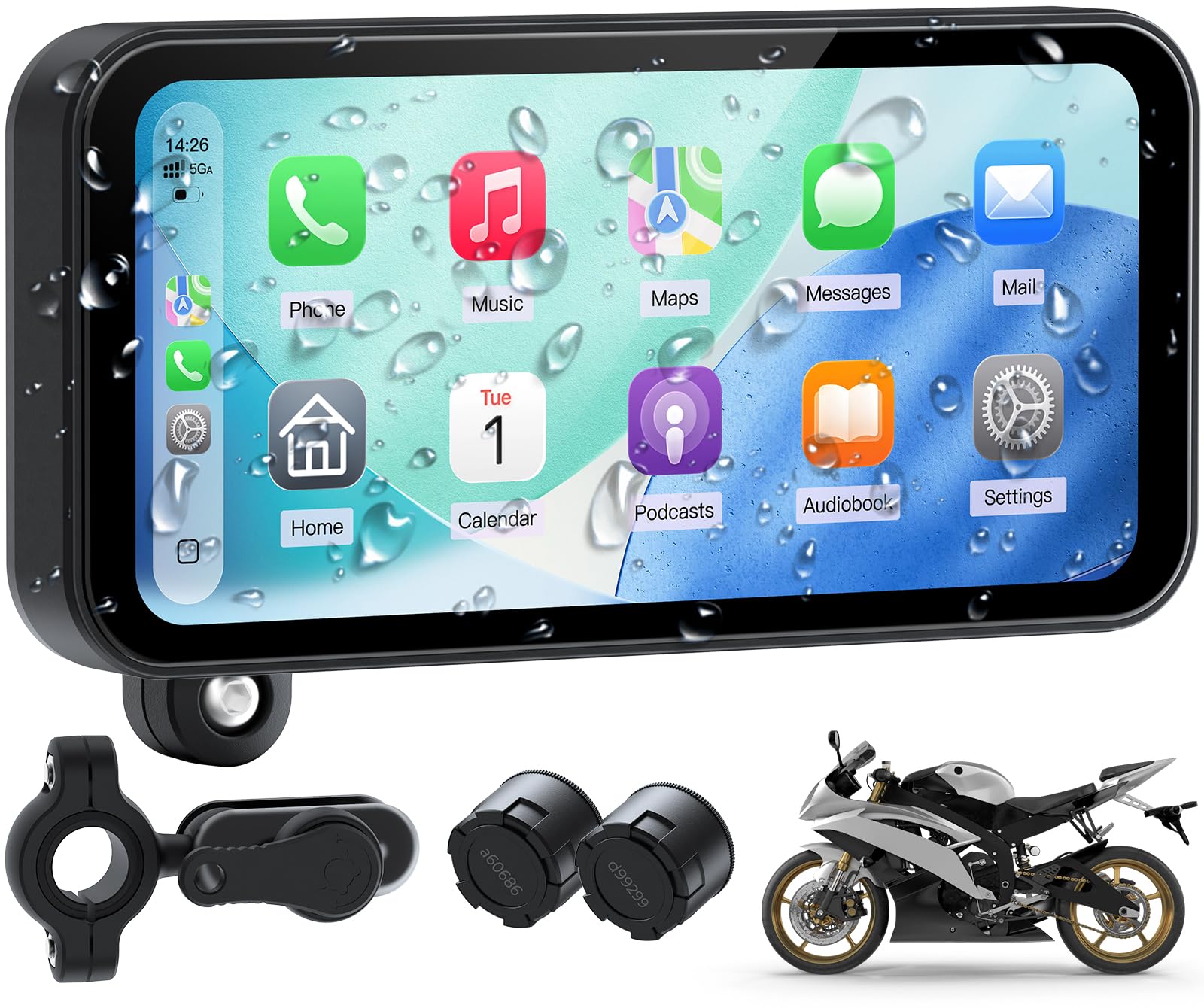
A 6.25-inch smart screen that bundles navigation, music, and tire monitoring into one bar-mounted unit.
The Wonsidary is the all-in-one answer for riders who already wanted CarPlay and now get tire monitoring as part of the deal. It runs wireless Apple CarPlay and Android Auto, so your maps and music live on a bright touchscreen while the built-in TPMS tracks both tires on the same display. Two sensors are included in the box for front and rear.
Real owners call it nearly identical to a comparable CarPuride unit at a significant discount, which is high praise for value. The IP67 waterproofing means it survives downpours, and the auto-brightness sensor adjusts the screen for day and night riding. Power it either by hardwiring the ACC 12V/1A line or plugging into a 5V/2.5A USB source.
One rider noted the bar mount didn’t fit their GSX8R from the start and used an alternate attachment, so check your bar setup if you ride something with unusual geometry. It operates in extreme cold down to -4°F and heat up to 158°F, making it genuinely all-weather.
Smart Display, Smart Buy: you get a full navigation screen with live tire data for less than most standalone display-only TPMS units cost.
The Fit Caveat: handlebar mounting hardware may not suit every bike’s bar diameter without a workaround.
3. Tenbaba 7″ Motorcycle Display
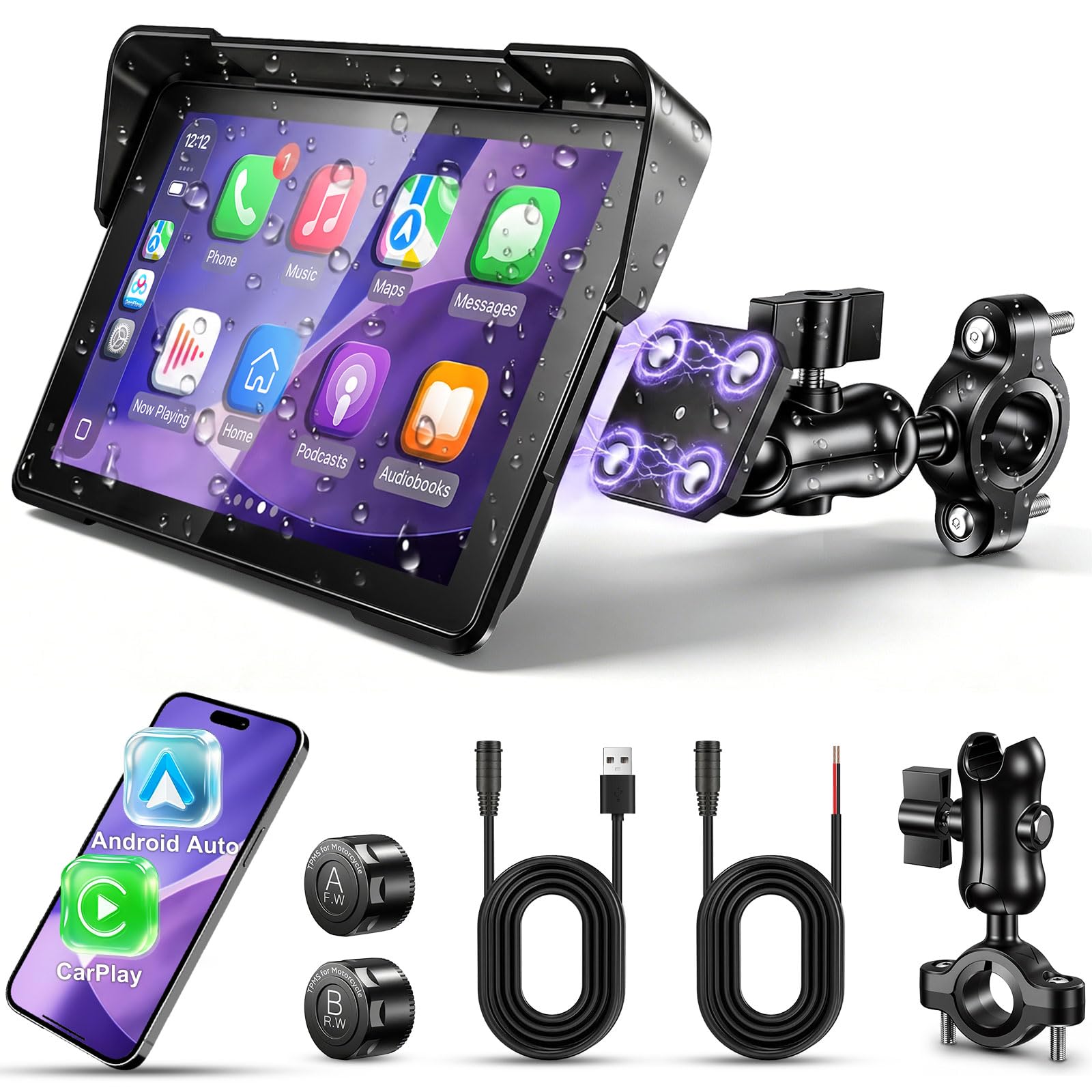
The largest screen on this list, pairing wireless CarPlay with live TPMS data for riders who want everything visible.
Tenbaba brings a 7-inch HD touchscreen with a 60Hz refresh rate that stays readable in direct sunlight, and it works even with gloves on thanks to the 2.5D glass. Beyond tire pressure, you get wireless CarPlay and Android Auto over Bluetooth 5.2, plus GPS, calls, music, and voice assistant access — all from the handlebar mount.
The TPMS is built in, so you get live tire data right on the big display rather than a separate gadget. Its IP69K waterproof rating is the highest on this list, protecting against heavy rain, mud, and even pressure washing. A 4-point magnetic quick-switch mount lets you pull the whole unit off in seconds or move it between bikes.
Audio latency is the recurring complaint, and it has no speaker of its own, so sound routes through your phone. It must be hardwired to the battery since there’s no 12V plug, which limits portability. For a do-it-all cockpit upgrade, the screen brightness and glove-friendly touch win riders over.
Choose this for: a full navigation and tire-monitoring cockpit on a big, sunlight-readable screen.
Accept the catch: the hardwire install and slight audio delay are the price of all that screen real estate.
4. FOBO Bike LITE
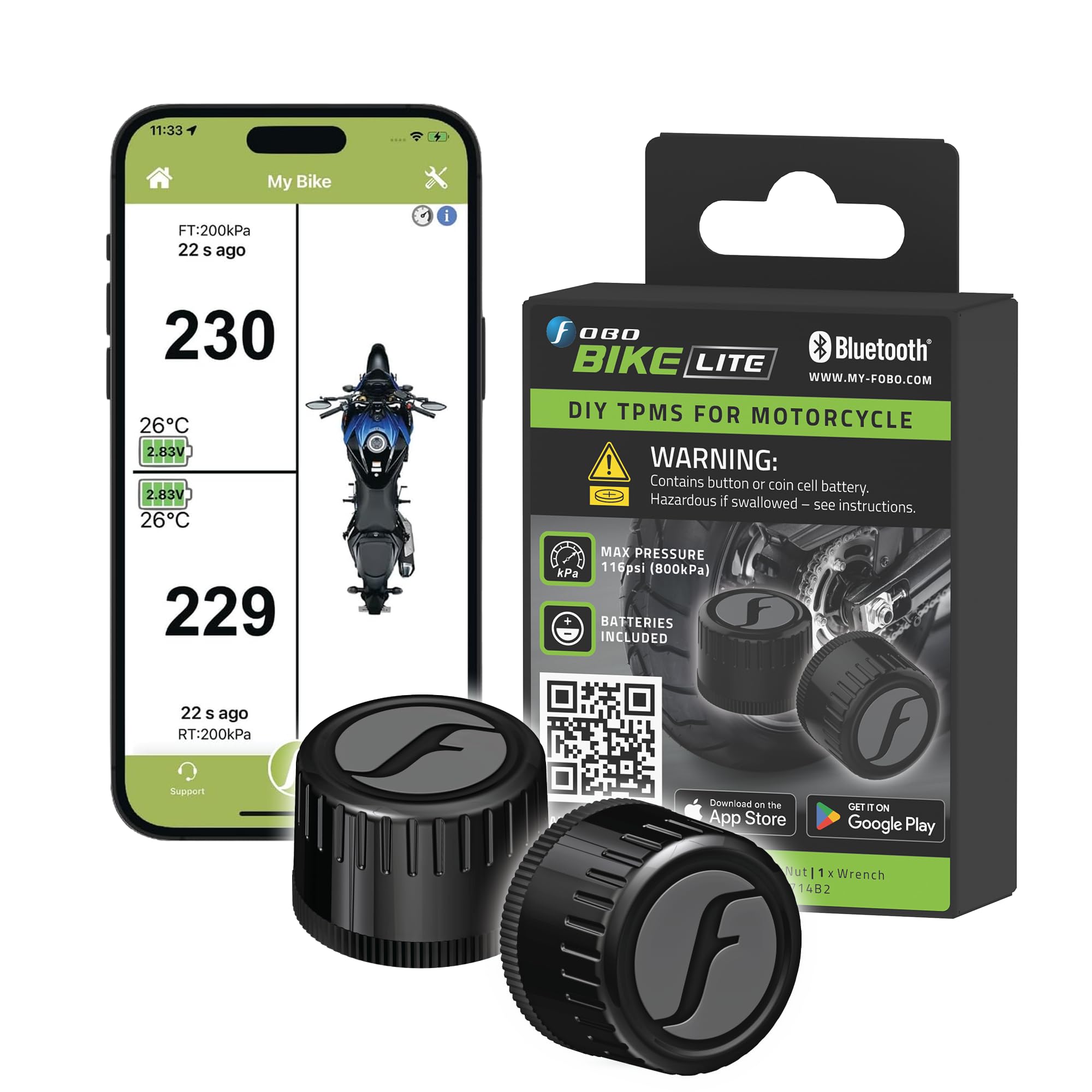
The simpler, cheaper sibling of the Bike 2 that pairs via QR code and supports up to 116 psi.
FOBO Bike LITE keeps the phone-based approach of its bigger brother but strips it down to the essentials: scan the QR code on each sensor with the FOBO app and you’re paired, no tools involved. It supports a maximum pressure of 116 psi, which covers most motorcycle and scooter applications comfortably, and batteries are included right in the box.
Compatibility is what riders praise most here — owners confirm it works cleanly with iPhone and Apple Car Play, and one even checks pressure on all three bikes from inside the house. The system runs 24/7 tracking and sends three-level alerts: haptic, visual, and audio, so you know the moment pressure or temperature shifts. It also detects both slow and fast leaks.
The honest limitation is that you have to unscrew the sensor to add air, which makes topping up a two-step affair. An occasional unit arrives with a weak sensor battery, though the customer service response gets high marks when that happens.
easy Setup: QR pairing gets you running in minutes, and the app works well with Apple Car Play for riders already in that ecosystem.
Plan Around It: removing the sensor for every inflation is the trade-off for that tiny, tool-free footprint.
5. OBEST M3
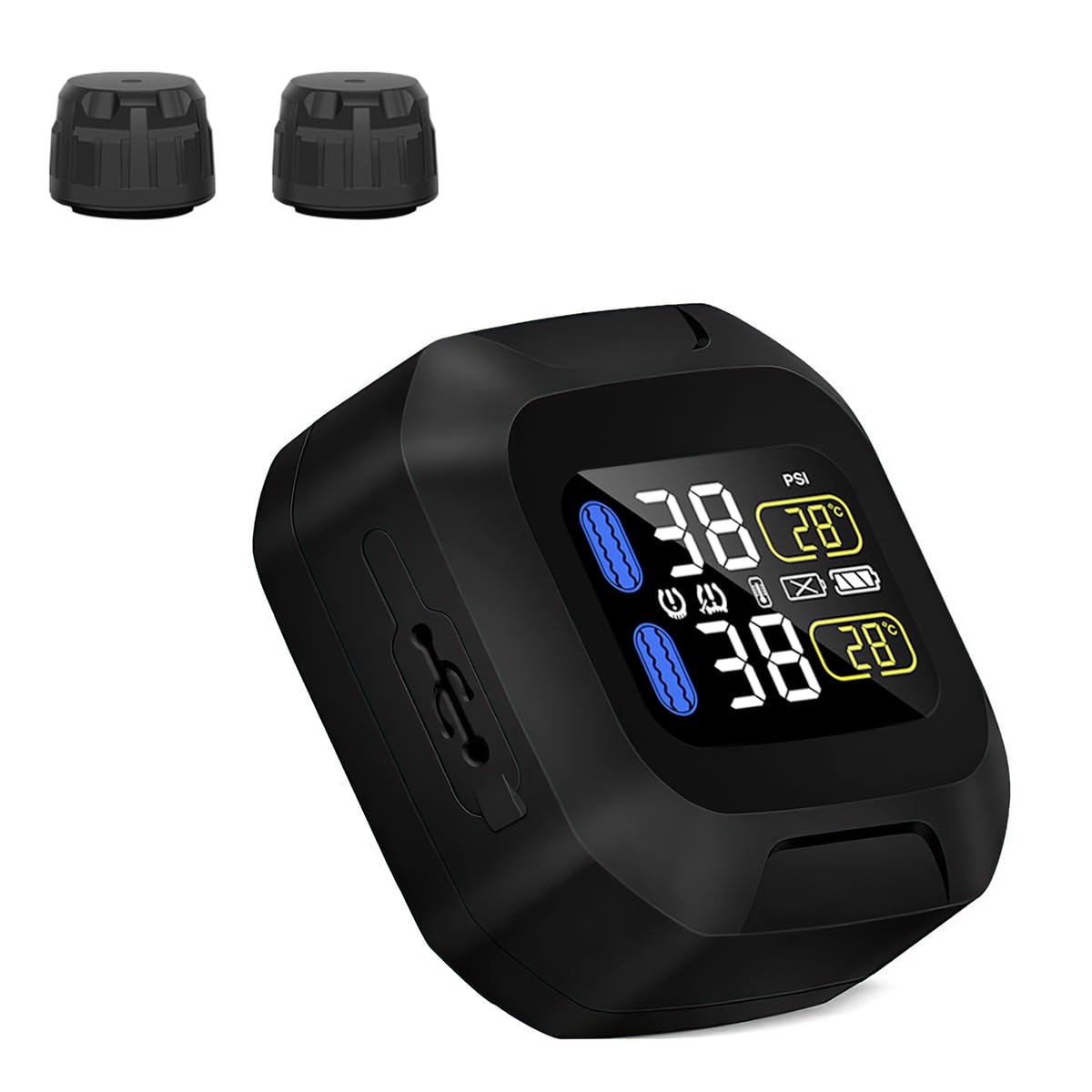
A dedicated color display with USB-C power that won a five-way shootout against rival systems.
The OBEST M3 is for riders who want a real screen on the bars, not another app. Its high-definition LCD shows color-coded tire data, and the display runs automatically when you ride. Accuracy is the thing owners praise most, with one verifying a 33 PSI reading against a gauge and the whole package earning the title “best of 5 tested” from a rider who compared it directly against competitors.
Build quality punches above its class: a metal insert mount, steel clamp, and thicker nuts than the usual plastic fare. It charges over USB-C rather than the older micro-USB, and the sensors are pairable, even supporting third-party units if you ever need a spare. The IP67 waterproofing handles rain without a second thought.
The biggest warning here is fitment — one owner reported a sensor hitting the brake caliper on a 2009 Harley Street Glide at highway speed, so measure your clearance carefully on bikes with tight rear calipers. A few units also ship with older sensor batteries that die quickly.
Grab this for: a bright, color bar display with USB-C convenience and sensor accuracy that beat four rivals in a direct comparison.
Check your rear clearance: tight caliper bikes need careful valve-stem measurement before you commit.
6. EOHMAK M5

The no-frills bar monitor that caught an 8 psi loss mid-ride and earned a second order.
EOHMAK M5 is the budget-friendly workhorse with an oversized LCD display showing pressure, temperature, and time all at once. It measures from 0 up to 6.6 bar, and the audiovisual alarm fires on leaks, low pressure, high pressure, or high temperature. One owner credits it with saving the day when the rear tire lost 8 psi over 20 miles — a loss that would have gone unnoticed until it was too late.
Battery life genuinely surprises people, with riders reporting the monitor runs for a long stretch and the sensor batteries are replaceable when they finally give out. The display is large and bright, and the system auto-powers on when you start riding. It’s waterproof and dustproof, ready for rain or shine.
The honest downsides are the finicky pairing and a menu system that requires patience — setting a custom limit can take many button presses. The mount fits 3/4–1 inch bars only, so the 1.25-inch bar crowd is left out. An unlucky few report units that drift and report stuck pressure readings, so consistency varies by unit.
Why Riders Stay
- Accurate pressure versus standalone gauges
- Surprisingly long battery life on both monitor and sensors
- Caught a real 8 psi rear-tire loss over 20 miles
Where It Tests You
- Menu setup needs many presses and patience
- Mount fits 3/4–1 inch bars only, no 1.25-inch support
- Pairing is tricky and instructions are poor
Pick this if: you want a cheap, reliable safety net on standard-diameter bars and don’t mind a learning curve.
Pass it by if: you ride fat 1.25-inch bars or want a system you can configure in under a minute.
7. KEMIMOTO 2-Pack
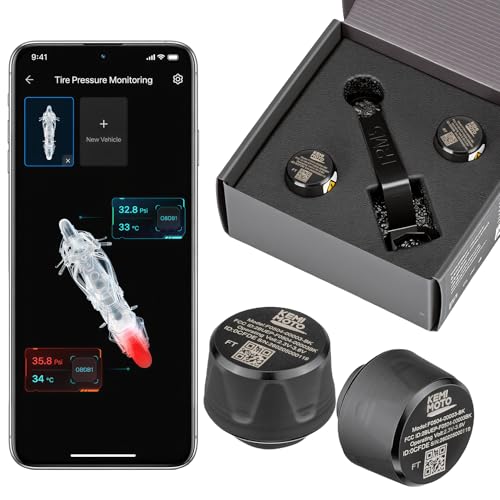
A sensor-only set with Bluetooth 5.2, voice alerts, and a two-year battery rated for long tours.
KEMIMOTO skips the display entirely, shipping just two external sensors that talk to your phone over Bluetooth 5.2. Accuracy is verified in-house at ±2 PSI and 2°C variance, and the sensors wake up once you pass about 12.4 mph for roughly 20 seconds. It’s powered by a Freescale chip for low power draw and stable transmission.
The battery story is the standout: genuine cells rated for approximately two years of continuous use, factory-tested and UL1642 certified for safety. That means no mid-tour surprises when you’re miles from a spare. The app supports up to 50 vehicles, ideal for multi-bike owners running group rides, and sends alerts to your smartphone, helmet headset, and smartwatch simultaneously.
Notably, one owner called it the best Bluetooth TPMS they’d tried for accuracy, praising the voice warnings that repeat until you address the issue. The catch is that sensors only wake with movement, so you can’t check pressure before a ride while the bike sits still. Also, the protruding sensor design can hit parts on some Harleys with stock mag wheels, so clearance is critical.
Set-and-Forget Power: a two-year battery rating makes this the lowest-maintenance option for riders who hate fiddling with charging.
Pre-Ride Blind Spot: you must roll before sensors wake, so morning pressure checks need a short ride first.
8. GoolRC TPMS

The entry-level LCD monitor with pre-connected front and rear sensors for fast e-bike and scooter fitment.
GoolRC offers the classic standalone monitor at the lowest tier, with a digital LCD display and two external sensors that come pre-marked front and rear. Riders report consistent readings, sensor batteries lasting weeks, and a unit that keeps running all day. It’s especially popular on e-bikes with 20×4 fat tires, where pressure directly affects mileage and leak prevention.
The full alarm suite covers leakage, low and high pressure, high temperature, low power, and no signal. There’s also a time display built in, plus settings for pressure units, thresholds, and 12-hour or 24-hour time formats. The wireless transmission and bracket mount mean no wiring to run.
Durability is the honest concern — buyers describe it as not a forever item and express doubt about build quality. The mounting clamp only fits thin bars and has broken after a couple of rides on at least one larger bike. Setup requires reading extremely small print, so bring your glasses.
What Works
- Pre-connected sensors marked front and rear
- Consistent readings with weeks-long sensor battery life
- Full-day display runtime on USB charge
What Worries
- Mounting clamp fits thin bars only and can break
- Tiny print makes setup a struggle
- Overall build feels less durable than pricier picks
Best for: e-bike and scooter riders who want a cheap, easy monitor without phone dependency.
Proceed with caution: the flimsy mount and fragile build mean it’s best on gentle roads and thin bars.
9. B-Qtech TPMS
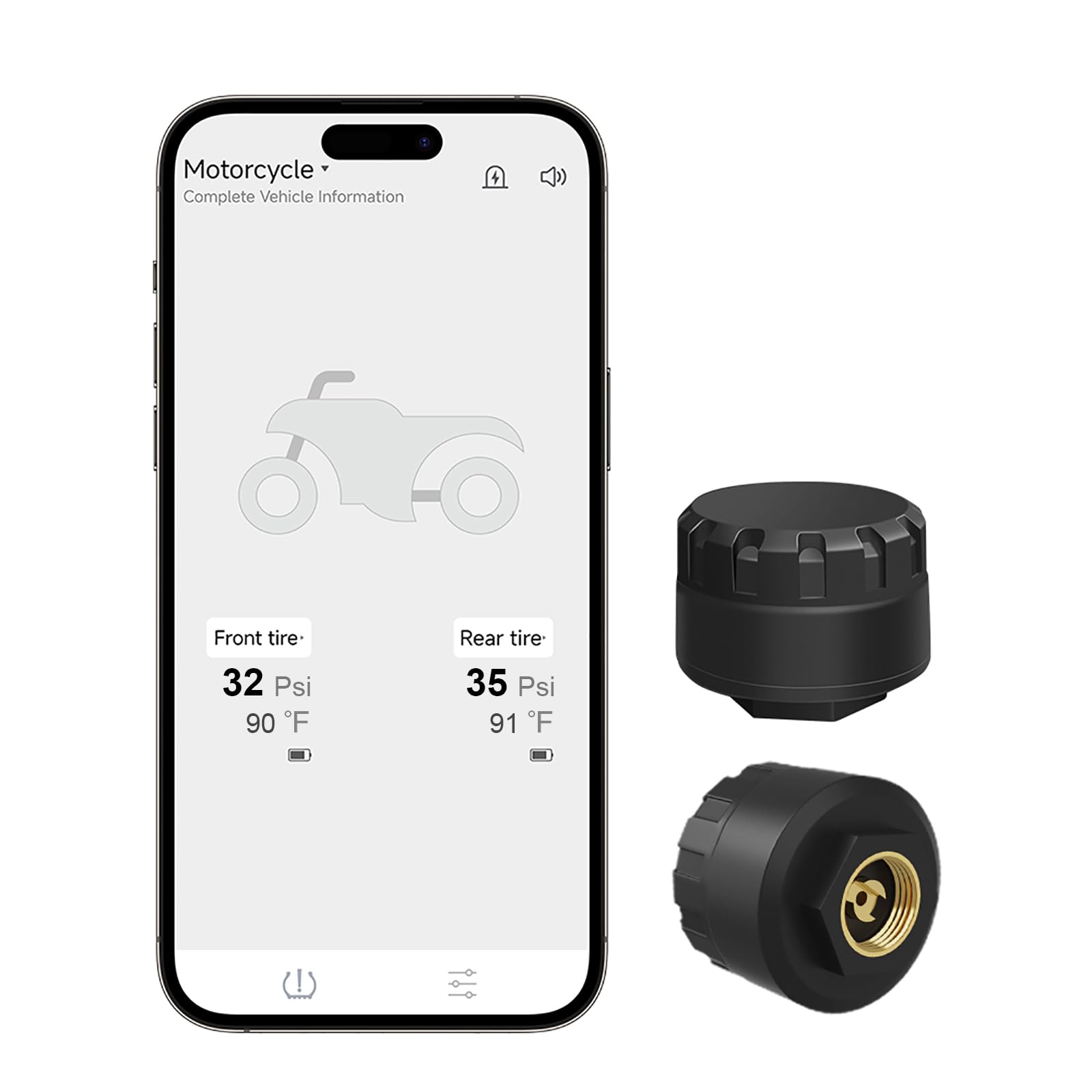
A featherweight phone-based system with ±1.5 PSI accuracy and a 15-minute DIY install.
B-Qtech is the ultra-compact option at just 1 ounce for the sensor set, relying entirely on a smartphone app rather than a display. It measures from 0 up to 116 PSI, which is the widest declared range among the phone-based picks here, and claims ±1.5 PSI accuracy. The 6-in-1 alarm suite covers leakage, low and high pressure, high temperature, low battery, and sensor faults.
Installation genuinely takes about 15 minutes with the included tool kit, and the IP67 waterproof sensors handle weather without issue. The app lets you adjust pressure units between PSI, BAR, and kPa, and set customizable alerts. Sensor batteries are user-replaceable, keeping maintenance costs low.
The app is where opinions split — some owners pair it via QR code and love it for an RV running 95–110 PSI tires, while others find the update lag frustrating and the English translation rough in places. For a basic motorcycle setup it works fine, but riders wanting instant refreshes may find it slow.
Featherweight Fit: at 1 ounce for the sensors, you’ll forget it’s on the valve stem until it saves you from a leak.
App Refinement Needed: translation quirks and slow updates make it better for casual monitoring than precision work.
Understanding the Specs
Accuracy in PSI
This is how close the sensor’s reading comes to your actual tire pressure. A system rated at ±1.5 PSI, for example, could read up to 1.5 pounds off in either direction. In practice, the best units land within a fraction of a PSI of a trusted gauge, which is why you see owners comparing readings against their manual gauges to verify.
IP Waterproof Ratings
The IP code tells you how well the unit survives the elements. IP67 means fully protected against dust and safe from immersion in water up to a meter, while IP69K is the top tier, handling high-pressure washdowns. For a motorcycle that lives outside, IP67 is the sensible minimum; anything less should make you think twice.
FAQ
Will a TPMS sensor fit my motorcycle’s valve stem?
How long do TPMS sensor batteries last?
Can I check tire pressure before I start riding?
What’s the difference between a display unit and an app-based system?
Are TPMS sensors waterproof?
Can a TPMS work on both front and rear tires?
Will the TPMS drain my phone battery?
Is a TPMS worth it if my bike already has a tire gauge?
Final Thoughts: The Verdict
For most riders, the motorcycle tpms winner is the FOBO Bike 2 because its app-first design delivers gauge-level accuracy and easy installation without cluttering your bars. If you want the all-in-one cockpit experience with navigation and tire data on one screen, the Wonsidary W622 delivers the most value for the money. And for pure budget simplicity on standard bars, the EOHMAK M5 is a proven lifesaver that owners have already trusted in a real emergency.
How We Picked
We do not accept paid placement. Every pick is matched to a real buyer and a real use-case; we do not hands-on test units.
Sources & Methodology
Specifications: manufacturer listings and product documentation. Review insights: verified customer reviews, as of August 2026. Pricing: not shown on this page (it changes often); check the current price via the retailer link.
As an Amazon Associate, Trending Car earns from qualifying purchases. This does not affect which products we feature.