
Our readers keep the lights on and my garage snacks stocked. As an Amazon Associate, I earn from qualifying purchases.
Specs are compiled from manufacturer listings and verified buyer reviews and can change over time — please confirm the key details on the product page before buying.
You are looking at a new set of motorcycle tires because the ones you have are worn, unpredictable in the rain, or simply not confidence-inspiring when you lean into a corner. The right set of rubber is the single biggest upgrade to how your bike feels, stops, and holds a line in a downpour. This guide cuts through the tire-tech noise to find the best motorcycle tires that actually deliver on grip, mileage, and real-world safety for your specific ride.
I’m Min Islam — the founder and writer behind Trending Car. This guide is built by comparing the manufacturers’ published specifications and the patterns across verified customer reviews, so you get each pick’s real strengths and trade-offs instead of marketing spin.
Whether you ride a sport bike, a cruiser, or a heavy touring machine, choosing the right rubber means matching your riding style to the tire’s compound, construction, and intended use. Let’s find the best set of motorcycle tires that will keep you planted, confident, and rolling mile after mile.
Our Picks at a Glance


How To Choose The Best Motorcycle Tires
A tire is a round piece of composite rubber, but it is also the single point of contact between you and the asphalt. Getting the wrong type can turn a fun day into a white-knuckle ride. Your choice starts with knowing your bike’s weight, your typical roads, and the weather you actually ride in — not the one you wish you had.
Match the Construction to Your Machine
Radial tires (like the MICHELIN Road 5 or the Bridgestone S22) have flexible sidewalls with a stiff belt under the tread. They run cooler at high speed, offer better wet grip, and are standard on modern sport and sport-touring bikes. Bias-ply tires (like the Dunlop D404 or the Kenda K671) have crisscrossed casing layers; they feel stiffer, support heavy loads well, and are common on older cruisers and Harley-Davidson models. Putting a radial on a bike designed for bias-ply changes the handling geometry — stick with the construction your manufacturer calls for.
Read the Load Index Like Your Life Depends on It
The load index number (the “73” in 73W) is not a suggestion — it is the maximum weight that tire can safely carry at full pressure. Exceed it on a fully loaded touring bike with a passenger, and the tire overheats, loses grip, and can fail. A MICHELIN Road 5 carries a load index of 73 (which means 890 pounds of capacity per tire), while a Shinko 777 front tire is rated for 908 pounds — a small difference that matters when the bike is packed for a cross-country trip.
Speed Rating: Reality vs. The Sticker
A “W” speed rating (up to 168 mph) or “H” (up to 130 mph) tells you the tire’s maximum safe speed under load. Most riders never approach these limits, but the rating also indicates how the tire handles heat buildup at sustained high speeds. A touring tire with a lower speed rating (like the Dunlop D402 at 40 psi max) is softer and designed for comfort at highway pace, while a Pirelli Diablo Rosso III with a W rating is built to shed heat during aggressive cornering. Pick a rating that matches how you actually ride — not the number on the spec sheet.
Quick Comparison
| Model | Best For | Load Index | Construction | Rim Size | Amazon |
|---|---|---|---|---|---|
| MICHELIN Road 5★ Best Overall | Wet-weather sport touring | 73 | Radial | 17 inches | Amazon |
| Kenda KM1Best Value | Budget-friendly sport touring | 54 | Radial | 17 inches | Amazon |
| Shinko 777 FrontCruiser Front Champ | Heavy cruiser front tire | 61 (H) | Aramid belted | 19 inches | Amazon |
| Kenda K671 Cruiser | Mid-size cruiser stability | 83 | Bias-ply | 15 inches | Amazon |
| Dunlop D404 Rear | Classic Harley replacement | 67 | Bias-ply | 16 inches | Amazon |
| Michelin Pilot Power 2CT | Aggressive lean angle | 54 | Radial | — | Amazon |
| Bridgestone S22 | Street sport & track days | 73 | Radial | — | Amazon |
| Shinko SR777 HD Rear | Touring on heavy cruisers | 77 | Bias-ply | 16 inches | Amazon |
| Dunlop D402 Front | Harley touring front | 90 | Bias-ply | 16 inches | Amazon |
| Continental Conti Motion 2-Pack | Entry-level sport touring set | — | Steel-belted | 17 inches | Amazon |
| Pirelli Diablo Rosso III Set | High-performance sport | — | Radial | 17 inches | Amazon |
In‑Depth Reviews
1. MICHELIN Road 5 Touring Radial Tire-180/55ZR-17 73W
Our pick — over 4.5★ from 550+ verified ratings; the strongest balance of quality and price.
The wet-grip champion that keeps stopping short even after thousands of miles.
You get the security of a tire that was designed to out-brake its own predecessor in the rain. The secret is Michelin’s patented XST Evo siping — buyers report that after 3,500 miles, these tires still stop as short as a new Michelin Pilot Road 4. That matters when you hit a surprise shower on a long tour. The 17-inch diameter fits a wide range of sport-touring bikes, and the load index of 73 (carrying 890 pounds per tire) means you can load up the saddlebags without worrying about stability.
The edges use a softer 2CT+ compound so you can lean confidently into corners, while the center tread resists flattening over straight highway miles. What wins owners over is the quality — it is the most-praised aspect of this tire — and the wet traction that lets you ride through a downpour with the same steering feel as dry pavement. The honest trade-off is durability feedback is mixed: some riders report the rear wears faster than they expected on heavier bikes, so treat this as a premium sport-touring tire rather than a 15,000-mile touring monster.
Loyal Michelin owners have replaced factory Dunlops with the Road 5s and described the cornering as “reliable” straight out of the gate, with no waiting for the rubber to heat up before you trust it. The casing technology (ACT+) gives a planted feel even on bumpy back roads, which is where this tire really separates itself from the budget options.
Michelin Road 5
- Rain traction is class-leading — fine-grain silica and XST Evo sipes grab wet asphalt immediately.
- Dual-compound gives you a soft shoulder for cornering and a hard center for mileage.
- Quality is the top compliment; owners trust the construction immediately.
Premium price
- Durability is mixed; heavier touring bikes may see faster rear wear.
- Premium-tier price reflects the engineering, not just the brand name.
Grip in wet: you ride in wet weather often, value short stopping distance over absolute maximum mileage, and want a tire that feels reassuring from the first ride.
Budget builds: your bike is a heavy full-dress tourer where maximum tread life is your priority — a harder compound touring tire may stretch the miles further.
2. Kenda KM1 110/70R17 Sport Touring Motorcycle Tire 54H
Nearly a thousand owners say this is the smartest money you can spend on a sport-touring tire.
The Kenda KM1 is a radial tire with a 4-ply construction that pairs a 35.5-inch diameter with a 17-inch rim size. That number — 35.5 inches — is more than double the diameter of a typical sport-touring tire like the MICHELIN Road 5 at 17 inches, which means the KM1 sits taller and offers a different ride geometry suited to specific touring applications. The tune apex geometry is designed to balance high-speed stability with agile handling, and the tread pattern is built to wear evenly while keeping grip in wet conditions.
Value for money is almost as widely praised as the tire’s quality — the second most-mentioned aspect by owners. One rider logged half tread remaining at 4,000 miles and estimated the rear would hit about 8,000 miles before replacement, which is strong mileage for a budget-conscious radial. The rubber compound heats up quickly from cold, so you are not waiting miles for the tire to become grippy. A few owners note the stiff sidewalls make mounting a challenge — one needed 40 PSI to seat the beads — and the tire is slightly more sensitive to road grooves at speed. But for a non-knee-dragging daily rider, the consensus is clear: this is a safe, capable tire that does not empty your wallet.
The honest trade-off is load capacity. With a load index of 54, this tire is not designed for a fully loaded touring bike with a passenger — it suits lighter sport-touring machines where maximizing value per mile matters more than handling 900 pounds of bike and gear.
Entry touring: you ride a lighter sport-touring bike, prioritize budget without sacrificing all-weather grip, and do not mind a slightly stiffer mounting process.
High mileage: heavy cruisers or fully loaded touring bikes that need a higher load index (67+) to stay safe under full weight.
3. Shinko 777 Front H.D. 100/90-19 (61H) Black Wall Motorcycle Tire
Heavy-duty aramid belting gives you a planted front end on a heavy cruiser.
The Shinko 777 front tire is purpose-built for V-Twin and metric cruiser models. That heavy-duty rating comes from the aramid-belted construction (a tough synthetic fiber that resists stretching) and a reinforced carcass that keeps the bike stable when you brake hard or lean into a turn with a heavy bike.
The rubber compound is formulated to provide what owners describe as maximum grip in both wet and dry conditions. The tread design includes functional siping (small slits in the rubber that squeeze water out) and grooves that channel rain away. Owners praise the cornering feel on winding roads, and one Harley rider doing stunts called it “the best tire you can get for cheap.” The appearance also gets positive mentions — the black wall fits classic cruiser styling well.
The main caveat is break-in time. The tire demands a careful break-in period of several hundred miles before the rubber reaches its full grip potential. A few owners also note the stability feedback is mixed; the wobble mention count suggests this is not the ideal front tire for bikes that are already prone to a shimmy at low speed. Stick to precise inflation and a proper front-end setup.
Cruiser front: a heavy cruiser or V-Twin where front-end stability and wet traction are non-negotiable — the 908-pound capacity means it carries the bike’s nose with authority.
Sport handling: your bike already has a known low-speed wobble issue; a tire with a slightly different profile might calm that better.
4. Kenda Cruiser K671 Motorcycle Street Tire – 170/80H-15

A 6-ply tire that one owner ran 15,000 miles on a Shadow — and still trusted in the rain.
The Kenda K671 is a bias-ply tire with 6-ply construction and an H speed rating (up to 130 mph). The load index is 83, which is a high number for a cruiser tire and means it can handle a mid-size to large cruiser with a passenger without sweating. The deep offset tread sipes (the small slits cut into the tread blocks) are designed to push water out from under the contact patch, which gives you wet-weather traction that owners describe as reliable even in a downpour.
What the review data really lights up about is the ride quality. Riders note that the tire rides “great on an unbalanced spoke wheel” and that the stiff sidewall provides a stable feel at highway speeds. The 19.6-pound weight is hefty, but that heft translates into a planted rear end that does not squirm when you accelerate out of a turn. Quality is the top praised aspect, with value for money a close second — a combination that is tough to top at this tier.
One long-term owner on a Honda Shadow VT1100c (a mid-size to large cruiser, as they described it) reported getting 15,000 miles from a previous Kenda Kruz model, so the brand has a real track record for mileage. The honest caveat: the wide contact patch and stiff profile mean the bike requires a bit more effort to initiate a lean compared to a softer, rounder tire. This is a straight-line and gentle-curve tire, not a canyon-carver.
Classic look: you put serious miles on a cruiser — the 6-ply rating and high load index (83) mean this tire is built to last under sustained highway and two-up riding.
Aggressive turns: you ride aggressively through twisty roads often; the stiff construction is less forgiving at extreme lean angles than a radial sport-touring tire.
5. Dunlop D404 Rear 130/90-16 67H
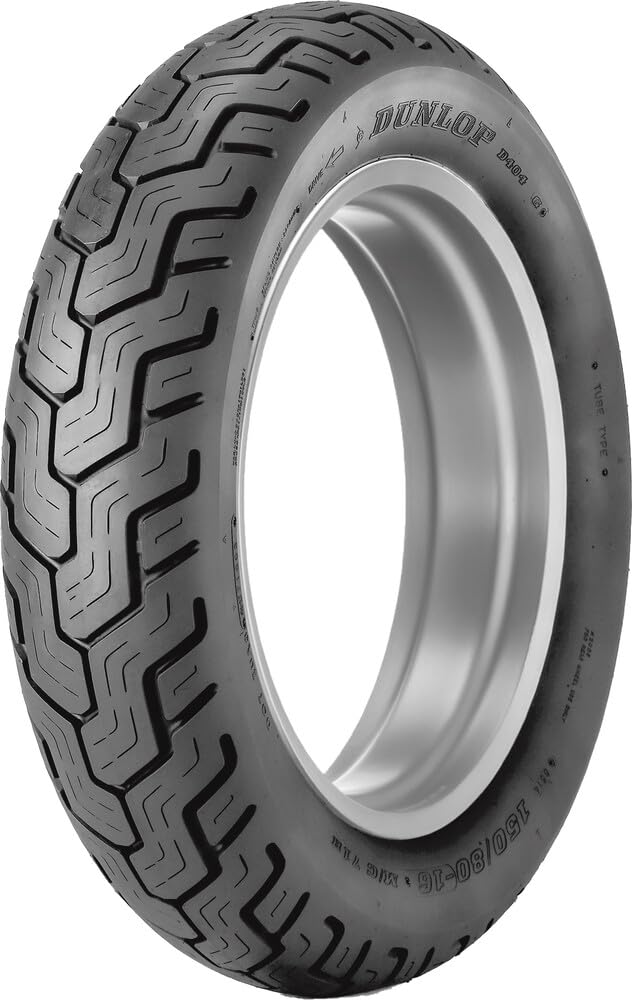
The drop-in replacement for Sportsters that has been keeping Harleys rolling for years.
The Dunlop D404 is a bias-ply tire engineered to be a direct fit for many Harley-Davidson models, particularly the 1991 Sportster and the 95 FXSTC. The tread compound and pattern are designed to balance mileage with grip, and the front-and-rear tread arrangement helps push water out of the contact patch for better wet-road confidence. The load index of 67 is respectable for a mid-weight cruiser — enough for a solo rider with a light touring load.
What stands out in the owner feedback is the smooth ride. The bias-ply construction absorbs bumps and highway expansion joints better than a radial, which is exactly what you want on a rigid-mounted cruiser. One rider on an 02 Sportster 1200 Custom described the grip as “amazing” and felt the price was fair. The tire feels planted at 80 mph, which is reassuring for a bias-ply tire at sustained highway speeds.
The honesty worth noting: the rubber is quite soft. The same Sportster owner reported about 4,500 miles before the tire showed noticeable wear — about half a season of aggressive riding. Durability gets mixed feedback in the review data as a whole, so consider this a comfortable, grippy bias-ply that trades ultimate longevity for a nicer ride feel.
Budget rear: a Sportster, Dyna, or Softail where you want a drop-in fit with a smooth, compliant ride and confident wet-road grip.
Wet traction: you ride 10,000+ miles a year and want a single rear tire to last a full season — a harder-compound touring radial might stretch the change intervals.
6. Michelin Pilot Power 2 CT Motorcycle Tire

A dual-compound sport tire that lets you drag knee on the street — and still get 9,000 miles.
The Michelin Pilot Power 2CT is a radial tire built around Michelin’s 2CT Dual-Compound Technology, meaning the rubber is harder in the center for straight-line mileage and softer on the edges for grip at extreme lean angles. The specification lists a maximum lean angle of 51.2 degrees, which is a serious number for a road-legal tire — you can run the bike to the edge of the tread without the tire losing composure. It is designed for sporty riding, but the compound resists aggressive acceleration and hard braking without chunking.
Quality is the top praise by a wide margin, and grip follows close behind. One owner on a Triumph Trophy SE said the tire was “so much better” than the old Dunlop, reporting a noticeably smoother ride. Another rider reported 9,000-plus miles on a set, which is strong for a dual-compound sport tire. The weight comes in at 9.4 pounds, which keeps rotating mass low enough that the bike flicks into corners eagerly.
The one thing to be honest about: the softer side rubber wears faster than the center, and once the edges go, the tire’s cornering feel changes noticeably. One owner noted that it “effects how the tire feels in the turns” once the sides wear, calling it a reasonable trade-off for the incredible grip you get when the rubber is fresh. This is not a tire for riders who only do highway commuting — the dual-compound’s edge-softness is wasted in a straight line.
Track days: you ride a sport bike aggressively through twisty roads and want a tire that sticks at 51.2 degrees of lean while still lasting longer than a pure track-day tire.
Daily commute: your riding is mostly highway mileage — the soft edges wear unevenly when they never get leaned on, wasting the dual-compound advantage.
7. Bridgestone Battlax Hypersport S22 Motorcycle Tire

Bridgestone’s premier street sport tire that owners say is stickier than Pirelli Rossos.
The Bridgestone Battlax Hypersport S22 is engineered as the company’s flagship street sport tire. The front and rear use different compounds — fine-grain silica in the rear formulation improves wet grip — and the pattern rigidity is designed to sharpen handling response. The load index is 73 with a capacity of 600 pounds, which is right for a modern sport bike. The 9.7-pound weight is slightly heavier than the Michelin Pilot Power 2CT’s 9.4 pounds, but the S22 makes up for it with stability at high speed; one owner reported the tire is stable up to 160 mph on a drag bike.
The real story is the wet weather performance. Owners describe the S22 as “the best wet weather street tire ever” with grip that works “cold or hot” and specifically excels “in rain.” The silica compound — fine microscopic particles that improve rubber flexibility in cold water — is what enables that confidence. One rider on an XSR900 confirmed the tire performs perfectly on that platform. Another called Bridgestone’s tires “stickier than the Pirelli Rossos on my Panigale,” which is high praise from an owner who owns the direct competitor.
The durability feedback is mixed. Owners on powerful bikes report the rear starts showing wear around 5,000 miles, and the front side tread can wear faster than expected if you push hard through corners regularly. One owner who uses the S22 for commuter duty confirmed the low mileage — around 5,000 miles on the rear — so plan your change intervals accordingly. This is a tire that prioritizes grip and feel over tread life.
Hypersport grip: you ride a modern sport bike in varied weather, value wet-grip confidence above all, and are willing to trade mileage for corner-exit traction.
Street only: you are on a tight budget for frequent tire changes — the 5,000-mile rear life on powerful bikes is a real cost to budget for.
8. Shinko SR777 HD Black Wall Bias Rear Tire – 150/80B16 77H

The 908-pound rear tire built for Sportsters packed for the long haul.
The Shinko SR777 HD is a bias-ply rear tire rated for heavy cruiser use. It carries a 4-ply carcass reinforced with aramid belting — a synthetic fabric that resists centrifugal growth at speed, keeping the tire’s shape stable under load. The load capacity is 908 pounds, and the H speed rating means it is certified for sustained speeds up to 130 mph, so a loaded touring cruiser on the highway is well within its design envelope.
This is the tire owners describe as a “great upgrade for a Sportster.” The reinforced carcass delivers what the brand calls enhanced handling stability and a longer service life. One rider, after a few thousand miles, reported that the tire “seems to be exactly what I needed” for a heavy cruiser. The ride quality is praised — the tire handles freeway expansion joints smoothly, which suggests the 4-ply casing is stiff enough to resist squirm but compliant enough for comfort.
The stability feedback is mixed, which is worth noting. Some owners mention a “major rear wheel death wobble” at certain speeds, though this is not a universal experience and may be specific to certain bike/tire combinations or improper balancing. The stainless-clear takeaway: verify the tire’s fitment compatibility with your specific model before buying, and ensure a professional mount and balance to minimize any vibration.
Harley rear: a heavy Sportster or metric cruiser where you need a rear tire that can handle passenger and luggage weight without overheating on long highway stints.
Light bikes: your bike has a known rear-end vibration profile — read fitment forums for your specific model before purchasing.
9. Dunlop Harley Davidson D402 Front Tire (Single / MT90B-16)

The official Dunlop tire engineered for Harley touring bikes — with a 90 load index to match.
The Dunlop D402 is the Harley-Davidson-approved touring tire, built with a three-ply polyester casing and two fiberglass belts. That construction gives it the stability needed for a fully loaded Road King or Electra Glide at highway speeds. The load index of 90 is the highest in this entire roundup, meaning it can carry 783 pounds per tire — enough for a heavy touring bike with a fairing, saddlebags, and a rider. The 40 PSI maximum pressure keeps the casing stiff enough to resist overheating on long, hot pavement stretches.
The tread profile is computer-tune with an offset center groove designed to reduce wandering on rain grooves and steel-grated bridges (those unnerving grate sections that catch lighter tires and pull the front end sideways). Customers note that the tire fits perfectly on 2014 Tri-Glide models and provides a smooth, confidence-inspiring ride. One rider on a 1990 Fatboy described the D402 as having “better grip, durability, and gas mileage” than the old-style tire it replaced.
The honest downside is installation. Owners note that the tire’s stiff construction makes mounting difficult — this is not a tire you want to spoon on with tire irons yourself unless you have a machine. Find a shop with a proper tire changer. The reward for the effort is a front tire that wears evenly, tracks straight through uneven pavement, and supports the massive weight of a touring bike without complaint.
Harley front: you own a Harley touring bike (Road King, Electra Glide, Street Glide, Tri-Glide) and want the OEM-approved tire that uses a high 90 load index for heavy-duty stability.
Touring comfort: your bike is a lighter cruiser — the stiff 3-ply casing and high load capacity add weight and firmness that is unnecessary on a Solo Dyna.
10. Continental Conti Motion 120/70ZR17 Front and 180/55ZR17 Rear Sport Touring Motorcycle Tires (2 Pack)
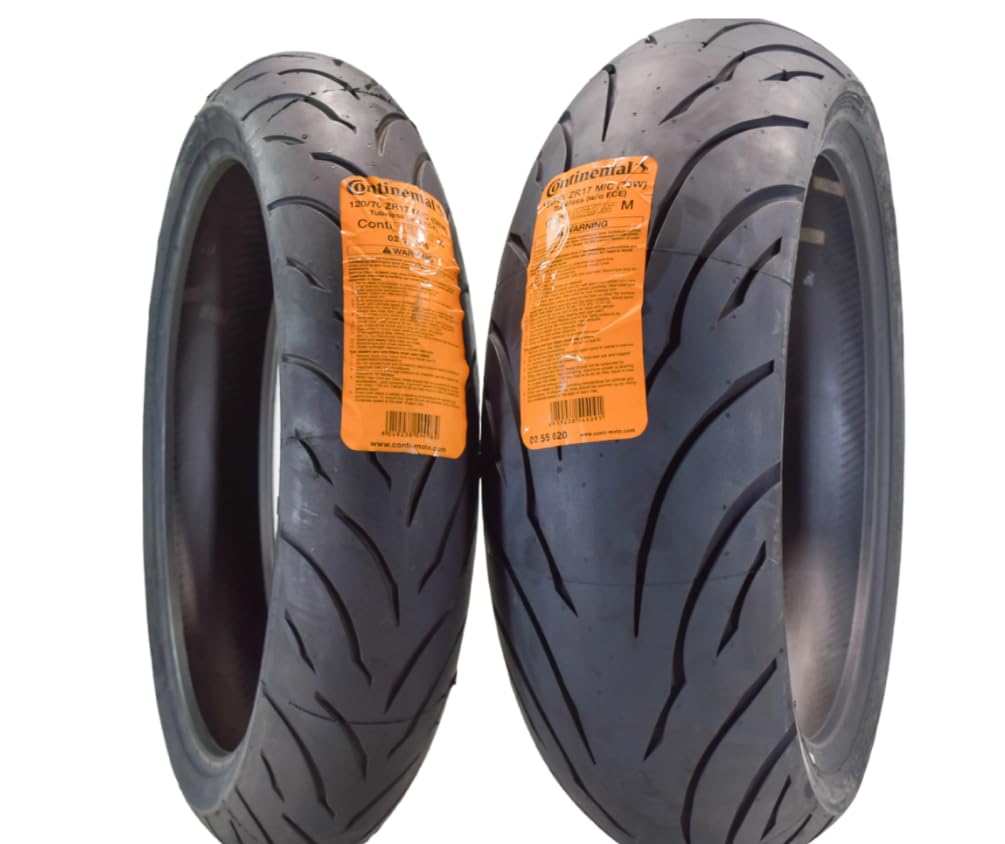
A 2-pack of sport-touring radials that a rider took to 160 mph and still felt confident on wet roads.
The Continental Conti Motion set pairs a 120/70ZR17 front tire with a 180/55ZR17 rear tire in a single package. The steel-belted radial construction uses formulated polymers to keep the cost down while still delivering what owners call “high grip in all weather.” The package is a full set — you buy this and you have both tires ready to mount, which simplifies ordering for a standard sport-touring bike. The 23-inch diameter and 17-inch rim size make this a direct fit for many Japanese and European sport-touring and naked-bike models.
The owner reviews lean heavily toward value for money — it is one of the top praised aspects. One rider on a 2014 Honda VFR reported excellent grip in the mountains and on damp roads, even in 40-degree Fahrenheit temperatures. Another rider, over three years on multiple sport bikes, pushed the Conti Motion to speeds between 80 and 160 mph on aggressive street rides and described the cornering as “predictable” and slides as “predictable.” That kind of feedback suggests the tire communicates its limits clearly — it does not let go without warning.
The honest note: the rear wears faster than expected, especially on heavier bikes. The same rider who loved the grip on a VFR noted that a 600-pound bike plus aggressive throttle use chewed through the rear faster than anticipated. The durability aspect is mixed in the review data, which is typical for a sport-touring radial at this price point. The trade-off is clear: you get 90% of the premium tire feel at a fraction of the cost, and the rear wears accordingly.
Sport touring: you need a front-and-rear set for a sport-touring or naked bike on a budget, and you value predictable cornering with honest feedback over ultimate tread life.
Track use: your bike is heavy (over 550 pounds) and you need a tire that stretches past 6,000 miles on the rear — a harder compound touring radial will go further.
11. Pirelli Diablo Rosso III Motorcycle Tire Set (120/70 ZR 17 & 160/60 ZR 17)

Pirelli’s World Superbike technology packed into a road-legal set that feels glued to the asphalt.
The Pirelli Diablo Rosso III is a high-performance sport tire set that includes both a 120/70 ZR 17 front and a 160/60 ZR 17 rear. It uses Pirelli’s advanced bi-compound construction — a wide soft stripe on the side that provides full grip starting from mid-lean angle, while the center tread is harder for straight-line stability. The “W” speed rating means it is certified up to 168 mph, which is appropriate for a sport bike that sees track-day use or aggressive canyon riding. The tire leverages technology from the World Superbike Championship, which is a genuine credential for a road tire.
Owners rave about traction — it is the most-mentioned aspect after the tires themselves. One rider on an R6 described them as “very grippy” and specifically noted that once warmed up, the tires “let you lay on down in the corners.” Another rider, comparing them directly to previous Michelins, said the Pirellis “smell good” and perform well but admit the Michelin Pilot Power 2CT handled gravel in the middle of a turn slightly better. That is a niche scenario but note if you ride on roads with occasional debris.
The durability is the main trade-off. The cold grip is excellent (one rider confirmed confident traction in 20-degree Fahrenheit weather), but the compound is soft and wears fast. A handful of owners also received the wrong size set during shipping, so verify the tire size immediately when the box arrives.
Canyon carving: you ride a sport bike hard on twisty roads or occasional track days and want World Superbike-derived grip with predictable feedback at extreme lean angles.
Wet roads: you need a tire that lasts more than a season of regular weekend rides — the soft compound is designed for grip, not mileage, and you will replace the rear frequently.
Understanding the Specs
Load Index
The load index is the code that tells you the maximum weight a tire can carry when inflated to its correct pressure. A tire with a load index of 73 can carry 890 pounds; a tire with a load index of 90 can carry 783 pounds. For a loaded touring bike with a passenger and full luggage, you need a higher load index to keep the tire from overheating and losing grip. For a lightweight sport bike, a lower index is fine and saves weight. Match the load index to your bike’s actual fully loaded weight — never go below the manufacturer’s minimum.
Dual-Compound (2CT/BDC) Technology
Dual-compound tires use two different rubber blends in a single tire: a harder central strip for straight-line mileage, and a softer edge compound for cornering grip. Michelin calls it 2CT, Bridgestone uses a similar approach, and Pirelli uses bi-compound with a wide soft stripe on the side. The benefit is you do not have to choose between long tread life and sticky corners — the center resists flattening, while the edges grip when you lean. The trade-off is once the edges wear down, the cornering feel changes noticeably.
FAQ
What is the real difference between a radial tire and a bias-ply tire on a motorcycle?
How do I find the correct tire size for my motorcycle?
Can I put a radial tire on a bike that came with bias-ply tires from the factory?
What does the load index on a motorcycle tire actually mean?
How many miles should a motorcycle tire last?
What causes a motorcycle tire to cup, and can you stop it?
Are motorcycle tires with a higher speed rating always better?
How do I break in a new motorcycle tire safely?
Can I install a motorcycle tire myself, or do I need a shop?
Final Thoughts: The Verdict
For most riders, the motorcycle tires winner is the MICHELIN Road 5 because it rewrites the rule that wet grip and long mileage cannot coexist — the patented XST Evo siping keeps stopping short even after 3,500 miles, and the dual-compound gives you cornering confidence on roads that shift from dry to wet in a single turn. If you ride a lighter sport-touring bike on a tighter budget, grab the Kenda KM1 — it is the crowd favorite for value, with a 4-ply radial that heats up fast and wears evenly. And for heavy cruiser owners who need maximum load capacity, the Dunlop D402 front tire carries the highest load index in this roundup (90) and is the approved Dunlop fitment for Harley touring models. Pick the tire that matches your bike’s weight and your riding style — the rubber between you and the road deserves this much thought.
How We Picked
We do not accept paid placement. Every pick is matched to a real buyer and a real use-case; we do not hands-on test units.
Sources & Methodology
Specifications: manufacturer listings and product documentation. Review insights: verified customer reviews, as of July 2026. Pricing: not shown on this page (it changes often); check the current price via the retailer link.
As an Amazon Associate, Trending Car earns from qualifying purchases. This does not affect which products we feature.