
Our readers keep the lights on and my garage snacks stocked. As an Amazon Associate, I earn from qualifying purchases.
Specs are compiled from manufacturer listings and verified buyer reviews and can change over time — please confirm the key details on the product page before buying.
Picking a set of street tires for your motorcycle isn’t like choosing gas station snacks — the wrong decision can push your bike wide in a wet corner or flat-spot the center after a summer of commuting. The best street tires balance grip you can trust in a downpour with a tread life that doesn’t leave you buying a new rear every season. That balance is harder to find than most riders expect. This guide breaks down ten street-legal tires that actually deliver on their promises, from the wet-weather genius of the Michelin Road 5 to the value-packed Kenda KM1 that commuters swear by.
I’m Min Islam — the founder and writer behind Trending Car. This guide is built by comparing the manufacturers’ published specifications and the patterns across verified customer reviews, so you get each pick’s real strengths and trade-offs instead of marketing spin.
Whether you ride a sport tourer to work every day or carve canyons on weekends, Choosing the right rubber starts with understanding your riding style, weather, and budget. — these are the best motorcycle tires for street use, ranked by real-world performance and owner experience.
Our Picks at a Glance


How To Choose The Best Motorcycle Tires for Street
The right street tire depends on three questions: how you ride, what the weather looks like where you live, and how often you want to replace rubber. Here’s what to look for.
Understand Your Speed Rating
The letter on the sidewall (H, W, Z, Y) tells you the maximum speed the tire can safely handle at full load. An H-rating is fine for highway cruising up to 130 mph, while a Z- or W-rated tire handles higher speeds and resists heat buildup during aggressive cornering. If you ride a heavy touring bike at legal speeds, H is plenty — you do not need a race-spec Z tire on a cruiser.
Radial vs. Bias-Ply Construction
Radial tires use steel or aramid belts running across the tread, which gives you better grip, cooler running temps, and longer tread life on sport and sport-touring bikes. Bias-ply tires (often found on cruisers and vintage bikes) have overlapping cord layers — they are cheaper and stiffer but run hotter and wear faster at highway speeds. For a modern street bike, radial is almost always the better choice.
Quick Comparison
| Model | Best For | Construction | Speed Rating | Weight | Amazon |
|---|---|---|---|---|---|
| Michelin Road 5★ Best Overall | Wet-grip supremacy & touring | Radial | W | 10.3 lb | Amazon |
| Kenda KM1Best Value | Budget sport-touring with strong value | Radial | H | — | Amazon |
| Shinko 777 FrontCruiser King | Cruiser and V-Twin stability | Aramid-belted | H | 9.15 lb | Amazon |
| Dunlop Sportmax GPR-300 | Affordable sport replacement | Radial | W | 6 lb | Amazon |
| Michelin Pilot Power 2CT | Aggressive sport riding & lean angles | Radial | H | 9.41 lb | Amazon |
| Shinko SR777 HD Rear | Heavy cruiser & touring durability | Bias (Aramid-belted) | H | 15 lb | Amazon |
| Bridgestone Battlax BT46 | Vintage sport & touring longevity | Bias | H | 13.0 lb | Amazon |
| Dunlop D402 Harley Davidson | OEM-grade Harley touring stability | Bias (3-ply/fiberglass) | H | — | Amazon |
| Continental Conti Motion | Entry-level sport touring 2-pack value | Steel-belted | W | — | Amazon |
| Pirelli Diablo Rosso III | High-performance sport/street cornering | Radial | W | — | Amazon |
In‑Depth Reviews
1. MICHELIN Road 5 Touring Radial Tire
Our pick — over 4.5★ from 550+ verified ratings; the strongest balance of quality and price.
The rain-master that refuses to give up grip even after thousands of miles.
The Michelin Road 5 exists for one overriding reason: to keep you glued to the tarmac when the sky opens up. Its patented XST Evo siping and Water Sipe Technology work together to actively push water out from under the contact patch, and the proof is in the numbers — buyers report that even after 3,500 miles, these tires stop as short as a brand-new Michelin Pilot Road 4. At 10.3 pounds, the Road 5 is on the heavier side for a sport-touring tire, but that weight comes from the sturdy construction that gives you a planted feel on split-grip surfaces like painted lines and pedestrian crossings.
The dual-compound layout (2CT and 2CT+ compounds) means the center is harder for mileage while the shoulders stay soft for cornering. That is the same tech that lets sport riders drag knees on the street, as the review pages put it: “the edges of the tire are soft and you can drag knees on the street.” The trade-off that keeps it from being perfect for everyone is the durability split — while quality and traction earn the loudest praise, the consensus on tread life is mixed. Some owners get excellent mileage; others see the rear flatten sooner than they would like on heavier bikes like a Concours. It is a 17-inch radial with a W-speed rating, so it handles autobahn speeds without breaking a sweat.
Why Owners Love It
- Benchmark wet-weather grip that inspires real confidence in downpours — the top positive theme by far
- Heats up fast from cold, so you have traction within the first few turns on a chilly morning
- Exceptional low-temperature traction and the ability to bump-start without skidding, unlike some Dunlop rivals
The Realistic Picture
- Tread life is the most-discussed mixed point — center wear on heavy sport tourers can accelerate
- At 10.3 pounds, it is a noticeably heavier tire than the Shinko 777 front at 9.15 pounds, which a few riders feel on turn-in feel
Your go-to if: You ride in wet weather often and want the safest possible tire for all-road confidence — this is the crowd favorite for a reason.
Look elsewhere if: You prioritize maximum rear-tire mileage over wet grip; a harder-compound touring tire may stretch your change intervals further.
2. Kenda KM1 110/70R17 Front Tire
The budget radial that refuses to ride like one — 911 owners can’t be wrong.
If you commute 140 miles a day like several owners do, tire cost per mile matters. The Kenda KM1 delivers a shockingly good ride for its price tier. Its tune apex geometry balances high-speed stability with agile handling, and the newly designed tread pattern promotes even wear while enhancing wet-weather grip. The 4-ply radial construction adds strength without making the tire feel like a rock, and the advanced rubber compound heats up quickly from cold — so you have grip from the first stoplight. The popular consensus: it lasts roughly 8,000 miles on the rear, with half the tread still visible at 4,000 miles.
Stiff sidewalls are the main DIY-install headache — owners mention they need a shop with a proper tire machine and 40 PSI to seat the beads. Once mounted, the KM1 offers quicker turn-in than Metzeler equivalents and a smooth highway ride. The trade-off? It is a bit more sensitive to road grooves and can produce a slight weave at triple-digit speeds, which matters less for daily commuting than it does for weekend canyon carving. The diameter is 35.5 inches, which is significantly larger than the Michelin Road 5’s 17 inches — a 2.1x difference that reflects the different rim sizes these tires are built for.
What Wins People Over
- Value for money is the second-most praised aspect — owners consistently call it the best bang for the buck in sport-touring
- Excellent wet and dry traction with a predictable, controllable slide limit that suits non-knee-draggers perfectly
- Higher mileage than the price suggests; one owner got 8,000 miles from a rear on a 140-mile daily commute
The Honest Catch
- Tire is slightly wider than the spec printed on the sidewall — verify clearance before ordering
- Stiff sidewalls make it a tough DIY mount; budget for a shop install if you don’t have a bead seater
Reach for this if: You commute hard and want a sport-touring radial that won’t bankrupt you at the 8,000-mile change interval.
Think twice if: You need a tire for track days or aggressive lean-angle riding — the compound’s grip ceiling is lower than stickier sport rubber.
3. Shinko 777 Front H.D. 100/90-19
The heavy-duty cruiser tire that makes a V-Twin feel planted at freeway speeds.
The Shinko 777 front is built around a simple truth: cruisers and V-Twins need a reinforced carcass to handle the weight and torque of those big engines. The H.D. (Heavy Duty) version delivers exactly that — an aramid-belted construction that provides a more stable, planted feel when accelerating, braking, and cornering. The tread design includes functional siping and grooves that pull water away for wet-road confidence, and the rubber compound is formulated for maximum grip and comfort rather than the rock-hard feel some budget cruiser tires have. At 9.15 pounds, it is lighter than the Michelin Road 5 by a full 1.15 pounds, which helps reduce unsprung weight on the front end.
Where the Shinko 777 really wins is in the ride feel. Customers note it corners well, grips confidently on wet roads, and stays smooth on the highway — precisely what you want from a cruiser front tire. The H-speed rating means it is safe up to 130 mph, more than enough for highway cruising. The mixed feedback on durability and wobble is worth noting: some reviewers point out cupping or a slight wobble at certain speeds, though the vast majority call it a fantastic value. The 19-inch diameter fits many V-Twin and metric cruiser models, making it a direct replacement for stock rubber that often costs twice as much.
What Riders Rave About
- Exceptional value for a heavy-duty cruiser tire — the price-to-performance ratio is consistently praised
- Sticky right out of the gate; the compound offers confidence-inspiring traction even in corners
- Reinforced carcass eliminates the vague front-end feel that plagues cheaper cruiser tires on grooved highways
A Fair Caveat
- Durability is reported as mixed — some owners see faster center wear on heavier bikes, especially with aggressive throttle use
- A small but notable number of owners experience a wobble at certain speeds; wheel balancing is critical with this tire
Best for: Cruiser and V-Twin riders who want a confidence-inspiring front tire without paying premium-brand prices.
Not for: Riders who hammer their front tire with hard braking in the twisties — the heavy-duty compound trades some ultimate grip for stability.
4. Dunlop Sportmax GPR-300 Front Tire

The sport radial that undercuts premium rubber without giving up the feel.
It is a well-balanced sport radial designed for a variety of sport bikes, and it delivers exactly what the category demands: confidence in corners and enough wet traction to keep you relaxed in a surprise shower. Several owners swapped from Michelin Road 5s and reported no perceptible difference in feel for half the cost — a direct challenge to the idea that you must spend big to get safe rubber. The GPR-300 weighs just 6 pounds, making it the lightest tire on this list by a significant margin, which translates to quicker steering response.
Center-wear is the recurring reality check. On a bike used primarily for straight-line commuting, the center compound flattens faster than a dedicated touring tire. Owners on Honda CB500Fs who use the bike for both commuting and track days note excellent grip and feedback in corners but faster center wear on the highway. For a weekend rider who does mostly twisty roads, the trade-off is negligible. The W-speed rating (168 mph+) is overkill for most legal riding but confirms the tire can handle high-speed heat buildup without delaminating. At 524 ratings, it is less-reviewed than the Michelin Road 5 or Kenda KM1, but The consensus is tightly positive: quality and value-for-money are the clear standouts..
The Highlights
- Incredible value at roughly half the price of premium sport tires — owners consistently call it a steal for the performance
- Excellent grip that feels confidence-inspiring in wet conditions and on grooved highways
- Lightest weight (6 lb) on this list makes the front end feel nimble and responsive
The Trade-Off
- Center tread wears faster than harder-compound touring tires when used for straight-line highway commuting
- Some shoppers say slightly quicker wear than Dunlop Road Smart 4, which offers longer life at a higher price
Grab this if: You ride a sport bike on a budget and want a tire that handles twisties without terrifying you in the wet.
skip it if: Your riding is 90% highway miles — a harder touring compound will stretch your tire budget further.
5. Michelin Pilot Power 2CT Motorcycle Tire

The dual-compound sport tire that lets you lean until the pegs scrape.
Michelin’s 2CT (Dual-Compound Technology) is the star here: a harder rubber strip down the center resists flat-spotting from acceleration, while softer compound on both edges boost grip when you’re cranked over. The claimed maximum lean angle of 51.2° gives you a tangible number for how far this tire is designed to go. That is genuine sport-bike territory, and owners confirm it — the “old heads and stunters alike” crowd on the review pages says this tire outperforms newer models they have tried. At 9.41 pounds, it is middleweight among the radials here, and the H-rating (up to 130 mph) is appropriate for road use rather than track-day abuse.
The Achilles’ heel is exactly what you would expect from a tire that prioritizes edge grip: the softer shoulder rubber wears faster than the center. One owner with a Triumph Trophy SE raves about how smooth the ride feels compared to the stock Dunlops, while another notes that once the sides go, the tire feels different in turns. That is the double-edged sword of dual-compound design — it works brilliantly if you lean the bike, but straight-line riders pay for shoulder rubber they never use. The consensus is loudest on quality and grip, with 78 and 47 mentions respectively, making it a clear first choice for riders who actually use the whole tire in corners.
Why It Shines
- Remarkable dry grip on the edges that gives sport riders the confidence to push deep into corners
- Lasts over 9,000 miles for some owners — impressive for a tire with soft shoulder compound
- Smooth ride quality that noticeably improves over budget or older tires; “I can’t believe how smooth” is a recurring reaction
Honest Reality
- Soft shoulders wear faster than the center, so the tire’s feel changes as the profile rounds off from side wear
- The H-speed rating leaves no headroom for sustained high-speed track sessions — this is a road tire, not a race tire
Perfect for: Sport riders who actually lean the bike in corners and want edge grip without paying for a full race compound.
Consider another tire if: Most of your miles are straight-line highway — the soft shoulder compound is wasted, and a harder touring tire will wear better.
6. Shinko SR777 HD Black Wall Bias Rear Tire

The heavy-duty bias tire that swallows highway miles and passenger weight without complaint.
This is the rear tire you want on a big cruiser or touring bike that sees two-up riding, luggage, or both. The aramid-belted 4-ply carcass gives it exceptional strength and structural integrity for long-distance, heavy-load riding. The H-speed rating (130 mph) is more than enough for legal cruising, and the reinforced construction delivers handling stability that keeps the bike planted when you have a passenger and a trunk full of gear. At 15 pounds, it is comfortably the heaviest tire on this list, and that heft translates directly to the “planted feel” owners describe — one calls it “the best tire I have ever ridden with” and notes it smooths out freeway expansion joints.
Stability is where the feedback splits. While most owners love the ride quality and grip (61 and 15 positive mentions respectively), a modest number flag rear wobble at certain speeds. That could be a balance issue or a bike-specific resonance, but it is worth knowing before you order. The 150/80-16 size fits a wide range of V-Twin and metric cruiser models, and the 908-pound load capacity gives you real headroom for touring. Compared to the Shinko 777 front at 9.15 pounds, this rear tire is significantly heavier — a 65% difference that underscores how much more structure a rear cruiser tire needs.
The Big Selling Points
- Exceptional value for a heavy-duty touring rear — the aramid belt gives you durability at a fraction of premium brand prices
- Remarkably smooth ride that masks road imperfections better than many harder touring tires
- Great grip on curves and in wet conditions, with no cupping or weird wear patterns reported by the majority
Worth Noting
- Stability is the most-discussed mixed point — some buyers report rear wobble, though it varies by bike and setup
- Heavier than most comparable tires at 15 pounds, which can affect rear suspension feel on lighter cruiser models
Best if: You ride a heavy cruiser or touring bike with a passenger and gear and want a rear tire that handles the load while staying affordable.
Not ideal for: Riders who push their bike hard through corners — the bias-ply construction prioritizes load and stability over ultimate side-grip.
7. Bridgestone Battlax BT46 Tire
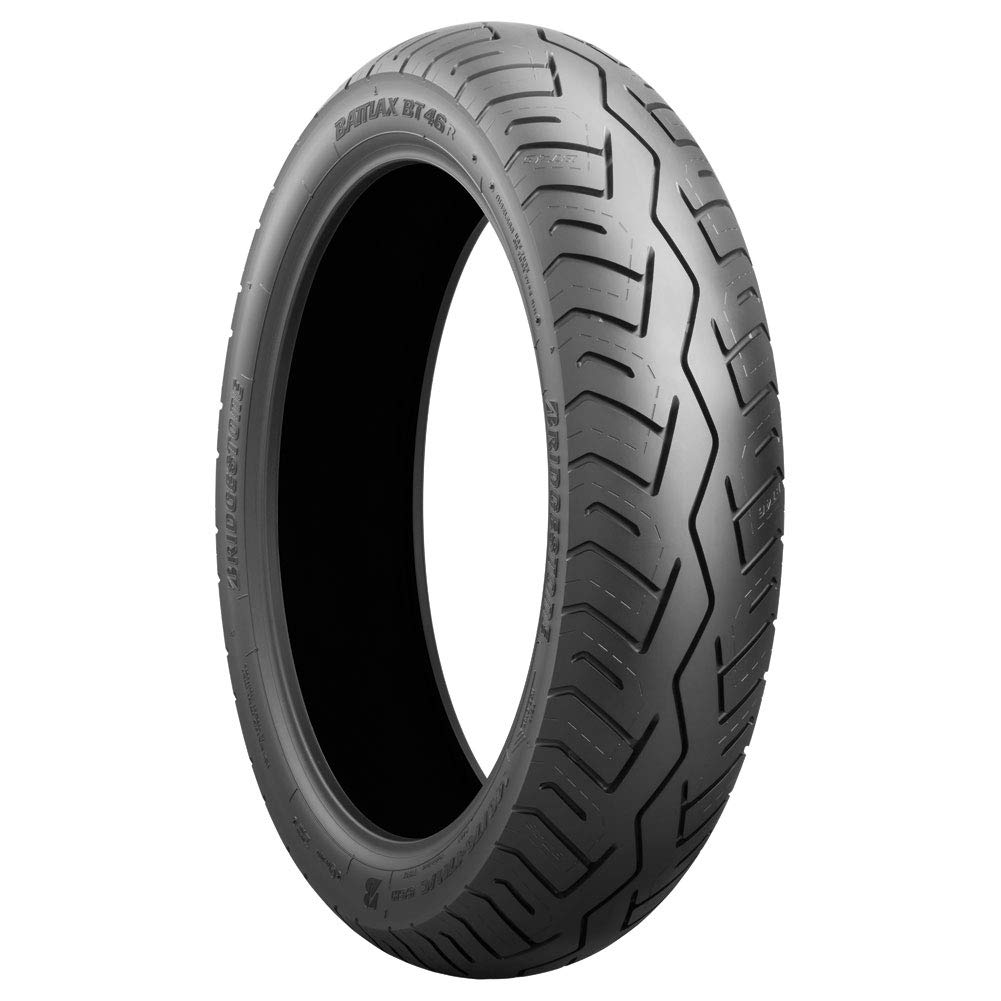
The bias-ply tourer that goes 35,000 miles on a Gold Wing — no joke.
The Bridgestone Battlax BT46 is a bias-ply tire built for vintage sport and touring motorcycles, and its defining characteristic is absurdly long wear. One owner on a 2022 Honda Goldwing racked up 35,830 miles and still had tread left when the replacement arrived — for context, that is roughly 4.5 times what a typical sport-touring radial sees on a heavy bike. The silica single-compound rear boost performance and grip while reducing wear, and the increased wet performance comes without sacrificing tread life. The BT46 is designed as a direct improvement over the BT45, and owners on Royal Enfield Interceptors call it a “big improvement over OEM” with roughly 10,000 miles of usable life.
The catch for sport riders: this is a bias-ply tire, not a radial. On a modern sport bike, a bias-ply construction runs hotter and offers less ultimate cornering grip than a radial. For its intended audience — vintage sport bikes, standard motorcycles, and touring machines — that trade-off is irrelevant. The H-speed rating (130 mph) is sufficient, and the 600-pound load capacity pairs well with midsize cruisers and nakeds. The main complaint is fit inconsistency: some owners receive the wrong size or have balance issues, though this seems to be a batch-control or seller issue rather than a design flaw. If you have a bike that originally wore bias-ply tires, the BT46 is a no-brainer upgrade.
Why It Stands Out
- Unbelievable longevity — 35,830 miles from one owner is the single best wear report on this list
- Silica compound delivers noticeable wet-grip improvement over the older BT45 without shortening tire life
- Smooth, comfortable ride quality that suits long touring days and vintage bike characteristics
Fair Warnings
- Bias-ply construction means less ultimate cornering grip than a modern radial — it is not a sport tire
- Fit is reported as mixed; double-check sizing with your bike’s spec sheet before ordering and be prepared for possible return
Reach for this if: You own a vintage sport or touring bike and want a tire that handles wet roads well without needing replacement every season.
pass on it if: You ride a modern sport bike and want maximum cornering performance from a radial carcass — this tire serves a different purpose.
8. Dunlop Harley Davidson D402 Front Tire

The factory-approved Harley touring tire that handles rain grooves like they do not exist.
If you ride a Harley-Davidson touring bike, the D402 is the tire the factory puts on it — and there is a reason for that. It is engineered and tested with Harley-Davidson to deliver maximum performance specifically for the weight, geometry, and riding dynamics of H-D touring models. The three-ply polyester casing with two fiberglass belts provides the stability needed for long-distance riding, and the computer-tune tread profile with an offset center groove is designed to reduce cupping while improving rider confidence over rain grooves and steel-grated bridges. The D402 is a tubeless tire with an H-speed rating (130 mph), more than sufficient for the speed limits these bikes live in.
What you get with the D402 is predictable, consistent behavior mile after mile. Owners on Road Kings and Tri-Glides praise the fit and ride quality — “it’s a Dunlop, what can I say” sums up the trust factor. The 783-pound load capacity gives you plenty of headroom for two-up touring with luggage. The trade-off is that this is a very specific tire for a very specific group of bikes. If you own a Harley touring model, it is the obvious choice. If you ride any other brand, the offset tread design and load characteristics may not suit your bike. For the Harley touring crowd, the quality and fitment precision get the loudest thumbs-up.
What Makes It Right
- OEM-grade engineering means perfect fit and predictable handling on Harley touring models — no guessing
- Excellent rain-groove stability; the offset center groove design kills the wandering sensation common on older cruiser tires
- Durable, long-wearing construction that suits the weight and torque of large V-Twin touring bikes
What to Know
- Purpose-built for H-D touring models — it may not perform optimally on metric cruisers or sport bikes
- Premium-brand pricing; you pay for the OEM engineering, but owners consistently say it is worth it for the fit
Get this if: You own a Harley-Davidson Road King, Electra Glide, Tri-Glide, or similar touring model and want the exact tire the designers intended.
Look elsewhere if: You ride a non-Harley cruiser — the D402’s offset tread and load rating are tuned specifically for H-D chassis dynamics.
9. Continental Conti Motion 2-Pack Set
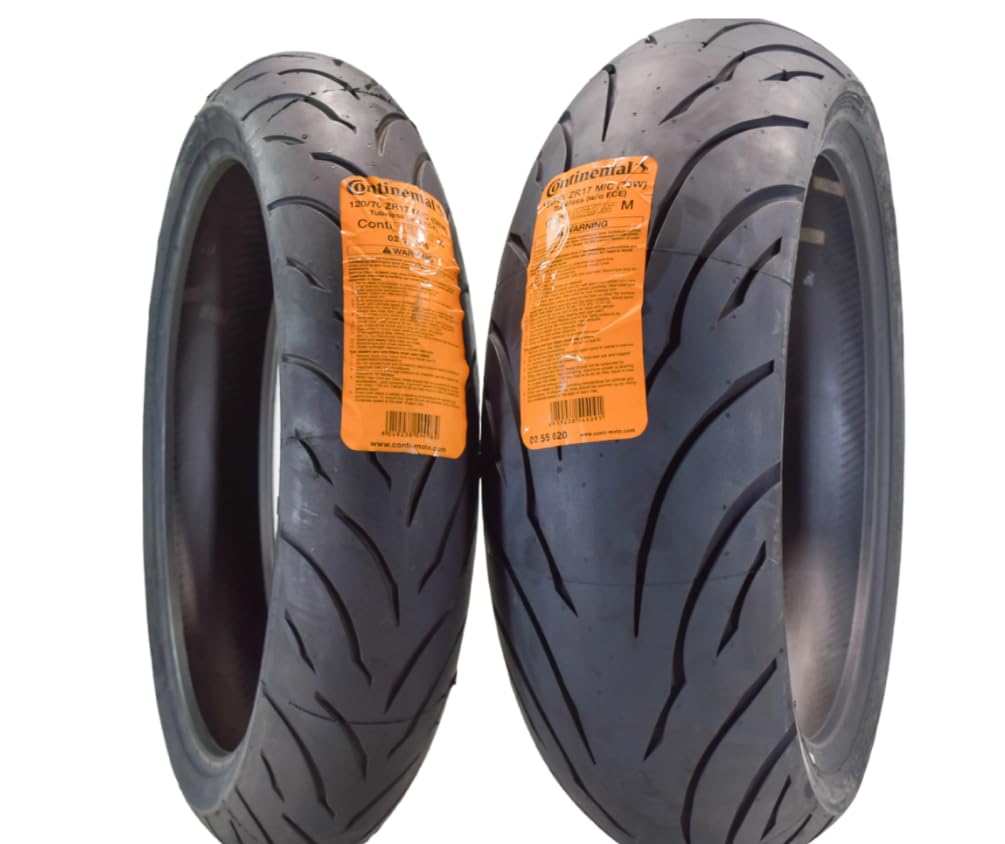
The sport touring two-pack that gives new riders a safe, affordable way to rubber up.
The Continental Conti Motion is described by the manufacturer as a sport-touring all-season radial with high-end performance for the money, explicitly targeting entry-level riders and economic-minded veterans. The formulated polymers in the compound are designed to deliver an impressive cost-per-mile ratio, and the steel-belted construction adds durability without making the tire feel harsh. At 974 ratings, it is among the most-reviewed tires on this list, and The consensus is clear: you get safe, reliable feedback on dry or wet roads without emptying your wallet.. The front is 120/70ZR17 and the rear is 180/55ZR17, a common sport bike pairing.
Where the Conti Motion shines is predictability. Owners say it holds well on the road, in corners, and on wet pavement, with one calling it “surprisingly aggressive performance for the street rider.” It balances well and offers predictable cornering and slides that are easy to read. The trade-off that the review pages mention most is durability — the rear wears faster than many riders expect, especially on heavier bikes like a 600-pound sport tourer. One owner chalking it up to “operator enjoyment” is a fair summary: if you like the throttle, the rear will not last as long as a harder touring compound. The 2-pack format means you get a matched set delivered together, which simplifies the ordering process significantly.
Why Riders Pick It
- Outstanding value as a complete set — the front and rear together cost less than some single premium tires
- Reliable grip in all weather conditions, from mountain roads in the damp to 40°F spring mornings
- Predictable, controllable behavior at the limit, which builds confidence in newer riders
The Reality
- Rear tire wears faster than budget-conscious riders expect, especially on heavier bikes or with aggressive throttle use
- Harsher bump impact than some touring-focused tires; the sport-oriented compound prioritizes feedback over plushness
Best for: Entry-level sport bike riders and veterans who want a good set of rubber for a fair price and do not mind replacing the rear a bit sooner.
Not ideal for: Touring riders who want maximum rear-tire mileage — the softer compound trades longevity for grip.
10. Pirelli Diablo Rosso III Tire Set

The street-legal tire that brings World Superbike Championship technology to your canyon run.
The Pirelli Diablo Rosso III is the direct result of technology developed in the World Superbike Championship, translated into a street-legal sport tire. The big headline is the advanced bi-compound construction: a wide soft stripe on the side that gives you full grip starting from mid-lean angle, which means you get the confidence to push deeper into corners without worrying about a sudden breakaway. The large footprint area improves grip on various road surfaces, and the wet-weather design has proven itself reliable in both rain and unpredictable conditions. The set is a front 120/70ZR17 and rear 160/60ZR17, sized for many popular middleweight sport and street bikes.
Cold-weather performance is a standout. Owners mention excellent grip in temperatures as low as 20°F while still holding 140mph corners — a trick that many sport tires cannot pull off. The trade-off that shows up most often in owner feedback is rear-tire lifespan: riders on powerful bikes like the CBR929RR see roughly two rears per season with hard riding, which is consistent with a high-grip sport compound. The Michelin Pilot Power 2CT apparently handles gravel and dirt intersections slightly better, but in the Rosso III’s element — clean, fast pavement — it is exceptional. The W-speed rating confirms it can handle sustained high-speed running, though for most riders, the limiting factor will be the wear rate, not the speed rating.
What Makes It Great
- Superb grip in both wet and dry conditions — owners call it “the best for sport bikes” and say the bike feels glued to the road
- Excellent cold-weather performance down to 20°F without sacrificing traction at high speeds
- World Superbike tech delivers precise, confidence-inspiring handling that makes the bike feel more nimble
The Honest Picture
- Rear tire wears quickly on high-power sport bikes — owners on CBR929RR and Hayabusa class machines see about two rears per season
- More sensitive to gravel and debris in corners than the Michelin Pilot Power 2CT, per owner comparisons
Perfect for: Sport bike riders who push hard on clean pavement and want the most advanced traction technology available in a street-legal tire.
Think twice if: Your riding includes a lot of rough pavement, gravel intersections, or long highway commutes — the compound prioritizes grip over longevity.
Understanding the Specs
Speed Rating (H, W, Z, Y)
The speed rating is the tire’s certified maximum safe speed at full load. H-rated tires are tested to 130 mph, which is plenty for legal highway riding on cruisers and touring bikes. W-rated tires go to 168 mph, and Z-rated is 149+ mph. The rating matters because a tire pushed beyond its speed rating builds up heat and can fail. For a street rider who never exceeds 80 mph, H is more than adequate. For a sport bike rider who hits triple digits on-ramp merging, W or Z gives you a safety margin against heat buildup.
Radial vs. Bias-Ply
A radial tire has belt plies running across the tread at a 90-degree angle to the centerline, which allows the sidewall and tread to flex independently. This gives you better grip, cooler running temperatures, and longer tread life on modern sport and sport-touring bikes. A bias-ply tire has overlapping cord layers that create a stiffer carcass. It runs hotter and has less ultimate grip, but it is cheaper and more durable under heavy loads — which is why many cruiser and touring bikes still use bias construction. Matching the tire construction to your bike’s original spec is important for handling predictability.
FAQ
How do I read a motorcycle tire size code?
What is the difference between a sport tire and a touring tire?
Will a radial tire fit my bike that originally had bias-ply tires?
How many miles shouldA street tire’s lifespan depends on your bike’s weight, riding style, and the tire compound. A soft sport tire may last 2,000-4,000 miles on a powerful bike with aggressive riding, while a touring tire can easily go 10,000-15,000 miles on a lighter bike used for commuting. Check tread depth regularly — the legal minimum in most places is 1.6mm (2/32 inch), but replacing at 3mm is safer for wet-weather grip.?
Does a higher speed rating make a tire safer for highway riding?
How important is wet grip for a street tire?
What is the difference between the Shinko 777 and Shinko SR777 HD?
Can I use a front tire from one brand and a rear from another?
How much does tire weight affect performance?
Why do some tires need a break-in period?
Final Thoughts: The Verdict
For most riders, the top pick for motorcycle tires for street use is the Michelin Road 5 because its wet-weather grip is genuinely class-leading and the dual-compound construction delivers a rare blend of cornering confidence and reasonable tread life. If you want the strongest value-to-performance ratio, the Kenda KM1 is the commuter’s choice — it does 90% of what the premium tires do for a fraction of the price, with 8,000-mile rear life that rivals much more expensive rubber. And for the Harley touring crowd, the Dunlop D402 is the engineered-for-your-bike answer that removes the guesswork completely. Pick the tire that matches your bike, your weather, and your riding style — The right set transforms your bike’s handling, grip, and confidence on every ride..
How We Picked
We do not accept paid placement. Every pick is matched to a real buyer and a real use-case; we do not hands-on test units.
Sources & Methodology
Specifications: manufacturer listings and product documentation. Review insights: verified customer reviews, as of July 2026. Pricing: not shown on this page (it changes often); check the current price via the retailer link.
As an Amazon Associate, Trending Car earns from qualifying purchases. This does not affect which products we feature.