
Our readers keep the lights on and my garage snacks stocked. As an Amazon Associate, I earn from qualifying purchases.
Specs are compiled from manufacturer listings and verified buyer reviews and can change over time — please confirm the key details on the product page before buying.
Running the wrong pressure on a motorcycle changes how the bike leans into corners, how hard the brakes bite, and how quickly the tread wears down the middle. A gauge that lies by a few PSI can turn a confident ride into a squirmy one, especially when you are chasing the precise low pressures that off-road and adventure bikes need. The right tool reads accurately, holds the reading while you reach for a pump, and fits the tight space around a spoked wheel.
I’m Min Islam — the founder and writer behind Trending Car. This guide is built by comparing the manufacturers’ published specifications and the patterns across verified customer reviews, so you get each pick’s real strengths and trade-offs instead of marketing spin.
Finding a reliable motorcycle tire gauge means weighing accuracy standards, pressure range, and the chuck design that actually seals on a valve stem without leaking air.
Our Picks at a Glance

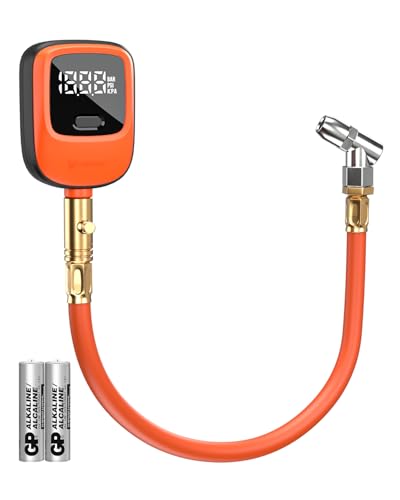
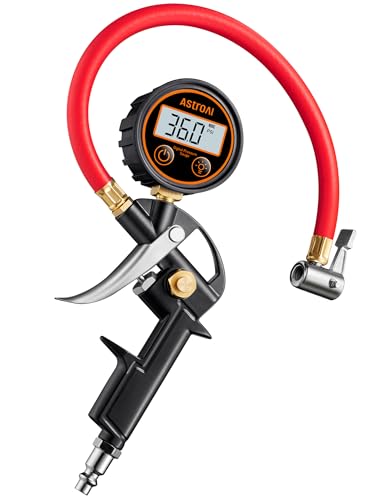
How To Choose The Best Motorcycle Tire Gauge
Motorcycle tires run a much wider spread of pressures than car tires, which changes what you should actually buy. A sportbike might want 36 PSI on the street, while an adventure bike aired down for sand could drop to 15 PSI or lower. A gauge built for trucks tops out at 250 PSI and often reads poorly at the low end, so the first decision is matching the range to your riding.
Match the Range to Your Riding
Low-pressure dial gauges are the specialist tool here. They measure a narrow band, like 0-30 PSI, with a large, readable scale so small changes are obvious. That makes them ideal for ATV, UTV, dirt bike, and off-road tires that run soft. If you only ride asphalt at typical street pressures, a digital gauge with a wide 0-250 PSI range and 0.1 PSI resolution gives you the precision you need without a second tool.
Know Your Accuracy Standard
Accuracy grades tell you how honest the reading is. Digital gauges often cite ANSI B40.7 Grade 2A, which allows a tolerance of about ±1 PSI, or tighter claims like ±0.5%. Dial gauges reference ANSI standards with a percentage, such as ±1.5%. A gauge that is off by a pound or two at 15 PSI is a bigger problem than the same error at 36 PSI, so riders running low pressures should lean toward the tightest tolerance they can find.
Check the Chuck and Hose
The chuck is the part that actually touches the valve stem, and it decides whether you get a clean seal. A lock-on clamp style grips the stem so you can read and bleed pressure with one hand, and a 360-degree swivel head helps when the valve sits at an awkward angle behind a brake disc. Some gauges connect directly to the valve, while others use a short rubber hose for reach. Bikes with tight rim clearances sometimes need that hose, so measure your access before you choose.
Quick Comparison
| Model | Best For | Pressure Range | Accuracy Rating | Weight | Amazon |
|---|---|---|---|---|---|
| Milton 507KIT★ Best Overall | Garage inflating with a compressor | 0-250 PSI | ±1.0 PSI | 10.56 oz | Amazon |
| ETENWOLF T600Best Value | High-precision digital all-rounder | 0-250 PSI | ±0.5% | 9.6 oz | Amazon |
| AstroAI T1Precision Pick | All-around digital accuracy | 3-250 PSI | ±1 PSI (Grade 2A) | 0.36 kg | Amazon |
| CZC AUTO 250PSI | Budget digital inflating | 0-250 PSI | ±2% (Grade B) | 14.4 oz | Amazon |
| CZC AUTO Dual Head | Compressor owners wanting dual chucks | 0-250 PSI | ±2% (Grade B) | — | Amazon |
| Tusk Low Pressure | Dirt bike and ATV low pressures | 3-15 PSI | — | 8 oz | Amazon |
| JACO Elite E30 | Off-road low PSI with premium build | 0-30 PSI | ±1.5% | 6 oz | Amazon |
| GERCHWAY DPG-3TP | Reaching tight valve stems | 0-200 PSI | ±1% | 0.25 kg | Amazon |
| AZUNO TIG200 | Portable kit with carrying case | 0-200 PSI | ±1% | 1.5 lb | Amazon |
In‑Depth Reviews
1. Milton 507KIT Digital Tire Inflator
Our pick — over 4.5★ from 700+ verified ratings; the strongest balance of quality and price.
The steel pistol-grip inflator that makes one-handed pressure checks feel easy.
This is the gauge for the rider who already owns an air compressor and wants a tool that lives in the garage, not the tank bag. The steel pistol-grip body fits your hand like a power tool, and the fully integrated deflate button lets you fine-tune pressure without reaching for a screwdriver. A 14-inch rubber hose with an easy-clip air chuck snaps onto the valve stem securely, so you can inflate, read, and bleed all with one hand — a huge help if you have arthritis or simply want less fumbling at the valve.
Accuracy is where it earns its keep. It reads within 1.0 PSI across a 0-250 PSI range to the ANSI/ASME B40.1 standard, with a resolution of 0.1 PSI, so you can see the exact tenth of a pound as you bleed down to your target. Buyers report it stays “Accurate within 0.5 psi vs. 3 gauges,” and the lock-on brass clamp — the point where cheap gauges leak air — holds pressure leak-free. The backlit LCD auto-powers when it detects pressure and shuts off after 15 seconds to save the 2 AAA batteries.
The trade-off is the plastic gauge face and stiff hose. The gauge face is plastic rather than glass, which is the one fragile point on an otherwise solid steel body, and the stiff hose takes a bit of force to bend into tight wheel wells. It also weighs 10.56 ounces, actually lighter than the CZC AUTO inflator at 14.4 ounces, while carrying the longer 14-inch hose versus that gauge’s 13 inches. An occasional unit arrives with the handle split at the threads from the pre-applied sealant, so treat the connection point with care on first use.
portable inflation power
- 0.1 PSI resolution gives you precise, repeatable bleed-downs
- Lock-on brass chuck seals leak-free every time
- Auto on/off backlight works great in a dim garage
corded bulk limits
- Plastic gauge face is less durable than a glass dial
- Batteries should be removed for long-term storage
- Stiff 14-inch hose resists tight bends
grab for trips: you want a compressor-side inflator with genuine 0.1 PSI precision and leak-free one-hand clamping for all your vehicles.
skip for garages: you need a compact gauge to carry on the bike — this steel body belongs on a workbench.
2. ETENWOLF T600 Digital Tire Pressure Gauge
A pocket-friendly digital gauge with lab-grade ±0.5% accuracy that fits in a glovebox.
If you want one digital gauge that moves from street bike to truck to bicycle without missing a beat, the ETENWOLF T600 is the pick. It is manually calibrated to the ANSI B40.7 Grade 2A standard with an accuracy of ±0.5% PSI — the tightest tolerance on this list — across a 0-250 PSI range that covers everything from a 15 PSI dirt tire to a 80 PSI RV tire. In practice, owners mention it matches an OEM tire pressure monitoring system exactly, down to matching a 38 PSI front and 42 PSI rear reading to the pound.
The design makes it genuinely pleasant to use. A 360-degree rotating nozzle lets you hit the valve from any angle, which matters when the stem is tucked behind a brake caliper on a sportbike. Readings lock on the display until you press the power button to zero it, and the bleed button releases air in real-time tenths of a PSI so you can nail an exact pressure without over-shooting. It runs on two replaceable AA batteries that come in the box, and a 2-year warranty covers the purchase.
The one habit to learn is seating the chuck fully on the stem before reading — owners note it takes a firm push to get a proper seal. It supports three units (PSI, BAR, KPA) rather than four, and the angled chuck is the only style offered. At 9.6 ounces it is not the lightest pocket gauge, but the sturdy metal-and-rubber build inspires more confidence than a plastic stick gauge, and it reads lower pressures well enough to double as a light off-road tool.
quick checks: the highest accuracy per dollar — ±0.5% precision that a shop-grade analog gauge would be proud of.
low-light jobs: you want a dedicated low-pressure dial for 5-15 PSI dirt riding; the digital display here is better at street pressures.
3. AstroAI T1 Digital Tire Pressure Gauge
The all-in-one digital gauge that clips on, inflates, deflates, and moves on in seconds.
For riders who service multiple vehicles, the AstroAI T1 bundles everything into one brass-bodied tool. It is manually calibrated to the ANSI B40.7 Grade 2A standard, holding accuracy to ±1 PSI, and switches freely between PSI, BAR, KPA, and KG/CM². The pressure range of 3-250 PSI starts lower than many digital gauges, so it actually registers a soft off-road tire that might read as zero on a less capable unit — a real advantage when you air down for trail riding.
What wins people over is the workflow. The secure clip-on chuck attaches to the valve stem, and the integrated deflation valve lets you bleed air with a button press instead of hunting for a screwdriver. Owners describe the process as: clip it on, inflate, deflate, then move to the next tire in seconds. The backlit screen is bright enough for night checks, and auto shut-off preserves the battery between uses.
The honest caveat is mixed build quality, with some units feeling less premium. Some units feel well made, while others note the battery cover can pop off, and the brass body weighs in at 0.36 kg — noticeable in a tank bag but fine on a workbench. It also lacks a separate pressure release button, so if you over-fill, you are working with the bleeder valve instead. For the price, it is a strong middle ground between a bare gauge and a full inflator kit.
daily drivers: multi-vehicle owners who want one brass tool for checking, inflating, and bleeding across bikes, cars, and trucks.
rough handling: anyone who demands a glass-smooth premium feel — this is a functional tool, not a showpiece.
4. JACO Elite Low Pressure Tire Gauge

A solid-brass dial gauge that reads low off-road pressures with zero batteries to die.
This is the specialist tool for adventure and dirt riders who live in the 8-22 PSI range. The JACO Elite is performance-tested and calibrated to ANSI standards at ±1.5%, and its 0-30 PSI dial is where it shines — the low-pressure scale is spread across a large 2-inch face, so a half-pound change is clearly visible. Because it is a mechanical dial, there are no batteries to drain in storage and nothing to fail in freezing weather.
The build is the story here. It is machined from solid brass with a shock-resistant rubberized guard, so it survives drops onto gravel, and the thick 2.25-inch brass stem includes a built-in deflator valve. The 360-degree swivel air chuck with an extended tip seals from any angle, which riders report makes it easy to use one-handed on an adventure bike without disconnecting a hose. The dial glows in the dark, and the reading locks until you press the reset button, so you can pull the gauge away and still see the number. A lifetime warranty covers performance issues.
The 0-30 PSI range limits it to off-road use only. At 0-30 PSI it cannot read a street bike at 36 PSI or a car at 35 PSI, so this is not a do-everything tool. Some owners note the pressure hold feature can fail over time, and a few found the 0-15 PSI variant needed recalibration from the start. But for its intended job — accurate low-pressure readings on ATV, UTV, dirt bike, and tractor tires — it is the most confidence-inspiring dial on this list.
low-pressure offroad star: if your riding lives under 30 PSI, this brass dial with its lock-on swivel chuck and lifetime warranty is the one to keep in the trailer.
street-use overkill: typical motorcycle road pressures exceed its 30 PSI ceiling, so keep a separate gauge for asphalt.
5. Tusk Low Pressure Dial Tire Gauge
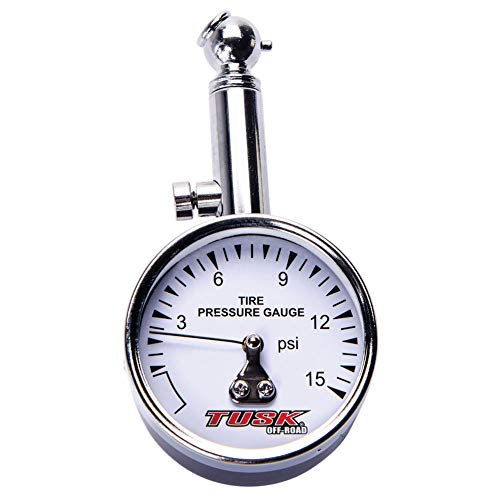
The tiny 8-ounce dial gauge that nails ultra-low pressures for ATV and dirt tires.
When you are airing down a quad or a dirt bike to 5-8 PSI for sand or rock crawling, a standard gauge simply will not read accurately. The Tusk Low Pressure gauge is built specifically for that job, with a 3-15 PSI dial that gives you a precise, easy-to-read measurement where other gauges show a useless near-zero. Owners specifically note its precision at 5 PSI, catching uneven pressure between tires that a wider-range gauge would miss entirely.
Its biggest strengths are simplicity and portability. At 8 ounces with a compact plastic body, it slips into a tank bag or toolbox, and the included hard plastic case protects the dial face when it is rattling around the garage. The needle holds its position after you pull it off the valve, and a bleeder button lets you fine-tune pressure down to the exact readout. The analog dial needs no batteries, so it is always ready.
Read the range carefully before you buy: this gauge reads 3-15 PSI only, and using it above 15 PSI risks damage to the mechanism. That makes it a dedicated off-road tool, not an all-rounder, and owners describe the durability as mixed — some have had units break quickly, though the protective case helps. If your riding stays under 15 PSI, it is the right specialist for the job.
muddy rides: you exclusively run dirt, ATV, or UTV tires under 15 PSI and want a cheap, battery-free dial that reads true at 5 PSI.
gloved hands: you also ride street bikes — this gauge cannot handle anything above 15 PSI.
6. GERCHWAY Digital Tire Pressure Gauge
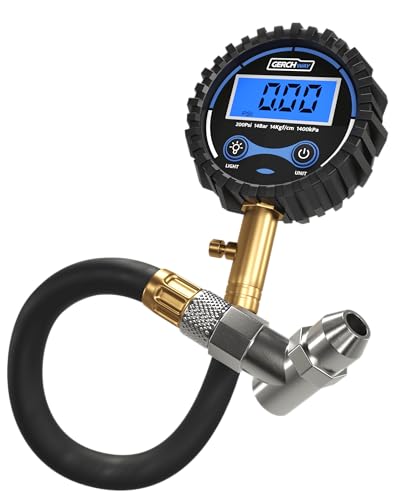
The 45-degree angled chuck that finally reaches those tucked-in motorcycle valve stems.
Motorcycle wheels have a way of hiding the valve stem behind a brake disc or a caliper, and that is exactly the problem this gauge solves. The GERCHWAY features a 45-degree angled chuck that reaches compact and hard-to-access valve stems on motorcycles and tight wheel setups, so you are not contorting your hand into the wheel. A 12-inch flexible hose adds extra reach for inner valve stems on dually and racing tires, and the bright backlit display is easy to read in the dark.
Accuracy is solid at ±1% across a 0-200 PSI range, with a resolution that owners describe as accurate and repeatable across multiple checks. The integrated air bleeder valve lets you release pressure precisely without removing the gauge from the stem, so you can bleed down from 40 PSI to 36 PSI in controlled steps. It comes with a storage bag, and the brass construction gives it a reassuring heft.
Durability is mixed, with some units arriving damaged in shipping, so inspect the chuck on arrival. It tops out at 200 PSI, which covers bikes and most trucks but not heavy commercial tires. The 6-month warranty is shorter than the ETENWOLF’s 2-year coverage, though the design focus on valve access makes it the right call for riders who fight for stem clearance every ride.
clearance-friendly design: the 45-degree chuck and 12-inch hose make this the easiest gauge to get onto a cramped motorcycle valve stem — accuracy of ±1% seals the deal.
limited PSI range: shipping damage is the recurring complaint, so check the angled chuck bends correctly before your first use.
7. CZC AUTO Digital Tire Inflator, Dual Head

The compressor-side inflator with two chucks, built for anyone who owns an air pump.
If you already have a compressor and want an inflator that connects with standard 1/4-inch NPT fittings, the CZC AUTO Dual Head is a functional workhorse. It carries a 13-inch heavy-duty rubber hose rated to 250 PSI, a frosted aluminum handle, and the distinguishing feature here: dual head chucks, so you have a backup or a second connection style without buying another tool. The 3-in-1 design tests pressure, deflates via a brass bleeder button, and inflates with a chrome-plated iron thumb trigger.
Accuracy holds to the ANSI B40.1 Grade B standard at ±2%, with a resolution of 0.1 PSI across four units (PSI, kg/cm², bar, kPa). Owners who checked it against a known reference gauge found it “accurate within 0.1 psi,” and the large blue backlit LED screen is easy to read in dim conditions. It takes 2 AAA batteries, auto-powers when connected to a valve, and shuts off after 20 seconds of inactivity to save power.
The recurring trade-offs are battery drain and slower airflow. Some customers note the gauge kills batteries within a month if left installed, so pull them between uses, and the air flow gets mixed marks for speed when filling larger tires. It is also the heavier pick of the CZC AUTO pair at 14.4 ounces — 36% heavier than the Milton’s 10.56 ounces. For compressor owners who want a budget dual-chuck inflator, it gets the job done without fuss.
two-vehicle homes: home mechanics with a compressor who want a budget-friendly dual-chuck inflator and do not mind removing batteries between sessions.
minimalists: you want a single portable gauge for the bike — this is a shop tool, and the battery drain is your main maintenance task.
8. CZC AUTO Digital Tire Inflator, 250 PSI

The entry-level digital inflator that brings backlit readings to any compressor setup.
This is the most affordable way to get a backlit digital pressure readout on your compressor. The CZC AUTO 250 PSI model carries a frosted aluminum handle, a 13-inch rubber hose, and a straight brass lock-on chuck that grips the valve stem securely. It inflates with a chrome-plated thumb trigger, deflates with a brass bleeder button, and measures across four units with a 0.1 PSI resolution, calibrated to the ANSI B40.1 Grade B standard at ±2% accuracy.
For the price, owners find a lot to like. The large blue backlit numbers are a genuine upgrade over a stick gauge, making night checks and dim garage work far easier. Reviewers point out it reads accurately to the half-pound, holds a seal at the brass chuck, and inflates tires quickly when connected to an air pump. It runs on 2 AAA batteries (not included), auto-powers when it senses pressure, and shuts off after 20 seconds of inactivity.
The honest limits are the 5 PSI reading floor and the 14.4-ounce weight. The display “doesn’t start show psi till 5psi,” so this is not the gauge for ultra-low dirt pressures, and at 14.4 ounces it is heavier than the Milton’s 10.56 ounces despite carrying a shorter 13-inch hose. It is also built with a mix of aluminum, brass, and rubber rather than all-steel, so it feels less premium in hand. For simple street-bike pressure checks and inflation at a compressor, it delivers solid value.
truck owners: a budget digital inflator with a bright backlit display and solid ±2% accuracy for street pressures above 5 PSI.
sedan users: you need to read low off-road pressures or want a lighter, all-steel tool.
9. AZUNO Digital Tire Inflator with Pressure Gauge
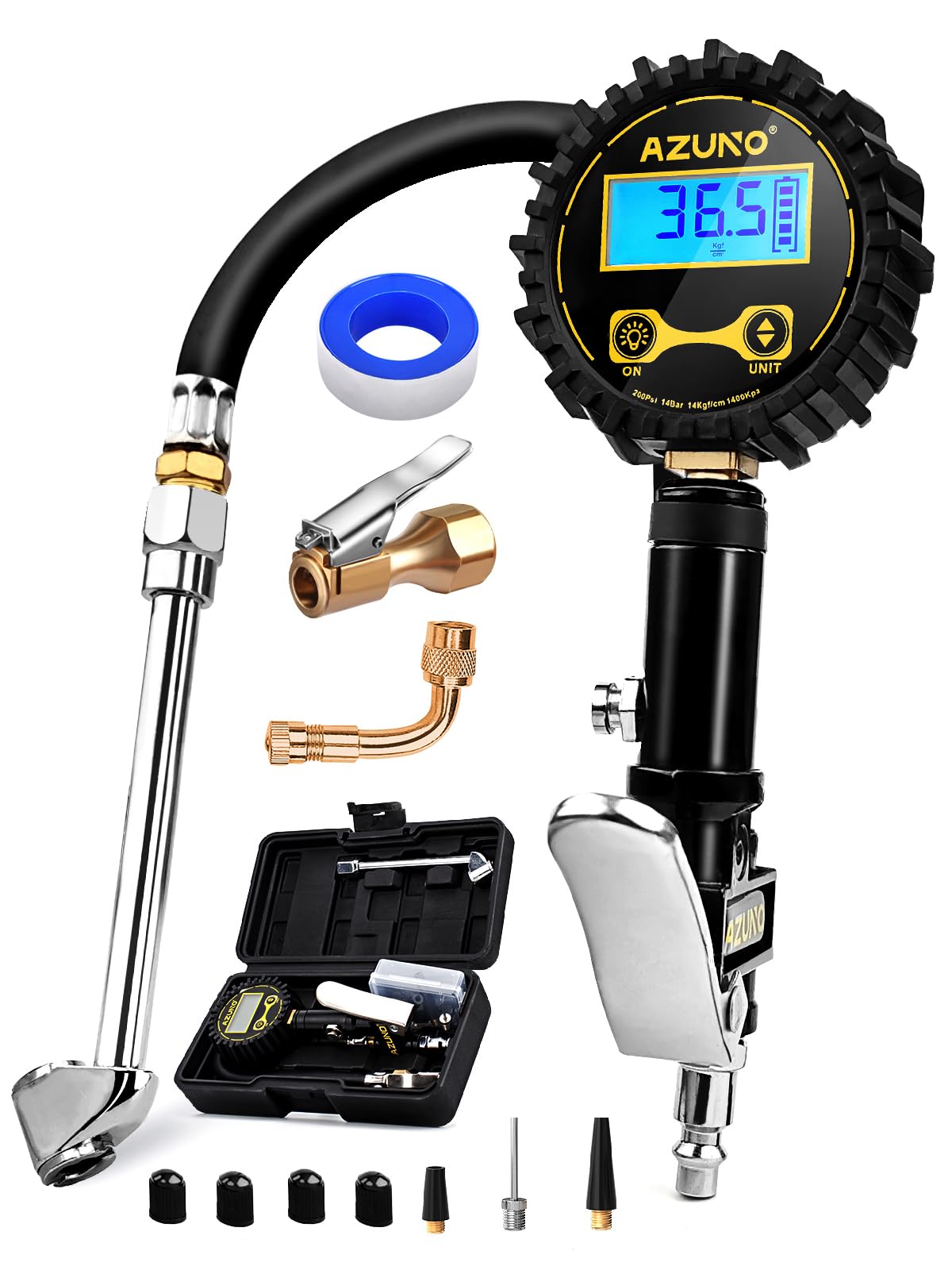
A complete inflation kit in a carrying case, ready for every vehicle you own.
This is the one-box solution for the rider who wants the whole package organized and ready to go. The AZUNO digital inflator includes a portable carrying box that keeps the gauge, hose, and chuck together, so nothing gets lost between the garage and the road. It reads stably within 1% of exact pressure at a 0.1 display resolution, and the wide backlit LCD shows large numbers across four units — PSI, KPA, Bar, or Kg/cm² — so the readout works for whatever spec you are chasing.
The workflow is straightforward: press the trigger to inflate, press the air bleeder to deflate, and watch the numbers update on screen in real time. Owners appreciate that it saves time by measuring pressure while adding air, rather than checking with a separate gauge. The construction covers construction vehicles, large trucks, SUVs, cars, and motorcycles, so one kit can serve the whole driveway.
The main complaint is air leakage at the connection, so check the fittings on arrival. It is also the heaviest pick here at 1.5 pounds, though the carrying box makes the weight easy to manage. If you want a grab-and-go kit with an organized case rather than a bare gauge, this fits the bill.
roadside kits: a self-contained inflator kit in a box that handles everything from motorcycles to trucks with a bright 4-unit display.
stationary use: you already own a compressor hose setup and just need a bare gauge — the integrated kit is more than you need.
Understanding the Specs
Accuracy Grades
Digital gauges cite standards like ANSI B40.7 Grade 2A, which means the reading holds within about ±1 PSI of true pressure. Tighter claims like ±0.5% mean less error, which matters most when you are bleeding down to a precise low pressure for off-road riding.
Chuck Types
A lock-on clamp chuck grips the valve stem so you can read, inflate, and bleed with one hand. A 360-degree swivel head helps reach awkward valve angles, while a 45-degree angled chuck on a hose is best for stems tucked behind brake discs.
FAQ
What PSI range do I need for a motorcycle tire gauge?
Is a digital or dial gauge better for motorcycles?
How do I get a leak-free seal on a motorcycle valve stem?
Can I use a car tire gauge for my motorcycle?
Why does my digital gauge show zero below 5 PSI?
How long do digital tire gauge batteries last?
What does ANSI B40.7 Grade 2A accuracy mean?
Can one gauge handle both my motorcycle and my truck?
Final Thoughts: The Verdict
For most riders, the motorcycle tire gauge winner is the Milton 507KIT because it pairs genuine 0.1 PSI resolution with a leak-free lock-on chuck and a steel body built for years of garage use. If you want the tightest accuracy in a portable package, grab the ETENWOLF T600 with its ±0.5% rating. And for off-road riders chasing precise 5-15 PSI trail pressures, the JACO Elite is the one to reach for.
How We Picked
We do not accept paid placement. Every pick is matched to a real buyer and a real use-case; we do not hands-on test units.
Sources & Methodology
Specifications: manufacturer listings and product documentation. Review insights: verified customer reviews, as of August 2026. Pricing: not shown on this page (it changes often); check the current price via the retailer link.
As an Amazon Associate, Trending Car earns from qualifying purchases. This does not affect which products we feature.