
Our readers keep the lights on and my garage snacks stocked. As an Amazon Associate, I earn from qualifying purchases.
Specs are compiled from manufacturer listings and verified buyer reviews and can change over time — please confirm the key details on the product page before buying.
Nothing kills a riding season faster than a bike that won’t fire after months in the garage. That stale, varnish-coated fuel in your tank is the culprit, and the right additive stops it before it starts. This guide compares the top stabilizers by how long they keep fuel fresh, how they handle ethanol, and what owners actually experience after a long winter.
I’m Min Islam — the founder and writer behind Trending Car. This guide is built by comparing the manufacturers’ published specifications and the patterns across verified customer reviews, so you get each pick’s real strengths and trade-offs instead of marketing spin.
We’ve broken down the top formulas that keep your tank ready to roar after storage. Find the right motorcycle fuel stabilizer for your bike and riding habits.
Our Picks at a Glance


How To Choose The Best Motorcycle Fuel Stabilizer
Fuel stabilizers are a simple purchase, but picking the wrong one means a gummed-up carburetor come spring. The core job is to stop gasoline from oxidizing into sticky varnish while your bike sits. There are three things that separate a good one from a great one.
Storage Time and Freshness
Check how long the formula keeps fuel usable. Some stop fuel degradation at 12 months, while top-tier options hold it fresh for up to 24 months. If you only park your bike for a few winter months, a shorter window is fine. If you occasionally let a bike sit for a year or more, you want the longest shelf life available.
Ethanol and Corrosion Defense
Modern pump gas with ethanol absorbs moisture from the air, which can lead to phase separation and corrosion in your tank. Look for an alcohol-free formula that specifically combats these issues. These stabilizers protect the metal in your fuel system and carburetor from rust and corrosion while the bike sleeps.
Dosage and Engine Type
Pay attention to how much fuel one bottle treats. A small 8-ounce bottle might be perfect for a couple of bikes, while a 32-ounce jug treats 80 gallons. Also confirm the formula is designed for your engine, whether that is a modern fuel-injected inline-four or a classic 2-cycle bike.
Quick Comparison
| Model | Best For | Storage Lifespan | Bottle Size | Fuel Capacity | Amazon |
|---|---|---|---|---|---|
| STA-BIL Storage★ Best Overall | Long-term winter storage | Up to 24 months | 32 oz | 80 gallons | Amazon |
| Yamalube Stabilizer PlusOEM Pro Pick | E10 fuel protection | Up to 1 year | 12 oz | — | Amazon |
| HappyFuel PremiumClassic Choice | Classic cars & bikes | Season-long | 3.89 oz can | — | Amazon |
| Honda Fuel Stabilizer | OEM Honda reliability | Up to 1 year | 8 fl oz | 80 gallons | Amazon |
| Yamalube Stabilizer Plus (12 oz) | Carbon deposit removal | — | 12 oz | — | Amazon |
| Mercury Quickare | Regular fill-up use | Up to 3 months | 12 oz | 10 gallons per oz | Amazon |
| Star Tron Enzyme | Reviving old fuel | Up to 2 years | 8 oz | 16 gallons per oz | Amazon |
| Yamalube Stabilizer (32 oz) | Multi-engine households | — | 32 oz | — | Amazon |
In‑Depth Reviews
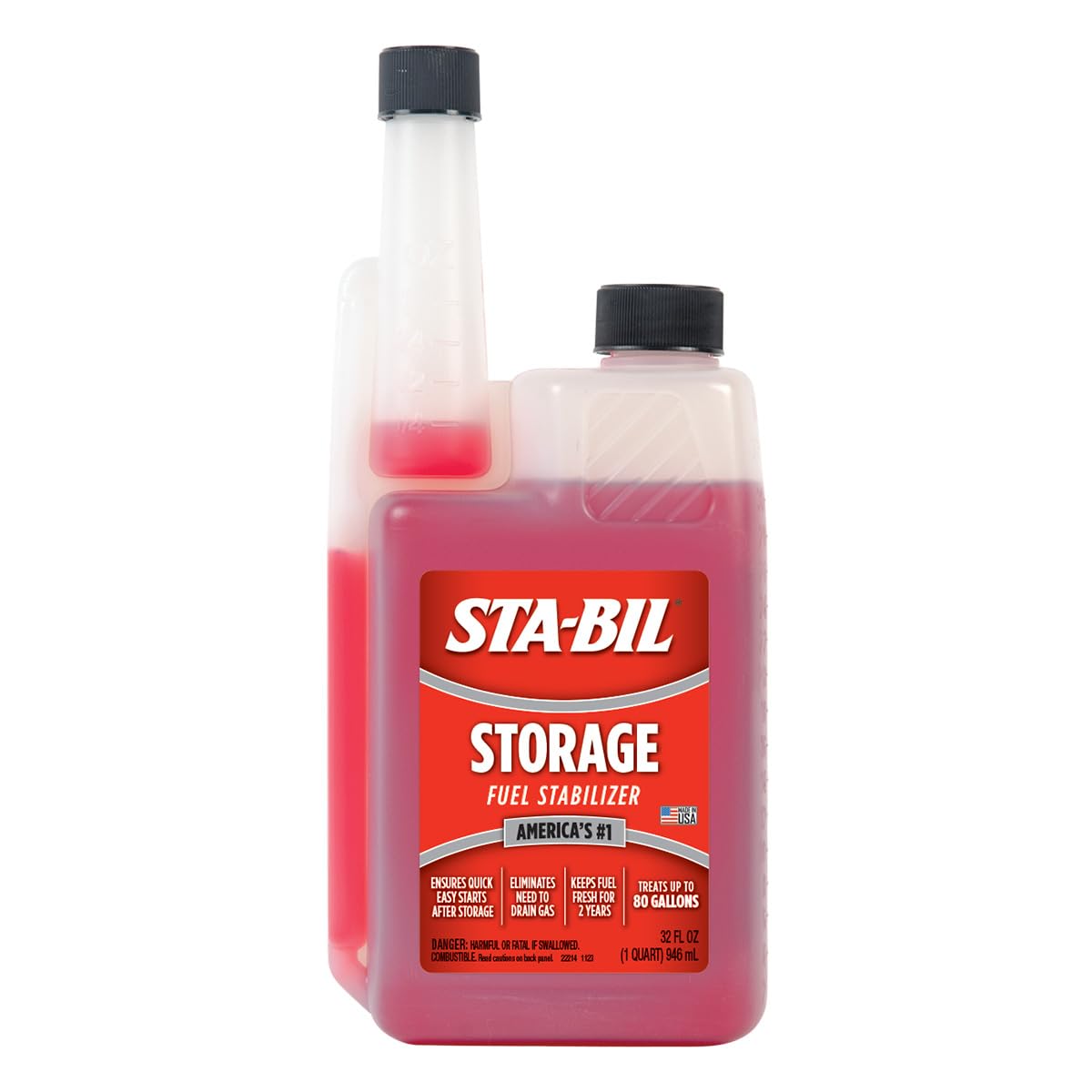
1. STA-BIL Storage Fuel Stabilizer
Our pick — over 4.5★ from 36,000+ verified ratings; the strongest balance of quality and price.
The crowd-favorite giant that keeps a tank ride-ready for two full years.
This is the bottle most riders reach for before hibernation, and for good reason. It holds gasoline fresh for up to 24 months, which is the longest guarantee on this list and beats the Yamaha’s 1-year window handily. You pour 1 oz for every 2.5 gallons of gas, run the engine for 5 minutes to circulate it, and forget about the bike until spring.
The formula is alcohol-free, so it plays nice with ethanol blends from E-10 through E-85, and it actively prevents the gum, varnish, and rust that clog fuel lines. At 1.83 pounds, the 32-oz jug treats up to 80 gallons—enough for a bike, mower, and snow blower from a single bottle. Owners confirm the magic: a lawnmower that started instantly after winter storage, ran smoothly with no gunk, and stayed that way for three straight years on a single habit.
The recurring sentiment is that it “takes the water out of the gas” and cleans carburetor bowls and jets, making it a maintenance staple beyond just storage. It’s also noted as a better value than big-box store prices, and one bottle lasts years for a typical rider. The only mild grumble is that it can feel a little pricey at checkout, though the hundreds saved on avoiding fuel-system repairs more than balance that.
Why It Wins
- Industry-leading 24-month fuel freshness for deep winter storage
- Huge 80-gallon capacity from one 32-oz bottle
- Effective in all gasoline, including E-10 through E-85 blends
Before You Buy
- Some find the per-bottle cost slightly higher than store brands
- Overkill if you only store the bike for a month or two
Grab it if: you park the bike for the full winter and want the longest protection available.
Think twice if: you only take a short break from riding—a smaller, cheaper dose would do.
2. Yamaha Yamalube Outboard Fuel Stabilizer & Conditioner Plus
The factory-blessed cure-all that straightens out rough-running engines everywhere.
When the manufacturer that builds wave runners, leaf blowers, and outboards puts its name on a stabilizer, riders listen. This 12-ounce bottle is strongly recommended for E10 fuels, using an alcohol-free formula that stops fuel oxidation and phase separation when ethanol absorbs moisture. Buyers report a favorite trick: a tank of fresh gas with this additive “straightens things out” and delivers a smooth-running machine again.
The metal filmers provide extensive protection for steel and aluminum components, and it doubles as a corrosion inhibitor for carburetors and fuel systems. It even prevents carburetor icing and gas line freeze, so you don’t need to drain the tank for storage. At 12.6 ounces, it is the heavier bottle in the Yamaha lineup, packing more additive per pour than the Fuel Med’s 8-ounce size.
Continuous use keeps fuel fresh, potent, and free from gum and varnish for up to one year of storage. Users note it “helps with fuel mileage” and call it a must-have for ethanol fuel, adding just a little to every fill-up. There’s a reason the Yamaha-specific formula is a fixture in marine tanks and motorcycle garages alike.
OEM confidence: If you want a factory-engineered formula that protects steel, aluminum, and carburetors while reviving rough runners, this is the pick.
Overkill check: Its 1-year freshness window is shorter than STA-BIL’s 24 months, so extreme long-term storage leans the other way.
3. HappyFuel Premium Fuel Stabilizer
A pint-sized power can built by classic car owners who swear by its one-shot kick.
At just 3.89 ounces and packed in a tiny metal can, this is the lightest and most compact stabilizer here—smaller by a 3.2x weight gap than the Yamaha 12-ounce bottle, and a 2.9x dimension gap versus the big STA-BIL jug. Its creators are long-standing members of the classic car community, and they use it exclusively in their own vehicles. The pitch is simple: pour a full can into the tank, fill up with gasoline, and store the bike.
The science is real. It was tested against ASTM D525, the standard for oxidation stability, and its chemistry tackles fuel storage from four angles: bonding with gasoline to prevent evaporation, forming a protective metal layer against corroding water, scavenging water to stop tank-bottom deposits, and preventing corroded metal ions from destabilizing the fuel. Owners mention it “helps significantly with the ethanol blended fuels” and works better than other products they’ve tried.
The proof is in the starts. A 2018 Harley-Davidson FLHXS that had engine popping on downshifts ran cooler and smoother after one dose of this “Happy juice.” A collector car fires right up and runs great the first time every spring. If you want a stabilizer that fits in a pocket and disappears into the fuel system, this is it.
The Standout Bits
- Ultra-compact 3.89-oz metal can is easy to stash on the bike
- Backed by ASTM D525 oxidation stability testing
- Four-part chemistry tackles evaporation, corrosion, and water
The Trade-off
- Small bottle means less total fuel treated per purchase
- One-shot full-can dosage suits single-tank storage best
Reach for this if: you store a classic bike or car and want meticulous chemical protection in a tiny package.
Look elsewhere if: you need to treat multiple engines—a bigger bottle covers more ground.
4. Genuine Honda Fuel Stabilizer & Corrosion Inhibitor
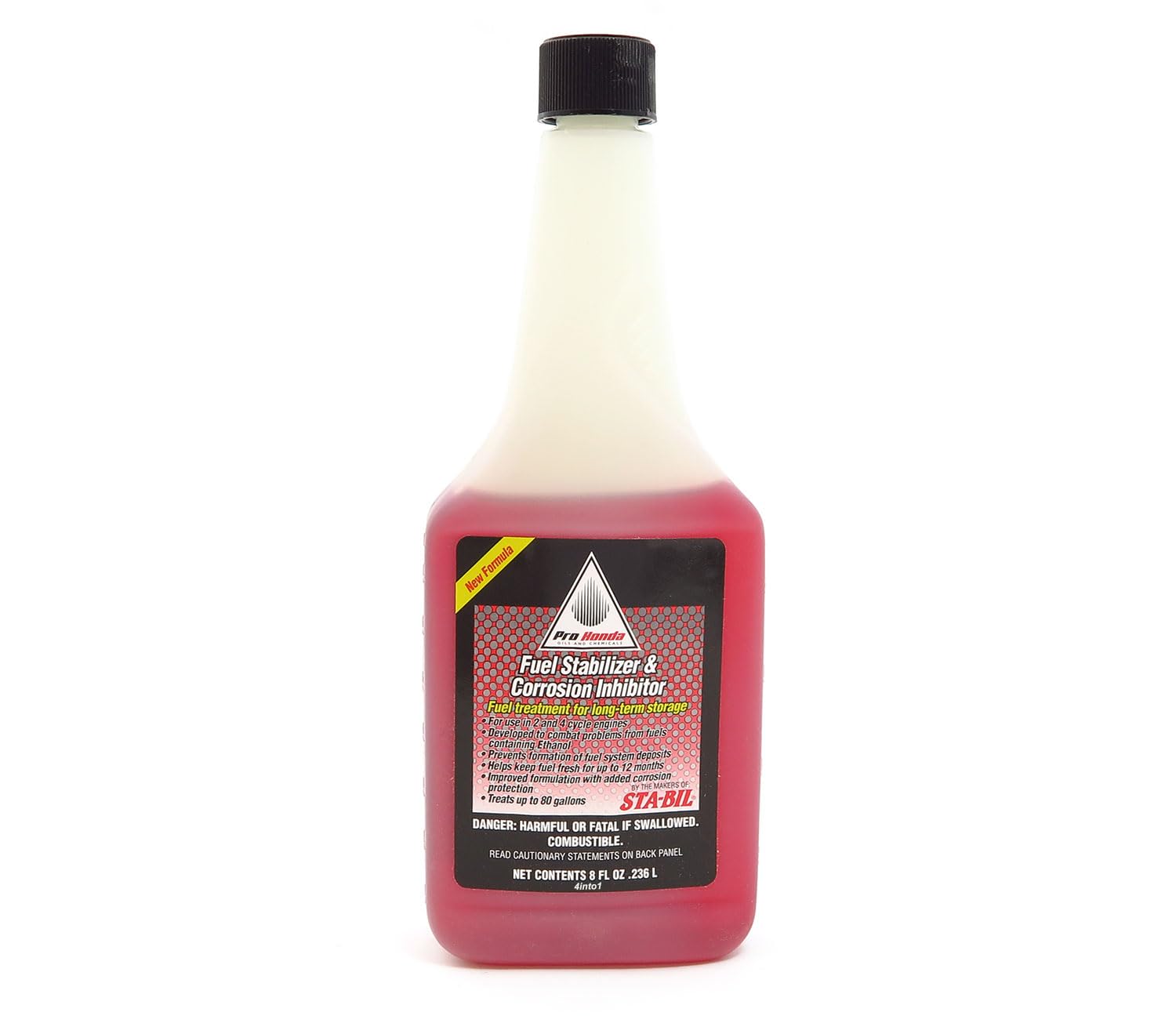
The factory-fresh Honda formula that ticks off every box for long-term storage.
If you ride a Honda, this is the exact part number (08732-0800) the dealership would hand you. It’s a genuine OEM stabilizer and corrosion inhibitor, and it’s a bargain relative to other factory bottles. The math is clean: add 1 oz to every 5 gallons of fuel, and it keeps the gas stable for up to a year of storage.
The 8-fluid-ounce bottle treats up to 80 gallons, matching the big STA-BIL jug’s capacity with a quarter of the size. It works in both 2-cycle and 4-cycle engines, and it was developed specifically to combat problems from fuels containing ethanol. A rider putting a Honda ADV160 to bed for winter called it “glad to use a Honda product to keep my fuel fresh over the cold months.”
For those who trust factory engineering over aftermarket chemistry, this delivers. It’s a quality product at a great price, well-packaged, and it holds a perfect streak in buyer satisfaction. If your garage is Honda-heavy, this is the stabilizer that belongs in it.
Factory trust: You pay for the Honda name and get a genuine part that’s proven in 2-cycle and 4-cycle engines.
Freshness ceiling: The 1-year storage window is shorter than the 24-month leaders, so multi-season parking needs a stronger formula.
5. Yamalube Fuel Stabilizer & Conditioner Plus (12 oz)
The Yamalube formula that fights carbon deposits while it stabilizes your fuel.
This 12-ounce bottle pairs fuel stabilization with a serious cleaning job. It improves power and efficiency in two- and four-stroke engines by removing and preventing carbon and varnish deposits from injectors, carburetors, intake valves, intake ports, and combustion chambers. Those deposits come from poor fuel quality, and this formula tackles them directly.
It even combats the corrosive elements of sulfur in ethanol-blended fuels, adding another layer of protection. Yamaha recommends pairing it with the Yamalube Plus Fuel Stabilizer and Conditioner to avoid any harmful effects. At 12.32 ounces, it’s a similar size to the standard Yamaha stabilizer but with an added cleaning punch.
Owners call it a “great product with easy instructions” and simply “the best.” The one caution flag comes from the vendor side rather than the chemistry—there was a case of poor packaging where a container shipped without its screw-on top, the aluminum seal alone holding the liquid in. Treat it as a shipping check, not a product flaw.
What It Adds
- Removes and prevents carbon and varnish build-up
- Works in both 2-stroke and 4-stroke engines
- Combats sulfur corrosion in ethanol-blended fuel
Watch For
- An occasional unit ships with a missing cap—check the seal on arrival
- Designed to pair with a separate Yamalube stabilizer for full coverage
Choose this if: your bike has carbon build-up or you want a cleaner alongside your stabilizer.
skip it if: you need pure storage stabilization—the standard Yamalube does that alone.
6. Mercury Quickare Fuel Treatment Additive
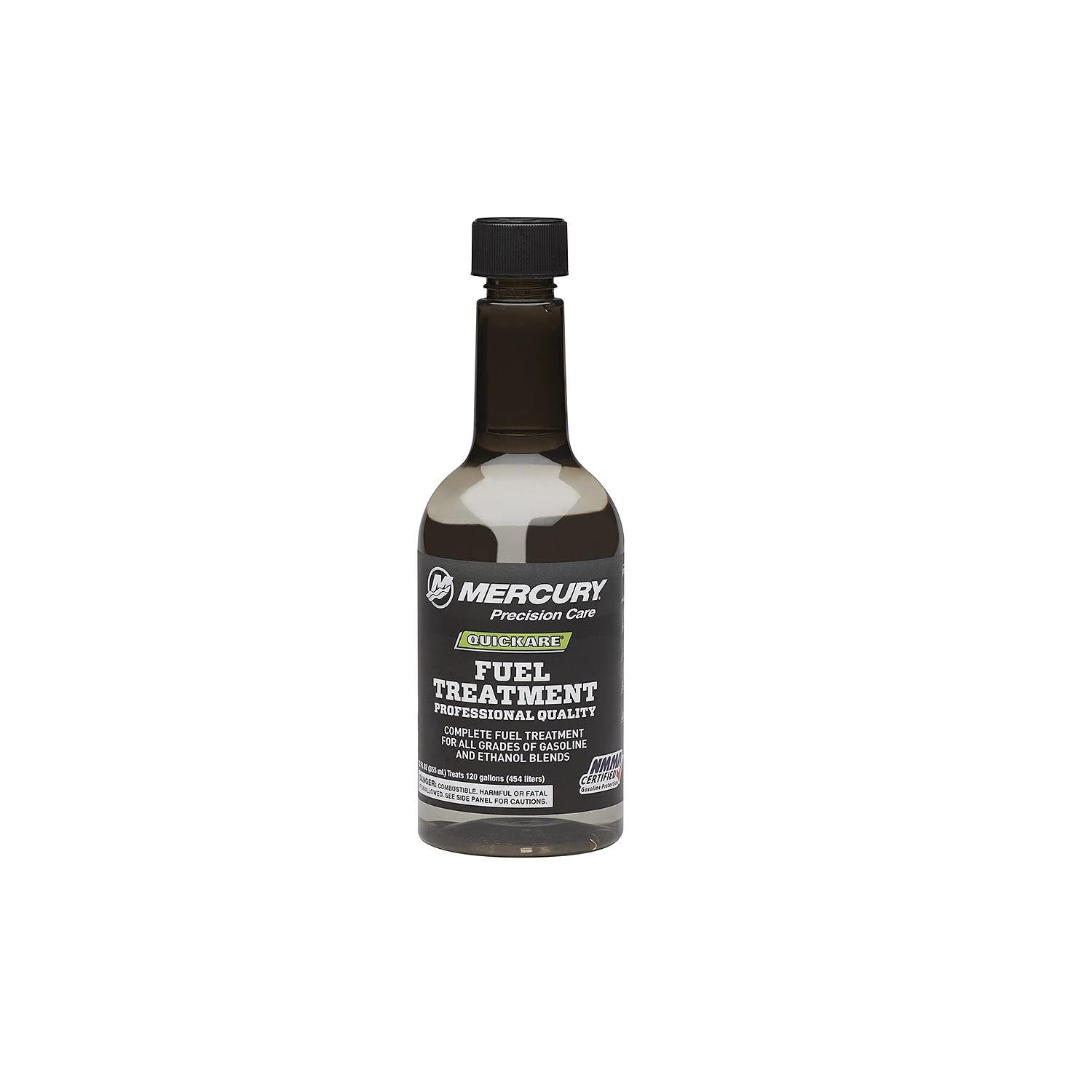
The every-fill-up additive that keeps fuel honest for three months at a time.
Mercury positions this as a maintenance companion, not just a storage tool. It helps keep fuel fresh between fill-ups for up to 3 months, and it cleans existing varnish and gum deposits in fuel lines, tanks, carburetors, injectors, intake valves, and spark plugs. The dose is lean—just 1 ounce treats 10 gallons of gasoline, so this 12-fluid-ounce bottle goes a long way.
It helps control corrosion, gumming, and varnish build-up, along with the phase separation associated with ethanol-blended gasoline. The brand’s marine heritage shows: a boater running a 250 HP Yamaha SHO adds it “every time I fill up” to keep the engine running smoothly. It’s also noted as working better than a certain big-name stabilizer, a direct nod in the review pages.
For riders who want a formula they can pour at every fuel stop rather than only before storage, this fits. It’s backed by Mercury’s decades of marine engineering, and buyers consistently call it good value. The 3-month freshness window is the shortest here, so it’s built for regular riding, not long hibernation.
Daily driver: Ideal for treating every tank to prevent build-up before it starts.
Not a winterizer: With just 3 months of freshness, it won’t protect a bike parked for six months.
7. STAR BRITE Star Tron Enzyme Fuel Treatment

The enzyme-based revitalizer that wakes up old, sub-spec fuel.
This is the most technically distinct formula on the list. Instead of just preventing problems, Star Tron uses enzyme technology to cure them—it helps engines start more reliably and run cleaner, even after periods of inactivity. It stabilizes fuel up to 2 years and can help rejuvenate old, sub-spec fuel, making it the pick for rescuing a tank that’s already gone stale.
The dosage is remarkably economical: just one fluid ounce per sixteen gallons of fuel. That makes this 8-ounce bottle stretch further than almost anything else here. It disperses water throughout fuel as submicron-sized droplets cleared while the engine runs, preventing the phase separation that plagues ethanol blends in humid conditions. Customers note it fixed hard-starting outboards by clearing clogs and gumming in small fuel jets.
The real-world results are striking. Harleys idle better after treatment, with owners noting fuel economy gains of 1-2 mpg. It’s been used for 10+ years in boats, mowers, snow blowers, generators, and trucks without a single bad-gas incident. One enthusiast called it “the best fuel treatment I’ve used for stabilizing fuel long-term,” praising its active enzyme for clearing deposits where other stabilizers fall short.
Why It Stands Out
- Enzyme tech cures existing deposits, not just prevents new ones
- Ultra-lean 1 oz per 16 gallons makes the bottle last
- Stabilizes up to 2 years and rejuvenates old fuel
Consider This
- Higher upfront cost per bottle than basic stabilizers
- Enzyme approach may be overkill for casual short-term storage
Pick this if: you want a do-it-all treatment that rescues old fuel and clears existing gum.
Reconsider if: you only need simple winter protection—a basic stabilizer does that for less.
8. Yamaha Yamalube Fuel Stabilizer & Conditioner (32 oz)
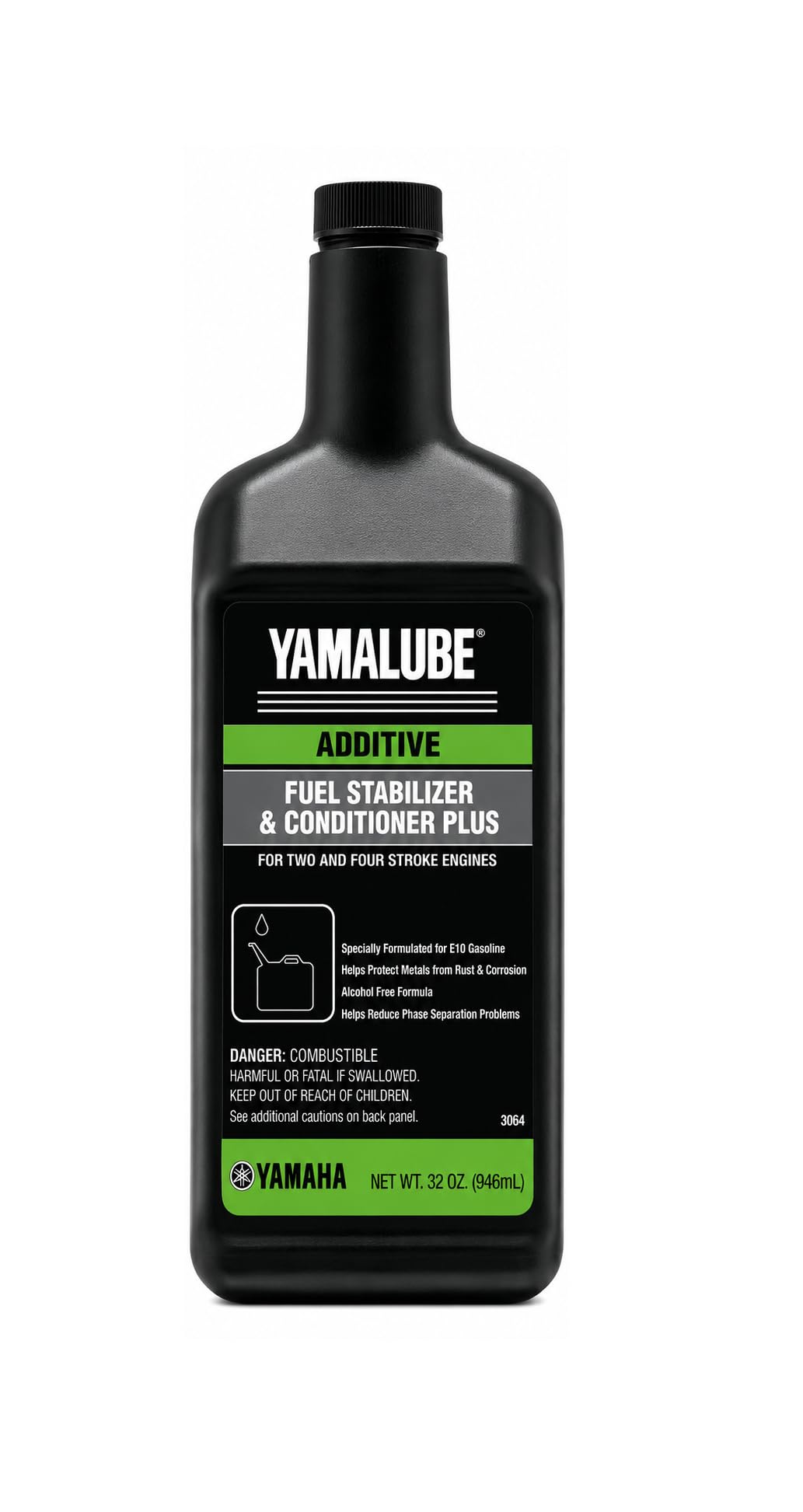
The big-bottle Yamalube that serves an entire garage full of engines.
This is the family-size edition of the Yamaha stabilizer, and it’s the one to grab when you maintain more than just a motorcycle. At 1.96 pounds with a 32-ounce capacity, it matches the STA-BIL jug’s footprint but carries the Yamaha factory formula. It’s the newest addition to the lineup, appearing on shelves in late 2023.
The application is broad. A long-time user runs it in Yamaha motors, then a Mercury and a Suzuki motor, calling it something that “can save your motors.” Another has trusted it for ten years “with no fuel related issues.” Whether you’re treating a 115HP outboard or a weekend cruiser, this formula holds its own across brands.
Quality and value-for-money are the recurring themes in the feedback, and the larger bottle means you’re not reordering every season. For a household with a bike, a mower, and maybe a boat, this single jug covers them all. It’s the cost-per-dose champion among the Yamaha options, with all the OEM engineering you’d expect.
Garage staple: One 32-oz jug handles multiple engines and multiple seasons of storage.
Brand lock: It’s a Yamaha formula, so die-hard owners of other brands might prefer a universal option.
Understanding the Specs
Storage Lifespan
This is the number that tells you how long treated fuel stays fresh. The leaders here hold gasoline for up to 24 months, while others stop at one year or even three months. Match the window to how long your bike actually sits—a full winter needs the 24-month formulas, while a short break can get by with less.
Treat Rate and Capacity
The dosage tells you how far a bottle goes. STA-BIL uses 1 oz per 2.5 gallons to treat 80 gallons total, while Star Tron stretches to 1 oz per 16 gallons. A bigger treat rate means a smaller, cheaper bottle covers more fuel, which matters if you’re stabilizing several machines at once.
FAQ
How much fuel stabilizer should I add to my motorcycle?
Will a fuel stabilizer fix fuel that has already gone bad?
Is there a difference between STA-BIL and Star Tron?
Can I leave a stabilizer in my tank all riding season?
How long does treated fuel actually stay fresh?
Will this damage my fuel-injected motorcycle?
Do I need to drain my tank before using a stabilizer?
Is a motorcycle-specific stabilizer better than a universal one?
Final Thoughts: The Verdict
For most riders, the motorcycle fuel stabilizer winner is the STA-BIL Storage because it combines the longest 24-month freshness window with a massive 80-gallon capacity. If you want factory-engineered protection for ethanol-heavy fuel, grab the Yamaha Yamalube Outboard Stabilizer. And for rescuing a stale tank or clearing years of gum, the Star Tron Enzyme is the one to reach for.
How We Picked
We do not accept paid placement. Every pick is matched to a real buyer and a real use-case; we do not hands-on test units.
Sources & Methodology
Specifications: manufacturer listings and product documentation. Review insights: verified customer reviews, as of August 2026. Pricing: not shown on this page (it changes often); check the current price via the retailer link.
As an Amazon Associate, Trending Car earns from qualifying purchases. This does not affect which products we feature.