
Our readers keep the lights on and my garage snacks stocked. As an Amazon Associate, I earn from qualifying purchases.
Specs are compiled from manufacturer listings and verified buyer reviews and can change over time — please confirm the key details on the product page before buying.
A dead battery turns a ride into a roadside wait. A weak battery strands you at the trailhead, gas station, or garage. This guide cuts through the chemistry to find a battery that starts reliably, holds a winter charge, and fits your bike.
I’m Min Islam — the founder and writer behind Trending Car. This guide is built by comparing the manufacturers’ published specifications and the patterns across verified customer reviews, so you get each pick’s real strengths and trade-offs instead of marketing spin.
The choice depends on cold cranking amps, physical fit, and chemistry—AGM, GEL, or lithium. After analyzing the data, these are the best motorcycle battery choices for different bikes and budgets.
Our Picks at a Glance


How To Choose The Best Motorcycle Battery
Choosing a battery isn’t just about price. It’s about matching chemistry, size, and cranking power to your engine and riding style. A scooter battery won’t crank a big V-twin, and a lithium unit can fry in an old bike with an unregulated charging system.
Match the chemistry to your use
Most modern batteries are sealed AGM (Absorbed Glass Mat) — they are spill-proof, maintenance-free, and hold a charge well during storage. GEL batteries use a thick paste instead of liquid acid; they handle deep discharges and extreme temperatures better but need a gentle charger. Lithium (LiFePO4) is the lightweight king — lighter than lead-acid with massive cranking amps, but it requires a stable charging system under 15.0V and a compatible lithium charger.
Cold cranking amps (CCA) matter most
CCA tells you how much starting power the battery can deliver in cold weather. A small 250cc bike might only need 135 CCA, while a big Harley or a high-compression sportbike needs 300 CCA or more. If you live in a cold climate or let the bike sit for weeks, go higher on CCA rather than lower.
Physical fit is not optional
Motorcycle battery trays come in standard BCI sizes (YTX9-BS, YTX12-BS, YTX20L-BS, and so on). Measure your old battery’s length, width, and height, and check the terminal layout — positive on the left or right. A battery that is one inch too tall will not close the seat, and reversed polarity will fry the electronics.
Quick Comparison
| Model | Best For | CCA | Capacity (Ah) | Weight | Amazon |
|---|---|---|---|---|---|
| Yuasa YUAM32ABS YT12A-BS★ Best Overall | Proven longevity | 175 CCA | 10 Ah | 7.7 lbs | Amazon |
| Mighty Max YTX9-BS GELCompact Power | Budget GEL upgrade | 135 CCA | 8 Ah | — | Amazon |
| ExpertPower YTX12-BS AGMBest Value | Best value 12Ah | — | 12 Ah | — | Amazon |
| Weize YTX20L-BS | High CCA for big bikes | 300 CCA | 18 Ah | 12.8 lbs | Amazon |
| UPLUS YTX20HL-BS | Premium value AGM | 310 CCA | 18 Ah | 13.1 lbs | Amazon |
| Yuasa YUAM329BS YTX9-BS | OEM-grade AGM | — | — | 4 lbs | Amazon |
| TYKOOL LFP10S-STD Lithium | Lightweight lithium | 300 CCA | 5 Ah | ~2.2 lbs | Amazon |
| Deka ETX20L | Proven big-V power | 310 CCA | 18 Ah | — | Amazon |
| Anti-Gravity AG-ATZ-10-RS | Top-tier lithium with restart | — | — | 1.18 kg | Amazon |
In‑Depth Reviews
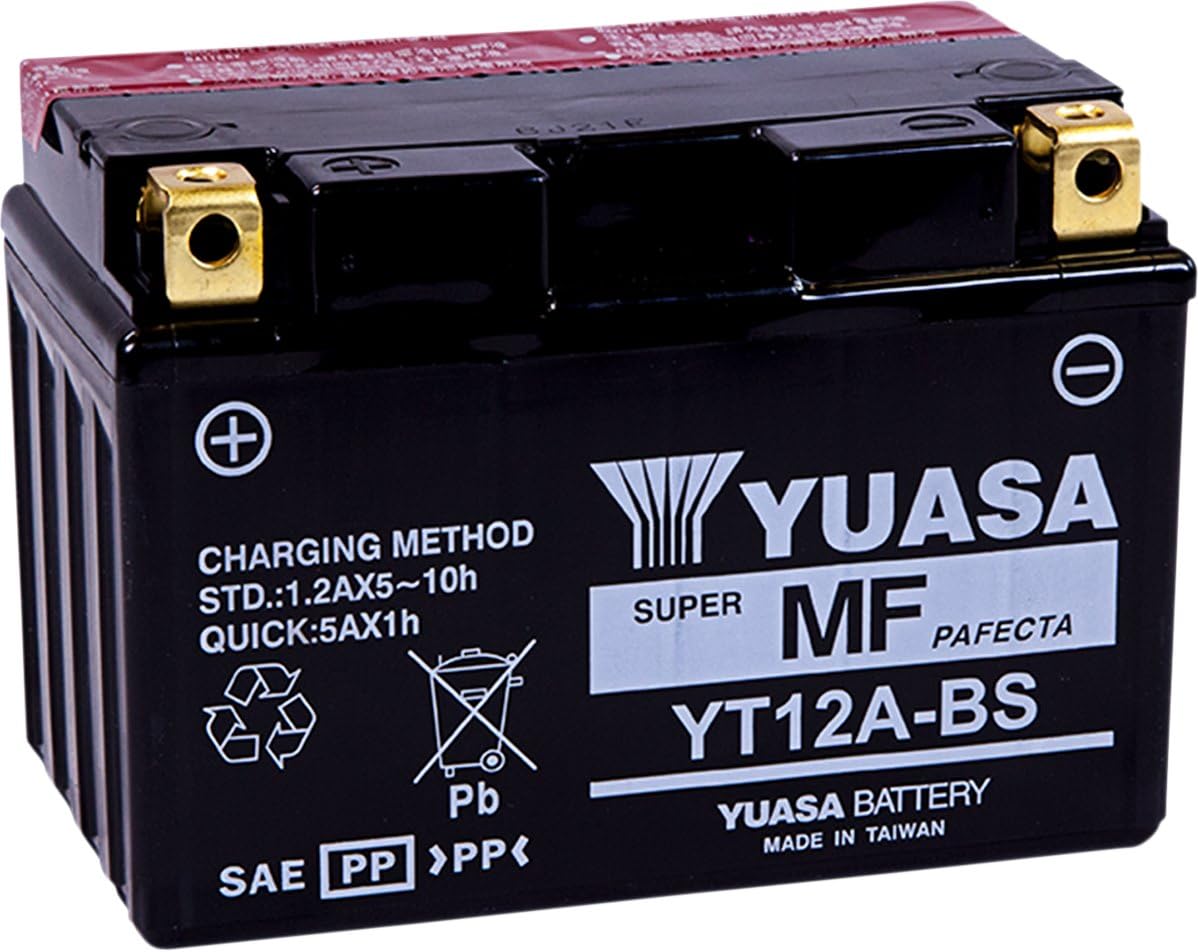
1. Yuasa YUAM32ABS YT12A-BS Battery
Our pick — over 4.5★ from 500+ verified ratings; the strongest balance of quality and price.
The crowd-favorite workhorse delivers reliable starts year after year.
What wins people over is the consistency — this is the battery that, as the review pages sum it up, “with a tender during the off season, they last ~5 years.” That is a half-decade of reliable starts for a modest upfront investment. The 175 CCA and 10 amp-hour rating are plenty for a standard street bike, and the advanced lead-calcium chemistry holds specific gravity (the measure of charge readiness) more than three times longer than conventional lead-antimony batteries.
The YT12A-BS is sealed and spill-proof from the factory. The dimensions are 3.43″D x 5.91″W x 4.13″H, so it fits specific slots, not universal ones.
At 7.7 pounds, it is not the featherweight option, but the crowd values toughness over lightness. The recurring praise is that a properly maintained Yuasa simply does not quit. This is the OEM-grade choice for riders who want to install it once and forget about it for years.
Built to Last
- Proven 5-year lifespan with a tender
- 175 CCA with advanced lead-calcium hold
- Sealed, spill-proof, maintenance-free design
Check the Fit
- Vehicle-specific fit — measure your tray first
- Acid-fill requires careful assembly
- Heavier than a lithium alternative at 7.7 lbs
Your ride-or-die pick: Perfect for daily riders who want a battery they can trust for half a decade.
Not your pick if: You need a lightweight lithium upgrade for racing, or you own a vintage bike with an unregulated charging system.
2. Mighty Max Battery YTX9-BS GEL
A GEL powerhouse that punches above its small frame.
Unlike the standard AGM batteries most bikes use, this one packs a thick gel paste instead of liquid acid. That GEL construction makes it safer — less prone to leaks and harmful fumes — and more resilient in extreme temperatures. With 135 Cold Cranking Amps and 8 amp-hours, it is ideal for smaller engines including 150cc scooters and kids’ ATVs, where one owner reports it “works great after for over 6months” starting every time.
The Mighty Max measures just 5.9″D x 3.38″W x 4.25″H, which is a slim fit compared to the Yuasa YT12A-BS. It is a universal-fit design, so while it slides into many battery trays, you should still check dimensions. The slower self-discharge rate (a built-in advantage of GEL chemistry) means it holds its charge longer during storage than a standard AGM — helpful for seasonal riders who let the bike sit for weeks.
The trade-off is clear at the mid-range price point: while the battery is a fantastic value upfront, a small shop owner who sells dozens calls it “the best and most affordable battery I have found,” long-term reports show it may fade after a year or two, especially if it is not kept on a tender. This is a budget-friendly workhorse, not a decade-long investment.
Gel Advantages
- Superior in extreme heat and cold
- Thick non-spillable gel is safer to handle
- Slower self-discharge than standard AGM
Budget Realities
- 8 Ah capacity is lower than the ExpertPower 12 Ah
- Universal fit requires careful dimension checks
- Longevity may drop without winter maintenance
Scooter and ATV champion: If you need a cheap, tough battery for a small engine that lives outside, this is the smart buy.
Skip it for: A big touring bike or a daily commuter who needs high CCA and multi-year reliability without compromise.
3. ExpertPower YTX12-BS AGM
More amp-hours than the Mighty Max, and it ships ready to install.
It is a sealed AGM (Absorbed Glass Mat) battery, meaning the acid is absorbed into fiberglass mats between the plates. That makes it spill-proof, vibration-resistant, and completely maintenance-free. The factory-activated design means you open the box, connect the terminals, and ride.
The real-world feedback is consistent: “I finally got a decent battery that hasn’t died in a year.” Owners of ATVs like the Honda Recon 250 praise the perfect fit and the strong starting power. The dimensions are 5.91″ x 3.43″ x 5.12″, and it drops into any slot designed for a YTX12-BS, GTX12-BS, or UTX12-BS replacement. The AGM chemistry holds voltage for extended storage periods, which is a direct benefit if you ride seasonally.
One honest caveat from the data: a small number of units arrive with a cell issue. This is not a pattern — the overwhelming majority of the crowd loves the value — but it is worth checking voltage with a multimeter on arrival. For the price, this is the best bang-for-buck 12Ah AGM on the list.
Capacity King
- 12 Ah capacity (Mighty Max has 8 Ah)
- Ready to install — no acid filling needed
- Sealed, spill-proof, and vibration-resistant
Check the Voltage
- Occasional reports of weak cells on arrival
- No spec for CCA provided in the data
- Vehicle-specific fit — not a universal tray filler
The smart upgrade: If you are replacing a tired battery on a Honda Recon or similar ATV, this gives you the most capacity for the least cash.
Pass it by: When you need the highest CCA for a big V-twin or a bike that sits through a brutal winter without a tender.
4. Weize YTX20L-BS High Performance

300 cold-cranking amps for the bikes that demand real grunt.
This is the battery for the bigger machines — Gold Wings, VTX1800s, big V-twin cruisers and the Honda Rincon. With 300 CCA and 18 amp-hours of capacity, the Weize YTX20L-BS delivers 300 CCA (the Mighty Max has 135 CCA) and weighs 12.8 pounds. The AGM (Absorbed Glass Mat) construction and sealed design mean you mount it in any position without worrying about acid spills.
The crowd that uses this battery is enormous — over 57,000 ratings. The thing everyone raves about is the instant starting power and the perfect fit for models like the Honda CVX and Cub Cadet lawn tractors. The dimensions (6.89″ x 3.43″ x 6.1″) match the standard YTX20L-BS slot, and the quad-terminal layout gives you flexibility if you need accessory power taps.
The honest note from the data: some buyers report the charging capability as mixed. A handful mention the internal lifting bolt design makes attaching cables slightly fiddly, and the battery can die suddenly without a warning low-crank period if subjected to high vibration or a constant 15.5V charge. Treat it well — keep it on a tender — and it earns its mid-range price tag back over two seasons.
Big-Bike Boss
- 300 CCA — serious starting power
- 18 Ah capacity for touring accessories
- Massive crowd support with 57,000+ ratings
Handle with Care
- Mixed charging feedback — check your system voltage
- 12.8 lbs is heavy; lithium drops to ~2 lbs
- Terminal bolt design can be awkward
Delivers for high-draw bikes: If you ride a big touring or cruiser, this is the affordable AGM with the cranking amps to back it up.
Look elsewhere: When you need a compact battery for a small scooter tray, or if you want the extreme weight savings of lithium.
5. UPLUS YTX20HL-BS AGM

310 CCA and a 5-year lifespan claim for serious duty cycles.
The UPLUS edges past the Weize with a slightly higher 310 CCA and the same 18 Ah capacity. It is built as a direct replacement for YTX20HL-BS and YTX20L-BS slots — covering Harleys, Yamaha Kodiak ATVs, and Sea-Doo jet skis. One owner of a Yamaha Kodiak noted it was a “perfect ATV battery replacement” that saved roughly over the auto parts store price.
The manufacturer claims a five-year lifetime, thanks to PP material (polypropylene) for the casing that resists heat better than traditional ABS plastic. The battery weighs 13.1 pounds and measures 6.89″ x 3.43″ x 6.1″ — identical dimensions to the Weize above but with a 15-month warranty instead of the standard 12-month. A buyer who runs a jet ski put it through a thousand starts without ever charging it and called it “the best battery I have found online.”
The recurring negative is the terminal material. A detailed report from a Harley rider (5,000 miles per year) describes lead terminals that deform under normal torque, causing loose connections over time. It is not a universal problem, but it is worth checking the tightness after a few heat cycles. For the price, this is a well-specced AGM that competes directly with the Deka below but costs significantly less.
All-Day Power
- 310 CCA for heavy starting loads
- PP casing for high-heat resistance
- 15-month warranty adds confidence
Terminal Watch
- Lead terminal material may deform over time
- Heavier than lithium at 13.1 lbs
- Not for vintage bikes with unregulated charging
High-value AGM: Pick this for its strong CCA and the manufacturer-backed 15-month warranty on a heavy-duty build.
Not the best fit if: You need reliable terminals for a heavily-optioned touring bike, or you want the featherweight of a lithium unit.
6. Yuasa YUAM329BS YTX9-BS AGM

The original equipment standard, shipped dry for zero shelf degradation.
This Yuasa ships as a dry battery with the electrolyte stored separately in a plastic container. You fill and seal it yourself. That process sounds like a hassle, but it ensures the battery has never sat on a shelf losing charge — the plate chemistry is pristine until you activate it. The advanced lead-calcium technology holds specific gravity three times longer than conventional batteries, so the charge stays put.
Owners of sportbikes like the 2016 ZX6R and 2015 ZX6R call it a “perfect replacement” with flawless cranking even in chilly temperatures. The battery is compact at 3.44″D x 6″W x 4.19″H and weighs only 4 pounds — significantly lighter than the big 12.8-pound Weize. The AGM (Absorbed Glass Mat) separators absorb all the electrolyte, making the battery nonspillable and valve-regulated so you never add water.
The caution from the data: because the battery ships dry, the acid-fill step requires a careful hand. An owner reported that a counterfeit unit failed after three months, and Yuasa customer service advised buying from local shops to avoid fakes. Buy from a trusted seller and charge for 4-6 hours after filling. If you get a genuine unit, it is the gold standard for OEM-level reliability — especially on KTMs and other European bikes.
Fresh-Cell Advantage
- Ships dry — zero degradation on the shelf
- Excellent cold-weather starting reported
- Weight of 4 lbs is very light for a lead-acid
Activation Required
- Must fill acid, seal, and charge for hours
- Counterfeit risk — buy from verified sellers
- No CCA or Ah specs listed in the item data
Your OEM-reliable choice: Ideal for riders who want the absolute gold standard in AGM technology for a sportbike or ADV.
Skip it: If you want a battery that is ready from the start with no activation, or you prefer the higher CCA of a YTX20L-class battery.
7. TYKOOL LFP10S-STD Lithium
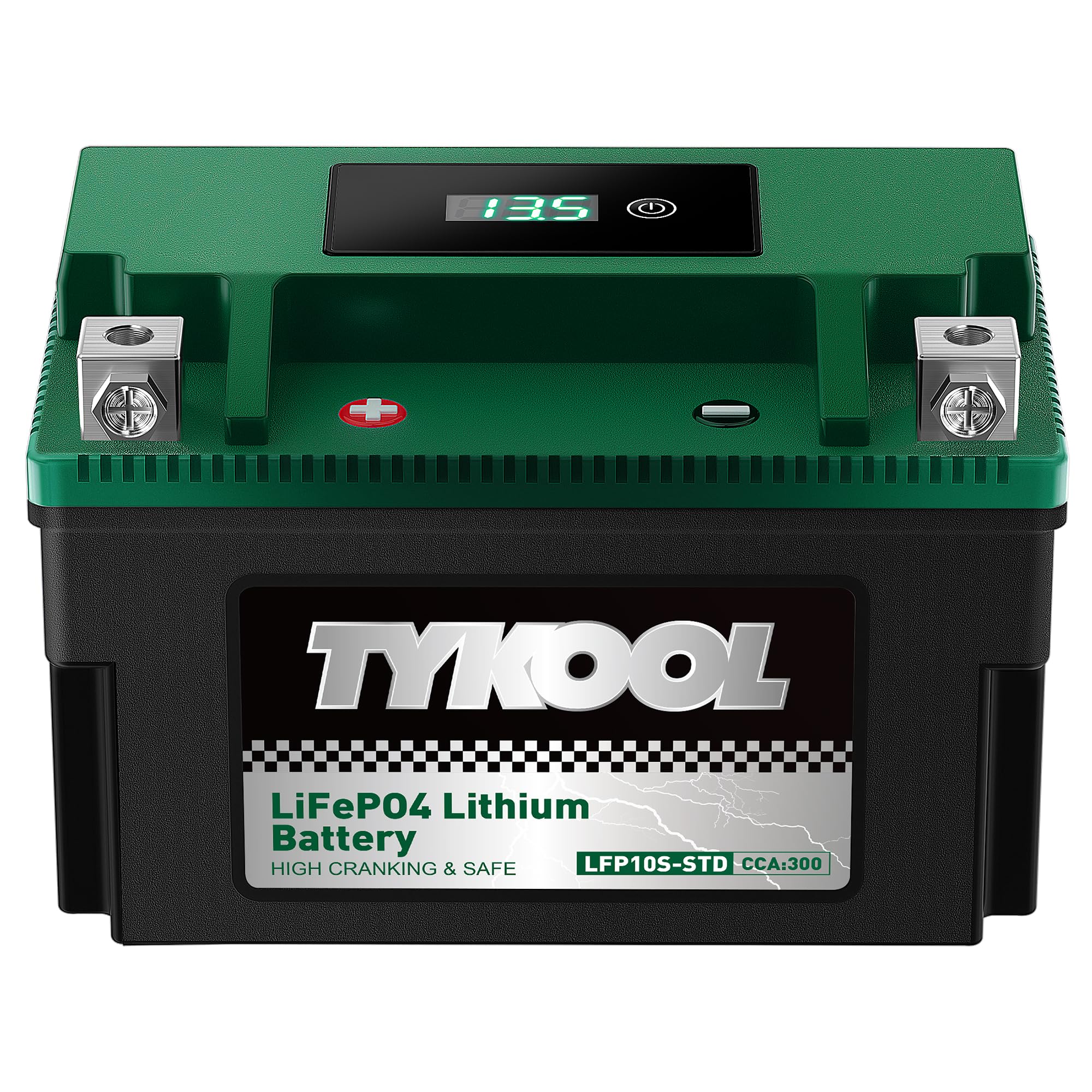
Lithium power inside, plus a digital display.
This is the lightest battery in the lineup. The TYKOOL weighs about 1 kg (roughly 2.2 lbs) — a fraction of the 12.8-pound Weize — thanks to LiFePO4 (lithium iron phosphate) cells. At about 2.2 lbs, it trims real mass off the bike, improving handling and power-to-weight ratio. It delivers a massive 300 CCA in a tiny YTZ10S footprint (3.42″D x 5.9″W x 3.70″H).
The standout feature here is the built-in LCD state-of-charge (SOC) display on the top of the battery. You glance at the battery and see real-time health status — no guessing if it is time to charge. The advanced BMS (Battery Management System) protects against over-charge, over-discharge, and over-current, and the IP66 rating means it laughs off rain, pressure washes, and dusty trails.
The critical catch: lithium batteries require a regulated charging system that stays under 15.0V — the ideal peak is 14.4V ± 0.2V. A vintage Harley owner found that the bike’s charging system killed the battery in ten miles. If your bike has a known high-voltage regulator or an unregulated system, you need a certified regulator upgrade. For modern bikes (R1, R6, BMW S1000RR), it is a direct drop-in that starts the engine instantly and holds a charge for weeks.
Weightless Wonder
- ~2.2 lbs — dramatically lighter than lead-acid
- Integrated SOC display for instant health check
- IP66 waterproof for all-weather confidence
System Warning
- Requires regulated charging under 15.0V
- Not compatible with vintage bikes
- Higher upfront cost than AGM
Track and street machine: Perfect for the modern sportbike owner who wants every ounce of weight savings and instant cranking power.
Stay away: If you ride a pre-2000 bike, a Harley with a stock charging system, or any vehicle you cannot verify stays under 15.0V.
8. Deka ETX20L Power Sports Battery
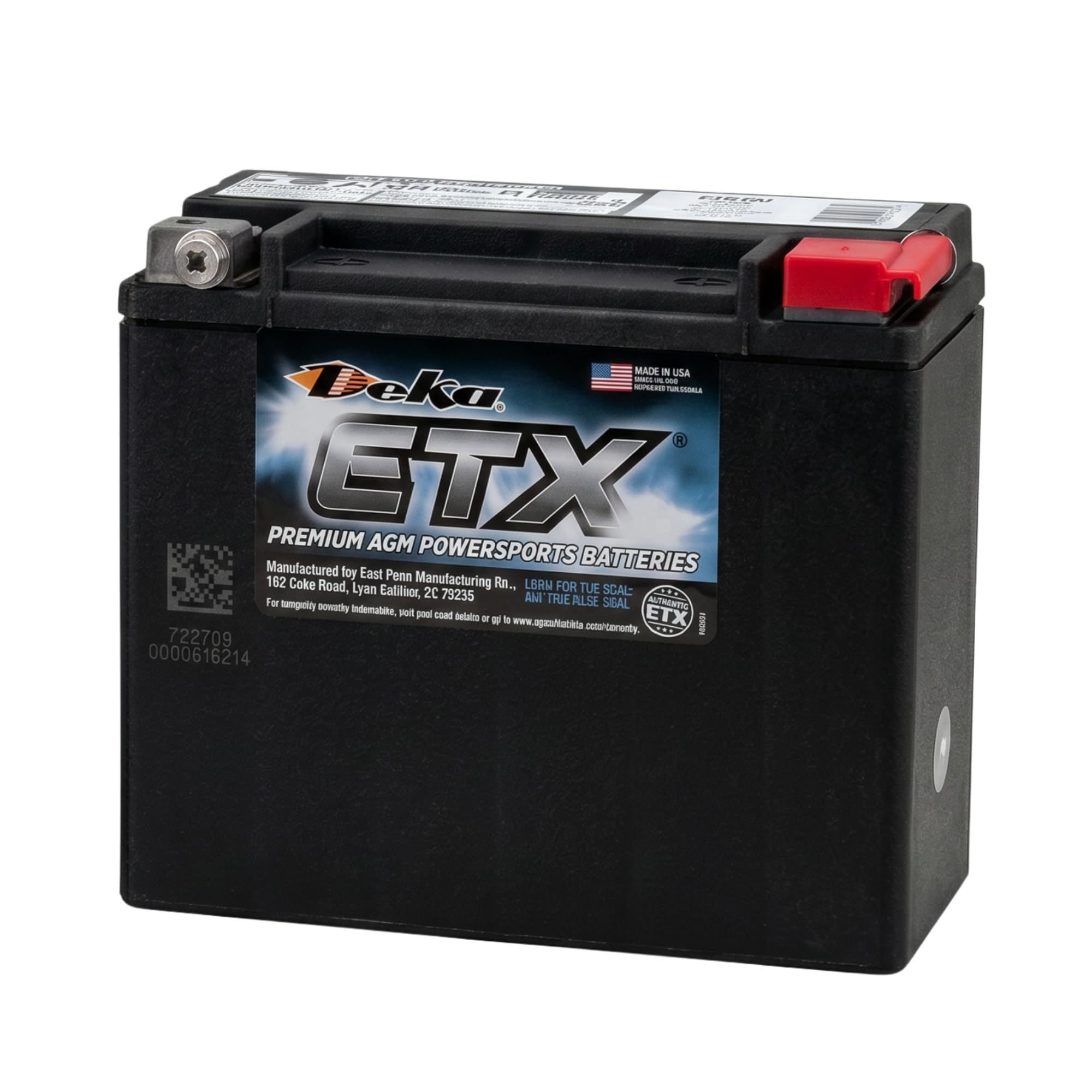
The OEM trust that Harley and Sea-Doo owners swear by.
The Deka ETX20L delivers 310 Cold Cranking Amps and 18 amp-hours from a sealed, leakproof case that ships fully charged. It is built by East Penn, one of the largest battery manufacturers in the US, and the crowd across nearly 900 ratings calls it a “great powerful battery.” It comes as a direct replacement for YTX20L-BS, YTX20HL-BS, YB18L-A, and Harley-specific part numbers like 65989-97A.
The quality of the build is the most-praised aspect — 125 owners highlight it. Owners of big V-twins (Dyna Super Glide, 2000 Fat Boy) and newer Sea-Doo jet skis (Wake Pro 230) report it fits perfectly and cranks with authority. The newer units include screws instead of nuts for easier terminal attachment, a small design win. For snowmobiles, it is a popular choice because the sealed construction laughs at the elements.
The mixed feedback centers on battery life — a segment of owners mention failure inside 13 months. This is not a universal defect (the majority are happy), but note that a few batteries underperformed. If you get a good unit (and the odds are with you), it is a premium drop-in for heavy-draw applications that need 310 CCA right from the start.
Heavy Lifter
- 310 CCA — plenty for big V-twins and PWC
- Most-praised build quality of any battery here
- Ships fully charged and ready to install
Life is a Gamble
- Mixed battery life — some fail in 13 months
- Heavier than lithium at a similar price point
- No terminal bolts included in the package
Harley and PWC owners: This is the drop-in replacement that delivers proven cranking power from a top US manufacturer.
Consider alternatives: If you want a budget-friendly option with the same 310 CCA (the UPLUS is cheaper), or if you need the weight savings of lithium.
9. Anti-Gravity AG-ATZ-10-RS Lithium-Ion

The battery that jump-starts itself — no cables, no stranger needed.
This is the most advanced battery on the list. The AG-ATZ-10-RS features Anti-Gravity’s patented “RE-START” technology: if you drain the battery (lights left on, parasitic draw), you push a button on the battery case itself, and it reserves enough internal power to start the engine. No jumper pack. No push-start. No waiting for a neighbor. A remote RE-START accessory is also available so you do not have to access the battery.
At just 1.18 kg, it is lighter than a standard lead-acid battery. Owners of modern high-performance bikes — 2018 GSX-R1000R, BMW S1000RR, KTM 1290 Super Adventure R — praise it as a perfect OEM replacement. The crowd raves about battery life (116 positive mentions) and the lightweight design (61 mentions). One rider reports it started reliably after an entire winter in outdoor storage.
The honest trade-off is the price — this is a premium investment. The RE-START feature requires a compatible charger; using a standard charger like the Oxford Oximiser 900 caused an initial failure that was revived with a CTEK Lithium charger. Reliability gets a mixed score from 71 owners, meaning a small share report failure inside a year. If you want the absolute best lithium technology with a safety net, this is it. For most riders, a standard AGM or a simpler lithium is likely enough.
Tech Marvel
- Built-in self jump-start — a genuine lifesaver
- Extremely light at 1.18 kg
- Massive cranking power for high-comp engines
Pricey Premium
- Significantly more expensive than any AGM here
- Requires a lithium-specific charger
- Mixed reliability reports from a minority of owners
No-compromise choice: If you hate being stranded and want the lightest, most advanced battery, the RE-START technology changes the game.
Not for the budget-conscious: If you are looking for a simple, reliable AGM at a fraction of the price, skip this and grab the Yuasa or Weize instead.
Understanding the Specs
Cold Cranking Amps (CCA)
This is the most important number for starting. CCA measures how many amps a battery can deliver for 30 seconds at 0°F while maintaining at least 7.2 volts. A higher CCA means stronger cranking in cold weather. Small bikes (250-400cc) can get by with 135-175 CCA. Big cruisers, V-twins, and high-compression sportbikes need 300 CCA or more. Do not undershoot on a big engine — a battery rated too low will struggle when the temperature drops.
Amp-Hours (Ah) vs Capacity
Amp-hours tells you the total energy storage — how long the battery can run accessories without the engine running. A 10 Ah battery can deliver 1 amp for 10 hours. For a pure starting battery, 8-12 Ah is typical. If you run heated grips, auxiliary lights, or a stereo while parked, aim for 18 Ah or more. Note that lithium batteries often have a lower Ah number (5 Ah) but still start powerfully because of their chemistry and high CCA.
FAQ
How often should I replace my motorcycle battery?
What does CCA mean and how much do I need?
What is the difference between AGM and GEL batteries?
Can I put a lithium battery in my old bike?
How do I know if a battery fits my motorcycle?
Do I need to charge a new battery before installing it?
What is a maintenance-free battery?
Can a motorcycle battery freeze?
How do I safely dispose of an old motorcycle battery?
What does the RE-START button do on the Anti-Gravity battery?
Final Thoughts: The Verdict
For most buyers, the best motorcycle battery is the Yuasa YUAM32ABS YT12A-BS because it delivers proven 5-year reliability, 175 CCA, and a spill-proof build at a fair price. If you want maximum cranking power for a big bike on a budget, the Weize YTX20L-BS gives you 300 CCA for less. And for the weight-obsessed modern sportbike owner, the TYKOOL LFP10S-STD lithium battery is lightweight with an integrated SOC display. No matter your pick, measure your tray and check your charging system first — the right battery starts every time.
How We Picked
We do not accept paid placement. Every pick is matched to a real buyer and a real use-case; we do not hands-on test units.
Sources & Methodology
Specifications: manufacturer listings and product documentation. Review insights: verified customer reviews, as of July 2026. Pricing: not shown on this page (it changes often); check the current price via the retailer link.
As an Amazon Associate, Trending Car earns from qualifying purchases. This does not affect which products we feature.