
Our readers keep the lights on and my garage snacks stocked. As an Amazon Associate, I earn from qualifying purchases.
Specs are compiled from manufacturer listings and verified buyer reviews and can change over time — please confirm the key details on the product page before buying.
Choosing the right motor paint depends on one thing: keeping the finish on your engine block, exhaust, or calipers looking fresh after months of heat, oil, and road grit. A paint that flakes off after a week is worse than no paint at all, and the wrong heat rating can leave you with a blistering, peeling mess. This guide cuts through the choices to find the nine best options for your build.
I’m Min Islam — the founder and writer behind Trending Car. This guide is built by comparing the manufacturers’ published specifications and the patterns across verified customer reviews, so you get each pick’s real strengths and trade-offs instead of marketing spin.
Whether you are restoring a classic small-block Chevy or just touching up a marine outdrive, the right motor paint needs to handle the heat, resist chemicals, and go on without a fight — here are the nine that actually deliver.
Our Picks at a Glance

How To Choose The Best Motor Paint
Motor paint has to survive a hostile environment — high temperatures, oil and gas splashes, vibration, and weather. Picking the right one means matching the paint’s heat ceiling to the part you are painting and choosing an application method you can actually execute. Here is the short list of what matters.
Heat Rating: Match It to the Part’s Surface Temperature
An engine block typically runs between 200°F and 300°F. A header or turbo housing can hit over 1000°F. If you pick a 450°F paint for an exhaust manifold that touches 700°F, the finish will discolor and peel. For blocks and valve covers, a 450°F–650°F paint works. For exhausts, grills, and fire pits, you need 1200°F or higher.
Application: Spray vs Brush
Spray paints (aerosol cans) give a smooth, even finish with less effort, but you need good ventilation and masking to avoid overspray. Brush-on paints let you work in tight spots and avoid the mess, but quality depends on the paint’s self-leveling ability — some brush-on formulas leave zero brush marks, while others need a careful hand. A few paints can be applied either way.
Chemical Resistance
An engine bay is full of oil, transmission fluid, gasoline, and brake cleaner. A paint that softens or lifts when it contacts these chemicals will fail fast. Look for paints explicitly labeled as oil-, gas-, or solvent-resistant. For marine use, saltwater and moisture resistance becomes the critical factor.
Quick Comparison
| Model | Best For | Temperature Rating | Coverage | Application | Amazon |
|---|---|---|---|---|---|
| KBS Coatings 60302 Gloss Black Motor Coater★ Best Overall | Full engine restoration, brush-on finish | 450°F | 25 sq ft | Brush or Spray | Amazon |
| MTN PRO Heat-Resistant Paint Black 400mlBest Value | Budget-friendly exhaust paint | 700°C (~1292°F) | 20 sq ft | Aerosol | Amazon |
| Seymour 16-1201 Hot Spot Aluminum 12 ozTop Performer | 1200°F continuous high-heat surfaces | 1200°F | Depends on Application | Aerosol | Amazon |
| VHT SP404 Engine Metallic Gold Flake 11 oz | Custom metallic caliper and engine accents | 650°F | Full | Aerosol | Amazon |
| VHT SP403 Engine Metallic Silver Blue 11 oz | OEM color match for older outboards and engines | 650°F | Medium | Aerosol | Amazon |
| MERCURY 8028781 Phantom Black Enamel 12 oz | Mercury and MerCruiser factory color match | Standard enamel | 10 sq ft | Aerosol | Amazon |
| POR-15 High Temperature Paint Aluminum 15 oz | Extreme 1200°F heat with corrosion resistance | 1200°F | Full | Aerosol | Amazon |
| KBS Coatings 65328 Pure White Xtreme Coating 1 Pint | Ultra-high heat (1500°F) on exhaust and stoves | 1500°F | 40-50 sq ft | Brush or Spray | Amazon |
| KBS Coatings 58001 Chevy Orange Motor Coater Kit | Complete Chevy engine restoration kit | Standard enamel | 1.25 Pints | Brush, Aerosol, or Spray Gun | Amazon |
In‑Depth Reviews
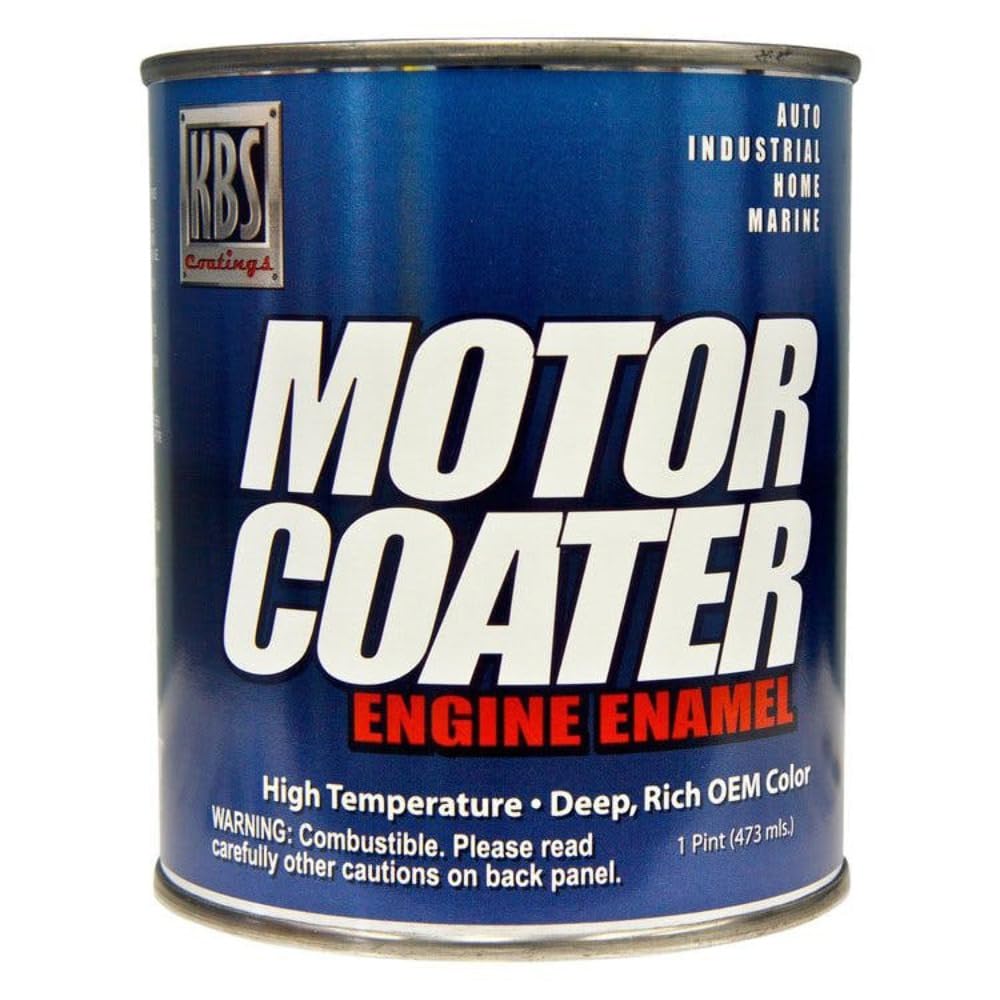
1. KBS Coatings 60302 Gloss Black Motor Coater Engine Paint – 1 Pint
Our pick — over 4.5★ from 350+ verified ratings; the strongest balance of quality and price.
The brush-on that lays down like it was sprayed — no streaks, no mess.
This is the pick for anyone who wants a professional-looking engine without owning a spray gun. The 1-pint liquid formula can be brushed or sprayed, and the crowd is united on one thing: a brush leaves virtually no marks. One owner called it “excellent paint for my SBC motor” and noted that a little goes a long way. The heat ceiling sits at 450°F, which is perfect for an engine block or valve cover but not for an exhaust manifold. Coverage is generous at 25 sq ft per pint, so you get enough for a full small-block with leftover for touch-ups. It is also resistant to oil, transmission fluid, and gas — the big three enemies under the hood.
The color match wins praise too. While this Gloss Black is straightforward, the same formula is used across other factory-matching colors (like Ford engine blue or Cummins white on marine engines). If you want a self-leveling finish that looks like it came from a booth without the booth, this is the one.
A fair caveat: at 450°F, do not put this on exhaust parts. Keep it on blocks, heads, brake calipers, or other components that stay under that threshold. Also, this is not a rattle can — you need to supply your own applicator. The crowd favorite — 4.7 stars across nearly 400 owners — makes the trade-off easy.
Glossy durable finish
- Brushed finish that looks sprayed — no brush marks when it sets up
- 25 sq ft of coverage from a single pint, enough for a whole engine
- Resists oil, transmission fluid, and gas long-term
Needs thorough prep
- 450°F ceiling means it is not for headers or exhaust manifolds
- Requires a brush or spray gun — not ready-to-go from a rattle can
Best for show cars you want a show-quality brush-on engine finish without a spray booth.
Skip if budget tight your part sees over 450°F — then step up to a high-temp coating.
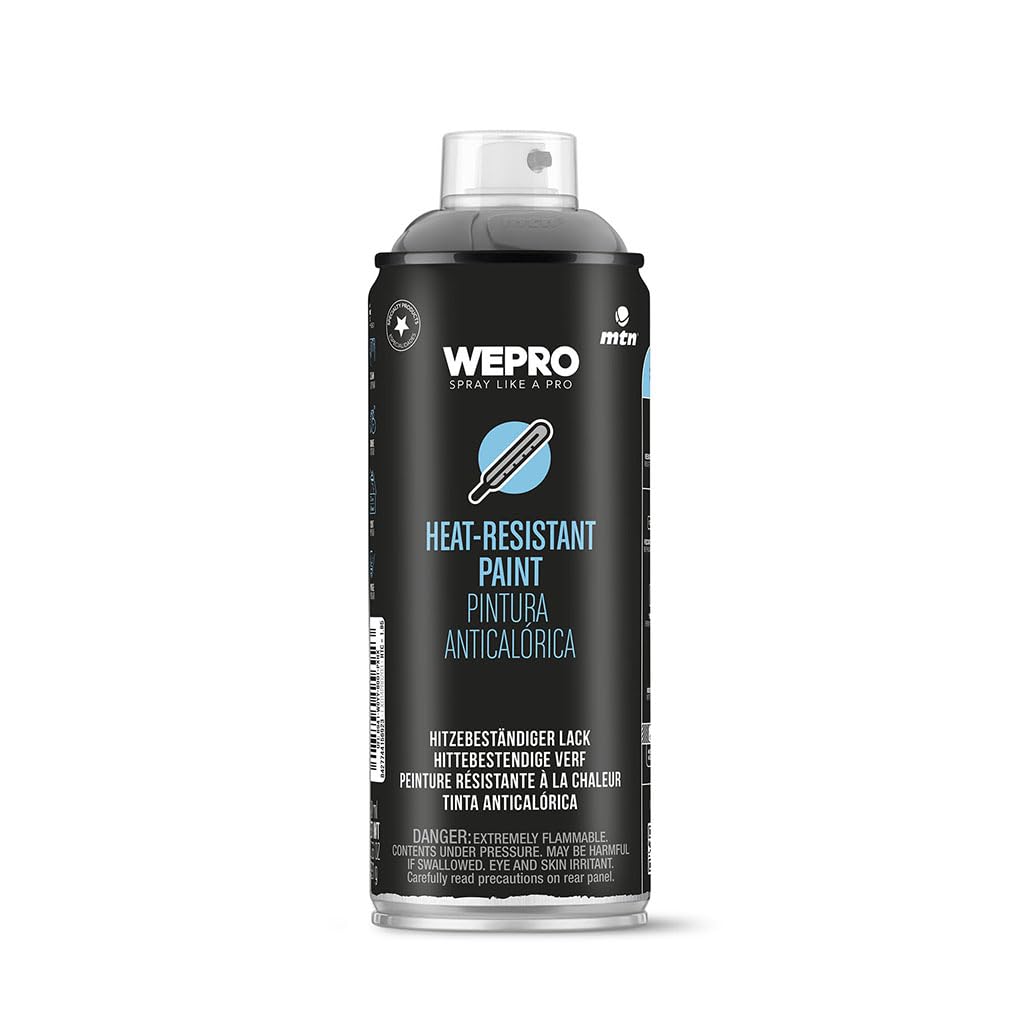
2. MTN PRO Heat-Resistant Paint Black 400ml
A budget aerosol that laughs at 700°C — perfect for exhausts and grills.
This Spanish-made spray paint from Montana Colors packs an extreme heat rating — 700°C (about 1292°F) — into a 400ml can that costs a fraction of the premium offerings. It is formulated with a polybutylene and titanate resin base and lead-free pigments, making it a smart choice for motorcycle exhausts, car radiators, and BBQ grills. The finish is a metallic black that one owner applied in 8 thin coats on a bike silencer, reporting that the leftover material covered touch-ups. The dry time between coats is 10–30 minutes, with a final heat cure (30 minutes of fast riding) to fully harden the paint.
Where it really shines is sheer value. You get a heat rating that beats most paints in its price tier and a finish that looks close to factory matte black. It is also versatile enough for car radiators — one buyer used it for exactly that with great results. For a budget can that goes past 1000°F, it is tough to top the per-dollar heat performance. Durability against fuel splashes is still unproven long-term, but the initial owner feedback is strong.
The catch is coverage. At 20 sq ft per can, you get less area than some competitors, and the aerosol tip is fixed — you cannot spray upside down for hard-to-reach angles. This is a no-frills, high-heat paint for a specific job, not an all-in-one engine coating. skip it if you need a chemical-resistant finish for an oil-soaked engine block; grab it if you are painting an exhaust pipe or grill.
Best for quick jobs exhausts, bike silencers, and grills needing extreme heat resistance at a low cost.
Skip for large areas engine blocks exposed to oil and gas — it is a heat paint, not a chemical-resistant coating.
3. Seymour 16-1201 Hot Spot High Heat Spray Paint Aluminum 12 oz – 1200°F
The porcelain-like finish that bonds at 1200°F — a true exhaust and grill specialist.
When the part sees extreme heat — think grills, wood stoves, exhaust pipes, or fire pits — the Seymour 16-1201 is engineered for it. This aluminum aerosol handles 1200°F continuously and forms a durable finish that resists blistering, peeling, and discoloration. what separates it is the “porcelain-like bond” that forms at high temperatures, extending the life of the coated surface. Owners confirm that after heat cycling, the paint darkens and hardens into a flat, durable shell — one buyer used it on a John Deere A exhaust manifold and called it 100% effective. The burn-in process turns it flat, not satin, which is worth knowing if you want a glossy look.
At 1200°F, it matches the thermal ceiling of the POR-15 offering, but at a lower price point. The 12 oz can is a standard aerosol size, and the formula is VOC-compliant with no lead, cadmium, mercury, or chlorinated solvents. It is also compatible with multiple metal surfaces: grills, mufflers, engine parts, and heater components. Coverage is listed as “Depends on Application,” meaning you may need two cans for larger jobs like a full grill or exhaust system.
The honest trade-off is the finish expectation. Some buyers report the advertised satin finish turns flat after heat cycling — owners mention it “cures flat, not satin.” Also, the coverage aspect is mixed; some owners get great coverage while others find it thin. If you need a proven 1200°F paint that resists blistering and you are okay with a flat final look, this is one of the strongest options. The crowd ratings back it up — 4.5 stars across nearly 450 owners.
Best for exhaust parts you need a 1200°F coating for a grill, exhaust, or stove pipe and want a tough, blister-resistant finish.
Skip for indoor use you need a glossy or satin sheen — the heat cure pushes it flat.
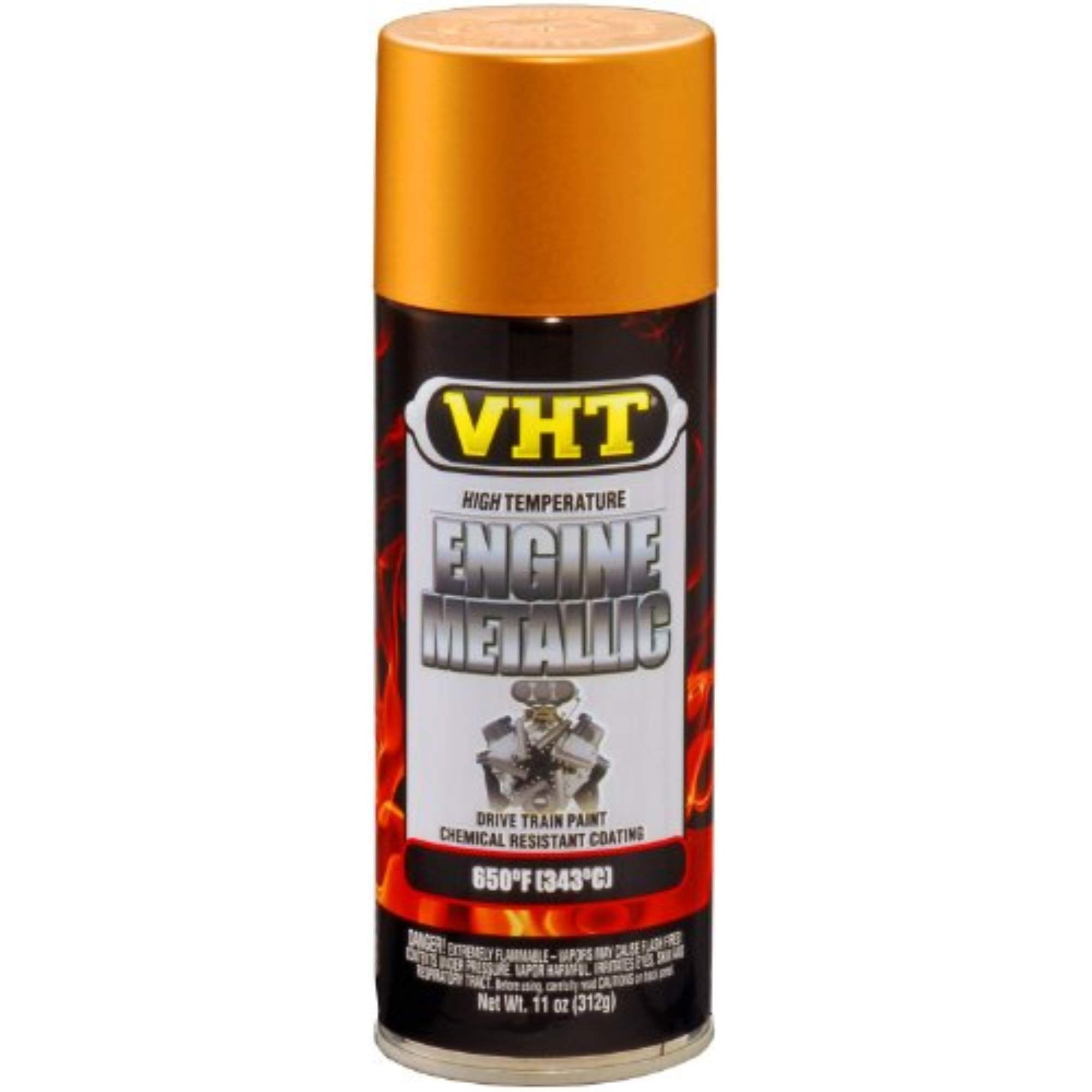
4. VHT SP404 Engine Metallic High Heat Spray Paint – Gold Flake – 11 oz
A gold metallic that turns calipers and valve covers into a showcase piece.
The VHT SP404 is not your basic black or silver engine paint. It is a urethane-and-ceramic-resin blend with a gold flake metallic finish that stands out. Rated for 650°F intermittent heat, it works on engine blocks, valve covers, brackets, water pumps, and brake calipers. The paint dries to the touch in 30 minutes and thoroughly overnight. Owner feedback is consistently positive on the color — described as “cool” and “looks awesome” — and the end result. One owner applied it to brake calipers and reported zero fading after 6 months with weekly scrubbing, calling it “great paint, going on 6 months no real wear.”
VHT is a known brand in the high-heat coating space, offering 31 colors across OEM, universal, and metallic families. This Gold Flake is part of their metallic line and gives a sparkling, non-dull finish. The spray pattern is even, and the paint flows well for a metallic. It is also waterproof, which helps for exterior engine detailing. For a custom or show-car look, this is among the most distinctive options available.
The main drawback is durability for heavy-use parts. A detailed review noted the paint is “very thin” and less durable than a two-part caliper paint like G2, with concerns about long-term chip resistance. It also carries a strong odor — the same reviewer reported respiratory issues despite ventilation. If you are building a trailer queen or a weekend cruiser, the SP404 is a fantastic look; for a daily driver with aggressive brake heat cycles, you might want a thicker coating.
Best for accent parts custom engine builds, caliper detailing, and show-car accents where the gold flake sets the tone.
Skip for heavy wear you need a thick, chip-resistant daily-driver coating — this metallic is on the thin side.
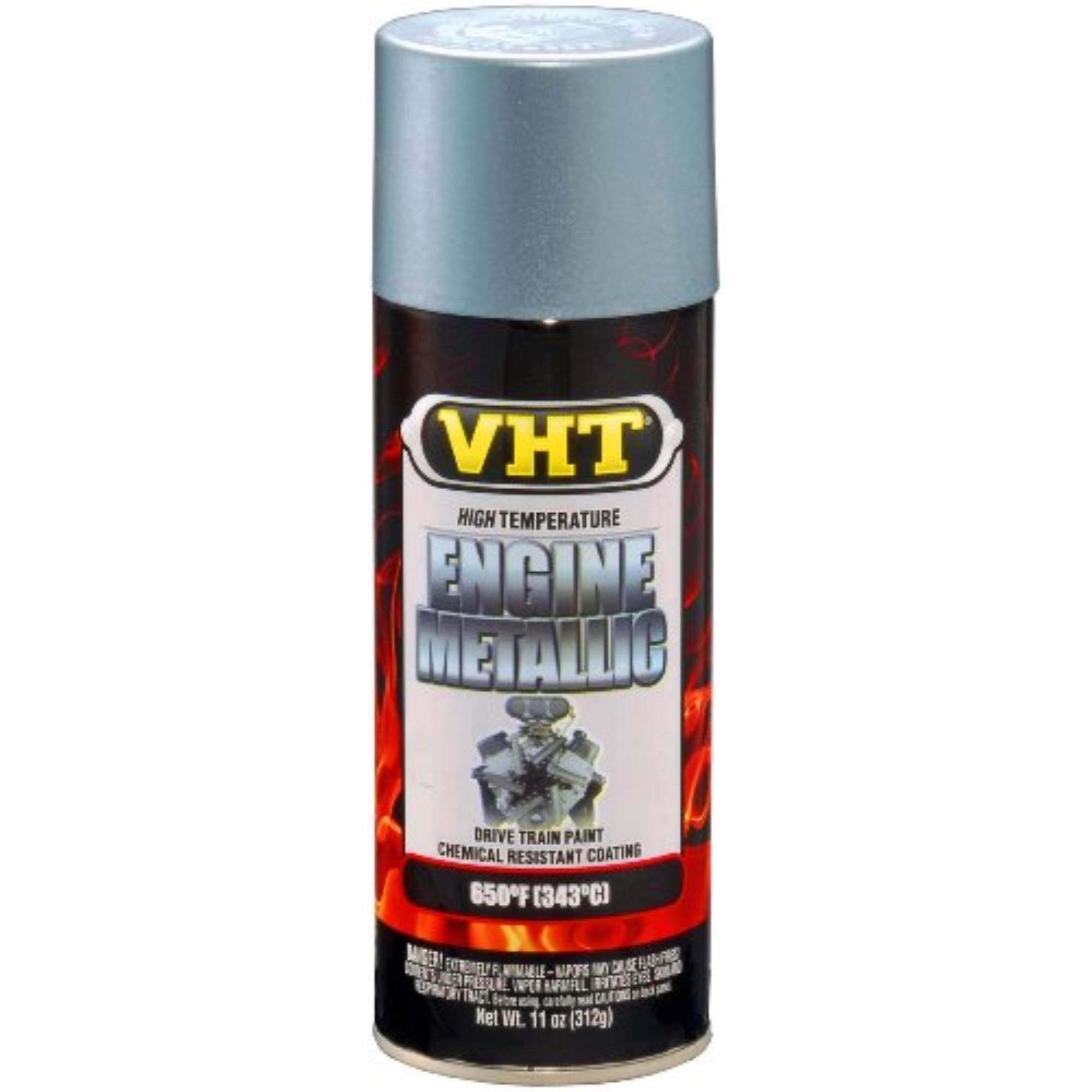
5. VHT SP403 Engine Metallic Titanium Silver Blue 11 oz. Aerosol
A near-perfect match for old-school blue — Evinrude and Sun Machine restorers love it.
This metallic silver-blue from VHT has found a cult following among restorers of vintage outboards and distributor machines. One owner used it on a 1981 35HP Evinrude and said it was a “perfect match.” Another restored a Sun distributor machine and called it “almost a perfect color match” for the OEM blue, noting the only missing element was the original hammertone texture. Like the SP404 Gold Flake, it uses a urethane/ceramic resin blend and handles 650°F intermittent heat — enough for engine blocks, heads, brackets, and outdrive components. The metallic gives it a sparkle that mimics the original factory finishes of the era.
Beyond restoration, the color is also a near-perfect match for Subaru Wilderness trim, making it useful for non-engine automotive projects too. The spray is easy to apply, and the nozzle delivers a consistent fan pattern. Drying to the touch in 30 minutes with an overnight full cure fits a standard workflow. At 11 oz, it is enough for several coats on a 4-cylinder engine block or a set of brackets and covers.
The honest note is the color name is slightly misleading. As one owner put it bluntly: “This is straight up blue,” not silver. If you expect a neutral silver, this is a blue-toned metallic. It is a gorgeous blue, but it is blue. Also, the durability is mixed on high-abrasion areas. If you specifically need a vintage-engine blue or Subaru Wilderness green-adjacent metallic, this is an outstanding choice. If you need pure silver, look elsewhere.
Best for custom builds you are restoring a blue outboard, distributor, or vintage engine and need the closest factory metallic match.
Skip for solid colors you want pure silver — this is unmistakably blue.
6. MERCURY 8028781 Phantom Black Enamel Spray Paint and MerCruiser, 12 oz Spray Can
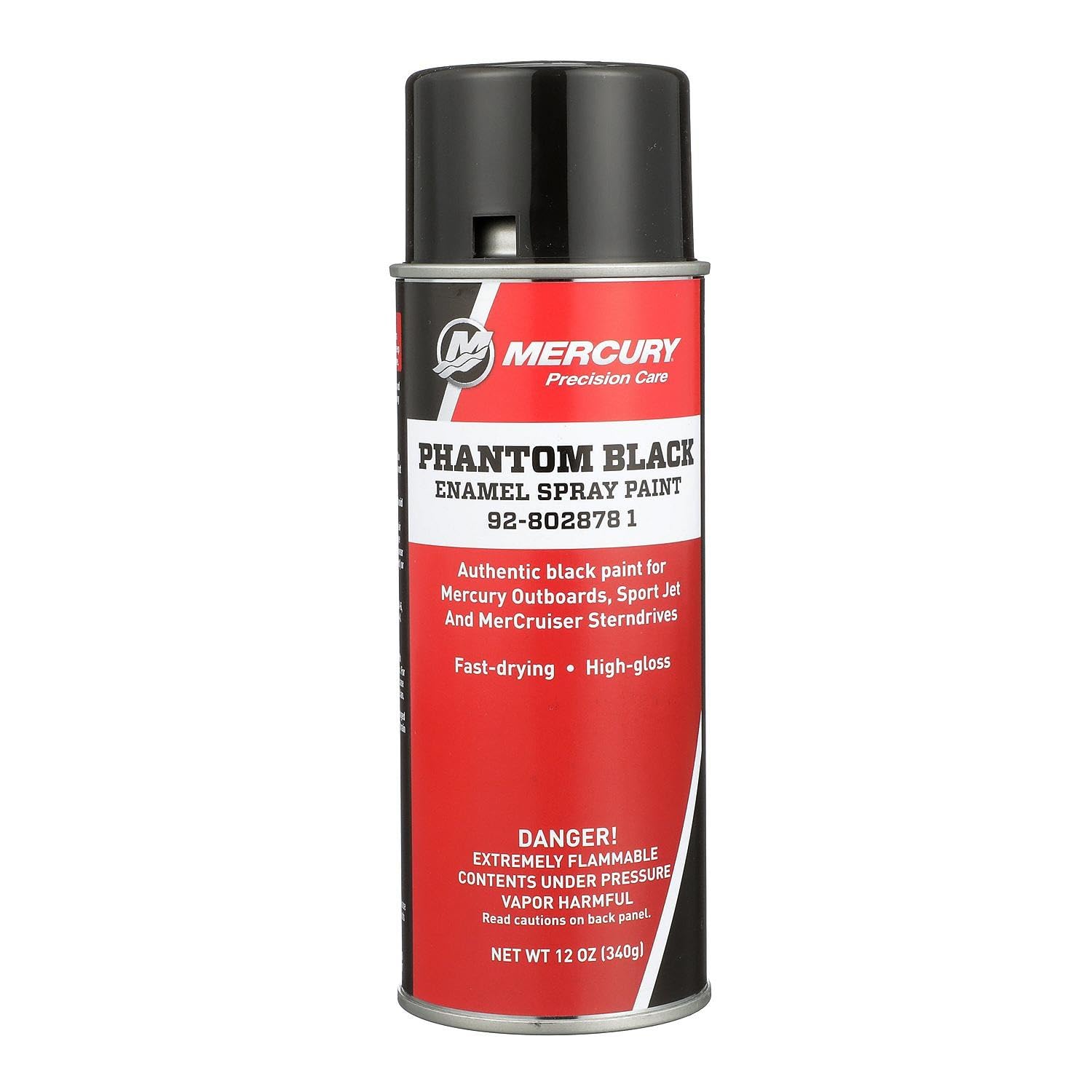
The factory satin black that makes a MerCruiser lower unit look brand new.
When you need an exact factory match for a Mercury outboard or MerCruiser sterndrive, this is it — straight from Mercury Marine themselves. The 12 oz aerosol is a satin black enamel that matches the original Phantom Black finish on thousands of Mercury outboards, MCM, and MIE engines. The color match is what drives the positive reviews — one owner said the lower unit “looks brand new” after application, and another noted it matched perfectly after using a non-matching black before. Coverage is rated at 10 sq ft per can, which is enough for a full lower unit and some touch-ups on the cowl.
This is not a high-heat paint. It is a standard enamel enamel designed for cosmetic touch-ups on painted aluminum and steel marine parts, not for exhaust manifolds or headers. The satin finish replicates the factory sheen, so the repaired area blends with the surrounding original paint. For a weekend boater refreshing a used outboard or sterndrive, this is the easiest path to a factory-correct look. Owners also note the quality is excellent — the paint lays down smooth and lasts on the water.
The caveat is the spray nozzle. A recurring owner complaint is that the spray performance is inconsistent — some cans “hardly spray at all.” It is a manufacturing variance, not a design flaw, but it is common enough to note. If you get a good can, it is excellent; if you get a dud nozzle, you will struggle. Also, the 10 sq ft per can is modest; for a full engine block, you may need two cans. If you are not restoring a Mercury/MerCruiser, the generic color “black” may not justify the premium over standard marine enamel.
Best for marine use Mercury outboard and MerCruiser owners needing a perfect factory color match for lower units and drives.
Skip if impatient high-heat engine parts — it is an enamel, not a heat-resistant coating.
7. POR-15 High Temperature Paint – Aluminum – 15 fl. oz. – 1200°F

The 1200°F aluminum coating that fights corrosion while it handles extreme heat.
POR-15 is a trusted name in rust prevention, and their High Temperature Paint brings that toughness to extreme-heat surfaces. This aluminum-colored aerosol withstands 1200°F (648.8°C) and resists cracking, chipping, and peeling. It also adds corrosion resistance against weather, salt, and moisture, which makes it a strong choice for marine exhausts and outdoor fire pits. The finish is a satin-to-gloss aluminum that, as owners note, “looks like sandblasted aluminum” and sprays on evenly like a powdercoat. One owner applied 3 coats at 8-10 inches apart, followed by a 24-hour air dry and a 2-hour heat cure at 400°F, and called it the best high-temp paint compared to Rustoleum or Krylon.
The heat ceiling matches the Seymour 16-1201 at 1200°F, but POR-15 adds the extra corrosion protection and a glossier finish that some owners prefer for intake manifolds and valve covers. It requires a 24-hour cure before raising the temperature above 300°F, and the oven cure “smokes heavily” — so plan for adequate ventilation. A single 15 oz can covers roughly 4 manifolds, according to owner experience. It meets MIL-C-13370 specifications, adding a layer of defense for those who want military-spec toughness.
The honest trade-off is cure time and process. You cannot simply spray and drive — the 24-hour dry plus heat cure is non-negotiable for full durability. And while the spray pattern is good, the paint is thin enough that runs can happen if you apply too thick in one pass. If you are restoring a set of headers or a stove and want the longest-lasting finish with corrosion protection, the POR-15 is a strong investment. The crowd favorite — 4.6 stars across nearly 350 owners — backs it up.
Best for metal parts you need a 1200°F coating that also protects against rust and salt — ideal for marine and outdoor high-heat parts.
Skip for plastic you want a spray-and-go finish — this needs a full 24-hour cure + heat cycle to reach full strength.
8. KBS Coatings 65328 Pure White Xtreme Temperature Coating – 1 Pint

The 1500°F white coating that survives a turbo exhaust housing — and still looks clean.
This is the highest-temperature paint in the lineup. It is designed for headers, exhaust manifolds, mufflers, BBQ grills, wood stoves, and pellet stoves. The 1-pint liquid can be brushed or sprayed (HVLP or aerosol gun), and it covers 40-50 sq ft per pint — double the coverage of many spray cans. It dries to the touch in about 1 hour and resists scratching, marring, peeling, flaking, and chalking. One owner applied it to a turbo exhaust housing that spiked to 1300°F and reported it held up well and looked great.
Owner feedback is generally positive on ease of application and heat resistance, with several noting it is cheaper than POR-15’s high-temp offering yet works just as well on exhaust parts. The matte white finish is a practical choice for stoves and grills where a clean, light color hides soot less than black but reflects heat better.
The weak spot is adhesion on unprepared surfaces. A small number of customers note the paint peeling off exhaust parts after a few weeks, and Amazon’s own review summary notes some flaking within weeks. The key factor is surface prep — the manufacturer recommends a clean, roughened surface, and skipping that step leads to failure. Also, the 8-hour wait between coats can stretch a project over a full weekend. If you are building a high-heat system (turbo, headers, wood stove) and want the highest thermal ceiling available at a reasonable price, this is the coating. But treat surface prep as non-negotiable.
Best for light colors extreme-heat applications like turbo housings, headers, and wood stoves that exceed 1000°F.
Skip for dark base quick cosmetic jobs — the 8-hour recoat time and strict prep requirements mean it demands patience.
9. KBS Coatings 58001 Chevy Orange Motor Coater Engine Paint Kit

The complete Chevy orange kit — enough to do a whole block in high-gloss enamel.
This is a full engine painting kit designed for one specific job: turning a small-block Chevy (SBC) orange. The kit includes the paint, thinner, stirring stick, and gloves, and it can be applied by hand brushing, aerosol, or spray gun. The acrylic enamel is extremely high gloss, fast-drying, and self-leveling — brush marks flow out during cure. One owner sprayed the entire engine with 3-4 coats and had 1/8 of the can left, confirming the kit is sized for a full build. The paint is air-curing (no baking needed) and resists oil, transmission fluid, and gas. For a classic Chevy restoration, this is the color-matched, purpose-built solution.
The quality of the finish is a highlight. Owners call it “very glossy” and note the “factory color matched perfectly.” The versatility is a bonus — you can brush hard-to-reach spots and spray the main surfaces. The kit eliminates the guesswork of buying separate paint, thinner, and applicators. KBS Coatings is the same brand behind the Gloss Black Motor Coater (product #1), so build quality is consistent.
The honest note: the paint is hard to remove — one owner warned the “etch compound will stain concrete” and the paint “won’t wash off” skin, staining for days. Wear gloves. Also, for a price in the premium tier, you are paying for a very specific color and kit format. If you are not building a Chevy orange engine, the kit’s value shrinks — you can get the same KBS quality in black or other colors for less. But for a fan of the Bowtie, this is the pick.
Best for restoration you are restoring a Chevy small-block and want a complete kit that matches the factory orange exactly.
Skip for daily drivers you need a different color — this is strictly Chevy orange, and the kit form is overkill for a single-valve-cover job.
Understanding the Specs
Temperature Rating
This is the maximum surface temperature the paint can withstand continuously (or intermittently, depending on the label). Engine blocks run around 200–300°F, so a 450°F paint is fine. Exhaust manifolds, headers, and turbo housings can hit 700°F–1200°F, requiring a high-temp coating. If you exceed the rating, the paint will discolor, blister, or peel. Always match the paint’s heat ceiling to the hottest surface the part will reach, not the average operating temp.
Chemical Resistance
Engine paint lives in a soup of oil, gasoline, transmission fluid, brake cleaner, and coolant. A paint labeled “oil and gas resistant” or “chemical resistant” will hold up to these spills during maintenance and operation. Paints without this label may soften, stain, or lift when contacted by hydrocarbons. For marine use, look for explicit “waterproof” or “moisture resistant” claims to prevent saltwater wicking.
Coverage and Application Method
Coverage is listed in square feet per pint or can. Engine paints range from 10 sq ft (small spray can) to 50 sq ft (pint brush-on). A full small-block engine needs 20-30 sq ft for a complete coat. Brush-on paints offer self-leveling (brush marks flow out) but require more labor. Aerosol paints are convenient but can clog or spatter. Some paints are compatible with both methods, giving you flexibility for detailed areas vs. large surfaces.
Cure Time
Heat-resistant paints often require a staged cure: an air-dry period (hours to a full day) followed by a heat cycle (running the engine or baking the part in an oven) to harden the coating. Ignoring the cure schedule leaves the paint soft to scratches and chipping. Standard engine enamels may be “air-curing” and ready to handle in a few hours. Always check the full cure time before exposing the part to heat, grease, or water.
FAQ
What is the best motor paint for an engine block?
Can I use motor paint on my exhaust manifold?
Is it better to brush or spray motor paint?
How much motor paint do I need for a full engine?
Does motor paint need a clear coat?
How long does motor paint take to cure fully?
Will motor paint stick to bare cast iron or aluminum?
Can I paint brake calipers with motor paint?
Is motor paint resistant to gasoline and oil?
How do I match OEM motor paint colors like Cummins white or Ford blue?
Final Thoughts: The Verdict
For most owners, the motor paint winner is the KBS Coatings 60302 Gloss Black Motor Coater because it delivers a brush-on finish that looks sprayed, resists oil and gas, and covers a full engine block in one pint — all at a 4.7-star crowd rating across hundreds of owners. If you need extreme heat resistance for exhaust or turbo parts, the POR-15 High Temperature Paint in Aluminum is the durable 1200°F champion with added corrosion protection. And for a budget-friendly exhaust spray that hits 700°C while staying affordable, the MTN PRO Heat-Resistant Black is the one to reach for.
How We Picked
We do not accept paid placement. Every pick is matched to a real buyer and a real use-case; we do not hands-on test units.
Sources & Methodology
Specifications: manufacturer listings and product documentation. Review insights: verified customer reviews, as of July 2026. Pricing: not shown on this page (it changes often); check the current price via the retailer link.
As an Amazon Associate, Trending Car earns from qualifying purchases. This does not affect which products we feature.