
Our readers keep the lights on and my garage snacks stocked. As an Amazon Associate, I earn from qualifying purchases.
Specs are compiled from manufacturer listings and verified buyer reviews and can change over time — please confirm the key details on the product page before buying.
Once your odometer rolls past 75,000 miles, your engine’s seals start to shrink and harden, which is exactly when a standard oil stops cutting it. High-mileage oils add special conditioners that plump those seals back up, so you burn less oil and see fewer drips on the driveway. This guide sorts through the best full synthetics and blends for aging engines, focusing on which formulations actually protect a motor that has already seen decades of heat and friction.
I’m Min Islam — the founder and writer behind Trending Car. This guide is built by comparing the manufacturers’ published specifications and the patterns across verified customer reviews, so you get each pick’s real strengths and trade-offs instead of marketing spin.
Whether you drive a daily commuter or a weekend truck, choosing the right motor oil for high mileage cars determines how quietly your engine runs and how long it keeps going before costly repairs.
Our Picks at a Glance

How To Choose The Best Motor Oil for High Mileage Cars
High-mileage oil is not a marketing gimmick. It contains a different additive package than standard oil, designed to address the specific problems of worn engines: shrinking seals, oil consumption, sludge buildup, and increased friction. Match the oil to your engine’s age, your climate, and the viscosity grade your owner’s manual specifies.
Check the Viscosity Grade First
The number on the bottle, like 5W-30 or 10W-30, tells you how thick the oil is at cold and hot temperatures. The “W” stands for winter, and the lower the first number, the better the oil flows in freezing weather. The second number is the thickness at operating temperature. Always check your owner’s manual for the recommended grade before buying, because using the wrong thickness can cause noisy lifters or poor fuel economy.
Look for Seal Conditioners
This is the defining feature of high-mileage oil. As seals age, they harden and shrink, which lets oil seep past them and causes leaks. Seal conditioners are chemical additives that revitalize the rubber, helping it swell slightly to fill gaps. If your engine is burning oil or leaving drips, this additive is what you are paying for.
Decide Between Full Synthetic and Blend
Full synthetic oil is engineered at the molecular level for maximum stability and protection, and it handles extreme heat better than conventional oil. Synthetic blends mix conventional oil with a smaller portion of synthetic base stock, offering better protection than pure conventional at a lower price. If your engine is prone to sludge or runs hot, full synthetic is usually the safer investment.
Quick Comparison
| Model | Best For | Viscosity | Volume | Type | Amazon |
|---|---|---|---|---|---|
| Mobil 1 High Mileage 0W-20★ Best Overall | Everyday fuel economy | 0W-20 | 5 Quarts | Full Synthetic | Amazon |
| Havoline 5W-30 Smart ChangeBest Value | High-value 6-quart fills | 5W-30 | 6 Quarts | Synthetic Tech | Amazon |
| Valvoline MaxLife 10W-30Premium Pick | Older engines needing 10W-30 | 10W-30 | 5 Quarts | Full Synthetic | Amazon |
| Pennzoil High Mileage 5W-30 | Budget leak prevention | 5W-30 | 6 Quarts | Synthetic Blend | Amazon |
| Valvoline 150K 5W-30 | Engines past 150,000 miles | 5W-30 | 5 Quarts | Full Synthetic | Amazon |
| Castrol GTX 0W-20 | Hybrid and cold-climate cars | 0W-20 | 5 Quarts | Full Synthetic | Amazon |
| Mobil High Mileage 5W-30 | Trucks needing 6 quarts | 5W-30 | 6 Quarts | Full Synthetic | Amazon |
| Pennzoil Platinum 5W-30 | Maximum piston cleanliness | 5W-30 | 6 Quarts | Full Synthetic | Amazon |
| Royal Purple HMX 10W-30 | Performance and noise reduction | 10W-30 | 6 Quarts | Full Synthetic | Amazon |
In‑Depth Reviews
1. Mobil 1 High Mileage Full Synthetic 0W-20
Our pick — over 4.5★ from 10,000+ verified ratings; the strongest balance of quality and price.
The crowd favorite that restores smooth operation to a thirsty high-mileage engine.
This is the pick that wins over the most owners, and the reason is simple: it targets the 0W-20 grade that modern engines demand while packing Mobil 1’s Triple Action Formula for performance, protection, and cleanliness. Buyers report excellent quality and note that it works well for high mileage vehicles, even increasing fuel efficiency by 3-4 MPG in some cases. It is particularly suitable for older GM vehicles, which makes it a smart choice for veteran trucks and sedans.
The formulation is built for engines with over 75,000 miles and is designed to go up to 10,000 miles between oil changes, so you are not tied to a strict 3,000-mile habit. It meets ILSAC GF-6 standards, which means it guards against low-speed pre-ignition (a dangerous condition where fuel ignites early in turbo engines) and timing chain wear. It provides excellent internal engine heat protection up to 500 degrees F and low temperature protection down to -30 degrees F, making it a strong all-season option.
Reviewers consistently mention that the clear fill marker on the side helps with a 3.75 qt change, and the stable container has low tip-over risk. Owners who switched from conventional to full synthetic noticed smoother engine operation right away. The crowd favorite here holds a 4.9-star score across 10,000+ owners, which is about as strong a consensus as you will find in this category.
Why it leads: The combination of 0W-20 cold-flow, up to 10,000-mile intervals, and a verified community of owners reporting smoother engines makes it the safest bet for most high-mileage cars.
The trade-off: If your engine specifically needs 5W-30, this 0W-20 grade won’t match your manual’s requirement, so check your spec before buying.
Reach for it if: you drive a modern GM vehicle past 75K miles and want better fuel economy with a proven full synthetic.
Look elsewhere if: your owner’s manual calls for a 5W-30 or 10W-30 grade, since this is locked to 0W-20.
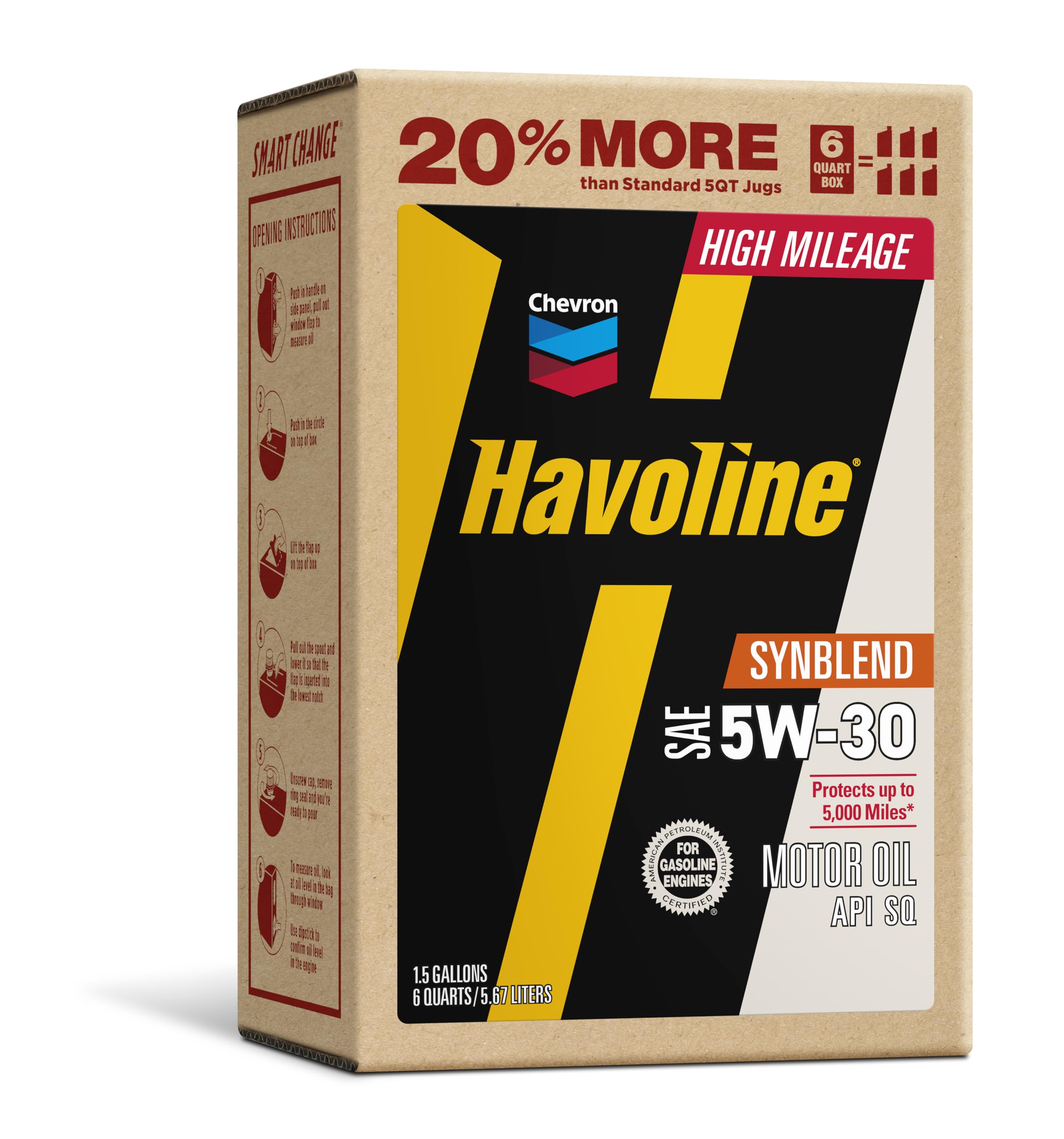
2. Havoline 5W-30 High Mileage Smart Change
A 6-quart box that pours mess-free and quiets high-mileage cold starts.
If you drive a full-size truck or SUV that needs an extra quart, this Chevron Havoline formula holds 20% more oil than a standard 5-quart jug — 6 quarts versus the 5 quarts you get from most competitors — so you buy one jug instead of two. The bag-in-box packaging is a genuine surprise: it is durable, leak-free, and pours mess-free, which owners repeatedly highlight as a reason to repurchase. It carries a 5W-30 viscosity (a common grade for moderate climates) that suits a wide range of cars, SUVs, and even light trucks.
The high-mileage chemistry here is built to preserve fuel economy better than conventional oils, reduce leaks, and prevent oil consumption. Owners mention a quieter, smoother engine, especially on cold starts, with one describing a 280k-mile Tahoe/Yukon running smoothly with no leaks or consumption. The seal conditioners in the formula are the reason, as they help hardened seals expand back into place.
Owners praise the oil quality most, with value for money a close second. Customers note the 6-qt box is great for frequent top-offs on oil-leaking older cars, and the Honda Pilot crowd appreciates that the 6-quart capacity matches their engine’s exact requirement. One owner running a V8 with over 400 horsepower from the factory reported an extra smooth idle and 24 miles per gallon after the switch.
What wins people over
- 6 quarts of oil at a value price per ounce
- Mess-free bag-in-box design that pours clean
- Seal conditioners that quiet cold starts on 280k-mile engines
Who should look past it
- Pouch packaging is unusual if you prefer a rigid jug for storage
- 5W-30 grade won’t fit engines that spec 0W-20
Grab this for: trucks and SUVs that need 6 full quarts and anyone tired of messy pour spouts.
skip it if: you want a traditional bottle that stands on a garage shelf, since the box format stores differently.
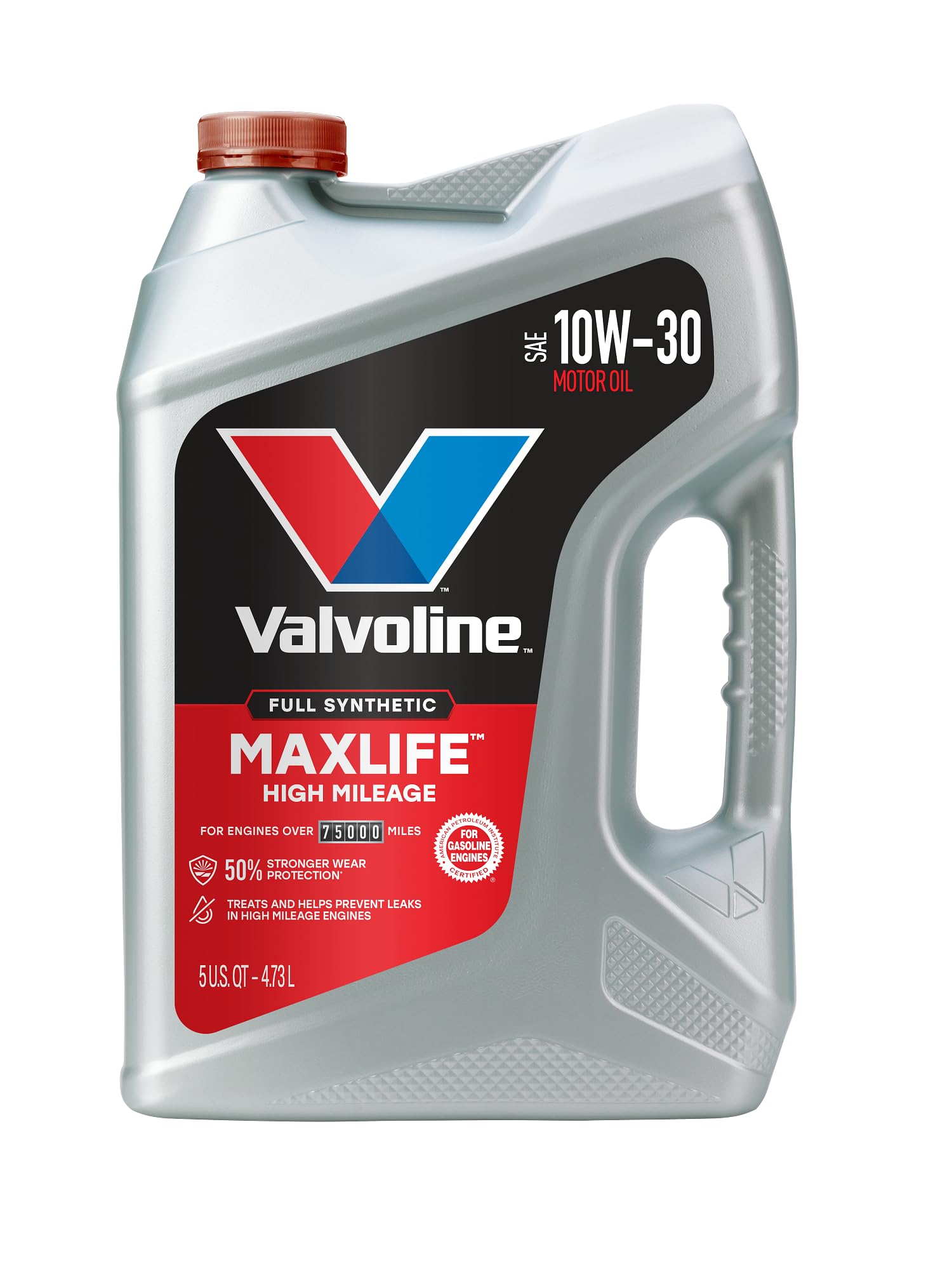
3. Valvoline MaxLife Full Synthetic 10W-30
The heavy-duty 10W-30 for engines that have earned their stripes past 75,000 miles.
For an engine that has already seen 75,000 miles or more, this Valvoline MaxLife formula goes hard on the protection numbers. According to the brand, it delivers 50% stronger wear protection than industry standards, 20% stronger sludge defense, and 2.5X better heat protection — so you get real confidence for a high-mileage engine. The seal conditioners are formulated to help prevent oil leaks, reduce oil consumption, and improve fuel economy.
Owners with an older 1998 Chevrolet Blazer LS confirmed its effectiveness, and one reported it runs clean for 3000 miles. The 10W-30 grade is the classic choice for older trucks and muscle-era engines, and reviewers point out their engines “run and sound like new” after switching. It meets or exceeds ILSAC GF-7A, API SQ, API SP, and API SN with SN PLUS, which is a broader certification list than most competitors cover.
Owners praise the oil quality most, with performance a close second. One 29-year-old Wrangler owner switched to this synthetic and called it good value, while another appreciated being able to refill their old quart bottles from the 5-quart jug for precise pours into smaller engines. The flash point sits at 448 °F, meaning the oil resists burning off even under serious heat.
Best fit: older engines that spec 10W-30 and need maximum wear and sludge defense at a premium level.
Know this: if your car requires 5W-30 for winter flow, this 10W-30 grade will feel thicker on cold starts, so match it to your manual.
Choose it if: you drive a classic truck or older sedan that calls for 10W-30 and you want the strongest protection claim in Valvoline’s high-mileage lineup.
Think twice if: you need a modern 0W-20 or 5W-30 grade for a newer engine.
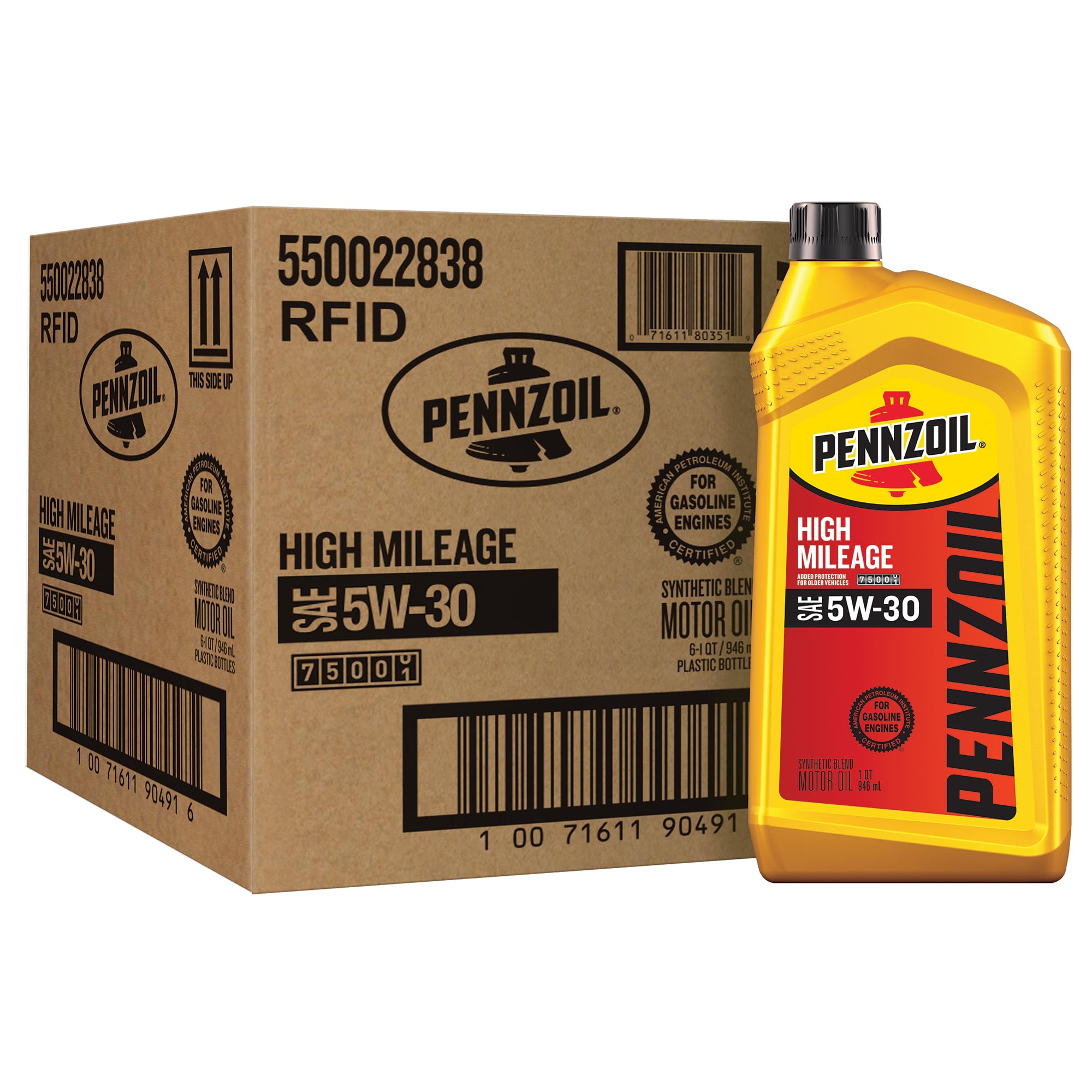
4. Pennzoil High Mileage 5W-30 Synthetic Blend
A budget-friendly synthetic blend that stops leaks without the full-synthetic price.
Pennzoil’s high-mileage blend is formulated to help stop leaks and reduce oil consumption in worn engines, and it is recommended for vehicles with more than 75,000 miles. It is the budget-friendly entry in this list that still delivers the essential high-mileage benefit: seal conditioning. Shoppers say the car drives smooth, stays leakage-free, and runs without noise, with value for money being the aspect praised most by a wide margin.
This 6-pack gives you 192 fluid ounces total, which is a full 20% more oil than a single 5-quart jug from most competitors. That extra volume means you can do a full change and still have oil left for a top-off, which is exactly what a high-mileage engine that burns a little oil needs between changes. It also helps prevent sludge and other damaging deposits, and it is suitable for modern turbocharged engines where low-speed pre-ignition protection is required.
Buyers report that one owner’s engine cleaned up nicely after using it, and the 6-quart case price is hard to argue with for a branded product. It weighs 11.9 pounds for the case, so shipping is solid, and the individual quart bottles make it easy to measure precise amounts for smaller engines or top-offs.
Why it sells: the per-quart cost for a reputable blend is the lowest way to get seal-conditioner benefits if you do not need full synthetic.
Keep in mind: a blend has less thermal stability than full synthetic, so if your engine runs hot, step up to a full synthetic option.
Reach for it if: you want a dependable leak-stopping 5W-30 without paying full-synthetic prices.
Pass on it if: you need maximum heat protection or your engine specs a 0W-20 grade.
5. Valvoline High Mileage 150K 5W-30
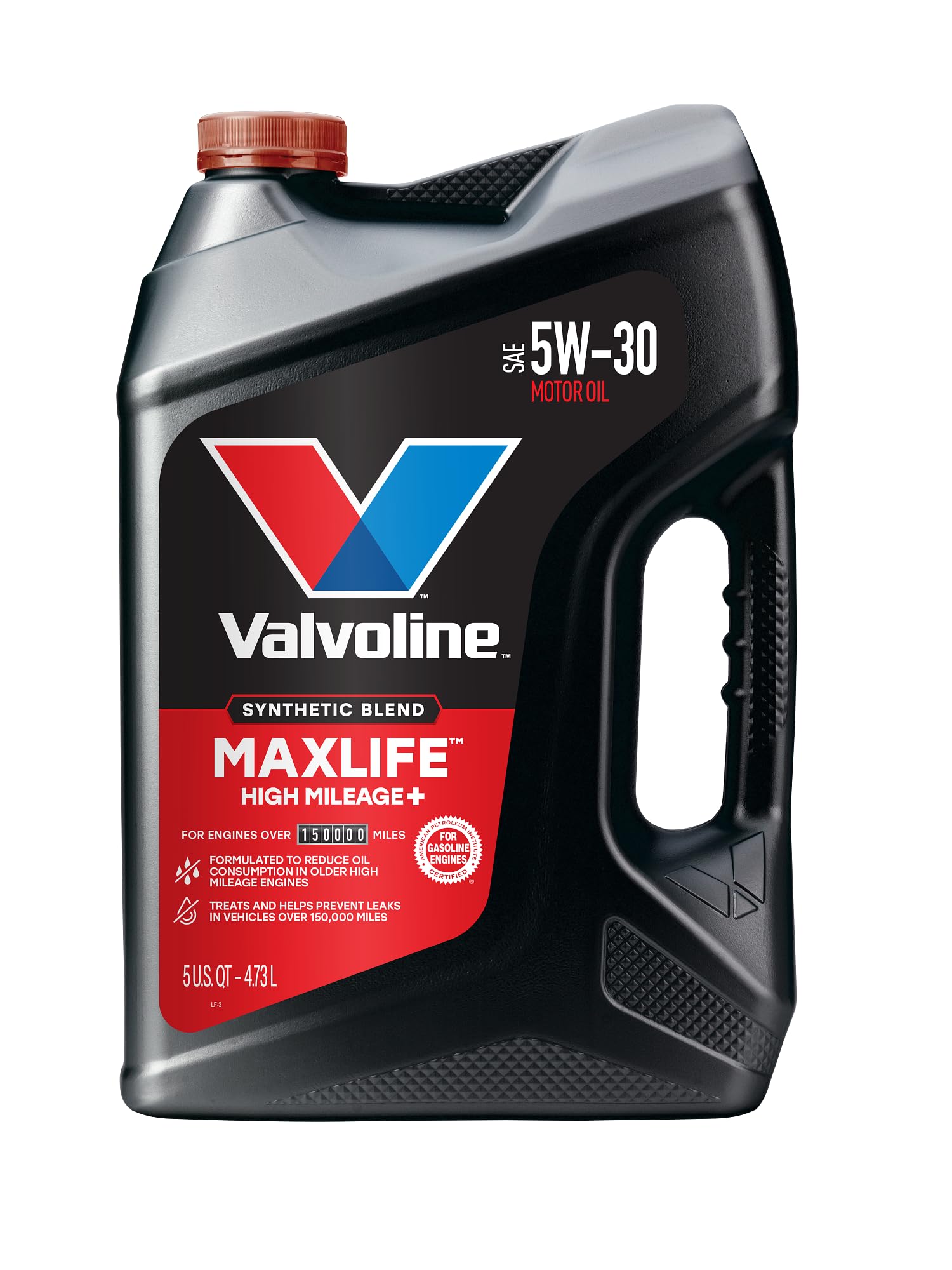
The dedicated formula for engines that have crossed the 150,000-mile line.
Once you pass 150,000 miles, a standard high-mileage oil might not be enough, and Valvoline makes a specific product for that moment. This 150K formula adds an Anti-wear Moly Additive that coats metallic engine parts to reduce friction, and it delivers 10% better wear protection than industry standards. It also brings 15% stronger sludge defense than industry standards, plus extra detergents that fight deposits and antioxidants that prevent thermal degradation.
The seal conditioners here are premium-grade, aimed at preventing oil leaks and reducing oil consumption in older high-mileage engines. Owners mention that it stopped leaks, with one 2002 Dodge Ram 1500 owner confirming its effectiveness, and multiple customers note their engines run more quietly after switching. One owner’s mileage crept over 175k, and they called the switch “definitely worth it.”
Owners praise the oil quality most, with performance a close second. The formula meets ILSAC GF-7A, API SQ, API SP, and API SN with SN PLUS, and it adds Ford WSS-M2C971-A1 and Chrysler MS-13340 approvals, which is useful if you drive a Ford or Chrysler product. The flash point is 394 °F, so it holds up well under normal operating heat.
The strong points
- Moly additive coats parts to reduce friction
- Proven to stop leaks in 2002 Dodge Ram 1500s
- Extra detergents fight deposits in extreme conditions
The honest caveat
- Noise level feedback is mixed, so results vary by engine
- 5W-30 grade only, so check your spec
Best for: high-mileage trucks and SUVs that burn oil or drip, where the extra detergents and moly coating pay off.
Not for: engines that spec 0W-20 or 10W-30, since this locks into 5W-30.
6. Castrol GTX Full Synthetic High Mileage 0W-20
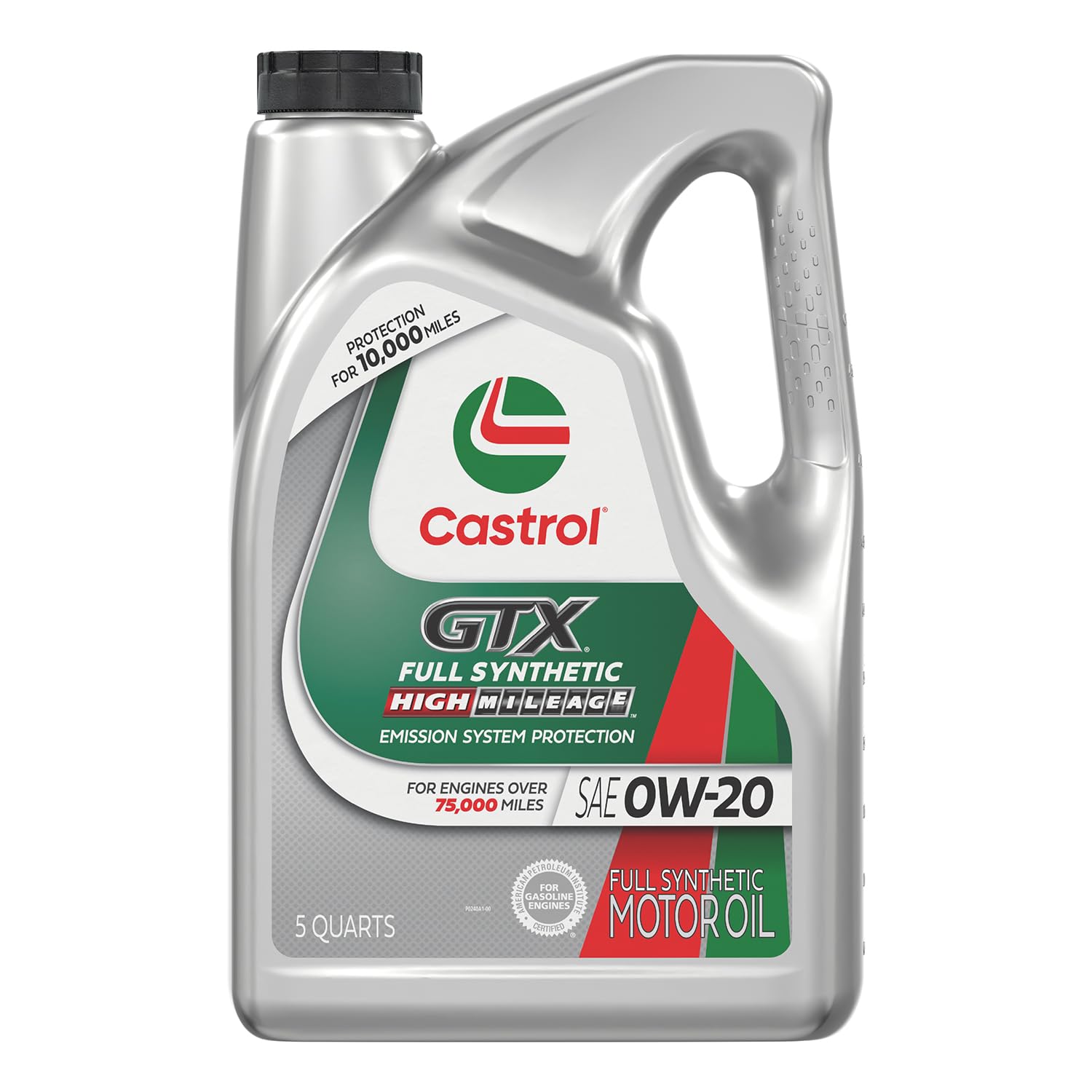
The 0W-20 choice with a catalytic converter safeguard built in.
Castrol brings two things to the table that most high-mileage oils do not. First, it uses Phosphorous Replacement Technology, which helps prevent catalytic converter and emission system failure — a real concern for older cars that are still on the road. Second, it claims 6X better wear protection than the industry standard, which is a serious number for an engine past 75,000 miles.
This is a 0W-20 grade, so it is the thin-flowing option that suits modern engines and hybrids, and Castrol explicitly notes it is suitable for hybrids. It protects for up to 10,000 miles between oil changes, matching the longest intervals in this list. Reviewers point out the engine runs noticeably smoother after an oil change, and they feel confident knowing it is designed specifically for higher-mileage engines while helping reduce engine wear.
The thing owners praise most is oil quality, with performance close behind. Shoppers say their engine internals stay cleaner with Castrol, and one called it their preferred oil across multiple vehicles. The exceptional oil burn-off protection exceeds industry standards, which matters if your engine has a tendency to eat oil between changes. At 160 fluid ounces in a 5-quart jug, it is the standard size for a typical passenger car change.
Why pick it: the catalytic converter protection and 0W-20 cold-flow make it ideal for modern high-mileage cars and hybrids.
The catch: 0W-20 is the only grade available, so older engines spec’ing 5W-30 or 10W-30 need a different bottle.
Ideal if: you drive a high-mileage hybrid or modern car that requires 0W-20 and want converter protection.
Skip if: your engine calls for a thicker 5W-30 or 10W-30 grade.
7. Mobil Full Synthetic High Mileage 5W-30 (6 Pack)

Six quarts of protection that keeps full-size truck engines running strong.
If you drive a truck that needs 6 quarts instead of 5, this Mobil case is the answer, and it is a favorite among GM truck owners. The full synthetic formula is designed for vehicles with over 75,000 miles, whether you are upgrading from conventional or synthetic blend, and it provides guaranteed protection that is 1.5X longer than Mobil’s conventional and blend oils, up to 7,500 miles between changes. The balanced additive system includes extra seal conditioner to help prevent oil leaks, sludge, and deposit formation.
Owners with an F150 report the truck runs fantastic on this oil, and one with 177K miles says it helps the vehicle perform well considering its age. It is even noted as a “great option for trucks needing 6 quarts vs. 5,” which is a specific and common pain point. It provides excellent resistance to oil breakdown and maintains oil viscosity at high operating temperatures, so it holds up to heavy towing and hot weather.
Owners praise the oil quality by a wide margin, and the 192 fluid ounces in a 6-pack covers a full change plus a spare quart. It is recommended for all types of gasoline-powered vehicles, including turbocharged engines, and meets API SP resource-conserving. Buyers who need a full-synthetic upgrade for a 5W-30 engine consistently call it a strong oil at a fair price.
Why it earns its spot
- 6-quart case matches full-size truck capacity
- 1.5X longer protection than conventional oils
- Maintains viscosity at high operating temperatures
The trade-off
- 5W-30 only, so 0W-20 or 10W-30 engines need another pick
- Premium full-synthetic price point
Pick this if: you own a GM truck or F150 that takes 6 quarts of 5W-30 and you want full-synthetic longevity.
pass on it if: your vehicle requires 0W-20 or you only need 5 quarts.
8. Pennzoil Platinum High Mileage 5W-30 (6 Pack)

Full synthetic muscle backed by a 15,000-mile protection guarantee.
Pennzoil Platinum is the performance tier of the Pennzoil lineup, and in high-mileage form it is backed by a 15,000-mile protection guarantee. That is the longest interval promise in this entire list, so if you want to stretch your oil changes as far as the chemistry will allow, this is the one. It keeps pistons cleaner than required by the toughest industry standard based on Sequence IIIH results, and it is proven to help stop leaks for engines with more than 75,000 miles.
This oil is made from natural gas, which is a different base stock than crude-derived oils, and it is formulated to deliver less oil burn-off than high-mileage oils made from crude oil. Owners of vehicles approaching 200,000 miles swear by it, noting their engines still run great after years of use. The 32 fluid ounces per quart with a 6-pack total gives you flexibility for precise pours.
Owners praise the oil quality, and the performance claims back it up: better fuel economy per industry standards, horsepower protection, faster cold-weather flow, and extreme-heat defense. It exceeds API SP, API SP-Resource Conserving, and ILSAC GF-6A, plus it meets Chrysler MS-6395 and Ford WSS-M2C961-A1. One owner prefers it over a popular competing brand, calling it “some of the best engine oil on the market.”
The headline: a 15,000-mile guarantee plus natural-gas base stock makes this the longest-interval full synthetic here.
Be realistic: most owners still change around 5,000 miles for high-mileage engines, so treat 15K as the ceiling, not the target.
Choose it if: you want the most advanced full-synthetic chemistry and the longest interval guarantee for a 5W-30 engine.
Pass if: you prefer frequent 3,000-5,000-mile changes and want to save money on a blend instead of paying for full-synthetic longevity.
9. Royal Purple HMX 10W-30 High-Mileage (6 Pack)

The distinctive purple oil that silences lifter tick on high-mileage V8s.
Royal Purple has a devoted following, and its HMX high-mileage formula is specifically designed to minimize wear and restore lost performance in engines with more than 75,000 miles. It is formulated with sturdy zinc/phosphorus anti-wear compounds (a chemistry that older flat-tappet and high-performance engines love) combined with Royal Purple’s proprietary additive technology. The HMX formulation is chemically enhanced to revitalize hardened seals, reducing the oil consumption that plagues high-mileage engines.
The real-world stories are striking: buyers report the oil eliminates sticky lifter noise on a 160k-mile Dodge Dakota 4.7L V8, and a 2500HD 6.0 gas engine shows a more smooth idle with less lifter tick after the first change. The ionic attraction to metal surfaces provides protection and minimizes wear at start-up, which is the most damaging moment for any engine. One generator owner with a Honda EU7000is reported internals look new at 2000 hours with no bearing wear or blow-by.
Owners praise the oil quality by an enormous margin, and the 192 fluid ounces in a 6-pack provides plenty for a full change plus top-offs. It reduces friction and metal-to-metal contact for peak engine performance, and it provides outstanding oxidation resistance to safely extend oil drain intervals. The iconic purple color is a bonus for owners who like to see exactly what is in their engine.
What makes it special
- Zinc/phosphorus anti-wear compounds protect high-performance engines
- Proven to eliminate lifter tick on high-mileage V8s
- Ionic attraction protects at start-up
Honest considerations
- Premium price point for a case of 6
- 10W-30 grade limits it to engines that spec that thickness
Best for: older performance V8s and trucks where lifter noise and oil consumption are the main complaints.
Not ideal if: your engine requires 0W-20 or 5W-30, since the 10W-30 grade is fixed.
Understanding the Specs
Viscosity Grade (SAE J300)
This is the number that matters most when buying oil. The first number followed by “W” (for winter) tells you how thin the oil is when cold — lower numbers like 0W flow better in freezing temperatures. The second number is the thickness at operating temperature; higher numbers like 30 or 40 handle more heat. Stick to what your owner’s manual recommends, since using a thicker grade than spec can reduce fuel economy and a thinner grade can increase wear.
API and ILSAC Standards
These are the industry certifications that tell you the oil is safe and effective for modern engines. API SP is the current gasoline standard, and ILSAC GF-6 is the newer fuel-economy standard. High-mileage oils that meet these standards include low-speed pre-ignition protection, which matters for turbocharged engines. If an oil meets an older standard like API SN, it is still fine but may lack the newest protections.
FAQ
When should I switch to high-mileage motor oil?
What is the difference between 5W-30 and 10W-30 high-mileage oil?
Will high-mileage oil stop my engine from burning oil?
Can I mix high-mileage oil with regular motor oil?
Is full synthetic high-mileage oil better than a synthetic blend?
How often should I change high-mileage motor oil?
Can I use high-mileage oil in a newer car?
What does the “0W” in 0W-20 mean for cold starts?
Does high-mileage oil improve fuel economy?
Final Thoughts: The Verdict
For most drivers of aging cars, the motor oil for high mileage cars winner is the Mobil 1 High Mileage 0W-20 because it pairs the most popular grade of the moment with up to 10,000-mile protection and a 4.9-star crowd consensus. If you want a full-synthetic upgrade for a truck that drinks 6 quarts, grab the Mobil High Mileage 5W-30 6-pack. And for an older V8 that ticks and burns oil, the Royal Purple HMX is the one serious owners reach for to quiet things down.
How We Picked
We do not accept paid placement. Every pick is matched to a real buyer and a real use-case; we do not hands-on test units.
Sources & Methodology
Specifications: manufacturer listings and product documentation. Review insights: verified customer reviews, as of August 2026. Pricing: not shown on this page (it changes often); check the current price via the retailer link.
As an Amazon Associate, Trending Car earns from qualifying purchases. This does not affect which products we feature.