
Our readers keep the lights on and my garage snacks stocked. As an Amazon Associate, I earn from qualifying purchases.
Specs are compiled from manufacturer listings and verified buyer reviews and can change over time — please confirm the key details on the product page before buying.
Your motard’s performance lives or dies on four palm-sized contact patches. The wrong rubber turns a nimble canyon carver into a nervous highway wanderer, while the right set transforms every ride, wet or dry. This guide cuts through the marketing to the five tyres worth your money, ranked by real owner mileage and honest spec sheets.
I’m Min Islam — the founder and writer behind Trending Car. This guide is built by comparing the manufacturers’ published specifications and the patterns across verified customer reviews, so you get each pick’s real strengths and trade-offs instead of marketing spin.
You’re here for a set of motard tyres that won’t let you down at speed or in the rain, and these five are the crowd-tested candidates that actually deliver on both promises.
Our Picks at a Glance

How To Choose The Best Motard Tyres
Before you hand over your cash, you need three things clear: the compound’s intent, the construction type, and the load rating. A soft sport compound that sticks like glue on a twisty Sunday will be flat-spotted by Tuesday’s commute. A touring compound built for high mileage on the freeway might feel vague when you tip it into a tight corner. Match the tyre to your riding, not the other way around.
Construction: Radial vs. Bias-Ply
Radial construction (the cords run across the tread at 90 degrees) generates less heat and offers a more compliant ride at high speeds, making it the standard for modern sport and touring motards. Bias-ply tyres have cords that cross diagonally; they are stiffer and cheaper but run hotter and can feel less precise on a larger bike. Every tyre on this list is a radial, which is the right choice for most riders.
Compound and Tread Design
A dual-compound tyre puts a softer, grippier rubber on the shoulders for cornering and a harder, longer-lasting compound in the centre for straight-line commuting. If you spend most of your time on straights, this saves you money. For pure canyon carving, a single soft compound across the full width delivers maximum grip but wears faster. The tread pattern’s groove depth and spacing determine how well water evacuates; deep central grooves are a strong sign of wet-weather confidence.
Load Index and Pressure
The load index (a two-digit number on the sidewall) tells you the maximum weight the tyre can carry at full pressure. A 69W rating means 716 pounds at a speed index of 168 mph. Ignoring this leads to overheating the carcass and a sudden loss of grip. Always match or exceed your bike’s axle load rating, and run the manufacturer-recommended psi, not the tyre’s maximum printed on the sidewall.
Quick Comparison
| Model | Best For | Construction | Load Capacity | Item Weight | Amazon |
|---|---|---|---|---|---|
| Kenda KM1 160/60ZR17★ Best Overall | High-mileage commuting | Radial – 4-Ply | 716 lbs | 16.2 pounds | Amazon |
| Michelin Pilot Street 2Best Value | Scooters and light motards | Radial | — | 8.6 pounds | Amazon |
| Continental ContiMotion Front | Budget front replacement | — | — | — | Amazon |
| Pirelli Angel ST Rear | Sport-touring all-weather | Radial – 2-Ply | 716 lbs | — | Amazon |
| Pirelli Diablo Rosso II Set | Sport cornering performance | Radial – 2-Ply | 520 lbs | — | Amazon |
In‑Depth Reviews
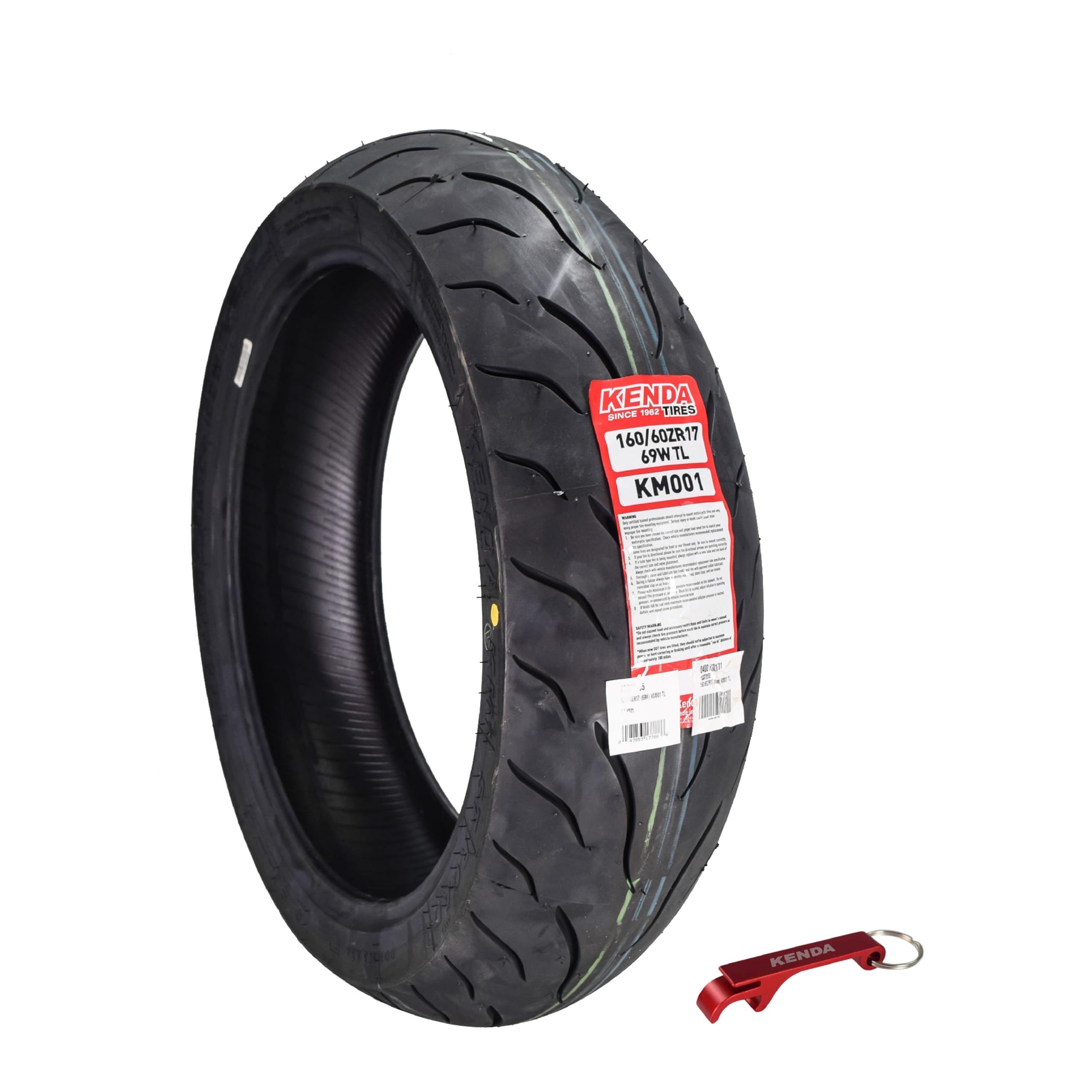
1. Kenda KM1 160/60ZR17 Sport Touring Motorcycle Tire 69W (160/60-17)
Our pick — over 4.5★ from 900+ verified ratings; the strongest balance of quality and price.
The budget hero that outlasts premium rubber on a 140-mile daily grind.
This is the crowd favorite for a reason — nearly a thousand owners have piled on the miles and the consensus is emphatic. The Kenda KM1 uses a 4-ply radial construction (four layers of casing material for high-speed stability) and an advanced rubber compound engineered to heat up quickly from cold, so you get grip from the moment you pull away. It’s noticeably heavier than a pure sport tyre at 16.2 pounds, but that weight translates directly into the toughness that makes it a commuter’s best friend.
Buyers report it “holds up to 140-mile commute,” with one owner noting the rear still has half tread remaining at 4,000 miles. The tune apex geometry (the internal shape of the sidewall) delivers a balance of high-speed stability and agile handling that works for both highway cruising and backroad carving. The single recurring adjustment is the stiff sidewall — expect a firm installation with tyre spoons and a need for higher pressure (around 40 psi) to seat the beads properly.
The thing everyone raves about is the value. Owners mention anticipating 8,000 to 10,000 miles from the rear. The trade-off is a slight sensitivity to pavement grooves at highway speeds and a subtle weave that some owners note compared to premium Metzelers.
Where it excels daily: The even-wear tread pattern and responsive handling make this the easy recommendation for any sport-touring rider who needs a durable rear that doesn’t demand a premium budget. The balanced apex design keeps you confident at speed.
Reach for this if: your commute or weekend ride covers 100+ miles of mixed highway and twisty stuff, and you want a rear tyre that lasts.
Look elsewhere if: you’re a knee-dragging track-day rider who needs the absolute softest, stickiest compound for maximum cornering grip.
2. Michelin Pilot Street 2 Tire (90/80-17 (03022))
The lightest, most confidence-inspiring tyre for scooters and small motards.
At 8.6 pounds, the Pilot Street 2 is almost half the weight of the Kenda above (16.2 pounds), making it drastically easier to mount at home. But its real a neat extra is the rain performance — buyers describe it as “performs perfectly in rain, no wobble.” The deep tread grooves and progressive side grooves are specifically designed to enhance water evacuation under hard braking or aggressive lean angles in the wet.
It’s a front or rear fit for scooters and smaller displacement motards, with owners reporting it fits a Honda Trail 125 and a Talaria 3X without any hassle. The consensus among the hundreds of owners is that the smooth ride and excellent road grip justify the price comfortably, and the ease of installation is frequently called out. One suggested tip from the community: use a degreaser on the tyre before the first ride to remove the protective film left from manufacturing.
The honest limitation is lifespan on a heavier bike. Because the Pilot Street 2 is designed for scooters, pushing it on a 400cc or larger motard will accelerate centre-tread wear. It’s a fantastic value for lightweight machines, not a high-mileage touring contender.
The rain confidence factor: The small central grooves and progressive side grooves are not just marketing — owners confirm the tyre tracks straight through standing water with zero rear-end wiggle, which is rare at this price point.
Best suited to: a 125cc to 300cc motard or scooter where light weight, easy fitment, and wet-road security matter more than outright high-speed mileage.
Who should skip: sport-touring riders on 650cc-plus machines — the carcass is not built to handle the higher weight and heat cycles of a big-bore commute.
3. Continental ContiMotion Sport/Touring Motorcycle Tire Front 120/70-17

The front tyre bargain that DRZ400SM owners swear by for wet grip.
Continental’s ContiMotion is the minimalist option — a single front tyre designed for sport-touring duty that punches way above its price point. Owners of the DRZ400SM supermoto are the most vocal fans, reporting “excellent grip even in wet conditions” and estimating “at least 5,000 miles out of the rear tire obviously more out of the front.” The performance-to-cost ratio is the core reason riders keep returning to this model.
The durability is the double-edged sword. One owner on a heavier bike noted the front “has worn quicker than any front tire I’ve purchased,” which suggests the rubber compound is tuned for grip first, lifespan second. Another buyer flagged that the stock they received had been sitting on a shelf for two years — check the date code on the sidewall when yours arrives. Fresh stock handles and wears noticeably better.
The lack of published technical specifications in the listing is a minor frustration, but the owner reports paint a clear picture: smooth ride, good traction, and balanced behavior at a price point that makes running a fresh front tyre every season financially painless.
Grip-first compound: The ContiMotion uses a sport-touring silica compound that prioritizes wet-weather grip over extreme high-mileage. For a front tyre that sees less outright wear than a rear, this trade-off makes sense for budget-conscious motard owners.
Choose this if: you need a quick, affordable front replacement for a DRZ400SM or similar supermoto, especially if you ride in wet conditions where grip matters most.
Pass it up if: you want maximum front-tyre mileage from a premium touring compound with a published wear guarantee.
4. Pirelli Angel ST 160/60ZR17 (69W) Rear Motorcycle Tire

A high-mileage rear that still grips like a sport tyre in the wet.
The Angel ST from Pirelli bridges the gap between pure sport and touring with a high-silica-content compound engineered for grip on dry surfaces while maximizing safety in wet conditions and low temperatures. Owners confirm the versatility: one rider on a Versys 650 reported 10,000 miles from the rear before it wore flat in the centre, and still praised its “excellent rain handling.” The unique tread pattern is designed for both mileage and appearance, so the tyre looks good even as it ages.
The 2-ply radial casing is lighter and more flexible than the Kenda’s 4-ply construction, which translates to a more compliant ride over rough pavement. The load capacity matches the Kenda at 716 pounds (load index 69), so it’s rated for the same sport-touring loads. The Angel ST includes a clear lifespan indicator — a visual cue on the tyre surface that shows you the residual tread depth, so you never have to guess when replacement is due.
The limitation is the centre-flat wear pattern reported by high-mileage commuters. On a Versys 650 doing mostly straight-line miles, the centre compound wears faster than the shoulders, which is typical for a sport-touring tyre designed with cornering grip as a priority. The front tyre from a set generally outlasts the rear by a significant margin.
Mileage leader: 10,000 miles from a rear sport-touring tyre is exceptional, and the Angel ST delivers that while maintaining wet-weather confidence that owners consistently describe as top-tier.
Go for this if: your motard sees a mix of long highway slogs and wet-weather riding, and you want a rear tyre that can exceed 10,000 miles without sacrificing cornering feel.
Think twice if: you run a pure track-day setup and need the absolute softest compound for maximum lean-angle grip at the expense of mileage.
5. Pirelli Diablo Rosso II Front & Rear Motorcycle Tire Set 120/70 & 180/55

The sport tyre set that transforms a motard into a canyon-scratching weapon.
The Diablo Rosso II is the performance benchmark here, using Pirelli’s dual-compound technology — a harder rubber compound in the centre for straight-line wear and a softer compound on the shoulders for extreme cornering grip. The asymmetric tread pattern is designed for efficient water displacement on wet roads while maximizing dry grip, making this a dual-purpose tyre that doesn’t compromise on either. It’s a full front and rear set (120/70 ZR 17 and 180/55 ZR 17) that comes with a bonus Pirelli keychain, a nice touch for brand enthusiasts.
Owners are emphatic about the handling transformation: “I can really get into the corners now,” one buyer wrote, while another praised the “outstanding dry and wet grip, responsive steering, planted cornering.” The maximum pressure is 36 psi, which is lower than touring-focused tyres; this softer carcass is tune for heat generation and mechanical grip during aggressive riding. The load capacity is 520 pounds, lower than the Kenda and Angel ST at 716 pounds, confirming this is a pure sport tyre not built for heavy touring loads.
The honest trade-off is longevity. The softer dual-compound limits high-mileage performance, especially if you “hit the twisties hard.” One owner gave a 4-star review noting “good sport riding profile and traction for a reasonably priced tire… but if you hit the twisties hard dont expect high milage.” This is not a commuter’s 10,000-mile tyre — it’s a canyon-carver’s weekend set.
Cornering transformation: The responsive steering and planted cornering that owners describe is the dual-compound at work — the soft shoulders let you lean deeper with confidence because the rubber literally conforms to the road surface under load.
Buy this set if: your motard lives for the weekend twisties and you want a tyre that delivers immediate, confidence-inspiring turn-in and a sticky feel at the apex.
skip it if: your riding is 90% commuting in a straight line — the soft compound will wear flat in the centre long before the edges show any use, wasting the dual-compound advantage.
Understanding the Specs
Radial vs. Bias-Ply Construction
The cords inside a radial tyre run across the tread at 90 degrees, which allows the sidewall and tread to flex independently. This reduces heat buildup at highway speeds and gives a more compliant ride. A 4-ply radial (like the Kenda KM1) uses four layers of casing material for high-speed stability, while a 2-ply radial (like the Pirelli Angel ST) is lighter and more flexible for a sportier feel. All modern motard tyres should be radial.
Load Index and Speed Rating
The load index is a two-digit number that corresponds to a specific weight limit — for example, 69 means 716 pounds. The letter after it (W, V, ZR) is the speed rating, telling you the maximum speed the tyre can sustain. A 69W tyre is rated for 716 pounds at up to 168 mph. Running a tyre with too low a load index for your bike’s weight will overheat the carcass and cause sudden grip loss.
Dual-Compound Technology
A dual-compound tyre uses a harder rubber in the centre tread area for lower rolling resistance and longer mileage on straight roads, combined with a softer compound on the shoulders for maximum grip during cornering. The Pirelli Diablo Rosso II is the prime example here — it extends wear life without sacrificing the stickiness you need when leaned over.
Section Width and Aspect Ratio
A size like 160/60ZR17 breaks down: 160 is the section width in millimeters (the tyre’s overall width), 60 is the aspect ratio (the sidewall height as a percentage of the width, so 96 mm in this case), and 17 is the rim diameter in inches. A wider section width (180/55 vs 160/60) puts a bigger contact patch on the road for more grip but can slow steering response.
FAQ
Can I run a sport tyre like the Diablo Rosso II on a daily commuter motard?
What is the difference between a 2-ply and a 4-ply radial tyre?
How many miles should a motard rear tyre last?
Is a 160/60ZR17 tyre compatible with my bike if the stock size is 150/60ZR17?
Do I need to use a degreaser on a new tyre before the first ride?
What does the “W” in 69W mean on a tyre sidewall?
Can I mix a Continental ContiMotion front with a Pirelli Angel ST rear?
How do I check the date code on a tyre so I know it is not old stock?
Final Thoughts: The Verdict
For most riders, the motard tyres winner is the Kenda KM1 because its 4-ply radial construction, advanced rubber compound, and owner-verified 8,000-plus-mile lifespan make it the best intersection of price, durability, and all-weather grip. If you ride a lightweight scooter or small motard and wet-road security is your priority, grab the Michelin Pilot Street 2. And for weekend canyon carving where cornering feel matters more than mileage, the Pirelli Diablo Rosso II set is the one to reach for.
How We Picked
We do not accept paid placement. Every pick is matched to a real buyer and a real use-case; we do not hands-on test units.
Sources & Methodology
Specifications: manufacturer listings and product documentation. Review insights: verified customer reviews, as of July 2026. Pricing: not shown on this page (it changes often); check the current price via the retailer link.
As an Amazon Associate, Trending Car earns from qualifying purchases. This does not affect which products we feature.