
Our readers keep the lights on and my garage snacks stocked. As an Amazon Associate, I earn from qualifying purchases.
Specs are compiled from manufacturer listings and verified buyer reviews and can change over time — please confirm the key details on the product page before buying.
A mirror dash cam replaces your factory rearview mirror with a screen that shows your rear camera feed while also recording the road ahead and behind you. The smartest picks add collision alerts (ADAS — a system that warns you about lane drifting or a car in your blind spot), built-in GPS that logs your speed and route, and parking surveillance that catches a hit-and-run in a lot. Resolution matters: a 4K front camera captures number plates that a standard 1080p lens might turn into blurs, especially in rain or at dusk.
I’m Min Islam — the founder and writer behind Trending Car. This guide is built by comparing the manufacturers’ published specifications and the patterns across verified customer reviews, so you get each pick’s real strengths and trade-offs instead of marketing spin.
We looked at nine models with the clearest night recording, largest screens, and the smartest driving aids to find the best mirror dash cam front and rear for different cars and budgets.
Our Picks at a Glance

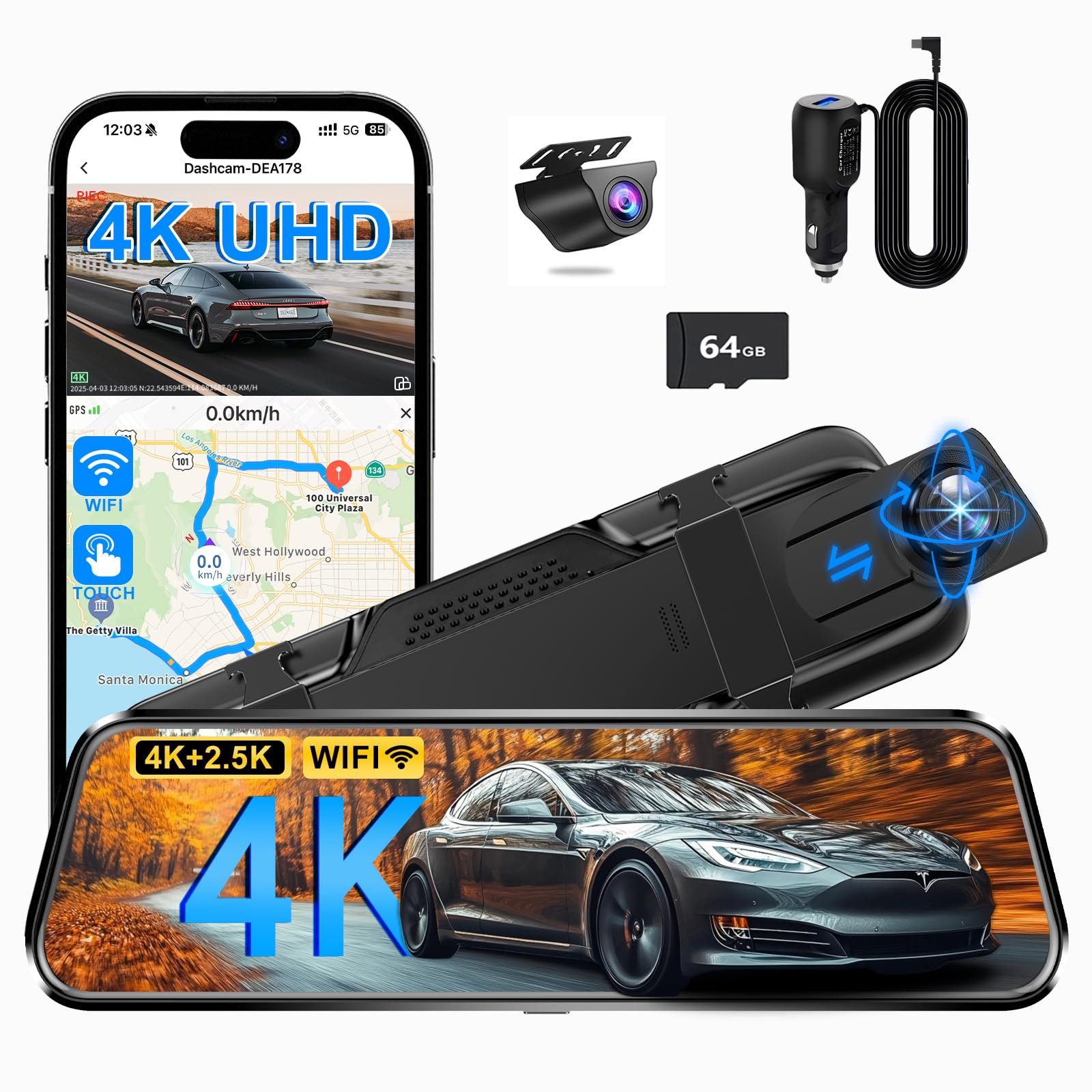

How To Choose The Best Mirror Dash Cam Front and Rear
Your goal is a camera that records clear evidence day and night while functioning as a usable rearview mirror. Four decisions separate a good buy from one you will want to replace in a year.
Resolution — front vs rear
A 4K front camera (3840 x 2160 pixels) captures much finer road detail than a 1080p one. It can read a license plate several car lengths ahead on a highway. The rear camera is often 1080p or 2.5K — enough for backup visibility and plate capture from behind. If you park on the street or drive at night often, prioritize front 4K with a minimum rear 1080p.
The sensor that drives night quality
Standard camera sensors struggle when headlights and shadow mix. A STARVIS 2 sensor (an upgraded image sensor made by Sony that collects more light) pulls detail out of dark scenes far better — think reading a sign in a tunnel rather than seeing a gray smudge. Models with an IMX678 chip (the specific sensor model) lead in low-light clarity right now.
Parking mode and power
Nearly every mirror dash cam offers parking surveillance — it wakes up when it senses a bump or motion and saves a clip. Some need a separate hardwire kit (a cable that taps into your fuse box or OBD-II port) so the camera stays awake while the car is off. Without that kit, most units only record while the engine runs. If you park in a busy lot, budget for the hardwire accessory.
Smart driving aids (ADAS and BSD)
Advanced Driver Assistance Systems give you voice or on-screen alerts for threats like a front-vehicle departure, lane drift, or a blind-spot car. These features range from genuinely handy (forward-collision warnings on the highway) to too-trigger-happy in city stop-and-go. If you commute on twisty or crowded roads, look for a model where the ADAS sensitivity can be adjusted or turned off entirely.
Quick Comparison
| Model | Best For | Front Resolution | Max Memory | Screen Size | Amazon |
|---|---|---|---|---|---|
| WOLFBOX G850 PRO★ Best Overall | Overall value with smart safety | 4K 2160P | 256 GB | 12″ IPS | Amazon |
| Mirror Dual Dash (QOZ)Best Value | Highest feature-per-dollar ratio | 4K 3840×2160 | 512 GB | 10″ IPS | Amazon |
| JOMISE K17 ProTech Savvy Pick | Built-in CarPlay and Android Auto | 2.5K | — | 12″ Touch | Amazon |
| AZDOME PG17 | Budget-friendly 4K starter | 4K | 256 GB | 12″ Touch | Amazon |
| Pelsee S12 Pro | STARVIS 2 night vision fidelity | 4K 2160P | 256 GB | 12″ IPS | Amazon |
| AZDOME PG17 Pro | 4K front + 2.5K rear with STARVIS 2 | 4K UHD | 256 GB | 12″ LCD | Amazon |
| Pelsee P12 Pro Max | Full feature set with OBD hardwire kit | 4K 30fps | 512 GB | 12″ LED | Amazon |
| AUTO-VOX T9PRO | OEM-style replacement with anti-glare screen | 1080p front | 128 GB | 9.35″ Laminated | Amazon |
| WOLFBOX G900 PRO-N | Sharpest dual 4K/2.5K with STARVIS 2 | 4K 3840×2160 | 512 GB | 12″ LCD | Amazon |
In‑Depth Reviews
1. WOLFBOX G850 PRO 4K Mirror Dash Cam
Our pick — over 4★ from 950+ verified ratings; the strongest balance of quality and price.
The mirror cam that gives you 4K video, driving alerts, and a generous 64GB card in the box.
The G850 PRO pairs a 4K front camera (recording at 2160P at 30 frames per second) with a 1080P rear camera that covers 170 degrees. That wide rear lens eliminates most blind spots — the kind of coverage you want for lane changes and backing out. The full IPS touchscreen measures 12 inches, and buyers consistently report that the display is bright and responsive even in daylight.
The Advanced Driver Assistance System (ADAS) here includes forward-collision warnings, lane-departure alerts, and lead-vehicle-start reminders. A blind-spot detection algorithm monitors the area beside and just behind your car, issuing alerts during lane changes. The 5.8GHz WiFi connection links to the WOLFBOX App for instant downloads — buyers report the connection is smooth for grabbing a clip without removing the memory card. The unit comes with a 64GB card pre-installed and supports up to 256 GB through an SD slot.
The crowd favorite — 4.4 stars across nearly a thousand ratings — the G850 PRO wins on sheer completeness. Owners mention “sharp 4K video day/night, bright responsive display, simple interface, easy install, fits over mirror without blocking view, reliable build.”
4K mirror clarity
- 4K front + 1080P rear at a 170-degree field of view
- ADAS and blind-spot alerts for proactive safety
- 12-inch IPS touchscreen with easy menu navigation
- Includes a 64GB memory card and external GPS antenna
bulky rear camera
- The screen brightness is good in low light but can feel distracting at night for some drivers — adjust the brightness setting to tame it
clear footage: you want one cam that covers 4K recording, smart alerts, and a big screen without hunting for accessories.
tight fit: you need 24-hour parking monitoring from the start — the G850 PRO needs an optional hardwire kit for that.
2. Mirror Dual Dash Camera (QOZ) 4K Front & 2.5K Rear
The entry-level 4K front that supports twice the memory of most rivals — 512 GB.
The front camera records at 4K (3840×2160) and the rear at 2.5K, each with a 170-degree + 150-degree wide-angle lens that covers almost everything beside your car. The 10-inch IPS touchscreen lets you adjust the split-screen view or tap to flip between the front and rear feed while you drive. Buyers describe the interface as responsive and the instructions as clear enough for a first-time installer.
This model bundles a suite of driving aids that you would expect from a premium-tier unit: ADAS (forward-collision and lane-departure warnings), BSD (blind-spot detection), and LCA (lane-change assist). It also includes a 64GB memory card right in the box, plus support for up to 512 GB — a 2x gap in memory capacity over the WOLFBOX G850 PRO, which caps at 256 GB. The Wide Dynamic Range (WDR) and Super Night Vision feature balances headlights against dark road shadows so number plates stay readable at night. Customers note the front camera delivers crisp video that beats brands costing twice as much.
The biggest applause goes to video quality and overall build quality — owners find it “one of the Best Buys” for the feature set. The catch is learning the settings menu the first week; some drivers need a few trips to get the blind-spot alerts dialed in.
dual high resolution: The budget-conscious driver who wants 4K front, 2.5K rear, and a 512-GB memory ceiling without moving to a model.
sharp daytime: value hunters who want extensive memory capacity and smart driving assist features without paying premium prices.
dim light: you need a bigger 12-inch screen — this one is a still-ample 10 inches.
3. JOMISE K17 Pro 2.5K Mirror Dash Cam
Combines a mirror dash cam with CarPlay and Android Auto in one screen.
The K17 Pro sets itself apart by integrating wireless Apple CarPlay and Android Auto directly into the mirror display. That means you can run navigation apps, take calls through your car speakers, and stream music — all through the 12-inch touchscreen. The front camera records at 2.5K resolution, and the rear camera includes a zoom function that magnifies up to 3x, letting you read a license plate from a greater distance than most fixed-lens rear cams can manage.
Installation takes roughly 30 minutes according to owners — the straps loop over the factory mirror, and the rear camera cable (21 feet) reaches the tailgate of most sedans, trucks, and EVs. The unit auto-starts recording when the car turns on, and voice commands handle tasks like locking a video file or taking a snapshot. GPS trip tracking logs your route and speed. Buyers like that the system retains the factory Bluetooth and steering-wheel controls — no permanent modifications are needed. One owner who installed it in a 2003 Chevy Tahoe said it made the truck feel modern.
The thing that wins people over is the inclusion of CarPlay, which eliminates the need for a separate phone mount and lets you use the big mirror display for maps and calls. The honest trade-off is that the front resolution tops out at 2.5K rather than 4K, so if reading plates far ahead at highway speed is your priority, a 4K model is a better fit.
low cost: drivers who want a single screen that does dash cam duty and smartphone mirroring.
no extras: you require a true 4K front camera — the 2.5K front here is still clear, but not as fine-grained as the 4K alternatives.
4. Pelsee S12 Pro STARVIS 2 Mirror Dash Cam

A STARVIS 2 sensor and AI color night vision that keeps detail visible even after sunset.
The S12 Pro uses a STARVIS 2 image sensor on the front camera to pull crisp footage from dimly lit streets — reviewing the clip at the end of a night drive, you can read signs and plates that most standard sensors would turn into dark blurs. The front records at 4K at 25 frames per second, and the rear at 1080P at the same frame rate. The 12-inch IPS display covers a 160-degree field of view.
The Advanced Driver Assistance System provides voice alerts for forward collisions, pedestrian detection, lane departure, and front-vehicle start — reviewers point out the alerts are accurate on highways and adjustable enough not to be annoying in the city. The 5.8GHz WiFi delivers transfer speeds up to 20MB/s via the Pelsee App for fast downloads. The rear camera cable measures 19.6 feet, which fits most standard cars, but larger vehicles like vans or full-size SUVs may need an extension cable (sold separately). The camera weighs 0.9 lbs and measures 11.81 inches long.
Video quality (71 mentions) draws the most praise from owners, who call it a “huge upgrade over factory mirror” and especially appreciate the night clarity. The reliability aspect sits as the most-discussed mixed point — a small number of owners had a unit freeze or needed customer support to resolve a rear-camera issue. Pelsee’s support team resolved those cases within a week according to the reviews.
The mirror measures 11.81 inches wide, so check that your factory mirror is at least 6.3 inches wide — if it is smaller, a separate OEM bracket is needed.
low light: most of your driving happens after dark or in low-light conditions and you want the clearest nighttime footage in this price range.
sunny days: you drive a large truck or van — the standard rear cable may be too short and the mirror width may need a bracket adapter.
5. AZDOME PG17 2CH Mirror Dash Cam 4K

A straightforward 4K dual dash cam with a bright 12-inch screen and minimal fuss.
The PG17 combines a front 4K camera with a 1080p rear camera, covering 150 degrees each. The 12-inch touchscreen offers multiple display modes — you can run a full-screen rear view, a front-only view, or a split showing both cameras at the same time. Among buyers, the build quality (62 mentions) and video quality (55 mentions) are the top positives, with owners calling it a “high-class product” that delivers clear daytime footage.
It includes built-in GPS for speed and route logging, plus parking assistance when paired with a separately purchased hardwire kit. The safety features include collision detection (via the G-sensor, a small accelerometer that detects bumps and sudden stops) and a time-lapse parking surveillance mode. Voice commands let you take a photo or switch camera views hands-free. The maximum memory support is 256 GB via microSDXC card. The rear camera is waterproof, and the Wi-Fi connectivity lets you pull clips to your phone without removing the card.
The honest feedback is that the camera functionality and recording quality carry a mixed verdict — while daytime video is crisp, night performance could be better, and the menu has a learning curve for first-time users. The built-in display has no auto day/night dimming, so you will need to adjust the brightness manually when the sun goes down.
big coverage: buyers who want a large, easy-to-read screen and a simple interface for daily commuting.
quick settings: drivers who need exceptional low-light recording — this model performs better in daylight than at night.
6. AZDOME PG17 Pro STARVIS 2 4K + 2.5K
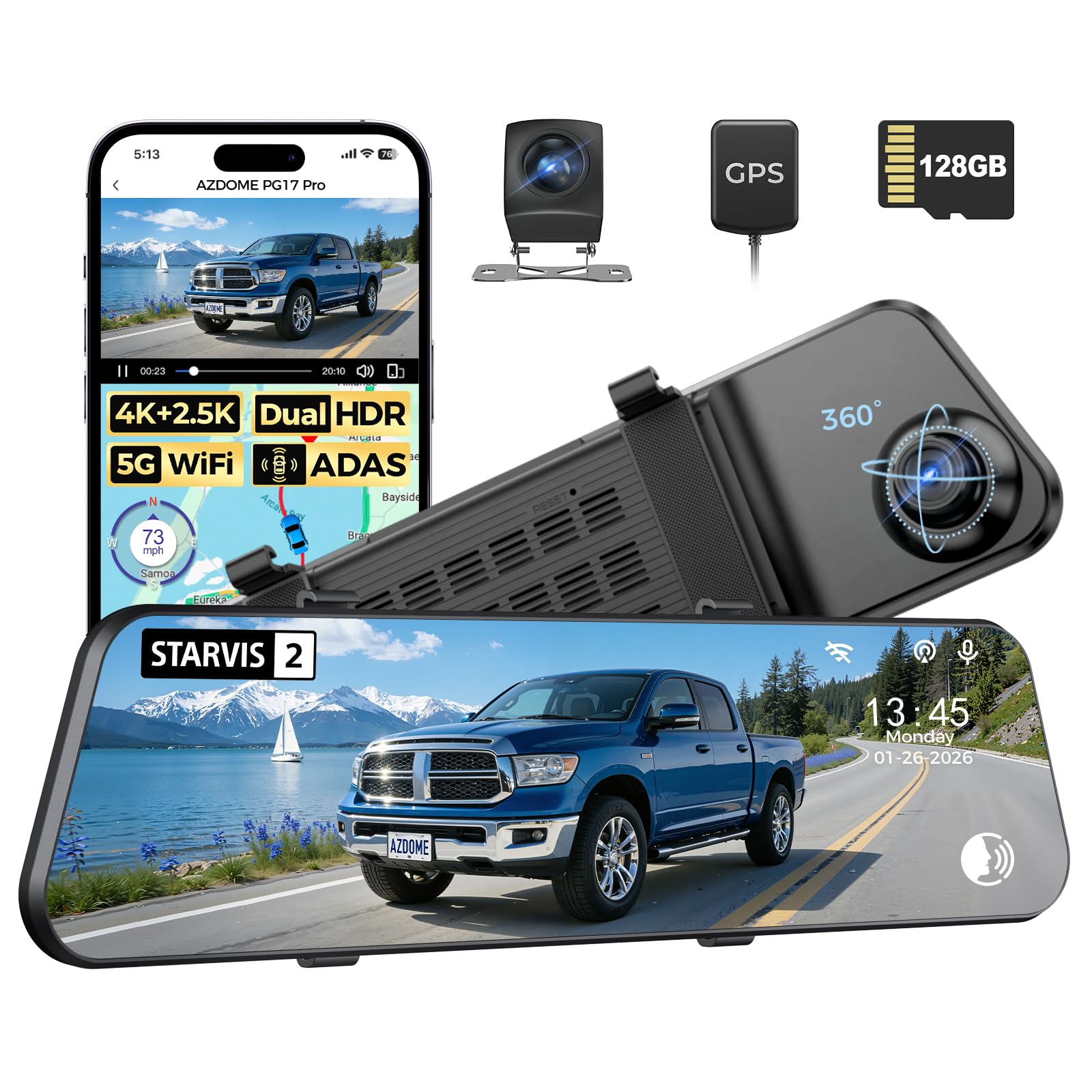
Takes the PG17 formula and adds a STARVIS 2 sensor plus 2.5K rear recording.
The PG17 Pro upgrades the rear camera from 1080p to 2.5K and equips the front with a STARVIS 2 IMX678 sensor — the same chip that powers some of the best night-vision dash cams on the market. The result is noticeably brighter, more detailed low-light footage from both ends of the car. The front records at full 4K UHD, and the rear at 2.5K HDR. The 12-inch LCD screen runs the same responsive interface as the standard PG17.
ADAS remains on board with real-time collision and lane-departure warnings, and the 5.8GHz WiFi delivers fast clip transfers to the AZDOME app. The package includes a 128GB memory card right in the box. The field of view for both cameras is 170 degrees. Camera quality and picture quality are the top positives among owners, with 15 and 13 mentions respectively — shoppers say the resolution is crisp enough to read license plates when you zoom in.
One honest note: visibility in sunny conditions gets mixed feedback. The large screen can produce glare that some drivers find distracting, though the matte black finish helps a little. The unit also includes a GPS receiver for speed and route logging. If you want a clear advantage over the standard PG17 without a huge price step, the Pro version’s sensor upgrade is the reason to spend it.
night vision: you need 2.5K rear resolution and the improved low-light performance of a STARVIS 2 front sensor.
tight budget: budget is tighter and 1080p rear video is sufficient for your commute.
7. Pelsee P12 Pro Max 4K + 2.5K
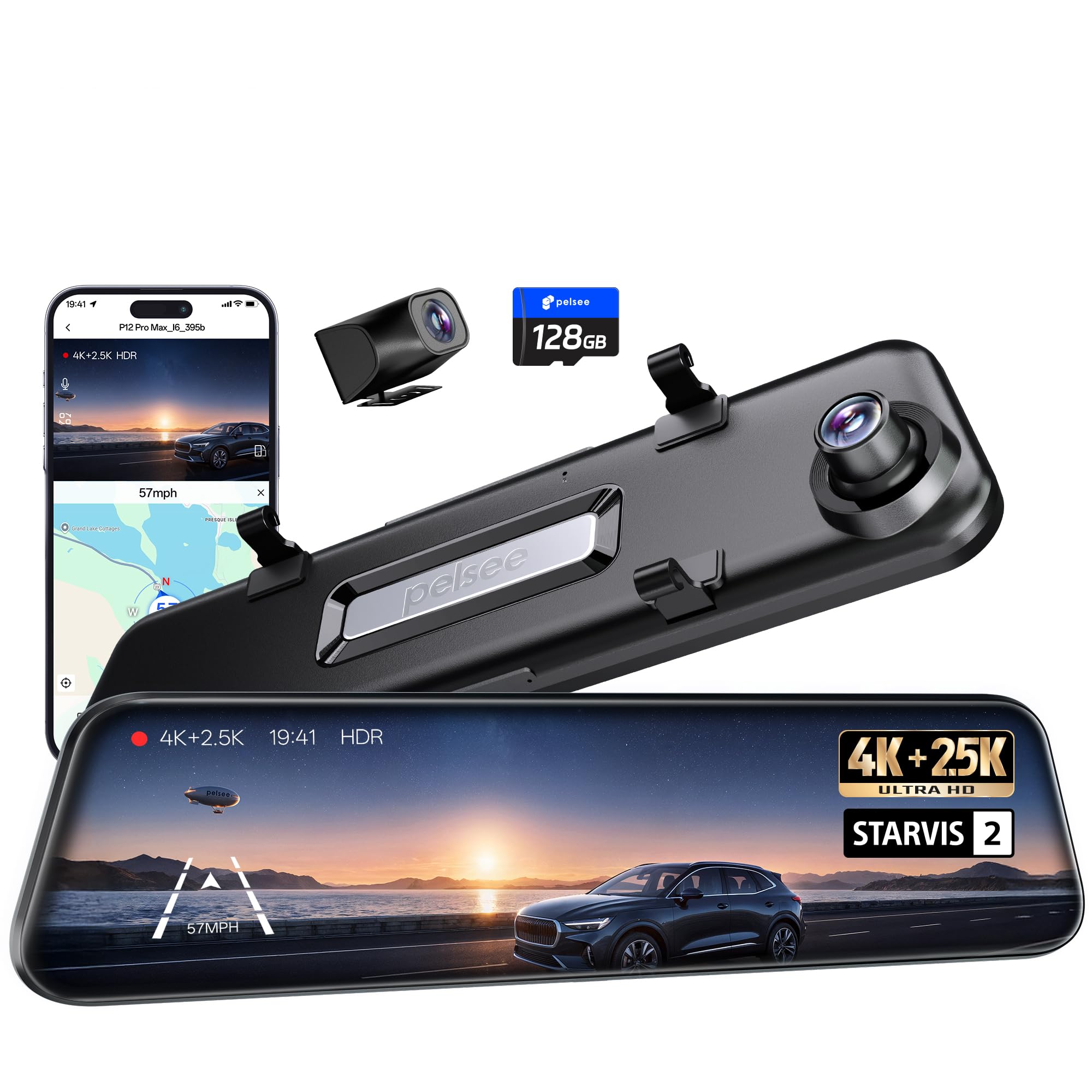
A true 4K front and 2.5K rear pair plus a STARVIS 2 front sensor and an OBD power kit.
The P12 Pro Max features a front STARVIS 2 IMX678 sensor recording at true 4K 30fps and a rear STARVIS IMX335 sensor recording at 2.5K. The HDR on the front and WDR on the rear keep exposure balanced when you pass under a bridge into direct sun or drive through a tunnel. The 12-inch LED display uses a 160-degree field of view on both channels.
This is the only model in the list that includes an OBD hardwire kit in the box, which plugs into your car’s OBD-II port to power 24/7 parking surveillance without draining the battery (it has low-voltage protection). Blind Spot Detection (BSD) monitors the areas your mirrors cannot reach and issues visual and audible alerts. The 33-foot rear camera cable is noticeably longer than the standard 19- to 21-foot cables on other models, making it a better fit for full-size SUVs and trucks. It comes with a 128GB memory card and supports up to 512 GB.
Owners praise the front 4K video clarity and the easy setup. The most-discussed mixed point is the low screen brightness in direct sunlight, which makes the reflection distracting for some. The rear camera cable has been upgraded to 33 feet to improve compatibility with larger vehicles, delivering a more stable signal versus using an extension cable.
ultra HD: you want a complete parking-monitor kit with OBD power, blind-spot alerts, and a 33-foot rear cable for a large vehicle.
small cars: you drive a smaller car and do not need the long rear cable or hardwire kit — you could save money on simpler models.
8. AUTO-VOX T9PRO OEM Mirror Dash Cam

A detachable front camera that can mount on the windshield to eliminate sun-visor blind spots.
The T9PRO takes a different approach: the front camera detaches from the mirror body and can be mounted separately on the windshield. That means you can position it below or beside the sun visor for a clear forward view even with the visor flipped down. The 9.35-inch laminated screen is designed to reduce glare in bright sunlight, and the fully laminated glass cuts reflections that most standard screens produce. Four bracket adapters are included to fit 90% of vehicles.
The rearview images include automatic parking guidelines that tilt the view downward when you shift into reverse, giving you a closer look at the curb. The IMX307 WDR sensor on the rear camera minimizes headlight glare in night vision, though some owners note that glare can still be present with strong oncoming lights. The hardwire kit is included for 24-hour parking monitoring — it wakes on collision and records a 30-second emergency clip, then shuts off to protect the car battery. The maximum supported memory is 128 GB.
Video quality (73 mentions) and overall quality (72 mentions) dominate the positive feedback. The OEM bracket mount system looks factory-installed rather than strapped-on. The main trade-off is functionality — no WiFi or app means you have to pull the SD card to review footage on a computer. Some owners found the initial setup instructions lacking clear images but praised the responsive customer support team (named Gigi and Sasa in reviews) for quick firmware updates.
stealthy: drivers who want a factory-installed look, an anti-glare screen, and do not mind retrieving footage via SD card.
wide view: anyone who wants to grab clips wirelessly through a phone app — the T9PRO lacks WiFi connectivity.
9. WOLFBOX G900 PRO-N 4K + 2.5K STARVIS 2
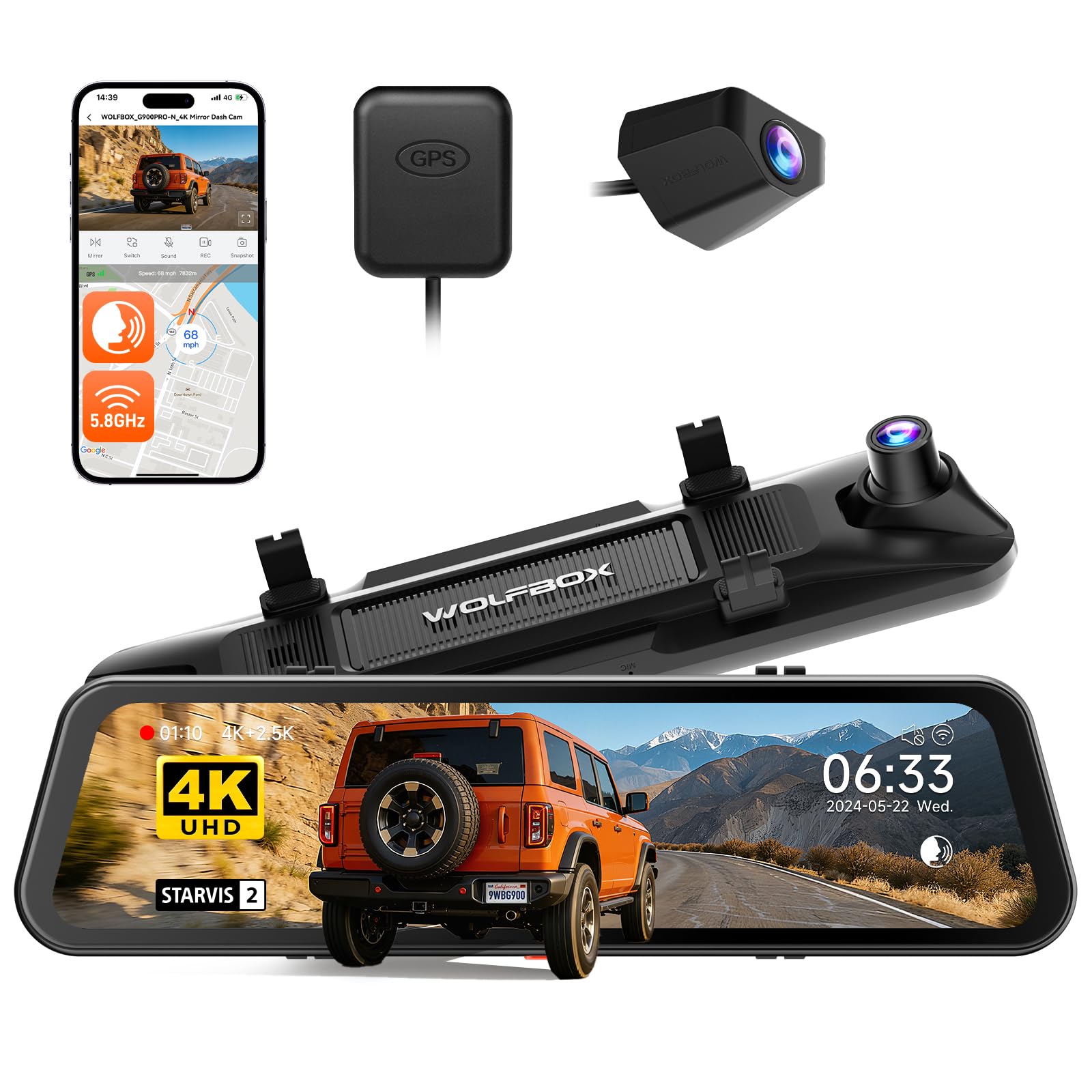
The sharpest dual-resolution in this lineup — 4K front with an 8MP sensor and 2.5K rear.
The G900 PRO-N records front video at true 4K (3840x2160P) using an 8-megapixel sensor and rear video at 2.5K (2560x1440P) using a 4-megapixel sensor, both at 30 frames per second. The front STARVIS 2 IMX678 sensor is paired with a 7-glass lens and F1.8 aperture, which lets in more light for night recording than the standard F2.0 lenses on many competitors. Buyers who upgraded from the G850 say the G900 is “much brighter and sharper,” measuring roughly 90% as good as a factory Toyota digital mirror in clarity.
The 5.8GHz WiFi is rated at 4x faster transfer than the previous generation, so large 4K files move to your phone quickly via the WOLFBOX Auto App. Voice commands let you lock a video or snap a photo without touching the screen. The rear camera cable runs 21.3 feet, and the unit supports memory cards up to 512 GB (card not included). The 12-inch LCD display is large enough to show both camera feeds at once without shrinking each view too much.
The most-discussed mixed point is functionality — while it works flawlessly for most drivers, a handful of buyers report occasional split-screen switching or a unit that needs a firmware tweak. The brightness aspect also gets mixed feedback, with some buyers wanting a brighter daytime display. WOLFBOX backs the G900 PRO-N with a 1-year guarantee and lifetime professional support. If you want the absolute highest resolution paired with a STARVIS 2 night vision sensor, this is the strongest kit available here.
latest tech: 4K front and 2.5K rear with a STARVIS 2 night sensor and fast WiFi are your top priorities.
older model: you want a more affordable package that still includes a 64GB card and most of the same smart safety features.
Understanding the Specs
4K, 2.5K, 1080P — What Each Means for Your Footage
The front camera resolution determines how far ahead you can read a license plate or a street sign in a recording. Full HD (1080p) is the baseline — fine for daytime city driving but often too soft for night plate capture. Quad HD (2.5K, about 2560×1440 pixels) sits in the middle, giving noticeably sharper detail than 1080p without the very large file sizes of 4K. True 4K (3840×2160 pixels) captures four times the pixels of 1080p, so you can zoom into a paused frame and still make out text that a lower-resolution sensor would only show as a blur. The rear camera usually runs at 1080p or 2.5K, which is enough for reversing and capturing plates behind you.
STARVIS 2 — Why Your Night Clips Look Different
A STARVIS 2 sensor (made by Sony) collects incoming light more efficiently than conventional CMOS sensors. In practical terms, it means the video you get from a dark alley or a poorly lit highway looks closer to what your eyes see — number plates are readable instead of washed into a gray blob. The specific chip designation IMX678 indicates the latest generation of this sensor. Models with a STARVIS IMX335 on the rear upgrade the lower rear resolution as well. If you drive after sunset or park in poorly lit areas, a dash cam with a STARVIS 2 front sensor is the single most effective spec you can pay for.
ADAS, BSD, and LCA — Helpful or Annoying?
ADAS stands for Advanced Driver Assistance System. It uses your camera feed to detect lane markings, vehicles ahead, and potential collisions, then gives you a voice or beep alert. BSD (Blind Spot Detection) watches the areas beside and just behind your car that your side mirrors miss, often using a visual icon or tone when a car enters that zone. LCA (Lane Change Assist) is closely related — it alerts you if a vehicle is approaching fast from behind in an adjacent lane while you signal. These features work best on highways with clear lane markings. In heavy stop-and-go city traffic, some systems trigger too often and become distracting; the best models let you adjust the sensitivity or turn specific alerts off.
Parking Mode and the Hardwire Kit
Parking mode keeps your camera recording in a low-power state even when the engine is off. Two types exist: buffered parking mode uses a capacitor to keep the camera alive briefly after power loss, while time-lapse parking mode records one frame per second to save space and stretch power. Both need a constant power source from the car battery (either a fuse-tap hardwire kit or an OBD-II adapter). Without that kit, the camera shuts off when the car turns off. Every hardwire kit includes a low-voltage cutoff that stops drawing power once the battery drops below a set voltage, so you do not wake up to a dead car. If parking surveillance matters to you, factor the cost of the kit into your budget — not every camera includes one in the box.
FAQ
Will a mirror dash cam fit over my factory rearview mirror?
Can I use the rearview mirror screen while the car is off?
What size memory card should I buy?
Does the rear camera need to be wired to the reverse light for backup guidelines?
How does the G-sensor protect my evidence in a parking lot?
What is the difference between WDR and HDR on these dash cams?
Can I turn off the ADAS voice alerts?
Does the camera record audio inside the car?
Which mirror dash cam has the best customer support based on owner reviews?
Final Thoughts: The Verdict
For most drivers, the best mirror dash cam front and rear is the WOLFBOX G850 PRO because it packs 4K video, ADAS and blind-spot alerts, a 12-inch touchscreen, and a 64GB memory card at a price that undercuts premium competition while still earning the highest overall rating. If you want the broadest memory ceiling and a lower entry cost, grab the Mirror Dual Dash (QOZ) — 4K front, 2.5K rear, and support for up to 512GB. And for drivers who need a single screen for navigation calls and recording, the JOMISE K17 Pro with CarPlay and Android Auto brings connectivity that no other mirror cam here matches.
How We Picked
We do not accept paid placement. Every pick is matched to a real buyer and a real use-case; we do not hands-on test units.
Sources & Methodology
Specifications: manufacturer listings and product documentation. Review insights: verified customer reviews, as of July 2026. Pricing: not shown on this page (it changes often); check the current price via the retailer link.
As an Amazon Associate, Trending Car earns from qualifying purchases. This does not affect which products we feature.