
Our readers keep the lights on and my garage snacks stocked. As an Amazon Associate, I earn from qualifying purchases.
Specs are compiled from manufacturer listings and verified buyer reviews and can change over time — please confirm the key details on the product page before buying.
Your car clicks but won’t crank. That dead battery is a headache you hear before you smell. A manual battery charger puts you in control—you pick the charge rate, set a timer, and know exactly when the battery is ready. This guide covers five of the best manual battery chargers, matching each to your garage, your budget, and your workload.
I’m Min Islam — the founder and writer behind Trending Car. This guide is built by comparing the manufacturers’ published specifications and the patterns across verified customer reviews, so you get each pick’s real strengths and trade-offs instead of marketing spin.
To pick a reliable manual battery charger, you need to understand cranking amps (the burst of power to start an engine), timer control (how long the charge runs), and which battery types (like AGM or gel) the charger supports.
Our Picks at a Glance


How To Choose The Best Manual Battery Charger
Unlike automatic chargers that decide everything for you, a manual unit puts the decisions in your hands. That gives you control, but you need to know the key specs to avoid overcharging or under-powering your battery.
Timer Control and Why It Matters
A manual charger uses a physical timer you set yourself, usually ranging from 30 to 135 minutes. This prevents overcharging, which can damage a battery. Look for a model with a clear, easy-to-set timer dial that gives you a real countdown, not just a guess.
Cranking Amps vs. Charge Amps
These are two different numbers. Cranking amps (like 250A) tell you how much raw power the charger delivers to start a dead engine instantly. Charge amps (like 10A) tell you how fast it refills the battery itself. A higher cranking amp number means better cold-weather starting power, while a higher charge amp number means faster full recharges.
Battery Type Compatibility
Most manual chargers work with standard lead-acid batteries, but if you have an AGM, gel, or deep-cycle battery, you need a charger that explicitly lists those types. Using the wrong charge profile can ruin a sealed battery. Check the spec list for AGM and gel support before buying.
Quick Comparison
| Model | Best For | Cranking Amps | Charge Amps | Timer | Amazon |
|---|---|---|---|---|---|
| Schumacher SC1446★ Best Overall | High-output versatility | 200A | 10A | 135 minutes | Amazon |
| PZP 0-15AMost Versatile | Adjustable current & repair | — | 15A | Manual knob | Amazon |
| CRAFTSMAN CMXCESM274 | Mid-range engine starting | 175A | 6A | 135 minutes | Amazon |
| CRAFTSMAN CMXCESM233 | High cranking power | 250A | 10A | 135 minutes | Amazon |
| Associated US20 | Professional shop use | 200A | 40A | Not specified | Amazon |
In‑Depth Reviews
1. Schumacher Electric Wheeled Manual 10A Car Battery Charger and 200A Engine Starter, SC1446
Our pick — over 4.5★ from 900+ verified ratings; the strongest balance of quality and price.
The wheeled workhorse that delivers 200 cranking amps (the burst of power to start a dead engine) and a precise 135-minute timer.
This Schumacher is a 2-in-1 device—it starts engines and charges batteries, so you need only one unit. It delivers a 200-amp 12V engine start (enough for most gas and diesel vehicles), a 40-amp 12V boost charge (to quickly top off a battery), a 20-amp 6V/12V boost charge, and a 10-amp 12V charging rate (the speed it refills the battery). The 135-minute timer gives you full manual control, so you walk away knowing exactly when the charge cycle ends. It works with 6V and 12V batteries, including standard, AGM, gel, and deep-cycle types.
The unit is heavy-duty with a sturdy steel case, heavy-duty clamps, a retractable handle, and solid compact wheels that make moving it around a garage easy. It includes a 6-foot power cord and front-mounted booster cables. One point to note: this charger is rated at 8 amps for the charging circuit, which is lower than the PZP’s 15-amp maximum—so it takes longer to fully recharge a deeply depleted battery than that model.
Buyers report that the analog ammeter (a gauge showing electrical current) is a handy visual check during charging, letting you see the current draw at a glance. The 200 cranking amps are enough to start most standard cars and trucks, but if you regularly need more punch, the CRAFTSMAN CMXCESM233 delivers 250 cranking amps instead.
What Stands Out
- 200-amp engine start handles gas and diesel vehicles
- 135-minute timer offers precise, repeatable charging control
- Works with 6V and 12V batteries including AGM and gel
- Steel case and wheels make it durable and portable
What to Consider
- 8-amp charge rate is slower than the PZP’s 15-amp rate
- At 29.86 pounds, it is not a lightweight carry unit
- No desulfation or maintenance modes
Best for: Anyone who needs a reliable, wheeled manual charger for cars, trucks, SUVs, and marine batteries and values a precise timer over ultra-fast charging.
Trade-off: If you need faster recharging, pick the PZP with its higher 15-amp adjustable current.
2. PZP 0-15Amp12V 24V Manual Battery Charger Maintainer, PZP-315
The intelligent adjuster that charges at 15 amps and uses pulse technology to repair batteries.
The PZP is not a wheeled brute—it is a compact, bench-top unit with a standout feature: you can arbitrarily adjust the voltage from 12V to 30V and the current from 0 to 15 amps. That means you can use it as a low-current trickle charger (750mA or 1A) for a motorcycle battery or a fast charger at 15A for a truck battery. Its 7-step charging procedure includes desulfurization (removing sulfate crystals that reduce battery capacity), pulse maintenance, and recondition modes, which can help restore lost performance in older or idle batteries. It is compatible with AGM, GEL, EFB, Wet, MF, and STD lead-acid batteries in both 12V and 24V systems — the only unit here to handle 24V.
The LED display shows voltage and current clearly, and you can even connect it to a battery without plugging into power to check the residual voltage. It has multiple safety protections against reverse polarity, overcharge, over-voltage, over-current, over-heat, and short circuits. The charger includes a Winter Mode that adds 0.2V to the base charging voltage, which helps in low temperatures down to -4°F.
One important note from the manufacturer: this unit cannot activate a totally dead battery or repair a physically damaged battery. Unlike the Schumacher or CRAFTSMAN units, the PZP has no engine-start capability—it is strictly a charger and maintainer. Buyers appreciate the adjustable current dial, which lets them match the charge rate precisely to the battery size, something the fixed-rate chargers cannot do.
Why It Shines
- 0-15A adjustable current fits batteries from 3Ah to 500Ah
- Desulfation and pulse maintenance extend battery life
- Winter Mode adds 0.2V for cold-weather charging
- LED display for precise voltage and current monitoring
Limitations
- No engine-start (jump) capability—charger only
- Cannot revive a totally dead battery
- Small footprint means less rugged than wheeled units
Pick this if: You need a versatile charger for multiple battery sizes (motorcycle to truck) and want desulfation and maintenance modes.
skip it if: You need a jump starter or you work with deeply discharged batteries that require a brute-force boost.
3. CRAFTSMAN Wheeled Manual 6A Car Battery Charger and 175A Engine Starter, CMXCESM274
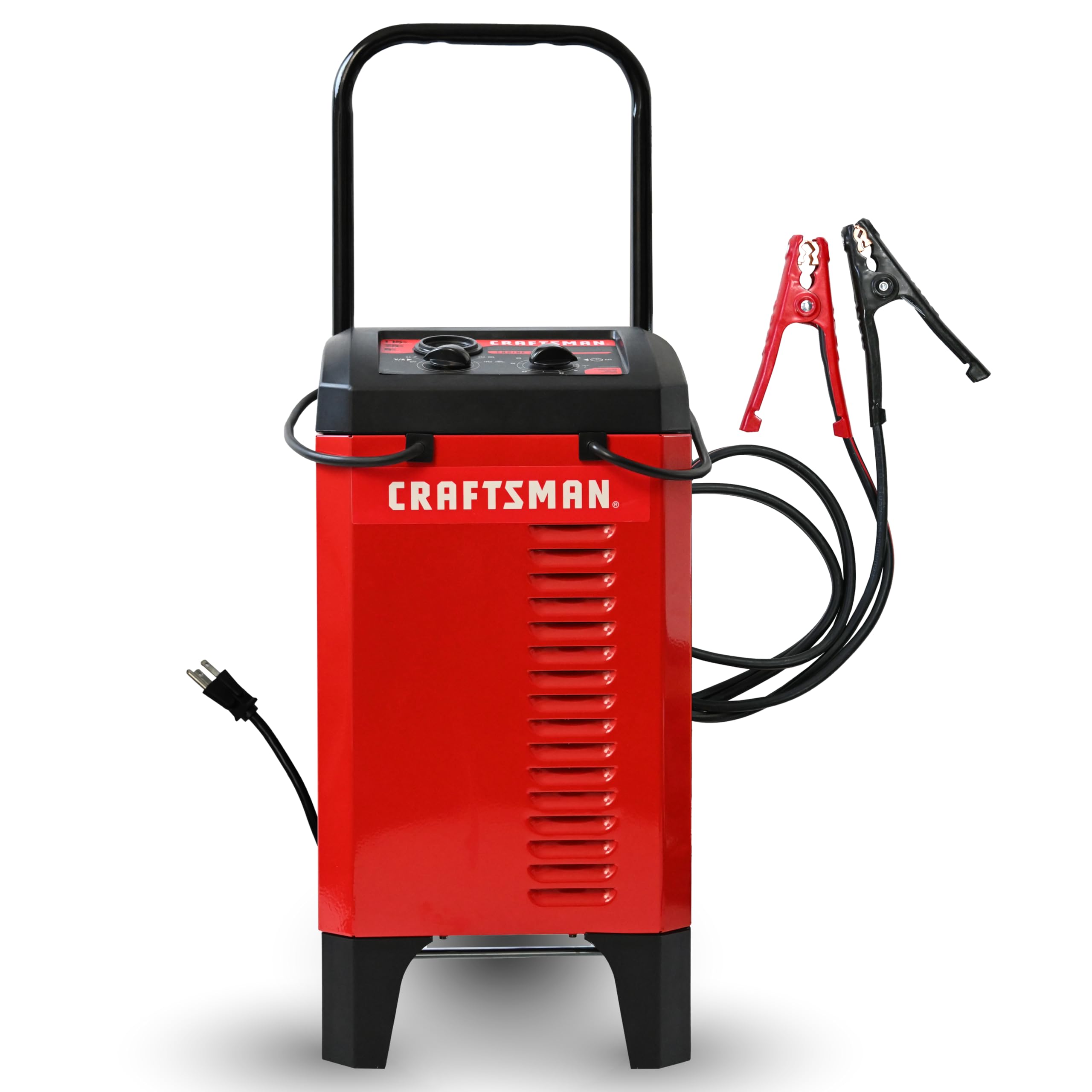
The red-wheeled starter that delivers 175 cranking amps (enough for most standard cars and light trucks) and a 25-amp boost for deeply discharged batteries.
This CRAFTSMAN is a 2-in-1 unit built for 12V systems only (no 6V support). It provides a 175-amp engine start, a 25-amp 12V boost charge, and a 6-amp charging rate. The 135-minute timer is identical to the Schumacher SC1446, giving you the same precise manual control over the charge cycle. It works with standard, AGM, gel, and deep-cycle 12V batteries, making it compatible with most cars, trucks, SUVs, RVs, and marine vehicles.
The construction is heavy-duty with a steel case, a retractable handle, and compact wheels. It comes with a 6-foot power cord and booster cables. Note that the charging current is only 6 amps, which is the lowest among the wheeled units here. That means it takes longer to fully recharge a big battery compared to the 10-amp Schumacher or the 40-amp Associated — owners mention the 6-amp rate is noticeably slow on large truck batteries.
Customers note that the analog ammeter is a simple, reliable way to monitor the charge. The 175 cranking amps are sufficient for standard cars and smaller trucks, but if you regularly work with larger diesel engines or SUVs, you will want the 250 cranking amps from the CRAFTSMAN CMXCESM233. The 25-amp boost charge is a nice middle-ground—it adds charge faster than the 6-amp rate without the high cost of the premium models.
Strong Points
- 175-amp engine start for most cars and light trucks
- 135-minute timer gives you full control
- 25-amp boost helps deeply discharged batteries
- Wheeled steel case is durable and portable
Weak Points
- 6-amp charge rate is the slowest in this group
- No 6V battery support
- Less cranking power than the 250A CRAFTSMAN model
Good match for: The owner of a standard car or light truck who wants a manual charger with a timer and does not mind a slower charge rate.
Not ideal for: Anyone with 6V batteries or large diesel engines that need the extra cranking punch.
4. CRAFTSMAN Wheeled Manual 10A Car Battery Charger and 250A Engine Starter, CMXCESM233
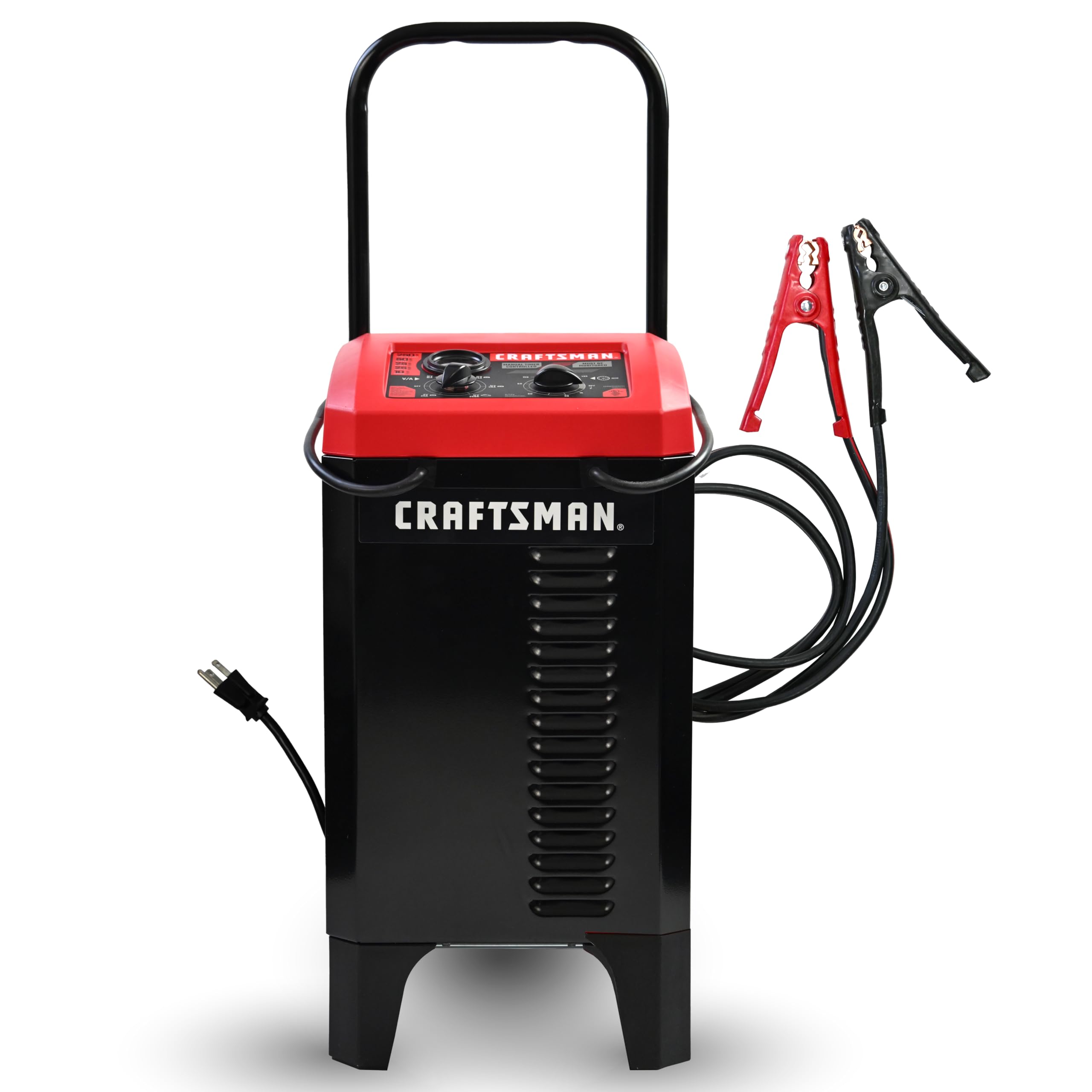
The black-wheeled powerhouse pumping 250 cranking amps with a 50-amp boost for the toughest starts — more than the 200-amp Schumacher SC1446 and the 175-amp CRAFTSMAN CMXCESM274.
This CRAFTSMAN is the most powerful wheeled unit in the group. It delivers a 250-amp 12V engine start, a 50-amp 12V boost charge, a 25-amp 6V/12V boost charge, and a 10-amp 12V charging rate. It also supports 6V and 12V batteries, unlike the 12V-only CMXCESM274.
The 50-amp boost charge is significantly higher than the Schumacher’s 40-amp boost, so it can add charge to a deeply discharged battery faster. The 135-minute timer is the same precise manual control found on the other CRAFTSMAN and Schumacher models. It works with standard, AGM, gel, and deep-cycle batteries, covering gas and diesel vehicles. The steel case, heavy-duty clamps, retractable handle, and compact wheels are all standard for this tier.
Reviewers point out that the 250-amp start easily fires up large SUVs and trucks, and the 50-amp boost is a real time-saver when you have a battery that is not completely dead but needs a quick top-off before starting.
Why It Excels
- 250-amp engine start for large gas and diesel engines
- 50-amp boost charge for fast recovery of deeply discharged batteries
- Supports 6V and 12V batteries
- Durable steel case with wheels for easy garage movement
Trade-Offs
- Heavier at 30.6 pounds
- No maintenance or desulfation modes
- Less adjustable than the PZP for different battery sizes
Best suited for: Truck and SUV owners, or anyone who needs maximum cranking power and a fast boost charge without moving to a professional shop unit.
If you need: A more adjustable charge current or battery repair features, the PZP covers those needs instead.
5. Associated Equipment US20 6/12 Volt Value Battery Charger, 40 Amps, Blue

The shop-grade charger delivering 40 amps of charging current — four times the rate of most wheeled units, so a full recharge takes about 90 minutes instead of 135.
The Associated US20 is built for serious work. Its 40-amp charging current dwarfs the 10-amp rate of the Schumacher SC1446 and the 10-amp rate of the CRAFTSMAN CMXCESM233. That means it can fully recharge a large battery in about 90 minutes, compared to 135 minutes for the Schumacher and CRAFTSMAN models. It provides a 200-amp cranking assist for engine starting, so it still has the punch to jump-start most vehicles.
This unit supports 6V and 12V batteries and has a manual timer for control, though the data does not specify the timer’s duration in minutes — the 90-minute charge time is the figure provided. It is made in the US, which matters to some buyers. The dimensions are large at 30 inches deep, 8 inches wide, and 6 inches high, and it weighs 37 pounds, making it the largest and heaviest charger here. It has wheels for mobility.
One notable difference: the US20 has a fixed connector type rather than clamps, which may require an adapter for some batteries. Buyers praise its build quality and the sheer speed of the 40-amp charge rate, especially for heavy equipment and large marine batteries. If you need to charge batteries daily in a shop environment, this is the fastest option by a wide margin.
Key Strengths
- 40-amp charge rate is the fastest in this comparison
- 90-minute charge time beats the 135-minute units
- 200-amp cranking assist for engine starting
- Made in the US
Considerations
- 37 pounds is the heaviest in the group
- Fixed connector may require an adapter
- Timer duration not specified; 90-minute charge time is for a full charge, not the timer limit
Ideal for: Professional mechanics or serious hobbyists who need the fastest charge times and have the space for a large, heavy unit.
Skip if: You need a portable unit for occasional use — the weight and size are overkill for home garages with light use.
Understanding the Specs
Cranking Amps (CA)
Cranking amps measure the burst of power a charger delivers to start a dead engine. A higher number, like 250A, means it can spin a larger, colder engine. For standard cars, 175-200A is usually enough. For big trucks or diesel engines, you want at least 250A.
Charge Amps (A)
Charge amps tell you how fast the charger refills the battery’s internal capacity. A 10-amp rate is standard for overnight charging. A 40-amp rate, like on the Associated US20, can recharge a battery in about 90 minutes. Lower rates like 6-8 amps are gentler but take longer.
FAQ
Can I leave a manual battery charger connected overnight?
What is the difference between a manual and automatic battery charger?
Will a manual charger work on AGM or gel batteries?
How do I know how long to set the timer?
Can I use a manual charger to jump-start my car?
What size manual charger do I need for a motorcycle battery?
Why does my manual charger get hot during use?
Can I charge a 24V battery with a 12V manual charger?
Final Thoughts: The Verdict
For the majority of shoppers, the manual battery charger winner is the Schumacher SC1446 because it combines a 200-amp engine start, a precise 135-minute timer, and 6V/12V compatibility into a wheeled, durable unit that fits home and semi-professional use. If you want adjustable current and battery repair features, grab the PZP 0-15A. And for maximum charging speed and professional-shop durability, the Associated US20 with its 40-amp charge rate is the fastest option by a wide margin.
How We Picked
We do not accept paid placement. Every pick is matched to a real buyer and a real use-case; we do not hands-on test units.
Sources & Methodology
Specifications: manufacturer listings and product documentation. Review insights: verified customer reviews, as of July 2026. Pricing: not shown on this page (it changes often); check the current price via the retailer link.
As an Amazon Associate, Trending Car earns from qualifying purchases. This does not affect which products we feature.