
Our readers keep the lights on and my garage snacks stocked. As an Amazon Associate, I earn from qualifying purchases.
Specs are compiled from manufacturer listings and verified buyer reviews and can change over time — please confirm the key details on the product page before buying.
Welding doesn’t have to cost a month’s mortgage payment. The real question is which budget-friendly machine actually lays a decent bead without constant frustration. This guide cuts through the confusing lineup of sub- multi-process welders to find the ones that earn their keep in a home garage or farm shop.
I’m Min Islam — the founder and writer behind Trending Car. This guide is built by comparing the manufacturers’ published specifications and the patterns across verified customer reviews, so you get each pick’s real strengths and trade-offs instead of marketing spin.
The machines here share a common goal: get you welding quickly while staying affordable. These five contenders each take a slightly different path to earning the title of best low cost welder, and we break down exactly where each one fits your toolbox and skill level.
Our Picks at a Glance

How To Choose The Best Low Cost Welder
Every cheap welder makes promises on paper. The ones that deliver combine the right power source, multi-process flexibility, and smart controls that reduce the curse of guesswork. Here is what separates a frustrating bargain from a real workhorse.
Dual Voltage Is a Lifeline
A welder that runs on both 110V and 220V adapts to whatever outlet you have. On 110V you can fix a gate or a fence at home; plug into 220V and you gain the penetration for thicker steel projects. Without dual voltage you are locked into one power ecosystem.
Synergic Control Takes the Mystery Out
Synergic control automatically matches the voltage and wire feed speed when you set the material thickness or amperage. For a beginner this means far fewer bad welds during the learning curve. For an experienced welder it is a fast starting point that still allows manual fine-tuning.
Multi-Process Matters More Than Peak Amps
A 140-amp welder that handles flux-core MIG, stick, and lift TIG beats a 200-amp machine that only does one process. Multi-process capability means you can switch from thin sheet metal to a rusty farm implement without buying a second machine. The amperage rating matters, but the versatility of the processes matters more for a tight budget.
Quick Comparison
| Model | Best For | Max Amps | Weight | Processes | Amazon |
|---|---|---|---|---|---|
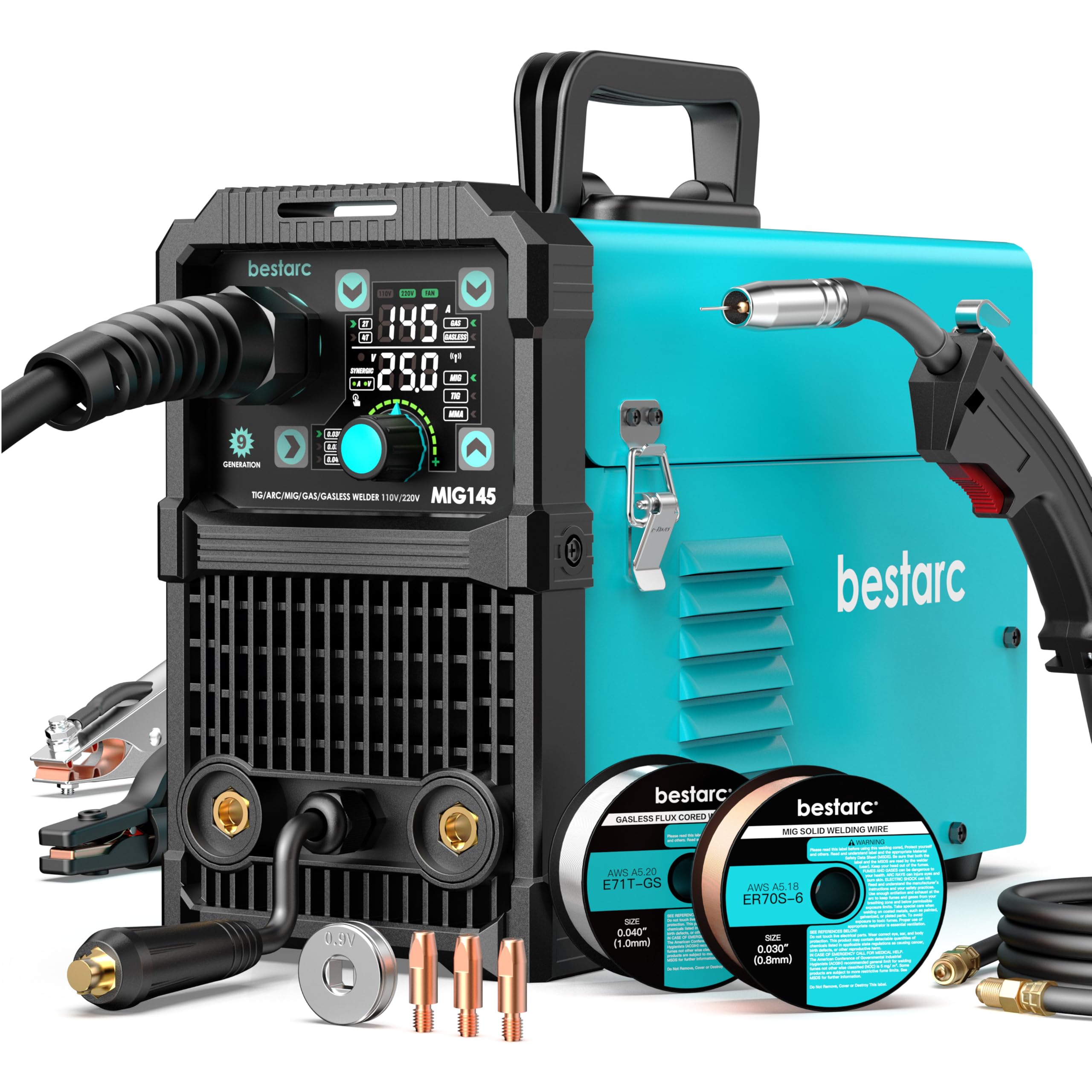
| Bestarc 145A★ Best Overall | Overall Value & Versatility | 145A | 22.6 lb | 4-in-1 (MIG, Flux, Lift TIG, Stick) | Amazon |
| S7 200APower Pick | Top-End Power in a Small Box | 200A | 4-in-1 (MIG, Flux, Lift TIG, Stick) | Amazon | |
| MIGVAN 140A | Absolute Beginner Friendliness | 140A | 15.6 lb | 3-in-1 (Flux, Lift TIG, Stick) | Amazon |
| ANDELI 135A | Complete Kit for Field Repairs | 135A | 18.3 lb | 3-in-1 (Flux, Lift TIG, Stick) + Pulse | Amazon |
| YESWELDER 160A | Biggest Owner Community | 160A | 27.5 lb | 4-in-1 (MIG, Flux, Lift TIG, Stick) | Amazon |
In‑Depth Reviews
1. Bestarc 145A MIG Welder 110V/220V
Our pick — over 4.5★ from 650+ verified ratings; the strongest balance of quality and price.
The multi-process machine that masters every common home-weld scenario without the steep learning curve.
You get four processes in one box — gas MIG, gasless flux core, lift TIG, and stick — so you can weld thin sheet metal with a clean solid-wire setup on 110V or switch to a heavy stick rod for a rusty gate on 220V. The synergic control (a smart system that automatically recommends the voltage and wire speed when you select the wire diameter) then lets you fine-tune by 3V in either direction for extra precision. That smart feature is what makes it the best entry point: you are not guessing at settings, you are adjusting from a good starting point.
The crowd favorite here is a 4.6-star machine with hundreds of owners backing it. The trade-off that comes up most often is the factory power cord. Some buyers report it struggles on 110V with the stock 14/2 AWG cord — swapping to a 12/2 cord solves the issue — and a few note the stick lead uses copper-clad aluminum rather than solid copper. Both are easy fixes that lift the performance well beyond the price point. At 22.6 pounds it is compact enough to stash under a workbench or toss in a truck bed, yet it carries enough weight to feel solid when you drag it across a shop floor.
What seals the deal is that this is the only pick at this price tier where the synergic system works well enough that absolute beginners burn a good bead on their first try — as many owners attest, the learning curve is short here.
Your daily weld partner: The Bestarc hits the balance of smart controls, four processes, and honest feedback from thousands of owners. If the stock cords bug you, a cheap swap makes it punch well above its weight.
Think twice if: You need to weld 3/8-inch plate consistently on 110V — this machine prefers 220V for its full 145A output.
Reach for this if: You want one welder that handles home repairs, farm fixes, and RV mods without a second mortgage.
Look elsewhere if: You demand a 200-amp ceiling for heavy fabrication from the start.
2. S7 200A 4‑in‑1 MIG Welder 110V/220V
The 200-amp contender that punches deep into thick steel without the premium price tag.
This machine delivers the highest amperage in the lineup — 200A on 220V — which means you can weld 3/8-inch plate work that the 140-amp class simply cannot reach. It runs all four processes (gas MIG, gasless flux core, lift TIG, and stick) and includes a full starter kit with MIG torch, ground clamp, electrode holder, and adapter cables for both 110V and 220V. The synergic control is present but owners mention it is more of a rough guide than a precision assistant — the real strength here is the raw power ceiling.
The compact dimensions (16 x 12 x 11 inches) make it the shortest option for shelf storage. The honest limitation: it is not as beginner-friendly as the Bestarc. The synergic preset range is wider, so you will need to learn how to dial in your own settings, and a few owners note the instructions are sparse. One owner captured it well: the welder works well but the 14/2 AWG factory cord limits its 110V performance; swapping to a 12/2 cord open up its potential. Another owner noted the stick welder function shines once you replace the copper-clad aluminum lead with solid copper.
The reliability and weld quality are what owners praise most — those two aspects together generate the bulk of positive feedback. An occasional unit arrives with a cosmetic dent or an early electronics failure, but the seller support is quick enough that several owners who had issues bought another unit anyway. That says something about the value here.
Why you want this
- 200A peak output handles thicker steel than any other sub- pick
- Lightest high-power option
- Full starter kit with adapters for both voltages
The catch
- Synergic control is less refined — expect to dial in manually
- Factory 14/2 AWG cord limits 110V performance until swapped
Grab this for: Projects that regularly hit 3/16-inch steel and thicker where 140A welders fall short.
skip it if: You want a plug-and-weld experience with zero setup tweaks.
3. MIGVAN 140A MIG Welder 110V
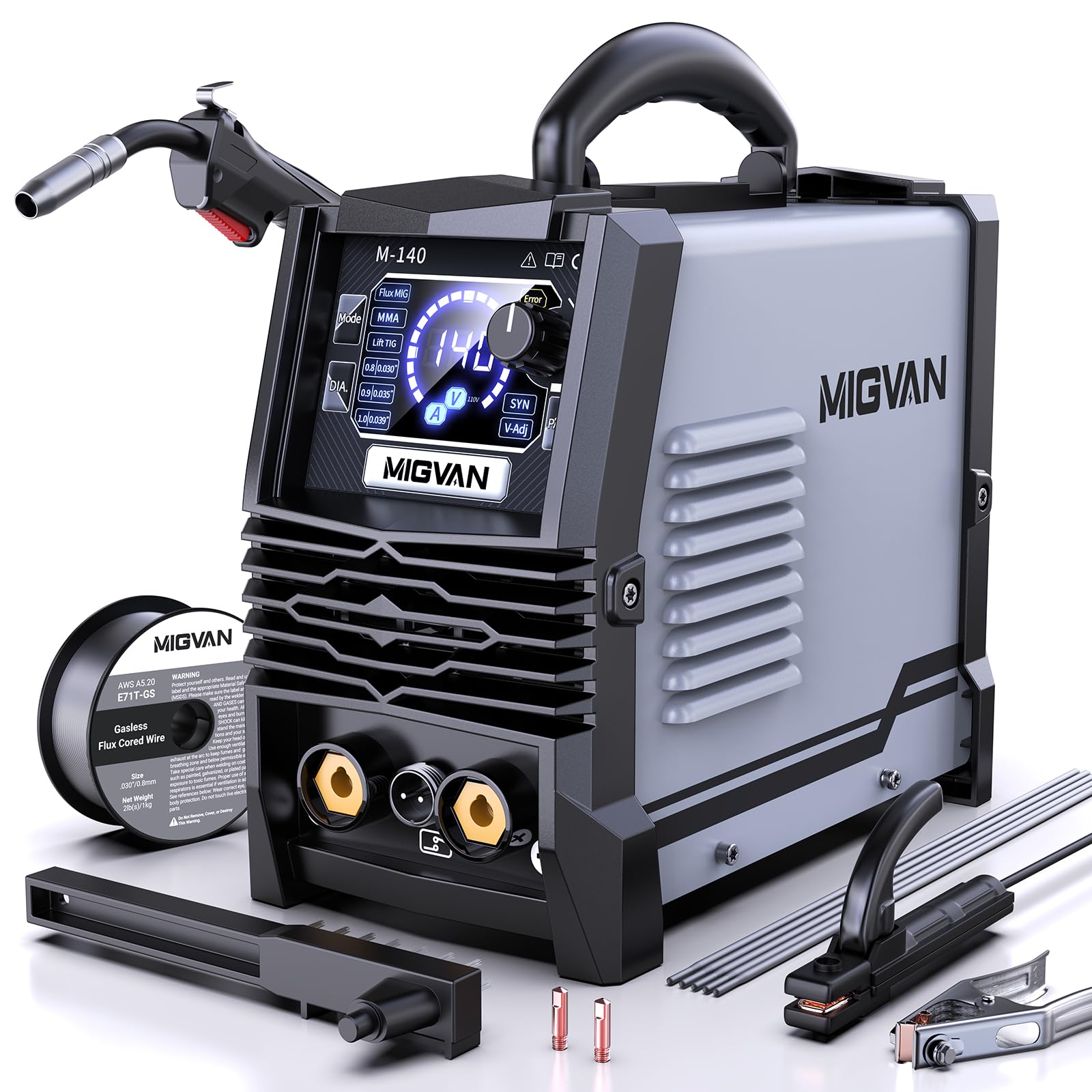
The featherweight that fits in a milk crate and still lays a solid bead on a tailgate repair.
At 15.6 pounds this is the lightest welder in the roundup — over 7 pounds lighter than the Bestarc and nearly 12 pounds lighter than the YESWELDER 160A. The weight difference is huge when you are carrying it up a ladder, into an attic, or across a farm yard. It runs on standard 110V household power and covers three processes: gasless flux core MIG, lift TIG, and stick welding with a maximum 140 amps. The synergic control here is genuinely beginner-friendly; you set the wire diameter and welding current, and the machine recommends voltage and wire speed automatically. You can still adjust plus or minus 3V for fine-tuning.
The design is clean: an 8-layer mainboard sealed with insulating resin for dust and moisture resistance, plus a 3.54-inch LED display that stays readable even in direct sunlight. The build quality and performance are the two aspects owners praise most — the machine produces a stable arc with minimal spatter straight from the start. One owner welded nubs back on a truck tailgate and called it simple plug-and-use after loading the wire. Another repaired a leaking water pipe with impressive arc stability on the first try.
The clear trade-off is the amperage ceiling. At 140A you are limited to mild steel up to about 1/8-inch thick for reliable single-pass welds. You cannot chase thicker projects with this machine, and there is no gas MIG option — it is flux-core or stick only. But for anyone who needs a portable repair welder for fences, gates, brackets, and light auto work, this is the easiest machine to grab and go.
Your takeaway: The MIGVAN trades peak power for portability and beginner-friendly controls. If your work stays under 1/8-inch steel, this is the most pleasant welder to own.
Best for: The DIYer who needs a travel-friendly welder for light repairs and doesn’t want to read a manual for an hour before each job.
Not for: Anyone planning to weld 1/4-inch plate or thicker — the 140A ceiling is a hard limit.
4. ANDELI 110V/220V MIG Welder 135A
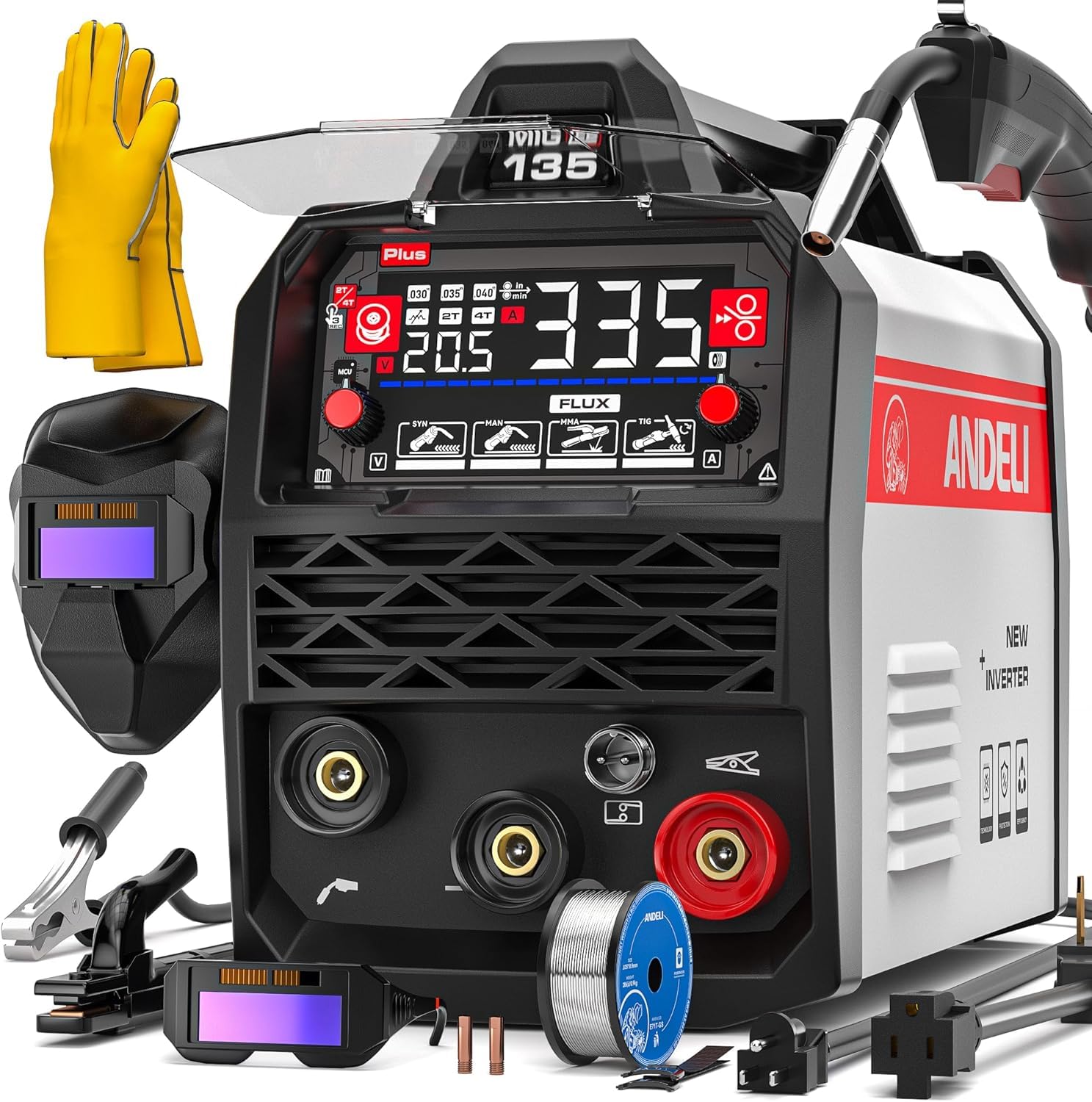
The kit that comes with everything except a gas tank — helmet, gloves, wire, and electrode holder included.
ANDELI packs the most accessories into the box: an auto-darkening helmet that converts to goggles, professional leather gloves, gasless wire, electrode holder, and welding torch. For someone buying their first welder this means zero additional purchases before striking an arc. The machine itself runs on both 110V and 220V with a maximum 135A output, handling mild steel up to 5.0 mm (0.19 inch) thick. It also includes a pulse function for flux-core MIG, which delivers a smoother arc and finer bead formation — a rare feature at this price point.
The 4.1-inch LED display is the largest in the group and sits behind a transparent cover that protects it from sparks and impact — a thoughtful touch for rough job-site use. The synergic control here works well for experienced users, but several owners note the settings feel less intuitive than the Bestarc’s system. The wire feed speed is displayed in amps rather than inches per minute, which confuses some beginners. The included helmet gets called “useless” by more than one owner, so you may still want to buy a quality mask separately.
Where this machine shines is light fabrication and field work — customers note consistent low-spatter arc performance on truck bed repairs and trailer projects using 110V power. It is portable at 18.3 pounds and the adjustable inductance control lets you fine-tune the arc softness, which is a capability the MIGVAN lacks entirely.
What it delivers
- Complete ready-to-weld kit — no extra purchases needed to start
- Pulse function produces smoother beads than standard flux core
- 4.1-inch protected LED display is the largest and most durable here
Where it stumbles
- Wire speed displayed in amps is confusing for true beginners
- Included helmet is low quality — budget for a replacement
Reach for this if: You want one box with everything to start welding today and appreciate the pulse function for cleaner flux-core joints.
Look elsewhere if: You are a pure beginner who needs the most intuitive synergic controls — the Bestarc is easier to learn on.
5. YESWELDER 160A MIG Welder 110V/220V
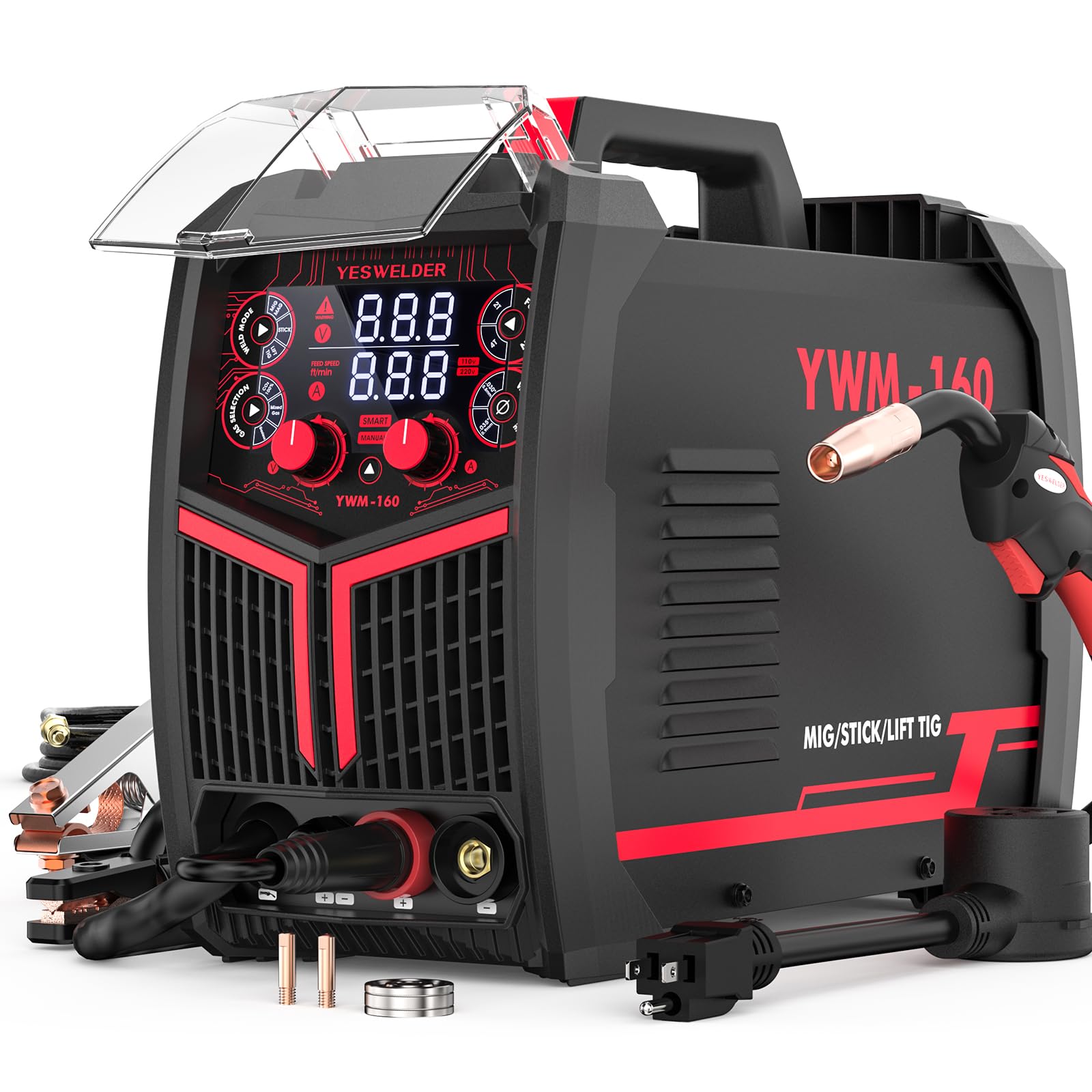
The most-bought welder on this list with nearly a thousand owners putting it through its paces daily.
YESWELDER’s 160A machine has the largest owner community in this roundup — a strong vote of confidence for its reliability and value. It runs all four processes on both 110V and 220V, with a synergic smart mode (auto-selects voltage and wire speed based on your material thickness setting), plus a full manual mode for experienced welders who want to dial in every variable. The LED display is clear and the safety protections (voltage fluctuation compensation, over-current, overload, over-temperature) match the Bestarc’s feature set. At 27.5 pounds it is the heaviest unit here, which gives it a planted feel during stick welding but makes it less portable than the MIGVAN by nearly 12 pounds.
Reviewers point out fantastic results on 1/4-inch steel using 220V and smart mode — one owner called it his second Amazon review ever and gave it five stars after flawless penetration on thick plate. The stick welding function draws consistent praise for its stable arc. The durability catch that surfaces most often is the MIG torch trigger: a few shoppers say the trigger fails after moderate use, causing the wire to feed only intermittently. The issue appears on a minority of units but it is note if you expect daily professional use. For hobby and repair work the vast majority of owners are satisfied.
Compared to the Bestarc 145A, the YESWELDER offers 15 more peak amps and a larger owner support community, but at 27.5 pounds it is 4.9 pounds heavier and the MIG trigger durability is less proven. The best fit here is the amateur who wants the insurance of thousands of reviews backing a purchase.
Your verdict: The YESWELDER 160A is a safe, well-reviewed buy that handles 1/4-inch steel with authority on 220V. The trigger concern is real but affects a small slice of owners.
Best for: The buyer who wants a well-known name with plenty of peer reviews and sticks to hobby-level use.
Not ideal if: You need a very compact welder for frequent transport — the 27.5-pound weight adds up.
Understanding the Specs
Synergic Control
This is a smart-assist feature that automatically selects the recommended voltage and wire feed speed when you tell the machine the wire diameter and welding current. For a beginner it eliminates the guesswork that causes birds-nesting (wire tangling) and poor penetration. Most machines here also let you fine-tune plus or minus 3V from the preset, so you can tighten up the bead as you gain experience.
IGBT Inverter Technology
IGBT stands for Insulated Gate Bipolar Transistor — a type of high-speed switching transistor that makes modern welders smaller, lighter, and more energy-efficient than the old transformer-based units. An IGBT inverter delivers a smoother, more stable arc and better penetration control, which is why all five picks here use it. Without it you would be lugging a 60-pound brick around for the same amperage.
FAQ
Can a low cost welder handle 1/4-inch steel?
Do I need a gas bottle for flux core welding?
What is the difference between lift TIG and scratch start TIG?
Will a 110V welder trip my home breaker?
How long can I weld continuously with these machines?
Can I use gas MIG without buying a gas tank?
What is the best amp rating for a beginner home welder?
Why does my new welder’s torch lead feel short?
Should I buy a welder that includes a helmet and gloves?
Final Thoughts: The Verdict
For most buyers, the best low cost welder is the Bestarc 145A MIG Welder because it combines synergic control that actually works for beginners with a versatile four-process capability at a price that doesn’t sting. If you need to weld thicker steel regularly and don’t mind dialing in manual settings, grab the S7 200A. And for the lightest, most portable option that fits in a bucket and runs on any 110V outlet, the MIGVAN 140A is the one to reach for.
How We Picked
We do not accept paid placement. Every pick is matched to a real buyer and a real use-case; we do not hands-on test units.
Sources & Methodology
Specifications: manufacturer listings and product documentation. Review insights: verified customer reviews, as of July 2026. Pricing: not shown on this page (it changes often); check the current price via the retailer link.
As an Amazon Associate, Trending Car earns from qualifying purchases. This does not affect which products we feature.