
Our readers keep the lights on and my garage snacks stocked. As an Amazon Associate, I earn from qualifying purchases.
Specs are compiled from manufacturer listings and verified buyer reviews and can change over time — please confirm the key details on the product page before buying.
A freezing garage makes every task harder — tools feel like ice, hands won’t cooperate, and quick projects become miserable chores. The right kerosene heater blasts real warmth without a power outlet, works during outages, and can heat a whole workshop from a single tank of fuel. Match the heater’s output to your space to avoid wasting money on excess heat or freezing on too little.
I’m Min Islam — the founder and writer behind Trending Car. This guide is built by comparing the manufacturers’ published specifications and the patterns across verified customer reviews, so you get each pick’s real strengths and trade-offs instead of marketing spin.
if you need to warm a single-car bay or a full 2,000-square-foot shop, this breakdown of the best kerosene heater for garage options walks you through the critical specs, real-world performance, and honest trade-offs every buyer should know.
Our Picks at a Glance


How To Choose The Best Kerosene Heater for Garage
Picking a garage heater depends on three things: space size, desired warm-up speed, and usage frequency. A small 9,000 BTU unit will eventually heat a two-car garage, but you’ll wait a while — while an 80,000 BTU forced-air model can have you in short sleeves in minutes. The rest of the differences — fuel capacity, safety sensors, noise level — help you pick the right flavor once you settle on the power level.
Match BTU Output to Your Square Footage
BTU (British Thermal Unit) is the number that tells you how much heat the unit pushes out per hour. A good rule of thumb: a well-insulated garage needs about 30 to 40 BTU per square foot. A 1,000-square-foot shop, for example, needs around 30,000-40,000 BTU for quick heating. The data shows a big range — from 9,000 BTU units that cover 215-323 sq ft all the way up to 135,000 BTU models that reach 3,200 sq ft. Measure your garage; undersized heaters run constantly without catching up.
Convection vs. Forced Air: Speed vs. Steadiness
Convection heaters (like the Dyna-Glo WK24BK and the Sengoku HeatMate) warm the air slowly and silently, radiating heat outward in all directions. They are quiet, don’t dry the air as much, and work well for long-duration use in occupied spaces. Forced-air models (like the Dyna-Glo KFA50DGD and the Mr. Heater 80,000 BTU) use a fan to blast hot air in a specific direction. They heat a space much faster and are ideal for big open shops, but they are louder and often require better ventilation.
Run Time and Fuel Capacity
A 1-gallon tank on a 10,000 BTU heater can run for 12 hours, while a 23,500 BTU unit with a 1.9-gallon tank might only last 7-12 hours depending on the flame setting. For daily garage use, longer burn time means fewer refueling stops in the cold. For emergency backup, a big tank — like the 5-gallon capacity on the Dyna-Glo KFA50DGD giving 14 hours — means you can make it through a multi-day outage without refilling in the dark.
Quick Comparison
| Model | Best For | BTU Output | Heating Coverage | Burn Time (approx) | Amazon |
|---|---|---|---|---|---|
| Dyna-Glo WK24BK★ Best Overall | Best Convection Value | 23,000 BTU | 1,000 sq ft | ~9 hours | Amazon |
| Sengoku HeatMate HMC-23KAlso Great | Best Overall Garage | 23,500 BTU | 1,000 sq ft | Up to 12 hours | Amazon |
| Dyna-Glo KFA50DGDShop Favorite | Best Forced-Air Shop | 50,000 BTU | 1,200 sq ft | 14 hours | Amazon |
| Mr. Heater 80,000 BTU | Best for Large Garages | 80,000 BTU | 2,000 sq ft | — | Amazon |
| Dyna-Glo 135,000 BTU Torpedo | Maximum Commercial Heat | 135,000 BTU | 3,200 sq ft | — | Amazon |
| Bluefire 11,000 BTU | Compact Dual-Use | 11,000 BTU | 500 sq ft | Up to 16 hours | Amazon |
| vnekjse 10,000 BTU | Budget for Small Spaces | 10,000 BTU | 215-323 sq ft | 12 hours | Amazon |
| YEXLXLN 9,000 BTU | Entry-Level Multi-Fuel | 9,000 BTU | 15 sq meters | 16-21 hours | Amazon |
In‑Depth Reviews
1. Dyna-Glo WK24BK 23,800 BTU Indoor Kerosene Convection Heater
Our pick — over 4★ from 1,500+ verified ratings; the strongest balance of quality and price.
A rugged, simple workhorse that rivals the Sengoku in power at a noticeably lower price.
At 23,000 BTU covering 1,000 sq ft, the Dyna-Glo WK24BK is practically a twin of the Sengoku on paper — but the real story is in the reviews. Buyers consistently mention it is “silent, odorless, and produces no soot or CO.” One reviewer with a 15×30 living room reported the heater made it toasty warm at 40°F outside. It runs for roughly 4 hours on a single gallon of kerosene, so the 1.9-gallon tank gives you about 7.5-8 hours of run time — shorter than the Sengoku’s 12 hours, which is the main difference to weigh.
Assembly is minimal, and the foot-operated shut-off lever is a nice safety touch if your hands are full. The unit sits low and compact — 17.52″ by 17.52″ by 26.97″H — and one buyer mentioned the bottom stays cool enough to sit safely on carpet. It has only one heat setting (on/off), so you cannot dial down the flame for milder days. For a garage that fluctuates between freezing and cool, consider pairing it with a simple timer or just letting it cycle off when the space warms up.
Build quality: Rugged construction with tip-over protection and a cool-to-the-touch bottom that works on concrete pavers for heat retention.
The shortfall: No adjustable flame height — it is either full blast or off, which limits fuel savings on milder garage days.
Reach for this if: You want the raw heating power of the top convection models but are willing to trade variable flame control for a lower upfront cost.
Look elsewhere if: You need fine-tuned heat output or longer than 8 hours between refills.
2. Sengoku Indoor & Outdoor Portable Kerosene Heater, 23,500 BTU, HeatMate
The 27-pound powerhouse that quietly heats a whole garage without a whisper of a fan.
The Sengoku HeatMate puts out 23,500 BTU — enough to cover 1,000 square feet, which matches the top convection heaters in its class. what separates it from the Dyna-Glo WK24BK (which also covers 1,000 sq ft at 23,000 BTU) is its thoughtful user experience: buyers report that the push-button start and EZ flame adjuster make it simple to dial in the perfect heat without fuss. It runs for up to 12 hours on its 1.9-gallon fuel capacity, so you can work through a full weekend day without stopping to refill.
It is a convection heater, which means no fan noise — just silent radiant warmth that fills the space evenly. The automatic shut-off and tip-over switch add real confidence in a cluttered garage where the heater might get bumped. One reviewer noted that the only weak point is the handle quality, calling it “cheap.” If you are moving it between a shed and the garage regularly, you’ll want to handle it with care, but for a stationary setup this is the most reliable all-rounder in the list.
Who it fits: The garage worker who wants silent, even heat for a 1,000 sq ft space with minimal daily refueling and the convenience of push-button start.
The trade-off: The handle feels flimsy for its 27 lbs, so plan to leave it in one spot rather than carting it around.
The pick for: Anyone who needs a single, reliable, safe kerosene heater for a standard two-car garage up to 1,000 sq ft, especially if you dislike noisy fans.
3. Dyna-Glo KFA50DGD 50,000 BTU Kerosene Forced Air Heater
When you need heat *now* — this forced-air blaster turns a cold shop into a workspace in minutes.
The Dyna-Glo KFA50DGD delivers 50,000 BTU and heats up to 1,200 sq ft, making it a step up in raw power from the convection heaters above. But it is a different beast entirely: forced air means a fan pushes hot air in a directed stream, so you feel the warmth almost instantly. Owners mention it can heat a 3-bed/2-bath house in about 30 minutes using kerosene with no smell. Its 5-gallon fuel tank keeps it running for up to 14 hours, which dwarfs the 1.9-gallon capacity of the convection models.
The trade-off is obvious: it is much louder. One owner reported the noise is manageable — “can talk over it without yelling” — but you will know it is running. It also lacks a built-in thermostat, so you have to manually switch it on and off. The 26.9-pound weight and carrying handle make it reasonably portable, though one reviewer wished for a sturdier handle. For a big uninsulated garage where you want to arrive and have heat fast, this is the clear winner among mid-range forced-air options.
What you get
- Blasts 50,000 BTU across 1,200 sq ft
- 14-hour run time on a single 5-gallon tank
- Runs on kerosene or diesel for fuel flexibility
The noise and control
- Louder than convection heaters — you will hear the fan
- No thermostat; need to manually switch on/off
Best suited to: The workshop or construction site where rapid temperature rise matters more than silence, and you prefer a single big tank over daily refills.
4. Mr. Heater 80,000 BTU Forced Air Kerosene Heater

Double the garage, double the BTU — this unit throws 80,000 BTU across 2,000 sq ft with thermostat control.
The Mr. Heater 80,000 BTU model is the step up from the Dyna-Glo KFA50DGD for anyone with a truly big shop. It heats up to 2,000 sq ft, which covers a large two-car garage plus a workbench area or even a small barn. A key advantage over the KFA50DGD: it comes with a built-in thermostat and LED troubleshooting diagnostics, so you can set a target temperature and let it cycle automatically rather than babysitting the switch.
Customers note that it warms a two-stall shop very fast — one customer observed “30 below outside, 20 minutes later you’re in a t-shirt.” It weighs 32.96 lbs and measures 29.5″ by 12.5″ by 17″H, so it is big but still rolls or slides into a corner easily. The downside: one user highlighted the unit did not come with a pressure gauge as advertised (though the manufacturer sent one), and it is “kinda loud.” On the plus side, it runs on both kerosene and diesel, giving you fuel options when kerosene is scarce.
Thermostat advantage: Unlike the KFA50DGD, this one maintains a set temperature automatically, saving fuel and keeping the space comfortable without constant adjustments.
Noise factor: It is a forced-air heater, so expect fan noise — but buyers consistently say it is worth it for the speed of heat.
Grab this for: A large, uninsulated garage or workshop over 1,200 sq ft where you want set-and-forget temperature control and rapid warm-up.
5. Portable Oil and Kerosene Torpedo Heater, 135,000 BtuH

The 60-pound beast that turns a frozen 50’x30′ shop into a workspace in 15 minutes flat.
This Dyna-Glo torpedo heater is in a different league: 135,000 BTU covering 3,200 sq ft. For context, it heats a 50’x30′ shop from 45°F to 65°F in 15-20 minutes, according to a reviewer who has owned it for over 3 years. It is a forced-air design, so it moves a massive volume of hot air very fast. The 60-pound weight and portable form factor mean it stays put in one spot in a large commercial garage or workshop.
One shopper added it uses about 0.28 gallons per hour of diesel (even better than the 1 gal/hr spec) and that the thermostat works well but only adjusts in 10°F increments, so the temperature swings 8-10°F before re-ignition. It is loud — one reviewer described it as “a bit loud” — but also said it heats an uninsulated 2-car garage from the low 20s to t-shirt comfort in 1-2 minutes. For anyone running a serious auto shop, warehouse, or large barn, this is the fastest path to warmth available in this list.
Raw power
- 135,000 BTU covers 3,200 sq ft — the largest here
- Heats a big shop from freezing to working temp in under 20 minutes
- Runs on kerosene or diesel; ~0.28 gal/hr actual consumption per one reviewer
The limitations
- Loud forced-air fan noise
- Thermostat only adjusts in 10°F increments
- 60 lbs — not for carrying around
The biggest play: You need industrial-grade heat for a large commercial garage, warehouse, or barn and can tolerate the noise and 60-lb stationary setup.
6. Bluefire Indoor & Outdoor Kerosene Radiant Heater, 11,000 BTU
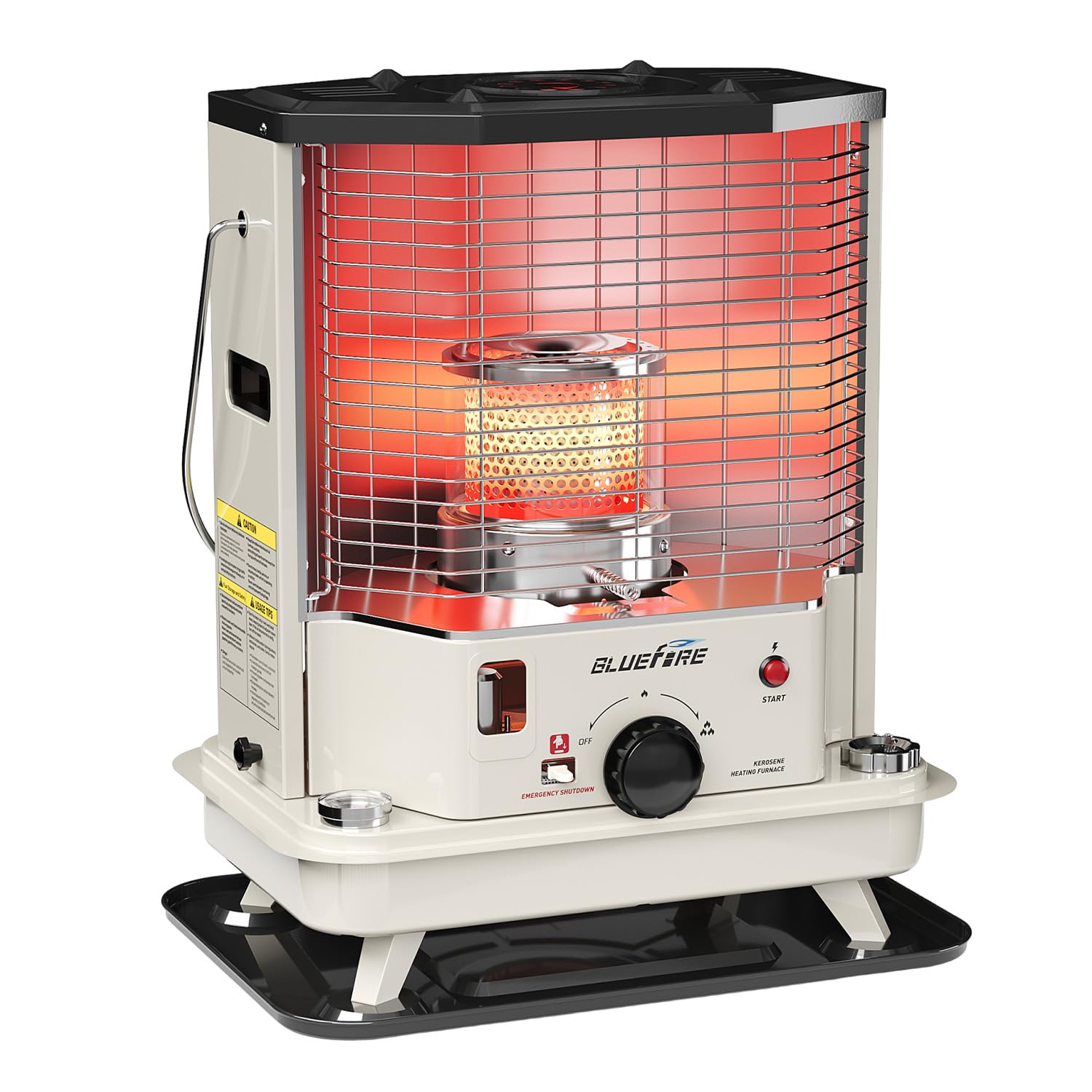
A small radiant heater that pulls double duty: warming a small garage while boiling water for coffee.
The Bluefire puts out 11,000 BTU and covers 500 sq ft — roughly a single-car garage or a small workshop bay. It is a radiant heater (meaning it heats objects and people directly rather than the air) and it doubles as a cooktop: you can remove the enamel top and use it to boil water, which reviewers point out is a handy bonus for camping or emergency cooking. Its 1.2-gallon tank delivers up to 16 hours of heat on a low setting, so it sips fuel compared to the forced-air options.
Here is the honest catch: the electronic ignition is unreliable. Multiple reviewers report the push-button start does not work — one said “the batteries are fresh and brand new, have to use a lighter to get started.” A few also mentioned the carrying handle is missing. For the price, you get a functional heater that lights manually, but the automatic start is essentially a miss. It is a solid budget option for a small, well-insulated garage where you are okay using a lighter, but not a set-and-forget device.
Best feature: The 16-hour burn time on a 1.2-gallon tank is excellent for fuel efficiency, and the dual-use as a cooktop adds real value for camping or emergencies.
The flaw: The automatic ignition often fails; plan to light it with a regular lighter every time.
Ideal for: A small single-car garage or camping scenario where fuel efficiency and the ability to boil water matter more than push-button convenience.
7. Kerosene Heater, Kerosene Heaters for Indoor Use, 10,000 BTU (vnekjse)

A lightweight, 10,000 BTU heater that shoppers say achieves a 12-hour burn time on a single gallon of fuel.
This vnekjse model is the smallest convection heater in the list at 10,000 BTU, covering 215-323 sq ft. That makes it a tight fit for even a small one-car garage — you will feel the heat, but it will take a while to warm the whole space. One reviewer noted that a single gallon of kerosene ran for 12 hours, which is excellent fuel efficiency if you only need to take the chill off a small workshop or a well-insulated bay. It also doubles as a cooktop with a removable enamel top.
The main safety concern: it lacks a tip-over auto shutoff. Buyers explicitly mention you need a match or lighter to start it, and one reviewer described a serious failure where the wick adjustment knob broke and the wick would not extinguish, requiring smothering with a wet towel. Others who used it correctly (proper flame adjustment, 1-K Klean heat) report it burns cleanly with just an initial 15-minute kerosene smell. This is a very basic device — no advanced safety sensors, no push-button ignition. It works if you are handy and careful, but it asks more of its owner than the premium picks above.
The good
- 12-hour burn time on 1 gallon — very fuel-efficient
- Compact 13″D x 13″W x 18″H fits in tight corners
- Cooktop surface adds utility for emergency use
The risks
- No tip-over shutoff — a real safety gap for a garage
- No automatic ignition; requires a match or lighter
- Reports of defective wick adjustment knobs leading to extinguishing failure
Only for the careful user: This is the cheapest route to kerosene heat, but it demands vigilant operation — keep a CO detector nearby and never leave it unattended.
8. Kerosene Heater & Stove, 9,000 BTU, Outdoor Camping Portable (YEXLXLN)
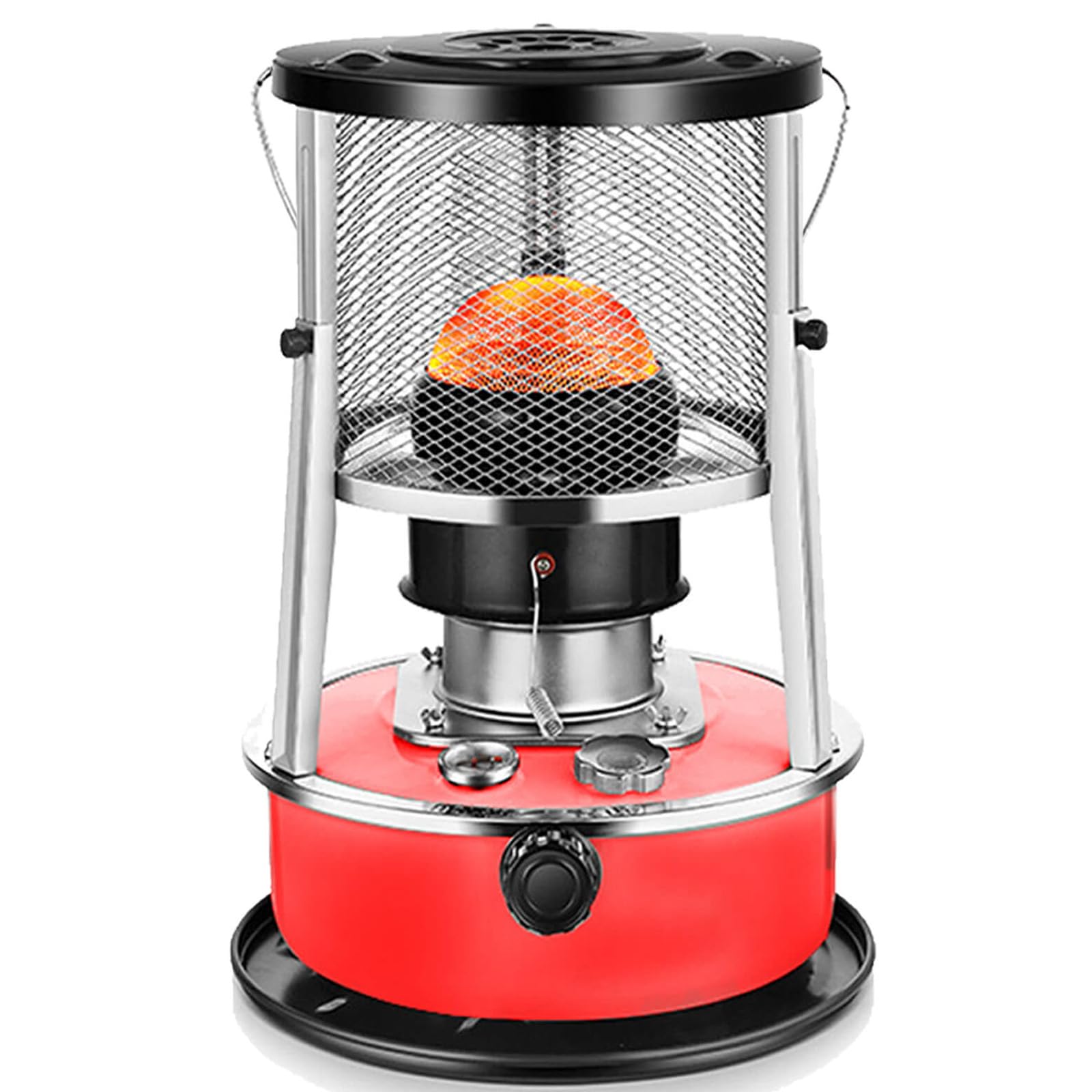
The smallest player here, at 9,000 BTU, but a buyer confirmed it heated a garage from 50°F to 70°F.
At 9,000 BTU, this YEXLXLN heater is the least powerful in the lineup — it heats roughly a 15-20 square meter room (about 160-215 sq ft), making it more of a personal space heater than a whole-garage solution. It does have the longest potential burn time at 16-21 hours on its 4.6-liter tank, which is great for overnight camping or a small enclosed tent. The adjustable hood can be raised or lowered by 10 cm, and it includes a cooking surface for boiling water.
One buyer mentioned it came with extra wicks, a funnel, and a siphon — nice touches. However, the same reviewer said the “carry handle is too short and burns the hand.” Another reported that after two months only half the wick burned, producing black smoke and no heat, which is a serious quality concern. Like the vnekjse, it lacks automatic ignition and tip-over shutoff. It is best treated as a camping stove that can also heat a tiny garage space in a pinch, not a primary garage heater.
High fuel efficiency: 16-21 hour burn time on a fill is the longest in the list, making it ideal for sustained low-heat output.
Durability question: The wick issues reported after two months suggest inconsistent build quality — you may get a good unit or a problematic one.
Best fit for: Campers, ice fishermen, or emergency kits who need a lightweight, multi-fuel burner that can also warm a very small enclosed space — not a primary winter garage heater.
Understanding the Specs
BTU — British Thermal Unit
BTU is the standard measure of heat output. One BTU raises the temperature of one pound of water by one degree Fahrenheit. For garages, aim for about 30-40 BTU per square foot of space. A 1,000 sq ft garage needs at least 30,000 BTU for quick heating; a 200 sq ft alcove can get by with 9,000 BTU. Convection heaters (like the Dyna-Glo WK24BK) spread heat evenly but slowly, while forced-air models (like the Mr. Heater 80,000 BTU) blast hot air fast.
Convection vs. Forced Air vs. Radiant
Convection heaters warm the air slowly and silently, ideal for long-duration use in occupied spaces. Forced-air units use a fan to push hot air directionally, heating a space much faster but with noticeable noise. Radiant heaters (like the Bluefire) heat objects and people directly rather than the air — great for pointing at a workbench but less effective for warming the whole garage. Your choice depends on whether you prioritize quiet, steady warmth or quick temperature rise.
Fuel Capacity and Burn Time
Burn time depends on tank size and the flame setting. A small 1-gallon tank on a 10,000 BTU heater runs for about 12 hours. A big 5-gallon tank on a 50,000 BTU forced-air unit lasts about 14 hours but uses fuel much faster per hour. For daily garage use, longer burn time means fewer refueling interruptions. For emergency backup, a larger tank means you stay warm overnight without refilling in the dark.
Safety Features: Tip-Over Shutoff and Oxygen Sensors
A tip-over shutoff kills the flame if the unit is knocked over — critical in a cluttered garage where tools or boxes might bump the heater. A low-oxygen sensor (ODS) shuts the unit off if the room lacks fresh air, preventing carbon monoxide buildup. Higher-end convection models like the Sengoku and Dyna-Glo WK24BK include both. Budget models (vnekjse, YEXLXLN) often skip these, which is a real risk for an enclosed space.
FAQ
Can I use a kerosene heater in an attached garage?
What is the difference between K-1 and K-2 kerosene?
How do I measure my garage to pick the right BTU?
Can I leave a kerosene heater on overnight?
How often do I need to replace the wick?
Is it cheaper to run a kerosene heater than electric?
Why does my new kerosene heater smell at first?
Can I use diesel in a kerosene heater?
What size garage does 23,500 BTU cover?
Do kerosene heaters produce carbon monoxide?
Final Thoughts: The Verdict
For most buyers, the kerosene heater for garage winner is the Sengoku HeatMate HMC-23K because it combines 23,500 BTU of silent convection heat with an automatic shutoff, tip-over protection, and up to 12 hours of run time — a complete package for the typical two-car garage. If you want faster heat for a big workshop, grab the Mr. Heater 80,000 BTU, which throws forced air across 2,000 sq ft with built-in thermostat control. And for a tight budget in a small single-car bay, the vnekjse 10,000 BTU offers a 12-hour burn time at a very low entry cost, provided you operate it with care and a CO detector nearby.
How We Picked
We do not accept paid placement. Every pick is matched to a real buyer and a real use-case; we do not hands-on test units.
Sources & Methodology
Specifications: manufacturer listings and product documentation. Review insights: verified customer reviews, as of July 2026. Pricing: not shown on this page (it changes often); check the current price via the retailer link.
As an Amazon Associate, Trending Car earns from qualifying purchases. This does not affect which products we feature.