
Our readers keep the lights on and my garage snacks stocked. As an Amazon Associate, I earn from qualifying purchases.
Specs are compiled from manufacturer listings and verified buyer reviews and can change over time — please confirm the key details on the product page before buying.
Swapping your factory rims for a set of real JDM wheels makes your car handle better and look the part. The tricky part is finding a set that actually fits your bolt pattern, clears your brakes, and won’t crack on the first pothole. This guide lines up four proven alloy wheel sets — each picked for a different budget and build — so you can match the right barrel width, offset, and load index to your car without guesswork.
I’m Min Islam — the founder and writer behind Trending Car. This guide is built by comparing the manufacturers’ published specifications and the patterns across verified customer reviews, so you get each pick’s real strengths and trade-offs instead of marketing spin.
Every recommendation in this article uses only the specs and real-world feedback you would find yourself — giving you the jdm wheels that truly earn their place on your car.
Our Picks at a Glance
How To Choose The Best JDM Wheels
First, lock down your car’s bolt pattern — measured as the pitch circle diameter (PCD) — the circle that passes through the center of each lug hole. A wheel for a 5×114.3 hub will not center correctly on a 5×100 hub without wobble-prone adapters. Next, check the offset, or ET, measured in millimeters, because a wrong offset can rub your fender or hit your brake caliper. Finally, match the wheel’s load index (the number that tells you the weight each wheel can safely carry) to your car’s weight — an index too low risks bending the rim under hard cornering or a heavy load.
Bolt Pattern (PCD) and Offset
The pitch circle diameter (the distance across your lug holes) runs 114.3 millimeters and 100 millimeters as the two common JDM patterns. The offset, measured in millimeters, pushes the wheel in or out from the hub face. A +40 offset sits further inboard, keeping the wheel tucked under the fender, while a +35 sits slightly wider, which can give a more aggressive stance. Always confirm both numbers against your vehicle’s factory specs before ordering.
Wheel Weight and Material
Every pound of unsprung weight (the mass of the wheel and tire not supported by the suspension) you shave off makes your suspension respond faster over bumps. A 16-pound wheel like the Enkei RPF1 is dramatically quicker to steer and stop than a 29-pound wheel like the Enkei EKM. Most JDM alloy wheels are made from cast aluminum, which balances strength with moderate weight. Lighter forged or flow-formed rims cost more but deliver sharper handling.
Finish and Durability
Painted and machined finishes hold up well to brake dust and washing, but curb rash shows more on darker finishes like gunmetal or hyperblack. Matte finishes require gentler cleaning — harsh chemicals can stain them. Bronze and gold finishes tend to hide dust better than silver or hyperblack.
Quick Comparison
| Model | Best For | Weight | Bolt Pattern | Diameter | Amazon |
|---|---|---|---|---|---|
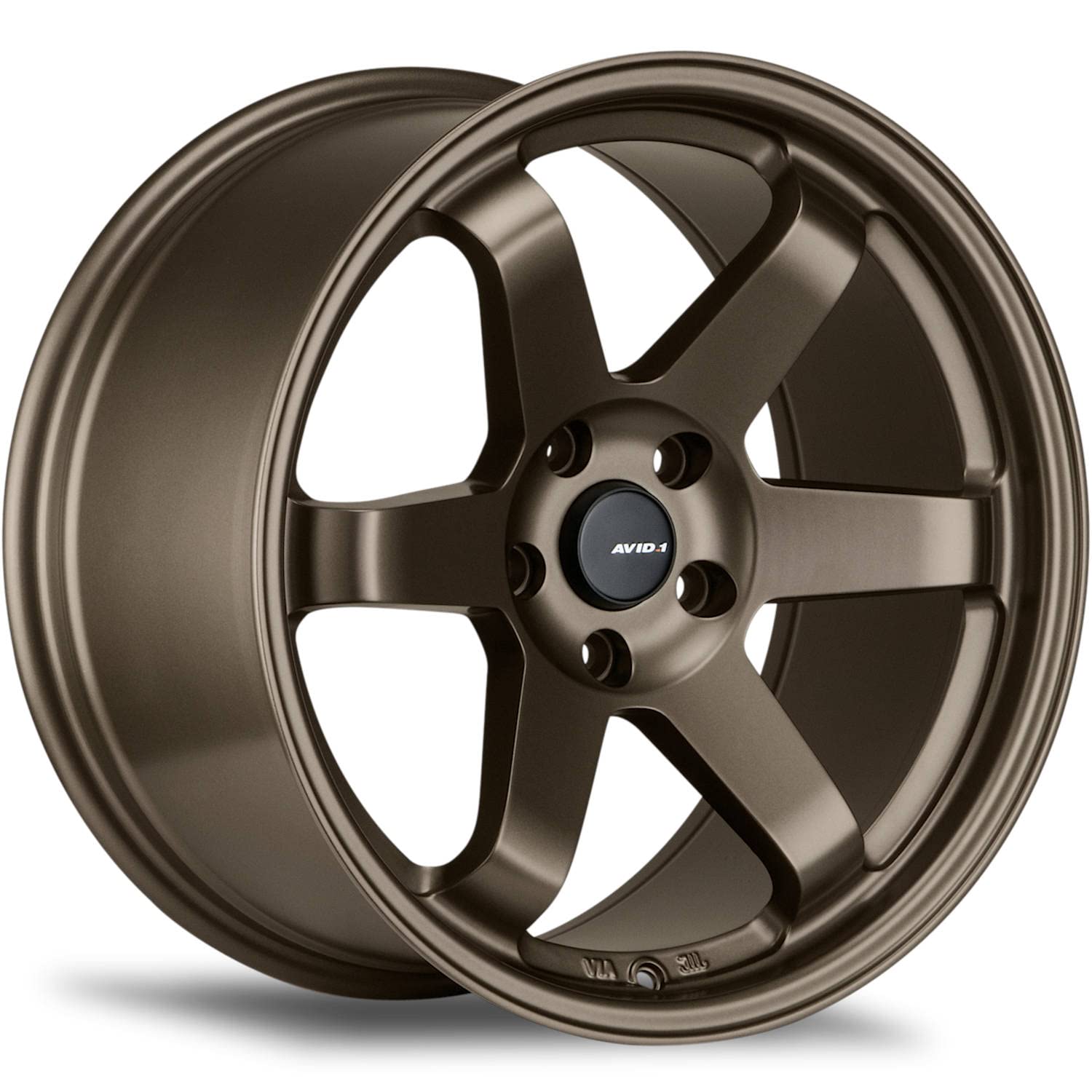
| AVID.1 AV-06 Matte Bronze★ Best Overall | Budget street performance | 26 lbs | 5×114.3 mm | 17 in | Check Price |
| Enkei ENKRPF Gold Wheel | Track-focused builds | 16 lbs | 5×100 mm | 17 in | Check Price |
| Enkei EKM Gunmetal Wheel | Oversized street style | 29 lbs | 5×114.3 mm | 18 in | Check Price |
| AVID.1 AV-20 Hyperblack | Direct bolt-on daily driver | 26 lbs | 5×4.5 (114.3 mm) | 17 in | Check Price |
In‑Depth Reviews
1. AVID.1 AV-06 Matte Bronze 17×8 Custom Wheel – Fits 5×114 Bolt Pattern
Our pick — over 4.5★ from 80+ verified ratings; the strongest balance of quality and price.
Bronze bread-and-butter that 86 ratings call a “must buy” for street builds.
For the budget-minded JDM build that still wants an aggressive split-spoke look, the AVID.1 AV-06 in matte bronze delivers a 26-pound alloy wheel that fits the common 5×114.3 millimeter bolt pattern. The 17×8 size with a +35 offset pushes the wheel slightly outboard for a meaner stance without rubbing. Owners mention these fit a Lancer “no problems” and look “amazing during daylight” — with 86 ratings at a 4.7 average, this is the most-vetted pick here.
One buyer who ran them for three years called them “very durable,” a strong endorsement for a wheel at this tier. The 70 load index is the lowest of the bunch, so beat on these at the track with caution. But for daily street driving and occasional back-road carving, the price-to-performance ratio is tough to top. The bronze finish hides brake dust well, too.
Why It Earns Its Spot
- Strong 4.7 average rating across 86 reviews — real-world trust from a large group of buyers
- Matte bronze finish hides dust and looks aggressive without screaming for attention
- Fits the common 5×114.3 bolt pattern used by Honda, Nissan, Mitsubishi, and more
What to Watch
- 26 pounds is not light — you feel the weight over sharp bumps compared to the 16-lb Enkei
- Load index of 70 is low; avoid heavy cargo or hard track use with this set
Great for the daily JDM: If you drive an older Civic, Integra, Lancer, or 350Z and want a tough, good-looking wheel that will survive three years of potholes without complaining, this is the one.
Not for weight weenies: At 26 pounds per corner versus the RPF1’s 16 pounds — the steering feel and acceleration will be noticeably lazier.
2. Enkei ENKRPF Gold Wheel (17×8″/5x100mm)

The featherweight that changes how your car turns — 16 lbs per corner transforms the driving feel.
At 16 pounds per wheel, the Enkei RPF1 in gold is significantly lighter than the 29-pound Enkei EKM. That is the difference between a car that turns eagerly and one that wants to keep going straight. The skinny 5×100 millimeter bolt pattern (the distance across the lug holes) fits Subaru WRX and STI models from 2002 through 2010 perfectly, and the 45-millimeter offset keeps the wheel tucked inboard for stock-like clearance, so it won’t rub your fenders.
Buyers report these are “super lite, and well made” and that they fit like OEM on a 2003 Subaru Impreza WRX. One review noted tiny knicks on the inside of the rim face, but overall the finish arrived in good shape. The 75 load index (the weight rating per wheel) means these can handle a moderately loaded car without bending, though they are not the strongest choice for extreme heavy hauling.
What Stands Out
- Only 16 pounds per wheel — dramatically reduces unsprung mass for sharper handling
- Authentic Enkei RPF1 design, a motorsport icon with years of track pedigree
- Fits 5×100 Subaru, WRX, and STI models from 2002-2010 without adapters or hub rings
The Trade-off
- 5×100 bolt pattern limits fitment — will not bolt onto Honda, Nissan, or most 5×114.3 cars
- Gold finish shows brake dust more than darker colors
If you track it: This is the pick for the enthusiast who prioritizes handling feel over wheel diameter — the 16-lb weight makes turn-in and braking noticeably sharper than any 26-lb or 29-lb wheel.
skip it if: Your car uses a 5×114.3 bolt pattern. The 100-millimeter PCD will not center without wobble adapters, which defeats the weight advantage.
3. Enkei EKM Gunmetal Wheel (18×8″/5×114.3mm)
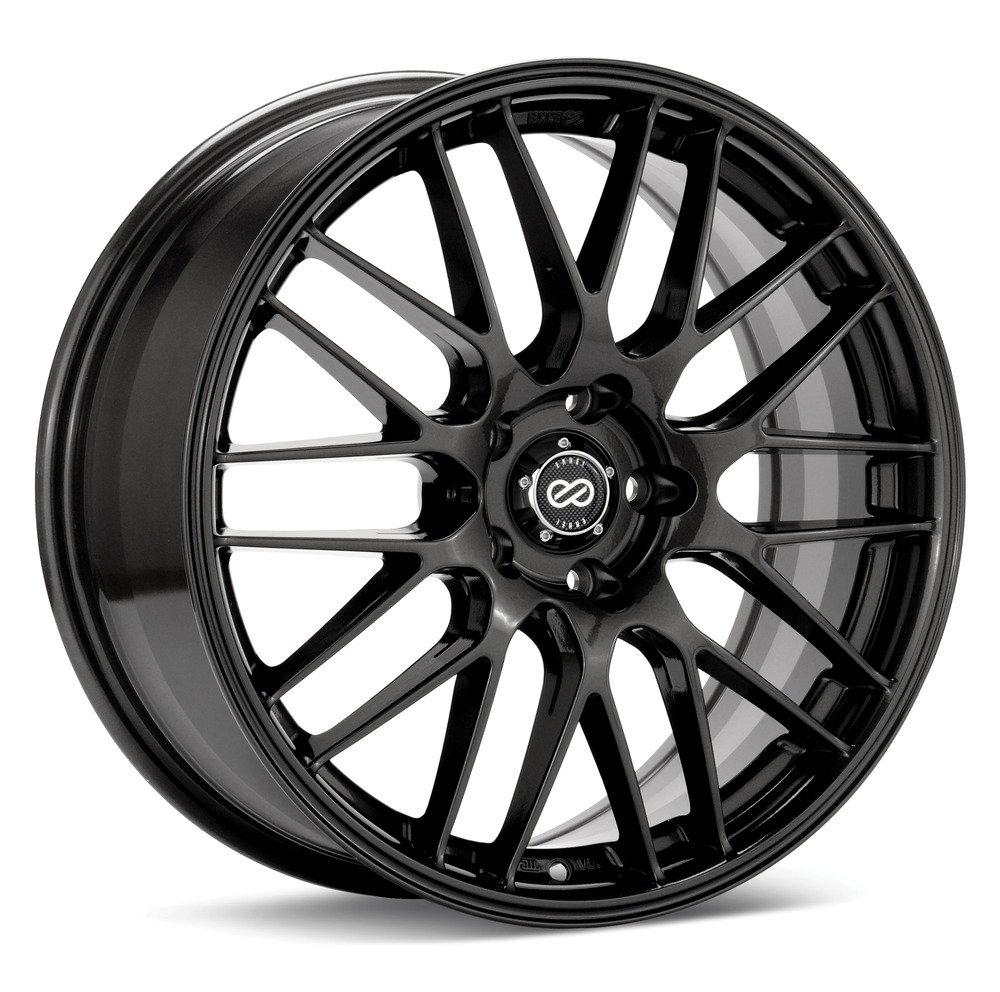
The 18-inch Enkei for those who want diameter over diet — 29 pounds of gunmetal presence fills the arches.
If you want an 18-inch wheel for a bolder fill of the wheel well, the Enkei EKM delivers that bigger diameter at 29 pounds — the opposite direction of the weight-minimizing RPF1. The 18-inch by 8-inch barrel with a +40 offset and 5×114.3 bolt pattern fits Mustangs, Toyotas, and many 5×114.3 Japanese cars. One reviewer noted the gunmetal color was “not too light” and they were “super glad” they chose it over black.
The weight penalty is real: at 29 pounds versus the RPF1’s 16 pounds, which means slower acceleration and a firmer ride over bumps. Buyers also note that the listing omits the need for new TPMS sensors (tire pressure monitoring sensors) and lug nuts — factory ones may not fit. That said, the wheel arrived well-packaged and within a day for one owner, who said it fit their Mustang “good” and plans to buy three more.
Strengths
- 18-inch diameter gives a taller, more aggressive look that fills the wheel arch better than 17-inch wheels
- Gunmetal paint is darker than silver but lighter than black — hides dust reasonably well
- Enkei brand quality with a 4.5-star average across 33 ratings
Watch Out For
- 29 pounds per wheel — the heaviest pick here, hurts acceleration, braking, and ride quality
- You may need new TPMS sensors and lug nuts because factory parts may not fit the Enkei bore
For the show-and-go crowd: If you are building a street car that prioritizes visual presence and 18-inch diameter, and you do not mind the extra rotational mass, the EKM delivers Enkei quality at a larger size.
Skip it for track work: The 29-pound weight is a handling penalty on every corner — go for the RPF1 or AV-06 instead if lap times matter.
4. AVID.1 AV-20 Hyperblack 17×8 Custom Wheel – 5×4.5 Bolt Pattern
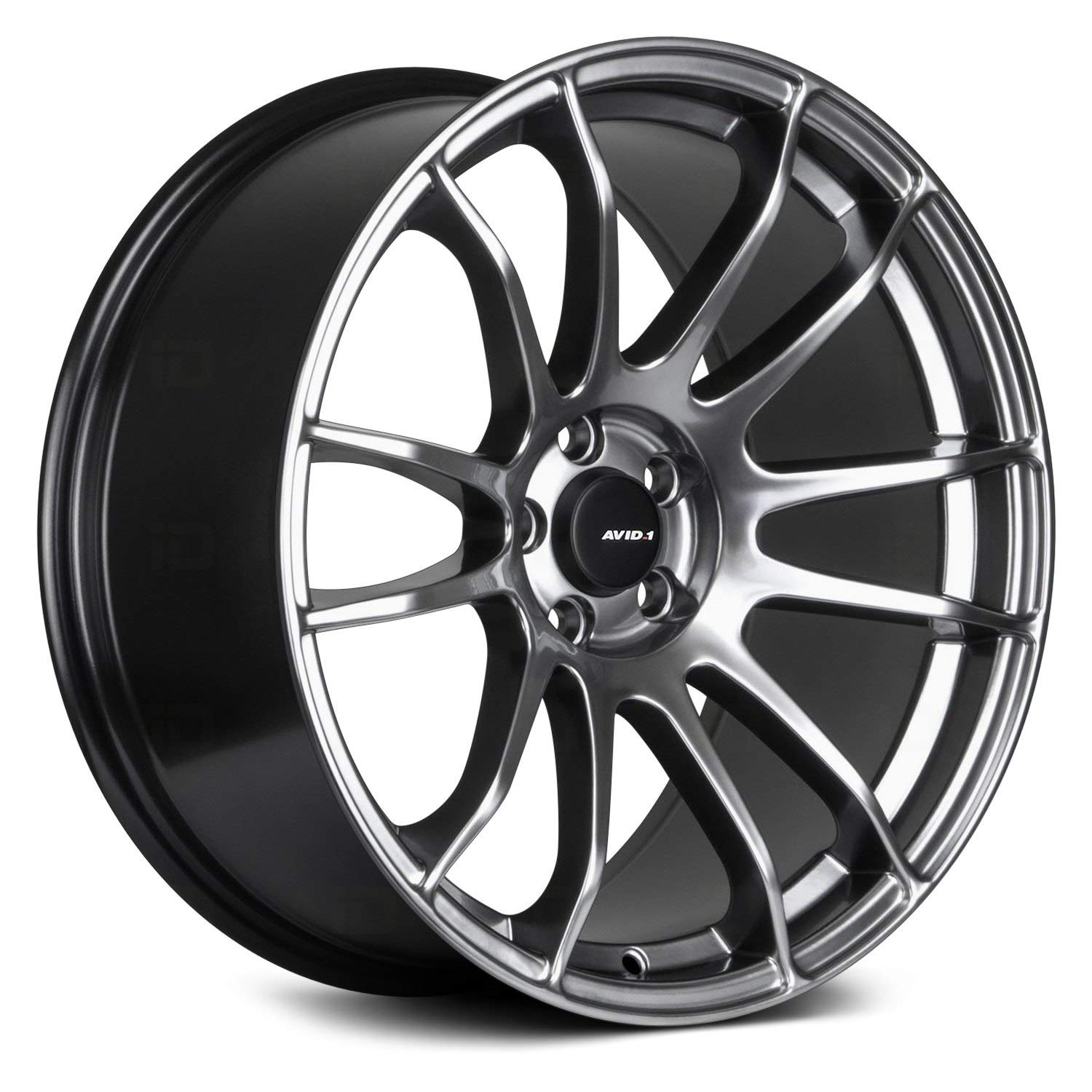
Split-spoke hyperblack fit for Hondas and Acuras — direct bolt-on with no suspension mods needed.
The AVID.1 AV-20 in hyperblack brings a modern split-spoke look to the 5×4.5 bolt pattern (the same 114.3 millimeter PCD as the AV-06). The 17×8 wheel with a +35 offset and 5.88-inch backspacing fits a wide range of Honda and Acura vehicles without adapters. One buyer who put them on a 2004 Acura TSX reported “they fit right in and look great” with “no modification on the suspension was necessary.” The 73.1 millimeter hub bore (the center hole) matches factory hubs for a center-bore fit that reduces vibration.
At 26 pounds, the AV-20 is the same weight as the AV-06, so the steering feel sits mid-pack — not as responsive as the 16-pound RPF1. A handful of reviews mention a manufacturing error where two wheels arrived in different colors, so inspect the set carefully upon arrival. The hyperblack chrome-like finish shines up nicely but shows fingerprints and dust more than matte finishes.
Top Qualities
- Engineered for 5×4.5 bolt pattern with correct hub bore — bolts to many Honda/Acura cars without wobble or rings
- Buyers confirm direct fit for cars like the 2004 Acura TSX with zero suspension modification
- Aggressive split-spoke design stands out on the street with a motorsport-inspired look
Risks to Check
- 26-pound weight — not a lightweight performer, though decent for daily driving
- Finish variation reported — one buyer received two wheels of one color and two of another, so open the box immediately
Ideal for Honda/Acura owners: If you have a TSX, Civic, Integra, or similar 5×4.5 car and want a wheel that bolts on without adapters or guesswork, the AV-20 delivers the simplest install path here.
Look elsewhere for lightness: The 26-pound weight means it is not the choice for a track-focused build — the 16-pound RPF1 will out-handle it every time.
Understanding the Specs
Pitch Circle Diameter (PCD) and Bolt Pattern
The pitch circle diameter (the measurement in millimeters across the circle your lug holes sit on) is 114.3 millimeters for the most common JDM pattern across Honda, Nissan, Mitsubishi, and many Toyotas. A 5×100 millimeter pattern (like the Enkei RPF1) fits Subaru WRX and STI models, but will not bolt onto a 5×114.3 hub without wobble or wobble-prone adapters. Always match the PCD exactly — a mismatch of even 14 millimeters means the wheel will not center properly, causing vibration and potential lug nut failure.
Offset (ET) and Backspacing
Offset measures how far the wheel’s mounting face sits from the centerline. A positive offset like +40 pushes the wheel further into the wheel well, while a lower offset like +35 moves it outward for a wider stance. The backspacing (given as 5.88 inches on the AV-20) tells you the distance from the mounting face to the inner edge of the rim — critical for brake caliper clearance. A wrong offset can rub your fender when you hit a bump or contact your brake caliper under hard braking.
Load Index
Load index is a number that tells you how much weight each wheel can safely carry. The Enkei RPF1 has a load index of 75, while the AVID.1 AV-06 has an index of 70. A lower index means the wheel is lighter but less strong — fine for a lightweight coupe or sedan, but risky for a heavy wagon or a car that carries passengers and cargo. Overloading a wheel with a low index can cause the rim to bend or crack on a sharp pothole.
Wheel Weight and Unsprung Mass
Every pound of weight you add or remove from the wheel and tire combo (called unsprung mass) affects how quickly your suspension can react to bumps and how fast your car accelerates and stops. The weight difference between the Enkei RPF1 (16 lbs) and the Enkei EKM (29 lbs) is enormous — the lighter wheel allows the suspension to move faster over rough pavement, improving grip and ride quality. Heavier wheels increase rotational inertia, which makes the car feel slower to turn and harder to stop.
FAQ
Will a 5×100 millimeter wheel fit on a 5×114.3 hub?
What does the +35 or +40 offset number mean for my car?
How do I know which bolt pattern my car uses?
Are AVID.1 wheels as durable as Enkei wheels?
Will a 17×8 inch wheel clear my brake calipers?
What is the difference between a 5×4.5 and a 5×114.3 bolt pattern?
Can I use my factory lug nuts with aftermarket wheels?
How much does wheel weight actually affect gas mileage?
Should I buy a set of JDM wheels with tires already mounted?
How long do matte bronze and hyperblack finishes last?
Final Thoughts: The Verdict
For most enthusiasts, the jdm wheels winner is the Enkei ENKRPF Gold Wheel because at 16 pounds per corner versus the EKM’s 29 pounds, it directly translates to sharper turn-in, faster acceleration, and better braking. If you are on a tighter budget and your car uses the common 5×114.3 bolt pattern, grab the AVID.1 AV-06 Matte Bronze for a durable street wheel with a proven 4.7-star track record. And for the daily driver who wants a bolt-on wheel that requires zero suspension modification, the AVID.1 AV-20 Hyperblack fits Honda and Acura cars right from the start.
How We Picked
We do not accept paid placement. Every pick is matched to a real buyer and a real use-case; we do not hands-on test units.
Sources & Methodology
Specifications: manufacturer listings and product documentation. Review insights: verified customer reviews, as of July 2026. Pricing: not shown on this page (it changes often); check the current price via the retailer link.
As an Amazon Associate, Trending Car earns from qualifying purchases. This does not affect which products we feature.