
Our readers keep the lights on and my garage snacks stocked. As an Amazon Associate, I earn from qualifying purchases.
Specs are compiled from manufacturer listings and verified buyer reviews and can change over time — please confirm the key details on the product page before buying.
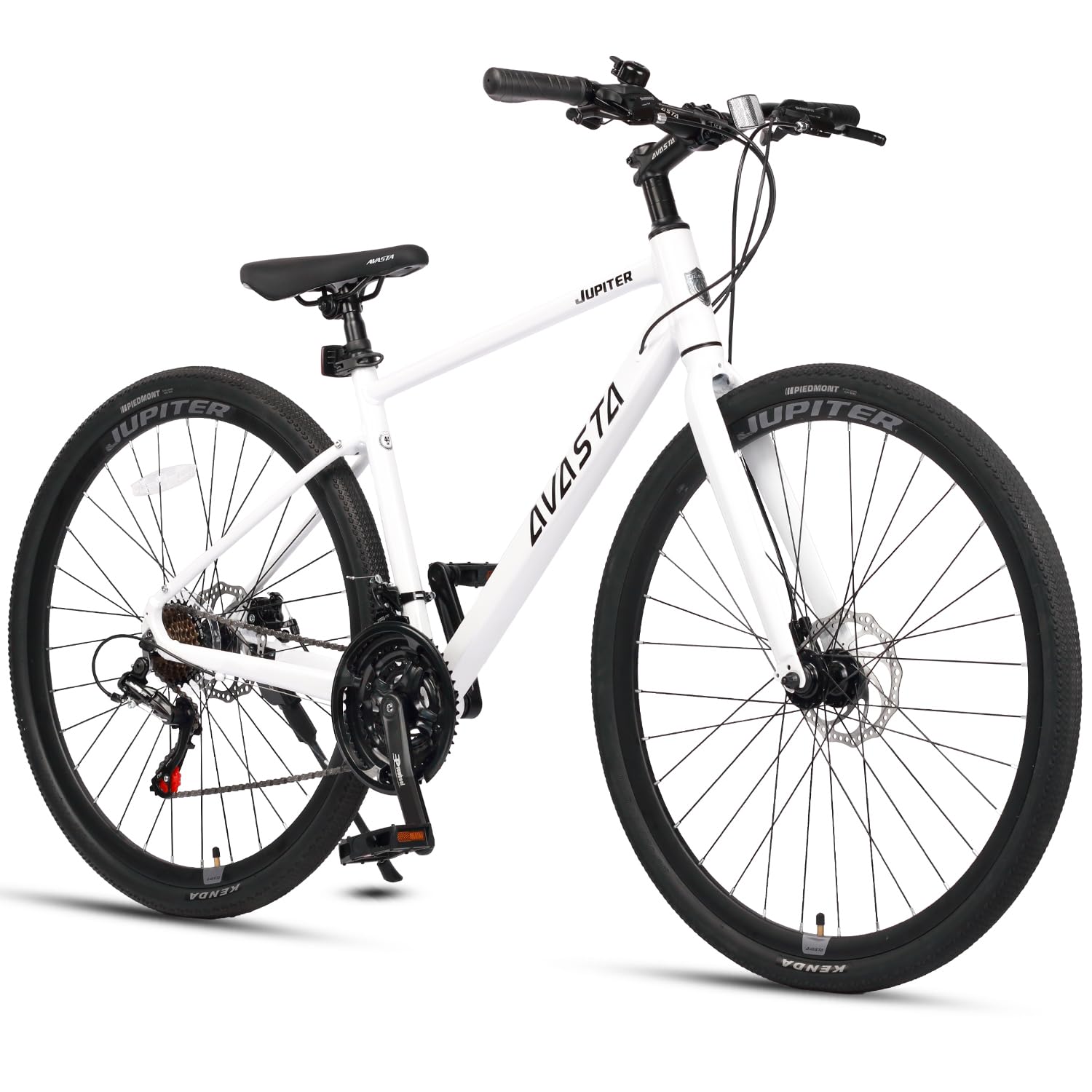
You want a commute bike that handles both pavement and gravel without costing a fortune. The problem is most cheap bikes feel flimsy the first time you hit a pothole. The AVASTA Jupiter solves that: it gives you 21 speeds (the Shimano EF500 drivetrain, a system of gear shifters and derailleurs that changes gears smoothly), a lightweight aluminum frame that resists rust, and dual disc brakes (mechanical calipers that squeeze a metal rotor so you stop in the rain). It costs less than a nice helmet and lock combined, and buyers report riding over 400 miles on it.
I’m Min Islam — the founder and writer behind Trending Car. This guide is built by comparing the manufacturers’ published specifications and the patterns across verified customer reviews, so you get each pick’s real strengths and trade-offs instead of marketing spin.
To pick the best cheap hybrid bike for your daily route, focus on the frame material (aluminum is lighter and rust-free; steel is heavier but smoother on rough roads), the number of speeds (7 is fine for flats; 21 handles real hills), and the brake type (disc brakes stop in wet weather; rim brakes lose grip when wet).
Our Picks at a Glance

How To Choose The Best Inexpensive Hybrid Bike
Every bike in this list stays under a budget, but they are not all built the same. To pick the right one, pay attention to three things: the frame you are sitting on, the gears you will shift through, and the brakes that keep you safe.
Frame: Aluminum vs. Steel
Aluminum is the lightest option for the price. It resists rust (so your frame stays solid through wet commutes) and makes a bike easier to lift onto a rack or carry up stairs. Steel is heavier but can feel more forgiving on rough roads (it absorbs vibration better than aluminum). For a first hybrid under, aluminum is almost always the better choice.
Gears: 7 Speeds vs. 21 Speeds
7-speed hybrids use a single chainring in the front (the sprocket attached to the pedals) and a wide cassette in the back (a cluster of sprockets on the rear wheel). That gives you enough range for flat commutes and gentle hills. 21-speed setups add two more front chainrings (for 3 front x 7 rear = 21 total gears). This gives you a much lower gear for steep climbs (so you can pedal uphill without standing up) and a higher gear for faster descents. If you live in a hilly area, the 21-speed route is the smarter buy.
Brakes: Disc vs. Rim
Disc brakes (mechanical, not hydraulic at this price) use a metal rotor clamped by calipers to stop the wheel. They work reliably in rain, mud, and snow because the rotor stays clean of debris. Rim brakes (called linear pull or V-brakes) squeeze the wheel rim itself. They are lighter and easier to adjust, but lose grip when the wheel rim is wet. For an all-weather commuter, disc brakes win.
Quick Comparison
| Model | Best For | Speeds | Frame Material | Brake Type | Amazon |
|---|---|---|---|---|---|
| AVASTA Jupiter★ Best Overall | Best Overall | 21 | Aluminum | Dual Disc | Amazon |
| VIRIBUS HybridPremium Pick | Premium Build Quality | 7 | Aluminum | Disc | Amazon |
| HILAND 700C | Easiest Assembly | 7 | Carbon Steel | Disc | Amazon |
| Tommaso Sorrento | Fitness & Commute | 21 (3×7) | Aluminum | Rim (Cantilever) | Amazon |
| Schwinn Suburban | Classic Cruiser Feel | 7 | Steel | Linear Pull (Rim) | Amazon |
In‑Depth Reviews
1. AVASTA Jupiter 700C Hybrid Bike
Our pick — over 4.5★ from 50+ verified ratings; the strongest balance of quality and price.
This bike gives you 21 speeds and disc brakes at a price that surprises owners — it feels more like a bike than a budget ride.
You get 21 speeds from the Shimano EF500 drivetrain, which shifts more smoothly than the simpler 7-speed setups on the VIRIBUS and HILAND. That means you can tackle steep hills in a low gear (to keep your legs from burning out) and still pedal fast on flat stretches. Owners mention clocking over 400 miles on a single AVASTA Jupiter, with the longest single ride stretching to 21 miles.
The dual disc brakes stop confidently in the wet, and the lightweight aluminum frame (which resists rust and makes the bike easier to lift) rides closer to a Trek than a department-store bike. Over a dozen owners single out the build quality. The pearl paint finish holds up to scratches better than you would expect at this price. The saddle is the usual budget-bike weak spot — many owners swap it — but the frame and drivetrain are solid enough that upgrading the seat feels like a choice, not a fix.
The AVASTA has 21 speeds while the HILAND below has 7 speeds, which is a meaningful advantage if your route includes any real climbing. The 21-speed Shimano EF500 system shifts more precisely than the simpler 7-speed setups on the VIRIBUS and HILAND, making it the best pick for riders who want to tackle varied terrain without spending more.
Why it wins: 21 speeds, lightweight aluminum frame, dual disc brakes, and a proven track record of durability from real owners. The price-to-performance ratio is tough to top.
The honest trade-off: The stock saddle is uncomfortable for longer rides — budget a few dollars for a replacement seat.
Reach for it if: you want the most capable all-rounder for hills, flats, and light gravel, and you want it under.
Look elsewhere if: you need a bike that comes 90% assembled and requires almost no setup — this one is straightforward but still takes some work.
2. VIRIBUS 28 Inch Hybrid Bicycle
This bike feels assembled with care — 26 owners call out its clean welds and sealed parts.
Build quality is the headline here — 26 owners call it out, and it is the most-discussed aspect of this bike. The VIRIBUS uses sealed-bearing headset (the steering mechanism that lets the handlebars turn smoothly), sealed-bearing bottom bracket (where the pedals connect to the frame), and sealed-bearing wheel hubs, plus a three-piece crankset (a more durable crank arm design than one-piece units) and clean TIG welds (a type of welding that creates smooth, strong joints) that look like they belong on a bike twice the price. It ships more than 85% assembled, so the setup is lean.
The 7-speed drivetrain is simple and low-maintenance, which is perfect for flat commutes and leisure rides. The aluminum frame keeps the weight down, and the included IPX4-rated front and rear lights (meaning they resist splashes from any direction) are a thoughtful addition for dusk riding. The recurring gripe is the cassette (the cluster of sprockets on the rear wheel): one owner reported that after 10 months the cassette wore out, causing chain skip in gears 6 and 7. The fix cost about in parts and was resolved directly with the seller.
The VIRIBUS has 7 speeds, while the AVASTA Jupiter has 21 speeds. That makes it a less versatile climber, but for riders on mostly flat roads, the simpler drivetrain means less maintenance and fewer things to go wrong.
Standout build: Sealed bearings, three-piece crankset, and professional-quality TIG welds at a budget price.
One honest caution: The cassette (rear gear cluster) durability is mixed — a small number of owners experienced wear within a year.
Best for: commuters who value long-term reliability and can handle a DIY cassette replacement down the road.
skip it if: you need more than 7 speeds for steep hills.
3. HILAND 700C Road Hybrid Bike
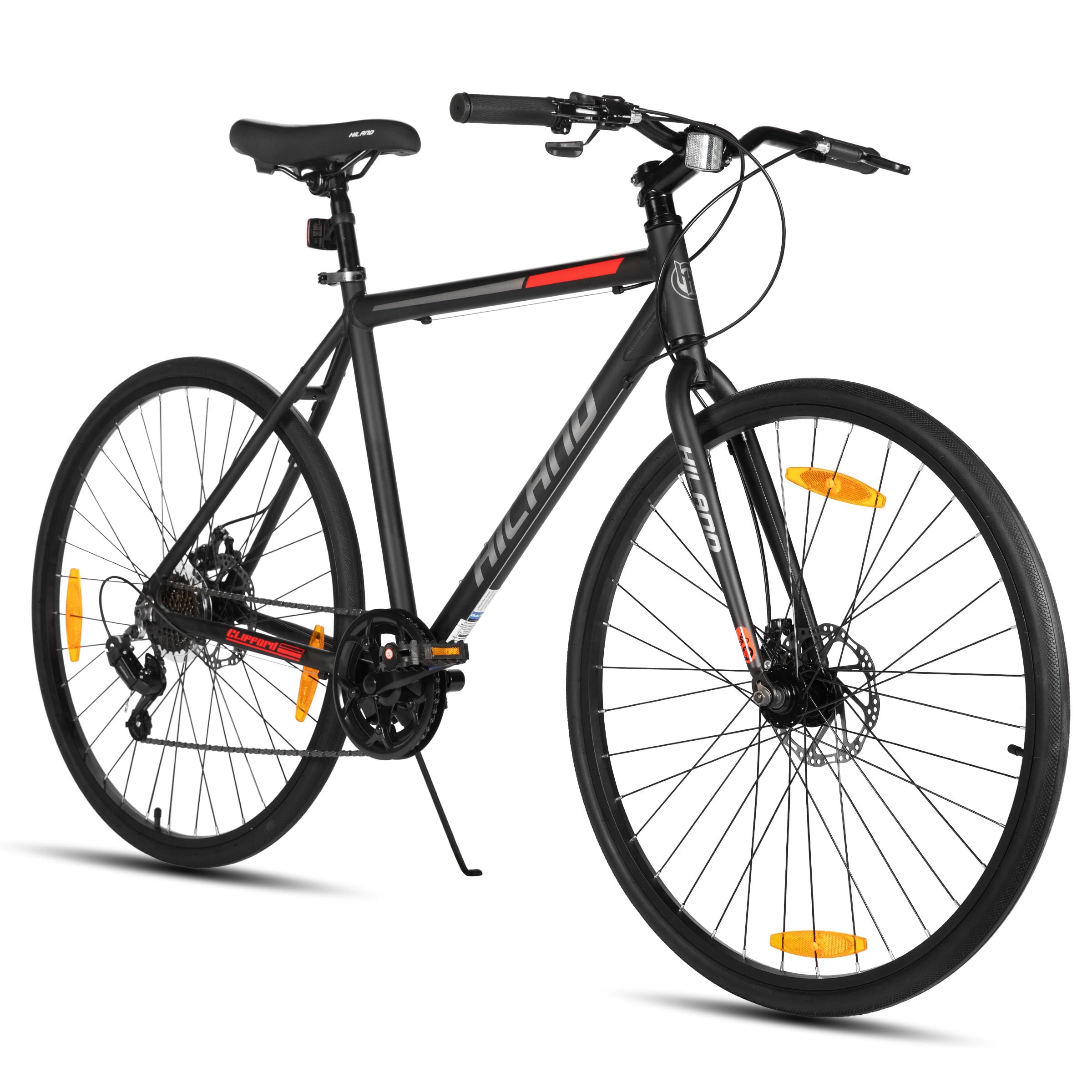
This bike is 90% assembled from the start — owners say the final setup takes minutes, not hours.
The HILAND comes 90% assembled, saving you the headache of building a bike from scratch. The 7-speed trigger shifter (a gear selector you push with your thumb and index finger) is intuitive, and the dual disc brakes work reliably from the first ride. Quality is praised by nearly a dozen owners, who note that the fit and finish feel like a much more expensive bike.
The frame is carbon steel (a steel alloy with added carbon for strength), which is heavier than the aluminum frames on the AVASTA and VIRIBUS, but it rides smoothly and absorbs road vibration well. The upright riding position (flat handlebars, meaning your back is straighter and less strained) eases strain on your back and neck, making it a good choice for casual cruising and neighborhood errands. One owner mentioned the seat post clamp needed pliers to tighten, but once dialed in, everything stayed solid.
Size M (53cm) fits riders from about 5’9″ to 6’1″, and the larger 57cm suits 6’1″ to 6’5″. If you are on the taller side, the frame geometry here is more accommodating than the AVASTA, which one reviewer recommended for 5’2″ to 5’5″ riders.
Quick-start design: 90% assembled from the start — ideal for anyone who does not want to spend an afternoon with a wrench.
The trade-off: Carbon steel frame is heavier than aluminum, and the 7-speed range is limited for serious hills.
Reach for it if: you value simplicity and want a bike you can unbox, assemble in 20 minutes, and ride the same day.
Look elsewhere if: you need to carry your bike up stairs regularly — the steel frame adds noticeable heft.
4. Tommaso Sorrento Shimano Tourney
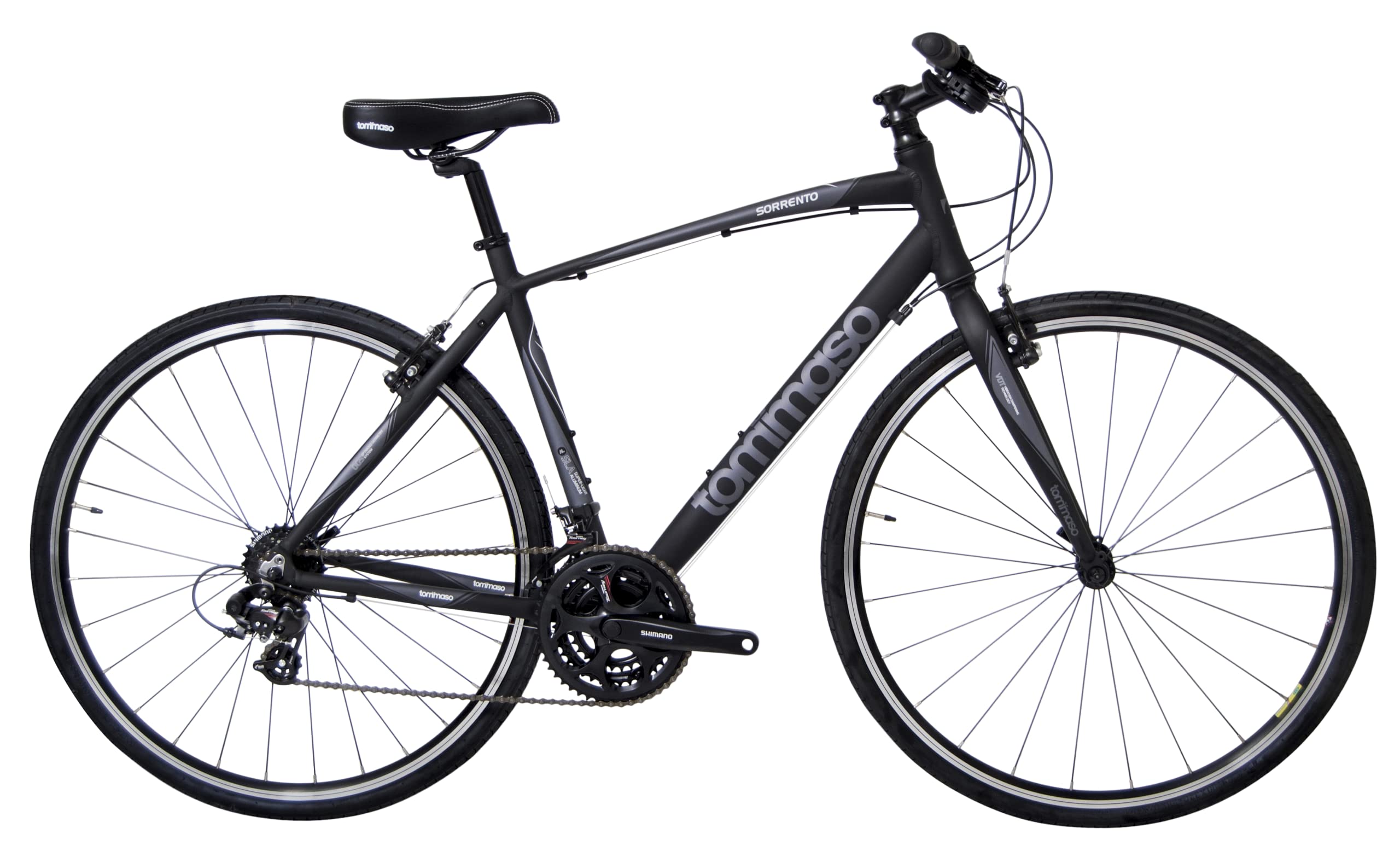
At 29 lbs with 21 speeds, this is the lightest fitness-focused hybrid in the lineup — one owner notes it feels “race-capable” for the price.
The Tommaso Sorrento weighs about 29 lbs, which is notably light for a hybrid at this price. That lower weight means you accelerate faster and carry less mass uphill. The Shimano Tourney 3×7 drivetrain (three chainrings in front, seven sprockets in back) gives you 21 speeds, just like the AVASTA Jupiter, but through a triple front chainring design. That means a wider range of gear ratios — lower for steep hills, higher for fast flats — which is exactly what you want for fitness riding and commuting.
Quality is praised by a dozen owners, and the lightweight aluminum frame gets its own spotlight from eight more. The Sorrento handles rolling hills well, and one owner noted that it feels quick and race-capable for the price. However, it uses cantilever rim brakes (a type of brake that squeezes the wheel rim from both sides with a curved arm) rather than disc brakes, which means stopping power in wet weather is a step behind the AVASTA and VIRIBUS. The stock seat is firm, and the pedals are described as tooth-edged — budget for replacements if you plan to ride more than 5 miles at a time.
Unlike the HILAND or VIRIBUS, the Sorrento ships with no assembly tools and no kickstand, so you will need your own set of wrenches and a plan for storing it upright. The ride quality is smooth and responsive, but the lack of disc brakes makes it better suited to dry commuting than all-season use.
Lightweight performer: At 29 lbs with 21 speeds, this is the best choice for riders prioritizing speed and hill climbing over wet-weather braking.
The honest trade-off: Rim brakes and no kickstand or tools included — plan for a few extra purchases and a dry-day ride.
Best for: fitness riders who want a lightweight, fast hybrid for paved roads and rolling hills.
pass on it if: you regularly ride in rain — the cantilever brakes will not stop as confidently as discs.
5. Schwinn Suburban Adult Comfort Bike

Over 50 owners praise the build quality of this upright cruiser, making it the most complimented bike in the lineup — for comfort, not speed.
The Schwinn Suburban is built for the rider who wants comfort above all. The steel step-over frame positions you upright, and the large cushioned seat and retro fenders complete the classic cruiser look. It rolls on 26-inch wheels with high-volume tires that soak up bumps, and the 7-speed twist shifter (a gear selector you rotate with your wrist) is simple enough to use without thinking. Over 50 owners praise build quality, making it the most-discussed positive aspect of this bike.
Assembly is the weak link here — more than 40 owners mention it, and the consensus is mixed. The manual is vague, and some owners reported missing hardware like axle nuts (the nuts that hold the wheel axle in the frame). The fender screws are easy to strip, and the linear pull brakes (a type of rim brake with a long arm that provides more stopping force than standard V-brakes) require careful adjustment. If you are not mechanically inclined, budget for a shop to finish the job.
The Suburban is significantly heavier than the aluminum-framed options above (steel frame, fenders, and larger tires add up), so it is not ideal for carrying up stairs or loading onto a bike rack. But for flat neighborhood cruising, coffee runs, and easy paved paths, it delivers a ride that feels far more expensive than its price tag suggests.
class-leading comfort: The upright seat position, cushioned saddle, and fat tires make this the most relaxing ride in the lineup.
The honest trade-off: Assembly is frustrating, the bike is heavy, and the steel frame will rust if left in the rain without care.
Reach for it if: comfort is your top priority and your rides are mostly flat, paved, and under 5 miles.
Look elsewhere if: you need a lightweight bike for hills, racks, or stairs — the steel frame is heavy.
Understanding the Specs
Drivetrain: 7 vs 21 Speeds
The number of speeds tells you how many gear ratios you have to choose from. A 7-speed hybrid uses a single chainring in the front (the sprocket connected to the pedals) and a cassette with 7 different sizes in the rear (a cluster of sprockets on the back wheel). That is plenty for flat commutes and gentle hills. A 21-speed setup adds two more chainrings in the front (for 3 front x 7 rear = 21 total). This gives you a much lower climbing gear (so you can pedal uphill without struggling) and a higher top gear (so you can pedal efficiently on fast descents). If your daily route includes a significant hill, 21 speeds will save your legs.
Brakes: Disc vs. Rim (Linear Pull)
Disc brakes use a metal rotor (a thin metal disc attached to the wheel) clamped by calipers (the part that squeezes the rotor) to stop the wheel. They work well in rain, mud, and snow because the braking surface stays clean. Every disc brake bike in this list uses mechanical (cable-actuated) discs, not hydraulic — that is normal at this price. Rim brakes (called linear pull or V-brakes) squeeze the wheel rim itself. They are lighter and simpler, but lose significant stopping power when the rims are wet. For an all-weather commuter on a budget, disc brakes are the safer choice.
FAQ
Will an inexpensive hybrid bike fit in a car trunk?
How many miles can I expect from a budget hybrid bike?
What size hybrid bike do I need for my height?
Are disc brakes on a budget bike worth the extra cost?
How hard is it to assemble these bikes?
Can I ride these bikes on gravel trails?
What is the weight limit for these hybrid bikes?
Do I need to tune up the bike after assembly?
Final Thoughts: The Verdict
For most riders, the best inexpensive hybrid bike is the AVASTA Jupiter because it gives you 21 speeds, a lightweight aluminum frame, and dual disc brakes at a price that leaves room for upgrades. If you prioritize build quality and sealed bearings for low maintenance, the VIRIBUS Hybrid is a smarter choice — its clean TIG welds and sealed parts are praised by 26 owners, though you trade steep-hill capability for that durability. And if ease of assembly is your deal-breaker, the HILAND 700C has you riding in under 20 minutes — just know you are trading a few pounds of steel frame and fewer gears (7 instead of 21) for that convenience.
How We Picked
We do not accept paid placement. Every pick is matched to a real buyer and a real use-case; we do not hands-on test units.
Sources & Methodology
Specifications: manufacturer listings and product documentation. Review insights: verified customer reviews, as of July 2026. Pricing: not shown on this page (it changes often); check the current price via the retailer link.
As an Amazon Associate, Trending Car earns from qualifying purchases. This does not affect which products we feature.