
Our readers keep the lights on and my garage snacks stocked. As an Amazon Associate, I earn from qualifying purchases.
Specs are compiled from manufacturer listings and verified buyer reviews and can change over time — please confirm the key details on the product page before buying.
The biggest change when you switch to an electric vehicle is realizing that your old wall outlet just does not cut it anymore. A standard 120-volt plug adds only a few miles of range per hour, which means you are either waiting all day or hunting for a public charger. A permanent Level 2 charger solves that entirely by running on a 240-volt circuit, so you wake up to a full battery every morning without thinking about it.
I’m Min Islam — the founder and writer behind Trending Car. This guide is built by comparing the manufacturers’ published specifications and the patterns across verified customer reviews, so you get each pick’s real strengths and trade-offs instead of marketing spin.
Whether you drive a brand-new electric sedan or an older plug-in hybrid, finding the right home level 2 charger determines how much time you spend waiting versus actually driving, and this breakdown helps you pair the right amperage, cable length, and smart features to your garage setup and daily routine.
Our Picks at a Glance

How To Choose The Best Home Level 2 Charger
Picking a home charger is mostly about matching your car’s onboard charger capacity, your home’s electrical panel capacity, and how fast you actually need to be ready each morning. A higher amperage charger can replenish an EV battery in a few hours, but it also requires a dedicated 60-amp breaker and thicker wiring, so the real decision is between plug-in convenience (NEMA 14-50) and a hardwired install that squeezes out the maximum possible speed.
Amperage and Circuit Requirements
Amperage is the main spec that decides charging speed. A 40-amp charger on a 50-amp breaker adds about 30 to 38 miles of range per hour. A 48-amp unit needs a 60-amp hardwired circuit and pushes that figure to roughly 46 miles per hour. Going higher to 50 amps (like the Autel MaxiCharger) requires the same 60-amp breaker but delivers the maximum your car can draw if it supports that rate. The catch is that the circuit must be dedicated and installed by a licensed electrician — you cannot just swap out breakers and call it done.
Connector Type: J1772 vs. NACS
Every non-Tesla EV sold in North America uses the J1772 connector, and Tesla models use the NACS (North American Charging Standard) plug. Many chargers now ship with one or the other, sometimes including an adapter for the opposite standard. If you own a Tesla, you can buy a native NACS charger and avoid an adapter entirely, while non-Tesla owners will want a J1772 unit. Some chargers include both connectors in the box, which future-proofs for households with multiple EVs from different brands.
Smart Features and App Control
Most modern Level 2 chargers connect to WiFi (2.4 GHz) and let you schedule charging during off-peak electricity hours, track energy costs, and adjust the current in 1-amp increments through a smartphone app. Some add RFID card access for shared driveways, voice control via Alexa or Google Assistant, and real-time connector temperature monitoring. These features matter most if your utility charges time-of-use rates or if you want to prevent unauthorized use by neighbors or guests.
Quick Comparison
| Model | Best For | Max Amperage | Cable Length | Connector Type | Amazon |
|---|---|---|---|---|---|
| EVIQO NACS Charger for Tesla★ Best Overall | Best Overall — Tesla Owners | 48A | 25 ft | NACS | Amazon |
| NexCyber Level 2 EV ChargerBest Value Smart Charger | Best Value Smart Charger | 48A | 25 ft | J1772 | Amazon |
| Lectron Level 2 EV ChargerPortable Simplicity | Portable Simplicity | 40A | 16 ft | J1772 | Amazon |
| EVDANCE Level 2 EV Charger for Tesla | Portable Tesla Charger | 40A | 25 ft | NACS | Amazon |
| IYILO Level 2 EV Charger | Best Safety Features | 48A | 25 ft | J1772 | Amazon |
| WOLFBOX Level 2 EV Charger | Best Display & Voice Control | 40A | 25 ft | J1772 | Amazon |
| ApexCharger MACH 1 | Versatile Dual-Connector | 48A | 30 ft | J1772 + NACS | Amazon |
| Autel Level 2 EV Charger 40A | Premium Plug-in | 40A | 25 ft | J1772 | Amazon |
| Autel Level 2 EV Charger 50A | Max Power Hardwired | 50A | 25 ft | J1772 | Amazon |
In‑Depth Reviews
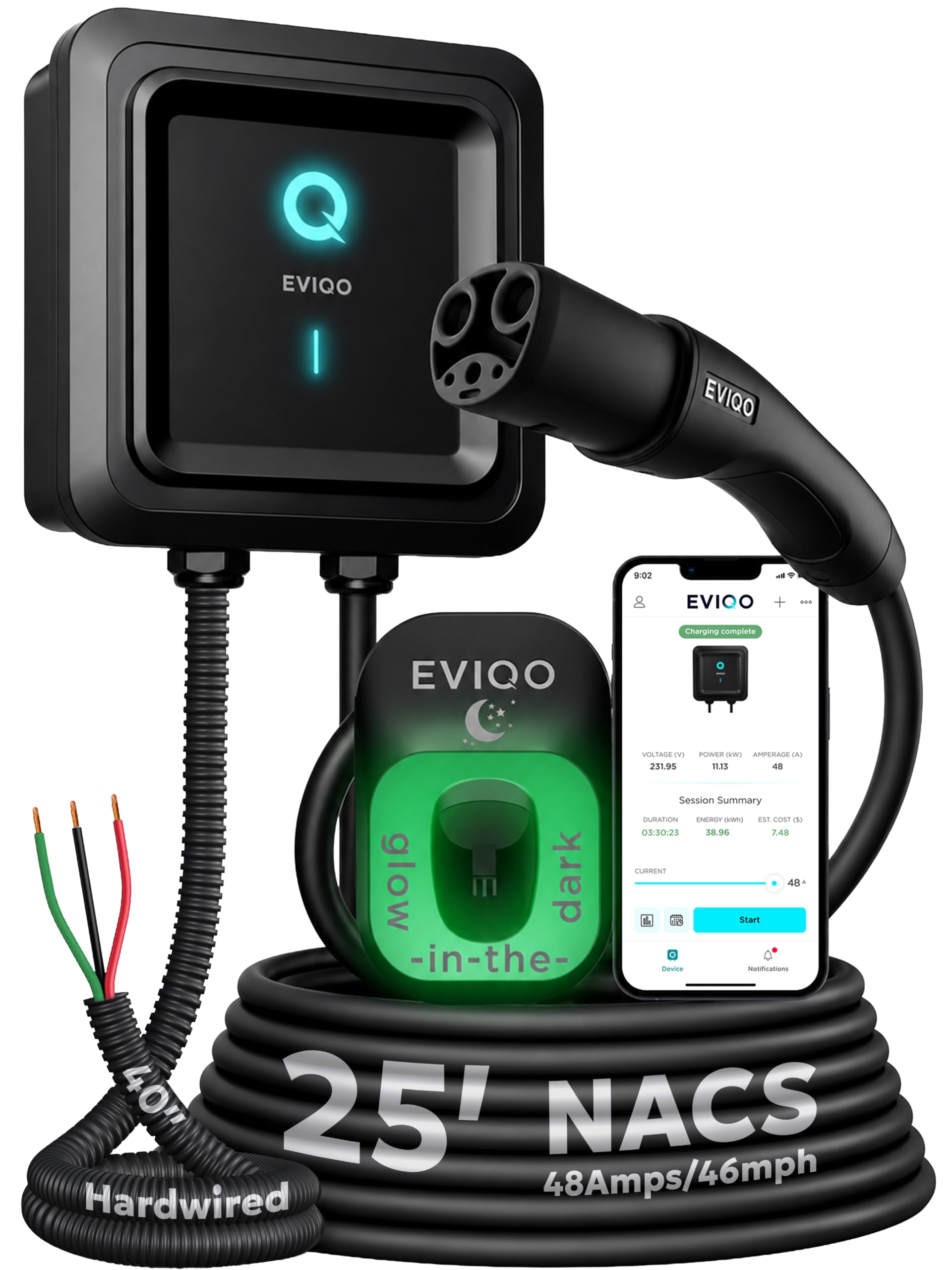
1. EVIQO NACS Charger for Tesla 48 Amp 240V Hardwired Level 2 EV Charger
Our pick — over 4.5★ from 250+ verified ratings; the strongest balance of quality and price.
The hardwired powerhouse that delivers the fastest Tesla-compatible charging at home.
This unit tops out at 48 amps on a dedicated 60-amp 240-volt circuit, which means it fully replenishes most electric vehicles overnight without fuss. The native NACS plug fits Tesla Model S, 3, X, and Y directly, and it works with other EVs using a NACS-to-J1772 adapter (sold separately). The smart app lets you start or stop charging remotely, set the current anywhere from 6 to 48 amps, and track consumption and estimated cost — all through a 2.4 GHz WiFi connection. Reviewers report charging a VW ID4 from empty to full in 5 to 7 hours with no hiccups.
Unlike plug-in models that cap at 40 amps on a NEMA 14-50 outlet, the EVIQO gains its speed from a direct hardwired connection, which also makes it more weather-resistant with an IP66/NEMA-4 enclosure that stands up to rain, snow, and dust. One owner noted the connector uses a soft plastic that scratches easily, so handling the plug gently helps keep it looking new. The high-visibility fluorescent holster absorbs light and glows after a few hours in the sun or under a garage light, making late-night plug-ins much easier.
Why it wins the top spot: The combination of a full 48-amp output, native NACS compatibility, UL/ETL certifications, and a well-reviewed smart app makes this the most complete package for Tesla owners who want a permanent wall charger.
The trade-off: Hardwired installation requires a licensed electrician, and the 50-amp open up via DIP switches demands a 70-amp circuit, which not every home panel can support.
Get this if: You own a Tesla and want maximum Level 2 speeds at home with app control and a sturdy weatherproof build.
Look elsewhere if: You need a plug-in charger you can easily take with you when you move, or your home electrical panel cannot accommodate a 60-amp circuit.
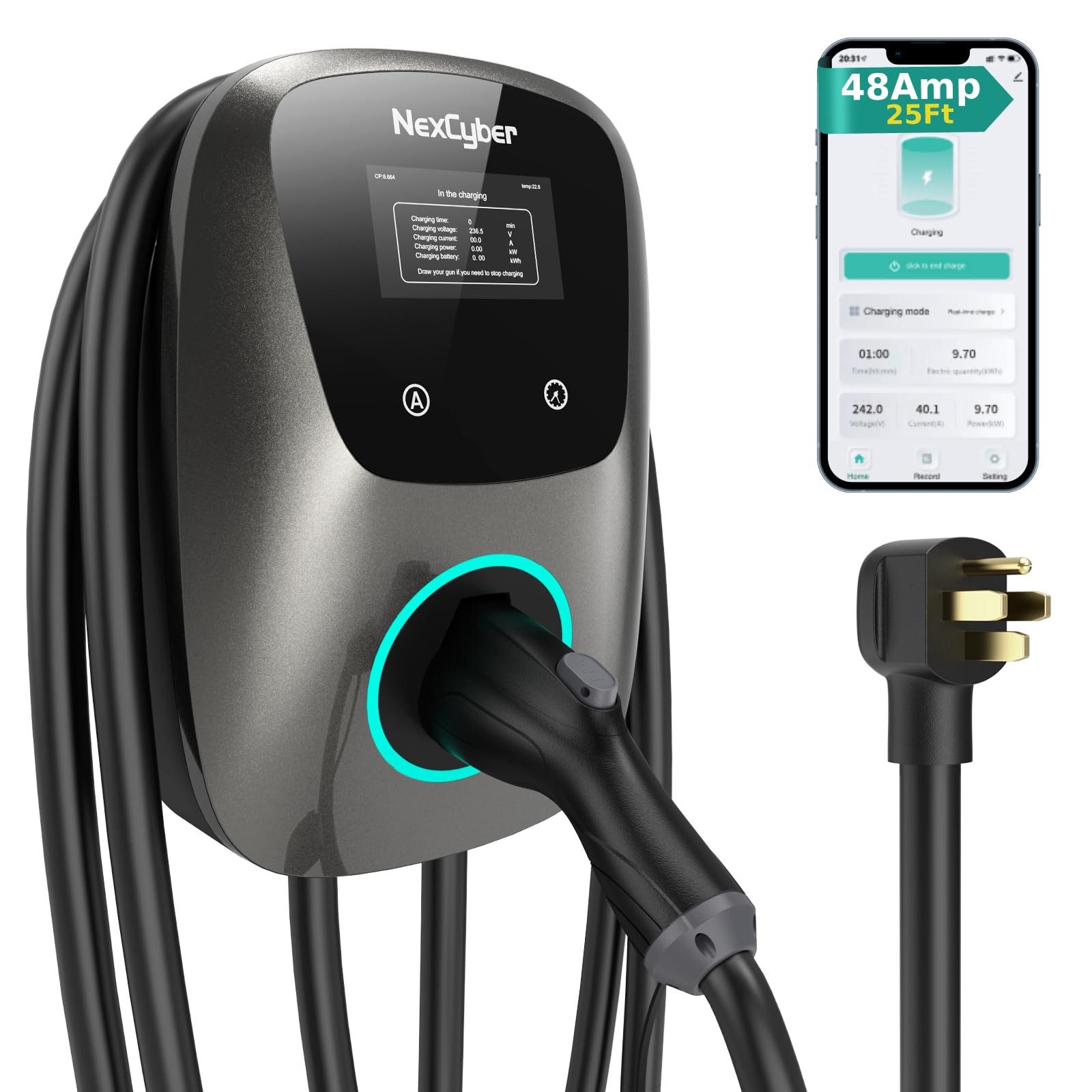
2. NexCyber Level 2 EV Charger 48A Nema 14-50p, 25ft Cable
The plug-in workhorse that gives you app control and a 48-amp ceiling without hardwiring.
from the start it supports 40 amps via the NEMA 14-50 plug, delivering about 38 miles of range per hour, and you can push it to 48 amps if you choose to hardwire it later. The J1772 connector works with virtually all non-Tesla EVs in North America, and a simple adapter covers Tesla models. A built-in touch screen shows amperage, charging speed, input voltage, and delay time right on the unit, so you do not even need the app for basic adjustments. One reviewer who runs it at 42 amps reports charging in under 3 hours with noticeably less heat than at full 48 amps.
The WiFi app lets you monitor charging cost, view history, and set off-peak schedules, though a few reviewers mention the app feels basic compared to premium competitors. At 8AWG the included cable handles up to 48 amps, and the unit carries ETL, FCC, and Energy Star certifications for safety. The NEMA Type 3 rating provides reasonable weather protection (similar to IP65), but the manufacturer recommends against direct sun or rain exposure, so mounting it under a covered carport or inside a garage is the best placement.
Where it shines: The option to use it as a plug-in or hardwire, combined with app scheduling and a clear on-unit display, gives you most premium features at a significantly lower cost than the Autel or ApexCharger options.
The catch: The E-stop button can trigger false faults if accidentally pressed, and the accompanying WiFi setup process can be finicky on certain routers.
Reach for this if: You drive a J1772 EV, want smart charging features without spending premium money, and might want to upgrade to hardwired 48-amp speeds later.
skip it if: You need a polished, feature-rich app experience with smooth ecosystem integration — this one is functional but not luxurious.
3. Lectron Level 2 EV Charger — 40 Amp, NEMA 14-50 Plug, 16 ft Cable
The no-fuss charger that skips the app and just delivers power reliably.
This unit delivers up to 240 volts, 40 amps, and a 9.6 kW charging rate, which roughly translates to a full charge for most EVs in about 3 to 5 hours depending on battery size. The NEMA 14-50 plug lets you connect directly to a standard 240-volt RV or dryer outlet, making it a true portable option that travels easily between home, a vacation rental, or a relative’s garage. Its IP65 rating means it resists dust and water splashes, and the thick cable survived one reviewer accidentally running over it without damage. Buyers report charging from 60% to 100% in about 3 hours with no app or screen required — just plug it in and walk away.
The trade-off is the cable length: at 16 feet, it is shorter than most competitors (the EVDANCE and WOLFBOX both offer 25 feet), so you need to park closer to the outlet. Some owners noted that the prongs can oxidize if the charger sits unused for months, though Lectron’s customer service replaced those units without hassle. This charger is ETL and Energy Star certified and carries UL2594 safety certification, so it meets the requirements for most utility rebate programs.
Best feature: It is the simplest Level 2 option on the list — no WiFi pairing, no account creation, just plug-in and charge at the full 9.6 kW rate.
The compromise: The 16-foot cable forces a tight parking position, and the lack of smart scheduling means you cannot automatically charge during off-peak rate windows.
Perfect for: Someone who wants a reliable, take-anywhere Level 2 charger for occasional use, such as at a second home or a rental property.
Not ideal for: Daily home use where a longer cable and app-based scheduling would save you money and hassle.
4. EVDANCE Level 2 EV Charger for Tesla — 40A, NEMA 14-50 Plug, 25ft Cable
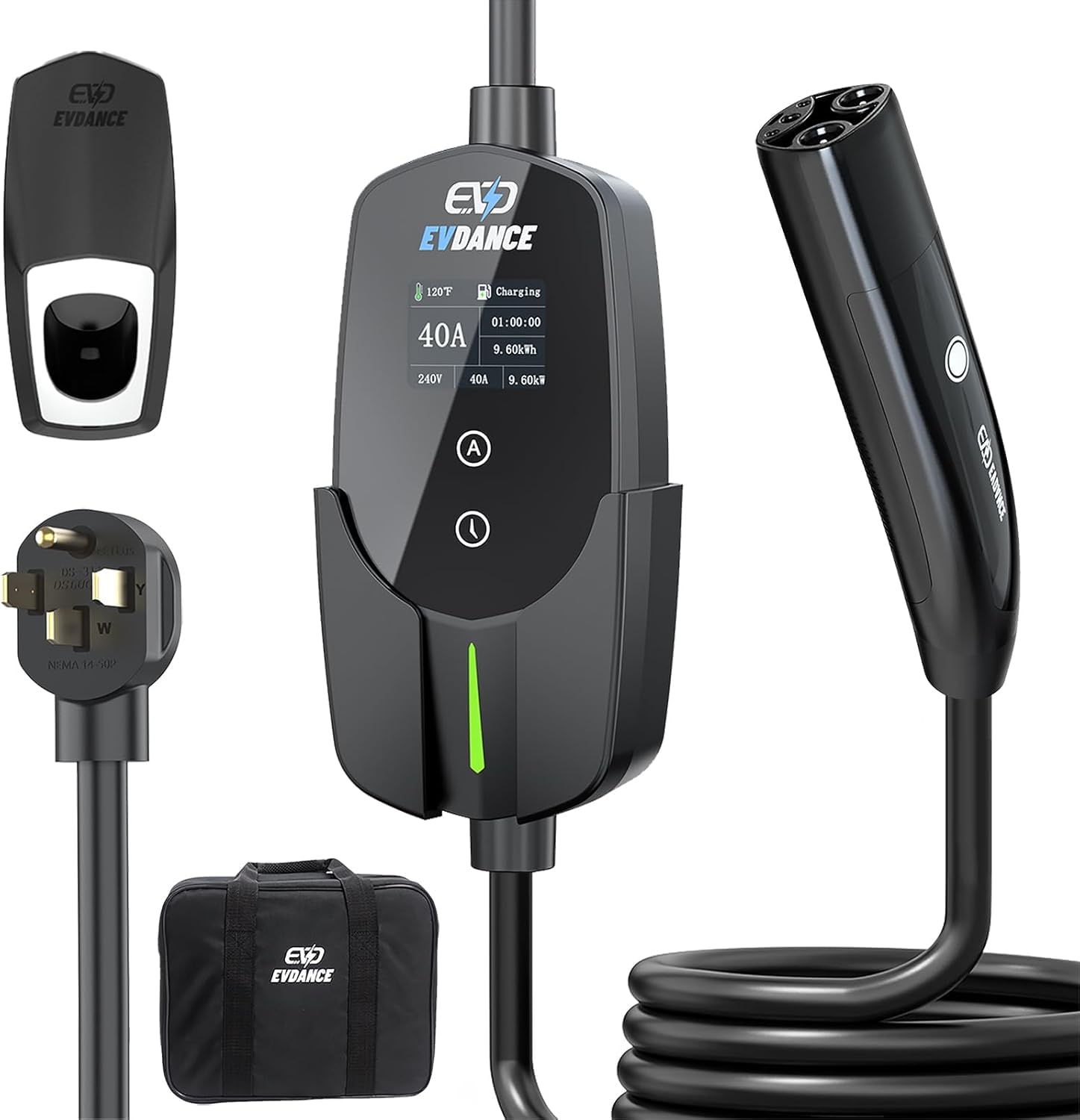
A travel-friendly Tesla charger with a generous cable and an informative display screen.
Rated for 40 amps and 9.6 kW via a NEMA 14-50 plug, the EVDANCE supports adjustable charging current in six steps from 10A up to 40A, helping you match the speed to your circuit capacity and avoid tripping breakers on older wiring. The native NACS connector works on any Tesla Model 3, Y, S, or X without an adapter, and the built-in button on the connector opens the Tesla charge port wirelessly — no fumbling for a key fob or phone. The 2.4-inch TFT display shows voltage, amperage, kWh delivered, and estimated charging time in real time, so you always know exactly what is happening.
One reviewer noted the cable is thicker than Tesla’s own mobile connector, and they appreciate that the unit stays cool even at 40 amps on a 50-amp breaker. The IP66 waterproof rating lets it handle extreme weather from minus 22°F to 122°F, and the included carry bag, cable holder, and control box holder make it convenient to pack for road trips. Unlike the Lectron charger, this one includes delayed charging (1 to 12 hours) to take advantage of off-peak electricity rates, though there is no WiFi app — all settings are managed through the display and buttons on the unit itself.
Why it stands out: The 25-foot cable and carry-bag-friendly design make this the best pure-portable option for Tesla drivers who want full Level 2 speeds at home and on the road.
What it lacks: No WiFi app for remote monitoring, cost tracking, or scheduling — you manually set the delay timer every time.
Grab this if: You own a Tesla, drive frequently between locations with NEMA 14-50 outlets, and want a sturdy portable charger without paying the premium for the Tesla brand name.
Pass if: You want a permanent wall-mounted unit with full smart app integration and remote control.
5. IYILO Level 2 EV Charger — 48A/11.5kW, J1772 Hardwired
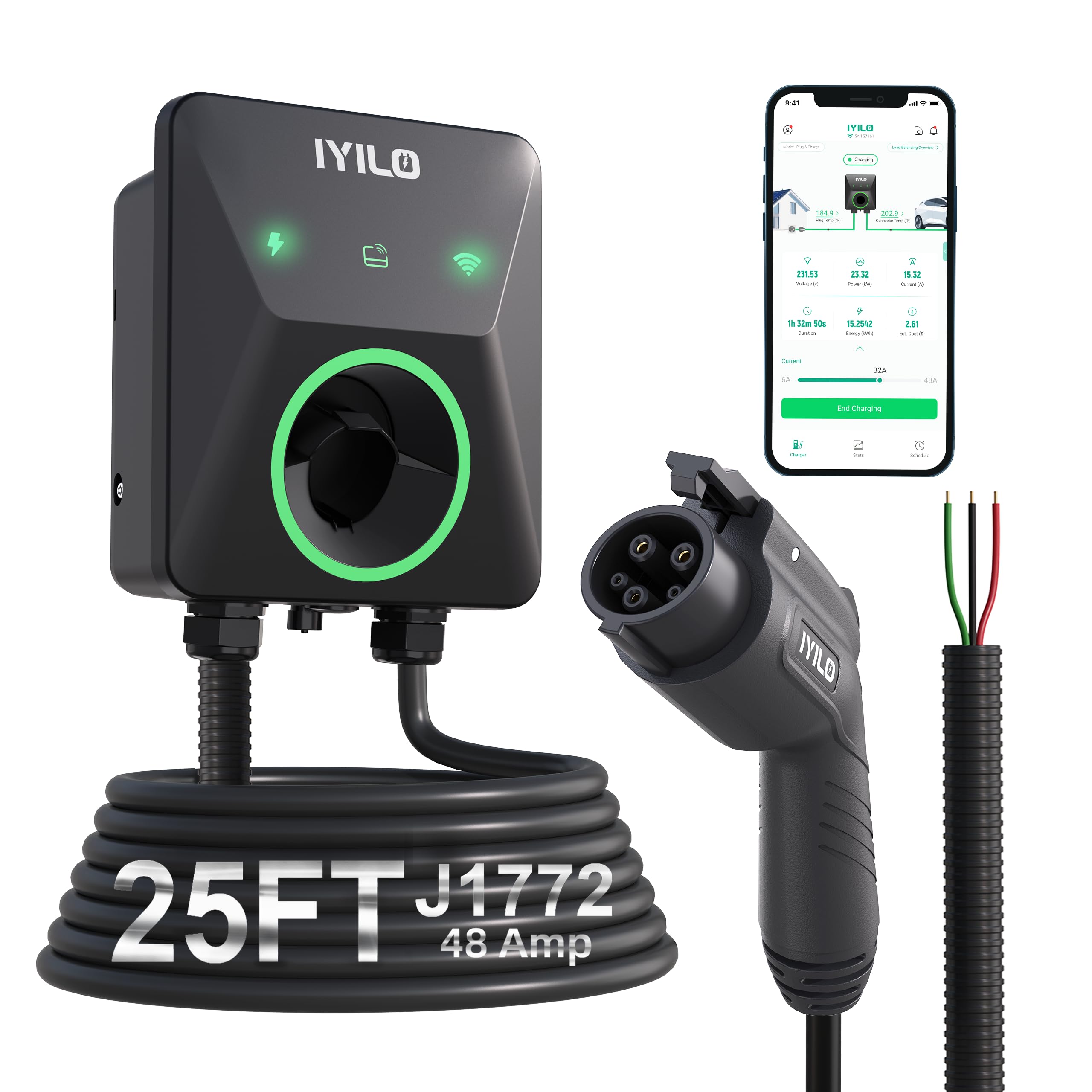
The charger that tracks connector temperature in real time and shuts down before damage occurs.
Delivering up to 48 amps (11.5 kW) via a hardwired 60-amp circuit, the IYILO adds up to 46 miles of range per hour. what separates it is the NTC temperature sensor built into the J1772 connector itself — the app shows the live temperature graph, and if the connector hits 221°F, the system automatically stops charging to protect both the handle and your vehicle’s charge port. One reviewer resolved a cycling on/off issue with certain Hyundai and Kia E-GMP cars after a simple firmware update pushed through the app.
Beyond temperature protection, it supports Power Sharing so two units can operate safely on a single circuit breaker without overloading, plus dynamic load balancing with an optional energy meter. The app handles time-of-use scheduling, RFID card access, and remote firmware upgrades. The 25-foot cable is notably flexible even in cold weather, and the NEMA 4 metal-bodied enclosure keeps it weatherproof for outdoor mounting. Unlike the EVIQO, which also hardwires at 48 amps, the IYILO includes the J1772 connector and adds the overheat safety layer that other brands do not offer at this price tier.
The standout feature: The connector temperature sensor with auto-shutdown is genuinely unique at this price point — no other charger in the same range offers live thermal graphing and automatic power reduction.
The downside: The build quality feedback is mixed — one unit arrived with scratches in the cable and a missing installation kit, suggesting quality control could be tighter.
Buy this if: Safety is your top concern and you want a hardwired 48-amp charger that actively monitors connector temperature and offers power-sharing for future expansion.
pass on it if: You want a plug-in charger you can install yourself without an electrician, or if you need a more polished out-of-box experience based on early owner reports.
6. WOLFBOX Level 2 EV Charger — 40A, NEMA 14-50, J1772

The plug-in charger with a bright 4.3-inch screen and voice control that makes charging data easy to read at a glance.
Operating at 40 amps on a standard NEMA 14-50 outlet and a 50-amp breaker, the WOLFBOX E40 adds about 38 miles of range per hour. The large color LCD display shows charging rate, elapsed time, voltage, and total kWh delivered, so you never need to open an app just to check progress. It also works with Alexa and Google Assistant for hands-free status checks, and it supports login via Google account for easy sharing among family members — unlike the Lectron or EVDANCE chargers which require manual adjustments at the unit.
The housing carries a NEMA 4X rating, meaning it is fully sealed against water jets, snow, and ice for outdoor mounting. Each unit comes with two RFID cards, so you can authorize specific friends or family members to charge without giving them app access. One reviewer pointed out that the time-of-use scheduling must see a plug-in event within the defined window — if you unplug and replug outside that window, the schedule resets. The 25-foot cable provides enough slack for most parking configurations, and the rubberized NEMA plug creates a secure grip in the outlet.
What makes it different: The large 4.3-inch display is the biggest and most readable screen in this roundup, and the voice assistant integration is rare among J1772 chargers at this price tier.
The flaw: The WiFi setup process can be unreliable, and one owner reported that RFID authorization stays active even after charging ends, which could lead to accidental follow-up charges.
Best for: Someone who wants a bright display for quick charging status checks, voice control convenience, and the security of RFID authorization in a shared driveway.
Not for: Anyone who needs rock-solid scheduled charging that works perfectly without an internet connection — its time-of-use logic has limitations.
7. ApexCharger MACH 1 — 48A Level 2 EV Charger, 30ft Cable, J1772 + NACS
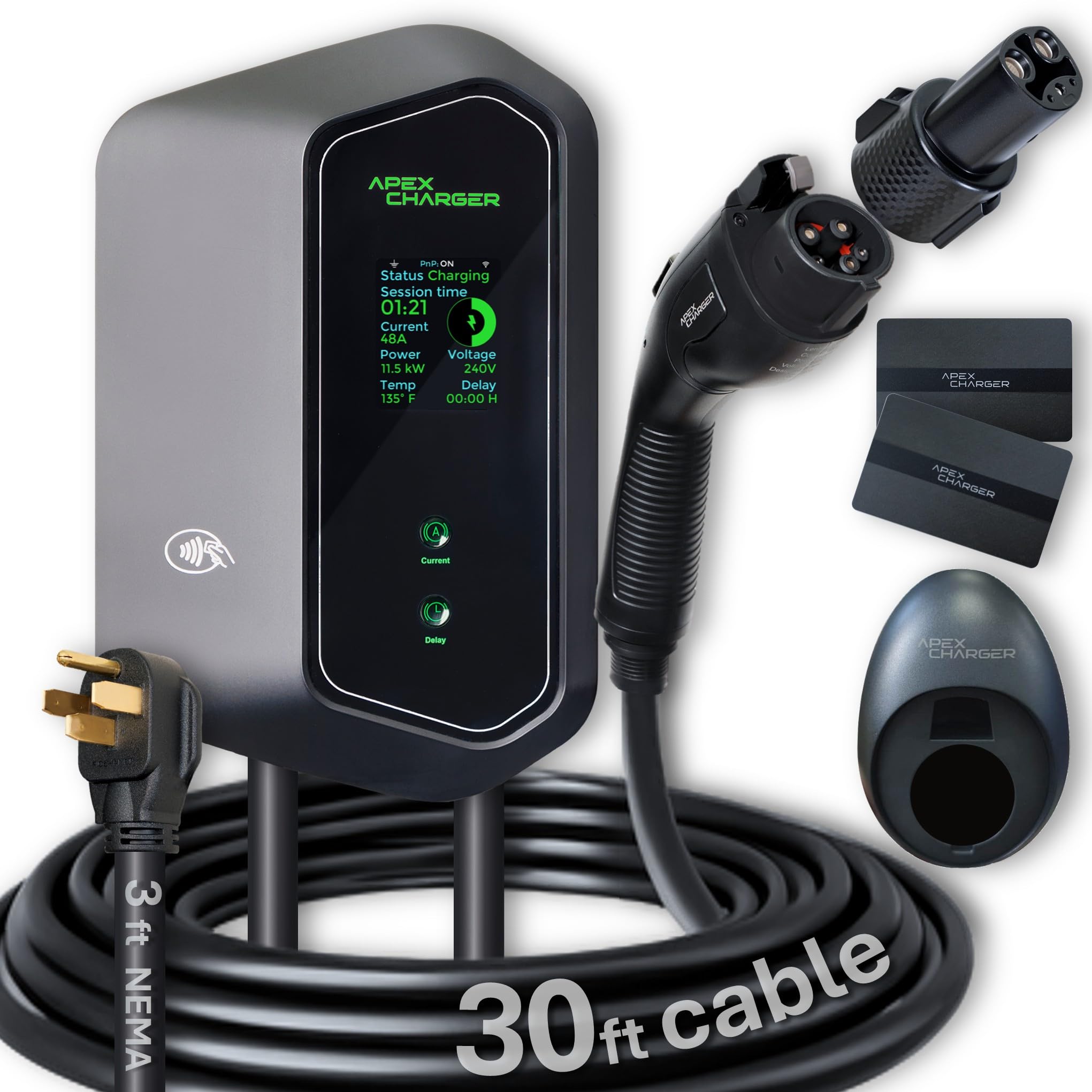
The longest cable and both connector types in the box let you serve any EV in your household.
At 30 feet, the MACH 1’s cable is the longest in this lineup, making it the most flexible choice for large garages, awkward parking positions, or outdoor charging where the outlet is far from the vehicle. It comes with both a J1772 connector and the PRO 1 NACS adapter (included in the box), so one charger handles any electric car currently sold in North America — no additional purchase needed. The unit supports 40 amps via the NEMA 14-50 plug or the full 48 amps when hardwired to a 60-amp breaker, giving you the same installation flexibility as the NexCyber model above.
The 2.4-inch LED display shows charging data at a distance, and the Bluetooth/WiFi app handles scheduling and monitoring. Two RFID cards are included for controlled access, and the charger carries ETL and Energy Star certifications. Reviewers consistently praise the customer support team — one owner got a Sunday-night response within an hour after a storm triggered an overheating error. The anti-theft bolt and mounting hardware are included, so the unit stays secure on the wall mount outdoors.
The biggest advantage: The 30-foot cable and the included NACS adapter make this the most versatile charger for multi-EV households, especially when the cars use different connector standards.
The limitation: The time-of-day scheduling feature had a bug that caused the charger to start at the scheduled time rather than staying active within the full window — an update fixed the worst of it, but individual day selection is still missing.
Choose this if: You need a long cable to reach across a wide driveway, or you own both a Tesla and a J1772 vehicle and want one charger to cover both.
Look elsewhere if: You want a clean, simple user interface for time-of-use programming — this one still has rough edges in scheduling logic.
8. Autel Level 2 EV Charger 40 Amp — NEMA 14-50 Plug, Dark Gray
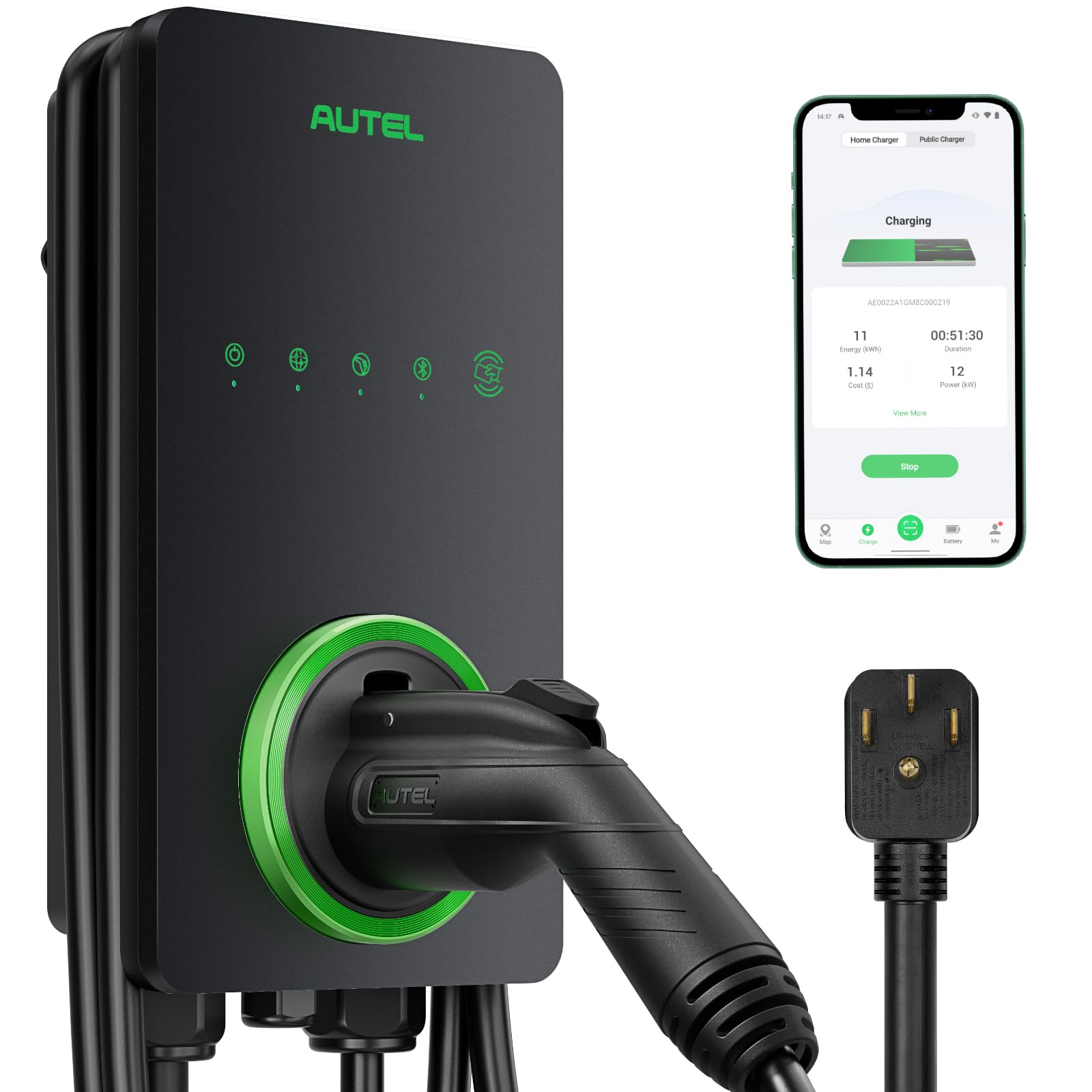
A respected brand’s plug-in charger that balances sophisticated software with a simple 5-minute wall mount.
Autel has been a major name in automotive diagnostics since 2004, and the MaxiCharger AC Home reflects that engineering background. Plug it into a NEMA 14-50 outlet, mount it on the wall bracket, and you are charging at up to 40 amps with no electrician involved. The Autel Charge app lets you adjust power in 1-amp increments from 16A all the way down to 6A — finer control than most competitors offer — so you can dial in exactly the speed your home’s circuit can handle safely. Buyers who own their seventh EV call it the best Level 2 charger they have used, praising the clean design and the way the unit slows its charging rate near the end of the cycle to prevent battery overheating.
The NEMA 4X rating is the highest weatherproofing standard in this roundup — dust-tight, water-tight, and resistant to ice and corrosion, making it suitable for fully exposed outdoor installation. One minor frustration: you must remove multiple covers inside the unit to set the maximum amperage below 40 amps, which is an awkward step if your home circuit cannot support the full 40 amps. The included 25-foot cable is thick but flexible, and the built-in side holster keeps the connector tidy without an extra accessory. Unlike the two Autel models on this list, the 40-amp version uses a plug, so moving it to a new home is straightforward.
Why it is worth the premium: Autel’s app is among the most polished in the category, with real-time cost tracking, 1-amp granularity, and over-the-air updates that keep the charger current for years.
The gotcha: RFID and scheduling features are locked behind the app setup, and the internal amperage limiter mechanism is needlessly complicated compared to on-screen settings on cheaper units.
Get this if: You want a premium plug-in charger with excellent app support, weatherproof build, and fine-grained current control from a brand with deep automotive credibility.
Pass if: You need a hardwired 48-amp charger for the fastest possible speeds — the 40-amp plug-in version tops out at 9.6 kW.
9. Autel Level 2 EV Charger 50 Amp — Hardwired, J1772

The highest-rated amperage charger in this guide, hardwired for the fastest possible home charging speeds.
This is the only charger on the list rated at 50 amps, delivering up to 11.5 kW of power (matching the IYILO in real-world output) and compatible with any J1772 EV or plug-in hybrid. It requires hardwired installation on a 70-amp dedicated breaker. Through the Autel Charge app, you can adjust current from 3 amps all the way up to 50 amps in 1-amp steps — the widest range of any unit here. One owner running a 2020 Ioniq EV sees about 5.5 kW at 48 amps, adding 26 to 28 miles of range per hour for a full charge in roughly 6.5 hours. A reviewer with a 2023 Ioniq 6 SEL reported charging at 11.2 kW with no issues after three years of daily use, underscoring the reliability.
The hardwired only design means it is a permanent fixture — there is no plug to disconnect and take with you on a road trip, which limits portability compared to the Autel 40-amp plug-in model. The NEMA 4X rating is identical to the 40-amp version, so outdoor mounting is fully protected. The unit includes Bluetooth, WiFi, Ethernet, CAN, and RS485 connectivity options, making it the most network-flexible charger in the guide. Some buyers found the lack of a charge-abort button in the app frustrating, and the included installation manual lacks detail on the power limit dial settings (though you can find those online).
Where it leads the field: At 50 amps with 1-amp adjustability from 3A to 50A, this charger gives you more control over current than any other unit here, and Autel’s track record with long-term reliability is well-documented across owner reviews.
The drawback: Hardwired-only installation locks you into a permanent setup — you cannot take it to a new home without an electrician visit, unlike the plug-in Autel 40A or the EVDANCE portable options.
Ideal for: Someone who plans to stay in their home for years, drives an EV that can accept 48 to 50 amps, and wants the absolute fastest home charging speed with premium app support.
Avoid if: You rent, move frequently, or want a charger you can pack in your trunk for road trips — a plug-in model like the EVDANCE or Lectron makes more sense.
Understanding the Specs
Amperage and Charging Speed
The amperage rating (measured in amps) determines how fast your battery fills. A 40-amp charger running on a 50-amp breaker delivers about 9.6 kW of power, which adds roughly 30 to 38 miles of range per hour for most EVs. Stepping up to 48 amps requires a hardwired 60-amp circuit and pushes the charging rate to about 11.5 kW, which translates to around 46 miles per hour. The 50-amp Autel MaxiCharger gives you the same hardwired requirement but can feed up to 12 kW if your car supports it — only a few EVs currently accept that rate.
Plug-In vs. Hardwired
A plug-in charger (NEMA 14-50) connects to a standard 240-volt outlet, just like an electric range or RV hookup. It is easy to install yourself and you can take it with you when you move. However, most plug-in chargers are limited to 40 amps because the 14-50 outlet and breaker pair are typically rated for 50 amps total, leaving a safety margin. Hardwired chargers bypass the outlet and connect directly to the breaker panel, so they can safely draw 48 to 50 amps. The trade-off is that you need a licensed electrician for installation, and removing the unit later means cutting the wiring.
FAQ
Can I install a Level 2 charger myself?
What is the difference between J1772 and NACS connectors?
How long does a Level 2 charger last?
Will a 48-amp charger work if my house has a 50-amp breaker?
Can I use a Level 2 charger outdoors?
What size cable do I need for a 48-amp hardwired charger?
How do I know if my EV can accept 48 amps?
Do utility companies offer rebates for Level 2 chargers?
What is the difference between 40A and 48A in real-world charging time?
Can I use an extension cord with a Level 2 charger?
Final Thoughts: The Verdict
For most homeowners, the home level 2 charger that balances speed, smart features, and build quality is the EVIQO NACS Charger for Tesla because it offers a full 48-amp output, native NACS compatibility, a reliable app, and IP66 weatherproofing at a price that undercuts premium brands. If you drive a J1772 EV and want plug-in convenience with app control, grab the NexCyber Level 2 EV Charger. And if connector safety monitoring and load-sharing for multiple EVs matter most, the IYILO Level 2 EV Charger delivers unique temperature protection that no other charger at this price point matches.
How We Picked
We do not accept paid placement. Every pick is matched to a real buyer and a real use-case; we do not hands-on test units.
Sources & Methodology
Specifications: manufacturer listings and product documentation. Review insights: verified customer reviews, as of July 2026. Pricing: not shown on this page (it changes often); check the current price via the retailer link.
As an Amazon Associate, Trending Car earns from qualifying purchases. This does not affect which products we feature.