
Our readers keep the lights on and my garage snacks stocked. As an Amazon Associate, I earn from qualifying purchases.
Specs are compiled from manufacturer listings and verified buyer reviews and can change over time — please confirm the key details on the product page before buying.
The biggest decision for a new EV owner isn’t the car—it’s how you’ll feed it at home. A standard wall outlet adds only a few miles of range per hour, which is painfully slow for daily driving. This guide cuts through the jargon to help you pick a Level 2 (240-volt) charger that matches your car, your electrical panel, and your budget.
I’m Min Islam — the founder and writer behind Trending Car. This guide is built by comparing the manufacturers’ published specifications and the patterns across verified customer reviews, so you get each pick’s real strengths and trade-offs instead of marketing spin.
Whether you drive a Tesla with a NACS port or a J1772-equipped EV, finding the right home ev charger means balancing charging speed, smart features, and installation complexity to fit your daily routine.
Our Picks at a Glance

How To Choose The Best Home EV Charger
Before you pick a charger, check your home’s electrical setup—it matters more than the specs. Plug a 48-amp charger into a circuit that can’t handle it, and you’ll trip breakers and waste money. So think about the amperage (how much power it draws), the plug style (what outlet it needs), and if you want an app to control it.
Match the Amps to Your Breaker
A charger’s amperage rating tells you how fast it can push power, but your home’s breaker must support it. A 40-amp charger typically runs on a 50-amp breaker, while a 48-amp unit needs a 60-amp breaker. Hardwired connections often let you hit the max amperage, while plug-in models like NEMA 14-50 are usually capped at 40 or 48 amps for safety.
Quick Comparison
| Model | Best For | Amperage | Connector | Installation | Amazon |
|---|---|---|---|---|---|
| EVIQO NACS 40A★ Best Overall | Tesla owners wanting plug-in ease | 40 A | NACS | Plug-in (14-50) | Amazon |
| VEIPHLOX J1772Best Value | Budget-friendly J1772 owners | 40 A | J1772 | Plug-in (14-50) | Amazon |
| NexCyber 48ATop Performer | J1772 owners who want a display | 48 A | J1772 | Plug-in (14-50) | Amazon |
| WOLFBOX E40 | Smart features and RFID control | 40 A | J1772 | Plug-in (14-50) | Amazon |
| ApexCharger MACH 1 | Both NACS and J1772 households | 40 A | J1772 + NACS | Plug-in or Hardwire | Amazon |
| WOLFBOX E48 | High-speed 48A hardwired installs | 48 A | J1772 | Hardwired | Amazon |
| Autel MaxiCharger 40A | Reliable brand with adjustable amps | 40 A | J1772 | Plug-in (14-50) | Amazon |
| EMPORIA 48A | Energy monitoring enthusiasts | 48 A | J1772 | Hardwired | Amazon |
| ChargePoint HomeFlex | Tesla owners wanting network access | 50 A | NACS | Hardwired | Amazon |
| Autel AC Elite 50A | Fast 50A hardwired charging | 50 A | J1772 | Hardwired | Amazon |
In‑Depth Reviews
1. EVIQO Level 2 EV Charger NACS 40A
Our pick — over 4.5★ from 300+ verified ratings; the strongest balance of quality and price.
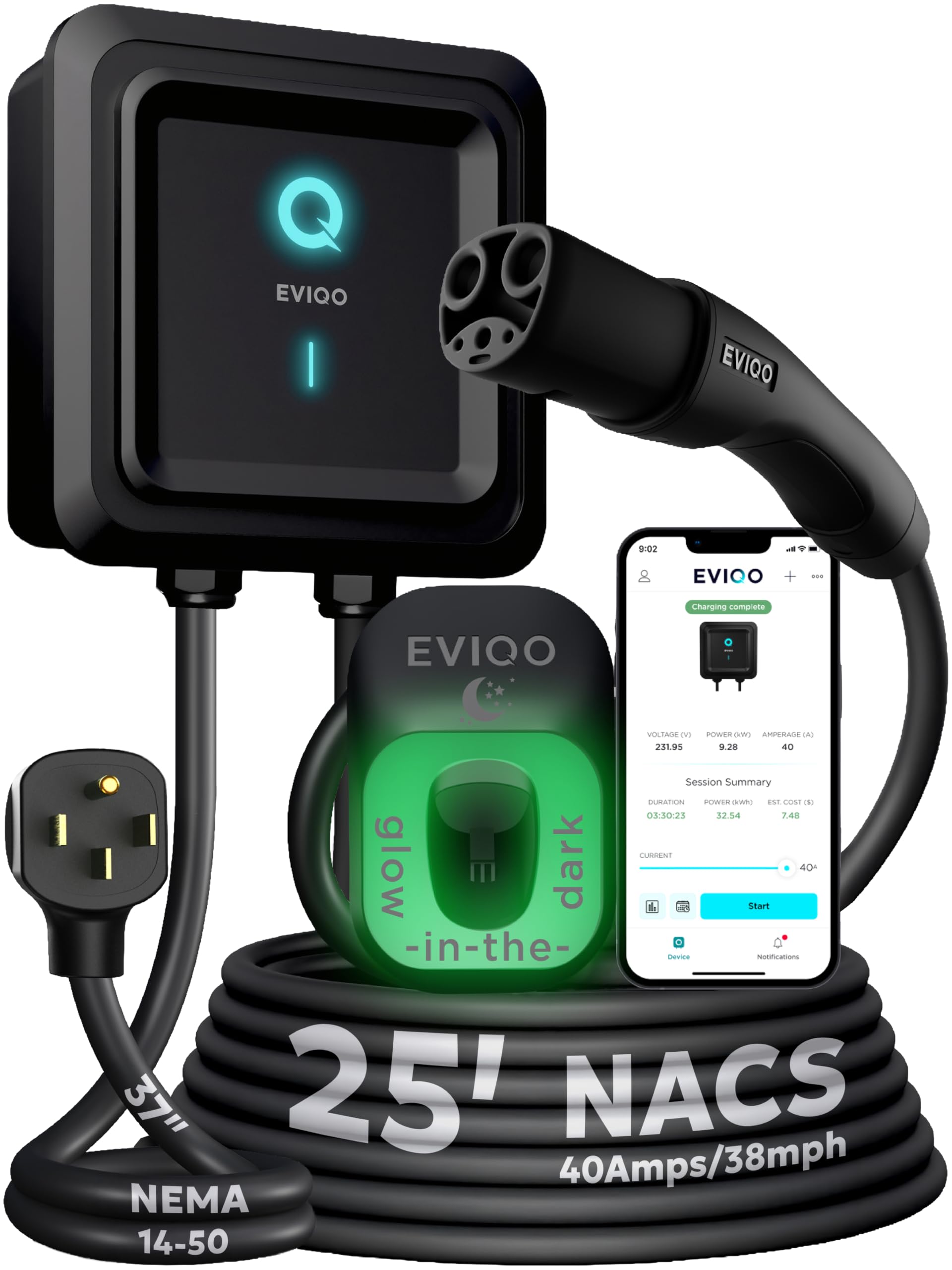
Tesla drivers get a smooth plug-in experience here, thanks to a native NACS connector (the Tesla-style plug) and a 25ft cable that reaches your port without stretching.
If you drive a Tesla, this is the charger that fits without any adapter gymnastics. It uses a native NACS connector (the Tesla-style port) for Model S, 3, X, and Y, and even has a built-in button on the connector to pop open your Tesla’s charge port. It pumps out a max of 40A on a dedicated 50A/240V circuit, which most owners say fully recharges their EV overnight.
The smart app is where this one shines. You can control start/stop, adjust the current from 6-40A, and track consumption and cost right from your phone, as long as it’s on a 2.4 GHz WiFi network. Owners routinely mention charging in 5-7 hours and appreciate the adjustable amperage for matching their home’s capacity. The build quality gets constant praise, especially the heavy-duty cable and high-quality connectors.
The 19.81-pound unit is built tough with an IP66/NEMA-4 weatherproof enclosure, so it’s happy mounted outdoors in rain or snow. It’s also UL, ETL, and Energy Star certified, and comes with a 3-year warranty. The fluorescent holster is a thoughtful touch—it absorbs light and glows in the dark, making the connector easy to find at night.
Why It Wins
- Native NACS connector for Tesla, no adapter needed
- Smart app with adjustable 6-40A current
- IP66 weatherproof for outdoor mounting
- 25ft cable with easy reach
Consider This
- For non-Tesla EVs, you’ll need a NACS-to-J1772 adapter (not included)
- Fully recharges most EVs overnight, but not the fastest 48A option here
Who It’s For: Tesla owners who want a straightforward plug-in charger with smart scheduling and a tough outdoor-rated shell.
The Trade-off: If your home has a J1772 vehicle, plan on buying a separate adapter to make this work.
2. VEIPHLOX J1772 Level 2 EV Charger 40 Amp
The no-frills, budget-friendly workhorse that skips the app and just gets the job done.
This is the charger for people who don’t want another app on their phone. It uses a simple plug-and-charge design—no complex configurations, no WiFi setup, just plug in your J1772 vehicle and go. The 40A/9.6kW max output from a NEMA 14-50 outlet delivers fast, reliable charging, and buyers report the plug stays cool even after 3 hours of Level 2 charging.
Weighing in at 15 pounds, it’s noticeably lighter and more compact than the EVIQO unit, with dimensions of 18.5 x 8.66 x 14.17 inches. The build quality feels premium, and the 25ft cable is long and flexible. It’s UL-certified with an IP65/NEMA 5 waterproof and dustproof housing, so it handles outdoor installation without worry.
Instead of a screen, it uses color-coded indicator lights—red for emergency stop, blue for ready, flashing green for charging, and solid green when done. The internal cord-holding design means you store the cable right on the unit, keeping your garage tidy without an external holster. Many owners describe it as looking like “a futuristic gas pump” and call it excellent value.
Simple and Solid: This is a dependable, no-app charger that delivers the promised 40A, with the only real compromise being the lack of smart scheduling features.
Reach for This If: You want the lowest-fuss, most reliable way to charge a J1772 EV and prefer a clean, uncluttered design.
Look Elsewhere If: You rely on an app for off-peak scheduling or need Tesla’s native NACS connector.
3. NexCyber Level 2 EV Charger 48A WiFi
A fast 48A charger with a built-in touch screen that works with or without its app.
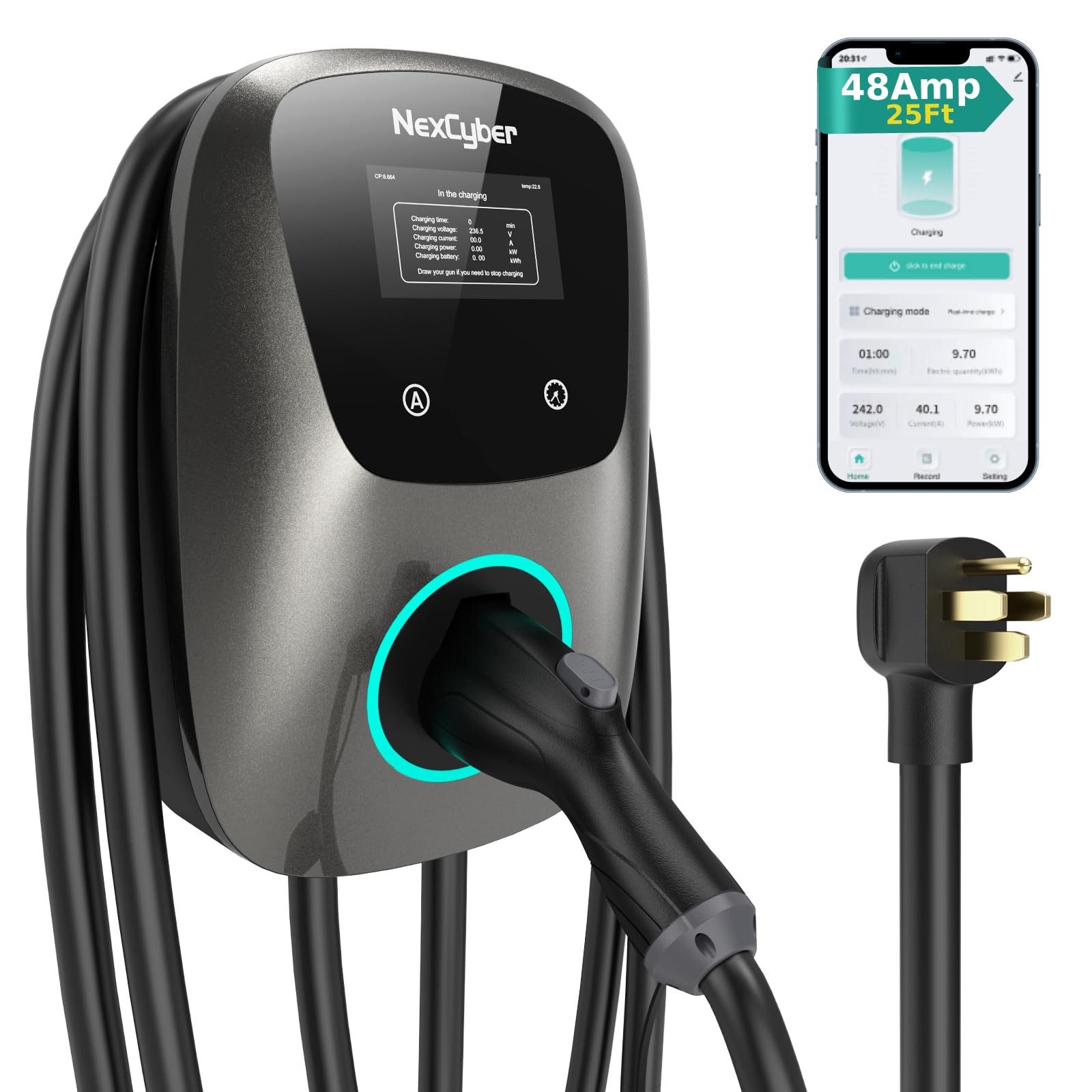
This charger gives you the best of both worlds: you can use the simple plug-and-play default mode with its smart touch screen, or connect to the WiFi app for full remote control. The screen clearly shows your charging amperage, speed, input voltage, and any delay time. You can adjust the amperage from 16A to 48A directly on the device, which owners find very handy.
At 48A via a hardwired connection, it delivers up to 46 miles of range per hour—about 9x faster than a standard wall outlet. If you’re using the NEMA 14-50 plug instead, the max drops to 40A for about 38 miles per hour. The 48A output makes it a clear step faster than the 40A EVIQO pick, and owners note it can complete a charge in about 2.5 hours in some cases.
The build quality is consistently praised as solid with heavy-duty electric cables. The 25ft cable is military-grade and drop-resistant, rated to endure over 10,000 charges. It’s ETL and FCC certified with a NEMA Type 3 protection degree and a 3-year warranty. The app lets you wirelessly check charging cost, history, and get fully-charged notifications, though a few owners mention the app interface could be more polished.
Standout Features
- 48A max output (46 mi/hr hardwired)
- On-device touch screen for no-app control
- Adjustable 16-48A amperage
- Comes with a carry handbag
Keep in Mind
- J1772 only—Tesla requires an adapter (not included)
- App interface is functional but not the most refined
Who It Beats: Anyone choosing between this and the WOLFBOX E40 gets more raw speed (48A vs 40A) for comparable money.
Who It’s Not For: Drivers who want a completely app-free experience will still see the screen, but Tesla owners need to factor in an adapter.
4. WOLFBOX Level 2 EV Charger 40A E40

A 40A charger that adds RFID card control and a 4.3-inch display for a premium smart-home feel.
This WOLFBOX unit is for the owner who wants control options. It includes an RFID card that can start and stop charging sessions, which is perfect for letting guests charge without handing over your phone. Some owners actually prefer the RFID card over the app because it’s quicker and doesn’t require pairing. The 4.3-inch LCD screen shows your charging rate, time, voltage, and charged amount at a glance.
It delivers 38 miles of range in one hour at 40A, which is about 7x faster than a Level 1 charger. The smart app supports scheduling for off-peak rates, real-time monitoring, and even integrates with Alexa and Google Assistant for voice control. Owners note it can cut a PHEV charge time from 12 hours down to 3.5 hours.
For a 40A plug-in charger, it’s a lightweight 13.49 pounds with compact dimensions of 12.68 x 7.43 x 4.72 inches. It’s CSA certified, meets UL safety standards, and uses a NEMA 4X waterproof housing with a 25ft premium cable. The recurring feedback is that it’s a reliable, solidly built unit that works perfectly as a basic charger, with the advanced features (like WiFi setup) having a slight learning curve.
Control-Centric: Between the RFID card, the informative display, and voice assistant support, this is the most flexible charger here for a smart home setup.
Who It Suits: Households with multiple drivers or guests who want simple RFID access without app sharing.
The Catch: WiFi setup can be finicky initially, and the RFID card stays active until swiped off—a minor security note for shared/public spots.
5. ApexCharger MACH 1 48A
The turnkey choice for households with both Tesla and J1772 vehicles, thanks to its included adapter.
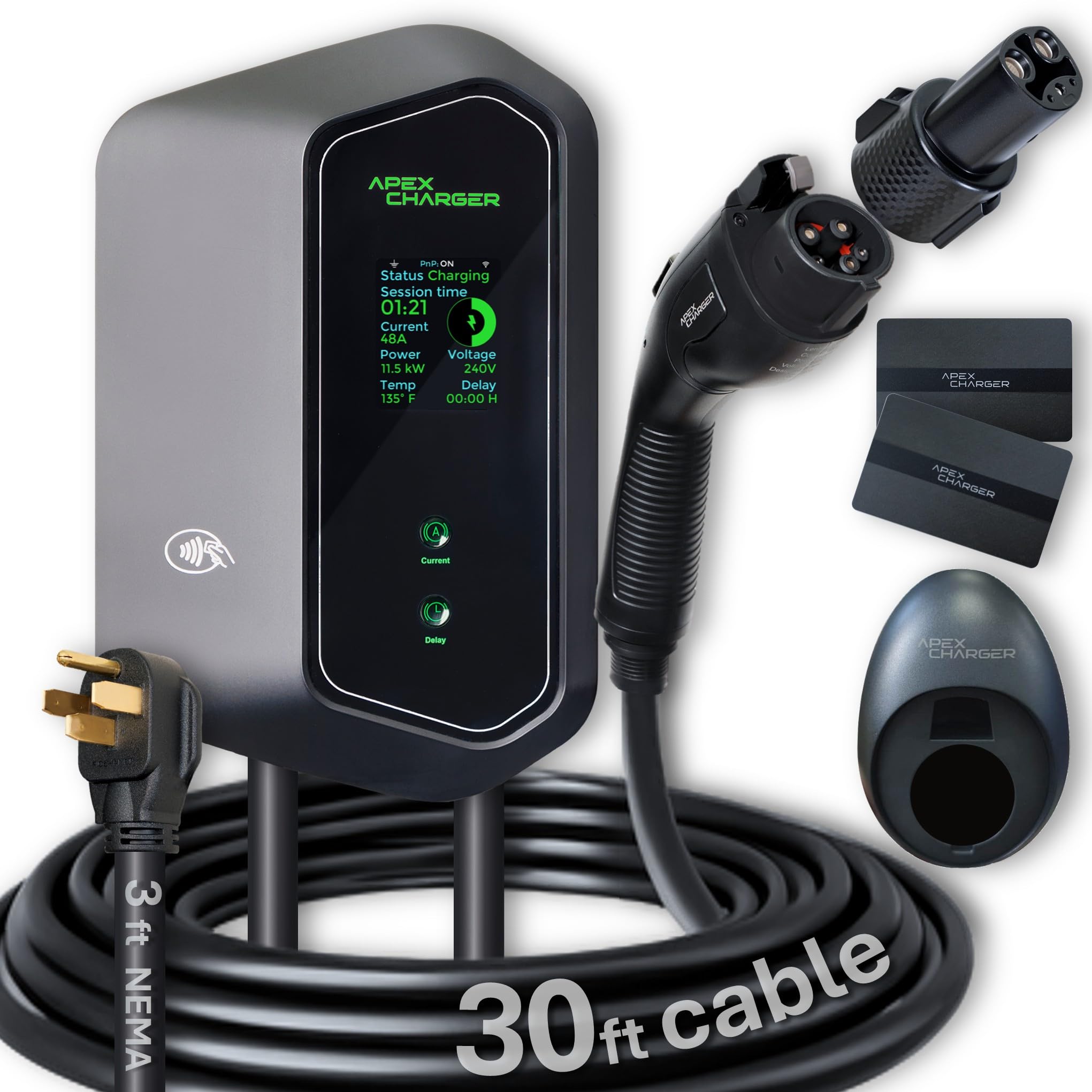
This is the one charger that genuinely works for every EV in America’s fleet right from the start. It includes a J1772 connector AND an exclusive PRO 1 NACS adapter for Tesla, both with a 30ft charging cable—the longest in this lineup. Whether you have a Model Y or an Ioniq 5, this unit has you covered without buying extra parts.
The MACH 1 is rated for 40A max when plugged into a NEMA 14-50 outlet with a 50A breaker, but can hit the full 48A if you hardwire it with the included kit on a 60A breaker. Owners mention the adjustable 0-48A charging works flawlessly, with one using it at 24A on a 30A outlet without issues. It’s rainproof and the 30ft cable gives you serious reach across a large garage.
This unit hugs the wall at 15 pounds and 3.15 x 6.72 x 10.35 inches, so it won’t stick out in your garage. The 2.4-inch LED display shows charging status at a glance, and Bluetooth/WiFi connectivity lets you control it from your phone. But what owners praise most is the customer support—one buyer had a “relay error” fixed via a firmware update after support diagnosed it remotely, and another got a same-hour Sunday evening response to an overheating error.
What Wins People Over
- Includes NACS adapter for Tesla + J1772 cable
- Longest cable here at 30ft
- Adjustable 0-48A for flexible electrical setups
- Responsive, praised customer support
Minor Gripes
- Time-of-day scheduling lacks individual day selection
- Max 48A requires hardwiring, not just plugging in
The Bottom Line: For mixed-EV households, this dual-connector approach saves you the cost and hassle of buying a second charger or adapters.
Think Twice If: You need granular day-by-day scheduling for complex off-peak utility plans.
6. WOLFBOX Level 2 EV Charger 48A E48

A 48A hardwired station that delivers 46 miles per hour, with the same smart WOLFBOX app and display.
If you’re ready to commit to a permanent hardwired installation, this WOLFBOX is a serious speed upgrade. At 48A, it provides 46 miles of range per hour—about 9x faster than a Level 1 charger. Owners with a 2025 Equinox EV report getting about 38 miles per hour in practice, with the cable staying warm but maxing out around 117°F. You’ll want a 60A breaker or greater for the full 48A output.
This model shares its 40A sibling’s features: a 4.3-inch LCD screen, RFID card control (tap a card to start charging), WiFi connectivity, and voice control via Alexa and Google Assistant. Owners say the app setup is simple and the display gives real-time data. It weighs 13.45 pounds and comes with a 25ft cable. The consensus is fantastic value—one owner called it “the best priced awesome charger,” noting the on-unit display shows details other chargers lack.
It’s CSA certified with a NEMA 4X waterproof housing, built for all-weather outdoor installation. The recurring feedback is positive on functionality and charger quality. One note: the included hardwire cable is on the shorter side, and a few owners found the app’s device selection confusing until they power-cycled the breaker during setup. WiFi connectivity on 2.4 GHz gets mixed feedback, so a strong signal is worth verifying.
Speed-Focused: For the money, this is one of the quickest ways to get true 48A hardwired charging with a full smart-feature set and a great display.
Reach for This If: You’re doing a permanent install, want the fastest home charging speed, and love seeing live data on a screen.
Look Elsewhere If: You rent or might move soon—a plug-in model would travel better than this hardwired unit.
7. Autel MaxiCharger Level 2 EV Charger 40A

Autel’s 40A plug-in charger pairs automotive-grade reliability with a flexible, cold-proof cable.
Autel has been building automotive diagnostic tools since 2004, and that engineering background shows in the MaxiCharger. It offers adjustable amperage settings (40A, 32A, 24A, 16A), giving you flexibility if your home circuit can’t handle the full load. Customers note it works great even on a 30-amp circuit, which makes it more forgiving of older electrical panels.
It delivers up to 40 miles of range per hour of charge at 240V. The updated 25-foot charging cable is designed to remain flexible “no matter the cold,” a real plus for unheated garages in winter. There’s also a longer 2.63-foot power cord to make installation into a pre-existing NEMA 14-50 receptacle easier. You can mount and dismount the plug-in unit in about 5 minutes.
The Autel Charge app is straightforward and lets you schedule charging for off-peak utility rates. Optional RFID card functionality can prevent unauthorized use. It’s NEMA 4X-rated, meaning it’s dust-tight and water-tight against windblown dust, rain, and even ice formation. Backed by a 3-year warranty and 24/7 customer hotline, owners describe it as a quality, great-looking unit with fast charging, noting the app allows fine adjustments down to 1-amp increments.
Pros
- Adjustable 40A/32A/24A/16A for flexible installs
- Cold-resistant 25ft cable
- NEMA 4X weatherproof rating
- Trusted automotive brand with 3-year warranty
Cons
- Multiple covers needed to adjust amps below 50
- App is less refined than some rivals
Who It’s For: Buyers who want a dependable, adjustable plug-in charger from an established name in automotive tech.
The Trade-off: If you live in a very cold climate, the flexible cable is a real perk, but the app experience feels a step behind WOLFBOX or Emporia.
8. EMPORIA Level 2 EV Charger 48A
The energy-tracking champion for hardwired 48A installs, with a full charge in 4-5 hours.
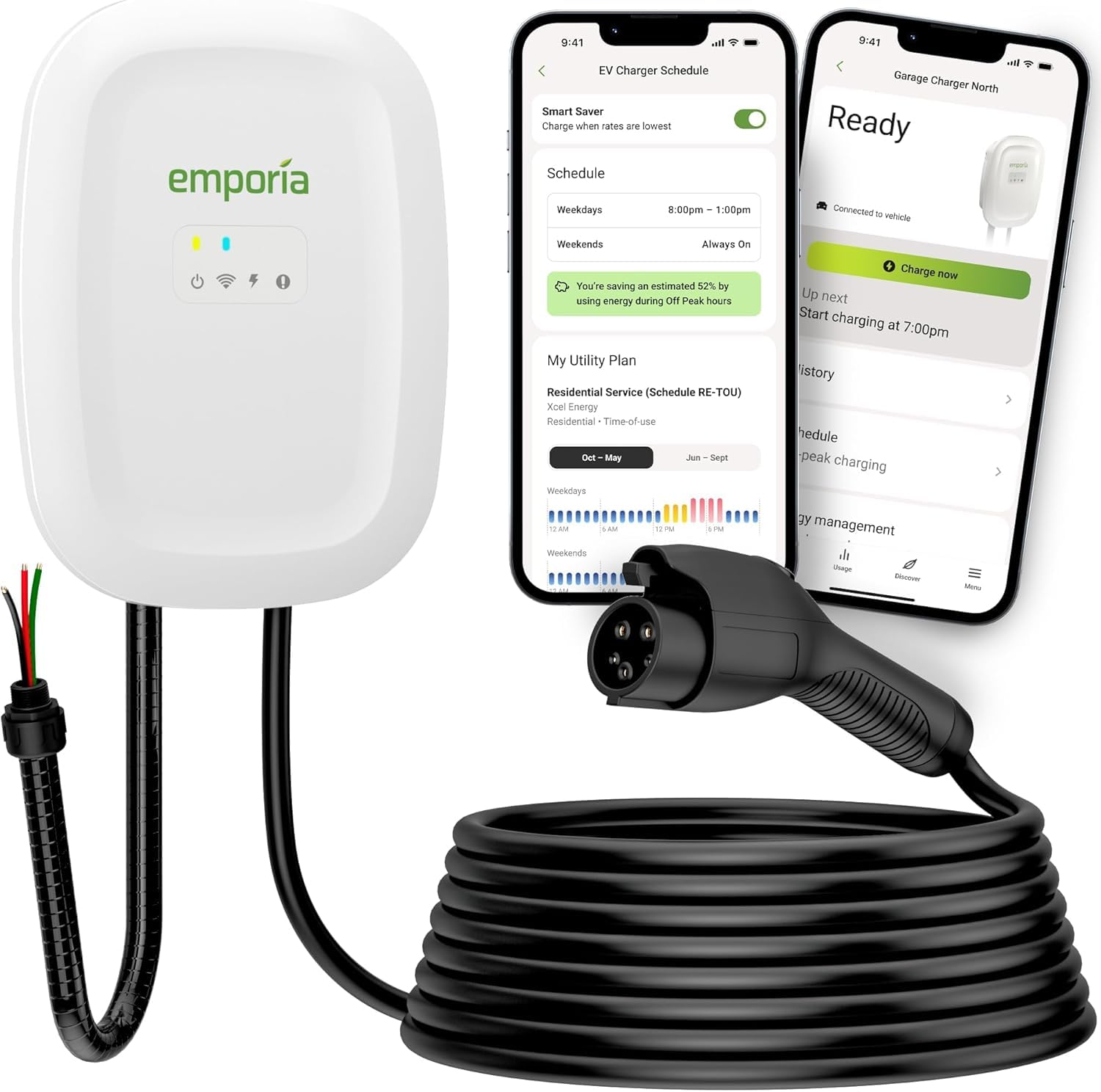
Emporia is the pick for data nerds and solar owners. This 48A hardwired charger provides up to 46 miles/hour charging speed, and the app doesn’t just control charging—it gives you real-time energy data, charging history, and even tracks kWh and dollar cost per charge and per month. One owner reports a full charge in 4-5 hours on an Ioniq 5 and just 1 hour on a Sportage PHEV.
The standout feature is its integration with Emporia’s Vue home energy monitor. This open up features like solar-only charging, demand limiting, and load control, which lets the charger shed loads on low-amp panels or prioritize your car. An owner who’s installed EVSEs since 2013 prefers this over Tesla, Rivian, Bosch, and JuiceBox, citing its easy troubleshooting and excellent tech support. They even saved a significant amount on demand fees by managing charging around peak times.
It’s preconfigured for hardwired installation with a whip for up to 48A. It’s UL listed and ENERGY STAR certified, meeting rigorous standards. The 25ft cable and handle holster keep things organized. Buyers consistently praise its functionality, ease of use, and value as an affordable home solution. The only caveats: there’s no 277V Tesla support (though a NACS cable is available separately), and advanced smart-home setup really needs a licensed electrician.
Data-Driven Charging: If you have solar panels or want to micromanage your energy costs, this charger’s monitoring capabilities are class-leading in this list—it tracks usage in real time so you can charge when rates are lowest.
Who It Suits: Homeowners with solar, EVs, and a desire to tune every kilowatt-hour they use.
Who It Doesn’t: Renters or those who aren’t ready for a permanent hardwired install with potential panel upgrades.
9. ChargePoint HomeFlex Level 2 EV Charger (NACS)

A hardwired NACS station from a giant in public charging, with access to a vast network.
ChargePoint is a household name in EV charging, and this HomeFlex unit brings that ecosystem into your garage. It’s a hardwired NACS station, meaning it’s built for Tesla vehicles right from the start. The big draw for some is the connection to ChargePoint’s network of 274k+ stations across North America and Europe, plus 565k+ roaming partner stations—useful if you want one app for home and away. It’s rated at 50A with a 240V input.
The unit is compact at 7.06 x 11.19 x 5.2 inches and easy for an electrician to install. It comes with a cold-resistant cable, a key feature for harsh winters. The ChargePoint mobile app lets you control the charger, manage reminders, connect to smart-home devices, and access charging data. Owners find the LED indicator lights clear and the setup simple, with one noting it easily charges a long-range Model Y.
However, this pick has the most vocal criticism in the lineup, mostly centered on WiFi reliability on older units. Some owners experienced WiFi failures after a couple of weeks, requiring replacements. ChargePoint has since released newer stock (Rev 5) that fixed the WiFi issue, but the customer service experience during those failures was described as frustrating by a few. If you’re risk-averse and just want a dependable NACS charger, the EVIQO at the top might be the safer bet.
What Stands Out
- Access to a massive public charging network via app
- 50A rating for fast Tesla charging
- Compact design with cold-resistant cable
Watch Out For
- Older stock had WiFi reliability issues
- Support waits can be long if you hit a problem
The Bottom Line: Buy the newest stock and this is a solid, fast NACS charger, but the brand’s support experience is the weakest link here.
Consider Alternatives If: You’d rather have a quick setup and fast support than a well-known brand and a rich app—this one may not be your first pick.
10. Autel AC Elite Level 2 EV Charger 50A
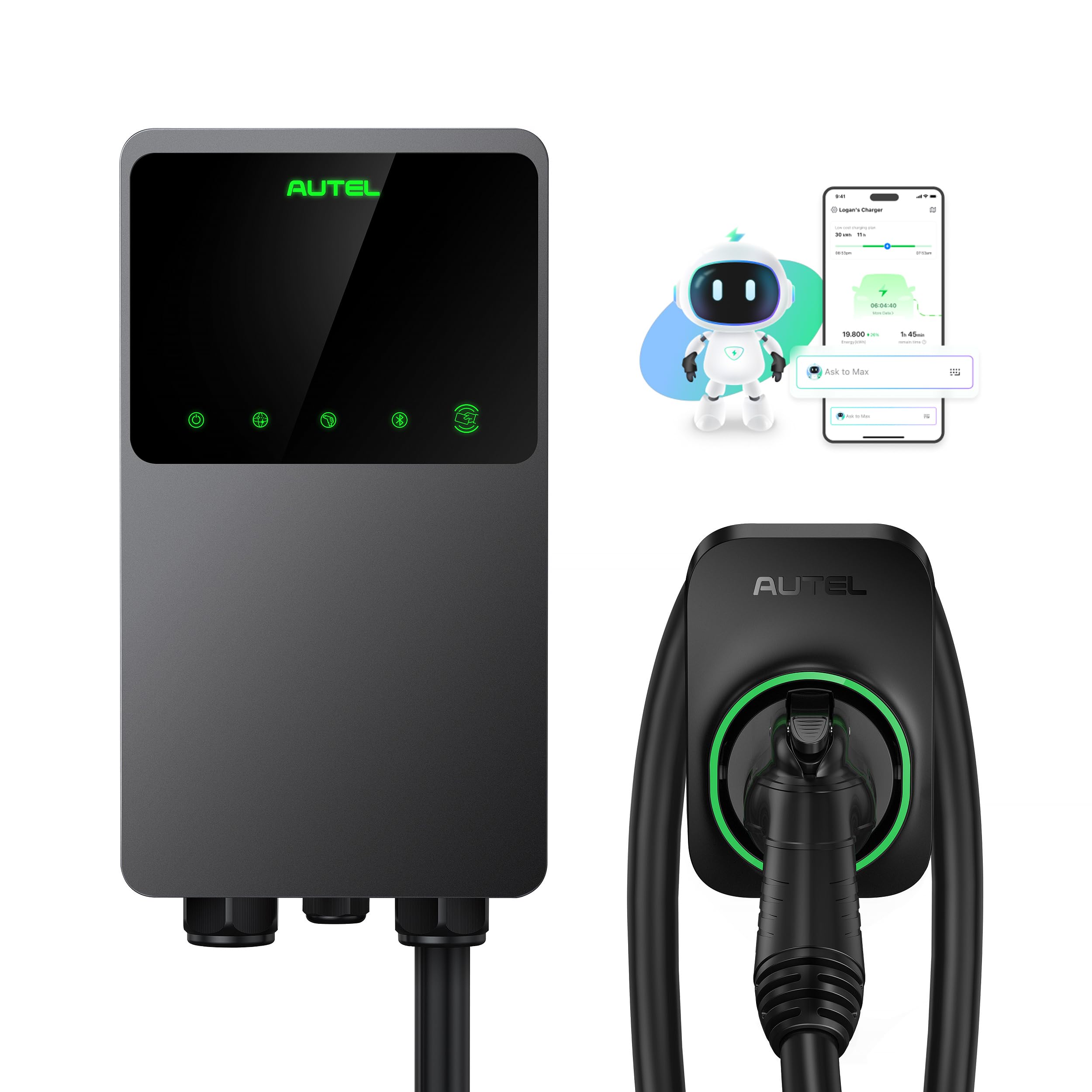
Autel’s top-tier 50A hardwired charger, delivering 12kW and 37 miles per hour for serious speed.
Autel’s premium AC Elite is for the buyer who wants the fastest possible home charging. With 12kW and up to 50A, it adds 37 miles per charging hour. The 25-foot cable stays flexible even at -40°C, making it a strong choice for owners in the coldest climates. Owners consistently praise its simple installation—it comes completely pre-assembled—and note it runs cool on a 220V/6AWG setup.
The Autel Charge app is a highlight, offering cost analysis, scheduling, and remote control. You can enter your electricity costs and the app tracks your savings over time. The unit offers both Bluetooth and WiFi connectivity, plus Ethernet access for rock-solid connections. Over-the-air (OTA) firmware updates keep it current. Owners say the physical amperage selector is handy, letting you set it for a 32A or 40A breaker as needed.
It’s CSA certified (a safety standard) with a NEMA Type 4 rating, meaning it’s sealed against rain and dust for outdoor use. Owners describe the build as top-notch, with thick cables and a sleek dark gray finish. A few note the app was initially limited in amperage until a support ticket fixed an account-linking issue, and one called it “slightly heavy.” Still, the overwhelming consensus is excellent functionality backed by standout support—one owner got a new charger delivered in 2 days after a warranty claim.
Why Go Premium
- Highest amperage here at 50A (12kW)
- Cold-proof cable rated to -40°C
- Bluetooth, WiFi, AND Ethernet connectivity
- Excellent warranty service
The Premium Price
- Hardwired only—no plug-in portability
- Needs a 60A+ breaker for full 50A output
Reach for This If: You’re doing a permanent install, want the fastest home speed, and value reliable remote connectivity via Ethernet.
Look Elsewhere If: You’re on a tight budget or want the flexibility to unplug and move your charger.
Understanding the Specs
Amperage and Speed
The amp rating (40A, 48A, 50A) determines how fast your car charges. A 40A charger typically needs a 50A breaker and adds about 38-40 miles of range per hour. A 48A or 50A unit needs a 60A breaker but gets you closer to 46-50 miles per hour. Think about your daily driving distance—if you drive less than the nightly range added, a 40A charger is plenty.
Connector Types: NACS vs J1772
Your car’s port determines which connector you need. Tesla uses the NACS standard (included on the EVIQO and ChargePoint picks). Most other EVs (Ford, Chevy, Hyundai, VW, etc.) use the J1772 connector. Some chargers include adapters to work with both. Check your vehicle’s port before ordering—it’s the single most important compatibility detail.
FAQ
Do I need a 40A or 48A home EV charger?
Can I plug a Level 2 charger into a regular wall outlet?
Will a J1772 charger work with my Tesla?
What does the IP66 or NEMA 4 rating mean?
Is it better to hardwire an EV charger or plug it in?
How long does a full EV charge take with these chargers?
Can I schedule charging to save money on electricity?
What size breaker do I need for a 48A charger?
Final Thoughts: The Verdict
If you want one dependable pick, the home ev charger winner is the EVIQO NACS 40A because it delivers a flawless plug-in experience with a native Tesla connector, a smart app, and rugged IP66 build quality. If you want a no-app, budget-friendly J1772 workhorse, grab the VEIPHLOX. And for a hardwired fast-charging installation, the WOLFBOX E48 or the energy-monitoring EMPORIA are the ones to reach for.
How We Picked
We do not accept paid placement. Every pick is matched to a real buyer and a real use-case; we do not hands-on test units.
Sources & Methodology
Specifications: manufacturer listings and product documentation. Review insights: verified customer reviews, as of August 2026. Pricing: not shown on this page (it changes often); check the current price via the retailer link.
As an Amazon Associate, Trending Car earns from qualifying purchases. This does not affect which products we feature.