
Our readers keep the lights on and my garage snacks stocked. As an Amazon Associate, I earn from qualifying purchases.
Specs are compiled from manufacturer listings and verified buyer reviews and can change over time — please confirm the key details on the product page before buying.
If your engine has crossed the 75,000-mile mark, it is no longer a young machine. Internal seals have hardened, clearances have widened, and standard oil just slips past those gaps, leaving you with puddles on the driveway and a burning-oil smell every time you stop. The real fix is not a thicker weight — it is a high-mileage formulation with seal conditioners that re-swell those dried-out gaskets from the inside out. That is what every pick on this list does, and the differences between them come down to how far you want to push between changes and how much quiet you want back.
I’m Min Islam — the founder and writer behind Trending Car. This guide is built by comparing the manufacturers’ published specifications and the patterns across verified customer reviews, so you get each pick’s real strengths and trade-offs instead of marketing spin.
Whether you drive a daily commuter with 90,000 miles or a truck that has seen 200,000, finding the right high-mileage motor oil depends on balancing viscosity, change intervals, and the specific additives that keep an aging engine sealed and sludge-free.
Our Picks at a Glance
How To Choose The Best High Mileage Motor Oil
Once your engine passes 75,000 miles, standard oil stops being enough. The main difference in a high-mileage formula is the additive package — seal conditioners that soften and re-swell dried-out rubber gaskets, plus extra detergents and antioxidants that fight sludge in the tight oil passages of an older motor. Choosing the right one means matching the viscosity to your climate and engine, and deciding how many miles you can safely stretch between changes.
Viscosity — The “Weight” That Actually Fits
The numbers like 5W-30 or 10W-30 tell you how the oil flows when cold (the W stands for Winter) and at operating temperature. Most high-mileage engines like a 5W-30 for moderate climates, while a 10W-30 adds a slightly thicker film at hot idle for engines with looser bearing clearances. Going too thick can starve narrow oil passages, so stick to what your owner’s manual recommends.
Change Interval — How Many Miles Before It Breaks Down
Standard conventional oil starts degrading around 3,000 to 5,000 miles. Full-synthetic high-mileage oils can stretch to 10,000, 15,000, or even 20,000 miles, depending on the specific formulation and your driving conditions. Shorter trips and heavy towing shorten that window, so pay attention to the bottle’s mileage claim rather than a fixed calendar date.
Additive Technology — What Keeps an Old Engine Alive
Beyond seal conditioners, premium high-mileage oils use zinc and phosphorus compounds (ZDDP) that protect flat-tappet camshafts, plus detergents that clean existing deposits without dislodging them all at once (which can clog a pickup tube). Some brands add moly-based friction modifiers to reduce wear further, and several now include phosphorus-replacement technology to protect catalytic converters from poisoning.
Quick Comparison
| Model | Best For | Viscosity | Volume | Max Change Interval | Amazon |
|---|---|---|---|---|---|
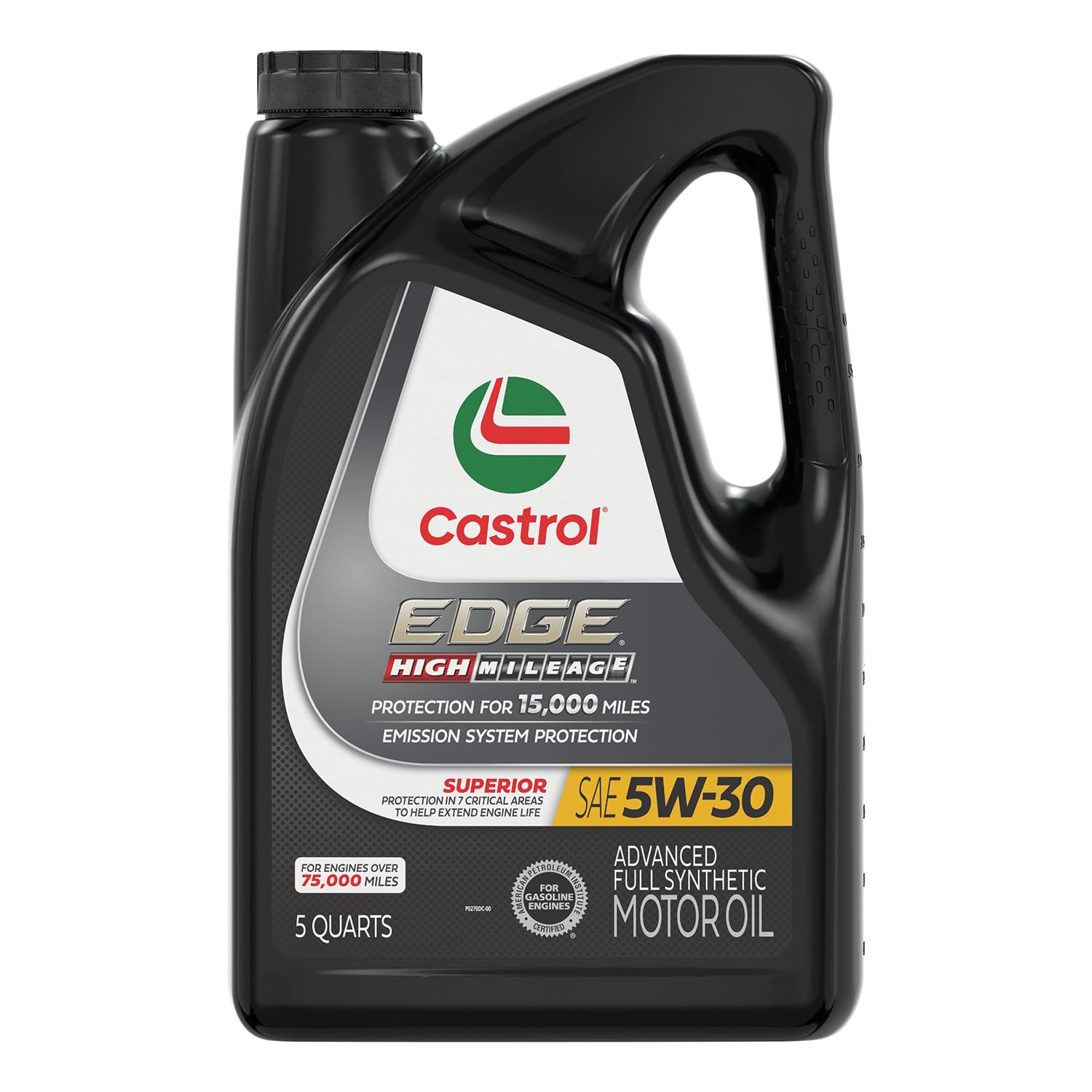
| Castrol EDGE High Mileage★ Best Overall | Balanced daily performance | 5W-30 | 5 Quarts | 15,000 miles | Amazon |
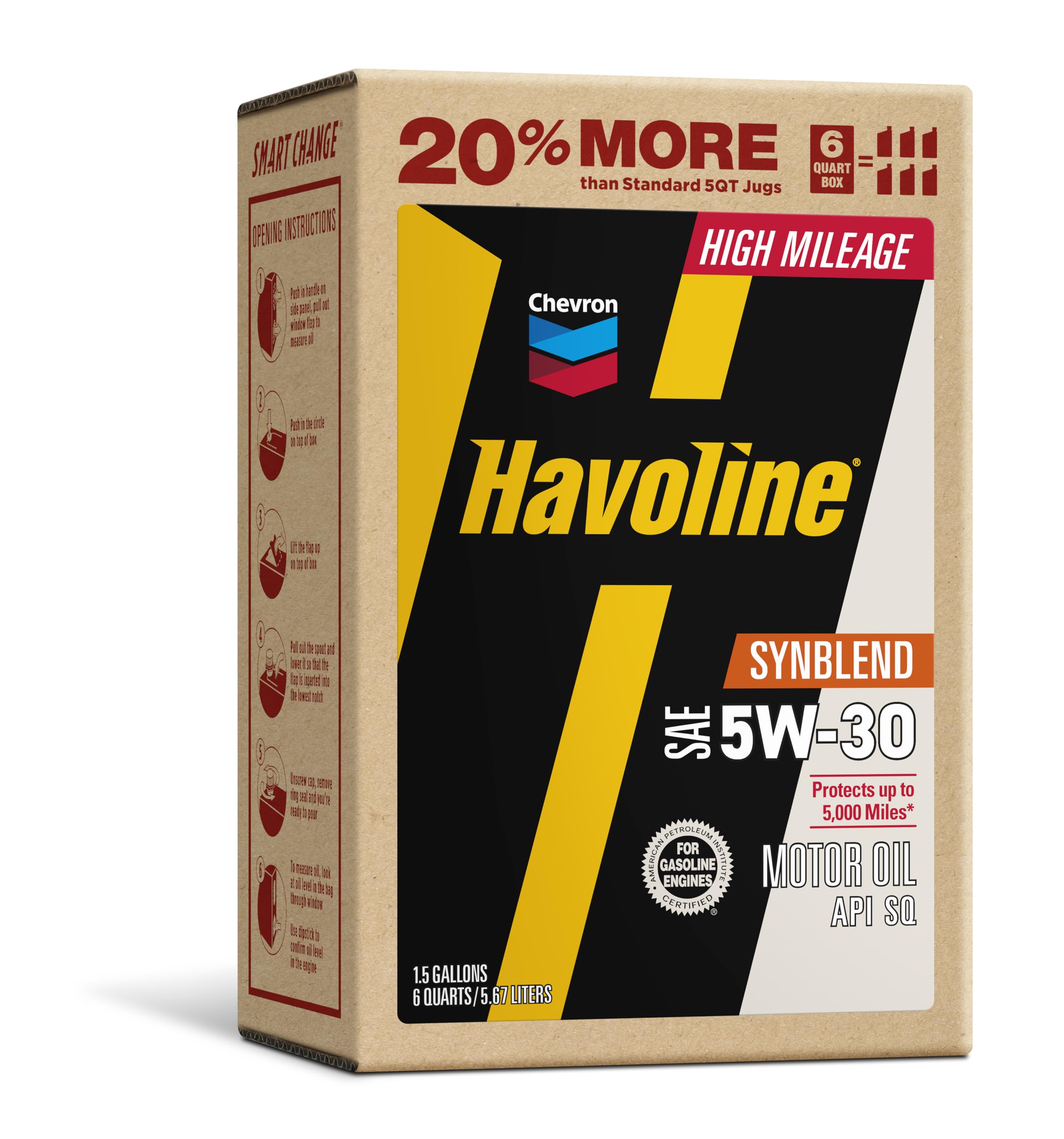
| Havoline High Mileage Smart ChangeBest Value | Leak-prone older engines | 5W-30 | 6 Quarts | — | Amazon |
| Valvoline High Mileage 150K MaxLife | Engines over 150,000 miles | 5W-30 | 5 Quarts | — | Amazon |
| Castrol GTX Full Synthetic High Mileage | Catalytic converter protection | 0W-20 | 5 Quarts | 10,000 miles | Amazon |
| Royal Purple HMX 10W-30 | Quieting noisy lifters | 10W-30 | 5 Quarts | Extended drains (safe) | Amazon |
| Mobil 1 Extended Performance High Mileage | Maximum extended drains | 5W-30 | 1 Quart (6-pack) | 20,000 miles | Amazon |
In‑Depth Reviews
1. Castrol EDGE High Mileage 5W-30 Advanced Full Synthetic Motor Oil, 5 Quarts
Our pick — over 4.5★ from 6,500+ verified ratings; the strongest balance of quality and price.
The one oil that protects both your engine internals and your catalytic converter, backed by a 15,000-mile change window.
You get a full-synthetic base that flows easily at start-up and holds its viscosity through thousands of miles of highway heat. The key advantage here is Phosphorus Replacement Technology: it extends the life of your catalytic converter and oxygen sensors while still giving the anti-wear protection older engines need. That is rare — most high-mileage oils tackle leaks and friction but ignore emissions, which matters if your car faces a smog check. A buyer who sent a sample to Blackstone Labs confirmed the 5W-30 Castrol EDGE did not shear down or lose its additive pack early, so the 15,000-mile claim holds up in real use. The 15,000-mile claim carries a one-year-or-15,000-miles asterisk, so short-trip drivers should still change it annually.
At 5W-30, it is a smart call for most modern high-mileage engines: thin enough at cold start to reach tight passages, thick enough at temperature to cushion worn bearings. For a healthy engine up to 150,000 miles, this delivers lab-verified durability that the Havoline (a synthetic blend) cannot match on interval length.
Real lab-verified durability: One buyer ran it through used-oil analysis and confirmed it held up under hard use, which backs up the 15,000-mile rating with actual data rather than just marketing.
The single trade-off: It is a mid-range synthetic — excellent for daily drivers up to 150,000 miles, but if your engine already has heavy sludge or persistent leaks, you may need a more aggressive seal-conditioner pack like the Valvoline 150K below.
Reach for this if: You want a lab-tested, emission-system-friendly synthetic that gives you a full year between changes on a healthy but aging engine.
Look elsewhere if: Your engine is already burning or leaking a quart every 1,000 miles — you need the higher-additive formulas designed for 150K-plus motors.
2. Havoline Motor Oil 5w30 High Mileage Synthetic Technology Smart Change Engine Oil, 6 Quarts
The 6-quart box that gives you 20% more volume than the standard 5-quart jug for the same job.
Many modern cars (Honda Pilot, Toyota V6, some GM trucks) take exactly 6 quarts at a change, and most high-mileage oils come in 5-quart jugs that force you to buy extra. Havoline solves that with a 6-quart pouch-and-box design — you get the full sump fill in one purchase. The seal-conditioner package targets older engines specifically, and reviews consistently note a noticeably quieter and smoother engine, especially on cold starts, even on vehicles with 280,000 miles. A buyer on a 280,000-mile car reported zero leaks or oil consumption between changes after switching to this 5W-30 Havoline.
It uses synthetic technology (not fully synthetic) at a conventional-oil price tier, so you get the detergency and high-temp protection of a synthetic blend without paying full synthetic premiums. That said, it does not carry a specific mileage-change claim like the Castrol EDGE (15,000 miles) or Mobil 1 (20,000 miles) — follow a standard 5,000-mile interval for safety. The 20% volume advantage over the Valvoline 5-quart standard means fewer mid-cycle top-ups for leak-prone engines.
Why it earns its spot
- 6-quart fill covers a wide range of cars without buying extra
- Buyers on 280k-mile vehicles report zero leaks or oil consumption between changes
- Uniquely easy-pour pouch design that avoids the clumsy 5-quart jug spout
One honest shortfall
- No published maximum-mileage drain interval — you cannot stretch it like the full synthetics above
Grab it if: You own a car that takes 6 quarts and you want the most affordable high-mileage oil that still quiets cold-start ticks.
skip it if: You want a confirmed 10,000- or 15,000-mile fully synthetic oil — this is a synthetic blend at conventional change intervals.
3. Valvoline High Mileage 150K with Maxlife Plus Technology 5W-30 Motor Oil 5 Quart

The formula that stops leaks on engines already past 150,000 miles, according to buyers on 230,000-mile cars.
Valvoline created this for the car that has already blown past 150,000 miles — the one with hardened valve stem seals, a leaking rear main, and bearing clearances measured in thousandths of an inch. The MaxLife Plus Technology adds a moly additive (a solid lubricant that reduces metal-on-metal friction) plus seal conditioners that target old, brittle rubber. A buyer reported it stopped a leak on a 230,000-mile car, proving the additive package works beyond the marketing label. Its Flash Point of 394 Degrees Fahrenheit means it resists burning off in high-heat conditions better than conventional oils.
The multi-dimensional anti-wear system exceeds current API SP (American Petroleum Institute’s highest standard) specifications, so even if your engine has flat-tappet lifters (common on older pushrod V8s), the zinc and phosphorus levels hold up. The 5W-30 viscosity stays universal for most climates, but unlike the Castrol EDGE (which focuses on emission protection), this one leans hard into seal-conditioning and sludge control. If your engine is under 100,000 miles, the strong detergent pack may loosen deposits too aggressively and cause a temporary consumption spike — stick with the Havoline or Castrol EDGE for younger high-mileage engines.
Stops leaks from the inside: Several reviews mention the seal conditioners reduced or eliminated existing oil drips within one oil change — not a guarantee, but a common experience.
Does it handle extreme cold? The 5W-30 flows down to about -22°F, fine for most winter climates, but owners in severe -40°F zones should consider a 0W-30 for easier cold starts.
Perfect if: You are at 150,000 miles or beyond and need an oil that actively fights sludge, stops leaks with seal conditioners, and adds moly for wear protection on worn internal parts.
Not for: A younger high-mileage car (under 100,000 miles) — the strong detergent pack may loosen deposits too aggressively and cause a temporary consumption spike.
4. Castrol GTX Full Synthetic High Mileage 0W-20 Motor Oil, 5 Quart
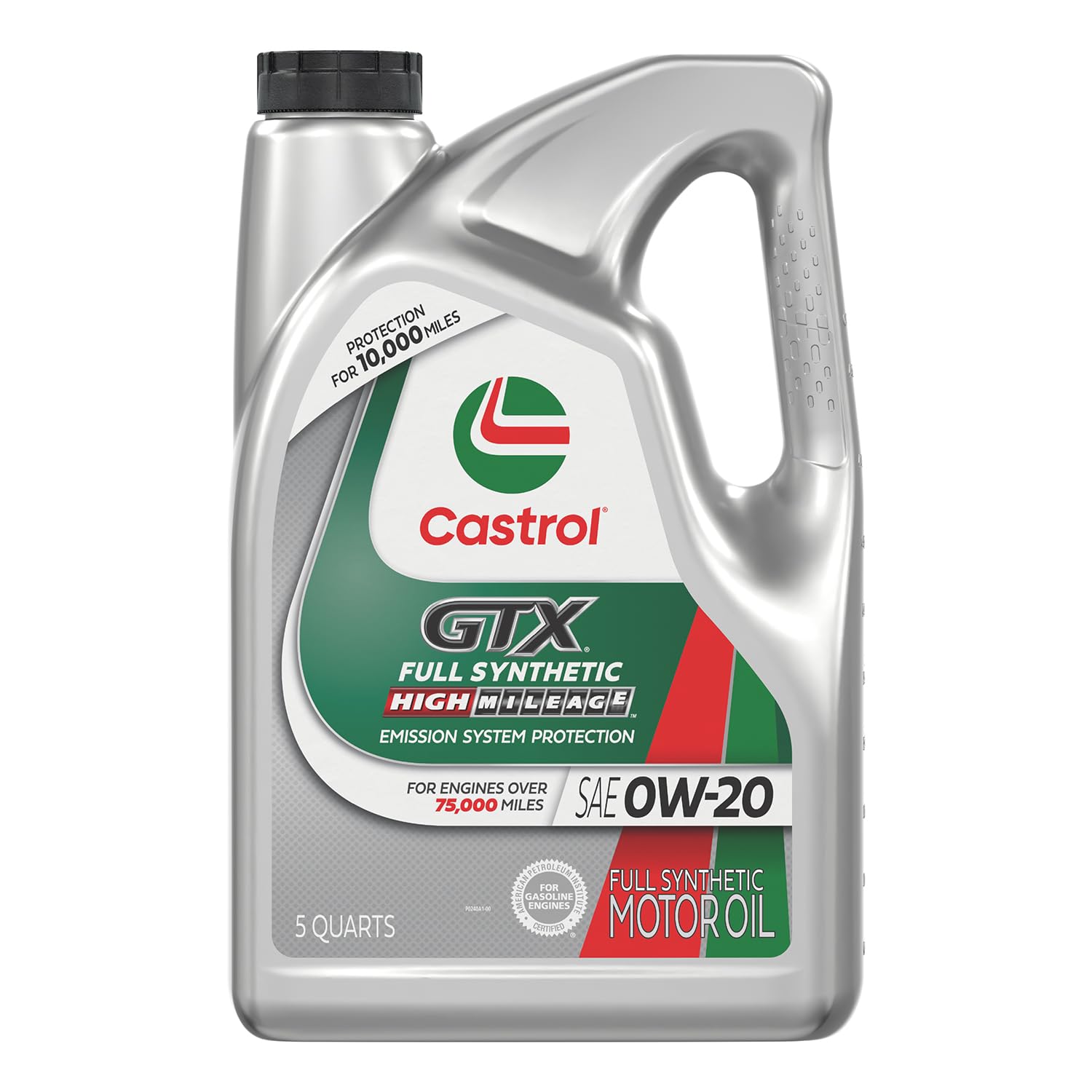
A 0W-20 synthetic that protects both your engine and your catalytic converter at the same time.
Not all older cars need a thick oil — most modern engines from the last 15 years call for 0W-20 to improve fuel economy and meet emissions standards. This Castrol GTX Full Synthetic provides the brand claims of 6x better wear protection than the industry standard (measured in the ASTM Sequence IVA test, which simulates valve-train wear), and the Phosphorus Replacement Technology prevents the anti-wear additives from coating and killing your catalytic converter. One reviewer noted that “oil passages get cleaner over time and the emission system protection formula will have your catalytic converters lasting for hundreds of thousands of miles.”
It carries a 10,000-mile change interval, which is 5,000 miles shorter than the Castrol EDGE’s 15,000-mile claim, but the 0W-20 viscosity means it handles extreme cold far better and improves fuel mileage on shorter trips. Castrol specifically markets it as suitable for hybrids (the 0W grades resist shearing in the stop-start cycles), so if you drive a Prius or a hybrid Accord with high mileage, this might be the best match. Bear in mind that 0W-20 is thinner than 5W-30 at operating temperature — older engines with loose clearances may show slightly more oil consumption.
The smart-buyer reasons
- Phosphorus Replacement Technology prevents catalytic-converter poisoning
- Castrol claims 6X better wear protection vs. the ASTM Sequence IVA industry standard.
- Suitable for hybrids and 0W-20 spec engines
A real consideration
- 10,000-mile interval is shorter than the EDGE and Mobil 1 options
Best match for: Any car that requires 0W-20 — especially hybrids or any daily driver where you want the catalytic converter to outlast the engine.
Think twice if: Your owner’s manual calls for 5W-30 or 10W-30; the thinner 0W-20 may increase oil consumption in an engine designed for a thicker grade.
5. Royal Purple 11750 HMX SAE 10W-30 High-Mileage Synthetic Motor Oil – 5 qt

The premium 10W-30 that uses zinc and phosphorus to restore lost performance and silence noisy lifters.
Royal Purple’s HMX line is chemically enhanced to revitalize hardened seals and reduce oil consumption common in high-mileage engines. The SAE 10W-30 viscosity is 2.0x thicker at cold start than the 5W-30 of the Castrol EDGE, giving a thicker film at idle for engines with worn bearings or loose piston-to-wall clearances. A buyer with a 2500HD 6.0-liter gas engine reported a noticeably smoother idle and much less lifter tick after switching — the zinc/phosphorus anti-wear compounds cushion metal-to-metal contact at start-up when the oil is still draining back into the pan.
The ionic attraction technology means the oil clings to metal surfaces even when the engine is off, reducing dry-start wear. It also provides outstanding oxidation resistance for extended drain intervals, though Royal Purple does not stamp a specific mileage claim on the bottle — most users run it 7,000 to 10,000 miles. At 9.2 pounds for 5 quarts, it is a heavy, high-additive oil that does not shear down as fast as conventional synthetics. The trade-off is the price, which sits at the premium end of the spectrum — the Havoline is a far better value if you don’t need the thicker 10W-30 film.
Stops the morning chatter: One owner with a 2500HD 6.0L said after switching, the lifter tick was virtually gone and the idle smoothed out — the zinc/phosphorus layer fills the microscopic gaps in worn lifters.
A thicker choice: The 10W-30 vs 5W-30 of the Castrol EDGE means you get a 2.0x viscosity gap at cold temperatures, better for warm climates or engines that already burn 5W-30.
Choose this if: You want to quiet a noisy valvetrain, have a high-mileage V8 that burns thinner oil, or want the most sturdy anti-wear chemistry available for a 10W-30 engine.
Pass if: Your car requires a 5W-30 or 0W-20 and you live in a cold climate — the thicker 10W-30 will struggle on sub-zero mornings.
6. Mobil 1 Extended Performance High Mileage Full Synthetic Motor Oil 5W-30, 1 Quart (6-pack)

The 20,000-mile oil that lets you forget about drain intervals for an entire year of highway driving.
Mobil 1’s Extended Performance High Mileage is the longest-duration high-mileage oil on this list, with a verified claim of up to 20,000 miles between oil changes. The Triple Action+ Formula combines engine performance, protection, and cleanliness while meeting the new ILSAC GF-6 standards for low-speed pre-ignition (LSPI) protection — crucial for turbocharged engines that are prone to destructive pre-detonation (an uncontrolled early fuel burn that can crack a piston). The 5W-30 viscosity handles up to 500 Degrees Fahrenheit of heat and flows down to -40 Degrees Fahrenheit, covering everything from Arizona summers to northern winter starts. On interval length, this beats the Castrol EDGE (15,000 miles) by 5,000 miles.
It comes as a 6-pack of 1-quart bottles rather than a single jug, which is ideal if your car takes 6 quarts but also gives you leftover bottles for topping off between changes. A mechanic confirmed to one buyer that after 20 years and 143,000 miles on a Chevy Tahoe, the engine was “perfect with no noises” — a strong real-world endorsement of the deposit-prevention formula. The downside is the upfront cost per quart, which is higher than the 5-quart jug formats. If you change oil every 5,000 miles, you do not need the 20,000-mile chemistry and can save money with the Castrol EDGE.
Why it stands alone
- Up to 20,000 miles between changes — more than any other pick here
- LSPI protection for turbo engines (GF-6 standard)
- 500°F flash point and -40°F low-temp flow
What to weigh
- 6-pack of 1-qt bottles costs more per quart than a 5-qt jug
Best for: High-mileage turbo engines or drivers who cover 20,000 miles a year and refuse to change oil more than once annually.
Not for: Short-trip city drivers who change oil every 3,000-5,000 miles anyway — the 20,000-mile capacity is wasted, and a cheaper high-mileage oil like Castrol EDGE is a smarter spend.
Understanding the Specs
Viscosity Grade (SAE J300)
This is the “weight” you see on the bottle, like 5W-30 or 10W-30. The first number (5W) tells you how the oil flows in cold weather — lower is better for freezing starts. The second number (30) tells you the thickness at full operating temperature. High-mileage engines with looser clearances sometimes benefit from a 10W-30’s thicker hot film, but always check your owner’s manual first. The Castrol EDGE uses 5W-30, while the Royal Purple HMX uses the thicker 10W-30, giving you a 2.0x gap in cold-flow viscosity.
Change Interval
This is the maximum number of miles the manufacturer guarantees the oil will protect before breaking down. Castrol EDGE claims 15,000 miles, while Mobil 1 Extended Performance pushes to 20,000 miles. Not all high-mileage oils publish a specific claim — Havoline and Valvoline let you follow your normal schedule. A longer interval saves money if you drive many miles per year, but short-trip drivers should still change annually regardless of mileage to remove moisture and fuel dilution.
FAQ
What makes an oil “high mileage” vs regular oil?
Can I switch to high-mileage oil if I have been using conventional oil for 100,000 miles?
Will high-mileage oil stop a rear main seal leak?
What is the difference between 5W-30 and 10W-30 high-mileage oil?
Is full synthetic high-mileage oil worth the extra cost?
Can I use high-mileage oil in a new car?
How often should I change high-mileage synthetic oil?
Will high-mileage oil save me money on fuel?
What is LSPI and why does it matter for high-mileage turbo engines?
Can I mix different brands of high-mileage oil?
Final Thoughts: The Verdict
Across the board, the best high-mileage motor oil is the Castrol EDGE High Mileage 5W-30 because it combines full-synthetic durability, emission-system protection, and a lab-verified 15,000-mile interval at a mid-range price that actually reflects real-world value. If you want the longest possible drain interval and have a turbo engine, grab the Mobil 1 Extended Performance High Mileage. And for a 150,000-mile engine that already leaks and ticks, the standout is the Valvoline High Mileage 150K with Maxlife Plus Technology on seal-conditioning and wear protection.
How We Picked
We do not accept paid placement. Every pick is matched to a real buyer and a real use-case; we do not hands-on test units.
Sources & Methodology
Specifications: manufacturer listings and product documentation. Review insights: verified customer reviews, as of July 2026. Pricing: not shown on this page (it changes often); check the current price via the retailer link.
As an Amazon Associate, Trending Car earns from qualifying purchases. This does not affect which products we feature.