
Our readers keep the lights on and my garage snacks stocked. As an Amazon Associate, I earn from qualifying purchases.
Specs are compiled from manufacturer listings and verified buyer reviews and can change over time — please confirm the key details on the product page before buying.
Picking the wrong helmet communication system leaves you shouting into a tin can at highway speed, fighting wind noise while your music cuts out and your riding partner hears nothing but static. The real problem isn’t just finding any headset—it’s finding one that stays clear, connects reliably, and fits your actual riding style without emptying your wallet on features you’ll never use. This guide cuts straight through the Bluetooth confusion to give you the honest strengths and trade-offs of the top systems available right now.
I’m Min Islam — the founder and writer behind Trending Car. This guide is built by comparing the manufacturers’ published specifications and the patterns across verified customer reviews, so you get each pick’s real strengths and trade-offs instead of marketing spin.
Whether you ride solo, with a partner, or as part of a large group, the right helmet communication system transforms every mile—and this breakdown of nine carefully vetted options shows you exactly where your money makes the biggest difference.
Our Picks at a Glance


How To Choose The Best Helmet Communication System
Buying a helmet communication system means balancing how you ride with how you communicate. Solo commuters need different features than group tourers, and weekend adventurers have priorities that don’t match daily commuters. Here are the three decision-shaping factors that really matter.
Bluetooth Generation and Latency
The Bluetooth version number—5.4 versus 5.0 versus 4.1—directly controls how stable your connection stays and how much audio delay you experience. A higher version, like Bluetooth 5.4, delivers lower latency (measured in milliseconds, or ms) which means the person you’re talking to hears your words without a distracting lag. For a system like the Fodsports FX-S with its 20 ms latency, that lag is essentially imperceptible, while an older chipset with 150 ms latency can make conversations feel disjointed.
Intercom Range and Rider Count
Every system advertises a maximum range, but real-world conditions—hills, trees, buildings—drastically cut that number. A unit claiming 1000 meters of open-terrain range might only reach 100 yards in mountain switchbacks. Think honestly about your typical group size. Two-rider systems work fine for couples or solo riders with a passenger, but if you regularly ride with three or more friends, you need a system explicitly built for multi-rider intercom or mesh networking.
Waterproofing and Build Durability
Riding gear gets rained on, splashed, and caked with dust. Look for an IP rating—a standard that measures how well the device resists water and particles. An IP67 rating means the unit is fully dust-tight and can survive immersion in a meter of water for 30 minutes; an IPX6 rating handles heavy rain but not submersion. Anything lower than IPX5 means you should avoid direct downpours or carry a backup baggy.
Quick Comparison
| Model | Best For | Bluetooth | Audio Latency | Battery Life | Amazon |
|---|---|---|---|---|---|
| Sena 20S EVO★ Best Overall | Upgraders from older Sena gear | 4.1 | 150 ms | — | Amazon |
| FreedConn TCOM-VBCompact Pick | FM radio and solo riders | 5.0 | — | 10 hours | Amazon |
| EJEAS V6Long-Range Pick | Long-distance two-up touring | 5.1 | — | 18 hours | Amazon |
| MAXTO MX1 | Gift buyers and value pickers | 5.0 | — | 20 hours | Amazon |
| Fodsports FX4 Pro | Small groups on a mid-range budget | 5.0 | — | 15 hours | Amazon |
| Fodsports FX6 | Six-rider group coordination | 5.0 | — | 10 hours | Amazon |
| Sena 60S | Global group rides and mesh users | 5.0 | — | 24 hours (talk) | Amazon |
| Cardo PACKTALK PRO | Premium sound and crash detection | 4.0 | — | 13 hours | Amazon |
In‑Depth Reviews
1. Sena 20S EVO Motorcycle Bluetooth Headset Communication System
Our pick — over 4★ from 800+ verified ratings; the strongest balance of quality and price.
Ten-year Sena veterans finally have a worthy upgrade without relearning everything.
The 20S EVO is the direct descendant of the beloved 20S, and owners who “upgraded from SMH-10 after 10 years” report that the intercom wind noise is drastically improved and the included HD speakers deliver noticeably fuller sound. The battery life gets singled out as excellent for long trips, and the quick charging means you’re never stuck waiting before a ride. However, the voice commands become unreliable once you’re moving—Siri simply cannot hear you over the wind—which limits the hands-free appeal the spec sheet promises.
Where this system really earns its reputation is in the sheer polish of the intercom stability. The fixed shark-fin antenna design is a deliberate fix for the flip-up antenna on earlier models, and it shows in fewer dropped connections. But the audio latency sits at 150 milliseconds—a 7.5x gap compared to the Fodsports FX-S’s 20 ms—so if near-instant conversation is your priority, the EVO feels noticeably slower than its budget competitor. The sound quality overall gets mixed reactions from buyers: some call it very clear while others find the volume merely okay, not loud.
The broad buyer consensus calls the build quality solid and the installation straightforward. It pairs easily to other Sena units, making it a natural choice if you’re already inside that ecosystem. Just be honest about the volume ceiling—if you ride a loud bike and want ear-splitting audio, you may find yourself wishing the speakers had more punch.
Reliable mesh veteran
- Intercom wind noise reduction is a big step forward from earlier Sena models
- Quick charging and excellent battery life for multi-day touring
- Easy pairing with other Sena headsets in your group
Bulky on helmet
- 150 ms audio latency feels slow next to newer chips—your conversation has a perceptible lag
- Voice commands are effectively unusable at speed; Siri cannot hear you
- Volume will not satisfy riders who want extremely loud speakers on a noisy bike
Best for groups: you’re already in the Sena family and want a proven, refined upgrade that keeps intercom stability as its bedrock strength.
Skip for solo: you need the lowest possible audio lag for natural conversation or you ride with friends who use a different brand’s system.
2. FreedConn TCOM-VB Motorcycle Helmet Bluetooth Headset
Built-in FM radio and straightforward operation for riders who just want to listen and talk.
The FreedConn TCOM-VB carves a specific niche: it is one of the few systems at this price level that includes a dedicated FM radio tuner, so you can catch live broadcasts without draining your phone battery. It supports two-rider real-time intercom with a maximum range of 800 meters (about half a mile at 120 km/h) and can pair up to three riders total. The Bluetooth 5.0 chip is a generation behind the FX-S but still modern enough for stable music streaming and GPS voice prompts.
What owners consistently praise is the sound quality—the top positive aspect by count—with one buyer noting calls come through clean and clear and that music is “audible over Harley slip-ons.” The installation is simple, and the device clips on and off easily for charging. Battery life is about 4-5 hours of active intercom, which means you need to charge after every serious ride; the standby time of 300 hours is misleading if you actually use the intercom feature heavily.
The recurring friction points are physical. The power button is hard to feel with gloves, and turning the unit off requires holding it for eight seconds. The speakers are slightly too large for some helmet cut-outs, and the controls on some units work in reverse (twist forward decreases volume). If you mainly ride alone and want radio plus occasional passenger intercom, this is a solid, affordable pick—just budget for the learning curve.
Ideal for beginners: solo riders who value FM radio and want easy intercom with one passenger. Step away if you need all-day intercom on group tours or prefer more glove-friendly button design.
3. EJEAS V6 Motorcycle Bluetooth Headset
A 1200-meter range and 18-hour intercom time for couples who ride all day.
The EJEAS V6 is purpose-built for two-up touring where you and your passenger or riding partner need to stay in touch over long distances. The advertised intercom range is 1200 meters—the highest claimed in this mid-range tier—and the 850 mAh battery delivers up to 18 hours of intercom time or 25 hours of music playback. That is enough for a full weekend of riding without hunting for a charger. The Bluetooth 5.1 chip is a solid middle ground, offering better power efficiency than the 4.1 generation while staying widely compatible.
Sound quality is the most-discussed aspect, and the verdict is split. Some owners find it excellent with clear sound at lower speeds, while others report muffled audio and poor quality above 50 mph. The advanced noise cancellation reduces wind and background noise, but it is not a magic fix for a turbulent helmet. The build quality and value for money are praised, making this a strong pick if you know you will mostly ride at moderate speeds and want the confidence of huge battery reserves.
The interface is where the V6 shows its budget roots. The button layout feels awkward until you learn it, and the buttons themselves are small enough that gloved operation can be imprecise. An occasional unit fails to turn on after months of non-use, which is a durability flag worth noting. If your priority is maximum range and battery life for a two-rider setup, the V6 is a compelling choice—just keep your expectations for high-speed audio clarity in check.
Reach for long trips: you ride two-up and want the longest possible intercom range and all-day battery life without spending premium-tier money. Skip if you ride above 50 mph often and need crisp audio at speed.
4. MAXTO MX1 Motorcycle Bluetooth Headset

Intercom range that surprised owners with “crazy far” real-world reach beyond 500 yards.
The MAXTO MX1 does not have the newest Bluetooth or the flashiest app, but it delivers on the two things that matter most for group riding: range and volume. Owners consistently report the intercom distance exceeds 500 yards with crisp sound, which is exceptional for a two-rider system in this price tier. The 500mAh battery provides up to 20 hours of music or intercom time and 200 hours of standby, with a low-battery voice prompt so you are never caught empty. The IPX6 waterproof rating handles heavy rain, though it is not fully submersible like the Fodsports FX-S.
Sound quality is the top positive aspect, with owners calling the HiFi 3D effects impressive for the price. The 40mm speakers deliver clean audio at moderate speeds, but at 80 mph some riders find the volume drops below comfortable levels. The universal pairing feature works with most Bluetooth headsets on the market, making this a reasonable choice if your group uses mixed brands—though the system does not support music playback during two-way intercom, which is a notable omission for riders who like background tunes during group chat.
Installation is easy with the included sticky pad and clamp, and the package is beautifully presented as a gift. The controls are simple enough that owners put the setup behind them quickly. The MX1 is proof that you do not need to spend premium money to get solid range and volume—just be aware that the intercom-music exclusivity is a real workflow constraint.
Best for durability: riders who prioritize intercom range and volume on a budget, and who either ride without music during comms or use separate devices. Not ideal if you need simultaneous music and intercom.
5. Fodsports FX4 Pro Motorcycle Helmet Bluetooth Intercom
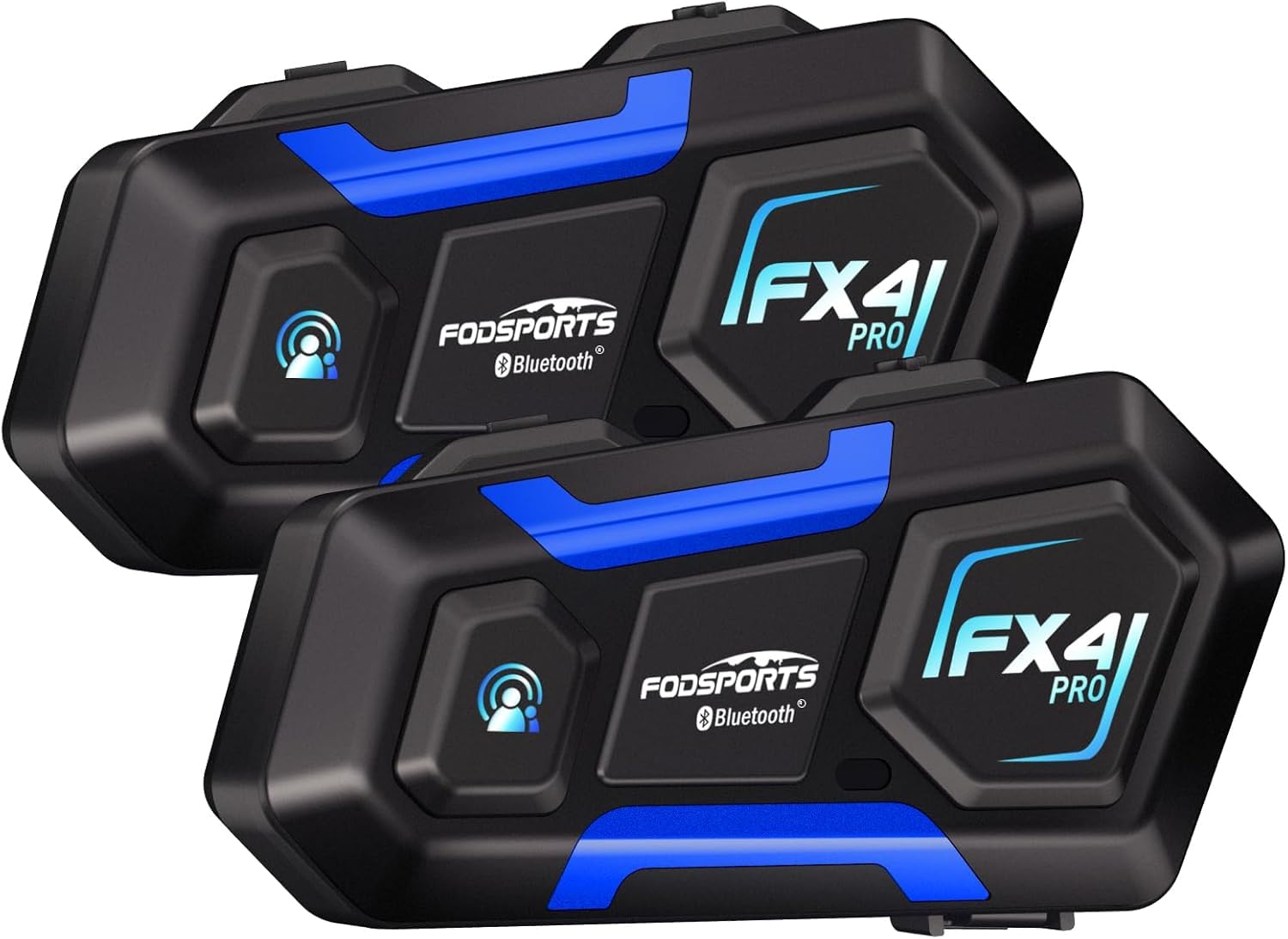
Four-rider intercom with CVC noise cancellation that actually works at highway speeds.
The FX4 Pro sits in a balance for small-group riders who want four-way communication without the complexity or cost of full mesh systems. It supports two to four riders with a 1000-meter range, and the CVC noise cancellation paired with the 40mm Hi-Fi speaker delivers clear audio even when wind and road noise are high. Owners mention the intercom ran 8+ hours with battery still at 80%, and the music quality is good enough for most ears. The FM radio covers the full 76-108 MHz range, adding another entertainment option.
The standout feature here is the hands-free auto-answer within 12 seconds and the voice assistant activation via a double-tap of the volume-down button. That keeps your hands on the bars and your focus on the road. However, the intercom connection takes 2-3 seconds to establish, which can feel slow when you want to quickly say something to your group. The range is strictly line-of-sight—static creeps in on hills and curves, cutting effective range to about 100 yards in mountainous terrain.
The biggest physical flaw is the charging port: the FX4 Pro still uses Micro USB, not USB-C. Buyers describe Micro USB as fragile and outdated, and it is the one spec that dates this otherwise capable system. The IP65 rating is dust-tight and splash-proof, so rain is not a concern, but the charging port door must be closed properly to maintain that seal. For a group of 2-4 riders who want reliable communication at a mid-range price, the FX4 Pro delivers—just pack a Micro USB cable.
Right for short commutes: small groups who want four-way intercom, FM radio, and proven noise cancellation without paying premium prices. Give it a pass if you insist on USB-C charging or need constantly reliable range in hilly terrain.
6. Fodsports FX6 Motorcycle Bluetooth Headset

Six riders, one conversation, and a battery that lasts the entire day ride.
The Fodsports FX6 is the group-touring specialist. It supports up to six riders talking simultaneously, with a claimed range of up to 0.62 miles in open terrain and a reliable connection even in wooded areas. The 40mm high-definition headphones and CVC noise suppression with ENC ambient noise control work well enough that one owner reported “had a meeting call while riding a fairly loud motorbike at 60mph and the other end sounds like sitting in a living room.” The battery gives you 10 hours of music streaming and talking, with the ability to charge while riding via a power bank thanks to dual-port charging.
Sound quality gets strong marks for clarity and natural tone, though bass is notably lacking—this is not a system for bass-heavy music lovers. The included boom mic works for open-face and modular helmets, while the button mic covers full-face lids. The universal pairing feature lets you connect with other brands, which is critical when your group runs mixed gear. Owners who used the FX6 for six years report it remained reliable, and the customer service replaced a damaged unit quickly.
Pairing the FX6 with some Android phones can be problematic—one owner had to restart Bluetooth on their S24—while iPhones paired immediately. The volume wheel has a slight delay, and intercom will interrupt and pause your music, which some riders find jarring. If you lead or ride in a group of 4-6 people, the FX6 is the most practical way to keep everyone linked without the heavy price tag of mesh systems.
Pick for clarity: medium-sized groups who need all-rider communication, universal brand compatibility, and on-the-go charging. Avoid if you demand powerful bass for music or use an Android phone that may have Bluetooth pairing quirks.
7. Sena 60S Motorcycle Communication Headset

Three intercom modes—including global WAVE—backed by Harman Kardon’s second-gen sound.
The Sena 60S is the Swiss Army knife of helmet communication, offering three distinct intercom modes: WAVE Intercom for connecting with riders virtually anywhere in the world, Mesh Intercom 3.0 for hands-free group pairing, and traditional Bluetooth Intercom for simpler two-way use. The range scales brilliantly—2 km (1.2 miles) with two users expands to 8 km (5 miles) when six or more riders join the Mesh network. The second-generation sound by Harman Kardon is widely praised, with owners noting clear phone calls and impressive music quality that auto-mutes during intercom speech.
The IPX7 waterproof rating is a standout—the unit can be submerged up to 1 meter for 30 minutes, so a sudden river crossing or pressure wash is not a disaster. Battery life reaches 24 hours of talk time, and firmware updates happen wirelessly over the air, so you never have to plug in for software improvements. The package includes four vibrant face covers (Chrome, White, Black, Silver) to personalize the look.
Where the 60S trips up is on initial setup. The instructions are notoriously unclear, and several customers note headaches pairing it to their bike’s audio system, requiring a support chat on Sena’s website. Some units have arrived with build quality issues or failed right from the start, which is frustrating at this price point. If you want the ultimate intercom flexibility—local mesh, global WAVE, or simple Bluetooth—and can power through the setup learning curve, the 60S is class-leading in features. But it demands patience.
Designed for pros: tech-savvy riders who want the complete Sena ecosystem—mesh, global WAVE, and long-range group communication—and are willing to invest time in setup. Not for anyone who wants a simple plug-and-play experience or cannot risk a defective unit.
8. Cardo PACKTALK PRO Motorcycle Helmet Communication System

Crash detection, auto on/off, and JBL’s biggest speakers—the premium endgame for many riders.
The Cardo PACKTALK PRO sits at the top of the pile for a reason. It combines crash detection that silently watches over you, an auto on/off feature that means you never forget to turn it off, and a Sound by JBL audio system with massive 45mm speakers that deliver “plenty of punch” even at highway speeds. The second-generation DMC (Dynamic Mesh Communication) makes group pairing easy—it handles up to 14 riders simultaneously with auto-healing if a rider drops out of range. Owners consistently call calls crisp at 80 mph on loud Harley-Davidson bikes, which is the gold standard for wind noise rejection.
The Air Mount magnetic system is simple and secure—the unit snaps into place and stays there until you deliberately remove it. The 13-hour battery life is lower than some competitors, but that is partly because the speakers are larger and more powerful. The 20-minute rapid charge time gets you back on the road quickly. Voice commands (“Hey Cardo”) work reliably for music, calls, and intercom, keeping your hands glued to the bars.
The catch is that the 45mm speakers may not fit flush in all helmet cut-outs. Owners with Shoei Neotec 2 helmets found the fit tighter around the ears, which can be uncomfortable on long days. The Bluetooth 4.0 chip is technically the oldest on this list, which is surprising for the most expensive product—Cardo relies on its own DMC mesh rather than Bluetooth for group communication, but for solo Bluetooth streaming, older chips are less power-efficient. If you have the budget and a helmet with deep speaker pockets, the PACKTALK PRO is as good as it gets.
Choose for quality: you want the absolute best audio quality, crash detection, and mesh group communication available, and your helmet can accommodate 45mm speakers. Look elsewhere if your helmet has shallow ear pockets or you are on a tight budget.
Understanding the Specs
Audio Latency
Measured in milliseconds (ms), this is the delay between someone speaking and you hearing it. Lower is better—20 ms feels instant, while 150 ms starts to feel like a walkie-talkie delay. It matters most during intercom conversations where natural rhythm is important. Music streaming is less sensitive, but for group communication, aim for 50 ms or lower.
Bluetooth Version
The Bluetooth generation (4.0, 4.1, 5.0, 5.1, 5.4) dictates connection stability, power consumption, and maximum data throughput. Newer versions like 5.4 offer lower latency and better range efficiency than 4.1. However, version alone does not determine audio quality—speaker hardware and codec support matter just as much. A 5.4 chip in a budget unit can still outperform a 4.1 chip in a premium unit if the speakers and noise cancellation are superior.
FAQ
Will any of these headsets fit a modular or open-face helmet?
Can I pair two different brands of helmet communication systems together?
How important is the IP waterproof rating for a communication system?
What does mesh intercom do that Bluetooth intercom cannot?
How do I know if 40mm speakers will fit my helmet?
Can I listen to music and use the intercom at the same time?
How long does it take to charge a helmet communication system?
What is CVC noise cancellation and does it actually work?
Can I use a helmet communication system for purposes other than motorcycling?
How long do these batteries last before they need replacement?
Final Thoughts: The Verdict
For most riders, the helmet communication system that offers the best balance of modern features, waterproofing, and price is the Fodsports FX-S because it delivers Bluetooth 5.4, IP67 protection, and 20-hour battery life at a fraction of premium prices. If you want the absolute best audio and crash detection in a mesh network, the Cardo PACKTALK PRO is the premium choice with JBL 45mm speakers that stay clear at 80 mph. And for large groups of up to six riders on a mid-range budget, the Fodsports FX6 keeps everyone connected without the mesh premium. Every system in this guide is matched to a specific riding style, so your next ride is quieter, safer, and more connected.
How We Picked
We do not accept paid placement. Every pick is matched to a real buyer and a real use-case; we do not hands-on test units.
Sources & Methodology
Specifications: manufacturer listings and product documentation. Review insights: verified customer reviews, as of July 2026. Pricing: not shown on this page (it changes often); check the current price via the retailer link.
As an Amazon Associate, Trending Car earns from qualifying purchases. This does not affect which products we feature.