
Our readers keep the lights on and my garage snacks stocked. As an Amazon Associate, I earn from qualifying purchases.
Specs are compiled from manufacturer listings and verified buyer reviews and can change over time — please confirm the key details on the product page before buying.
Riding a snowmobile is loud. Wind, engine, and snow crunch drown out everything except the rider right next to you. A helmet communication system cuts that noise and lets you talk to your group, follow GPS directions, or stream music without pulling off a glove. The right one survives freezing temps, fits inside your helmet without pressure points, and keeps a conversation clear at trail speed.
I’m Min Islam — the founder and writer behind Trending Car. This guide is built by comparing the manufacturers’ published specifications and the patterns across verified customer reviews, so you get each pick’s real strengths and trade-offs instead of marketing spin.
Finding the right helmet communication system for snowmobile depends on battery life that outlasts the ride and a microphone that handles wind. A solo rider needs different things from a group leader.
Our Picks at a Glance

How To Choose The Best Helmet Communication System for Snowmobile
Every snowmobile comms system pipes audio into your helmet and lets you talk to other riders. But the details decide whether it works or frustrates you. Focus on four things before you buy.
Mesh vs Bluetooth: The Group Ride Factor
Standard Bluetooth connects two or maybe four riders. If one rider drops out of range, the whole link breaks. Mesh intercom (a network where each rider acts as a relay) lets a group of six spread out over a mile and still hear each other. Every helmet passes the signal to the next. For a snowmobile group that naturally separates on the trail, mesh is a real advantage.
Waterproofing That Matches the Environment
Snowmobiling means wet snow, melting ice, and temperature swings. An IP67 rating (completely sealed against dust; survives immersion in 1 meter of water for 30 minutes) is effectively bombproof for trail use. A lower IP55 rating (dust-protected; handles low-pressure water jets) handles rain and spray but risks damage if the unit gets submerged in slush. Check the number, not just the word “waterproof.”
Speaker Depth and Helmet Fit
Your helmet’s ear pocket is a fixed size. A speaker that is too thick pushes against your ear and causes pain after an hour of riding. The thinnest systems are around 9.6mm, which fit into almost any helmet without modification. Standard 40mm speakers often require cutting or removing foam — check that before you commit to a unit.
Quick Comparison
| Model | Best For | Battery Life | Waterproof Rating | Bluetooth Version | Amazon |
|---|---|---|---|---|---|
| Cardo PACKTALK Outdoor★ Best Overall | Reliable all-day group comms | ~9 hours real use | IP67 | Bluetooth 5.2 | Amazon |
| Syphon SoundPro | Ultra-slim fit & loud audio | 10 hours | IP55 | Bluetooth 5 | Amazon |
| Sena Spider ST1 | Long-range mesh groups | 12 hours | — | Bluetooth 5.2 | Amazon |
| Cardo PACKTALK Edge ORV | Durable off-road duo pack | All-day (typical) | IP67 Equivalent | Bluetooth 5.2 | Amazon |
In‑Depth Reviews
1. Cardo PACKTALK Outdoor Helmet Communication System
Our pick — over 4.5★ from 250+ verified ratings; the strongest balance of quality and price.
The crowd favorite for group skiing and snowmobiling with day-long battery — IP67 sealed better than any competitor here.
This system keeps a family or crew of up to 15 riders talking on the trail without cell service. The voice engine responds to “hey Cardo,” so you never fumble for a button with thick mittens. The 40mm JBL speakers deliver clear audio, and buyers report the sound is good enough to use as a standalone music system. The IP67 rating (dust-tight and withstands 30 minutes submerged in 1 meter of water) handles being buried in snow or hit by a slush barrage — a full tier above most rivals.
Battery reality checks match the claims: a 9 a.m. start still leaves 50–75 percent charge by 4 p.m. in warm temps. The glue plate and V-strap clip let you install it on a full-face snowmobile helmet without drilling. Range hits about 0.6 miles (1 km) with clear line-of-sight, plenty for riders on the same run, though hills and trees shrink that. Owners mention an echo on chairlifts — mute the mic before you stop — but on the move nobody notices.
Compared to the Sena Spider ST1 below, this Cardo has a tighter group range (1 km vs 8 km or 5 miles) but far better waterproofing and voice control. For most snowmobile groups, the trade-off is worth it.
What wins people over
- Voice control works through a full-face helmet — no glove removal
- IP67 rating is the highest waterproofing in this list
- JBL speakers deliver crisp audio even at speed; customers note “equal music quality to standalone helmet speakers”
The honest trade-offs
- Range shrinks to 250 ft in some wooded terrain — not a system for riders splitting off on different trails
- Battery needs charging every night; it lasts the day but not into the next morning
- Pricier than simpler single-rider systems
Reach for this if: you ride in a tight group (3–10 machines) and want the most weather-proof, hands-free system available.
Look elsewhere if: your group regularly spans over a mile of trail — the range anxiety will annoy you.
2. Syphon SoundPro

The thinnest speaker around at 9.6mm that still blasts 115 dB into your helmet.
If your helmet has tight ear pockets and you do not want to cut foam, start here. At 9.6mm thick, the 40mm drivers push 115+ dB of sound — multiple reviewers point out it is noticeably louder than their old Sena units. One buyer needed 100% volume on his Sena 20s Evo but only 60% on the Syphon.
The glove-friendly twist controls are a real advantage with thick mitts. The IP55 rating (dust-protected; handles low-pressure water jets) means it survives rain and spray, though it falls short of the Cardo’s IP67 sealed build — submerged-in-slush risk is higher here. Battery life runs 10 hours, which covers most day trips. A single owner logged 5 months of daily use with the speakers still “loud and crisp.” On the downside, some buyers flag poor noise isolation; wind and engine noise can compete with calls if your helmet is not very quiet.
This is a pure audio system — no mesh intercom, no group comms. If you ride solo or just want music and phone calls, it beats the Sena for pure volume. But if group talk is your priority, the Cardo or Sena mesh systems are a better match.
Best angle: a rider who values helmet comfort and ear-splitting music volume over group communication features. The fit is easy, the battery lasts a full day, and the sound is loud enough to overcome a screaming two-stroke.
Pick this for: solo riders or two-up pairs who want the thinnest possible install with strong audio.
Pass if: you regularly ride in a group and need to chat — there is no intercom here.
3. Sena Spider ST1 Motorcycle Mesh Communication System
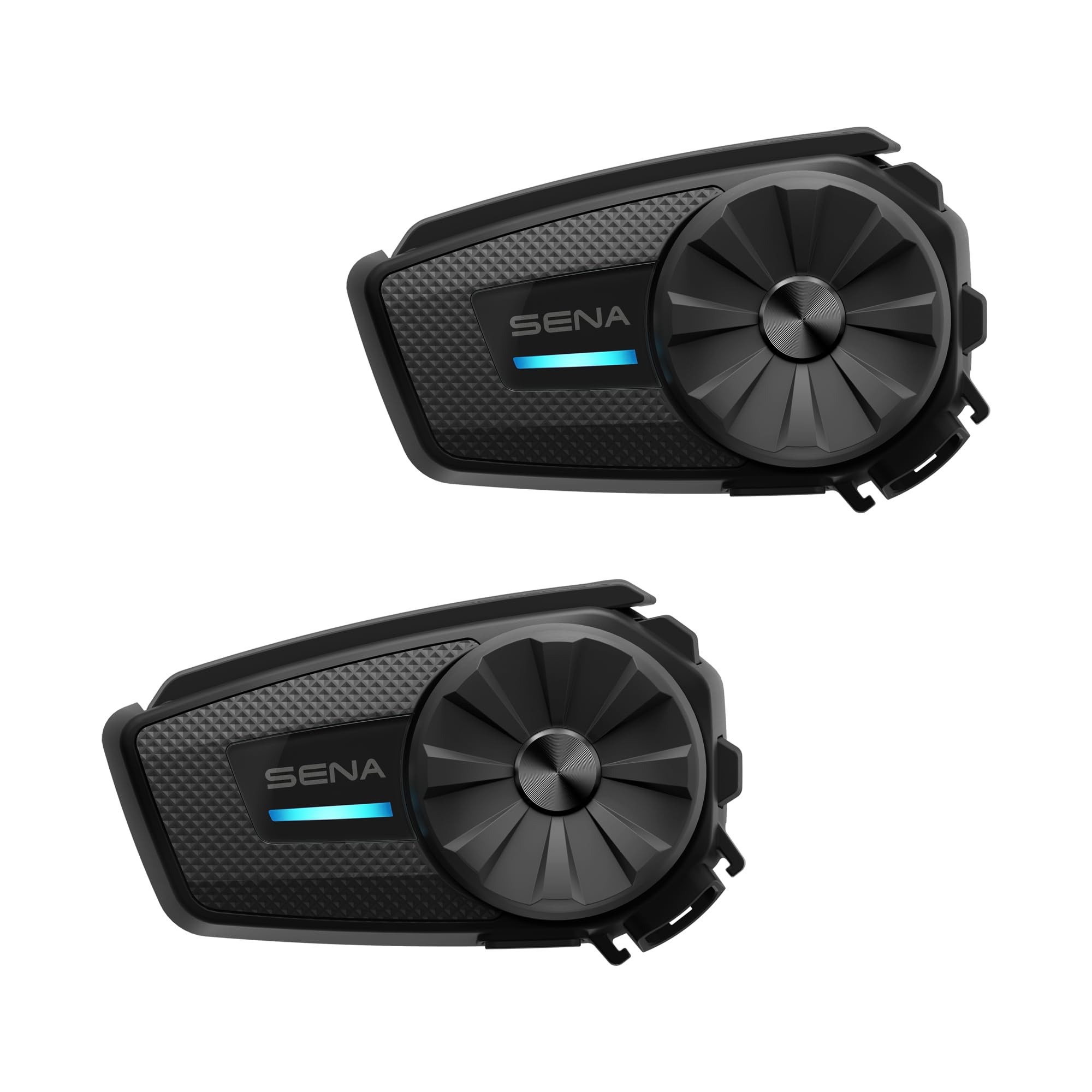
The mesh range king that keeps a massive group connected across miles — 5-mile range beats every other pick here.
When the group splits up to explore different trails, the Sena Spider ST1 keeps everyone in touch up to 5 miles apart. That mesh intercom (a network where every rider acts as a relay) hops the signal from helmet to helmet instead of relying on a single link. The system supports up to 24 riders in a private Group Mesh or unlimited riders on 9 Open Mesh channels.
Real-world snowmobile owners confirm the range: a verified 1-mile connection in cold conditions at -2°F. The battery delivers 12 hours per charge with a fast 60-minute recharge to get back out. The Bluetooth 5.2 chip handles music and GPS from your phone. The HD speakers provide a noticeable volume and clarity boost over older Sena models. A single-button press starts mesh intercom — simple with thick gloves. One reviewer noted occasional channel interference blips across 16 hours of use, but the issue resolved quickly.
The dual pack price is higher than the Cardo PACKTALK Outdoor single, but you get two units ready to ride. For groups that regularly push past a mile apart, this is the only system on this list that reliably holds the conversation.
Why it dominates big groups
- 5-mile mesh range — more than 8x the Cardo PACKTALK Outdoor’s 1 km
- 12-hour battery outlasts any other pick here
- Works at -2°F and recharges in 60 minutes
The fine print
- Dual pack cost is significant for a single rider buying solo
- No voice control; you use a button for everything
- Waterproof rating not stated — treat it as weather-resistant, not submersible
Ideal for: a crew of 4–10 snowmobilers who spread out over different trails and need reliable long-range comms.
Think twice if: you ride alone or just need music — you are paying for mesh range you will not use.
4. Cardo PACKTALK Edge ORV Duo Pack

A rugged off-road duo that keeps a rider and passenger in sync without a phone — IP67 equivalent with the same JBL sound as the Outdoor.
Built specifically for ORV, snowmobile, and ATV use, this duo pack is designed to be mudproof, sandproof, and waterproof (IP67 equivalent). The 40mm JBL speakers deliver the same high-definition audio as the PACKTALK Outdoor. The intercom reaches up to 1 mile between vehicles. The “freedom to roam” design means you can step out of the vehicle and keep talking — spotter mode, essentially — because the connection follows you, not the machine.
Owners confirm that the battery lasts all day and that the unit works well for snowmobiling in particular. One buyer mentioned it held charge longer than the older model. Sound quality gets consistent praise. The catch: wind noise at high speeds degrades audio clarity — a limitation that depends partly on your helmet’s design. The mixed connectivity feedback in reviews suggests that heavy tree cover can occasionally drop links, though reconnection is automatic.
The duo pack price is the highest entry point in this list, but you get two fully featured units from the start. For a rider-plus-passenger setup or two close machines, it avoids buying a second single unit separately. Compared to the Sena Spider ST1 dual pack, the Cardo has equal speaker quality but a shorter range — 1 mile vs 5 miles — though the Cardo is fully sealed against the elements while the Sena’s rating is unstated.
Best for: a snowmobile duo — rider and passenger or two machines that stay within a mile of each other. The waterproof build and all-day battery make it a low-hassle choice for back-to-back days on the trail.
Choose this if: you need two units at once and want the JBL sound quality with full weather sealing.
Skip if: your group stretches past a mile — the range will feel limiting compared to the Sena mesh.
Understanding the Specs
IP Waterproof Rating
The two digits after IP tell you how sealed the unit is. The first (2–6) measures dust ingress; the second (1–8) measures water. For snowmobile use, IP67 (dust-tight plus 30-minute submersion in 1 meter of water) is the gold standard. IP55 (dust-protected plus low-pressure water jets) handles rain but not submersion. A unit with no IP rating is a gamble in wet snow.
Mesh vs Bluetooth Intercom
Standard Bluetooth intercom connects riders in a chain — if the middle rider goes out of range, the whole group drops. Mesh intercom creates a web where every rider routes the signal for the group. Mesh range is typically stated per-rider (e.g. 5 miles) but translates to far more in a line of riders because the signal hops. For groups of 3+ that spread out, mesh is the clear choice.
Speaker Thickness
Most snowmobile helmets have fixed ear pockets. A speaker thicker than the pocket depth pushes against your ear, causing pain on long rides. Standard 40mm speakers are about 12–15mm thick. Ultra-slim systems like the Syphon SoundPro at 9.6mm fit almost any helmet without carving foam. If you swap helmets between brands, slim speakers reduce the risk of a bad fit.
Battery Life vs Real-World Use
Manufacturer battery claims often assume ideal conditions — moderate volume, no wind, no extreme cold. Cold saps lithium-ion batteries faster. A unit rated for 12 hours might deliver 8–9 hours in sub-freezing temperatures. Look for real-world reports from snowmobile owners to get the honest number.
FAQ
Will any motorcycle helmet communication system work in a snowmobile helmet?
How does extreme cold affect the battery life?
Do I need a mesh system or is standard Bluetooth enough?
Can I listen to music and talk to my group at the same time?
How do I attach the system if my helmet has no speaker pockets?
Will the system pair with my phone for GPS and music?
How many riders can talk at once on a mesh system?
What is the difference between Open Mesh and Group Mesh?
Can I use the system with a heated visor or helmet-mounted camera?
Why does the mic cause echo on chairlifts but not on the trail?
Final Thoughts: The Verdict
For most riders, the helmet communication system for snowmobile winner is the Cardo PACKTALK Outdoor because it combines IP67 waterproofing, voice control, and JBL audio into a single unit that works from first ride to last. If your group regularly spans over a mile, the Sena Spider ST1 is the right call with its 5-mile mesh range and 12-hour battery. And for a solo rider who just wants music that fits any helmet without cutting foam, the Syphon SoundPro delivers the thinnest install and the loudest speakers of the set.
How We Picked
We do not accept paid placement. Every pick is matched to a real buyer and a real use-case; we do not hands-on test units.
Sources & Methodology
Specifications: manufacturer listings and product documentation. Review insights: verified customer reviews, as of July 2026. Pricing: not shown on this page (it changes often); check the current price via the retailer link.
As an Amazon Associate, Trending Car earns from qualifying purchases. This does not affect which products we feature.