
Our readers keep the lights on and my garage snacks stocked. As an Amazon Associate, I earn from qualifying purchases.
Specs are compiled from manufacturer listings and verified buyer reviews and can change over time — please confirm the key details on the product page before buying.
A freezing garage turns every project into a chore. You need a heater that blasts real warmth without tripping breakers or burning a hole in your wallet. The right pick depends on your garage size, insulation, and how much power you can actually supply — and the difference between a 1,500-watt plug-in and a 7,500-watt hardwired beast is night and day.
I’m Min Islam — the founder and writer behind Trending Car. This guide is built by comparing the manufacturers’ published specifications and the patterns across verified customer reviews, so you get each pick’s real strengths and trade-offs instead of marketing spin.
heater for garage electric buyers face a choice between portable convenience and permanent power, and this guide maps exactly which model fits your space and budget.
Our Picks at a Glance


How To Choose The Best Heater for Garage Electric
To heat your garage, you first need to match the heater to your space size, your power supply, and your mounting preference. A 1,500-watt portable unit works fine for a small insulated one-car garage, while a 7,500-watt hardwired unit is the only real option for a large, uninsulated two-car shop. Here is what to check before you buy.
Wattage and British Thermal Units (BTU)
Wattage is the raw electrical power the heater pulls, and BTUs (British Thermal Units) tell you how much heat it actually produces. A general rule: you need about 10 watts of heating power per square foot of garage space. A 1,500-watt heater covers roughly 200 to 270 square feet, while a 6,000-watt unit covers about 600 square feet. For a typical two-car garage (around 500 square feet), anything under 4,000 watts will struggle to keep up, especially if the walls and ceiling are uninsulated.
Power Supply: Plug-in vs. Hardwired
Most portable garage heaters plug into a standard 120-volt wall outlet and are limited to 1,500 watts — that is the maximum a typical household circuit can handle. For any serious heating above that, you need a hardwired unit running on a 240-volt circuit. A 240-volt heater can deliver 3,000 watts, 6,000 watts, or even more. This means more heat, but it also means hiring an electrician to run a dedicated line unless you already have the right outlet in your garage. Check your breaker box before buying a high-wattage model.
Mounting and Form Factor
Garage heaters come in three basic forms: portable space heaters you set on the floor, wall-mounted units that save floor space, and ceiling-mounted shop heaters that blast heat downward. Portable units are easy to move around, but they take up floor space and can be a tripping hazard. Wall-mounted and ceiling-mounted heaters are permanent fixtures that free up your garage, but they require installation and are harder to reposition. If you have a dedicated workshop bench, a wall-mounted unit like the Cadet or Brightown keeps the area clear.
Quick Comparison
| Model | Best For | Max Wattage | Heating Coverage | Weight | Amazon |
|---|---|---|---|---|---|
| Dreo Space Heater★ Best Overall | Portable spot heating | 1,500 watts | 270 sq. ft. | 2.1 kg (4.63 lbs) | Amazon |
| VEVOR 7500WTop Performer | Large garages & shops | 7,500 watts | 732 sq. ft. | 20.2 lbs | Amazon |
| DR. INFRARED HEATER DR966 | High-power commercial use | 6,000 watts | 600 sq. ft. | 25 lbs | Amazon |
| Broan-NuTone 198 | Permanent wall heating | 4,000 watts | 265-400 sq. ft. | 11 lbs | Amazon |
| Comfort Zone CZ285 | Workshops & sheds | 1,500 watts | — | 3.75 lbs | Amazon |
| Brightown Smart Wall Heater | Smart & space-saving | 1,500 watts | 200 sq. ft. | — | Amazon |
| Cadet Com-Pak CSC151TW | Permanent in-wall heating | 1,500 watts | 200 sq. ft. | — | Amazon |
In‑Depth Reviews
1. Dreo Space Heater, 1500W
Our pick — 4.5★ from 15,000+ verified ratings; the strongest balance of quality and price.
A whisper-quiet tower heater that oscillates 70 degrees to spread warmth without the roar.
The Dreo is the quietest heater in this lineup at 34dB — about as loud as a library. It uses a 1,500-watt PTC ceramic element to heat up in seconds, and the exclusive trackball oscillation system lets it sweep 70 degrees to push warm air into corners. Shoppers say it heats a room from freezing to comfortable in about an hour, and the ECO mode adjusts power between 1,000 and 1,500 watts to hold your set temperature efficiently.
The unit has eight safety protections including tip-over shutoff and overheat protection, and the V0 flame-retardant materials (materials that resist catching fire) add confidence. It comes with a remote control and a 12-hour timer, so you can set it to warm the garage before you even step inside. The form factor is a slim tower at 5.9 inches deep, so it does not take up much floor space. The catch: like all 1,500-watt plug-in heaters, it pulls 12.5 amps, so you cannot run much else on the same circuit. The fan noise is low, but the oscillation mechanism makes a soft clicking sound that some buyers might notice in a completely silent space.
Standout feature: The 70-degree oscillation with a lifespan of over 750,000 cycles helps distribute warm air more evenly, and the ECO mode uses a built-in temperature sensor to cut power draw when the room is warm enough — a real energy saver for a garage you use daily.
Ideal for: a well-insulated garage or workshop where you want even heat distribution and very low noise. The remote control makes it easy to turn on from across the room.
Not for: a large, drafty garage — 270 sq. ft. is the ceiling here, and the 12.5-amp draw means you need a dedicated circuit.
2. VEVOR Electric Garage Heater, 7500 Watt
The brute-force answer for anyone with a big garage and a 240-volt circuit to feed it.
This is not a space heater — it is a machine. At 7,500 watts (25,600 BTUs), the VEVOR covers a massive 732 square feet, meaning it can heat a two-and-a-half-car garage without breaking a sweat. Unlike the 1,500-watt plug-in models further down this list, this unit requires hardwiring and a circuit breaker rated above 32 amps, so professional installation is non-negotiable. Buyers report it heats their two-car garage or shop easily, with one owner noting it made it through the first winter with no problems.
The unit uses an SPCC cold-rolled steel shell to resist deformation during long use, and it has a built-in overheat automatic power-off protection. You can mount it on a wall or hang it from the ceiling, and the louvers adjust so you aim the hot air exactly where you need it. A remote control lets you change settings from across the garage. The trade-off is that this unit is heavy at 20.2 pounds, so installation is a two-person job, and you need to buy a power cord separately.
Why It Dominates
- 7,500 watts covers 732 sq. ft. — the Dreo 1,500W unit covers 270 sq. ft.
- ETL certified with overheat auto shutoff for safety in a shop environment
- Flexible wall or ceiling mounting with adjustable louvers and remote control
The Real Hurdles
- Requires a 240V hardwired circuit and a breaker above 32A — not for DIY electricians
- Weighs 20.2 lbs and needs a solid mounting surface
- No power cord included; you must supply your own
Grab this if: you have a large, uninsulated garage or workshop (500–732 sq. ft.) and you can have a 240V circuit installed. It blows every 1,500W plug-in out of the water on raw heat output.
Look elsewhere if: you need a simple plug-and-play heater for a small insulated garage — this unit is overkill and requires serious electrical work.
3. DR. INFRARED HEATER DR966 240-volt Hardwired Shop Heater

Heavy-duty 240-volt commercial heat that switches between 3,000 and 6,000 watts on demand.
This unit from DR. INFRARED HEATER is built for serious shops and garages. In high power mode, it delivers 6,000 watts (20,520 BTUs) to cover 600 square feet, and you can drop it to low power mode at 3,000 watts when you only need a milder warmth. It uses a dynamically balanced 8-inch fan to push air with minimum turbulence, making it quieter than many smaller fan heaters. It is UL and CUL listed, and the mounting bracket is included for wall or ceiling installation.
This is a hardwired unit — there is no power cord, so you need to use 8 AWG copper wires for the connection. It weighs 25 pounds, making it the heaviest unit in this lineup, but that weight reflects the heavy-duty construction. The adjustable thermostat has both HIGH and LOW settings, giving you fine control over output. The catch is that at 25 amps, you will need a dedicated 240-volt circuit, which means an electrician visit is almost certainly required unless you already have a suitable outlet in your garage.
Real-world punch: This heater generates up to 20,520 BTUs using 6,000 watts of power, and the 8-inch fan distributes warmth with noticeably less noise than comparable commercial units. The trade-off is the 25-pound weight and the hardwired installation.
Choose this for: a dedicated workshop or commercial garage where you need dual power levels and reliable UL-listed safety. The 600 sq. ft. rating makes it a strong match for a two-car garage.
skip it if: you cannot install a dedicated 240V circuit, or if you want a portable heater you can move between locations.
4. Broan-NuTone 198 High Capacity Wall Heater

A heavy-gauge wall heater that recesses into the wall for a clean, permanent heating solution.
The Broan-NuTone 198 is a different kind of garage heater — it is designed to be recessed or surface-mounted into a wall, making it a permanent part of the room rather than a portable unit. It is factory wired for 4,000 watts at 240 VAC, but you can easily convert it to 2,000 watts at 120 VAC if you only have a standard outlet. The heavy-duty 18-gauge steel grille has downflow louvers that push heat gently toward the floor, preventing that hot-air-on-the-ceiling problem many garage heaters have.
This unit covers 265 to 400 square feet, so it fits a small to medium garage or a large workshop. It includes an adjustable front-mounted thermostat and a manual reset thermal overload protector for safety. Owners mention it is very quiet — one owner who had an older Broan unit said the new one is so quiet they didn’t even think it was working at first. The downside is the mixed reliability in reviews: one builder reported multiple failures across six units installed in a beach house, though other customers note years of trouble-free use. At 11 pounds, it is surprisingly light for a 4,000-watt heater.
What Stands Out
- Can convert from 4,000W/240V to 2,000W/120V — rare flexibility for a permanent heater
- 18-gauge steel grille with downflow louvers for even heating
- Quiet operation; one reviewer noted they barely knew it was running
Watch For
- Some reliability concerns in long-term use reported by contractors
- Covers only 265-400 sq. ft., so it is not for a large uninsulated garage
- Requires cutting into drywall for a recessed install
Best fit for: a medium-sized garage or workshop where you want a flush wall installation that looks built-in. The adjustable power makes it flexible for different electrical setups.
Consider another if: you need to cover more than 400 square feet, or if you are wary of the reported reliability issues from some bulk buyers.
5. Comfort Zone 1,500W Electric Ceramic Garage Heater CZ285
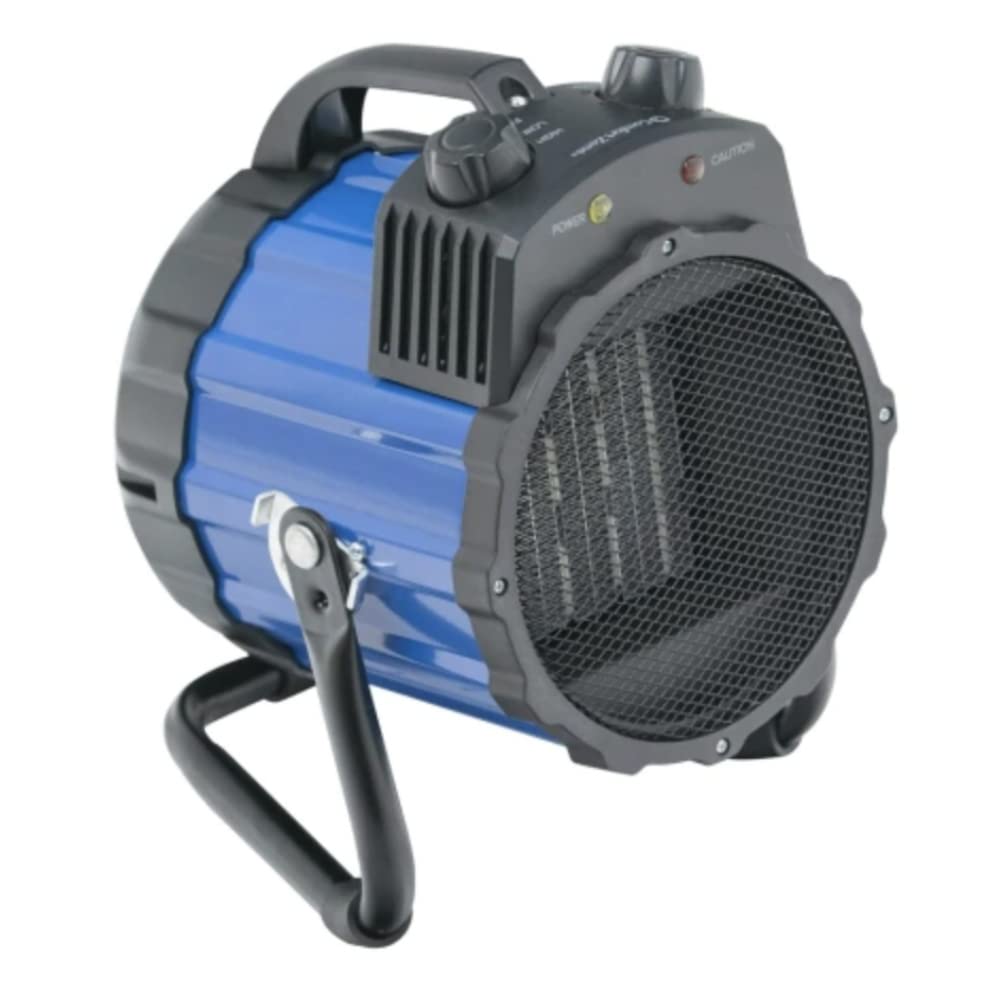
A rugged ceramic heater with a metal frame and pivot base that aims heat exactly where you work.
The Comfort Zone CZ285 is built for the workshop floor. It has a durable metal frame, a sturdy carry handle, and a pivoting cradle base that lets you tilt the heater to point directly at your workbench. It uses a 1,500-watt ceramic heating element to push out warm air quickly. The controls are large dials on top — easy to use even with work gloves on. Reviewers point out it heats a large bedroom in about 3 minutes and puts out powerful, warm air. One buyer mentioned they plan to buy more units for their barn, which tells you it earns trust in tough environments.
It has a built-in overheat protection sensor and a tip-over cutoff switch that shuts the heater off if it gets knocked over. The stay-cool body keeps the exterior safe to touch, and there are power and caution indicator lights to show status. The catch: at 1,500 watts, this is a spot heater, not a whole-garage solution. One owner reported it cannot heat a 450-square-foot poorly insulated shop even with two units running. The power cord is also short, so you need to be close to an outlet. At only 3.75 pounds, it is easy to move, but that lightness means it can tip if bumped hard.
Why It Works in a Shop
- Pivot cradle base lets you direct airflow exactly where you need it
- Durable metal frame and carry handle built for workshop abuse
- Overheat protection and tip-over shutoff add safety on a cluttered floor
Its Limits
- 1,500 watts is only enough for small or well-insulated spaces
- Short power cord limits placement options
- Some buyers found the controls confusing between fan-only, 750W, and 1,500W settings
Reach for this if: you need a tough, portable spot heater for a small workshop bench or shed, and you value a metal frame that can take a knock.
Pass on it if: your garage is larger than 300 square feet or poorly insulated — you will need something with more wattage, like the VEVOR or DR. INFRARED units above.
6. Brightown Smart Wall Heater, 1500W
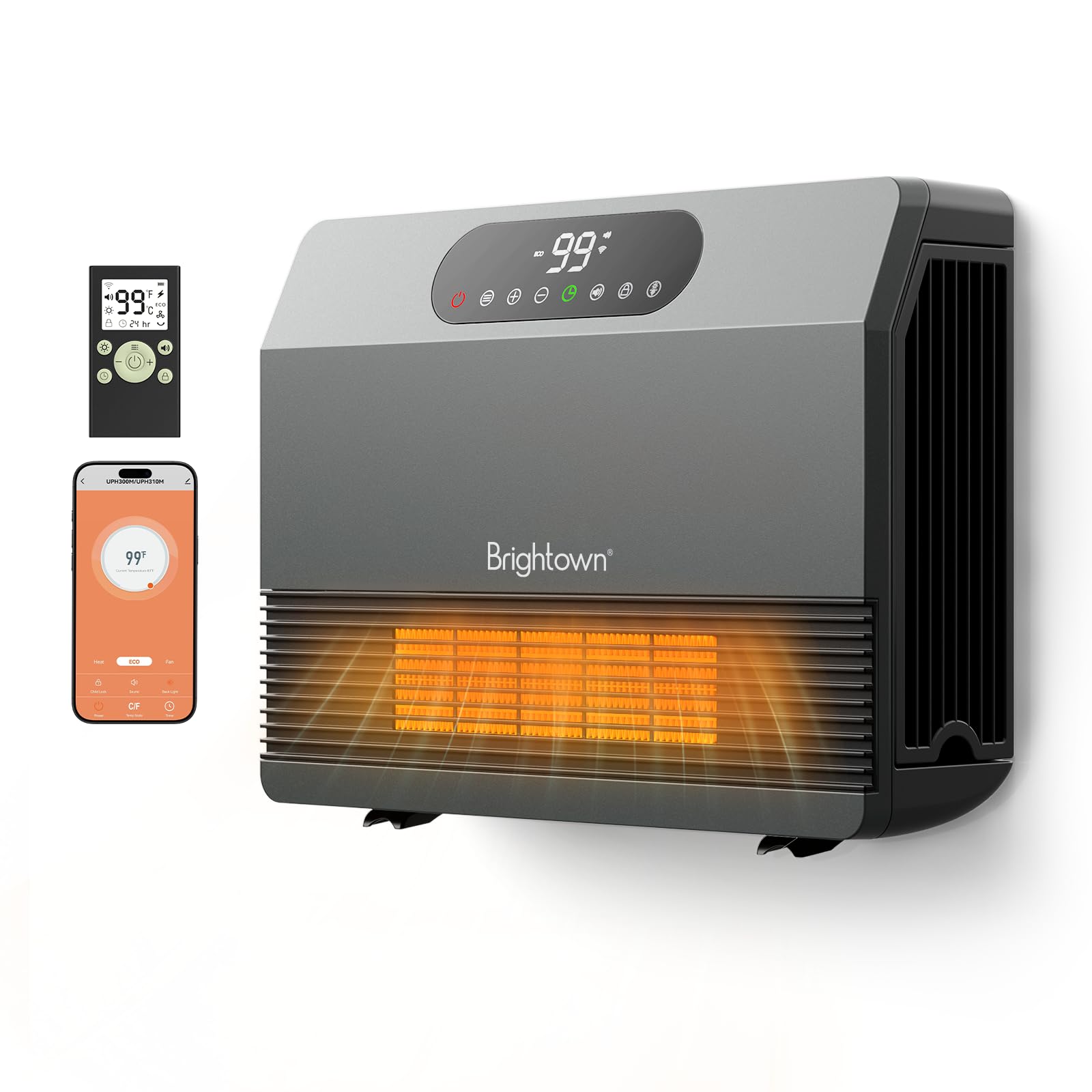
A smart, wall-mounted heater that frees floor space and responds to voice commands.
The Brightown is the only unit here with smart home integration — it works with Alexa, plus you can control it through an app, the included remote, or the touch panel on the unit itself. It mounts to the wall at 16.1 inches wide by 11 inches deep, saving valuable floor space in a cramped garage. It has five modes: ECO, P3 (1,500W), P2 (1,000W), P1 (600W), and a fan-only mode, so you can dial in exactly the power you need. The temperature range goes from 40°F all the way up to 99°F in 1°F increments, giving you very precise control.
Buyers report it heats their whole apartment, and it operates as quietly as a ceiling fan. The ECO mode automatically adjusts heating output once the room reaches your set temperature to save energy. It uses V-0 flame-retardant materials and is ETL listed with overheat protection. The catch: at 200 square feet of coverage, this is the smallest footprint in the lineup — it is meant for a small garage, a workshop nook, or a well-insulated single bay. It also needs a nearby outlet (the cord is standard length), and mounting it requires you to find studs or use drywall anchors, since the 16.1-inch width does not span two studs at standard 16-inch spacing.
The Smart Advantage
- Alexa and app control let you turn on heat before you walk into the garage
- Five power modes (600W to 1,500W) for energy-efficient spot heating
- Wall-mount design keeps the floor completely clear
Space Limits
- Covers only 200 sq. ft. — too small for a typical two-car garage
- Mounting width (16.1″) does not match standard 16″ stud spacing
- Smart features require the Smart Life/Tuya app setup
Pick this if: you have a small, well-insulated garage or workshop and want the convenience of voice control and app scheduling. The wall mount keeps it out of the way.
pass on it if: you need to heat a full two-car garage or any space over 200 square feet — you will be better served by a higher-wattage unit like the Comfort Zone or Dreo.
7. Cadet Com-Pak Electric Wall Heater CSC151TW

A classic in-wall heater that disappears into the wall and runs silently on a standard 120V circuit.
The Cadet Com-Pak is the go-to for anyone who wants a heater that looks like it was part of the house from day one. It installs directly into a wall cavity with a built-in can (the metal box that holds the unit), so only the white 9-inch by 12-inch grille is visible. It runs on a standard 120-volt outlet and delivers 1,500 watts (5,120 BTUs) to cover 200 square feet. It uses a forced-air fan and a radiant heating element, and it comes with an adjustable thermostat built right into the front.
Reviewers consistently say it quickly warms up a small bathroom or powder room, and one owner noted it prevented frozen pipes in a room over an uninsulated crawl space. The unit is designed for a dedicated circuit and requires heat-proof insulation in the wall, so it is not a simple DIY job if you are not comfortable with electrical work. Some buyers warn that it emits a terrible smell for the first day or two as the manufacturing oils burn off — this is normal for a new heater but worth knowing if you are sensitive to odors. At 4 inches deep, it fits into a standard 2×4 wall without protruding much, keeping the garage walls clean.
Heating reality check: This unit is best as a supplemental heater for a small garage workspace or a bathroom, not as the primary heat source for a large garage. The 200 sq. ft. rating and 1,500W output match the Brightown, but the in-wall installation is permanent.
Best for: a small garage workshop or a utility room where you want a flush, permanent heater that does not take up floor space. The built-in thermostat makes it set-and-forget.
Not the one if: you rent your garage (cannot cut into walls), need to heat a large open space, or are not comfortable running a dedicated electrical circuit.
Understanding the Specs
Wattage and Circuit Requirements
Wattage is the single most important spec for a garage heater because it dictates how much heat the unit can produce — and whether your electrical panel can handle it. A standard 1,500-watt heater pulls 12.5 amps from a 120-volt outlet, which is near the max for a typical 15-amp circuit. That is fine for a small garage, but you cannot run lights or tools on the same circuit without tripping the breaker. Once you go above 1,500 watts, you must use a 240-volt circuit, which requires a double-pole breaker and 10-gauge or thicker wire. A 7,500-watt heater like the VEVOR pulls over 31 amps and needs its own 40-amp or 50-amp breaker — that is serious electrical work. Always check your panel before buying a high-wattage heater.
BTU and Coverage Area
British Thermal Units (BTU) measure the actual heat output, while wattage measures electrical consumption. A rough conversion: 1 watt equals about 3.41 BTUs. A 1,500-watt heater produces roughly 5,120 BTUs, which covers around 200 to 270 square feet depending on insulation. A 6,000-watt unit produces 20,520 BTUs and covers about 600 square feet. The coverage number on the spec sheet assumes a well-insulated space with standard 8-foot ceilings. An uninsulated garage with high ceilings or drafty gaps will need more wattage — sometimes double the spec — to feel comfortable. If the data sheet says a heater covers 200 square feet, treat that as the absolute max for a closed, insulated room.
FAQ
Can I run a 1,500W garage heater on a normal extension cord?
How do I know if my garage has a 240V outlet for a high-wattage heater?
Which safety features matter most for a garage electric heater?
Will a 1,500W heater work in an uninsulated garage?
Can I install a wall-mounted heater myself?
How long does an electric garage heater last?
Does a garage heater need its own dedicated circuit?
What is the difference between PTC ceramic and radiant heating elements?
Final Thoughts: The Verdict
Across the board, the heater for garage electric winner is the VEVOR 7500W because it has enough raw wattage to heat a large, uninsulated garage and the ETL certification (a safety standard mark) to do it safely. If you want a portable plug-in that will handle a medium-sized insulated garage, grab the Dreo Space Heater. And for a permanent, flush-mount solution that disappears into the wall, the Cadet Com-Pak CSC151TW is the one to pick.
How We Picked
We do not accept paid placement. Every pick is matched to a real buyer and a real use-case; we do not hands-on test units.
Sources & Methodology
Specifications: manufacturer listings and product documentation. Review insights: verified customer reviews, as of July 2026. Pricing: not shown on this page (it changes often); check the current price via the retailer link.
As an Amazon Associate, Trending Car earns from qualifying purchases. This does not affect which products we feature.