
Our readers keep the lights on and my garage snacks stocked. As an Amazon Associate, I earn from qualifying purchases.
Specs are compiled from manufacturer listings and verified buyer reviews and can change over time — please confirm the key details on the product page before buying.
A two-car garage is roughly 400 to 600 square feet of space that often turns into a deep freeze in winter. The right heater for a 2 car garage doesn’t just blast hot air—it needs enough BTU or wattage to hold steady warmth, fit overhead so you don’t lose floor space, and run safely without you watching it all day. This guide breaks down the real specs and buyer experiences for seven options that can handle the job.
I’m Min Islam — the founder and writer behind Trending Car. This guide is built by comparing the manufacturers’ published specifications and the patterns across verified customer reviews, so you get each pick’s real strengths and trade-offs instead of marketing spin.
Whether you are a weekend mechanic, a woodworker, or just tired of scraping ice off your car inside, you need a heater that matches your garage’s size, power supply, and insulation level, and this breakdown of the best heater for 2 car garage gives you the straight spec-to-real-world comparison to make an informed buy.
Our Picks at a Glance

How To Choose The Best Heater for 2 Car Garage
Picking a garage heater starts with two questions: What fuel source can you supply, and how much power does your space need? An electric model requires a dedicated 240-volt circuit with a specific amperage breaker, while a gas model needs a gas line and proper venting. You also need to consider the physical size of the unit and the mounting options available in your garage.
Understand Your Garage’s Square Footage and Insulation
A standard two-car garage covers roughly 400 to 600 square feet, but your heat needs skyrocket if the garage is uninsulated. A good rule of thumb is that you need about 10 watts of electric heat per square foot for a reasonably insulated space, or roughly 40 BTU per square foot for gas. If your garage has single-skin metal doors and no wall or ceiling insulation, you will likely need a unit at the higher end of the power spectrum to keep up on the coldest days.
240-Volt Hardwired vs. Gas-Fired Heaters
Most electric garage heaters require professional hardwiring to a 240-volt circuit, and you need a dedicated breaker that matches the unit’s amperage draw—anywhere from 20 to 42 amps. A 5,000-watt heater will run on a 30-amp circuit with 10-gauge wire, while a 10,000-watt heater needs a 50-amp or larger breaker. Gas heaters like natural gas or propane units put out far more BTU per dollar and heat the space much faster, but they must be ceiling-mounted with clearance from the floor, and you need a gas supply line nearby. If you don’t have access to gas, a hardwired electric unit is your only practical path.
Thermostat Type and Remote Control
Since most garage heaters are mounted on the ceiling or high on a wall, a unit with a remote control or Wi-Fi connectivity is a huge convenience—otherwise you are pulling a chair over or climbing up to change the temperature. A digital thermostat is more precise than a dial, and a unit with a timer can keep the garage warm on a schedule while saving energy when no one is out there. Some buyers report that a standalone external thermostat works better than the unit’s built-in sensor, so look for models that are compatible with a standard 24-volt thermostat if you want the most accurate temperature control.
Quick Comparison
| Model | Best For | Heat Output (BTU) | Coverage (sq. ft.) | Wattage | Amazon |
|---|---|---|---|---|---|
| Comfort Zone CZ220BK★ Best Overall | Best Value for Basic Spaces | 17,065 BTU | 1,000 sq. ft. | 5,000 W | Amazon |
| Comfort Zone CZ230ERAlso Great | Best Overall Electric | 25,600 BTU | 1,250 sq. ft. | 7,500 W | Amazon |
| TEMPWARE 7500W | High-Output Electric with Remote | 25,590 BTU | 1,250 sq. ft. | 7,500 W | Amazon |
| VEVOR 10,000W | Maximum Electric Power | 34,129 BTU | ~970 sq. ft. | 10,000 W | Amazon |
| Heat Storm HS-6000-GC | Wi-Fi Smart Control | 20,000 BTU | 1,000 sq. ft. | 6,000 W | Amazon |
| Mr. Heater 80,000 BTU | Fast Gas-Heating for Large Garages | 80,000 BTU | 2,667 sq. ft. | — | Amazon |
| Qmark MUH35 | Long-Lasting Commercial Build | 17,065 BTU | — | 5,000 W | Amazon |
In‑Depth Reviews
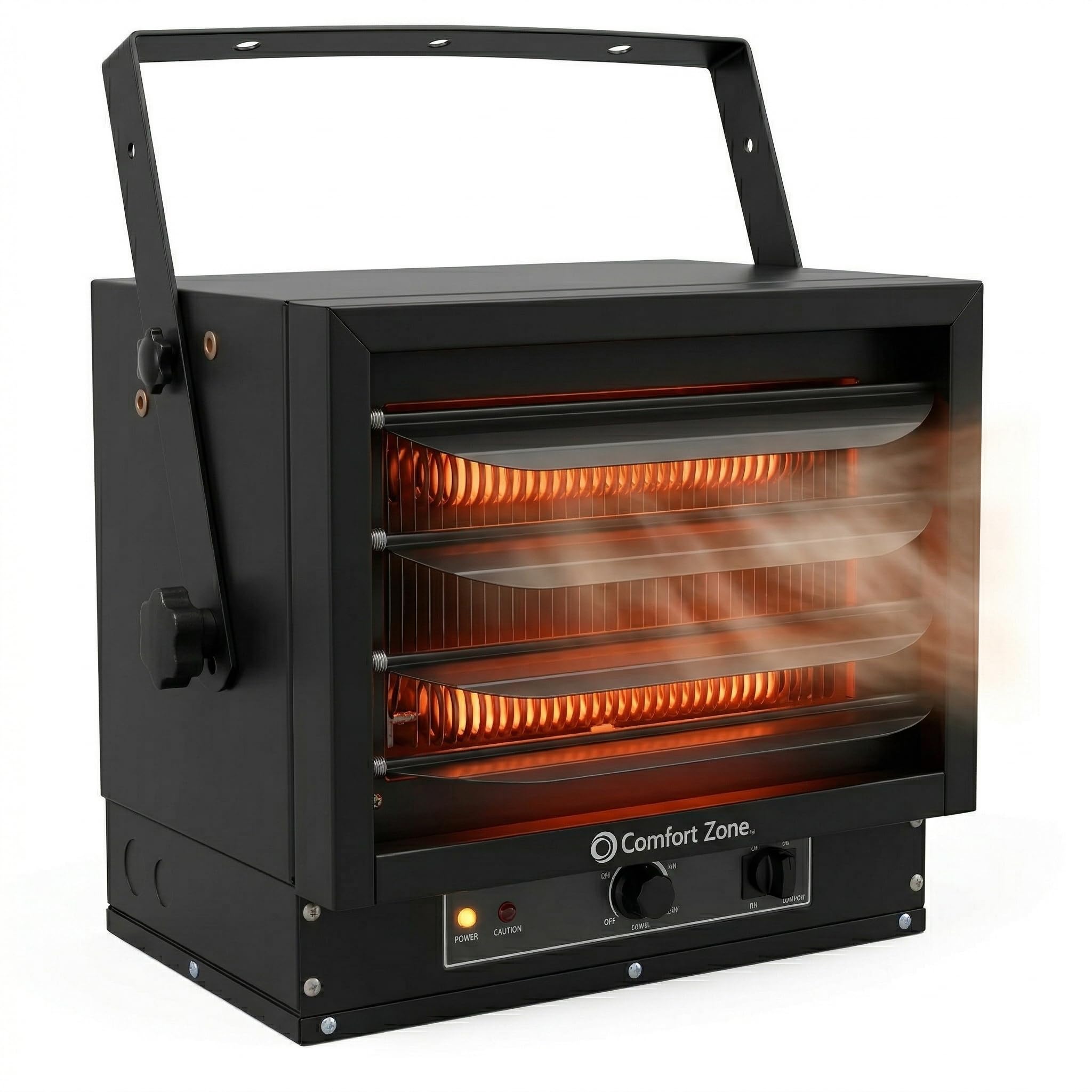
1. Comfort Zone CZ220BK
Our pick — over 4★ from 3,500+ verified ratings; the strongest balance of quality and price.
The 5,000-watt workhorse that kept a garage above freezing through an Omaha winter.
If you want a no-nonsense electric heater that gets the job done without a digital screen or remote, this Comfort Zone CZ220BK is the budget-friendly pick that buyers keep coming back to. It puts out 5,000 watts (17,065 BTU) with a heating coverage of 1,000 square feet, and it uses a simple dual-knob thermostat to control the heat. It operates on a 20.9-amp, 240-volt circuit and needs a 30-amp breaker with 10-gauge wire. A key comparison point: the 7,500-watt CZ230ER puts out 50% more heat (25,600 BTU vs. 17,065 BTU) and covers 25% more area (1,250 sq. ft. vs. 1,000 sq. ft.), but at a higher purchase price and a bigger electrical circuit requirement.
Customers note that this heater is on the quieter side—one buyer measured it at 52 dB at 1 foot and 47 dB at 6 feet. The build uses heavy-gauge steel and finned Kel-rod elements that do not glow red-hot, which feels safer than cheaper coil units. The catch is that the fan assembly often arrives needing some attention; multiple reviews mention that the nut is loose and requires blue Loctite and balancing to run smoothly. It also lacks a fan-only mode, so you cannot use it just for air circulation in the summer.
Smart Buy Reasons
- Quiet enough at 52 dB not to interfere with conversation or music in the garage
- Runs on a manageable 30-amp breaker (20.9 Amps actual draw), simpler than larger units
- Three selectable heat settings (3/4/5 kW) give you flexibility for milder or colder days
What to Watch For
- Fan assembly often arrives loose; many buyers have to reassemble and balance the blade
- No remote control and no digital thermostat—just two knobs, so less convenience than higher-priced models
- No fan-only setting for summer air circulation
Reach for this if: You have a modest budget and a garage that is well-insulated or in a milder climate. It is a capable, quiet heater that does not require complex setup beyond proper wiring.
Look elsewhere if: You need to heat a drafty, uninsulated space in a very cold climate—this 5,000-watt unit lacks the power of the 7,500-watt models for extreme conditions.
2. Comfort Zone CZ230ER
The ceiling-mount electric that brought a New England garage from freezing to comfy in an hour.
This is the unit to look at if you want a hardwired electric heater with a digital thermostat and a remote you can keep on your workbench. The Comfort Zone CZ230ER delivers up to 7,500 watts (25,600 BTU) and covers up to 1,250 square feet, which is roughly double the size of a typical two-car garage so it has plenty of headroom. It runs on a 240-volt circuit (31.25 Amps) and needs a 40-amp breaker and appropriate wiring, so you should expect to bring in an electrician if you are not comfortable with that. The included remote control is a practical choice for an overhead unit you would otherwise need to reach with a ladder.
Owners mention that this model heats a poorly insulated two-stall garage in New England from 15°F to the mid-60s in about one hour, with the remote being essential for that overhead installation. One review noted that a 24×36 insulated pole barn was kept at 62°F when set to 65°F with outside temps in the 30s. The main trade-off mentioned is that the internal thermostat is not perfectly accurate, and some users wire in a separate wired thermostat for better control. There is also no memory after a power loss, meaning the unit powers off and you have to manually reset it.
Why It Leads the Pack
- 7,500 watts (25,600 BTU) heats a 2-car quickly even in poor insulation
- Remote control is genuinely useful for an overhead unit you can’t easily reach
- Digital thermostat with a 12-hour timer lets you schedule heat around your workshop hours
Tucked-Away Shortcomings
- Internal thermostat is inaccurate; a separate wired thermostat is a smart upgrade
- No power-loss memory setting — after a blackout, you cannot just flip the breaker back on
- Requires a 40-amp breaker and 240V hardwiring, so an electrician visit is the norm
Your best bet for: Anyone with a standard two-car garage, especially with poor insulation, who wants powerful electric heat with the convenience of a remote and a timer. It has enough BTU to conquer a cold climate.
Think twice if: You are hoping for simple plug-and-play installation — this unit demands a dedicated 40-amp circuit, and you will likely need to pay an electrician.
3. TEMPWARE 7500W
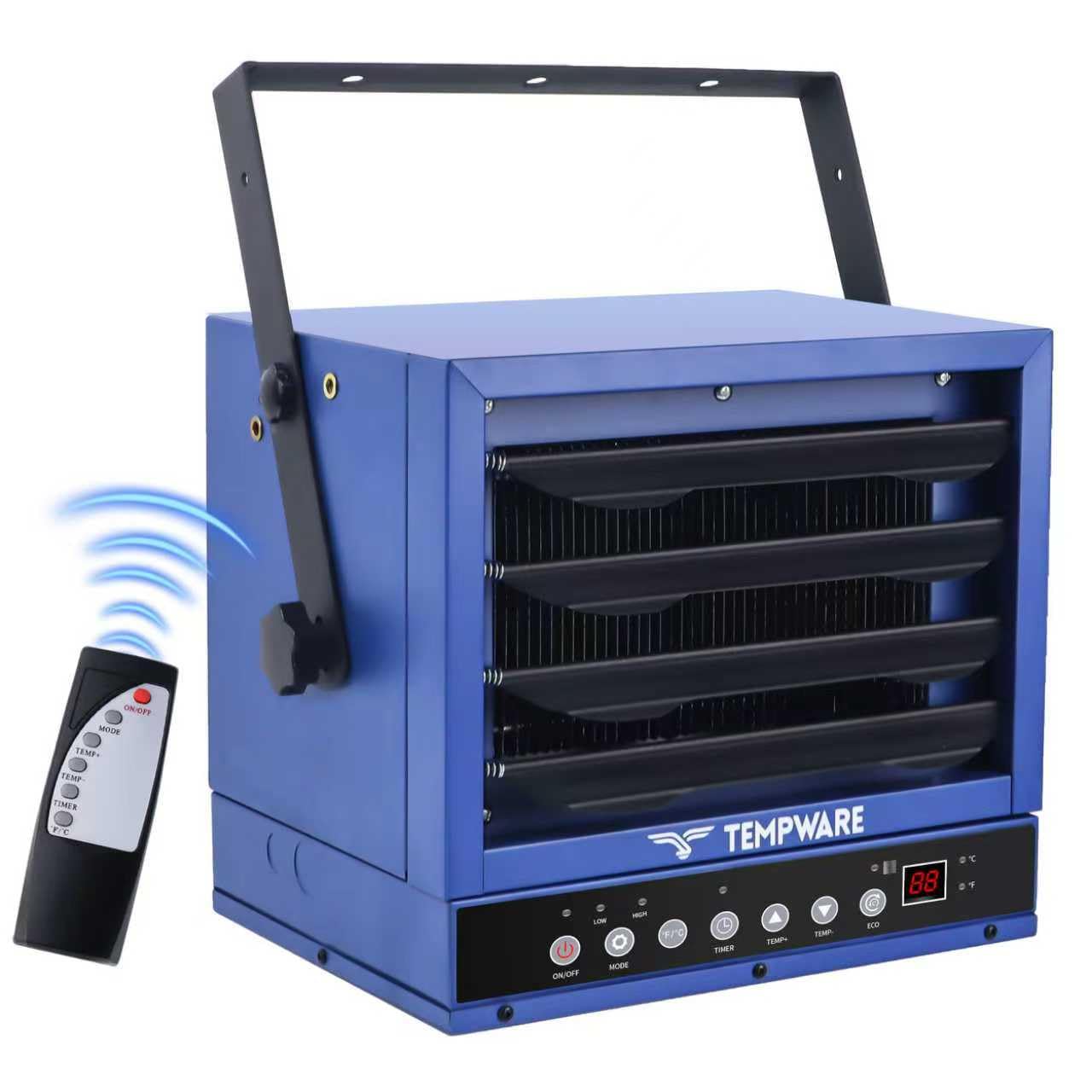
A direct 7,500-watt rival with a digital thermostat and a full-function remote for the same job.
The TEMPWARE 7500W sits as the direct competitor to the Comfort Zone CZ230ER at a similar power level: 7,500 watts producing 25,590 BTU with a coverage claim of 1,250 square feet at 240 volts and 31 amps. It offers a choice between a low setting at 6,250 watts and a high setting at the full 7,500 watts, plus a digital thermostat adjustable from 45 to 95 degrees Fahrenheit and a programmable 12-hour timer. The remote control is a full-function model, so you can adjust every setting without climbing up to the ceiling mount.
Positive buyer feedback highlights that it is “perfect for an average 2 car garage” and works well on a 30-amp/240V circuit. However, one review provides a cautionary data point: the reader reported that the unit failed to heat a 400-square-foot garage in 5 hours when outside temps were 32°F, only reaching 76°F, and the hot air stayed near the ceiling while the floor remained cold. The same reviewer noted the thermostat shuts off prematurely. Other reviews mention no customer support response and a remote without a label, so you are largely on your own if something is unclear.
Strengths to Note
- Digital thermostat with a precise 45–95°F range, allowing fine-tuning of the garage temp
- 12-hour programmable timer for energy-saving schedules
- Heavy-duty steel build with ETL certification for safety
Heads-Up Drawbacks
- One reviewer found it could not effectively heat a small garage in freezing weather—hot air layered near the ceiling
- No customer support response reported; remote lacks a printed label for functions
- Lowest thermostat setting at 45°F is not low enough for frost protection in milder climates
Grab it for: A well-insulated two or three-car garage where a digital thermostat and remote convenience matter, and you are comfortable with a DIY purchase from a newer brand.
Skip it for: Uninsulated garages in extreme cold, or if you want reliable customer support if something goes wrong—the brand has little to no service response according to feedback.
4. VEVOR 10,000W

The 10,000-watt beast that walks past the 7,500-watt crowd for anyone with a heavy electrical service.
When the standard 7,500-watt electric heaters are not enough, the VEVOR 10,000W steps in with a massive 34,129 BTU output from a 240-volt circuit pulling 41.67 amps. That means it requires a 50-amp or larger breaker and 8-gauge or thicker wire, which is a serious electrical commitment—essentially the power draw of an electric range. The coverage is rated at 90 square meters, which works out to about 970 square feet, but the sheer heat output means it will recover temperature much faster in a two-car garage than any 5,000 or 7,500-watt model.
Reviewers point out that this unit handles a 25×30-foot insulated garage with ease and does not cause a shocking electric bill. The build uses SPCC cold-rolled steel, which is resistant to warping over time, and it includes a 9-hour timer and a remote control. One reviewer noted they had to pull the thermostat wire away from the unit to get a more accurate reading—the same problem seen with the Comfort Zone models where the built-in sensor is affected by the heat from the unit itself. The biggest barrier is the electrical requirement, as a 42-amp minimum breaker is not trivial for most home panels.
Big Reasons to Buy
- 10,000 watts (34,129 BTU) is the most powerful electric option in this roundup—no electric unit here beats it for raw heat output
- Cold-rolled SPCC steel build resists long-term deformation better than standard sheet metal
- Remote control and 9-hour timer provide the same convenience as the Comfort Zone CZ230ER
The Installation Reality
- Requires a 50-amp circuit (minimum 42-amp breaker), which many home panels cannot spare without a sub-panel
- Heavier at 30.2 pounds, making ceiling installation a two-person job
- Remote control instructions are sparse; the interface takes some trial-and-error to figure out
For those who need it: A large or very poorly insulated garage where 7,500 watts cannot keep up. If you have the electrical panel capacity, this is the electric heater that will not leave you cold.
Forget it if: Your home’s electrical service is already running near its limit—the 42-amp breaker requirement is a major commitment that many garages cannot support without an upgrade.
5. Heat Storm HS-6000-GC
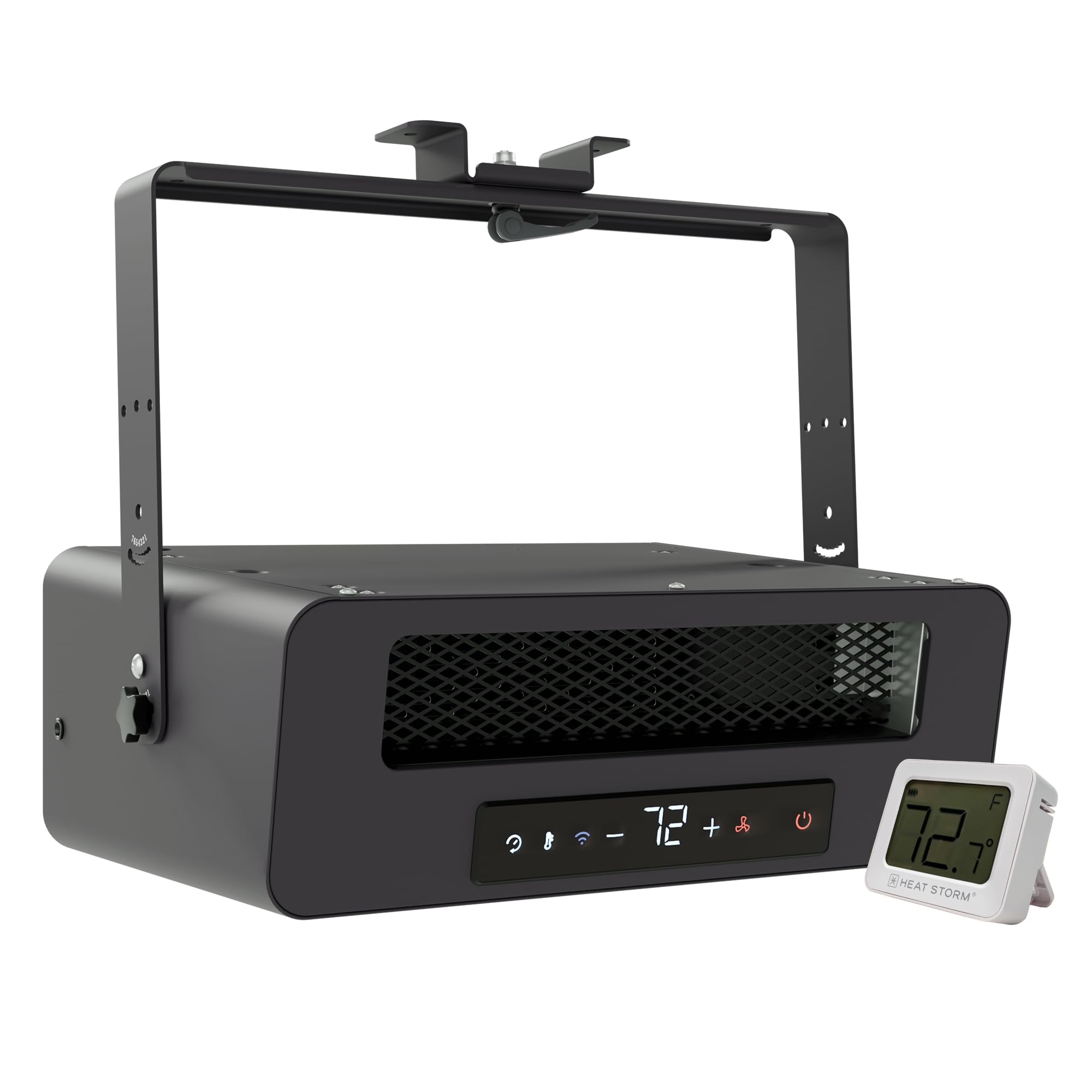
A Wi-Fi-connected electric heater you can turn on from your phone before you even walk out to the garage.
The Heat Storm HS-6000-GC offers a convection heating method rather than forced air, which means it heats more gradually and quietly without a noisy fan, but also requires more time to bring a cold space up to temperature. It delivers 6,000 watts (20,000 BTU) with a heating coverage of up to 1,000 square feet, and it draws 25 amps on a 240-volt circuit (30-amp breaker with 10 AWG wire). The standout feature is Wi-Fi connectivity, which integrates with a web app and supports scheduling—you can set it to warm the garage before you get home. It includes a remote control and an external thermometer for more accurate ambient reading.
Owners of smaller garages (around 400 to 700 square feet) report that it keeps the space comfortably warm even in sub-zero conditions. One buyer mentioned that in a Chicago winter, it heated a 400-square-foot uninsulated garage, but slowly, and that auxiliary fans are needed to push the heat around because the output blows straight out. The unit cycles off when the target temperature is reached, which means the concrete floor tends to stay cold. The internal thermostat reads about 5 degrees high, so you have to set it hotter to compensate. The lack of forced air means it is more suitable for well-insulated garages where you do not need rapid temperature recovery.
Unique Advantages
- Wi-Fi control with scheduling—turn on the heat from anywhere before you head to the garage
- Very quiet convection heat, no loud fan noise while you are working
- Compact at only 7 inches deep, fitting flush on a wall or ceiling without taking up space
Honest Limits
- Convection heating is slower than forced air; uninsulated garages will take long to reach temp
- Internal thermostat reads about 5 degrees high, requiring a trial-and-error compensation
- Hot air tends to stay near the ceiling, leaving the concrete floor cold without a fan to circulate
Ideal for: A well-insulated garage where you want app-based scheduling and quiet operation, not fastest temperature rise. If you value convenience over brute power, this is your unit.
Not the right fit for: Uninsulated garages or anyone who needs rapid heat-up on the coldest days—the 6,000-watt convection system lacks the raw oomph of a forced-air heater.
6. Mr. Heater 80,000 BTU
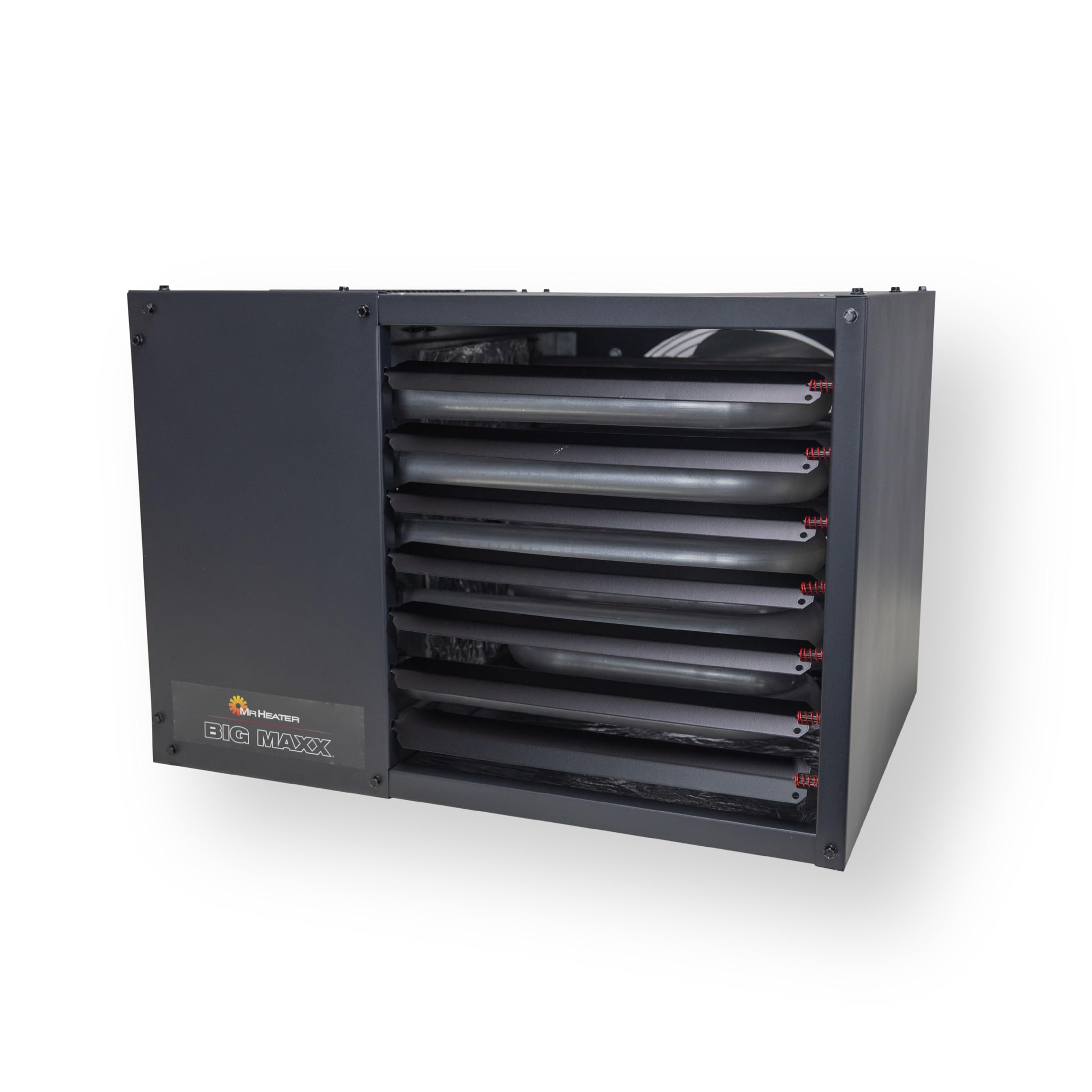
A gas-fired unit heater that takes a two-car garage from 40°F to a workable 60°F in 15 minutes flat.
If you have access to a natural gas line or are willing to use propane (a kit is included for conversion), this Mr. Heater 80,000 BTU unit is an entirely different class of heater compared to electric resistance models. It produces 80,000 BTU of forced-air heat, which is roughly 3 to 4 times the heat output of a 7,500-watt electric heater, and it covers up to 2,667 square feet—far more than any two-car garage needs. The low-profile design allows it to be ceiling-mounted with a minimum 10-foot ceiling height and an 8-foot clearance from the base to the floor.
Buyers rave about the speed. One review notes that a 37×27-foot building with 18-foot ceilings was heated from 40°F to 60°F in just 15 minutes using a Wi-Fi thermostat. Another reports that it handles a 24×36-foot shop with R-13 insulation easily in 10°F weather while using surprisingly little fuel. The heater is compatible with standard 24-volt thermostats and even newer Wi-Fi-enabled ones, so you can pair it with a smart thermostat for remote control. The main catches are that you need a gas line in the garage, the unit requires a minimum ceiling height, and the packaging is not great—several buyers reported cosmetic damage in shipping.
Why Gas Wins
- 80,000 BTU heats a large garage in minutes, not hours—orders of magnitude faster than electric
- Compatible with 24-volt or Wi-Fi thermostats for smart scheduling and remote control
- Extremely quiet during operation compared to electric forced-air units
Gas-Fired Trade-offs
- Requires a gas line (natural gas or propane) plus a 120-volt electrical connection for the fan
- Needs a minimum 10-foot ceiling with 8-foot clearance to the floor—not all garages meet that
- Poor packaging in shipping; multiple shoppers say cosmetic dents that require repair or exchange
Choose this if: You have natural gas in your garage and want the fastest, most cost-effective heat available. It is the clear winner for speed and operating cost—once installed, it is a set-and-forget system.
Pass on this if: You do not have access to a gas line or your garage ceiling is under 10 feet. It also requires professional gas-line hookup, adding to the upfront cost significantly.
7. Qmark MUH35

A field-adjustable commercial heater that lets you match wattage exactly to your garage’s size.
The Qmark MUH35 is a self-contained unit heater from Marley, a brand known for commercial and industrial electrical heating equipment. It delivers up to 5,000 watts at 240 volts (20.83 Amps) but has a unique feature: the wattage is field-adjustable, meaning you can tune the output to match your space during installation. It comes with a built-in thermostat and a mounting bracket for wall or ceiling installation, and the louvers are adjustable to direct the airflow where you need it. The max temperature setting is 90 degrees Fahrenheit, and the unit weighs about 25.5 pounds.
Buyer feedback is mixed. One report notes the heater works very well, but a separate negative review highlights a unit that developed a rattling fan motor after five months, and the company reportedly refused to honor the 5-year warranty for the labor, only covering materials. Another buyer received a unit with a missing screw and shipping scratches, and they pointed out the product description does not mention that no power cord is included, requiring a separate hardwiring purchase. The positive reviews praise its reliability and ease of installation, but the sample size is small with only 32 ratings.
Professional-Grade Appeal
- Field-adjustable wattage gives you flexibility to fine-tune the heater output to your exact garage size
- Built-in thermostat and adjustable louvers offer standard, no-nonsense control
- Marley is a recognized commercial brand with a 5-year warranty (covers materials)
Crucial Hiccups
- No power cord included at all—something buyers find out only after opening the box
- Warranty service is reported to only cover replacement parts, not labor for the repair
- Small sample size of reviews makes it harder to gauge long-term reliability; one unit failed in 5 months
Best suited for: A buyer who values a commercial brand name and adjustable wattage, and who has the time to deal with warranty claims if a defect appears. It is a niche pick for those who want a Marley unit specifically.
skip it if: You want a straightforward purchase with a cord included, a proven strong feedback record, or responsive customer support—the reviews flag real gaps on all three fronts compared to the Comfort Zone models.
Understanding the Specs
BTU vs. Wattage
BTU (British Thermal Units) measures the heat output directly, while wattage is the electrical power consumed to produce that heat. For electric heaters, 1 watt equals roughly 3.41 BTU. A 5,000-watt unit produces about 17,000 BTU, while a 7,500-watt unit produces about 25,600 BTU. Gas heaters are rated in BTU only and are far more energy-dense, so an 80,000 BTU gas heater is in a completely different performance class than any electric unit. For a typical two-car garage, you want at least 17,000 BTU (5,000W) for mild climates, and 25,000 BTU (7,500W) or more for cold winters.
Amperage and Breaker Requirements
Every electric garage heater must be paired with a properly sized circuit breaker and wire gauge. Multiply the unit’s amperage by 1.25 to get the minimum breaker size. A 20.9-amp unit needs a 30-amp breaker with 10-gauge wire, while a 41.67-amp unit needs a 50-amp or larger breaker with 8 or 6-gauge wire. If your garage electrical panel is already near capacity, a high-amperage unit may require a sub-panel or a service upgrade, which is a significant cost consideration. Always check your panel’s available capacity before buying.
FAQ
How many watts or BTU do I need for a standard 2-car garage?
Can I plug a 240V garage heater into a standard household outlet?
What is the difference between forced air and convection heating for a garage?
Do I need a dedicated circuit for my garage heater?
Can I use a propane or natural gas heater safely in a garage?
Will a 5,000-watt heater be enough for a 2-car garage in the Midwest winter?
What does it mean when a heater has a “field-adjustable wattage” feature?
Why do some garage heaters require a minimum ceiling height for installation?
Final Thoughts: The Verdict
If you want one dependable pick, the best heater for 2 car garage winner is the Comfort Zone CZ230ER because it delivers 7,500 watts with a digital thermostat and remote control, hitting the balance between power and price for a standard two-car garage. If you want the absolute fastest heat and have a gas line, grab the Mr. Heater 80,000 BTU. And for the best value on a budget, the Comfort Zone CZ220BK provides quiet, reliable 5,000-watt heat for milder climates or well-insulated spaces.
How We Picked
We do not accept paid placement. Every pick is matched to a real buyer and a real use-case; we do not hands-on test units.
Sources & Methodology
Specifications: manufacturer listings and product documentation. Review insights: verified customer reviews, as of July 2026. Pricing: not shown on this page (it changes often); check the current price via the retailer link.
As an Amazon Associate, Trending Car earns from qualifying purchases. This does not affect which products we feature.