
Our readers keep the lights on and my garage snacks stocked. As an Amazon Associate, I earn from qualifying purchases.
Specs are compiled from manufacturer listings and verified buyer reviews and can change over time — please confirm the key details on the product page before buying.
Faded, yellowed headlights don’t just make your car look older—they cut your nighttime visibility and safety. The real fix is a dedicated UV protectant that blocks sunlight before it can bake your lenses. This guide compares three proven options to help you choose the longest-lasting headlight UV protectant.
I’m Min Islam — the founder and writer behind Trending Car. This guide is built by comparing the manufacturers’ published specifications and the patterns across verified customer reviews, so you get each pick’s real strengths and trade-offs instead of marketing spin.
You just polished your headlights clear again, or you have a fresh set you want to keep that way. The headlight uv protectant you pick depends on one thing: how much elbow grease you want to put in and how many months you want the shield to hold.
Our Picks at a Glance
How To Choose The Best Headlight UV Protectant
The biggest mistake is using a polish or wax that claims UV protection but washes off quickly. A dedicated UV protectant creates a sacrificial layer that absorbs or blocks sunlight before it reaches the polycarbonate lens. Choose one that matches your desired effort and reapplication frequency.
Aerosol vs. Wipe-On Application
Aerosols like the Meguiar’s spray are the simplest to apply—spray, let it dry, done. But you have to mask off the surrounding paint to avoid overspray. Wipe-on sprays like the McKee’s 37 are better if you want precise control, but they require a microfiber towel and a little more elbow grease.
Prep Work: Sanding or No Sanding?
If your headlights are already hazy, a UV protectant alone won’t fix them—you need to sand and polish first. Some products, like the Detour, can serve as both a restorer and a protectant, saving you a step. Products like the McKee’s 37 explicitly require clean, undamaged lenses to bond correctly, so skip sanding only if your lights are already clear.
Longevity: How Long Does It Last?
The Meguiar’s coating lasts up to a year, while the McKee’s sealant claims years of protection with one application. But “years” comes with a caveat: you need to reapply it every few washes to maintain the barrier. The Detour is a 2-in-1 that offers professional-grade durability, but a small number of buyers report it drying opaque.
Quick Comparison
| Model | Best For | Application | Protection Claim | Bottle Size | Amazon |
|---|---|---|---|---|---|
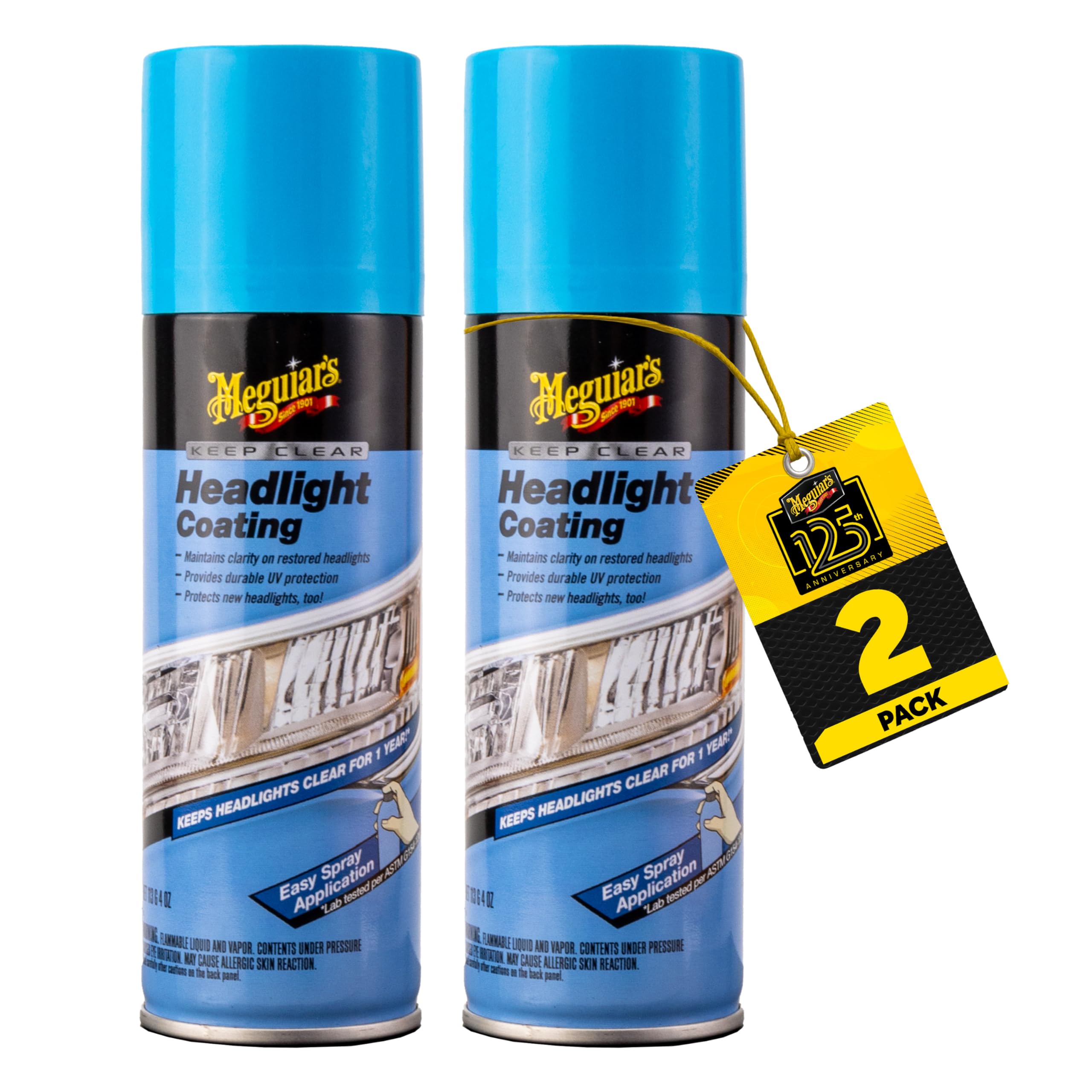
| Meguiar’s Keep Clear★ Best Overall | Easiest no-wipe coating | Aerosol spray (dry) | Up to 1 year | 4 oz (2-pack) | Amazon |
| Detour 1-Step | 2-in-1 restore + protect | Aerosol spray (dry) | Long-lasting UV clear coat | 3 oz | Amazon |
| McKee’s 37 | Wipe-on precision sealant | Spray + wipe | Years (one use, periodic reapplication) | 8 oz | Amazon |
In‑Depth Reviews
1. Meguiar’s Keep Clear Headlight Coating
Our pick — 4.5★ from 14,500+ verified ratings; the strongest balance of quality and price.
The spray-and-walk-away coating keeps lenses factory-clear for up to a year.
This is the easiest high-volume winner because you simply spray it on and let it dry. No wiping, no buffing, no special technique. The aerosol can covers a 4-ounce pair, and owners mention the clarity stays bright for months with UV protection that actively prevents yellowing. The real-world catch, as customers note, is that intensive sun—”California sun” specifically—means you should reapply within 2 years, and the formula is not the most durable on the planet, with reapplication needed after several months in harsh conditions. On clarity, sentiment is split: many say their headlights stay clear, while some find the layer can fog over time. Overall, the vote is overwhelmingly positive, with 987 owners calling out effectiveness and 368 praising the ease of use.
This is the fastest way to lock in your polish job. Mask the paint to catch overspray, spray two light coats, and walk away. The can measures 7.75 x 1.86 x 1.86 inches—noticeably bigger than the McKee’s 37 bottle (1.5 x 1.5 x 7 inches)—so you get more product per can. It also works on other exterior plastics like trim and bumpers. skip it if you hate masking tape; the aerosol overspray means you must tape off the surrounding paint.
Why it wins
- Aerosol application—literally spray, dry, done.
- UV protection layer holds up to sun exposure.
- Great value 2-pack for multiple vehicles.
Keep in mind
- Must mask paint to avoid overspray.
- Clarity results vary—some lenses fog.
- Not the most durable; needs reapplication every few months under heavy sun.
Grab it if: you want the least-effort coating that lasts up to a year on a clear or restored lens.
Think twice if: you live in extreme desert sun and want a single application that won’t need a touch-up.
2. Detour 1-Step Headlight Restoration Spray
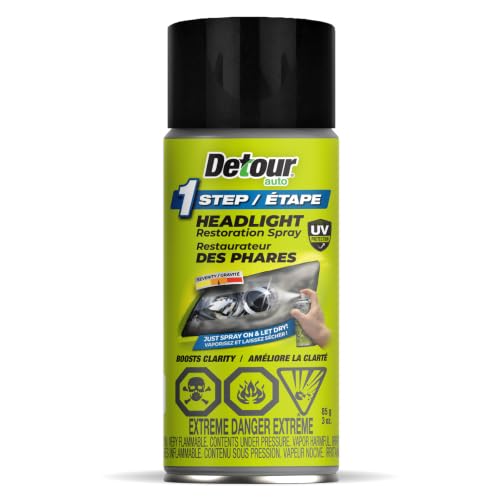
A single can that restores hazy lenses and seals UV protection in one step.
The Detour spray is built for the owner who wants to do only one job. It works on lightly oxidized headlights right out of the can—spray two coats, let it air dry, and the coating self-levels into a glossy clear finish that boosts light output immediately. On severely faded lenses, you can wet-sand first and then use this as your protective topcoat. The reviews reflect this split personality: owners love the ease and final look—”no scrubbing, no multiple steps, no grinding”—and the effectiveness score (9 mentions) backs it up. But the honest trade-off is real—a few reviewers point out it drying opaque instead of transparent, and some then had to spend an hour wet-sanding to fix the surface. As shoppers say: the product requires careful humidity control and grid-pattern spraying; if you rush it, the coating can fail.
This is not a low-maintenance product for everyone. But for the DIY-er who knows how to prep a lens and wants a professional-grade UV clear coat in a 3-ounce can, the Detour delivers results that genuinely make lenses look new. The manufacturer says it’s safe on all plastic lenses, including taillights and fog lights, and is silicone-free—important if you ever want to repaint down the line.
Why it stands out
- Single product for restoration and UV protection.
- Self-leveling finish—no wiping, no buffing.
- Respects professional quality: silicone-free, safe on all plastic lenses.
Watch out for
- Opacifying risk if humidity or spray pattern is off.
- Small bottle (3 oz) goes quick if you mess up a coat.
- 129 total ratings—small sample, mixed quality feedback.
Reach for this if: you are comfortable doing a single-step restoration and want a clear coat that actively fights UV.
pass on it if: you want a simple wipe-on maintenance product that doesn’t require precision spraying.
3. McKee’s 37 Headlight Protectant Spray

The professional-grade wipe-on sealant that lasts for years when applied to clean lenses.
You get precision with the McKee’s 37. Spray it directly onto the lens and wipe it off with a microfiber towel—no masking, no overspray worries. The polymer formula creates a durable barrier against grime and debris, and the maker claims one 8-ounce bottle can protect over 10 headlights. Owners call it easy to use (15 mentions, the top positive aspect) and reliable (14 mentions). One long-term owner says it keeps lenses “crisp with no yellowing or fogginess.” The honest caveat: it only works on clean, undamaged lenses. If your lights are already hazy, you must replace them or sand them down first. Compared to the Meguiar’s aerosol, the McKee’s bottle is a compact 1.5 x 1.5 x 7 inches vs. the Meguiar’s 7.75 x 1.86 x 1.86 inches but holds 8 oz of product—enough for several applications across 2-3 cars per year if used every two months. it’s not for you if you want a spray-and-forget clear coat; this one requires wiping.
The product has been around since 2016 and has a small but loyal following. Just set your expectations: you need to reapply it every few washes for best results, and the true UV protection claim (“years”) can’t be verified by a single season. For a maintenance sealant that is easy to apply and stays clear, this is a trusted choice.
Why it works: The wipe-on process gives you total control—no overspray, no fogging risk—and the UV barrier is proven to prevent yellowing.
The only catch: It demands a pristine lens to bond; this is not a restorer. Use it after a full polish or on brand-new lights.
Best for: owners who want a simple, precise UV sealant that lasts years with occasional reapplication.
Look elsewhere if: your headlights are already hazed and you don’t plan to sand and polish first.
Understanding the Specs
Aerosol vs. Wipe-On Application
Aerosol sprays (like the Meguiar’s and Detour) let you coat the lens and walk away—no touching, no streaks. The trade-off is that overspray can land on paint, so you must mask the surrounding area. Wipe-on sprays (like the McKee’s 37) go on exactly where you point them and require a dry microfiber wipe to level out the layer. The wipe-on method is better for precision and reuse; the aerosol method is faster for a full pair of lights.
Protection Longevity
UV protectants degrade at different rates. Meguiar’s claims up to a year, while McKee’s says one application lasts for years—but that requires periodic reapplication every few washes to keep the barrier strong. Detour doesn’t quote a specific duration, but its thicker clear-coat style is intended to outlast a standard wax or polish. In general, the longer the claimed lifespan, the more careful prep work is required upfront (sand, polish, clean).
FAQ
Will a headlight UV protectant fix yellowed lenses by itself?
How long does Meguiar’s Keep Clear actually last on the lens?
Can I use Detour 1-Step on lenses that are already clear and just want UV protection?
Is McKee’s 37 safe on vinyl windows and windscreens?
Do I need to mask my car’s paint when using an aerosol headlight coating?
Does McKee’s 37 work on damaged or deeply scratched lenses?
What is the best way to prepare a lens for Detour 1-Step?
Can I apply a UV protectant over a wax or sealant already on my headlights?
How often should I reapply a headlight UV protectant?
Which is bigger: the Meguiar’s Keep Clear bottle or the McKee’s 37 bottle?
Final Thoughts: The Verdict
For most owners who want the easiest, longest-lasting UV protection with the least effort, grab the Meguiar’s Keep Clear. Its aerosol spray delivers a clear coat that lasts up to a year with zero wiping. If you prefer the control of a precision wipe-on sealant and want a product that stretches over 10+ headlights, the McKee’s 37 is a reliable choice with years of potential protection. And if you are tackling a faded set of lenses and want a single can that both restores and shields from UV, the Detour 1-Step is the most efficient 2-in-1 on the shelf.
How We Picked
We do not accept paid placement. Every pick is matched to a real buyer and a real use-case; we do not hands-on test units.
Sources & Methodology
Specifications: manufacturer listings and product documentation. Review insights: verified customer reviews, as of July 2026. Pricing: not shown on this page (it changes often); check the current price via the retailer link.
As an Amazon Associate, Trending Car earns from qualifying purchases. This does not affect which products we feature.