
Our readers keep the lights on and my garage snacks stocked. As an Amazon Associate, I earn from qualifying purchases.
Specs are compiled from manufacturer listings and verified buyer reviews and can change over time — please confirm the key details on the product page before buying.
Finding a rear tire that actually hooks up on wet rocks, loose loam, and steep, root-infested climbs can feel impossible — until you know which compounds and ply ratings are built for the abuse. This guide cuts through the marketing to show you four proven hard enduro tires, each with the exact specs and real-rider feedback that tell you what it actually does on the trail.
I’m Min Islam — the founder and writer behind Trending Car. This guide is built by comparing the manufacturers’ published specifications and the patterns across verified customer reviews, so you get each pick’s real strengths and trade-offs instead of marketing spin.
Whether you ride a 250, a 450, or an e-bike, the right rubber changes everything — and we break down the top contenders in this hard enduro tire guide by what matters most: ply rating (the number of layers in the tire casing) for pinch-flat (a flat tire caused by the rim pinching the tire against a hard edge) prevention, compound stickiness on slick surfaces, and how each handles mud versus dry hardpack.
Our Picks at a Glance
How To Choose The Best Hard Enduro Tire
Hard enduro riding is all about crawling over boulders, clawing up wet roots, and picking lines through mud ruts. A standard motocross tire, built for high-speed berms and hard pack, simply won’t cut it. You need a tire with a specific mix of ply rating for puncture resistance, rubber compound for stickiness, and tread shape to self-clean in sloppy conditions.
Ply Rating: The Armor Underneath
The ply rating tells you how many layers of casing material are under the tread. A 4-ply tire is light and flexible, conforming to rocks for grip, but it is more vulnerable to a sharp-edge pinch flat (a flat tire from the rim pinching the tire against a rock edge). A 12-ply tire is heavier and stiffer, giving you serious puncture protection when you slam a rear wheel into a jagged rock at low speed. For extreme terrain, most experienced riders choose a higher ply count even though it adds rotating weight (the weight of the spinning tire and wheel, which affects acceleration).
Rubber Compound: Sticky vs. Durable
Hard enduro tires use a soft, tacky rubber — sometimes described as “trials-like” (like a trials motorcycle tire, designed for ultra-low-speed traction on obstacles) — that deforms around rocks and roots rather than sliding off them. The benefit is incredible traction when you need to creep up a wet slab. The downside is accelerated wear, especially if you hit paved connecting roads. A few tires also blend a stiff sidewall with a soft center compound to get durability where you need it and grip where you need that.
Tread Pattern: Knobs That Dig and Clear
The spacing and height of the knobs matter. Widely spaced lugs (the raised rubber blocks on a tire tread) let mud and clay shed from the tire so the knobs stay sharp and digging. Tighter, motocross-style knobs can pack up in wet loam and turn into a slick donut. Many hard enduro tires use a hybrid pattern that borrows from trials tires — tall, soft, flexible knobs that wrap around obstacles — while keeping enough space between them for self-cleaning in softer soil.
Quick Comparison
| Model | Best For | Ply Rating | Item Weight | Load Index | Amazon |
|---|---|---|---|---|---|
| Tusk Recon Hybrid (110/90-19)★ Best Overall | Budget trail riding | 4-Ply | 18.1 Pounds | 65.0 | Amazon |
| Shinko R525 Cheater Rear (120/100-18) | Loam & loose soil | 12-Ply | 17.25 Pounds | 68.00 | Amazon |
| Shinko R505 Sticky (110/100-18) | Dry hardpack & rocks | — | 10 Pounds | 64.0 | Amazon |
| IRC Enduro VE33 Rear (100/100-17) | Light bikes & smaller wheels | 12-Ply | 7.8 Pounds | 51 | Amazon |
In‑Depth Reviews
1. Tusk Recon Hybrid Tire 110/90-19
Our pick — 4.5★ from 70+ verified ratings; the strongest balance of quality and price.
The flexible 4-ply hybrid that lasts two years on a 250 and costs half of the premium picks.
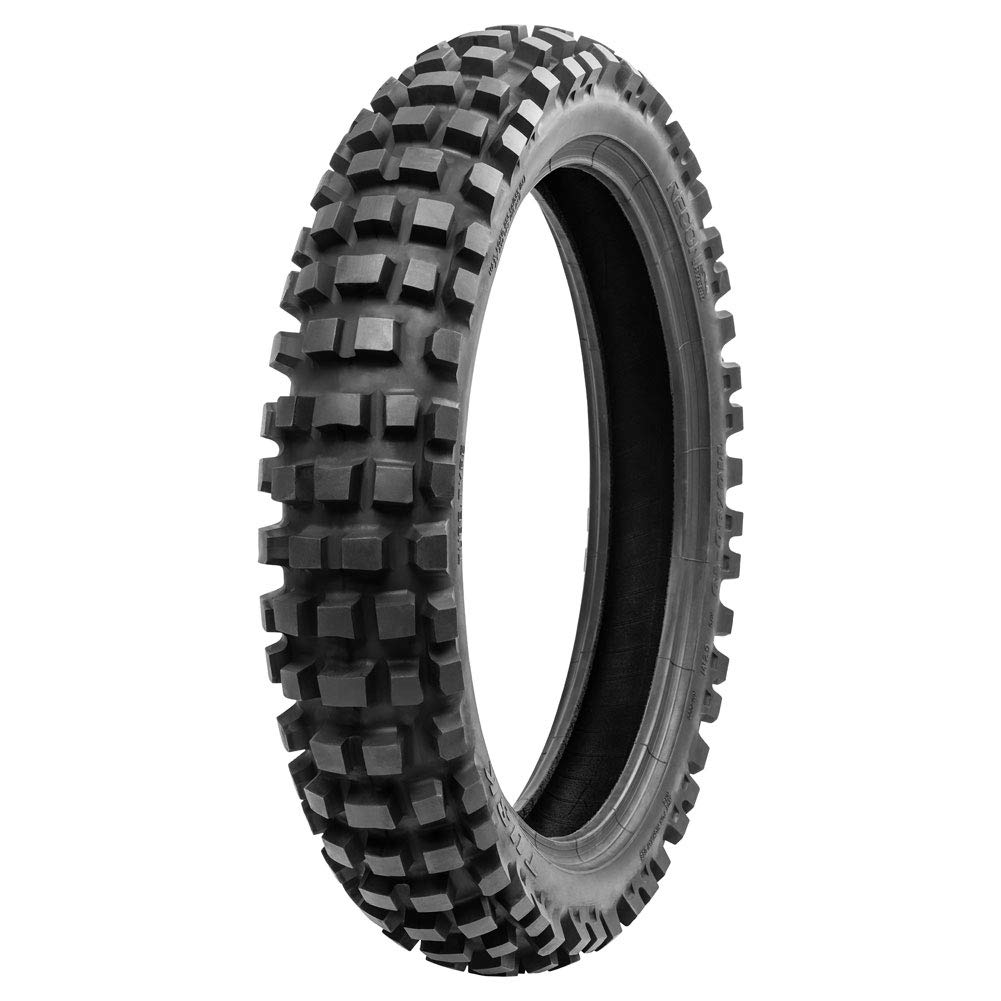
Do you ride a smaller-displacement bike or an e-bike and need a rear tire that hooks up while staying affordable? The Tusk Recon Hybrid uses a soft, sticky rubber compound (like a trials tire) in a motocross-inspired tread pattern that works across mud, sand, rocks, and aggressive braking. The carcass (the tire’s main body, beneath the tread) is much softer than a standard off-road or motocross tire, so it conforms around roots and rocks for traction, but it has better handling manners than a pure trials tire for cornering on faster sections.
The honest trade-off is in the ply count. At 4-ply, this tire is more vulnerable to a pinch flat in severe rock gardens compared to the 12-ply Shinko R525 — but many riders never hit that limit. One buyer says the “last one I had lasted 2 years of fairly regular use” on a 250, and the tire has held up over 750 hours in Colorado sand, rocks, and gravel for another rider. It is also the heaviest option here at 18.1 pounds, so it adds rotating mass (the spinning weight) on a light bike. Several owners even mount it on Talaria and Surron e-bikes for improved grip in PNW conditions (Pacific Northwest weather—wet, muddy, and rooty).
Value Highlights
- Soft compound grips wet roots and rocks well for the price.
- Versatile tread pattern works in mud, sand, and loam.
- Buyers report 2+ years of regular trail use on a 250.
What to Watch
- At 4-ply, you trade puncture protection for weight savings over a 12-ply tire — but it is still 18.1 lb, heavier than the 12-ply R525.
- Some riders note wheelspin on more powerful 450cc bikes.
Reach for this if: you are on a budget, ride a 250 or an e-bike in mixed terrain, and want a sticky tire that won’t wear out in one season.
Skip it for: extreme rocky enduro courses where a 12-ply carcass (like the R525’s) is the smarter insurance against a flat.
2. Shinko R525 Cheater Rear Tire (120/100-18)

The 12-ply brute that laughs at sharp rocks and digs through deep loam.
When your trail turns into a loose, loamy climb where the rear wheel wants to spin freely, this is the tire that bites and keeps pulling. The Shinko R525 uses a soft, sticky rubber compound like a trials tire, but its knobby tread pattern (with widely spaced lugs) clears mud so you maintain forward grip instead of packing up into a slick surface. At 17.25 pounds, it feels substantial on the bike, but that weight comes from a 12-ply carcass (a tire casing with 12 layers of rubberized fabric) — giving you serious pinch-flat (a flat tire from the rim pinching the tire) resistance compared to the 4-ply Tusk Recon Hybrid.
Buyers consistently point out its performance in the northeast on wet roots and rocks, calling it “super soft” with “great traction” for single-track (narrow, one-lane trails). The trade-off is that this is not a tire for dry, hard-packed fire roads — Shinko specifically says the 525 “excels in looser loamier soil,” while the lighter R505 Sticky handles harder conditions. If your riding is mostly rock gardens and root-filled creek beds, the load index of 68.00 (the highest among the four picks here) gives you confidence when the bike is fully loaded over jagged edges — it can carry a heavier load without damage than the 64.0-rated R505 or the 51-rated IRC VE33.
Why It Owns the Loam
- 12-ply construction means few pinch flats, even on square-edge rocks.
- Soft compound conforms around wet roots for grip when momentum drops.
- Loam-friendly tread clears mud rather than packing up.
The Weight Trade-Off
- At 17.25 lb it is noticeably heavier than the 10 lb R505 Sticky, which you feel on climbs.
- Soft rubber wears faster on pavement sections between singletrack.
Grab this if: your home terrain is loose loam, mud, and technical single-track where puncture resistance and deep-digging traction are everything.
Consider the R505 instead if: you ride more dry hardpack and rocks, since that tire is lighter and shines in harder conditions.
3. Shinko R505 Sticky 110/100-18 Tire

The trials-level stick that clings to polished granite like a basketball shoe on hardwood.
Where the heavier R525 is built for loam, the R505 Sticky is the specialist for dry, hard conditions where you need every knob pulling on slick rock. Shinko calls this their “ultimate hybrid off-road tire,” and the secret is an ultra-soft sticky rubber compound (the same family as the Trail Pro trials tire) molded into a knobby tread pattern. You get the conforming grip of a trials tire (a tire made for trials riding, with an extremely soft rubber that wraps around obstacles) — it “sticks like basketball shoes on clean hardwood,” as one rider put it — but with enough tread space to handle looser soil on top of the hard base.
There is a catch here that buyers openly share: “longevity unknown after 100 miles.” If you ride paved connector sections or dry, abrasive hardpack, the soft compound will wear faster than a more durable tire. The R505 is also not DOT-rated (not approved by the Department of Transportation for on-road use) for road use, so keep it strictly off-road. It is a full 7.25 pounds lighter than the R525, and that lower rotating mass (the weight of the spinning tire) makes the bike feel more responsive on technical climbs and easier to loft over obstacles. At a load index of 64.0, it handles a 582-pound load capacity — plenty for any dirt bike.
Stickiness Verdict: The R505 is unbeatable on dry rock gardens and desert hardpack, but you pay for that grip with faster tread wear.
Who It Fits: Riders in Arizona, Colorado, and California who want to claw up smooth granite slabs without the 17-plus-pound heft of a 12-ply tire like the R525.
4. IRC Enduro VE33 Rear Tire – 100/100-17 T10096

A 12-ply fortress that weighs just 7.8 pounds — built for lightweight bikes and 17-inch rims.
The IRC VE33 Rear Tire is a specialist in its own lane: a 17-inch, 12-ply rear tire that is 10.3 pounds lighter than the Tusk Recon and about 9.5 pounds lighter than the Shinko R525. That is a massive unsprung weight difference (the weight of parts not supported by the suspension, like the tire and wheel) that makes a bike feel snappier through turns and easier to lift over logs. The dimpled knobs are designed to give you extra gripping power by adding a textured surface that bites into slippery surfaces, and the puncture-resistant casing (12-ply) means you are not sacrificing flat protection to get that low weight.
The load index is 51.0, which is lower than the Shinko options (the R525 is at 68.00 — a 33% higher load margin), so this tire is best matched to lighter trail bikes, 17-inch wheel conversions, or smaller-displacement enduros. Buyers call it a “good meaty tire” that fits snugly on 17-inch rims, and the tube-type construction (a tire that requires an inner tube) keeps installation simple. If you ride a bike that uses a 100/100-17 size, this is one of the rare options that wraps heavy-duty puncture resistance into a featherlight package you barely feel spinning.
Why This Works
- 12-ply casing in a sub-8-pound package is rare — great protection without the mass.
- Dimpled knobs add a micro-bite on hard, slick surfaces like wet roots.
Size Limitation
- Only available in 100/100-17, so it fits a narrower range of bikes than the 18- or 19-inch options here.
- Lower load index (51) means it is not suited for heavy adventure bikes or aggressive 450-class torque.
Best for: riders on lighter trail bikes, 17-inch wheel conversions, or e-bikes who want 12-ply flat protection without the 17-pound penalty of the R525.
Not for: full-size 18-inch or 19-inch rear wheels — check your rim diameter first.
Understanding the Specs
Ply Rating
The ply rating tells you how many layers of rubberized cord fabric are under the tread. A higher number — like 12-ply — means a stiffer, thicker casing that resists pinch flats (flats from the rim pinching the tire) when you slam the tire into a sharp rock at crawling speed. The trade-off is extra weight. A 4-ply tire is lighter and more flexible, conforming to rocks for traction but vulnerable to punctures in extreme terrain. For true hard enduro, many experienced riders choose 12-ply for the confidence, even if it adds a couple of pounds.
Rubber Compound
The compound is the softness or hardness of the rubber itself. A “sticky” or “trials-like” (like a trials tire) compound is very soft so it deforms around rocks and roots, creating a larger contact patch (the area of the tire touching the ground) for grip. The benefit is unreal traction on wet slabs and polished granite. The cost is accelerated wear, especially if you ride pavement between trails. Harder compounds last longer but slide more on slick surfaces. This is the single biggest factor in how a hard enduro tire performs — and how often you replace it.
FAQ
What does ply rating mean on a dirt bike tire?
Can I use a hard enduro tire on a motocross track?
Will a Shinko R525 fit my bike’s rear rim?
Are hard enduro tires DOT-approved for road use?
How long does a soft-compound hard enduro tire last?
What is the difference between the Shinko R505 and R525?
Can I mount a hard enduro tire on a Talaria or Surron e-bike?
Does a heavier tire like the Shinko R525 feel sluggish on the bike?
Final Thoughts: The Verdict
For most riders, the hard enduro tire winner is the Shinko R525 Cheater Rear (120/100-18) because its 12-ply carcass and loam-digging tread pattern handle the worst rock gardens and deep soil you will face. If you want a lighter tire that sticks like glue on dry granite, grab the Shinko R505 Sticky (110/100-18). And for a budget-friendly hybrid that lasts two seasons on a smaller bike, the Tusk Recon Hybrid (110/90-19) is tough to top on price and versatility.
How We Picked
We do not accept paid placement. Every pick is matched to a real buyer and a real use-case; we do not hands-on test units.
Sources & Methodology
Specifications: manufacturer listings and product documentation. Review insights: verified customer reviews, as of July 2026. Pricing: not shown on this page (it changes often); check the current price via the retailer link.
As an Amazon Associate, Trending Car earns from qualifying purchases. This does not affect which products we feature.